
The Billionaire’s Card Was Declined, So I Paid His $63 Bill—Then I Learned Why He Came to My Diner
I had ninety-one dollars in my bank account when I paid a stranger’s sixty-three-dollar breakfast bill. He looked rich enough to buy the restaurant, but his card had been declined twice, and a man in the corner was making sure everybody noticed. I thought I was saving someone from an ugly moment. By Friday, I would discover who the stranger really was, why our diner was being forced out, and what he had deliberately hidden from me that morning.
Part 1
My checking account held ninety-one dollars and forty cents when the stranger in the charcoal coat asked me to run his card again. I knew the balance because I’d checked it beneath the counter five minutes earlier, trying to decide whether my car could survive another week on a tire with a slow leak. In six years at the Maple Street Diner, I’d served exhausted nurses, truckers, and a mayor who left a two-dollar tip. I’d never served anyone who seemed so unfamiliar with hearing the word “no.”
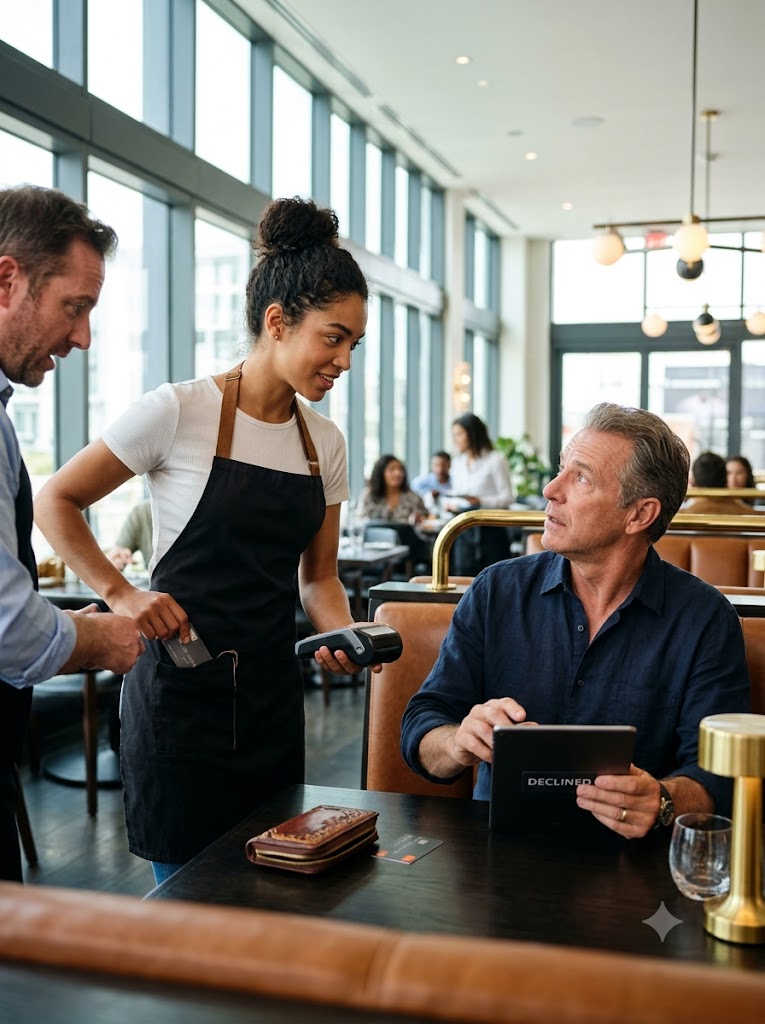
“It has to be a mistake,” he said, watching the red message on our payment terminal. His voice was calm, but his fingers tightened around a spotless leather wallet. I tried the card a second time while the griddle hissed behind me and rain ticked against the front windows. Same result.
“It happens,” I told him quietly. “The machines don’t care how nice your jacket is.” His mouth twitched, almost a smile, before a loud laugh came from the booth by the radiator. I didn’t have to turn around to know who it belonged to.
Derek Pruitt had been eating at our diner every morning that week, although he’d complained about every meal. He managed commercial properties for Vale Holdings, the company that had bought our block in downtown Pittsburgh, and he treated the staff like furniture that had failed to polish itself. That morning he’d brought a man with a tape measure and spent twenty minutes describing our restaurant as “dead space.” Now he pointed his fork at the stranger and said, “Nice suit. Shame about the bank account.”
The stranger stared at his wallet while the people behind him pretended not to listen. His order totaled sixty-three dollars because he’d bought breakfast and four boxed meals for road workers repairing the sidewalk outside. He said he could call his bank, but the line was building, and Derek was enjoying himself too much. I remembered my father’s face the afternoon his card failed at a grocery store, with strangers watching him put our cereal back on the shelf.
I pulled my own debit card from my apron. “I’ve got this,” I said, before common sense caught up with me. My boss, Ben Alvarez, appeared from the kitchen with his sleeves rolled to his elbows. “Nora, we can’t make a habit of paying for strangers,” he murmured, but I had already entered my PIN.
The machine chirped its approval. Twenty-eight dollars and forty cents until payday, I thought, but the stranger’s shoulders eased and that seemed worth something. When he offered to pay me back later, I handed him the receipt. “Come back when your card works. Nobody deserves an audience for a bad morning.”
Derek slid out of his booth, dragging his chair across the tile. “Beautiful philosophy,” he said. “Maybe you can pay the rent for this dump, too.” Ben stepped forward, and Derek flicked a cream-colored envelope onto the counter. “Friday at five. Sign the surrender agreement, or we start clearing the place next week.”
“We’ve paid every month,” Ben said, his voice rough. “My mother opened these doors thirty-two years ago.” Derek shrugged and adjusted his cuff links. “Your mother isn’t the future, Ben.” He left without taking his change, and the bell above the door gave its cheerful little ring, horribly wrong for the moment.
I turned to find the stranger studying the envelope rather than the receipt. “Does he talk to you like that often?” he asked. “Only when he wants something,” I said, reaching for the coffee pot. Then he asked a stranger question: “Did the company ever give you a written reason for terminating the lease?”
I stared at him. Ben hadn’t mentioned our lease to anyone outside the staff, and the letter Derek had delivered was still face down. The stranger looked toward the window, where Derek was getting into a black SUV, and his expression changed from embarrassment to something cold and focused. Suddenly, I wondered whether I had just paid sixty-three dollars to help the wrong man.
Part 2
I expected never to see the stranger again, but he returned the next morning before the first pot of coffee finished brewing. He wore an ordinary navy jacket this time, though his shoes still looked expensive, and placed sixty-three dollars on the counter. “I owe you,” he said. “You do,” I answered, taking the money, “but yesterday you asked a question you shouldn’t have known to ask.”
He introduced himself as Adrian, no last name, and claimed he worked “around commercial buildings.” He didn’t deny knowing who Derek was, which felt more suspicious than a lie. I had bills to pay and no patience for wealthy men’s little mysteries, so I pointed him toward a stool and told him to order or leave. He ordered black coffee and listened while the kitchen exhaust fan rattled overhead.
Ben came out carrying an accordion file thick with rent receipts. His mother, Rosa, had kept records in that file until arthritis made her handwriting too shaky; now Ben added a photocopy every month. “They say we missed payments and ignored repairs,” he told Adrian. “I’ve got proof of the payments. As for repairs, we asked for the leaking roof to be fixed eleven times.”
Adrian asked to look, but Ben shook his head. “No offense, buddy. The last man who offered to help brought us an agreement that would shut us down.” I watched Adrian take that without arguing. People who were accustomed to getting their way usually got angry when told no, and I couldn’t decide whether his silence made him safer or more dangerous.
Around noon, I carried soup to Mrs. Delaney, who owned the alterations shop two doors down. Her front window was bare except for a mannequin with one arm, and she kept glancing at a folded notice beside her sewing machine. “They charged me for plumbing work they never did,” she whispered. “Then they said the building had to be vacant for an inspection. Derek offered to forgive the charges if I signed.”
On my way back, I noticed identical notices taped inside three other storefronts. Each one called the closure “voluntary,” even though the owners looked anything but willing. I photographed the dates and returned to find Ben staring at the old lease on our counter. A paragraph had been highlighted in yellow, one he’d never noticed before.
“This says we have a right to cure violations and challenge disputed charges before any termination,” Ben said. The clause was missing from the single-page renewal Derek wanted him to sign. Adrian leaned close enough to read it, then stepped away, his coffee untouched. “Don’t sign anything until an independent attorney reviews both documents,” he said.
At three, Derek arrived while Ben was unloading flour. He saw the photographs on my phone and smiled without warmth. “A waitress playing detective. That’s adorable.” He leaned close enough that I smelled mint on his breath. “Keep interfering, and I’ll make sure the next management company on this street knows your name.”
I nearly said something that would have cost me my job, but I saw Ben in the doorway, trying to pretend he wasn’t afraid. “Then you won’t mind explaining why your inspection notice names a contractor that closed four years ago,” I said. Derek’s smile vanished. He snatched the paper, glanced at its footer, and left so quickly he forgot his umbrella.
That night, Ben and I spread the file across a clean table while rain hammered the awning. A maintenance request from last spring bore Ben’s signature, and beneath it lay a new document he’d never seen: a supposed consent to surrender the restaurant, with the same signature copied onto the last page. I held both pages under the pendant lamp until the matching ink blot became unmistakable.
“Someone used my name,” Ben said, sitting down hard. I photographed the pages and called the number Adrian had written on his coffee receipt, but it went to voicemail. A moment later, a message arrived from an unknown number: “Stop digging. The surrender is already approved.” Attached was a meeting agenda listing our diner as vacant by Monday.
Part 3
By Thursday morning, I’d slept three hours wondering how to afford a lawyer. The diner smelled of burned toast because Ben kept forgetting bread under the broiler. Adrian arrived just after eight, carrying a folder rather than his usual newspaper, and I shoved my phone toward him. “Someone forged Ben’s signature,” I said. “If you know anything, now would be a good time to stop being mysterious.”
He read the message and asked me to forward the photographs to an address he’d written down. “Who owns that address?” I demanded. “A compliance team,” he replied, which was not an answer. Before I could press him, Derek walked through the door with two men in dark coats and announced that he’d come to inspect the premises.
“You cannot bring inspectors in without notice,” Ben said, standing in front of the kitchen. Derek smiled. “They’re not inspectors. They’re the people who will inventory your equipment after you leave.” The taller man looked uncomfortable; the other stared at the floor. Several customers set down their forks, and the low conversation near the windows stopped.
Derek noticed Adrian at the counter and laughed. “Still trying to get breakfast on credit?” Adrian closed his folder. “I’m asking you one question, Derek. Who authorized you to use a forged surrender agreement?” Derek’s face tightened, but he recovered. “You don’t know a thing about our business.”
“I know your regional reports say these tenants voluntarily agreed to leave,” Adrian said. “I know the charges you added were classified as approved maintenance, although no work was performed.” Derek looked toward the door and then back at him. “Who the hell are you?”
Adrian took out his phone and called someone on speaker. “Clara, I’m at Maple Street Diner. Is Legal on the line?” A woman’s voice came through, brisk and clear. “Yes, Mr. Vale. We have the files you requested, and outside counsel is ready.”
The silence was so complete I heard the refrigerator click on. Derek whispered, “Mr. Vale?” I looked at Adrian, then at the silver V embossed inside the folder he’d laid on the counter. This was Adrian Vale, the founder of the company that owned our building and half a dozen hotels I’d seen advertised in airport magazines.
“Derek, you’re suspended pending a formal investigation,” Adrian said, evenly enough to sound more frightening than a shout. “Your access is being disabled, and your staff will preserve every lease record and payment ledger. You are not authorized to contact these tenants again.” Derek sputtered something about following orders, but the woman on the phone interrupted. “Counsel will contact you through the appropriate channels.”
The two men with Derek backed away. He stood there with his mouth half open, then stormed into the rain without his umbrella again. Ben gripped the counter to steady himself. I should have felt triumphant, but I was staring at the man whose breakfast I’d paid for, remembering how carefully he’d watched me swipe my card.
“You could have told us who you were,” I said. Adrian admitted he’d come because of tenant complaints and wanted to observe Derek without warning him. He claimed he hadn’t known about the forged surrender until that morning. “And the declined card?” I asked. For the first time, he looked genuinely ashamed.
“I turned it off myself,” he said. “I wanted to see what happened when people thought I couldn’t pay.” I felt the heat rise behind my eyes. He’d turned my twenty-eight-dollar bank balance into a moral experiment, and he’d let Derek laugh while I paid for it.
“You didn’t test kindness,” I told him. “You tested what someone with less money would risk to rescue you from embarrassment.” Ben called us over before he could apologize. On Adrian’s folder was a newly printed internal approval sheet, with the proposed eviction marked cleared by the executive office.
At the bottom was an authorization bearing Adrian Vale’s name. He looked at it as if he’d never seen it before. I looked at him and wondered which stranger had been the real one all along.
Part 4
Adrian asked us not to let anyone take the approval sheet, which made me want to grab it and run straight to a lawyer. “It has my electronic authorization,” he said, “but I didn’t approve this project.” I had spent two days listening to men with expensive coats tell us what was true; I wasn’t about to accept another explanation on trust. “Then prove it somewhere other than my counter,” I said.
By lunchtime, an attorney named Maya Chen had arrived with an investigator and a written notice freezing any proposed lease terminations while the company reviewed them. She was outside counsel, not an employee, and she encouraged Ben to retain his own lawyer. That mattered more to me than Adrian’s apology. Ben called a neighborhood legal clinic, which referred him to a small-business attorney willing to review the documents for a manageable fee.
The investigation uncovered a pattern rather than one bad manager. Derek had reported nonexistent repairs as costs charged to tenants, then offered to erase those charges if owners signed away their leases. A redevelopment partnership stood to profit from delivering a vacant block; someone in Vale Holdings’ executive office had approved the paperwork through a delegated system account. Adrian’s name appeared on every approval because the system stamped the founder’s name onto transactions under a certain category.
“That doesn’t mean you’re innocent of letting it happen,” I told him when he returned that evening. He sat in the same stool where he’d pretended to be helpless, his coffee cooling between his hands. “I know,” he said. “I built a company where complaints traveled through four people who were rewarded for keeping them quiet. That was my choice, even if this document wasn’t.”
Then Maya called with worse news. Derek’s supposed surrender agreement had already been submitted to the city’s development review office, and a hearing was scheduled for Friday afternoon. The city hadn’t accepted the diner as vacant, but the application described the block as cleared, supported by signed tenant consents. Unless the tenants objected on the record, the developer could use those documents to push its schedule forward.
I spent the next morning visiting the other shops with copies of the questionable forms. Mrs. Delaney showed me an email where Derek threatened an extra fee if she wouldn’t sign, and the barber across the street produced an invoice for an elevator his building didn’t even have. I carried their statements in a grocery bag that smelled faintly of onions because I had nothing better to use. For the first time all week, the owners weren’t whispering separately; they were talking to each other.
At noon, Derek called my phone from an unfamiliar number. “You’re making trouble for people who could help you,” he said. “Name a number, Nora. You want a better job? A new car?” My tire thumped softly against the curb outside while I listened, and for a second I thought of the bills stacked beside my bed. “You don’t get to buy back the truth after stealing it,” I said, then saved the call details and told Maya what he’d offered.
Adrian later offered to fund repairs at the diner immediately, but Ben shook his head. “I don’t want a favor we can lose when you change your mind.” I watched Adrian absorb that, then ask his lawyers what protection could actually be recorded and enforced. They began negotiating a twenty-year lease extension with a predictable rent cap and a recorded protection against displacement, subject to Ben’s attorney approving the terms.
That night, I received a photograph of the front door from an unknown number. A stack of empty cardboard boxes sat beneath the diner sign, and someone had scrawled “CLOSING” across a piece of paper taped to the glass. Ben was inside; nobody had broken in, but he said a delivery driver had left the boxes without explaining why.
I pulled the paper down and found a second message on its back: “Friday is your last chance.” Our hearing was less than eighteen hours away, and I suddenly understood that Derek wasn’t finished just because his key card had stopped working.
Part 5
The city hearing room smelled of wet coats and printer toner. Ben sat beside his attorney with both hands clasped around his mother’s battered accordion file, while Mrs. Delaney and six other tenants filled the seats behind us. Derek entered with a lawyer and avoided looking at me. Adrian arrived last, without a camera crew or the entourage I’d expected from a billionaire, and took a chair near the back.
The developer’s representative called Maple Street “largely vacated.” Our attorney asked whether a restaurant still serving breakfast that morning counted as vacant. She submitted our rent receipts, the original lease, the altered notices, and Ben’s signed maintenance request beside the forged surrender. The officer compared the identical ink blot on both pages.
Mrs. Delaney spoke about the plumbing fees, and the barber held up the invoice for the imaginary elevator. I described Derek’s warning to me and the phone call in which he’d offered money and a job. My voice shook at first, but I kept my eyes on the officer rather than on Derek. When I finished, Ben touched my wrist beneath the table, a small thank-you that nearly undid me.
Maya then explained what her independent review had established so far. Vale Holdings had identified unauthorized submissions, halted the redevelopment application on its side, and referred suspected document falsification to the appropriate authorities. The officer announced that the city would not rely on the disputed consents and that the proposal could not proceed in its current form. It wasn’t a conviction, but it stopped our deadline.
Outside, Derek tried to approach Ben. “This got out of hand,” he said, his voice suddenly soft. “Maybe we can resolve it privately.” Ben stepped between him and the restaurant owners. “Our lawyers can talk,” he answered. “You don’t get another conversation with us.” Watching Derek retreat, I realized I had spent the week hoping a powerful man would save us; what had saved us was a dozen ordinary people refusing to disappear quietly.
Three weeks later, Ben signed a twenty-year extension after his own lawyer negotiated the final language. The rent adjustments were limited and clear, the company’s overdue roof repairs were written into the agreement, and the protection against redevelopment displacement was filed with the property records. Other tenants negotiated separately; some left by choice, but nobody signed under those false documents.
Adrian came back one quiet afternoon carrying two things: a receipt for the sixty-three dollars he’d repaid and a proposal. Vale Holdings would establish a community property fund with independent oversight, published decisions, and seats reserved for local merchants and workers. He asked whether I’d apply for a paid coordinator position, not because of the breakfast but because I’d gathered statements, organized records, and persuaded eight frightened business owners to show up together.
“You made me part of an experiment without asking,” I reminded him. He nodded. “I know. I can’t undo that.” I told him I would consider the work only if the hiring panel was independent and the fund could challenge his company in public. A month later, after interviews and a background check, the panel offered me the job. I accepted, while keeping my Saturday breakfast shift until Ben found someone he trusted.
Adrian and I never turned that morning into a sentimental friendship. We disagreed about budgets and executives calling accountability “generosity.” He listened more often than he’d done at our first meeting, but I never let him forget that listening was the beginning of a responsibility, not its completion.
On the first Saturday of spring, Ben replaced the cracked OPEN sign his mother had hung in 1994, and the whole street smelled of fresh coffee and rain-washed brick. A road worker came in for four boxed breakfasts, and I wrote the order myself. When he reached for his card, I thought about what sixty-three dollars had really bought: not a billionaire’s gratitude, but a neighborhood standing up for itself.
Legal Notice: This story is a work of fiction. Names, characters, businesses, events, and incidents are the product of the author’s imagination or are used fictitiously. Any resemblance to actual persons—living or dead—or to actual events is purely coincidental. Thank you! 💓


