
My In-Laws Gave Every Sibling $20,000 for a House Except Us — Then We Bought a $41,500 Farmhouse and Grandma Discovered Their Secret
At Easter, my husband’s father gave each of his three younger children $20,000 toward a house. My husband and I received a greeting card congratulating us for never needing help. I thanked him while my husband stared at his plate. Two years later, we spent nearly every dollar we owned on an abandoned farmhouse. I thought the worst thing waiting inside was a collapsed ceiling. Then his grandmother saw the kitchen doorway, began to cry, and asked me to keep a secret from her own son.
Part 1
The checks came out between the glazed ham and the lemon pie. Dennis Whitcomb had tucked cream envelopes under everyone’s dinner plate, and my sister-in-law Lauren discovered hers when she reached for the potatoes. Her husband, Matt, unfolded the check and let out a whistle. “Twenty thousand dollars?” he said, looking at Dennis as if he’d just handed them the keys to the governor’s mansion.
“House money,” Dennis announced, lifting his coffee cup. Grant opened his envelope next, then Paige, the youngest, and each found an identical check. Elaine, my husband’s stepmother, dabbed her eyes while they hugged her; she’d been talking for years about how embarrassing it was that three grown children still rented. Then she turned toward us with a smile that made the back of my neck prickle.
Our envelope held a card with a yellow meadowlark perched on a fence. Inside, Elaine had written, “To our wonderfully independent couple. You always find a way.” I checked the envelope again, stupidly, while Owen read the words over my shoulder. His ears went scarlet, the one warning sign on a face that almost never betrayed him.
“Nothing wrong with being self-reliant,” Dennis told the table. “Owen knows that better than anyone.” I managed to thank them for the card and asked Lauren to pass the green beans, because the alternative was asking a question they had rehearsed an answer to. Across the table, Grandma June stared at the three checks, then at Dennis’s polished watch, before turning her gaze toward the window.
Owen was Dennis’s eldest, born during his first marriage. His mother, Rose, had died when he was five, and Elaine had married Dennis two years afterward. Nobody openly called Owen an outsider, but when he was little, family vacation photographs somehow always placed him at the edge, and the expensive birthday gifts went to the children Elaine called “the little ones,” even after they were thirty.
On our drive home through the black Iowa fields, the heater in Owen’s truck rattled like loose silverware. “How much have we saved?” he finally asked. “Just over six thousand,” I said, already knowing what came next. Owen took my hand at a stop sign and said, “Then we’ll build the rest ourselves.”
For twenty-three months, building meant sleeping less. I worked weekdays handling patient accounts at Redfield Community Hospital, then pulled Friday and Saturday shifts at a diner outside town, where my clothes came home smelling of fryer grease and burnt coffee. Owen repaired tractors after his regular equipment-shop hours, sometimes crawling into bed with hydraulic oil still under his nails. We canceled vacations, ate eggs four nights a week, and put every spare dollar into a savings account.
By the second spring, we had saved $43,900, including the money from selling Owen’s late grandfather’s fishing boat. Regular houses were still out of reach, but one noon hour I found a notice for an estate auction in the county paper. The old Harper place, two acres and an empty farmhouse six miles outside Redfield, would be sold as-is.
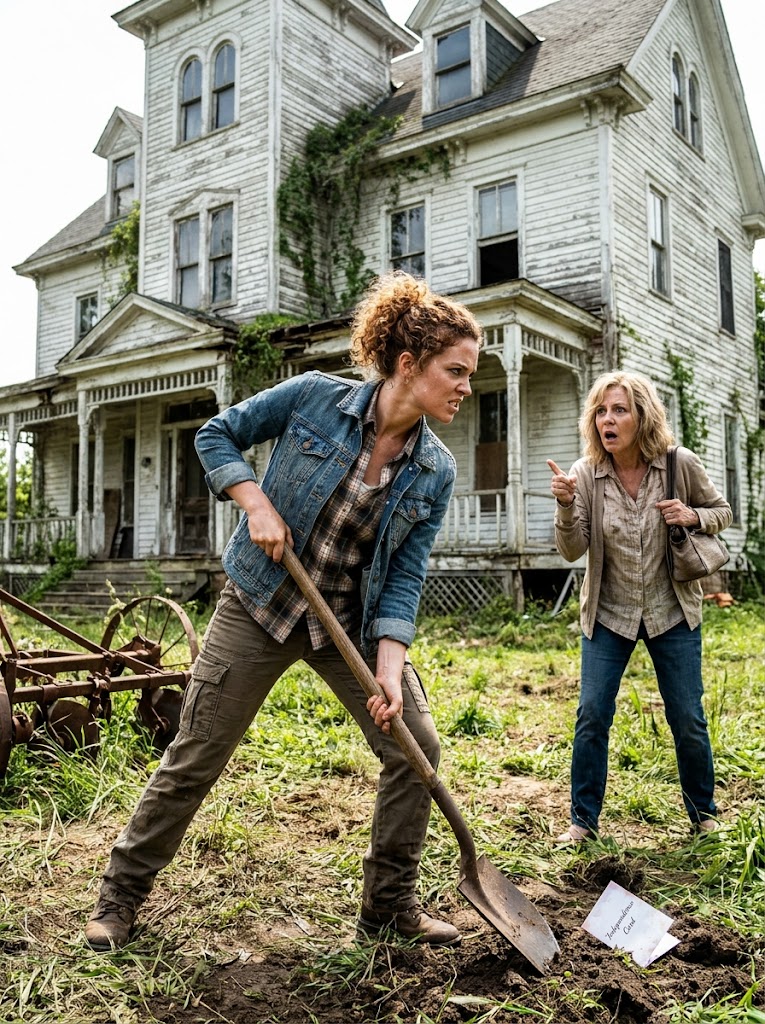
The house had sagging porch steps, cracked windows, and an attic full of daylight where the roof should have been solid. Owen spent an hour examining the limestone foundation and beams while I watched a mouse disappear under the porch. “The structure can be saved,” he said at last, brushing dirt from his knees. “If we can afford the roof.”
At the auction, a property investor in a quilted vest kept bidding without looking at us. When the price hit forty-one thousand, my mouth went dry; we’d agreed on a hard ceiling of forty-two. Owen offered $41,500, and after a long look at his phone, the investor stepped back.
A newspaper photographer captured us beside the courthouse steps, and the administrator explained when the sale would close. We went home with a receipt, a stomach full of nerves, and a future that smelled like wet lumber.
Three weeks later, the deed was recorded, and a single line appeared in the local paper. That evening my phone rang at work. June Whitcomb said, “Mara, I saw what you bought. Take me out there Sunday—and don’t tell Dennis.”
Part 2
On Sunday, June waited outside her assisted-living apartment in a lavender cardigan, clutching a purse that looked too heavy for her narrow shoulders. She was eighty-eight and walked with a cane after breaking her hip, but she waved away my offer to carry her things. “Just drive,” she said. “Before somebody calls my son and tells him where I’ve gone.”
I tried making conversation along Old Mill Road, pointing out the first green shoots in the fields. June answered with a distracted nod, then leaned forward when our farmhouse appeared between two cottonwood trees. “That porch used to have a swing,” she whispered. “My daddy built it so my mother could shell peas in the shade.”
Inside, the house smelled of plaster dust and rainwater. June passed our stacks of salvaged floorboards, ignored the bucket beneath a ceiling stain, and stopped at the kitchen doorway. She pressed a thumb to thin pencil marks under the chipped white paint. Beside one line, I could barely make out a J and the number 1947.
“My mother measured me here every birthday,” she said, her voice catching. “I was June Harper before I married your husband’s grandfather. My brother Calvin lived here until he died, and Dennis told me this place wasn’t worth saving.” She looked past me toward the kitchen window. “I was born upstairs during a February snowstorm, and now my grandson owns the house.”
I guided her into the only steady chair while she told me about her mother’s apple preserves and the rooster Calvin used to chase through the kitchen. Then June opened her purse and laid a hospital collection notice across my knees.
The amount was $7,260, from treatment after her fall. June had always kept supplemental coverage, she said, paying the premium automatically from her checking account. But when she called to ask why the bill hadn’t been settled, an insurer told her the policy had lapsed months earlier because payments stopped.
“Maybe the bank switched something,” I suggested, although the paper felt suddenly slippery in my hands. June shook her head and said she’d been told her monthly statements now went to Dennis’s address. She hadn’t seen one in nearly two years, not since she’d signed paperwork during rehabilitation authorizing him to manage her finances.
“He brought a woman who witnessed my signature,” she said. “I thought he was arranging my rent and groceries. He said I didn’t need to worry about the small print.” She opened a worn leather checkbook and showed me her last handwritten balance, copied from an older bank statement. Just over $187,000.
“And now?” I asked. She unfolded an account balance slip she’d requested at the bank the previous week. It showed $39,814, an amount still large enough to sound comfortable until I compared it with what she’d once had.
June studied my face instead of the numbers. “Dennis told me the business was finally doing well when he gave the children those checks,” she said. “But last winter he asked me to cover the taxes on his house. Why would a man doing well need his mother’s money?” The wind lifted a strip of wallpaper behind her, making a faint scraping sound.
I wanted to blame a bookkeeping mistake, or a fraudulent stranger, or even the bank. June took the meadowlark card’s description from me without looking surprised. “I watched your husband put it away,” she said. “I watched my son look proud of himself, too.”
That evening I told Owen everything as we sat on the porch steps eating sandwiches wrapped in wax paper. He went quiet at the mention of June’s childhood marks, then quieter still when I showed him the collection notice. “If Dad really took her money,” he said, “I don’t want an apology. I want to know where it went.”
I explained that June wanted us to accompany her to the bank, not confront Dennis yet. Owen nodded, staring at the barn until the last orange light left its roof. Then he asked the question I had been afraid to hear: “Mara, what if Grandma paid for everybody’s houses without even knowing it?”
Part 3
The bank manager, a patient woman named Teresa Bell, knew June well enough to ask whether she wanted us in the room before she opened the records. June answered firmly and signed a written authorization. The wall clock clicked sharply.
Teresa spread nearly two years of statements across the desk. At first I saw ordinary charges: assisted-living fees, electric bills, pharmacy purchases, donations to June’s church. Then the larger transactions appeared, all authorized under Dennis’s power of attorney. A payment of $38,900 to the lender financing his repair business, several transfers into his personal account, property taxes on his house, and monthly payments toward Elaine’s credit cards.
Then I found the three cashier’s checks. Lauren Whitcomb: $20,000. Grant Whitcomb: $20,000. Paige Whitcomb: $20,000. All issued two days before that Easter dinner from funds withdrawn from June’s savings.
Owen leaned over the desk and read each name aloud, as though saying them slowly might change the ink. June pushed her reading glasses up her nose and examined the dates herself. “I didn’t write those checks,” she said. “I didn’t even know they’d been issued.”
The manager turned another sheet toward us. Dennis had directed the bank to redirect statements to his home and had stopped the recurring premium payment for June’s supplemental insurance. Teresa explained that the power of attorney appeared valid on its face, but she could not tell us whether each expenditure was legally permitted. “You need your own attorney to review this,” she said.
June didn’t cry. She asked Teresa to help safeguard the remaining accounts, then requested copies of the statements to take to a lawyer. I watched her initial every page with the same hand that had once measured children on a kitchen doorframe, and I realized how much steadier it was when she knew exactly what she was signing.
Our next stop was a small law office above the hardware store. Attorney Miriam Cole listened to June alone first, then invited Owen and me inside at June’s request. She explained that having authority to pay bills did not automatically make Dennis the owner of the money, and that any recovery would require records, formal notices, and possibly court action.
June instructed Miriam to prepare a revocation of Dennis’s authority, notify the financial institutions, and establish new safeguards with two trusted people required for major decisions. She chose Owen and me, but refused to surrender her own control while she remained able to make decisions. “I need help with paperwork,” she said, “not someone to tell me when I’m allowed to buy a pair of shoes.”
Miriam also suggested making a report to the proper authorities, while promising that June would choose how to proceed after understanding her options. Before we left, June asked to review her will privately. When she returned, she looked tired but less frightened, as though she’d finally discovered where the floor was under her feet.
At the hospital, I helped her request billing records through the normal patient authorization process rather than touching her account at work. We filed a formal appeal with her insurer, explaining the disputed cancellation and enclosing documents through the approved process.
On Thursday, Miriam’s certified notice reached Dennis. He called Owen while we were hauling damp insulation out of the farmhouse attic, and his voice carried through the speaker over the rasp of the shop vacuum. “You dragged my mother to a lawyer?” he demanded. “After everything I’ve done for you?”
Owen switched off the vacuum. “You used her retirement savings to buy houses for three people, Dad. You let her medical coverage lapse, and now you’re angry somebody checked?” Dennis insisted that the money would have belonged to him eventually and that he had only been protecting the family.
“Grandma is the family,” Owen said. “And she’s still here.” He ended the call, then stood staring at a patch of sunlight on the dusty floorboards.
Minutes later, my phone rang. It was Paige, crying so hard she could barely speak. “Mara,” she said, “Mom told me why Owen didn’t get a check. You need to hear what she said.”
Part 4
Paige asked me not to tell her father she’d called. She’d confronted Elaine after learning the checks had come from June’s account, and Elaine had defended the decision with a sentence that Paige could hardly repeat. “She said Owen has always been independent because he isn’t really one of us. She said the money was for her children.”
I looked through the farmhouse window at Owen in the yard, carrying a bundle of rotten porch boards to the dumpster. There was no dramatic revelation in Elaine’s words, only a confirmation of something he had spent thirty-six years trying to disprove. “You should tell him yourself,” I said, and Paige did that evening.
She brought groceries. Owen listened while she apologized for taking the check and for keeping quiet about Elaine’s remark at Easter. “I didn’t know it was Grandma’s money,” Paige said, wiping her cheeks, “but I knew that card was cruel, and I let it happen.”
“Thank you for finally saying it,” Owen replied. He didn’t hug her, but he accepted the bag, and they spent ten minutes discussing how to keep rain out of the kitchen. It was the first ordinary conversation I’d heard between them in months.
Meanwhile, Dennis sent increasingly frantic messages insisting we’d misinterpreted the transactions. Elaine told Lauren and Grant that we were manipulating June because we wanted an inheritance, and Grant repeated it in a family group chat before abruptly deleting the message. June read the screenshots I brought her, handed back my phone, and asked whether the bakery still made strawberry cakes.
Her eighty-ninth birthday was approaching, and she wanted the traditional family lunch at Dennis and Elaine’s house. “They’ll accuse you of trying to humiliate them,” I warned. June adjusted the pearl earrings she wore on Sundays. “Then they can sit with that feeling for an afternoon. I’ve been sitting with worse.”
We arrived at one o’clock to a table set with flowered china and folded cloth napkins. Dennis looked older than he had three weeks before, and Elaine’s greeting was as thin as the icing on the cake. Lauren kept her hands in her lap, Grant stared at his water glass, and Paige gave June a shaky smile.
June insisted everyone eat before talking. Dennis abandoned his fork after three bites. After the cake, June took a stack of small envelopes from her purse and placed one in front of each sibling.
Each held a meadowlark card and a copy of the corresponding bank transaction. Lauren opened hers and whispered, “This was yours?” Grant compared the date with the day their parents announced the gifts. Paige covered her face, already knowing.
Dennis received a thicker envelope containing the attorney’s accounting request and a summary of the transfers. Elaine read it over his shoulder and hissed, “You didn’t have to do this publicly.” June touched the bird on the card. “You thought public generosity was lovely when the money wasn’t yours.”
Dennis finally admitted he’d used June’s savings because his equipment business was drowning in debt. He’d told himself he would eventually inherit the money anyway, and he wanted Elaine’s children to believe their father could provide for them. His explanations became smaller each time June asked whether she’d agreed to any of it.
“And Owen?” I asked. Dennis looked toward his eldest son, but Elaine answered first. “He didn’t need a handout.” Owen’s chair scraped the floor. “I needed a father who considered me his child,” he said, “not a lesson in self-reliance.”
June told Dennis that Miriam had prepared a proposed repayment agreement and that refusing a proper accounting would have consequences. She asked the younger siblings to consider returning the gifts voluntarily, while making clear that Dennis remained responsible for what he’d taken. Nobody argued when she said the days of secrecy were finished.
Then June reached into her purse again and handed Owen a plain white envelope. He opened it, expecting another bank record, but inside was an old photograph of his mother standing on our farmhouse porch. On the back, written in Rose’s handwriting, was a sentence neither of us had ever seen.
Part 5
The handwriting on the photograph was unmistakably Rose’s, small and slanted, the letters leaning into one another. “For Owen, when he’s old enough to understand: I hope you always find a place where you never have to wonder whether you belong.” June explained that Rose had visited the Harper farmhouse often, bringing baby Owen to sit under the cottonwoods while June’s brother repaired the old porch swing.
Owen held the photograph by its edges. He looked across the birthday table at Dennis, who seemed ready to explain something, and said, “Don’t. Whatever story you have about Mom, I don’t need it from you.”
In the truck, Owen kept the photograph against his chest, and I let the silence last until we reached the road lined with grain elevators. “I spent my whole life believing I didn’t have a place in this family,” he said. “Turns out I was looking at the wrong people.”
Consequences came slowly, on ordinary weekdays. June filed a report with the proper protective agency, and Miriam negotiated a documented repayment agreement while preserving June’s right to pursue further action if Dennis failed to comply. Dennis sold machinery and land for an initial payment; the rest became an enforceable obligation.
Lauren eventually acknowledged the money’s source and arranged modest voluntary repayments to June. Grant resisted for months, claiming he had never asked where the check came from, but after June spoke with him privately, he signed an agreement to repay his gift over time. Paige sold her house and returned the full $20,000, then rented a tiny apartment above a florist’s shop.
“I don’t want a home that reminds me what I ignored,” she told me as I helped carry boxes upstairs. Her apology didn’t erase the past, but she slowly earned our trust by showing up without making excuses.
After months of appeals and documentation, June’s insurer reversed the disputed cancellation and reprocessed the hospital claim. The billing dispute was resolved, and June showed me the final notice with a satisfied tap of her fingernail. “Now,” she said, “could somebody please talk about something besides my bank account?”
By then our farmhouse finally had a sound roof, inspected wiring, warm windows, and porch steps that didn’t tilt. Owen did much of the carpentry himself, but we hired licensed professionals for the work that required them. The first night we slept there, rain drummed steadily on the shingles instead of dripping into buckets, and I lay awake listening to the unfamiliar luxury of staying dry.
June moved into the downstairs bedroom the following autumn, by her own choice, after we finished a bathroom she could use safely. She contributed toward household expenses and insisted on choosing the curtains, pale green with tiny white flowers. Every morning she drank coffee by the window overlooking the fields where her father once farmed, reading the newspaper.
Dennis wrote Owen three letters. The first defended his choices, the second apologized for the money, and the third finally admitted that treating his oldest child as an outsider had been wrong. Owen read that last letter once, placed it in a drawer, and sent back a short reply: “I hope you become someone better. I won’t be returning to the relationship we had.”
Elaine never apologized directly. Sometimes she sent Christmas cards addressed to “the family,” but we didn’t invite her or Dennis into our home. Their absence wasn’t revenge; it was the quiet that let us enjoy the rooms we’d worked so hard to save.
One Thanksgiving, June found the old growth marks on the kitchen doorway restored beneath a clear protective finish. She asked Owen to stand against the wood, even though he was nearly forty, and made a new pencil line above her childhood marks. Then she wrote his name, the year, and one word: “Home.”
When she handed me the pencil, I finally understood why she had called me instead of Dennis on that first Sunday. The farmhouse had never been about proving that we could survive without anyone’s help. It was about finding the people whose help didn’t come with a price, and choosing them as our family.
Legal Notice: This story is a work of fiction. Names, characters, businesses, events, and incidents are the product of the author’s imagination or are used fictitiously. Any resemblance to actual persons—living or dead—or to actual events is purely coincidental. Thank you! 💓


