
My Wife Told Me Our 7-Year-Old Daughter Had Died While I Was Away—Four Days Later, I Found Her on Our Porch Whispering, “Daddy, Don’t Go Inside!”
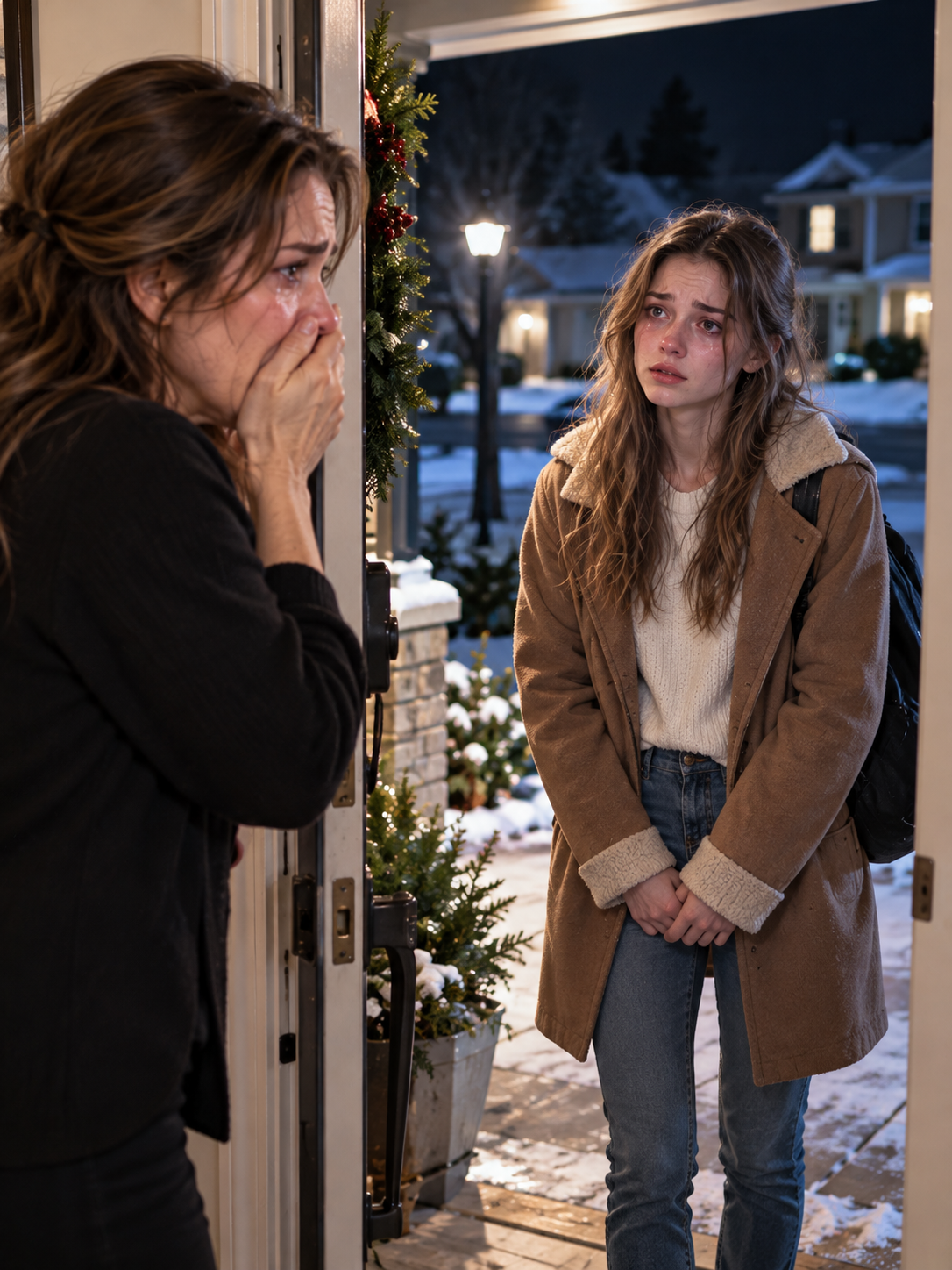
My wife called while I was working two thousand miles from home and told me our seven-year-old daughter had died in an accident involving my beehives. Her father, a respected doctor, confirmed everything, and the funeral director insisted I shouldn’t see her body. Four days later, after burying a closed casket, I returned home and found my daughter sitting on our porch, alive and terrified. She grabbed my collar and whispered, “Daddy, don’t go inside. Mommy and Grandpa are talking about what they did to me.”
Part 1
The last ordinary thing I remember was the smell of almond blossoms drifting across an orchard outside Fresno, California. I was checking a wooden hive box when my phone started vibrating inside my jacket, and I almost ignored it because hundreds of bees were moving across the frame in my hands. Then I saw three missed calls from my wife, Serena, and something in my stomach tightened. I stepped away from the hives and answered.
“Miles, it’s Lily,” she said, her voice strangely flat beneath the crackling connection. “She went near the bees behind the barn, and something happened.” I asked whether Lily was at the hospital, already reaching for my truck keys, but Serena interrupted before I could finish. “Dad was there, Miles. He tried everything, but she’s gone.”
I stood completely still, listening to the steady hum of thousands of bees working among the white blossoms. My daughter was seven years old, had grown up around beehives, and knew more about their behavior than most adults. She owned a little protective veil with a purple ribbon, and she never approached a hive without asking permission. “That’s impossible,” I whispered, but Serena only repeated that I needed to come home.
I owned a small commercial beekeeping operation outside Briar Creek, Missouri, and every February I hauled hundreds of colonies west to help pollinate almond orchards. The work kept our mortgage paid and allowed Serena to stay home with Lily, although I hated missing those weeks of my daughter’s childhood. My crew supervisor took one look at my face and offered to handle the remaining contracts. Eighteen hours later, I was driving toward our farmhouse through cold Missouri rain.
Cars filled the driveway when I arrived, and aluminum trays of casseroles covered the kitchen counter. Neighbors touched my shoulder and told me how sorry they were, their voices blending into a low, continuous murmur. Serena stood beside her father, Dr. Calvin Bell, who had practiced medicine in our county for nearly forty years. He was also the county coroner, a position everyone trusted him to handle with dignity.
Calvin reached me before my wife did and wrapped both hands around my shoulders. “I’m sorry, son,” he said, looking directly into my eyes. “It happened quickly, and there was nothing anyone could have done.” I asked to see Lily, but his expression tightened. “You don’t want those images replacing the beautiful memories you have of her.”
The funeral director, Owen Vale, approached from the dining room wearing a charcoal suit. He explained that a closed-casket service would be kinder to everyone, particularly me, and said he’d already made the necessary arrangements. I remember asking whether Lily had been frightened. Nobody answered that question directly, and Serena began crying just loudly enough for the neighbors to turn around.
“Just tell us what she should wear,” Owen said, placing a reassuring hand on my shoulder. I thought of the yellow dress Lily loved, with tiny embroidered bees around the hem, and told him where to find it. Serena immediately said she’d get it. I noticed Calvin watching Owen over her shoulder, but I was too exhausted to understand why.
That afternoon, I walked behind the barn to the forty hives I kept at home during winter. The boxes stood in neat rows, their lids wet from melting frost, and I remembered teaching Lily how to recognize the sound of a healthy colony. Then I saw her little veil hanging inside the barn, exactly where she always left it. Something about that bothered me enough to stop walking.
According to Serena, Lily had approached the hives alone on an unusually warm afternoon. She could have forgotten her veil, I told myself, even though she’d once scolded me for leaving mine on a workbench. Children broke rules occasionally. Yet Lily had been so particular about hers that she’d refused to stand near an open hive even when I promised to hold her hand.
The funeral took place Thursday beneath a gray sky. I stood beside the small white casket, pressed my palm against its smooth wooden lid, and whispered, “Daddy’s here, Bug.” Serena sat quietly throughout the service, staring toward the altar, while Calvin kept a hand on my arm. Twice, I noticed her checking her phone beneath her coat.
At the cemetery, the pallbearers carried Lily’s casket toward the open grave. They moved with surprising ease, and I caught myself wondering how something containing my entire world could appear so light. I immediately felt ashamed for noticing. Grief had made every ordinary movement seem wrong.
Afterward, the cemetery caretaker, Walter Price, caught me near my pickup. He explained that Owen had requested an unusual burial arrangement and asked whether I’d personally approved it. I said I hadn’t even known there were choices to make. Walter looked back toward the grave, his weathered face troubled.
“Something about this doesn’t sit right with me, Miles,” he murmured. Then he lowered his voice further. “Before you go home tonight, there’s something about that casket I think you ought to know.”
Part 2
Walter was seventy-two, a quiet man who had maintained Briar Creek Cemetery longer than I’d been alive. He explained that the funeral home had changed several details shortly before the burial, including arrangements that normally would have been discussed with the family. “Maybe it’s nothing,” he admitted, rubbing his hands together against the cold. “But when people start telling me not to ask ordinary questions, I get suspicious.”
I asked him what he wanted me to do, and he told me to speak with Owen before approving any additional paperwork. His concern unsettled me, but the possibility that I’d mishandled something for Lily hurt even more. I drove away with the heater blasting and the radio switched off, unable to face returning to the farmhouse. Every road sign reminded me that the world was continuing without my daughter.
My younger sister, Hannah, called while I was parked beside the Missouri River. She worked as an emergency department nurse in Columbia and had been trapped on an overnight shift during the funeral. When I told her nobody had allowed me to see Lily, she went quiet. Then she asked whether anyone outside Calvin’s immediate circle had independently confirmed what happened.
“He’s a doctor, Hannah,” I said, struggling to keep my voice steady. “He’s her grandfather.” She answered carefully, saying she wasn’t accusing anybody, but she wanted to review the medical records and death documentation. “Please don’t sign anything else until I get there,” she said. “You deserve to understand what happened to your little girl.”
By the time I turned onto our gravel road, darkness had settled over the fields. I could see three vehicles near the house: Serena’s sedan, Calvin’s SUV, and Owen’s long black car parked beside the barn. I wondered why the funeral director was still there, but I had no energy for another conversation. Then my headlights swept across the front porch.
A small figure was sitting beside the door, wearing a yellow dress. Her knees were pulled against her chest, her brown hair hung loose around her face, and the white collar of her dress was stained with dirt. My foot hit the brake so hard that my pickup skidded across the gravel. The little girl raised her head, and I saw Lily’s face.
I don’t remember opening the door or crossing the yard. I remember falling onto my knees and wrapping my arms around her while she clung to my neck. Her hands were freezing, but she was breathing, and when I pressed my cheek against her hair, she whispered the word I’d thought I’d never hear again. “Daddy.”
I wanted to scream for help, carry her into the warm kitchen, and demand to know what had happened. But Lily pulled away just enough to look directly into my eyes. “Don’t go inside,” she whispered. “Mommy and Grandpa are in there, and they’re talking about me.”
My entire body went rigid. I lifted her into my arms and stepped toward the side of the house, where the kitchen window stood slightly open above the flowerbed. Voices drifted through the gap, familiar voices speaking in the calm tones people use when discussing business. I recognized Calvin first.
“The paperwork will be processed once the insurer completes its review,” he said. Owen answered that the funeral records matched what Calvin had certified, but he sounded nervous. Then Serena said something that made the world tilt beneath my feet. “You promised nobody would find out she was at the cabin.”
I pressed Lily closer against my chest. Through the curtains, I could see Serena sitting at the table beside a thick folder, while Calvin studied a document under the overhead light. Owen kept glancing toward the back door. “We have to stop talking about this here,” he muttered.
Serena sounded irritated rather than frightened. “Miles thinks the bees killed her, and that’s what everyone believes.” Calvin told her to lower her voice, then reminded Owen that the paperwork had to remain consistent. I suddenly understood why nobody had allowed me to look inside the casket.
Lily began trembling harder, and I knew listening any longer would risk her safety. I backed away toward the barn, searching for somewhere hidden from the kitchen. A flashlight blinked near the fence, followed by Walter’s familiar voice. “Miles, over here. I’ve been looking for you.”
He stopped when he saw Lily in my arms. His expression changed from concern to astonishment, and then to something like relief. Without asking questions, he opened the passenger door of his pickup and helped us inside. “We need to get her somewhere safe,” he said.
As we drove away, Lily rested against my chest and whispered something that made my heart tighten again. “Daddy, Mommy said I had to pretend to be gone forever, because Grandpa was going to make us rich.”
Part 3
Walter drove straight toward Columbia while I called Hannah from the passenger seat. She thought I’d misunderstood when I said Lily was alive, but then Lily lifted her head and spoke into the phone. “Aunt Hannah, can I come see you?” There was a sharp silence, followed by my sister’s shaking voice. “Yes, sweetheart. We’re getting everything ready.”
At the hospital, nurses brought Lily a warm blanket, clean clothes, and a stuffed rabbit from a cabinet near the reception desk. A physician examined her while I stood beside the bed holding her hand. She was exhausted and dehydrated, but thankfully had no serious physical injuries. The doctors wanted to observe her overnight and make sure she’d received everything she needed.
Hannah took me into the hallway, where the fluorescent lights buzzed above an empty row of chairs. “Miles, we need to report this immediately,” she said. I told her what I’d overheard through the kitchen window, and her face tightened. She explained that the hospital would contact the appropriate child-protection and law-enforcement authorities, keeping Lily away from anyone involved until her safety was established.
Later, with a trained specialist present, Lily began describing what she remembered. Serena had picked her up early from school on Monday and driven her to Grandpa’s lake cabin, promising a special surprise for Daddy. Lily was told to stay inside, avoid the windows, and treat the entire adventure like a secret game. She thought I would arrive eventually and that everybody would laugh together.
Instead, days passed without me appearing. Owen visited the cabin twice, bringing groceries and speaking quietly with Serena in another room. Lily remembered asking when the game would end, but her mother told her to be patient and stop asking questions. She had no idea there was a funeral happening back home, with everyone believing she was dead.
On Thursday afternoon, an older woman arrived at the cabin to check on her. Lily overheard her arguing with someone on the telephone about being told to keep a child there without knowing the full situation. When the woman stepped outside to call for help, Lily became frightened and left through the front door. The woman found her walking down the lane and eventually brought her close to our property, where Lily insisted she wanted to wait for Daddy.
I listened without interrupting, gripping the edge of my chair until my fingers ached. Lily believed she’d been punished for breaking the rules of the game. When I assured her she hadn’t done anything wrong, she asked whether I was angry about the funeral. I held her close and promised that whatever had happened was the responsibility of the adults, never hers.
A state investigator named Detective Aaron Pierce arrived shortly after midnight. He spoke with Hannah and the hospital staff before interviewing me about Calvin, Serena, and Owen. When I repeated the conversation I’d overheard, he listened without changing expression. Then he asked whether I’d ever seen paperwork for an insurance policy involving Lily.
I remembered Serena mentioning a family protection plan the previous autumn. Calvin had recommended increasing our coverage because my work took me away from home so often, and I’d signed several forms after Serena assured me everything was routine. The detective asked whether I could retrieve copies. I told him the folder was probably inside Calvin’s study.
Pierce explained that investigators had already noticed irregularities in several older death claims connected to Calvin’s office and Owen’s funeral home. Nothing had been proven, but Lily’s appearance made the current case impossible to dismiss as an administrative mistake. The closed casket, questionable certification, and unexplained stay at the cabin required immediate investigation. I felt my stomach turn as I realized Lily might not have been their first insurance-related deception.
“What do you need from me?” I asked. Pierce replied that he needed my statement, the original documents, and permission to examine relevant records. He also warned me not to confront the people involved or attempt to gather evidence myself. Lily would remain protected while investigators secured the necessary information through lawful procedures.
Hannah stayed beside Lily’s bed while I answered questions late into the night. My daughter finally fell asleep holding the stuffed rabbit, her little fingers curled around one ear. I sat watching her breathe, terrified that closing my eyes would make her disappear again. Then Detective Pierce returned with information from the insurance investigator.
The policy carried a substantial accidental-death benefit, and Serena had recently asked about how quickly it would pay. But there was something more disturbing in the records: Calvin and Owen had handled several earlier cases that now appeared suspiciously similar. Suddenly, Lily’s false funeral looked less like an isolated lie and more like one part of a much larger scheme.
Part 4
By Saturday morning, investigators had secured the lake cabin, collected the funeral home’s records, and obtained authorization to examine the relevant financial documents. Lily remained at the hospital with Hannah while I stayed in a quiet room nearby. Every few minutes, I checked my phone, half expecting Serena to call and accuse me of taking our daughter. Instead, she sent a message asking where I’d disappeared after the funeral.
I showed the detective without answering. He advised me to leave further communication to the investigation, which was difficult because every part of me wanted to hear Serena explain herself. I had loved that woman for eleven years. We’d painted our nursery together, argued about baby names, and stayed up half the night after Lily was born because neither of us wanted to put her down.
Detective Pierce returned that afternoon with an insurance investigator named Rebecca Shaw. She carried a canvas briefcase filled with documents and spoke in a careful, measured voice. “Your father-in-law’s office certified several deaths that resulted in unusually rapid insurance claims,” she said. “We’re reviewing each case independently, because a suspicious pattern isn’t the same thing as proof.”
Rebecca laid a copy of Lily’s policy on the table. The insured amount was one and a half million dollars, with a larger benefit under certain accidental-death provisions. Serena was the primary beneficiary, while Calvin had helped arrange the paperwork through an intermediary. I stared at the signatures, remembering the evening Serena had pushed the forms toward me while I was repairing a broken kitchen drawer.
“She told me it was routine coverage,” I said. Rebecca nodded and explained that insurance itself wasn’t suspicious; the circumstances surrounding the claimed death were. Lily had been deliberately removed from school, hidden from me, and reported dead without a credible independent examination. Someone had then arranged a closed-casket funeral and tried to move a claim forward.
The investigators also found that Owen had submitted records suggesting he’d received and prepared Lily’s remains. Those statements couldn’t be reconciled with the fact that my daughter was alive. Walter’s testimony became important because he’d questioned the unusual arrangements before anyone knew what was happening. When detectives examined the burial records, they found additional inconsistencies that required further investigation.
Late that afternoon, Serena finally called. Pierce arranged for me to speak with her while the conversation was properly documented and monitored. I sat alone at the table, looking at a small photograph of Lily taped inside my wallet. When I answered, Serena sounded breathless. “Miles, where are you? Dad says you’re not answering anybody.”
“I’m somewhere safe,” I replied. She immediately asked whether I was returning home and said she couldn’t stand being alone with the memories. I asked one simple question. “Serena, did you ever see Lily after Monday morning?”
There was a silence long enough for me to hear a television playing in the background. “What kind of question is that?” she finally said. I repeated it, and her voice rose sharply. “Calvin handled everything. You know how hard this has been for me.”
“I know Lily wasn’t in the house when you called me,” I answered. Serena stopped speaking, and I heard a faint rustling sound as though she’d covered the phone. Then she whispered, “What have you found out?” I didn’t tell her where Lily was, but I said the truth was coming out and she needed to speak with investigators.
Her tone changed immediately. “Miles, you don’t understand what happened,” she pleaded. “Dad said there was a way to fix everything, and Owen agreed it would work.” I asked what needed fixing, but she began crying and saying she’d been frightened. Before she could explain further, another voice entered the background, and the call ended.
Investigators acted quickly after that. With the accumulated evidence, they obtained the required warrants and took Calvin, Serena, and Owen into custody. Nobody was injured, and Lily remained safely away from the scene. I received the news while sitting beside her hospital bed, where she was drawing purple flowers around the edges of a coloring page.
“Daddy, are we going home?” she asked. I looked at her face, at the freckles across her nose and the gap where she’d lost a front tooth. “Not to the same house right away,” I answered. “But we’re going somewhere safe, and I’ll be there with you.” She nodded and went back to coloring, trusting me more easily than I felt I deserved.
That evening, Pierce called with one final development. Owen had agreed to cooperate and was beginning to describe how the false certification had been arranged. He also claimed that Calvin had directed similar paperwork in previous cases, though those allegations still required independent proof. When Pierce told me Serena had been involved in planning Lily’s disappearance, I finally stopped looking for a misunderstanding that could explain everything.
Part 5
Nine months passed before the criminal cases reached their final stages. During that time, Lily and I moved into a small rented house outside Columbia, close enough to Hannah that she could visit after work. Our new kitchen smelled of fresh paint and cinnamon toast, and Lily chose a bedroom with windows overlooking a patch of woods. She insisted on having a night-light beside her bed, and I bought three because she worried one might stop working.
We attended counseling separately and together. Some days Lily talked freely about the cabin, while other days she wanted nothing more than to play with her stuffed animals and ask whether the bees missed her. Her counselor helped me understand that recovering a sense of safety would take time. I stopped trying to hurry her through the difficult days and learned to answer the same frightened questions patiently.
The investigation uncovered financial pressure that had been building for years. Calvin had debts from business investments, Owen’s funeral home was struggling, and Serena had quietly accumulated expenses she never mentioned to me. Prosecutors alleged that the three had conspired to claim Lily had died while concealing her whereabouts, with plans to move her elsewhere under a new identity. The scheme was reckless, cruel, and so poorly conceived that I still struggle to understand how they convinced themselves it could succeed.
Owen entered a guilty plea and provided documents and testimony about the false funeral records. His cooperation helped investigators examine several other insurance claims, although those cases remained separate and required their own evidence. Calvin denied wrongdoing until records from his office and witness testimony contradicted key parts of his account. He was ultimately convicted of multiple offenses connected to the scheme and received a lengthy prison sentence.
Serena pleaded guilty before her trial. Her attorney asked whether I’d be willing to speak with her privately, claiming she wanted to explain why she’d made those decisions. I agreed to one supervised meeting because I wanted to hear her take responsibility in her own words. It wasn’t an invitation to rebuild anything between us.
She looked older when I entered the visitation room, with dark circles beneath her eyes and her hair pulled into a loose ponytail. “How’s Lily?” she asked immediately. I told her our daughter was physically healthy but still afraid of being left alone. Serena began crying, saying she never wanted Lily to suffer and had believed Calvin when he promised the arrangement would be temporary.
“Temporary?” I repeated, staring at her across the table. “You let me stand beside a coffin and believe our daughter was gone forever.” She lowered her eyes and said she’d been desperate, that the money was supposed to solve their problems, and that things had spiraled beyond her control. I reminded her that there had been countless opportunities to stop, and she’d chosen not to take any of them.
“I still love you,” she whispered. Those words would once have been enough to make me reach for her hand. Now they sounded empty beside what she’d done. “You don’t get to call this love because you regret being caught,” I answered. “Lily and I are building a life without you, and I won’t change that.”
Serena asked whether she would ever see Lily again. I explained that any future contact would depend on the court, qualified professionals, and Lily’s welfare, not Serena’s wishes alone. Then I stood and walked toward the door. She called my name once more, but I didn’t turn around.
Our divorce was finalized while the criminal proceedings were still being resolved. I sold the old farmhouse after sorting through the belongings Lily wanted to keep, including her drawings, favorite books, and the little purple-ribboned veil. The sale hurt less than I expected. What made me cry was finding a height chart behind her bedroom door, where I’d marked every birthday with a pencil.
By the following spring, I’d arranged for my beekeeping business to operate closer to Columbia. I sold some colonies, hired another experienced beekeeper, and stopped spending weeks away from home. We weren’t wealthy, and I worked harder than ever to keep the business steady. But I could be there when Lily came home from school, and that mattered more than any contract.
One warm Saturday, Lily joined me beside a row of hives at our new property. She wore fresh protective clothing, with her old purple ribbon tied around the veil, and stood patiently while I inspected a frame. The air smelled of clover, wood smoke, and the faint sweetness of warm beeswax. I hadn’t realized how much I’d missed hearing her cheerful voice over the humming colonies.
“Daddy, do the bees know I’m back?” she asked, looking up at me through the mesh. I smiled and told her I thought they probably did. She considered that answer, then asked if we could tell them properly anyway. So we stood beside the nearest hive, and I let her speak.
“Hello, bees,” she said. “It’s Lily. I went away for a while, but I’m home now.” She paused, then added, “Daddy says we’re going to be okay.” I felt my throat tighten, but I nodded because I wanted those words to become true one ordinary day at a time.
On the walk back to the house, Lily slipped her hand into mine. She asked whether Mommy might someday become a good person again. I told her people could change, but that we didn’t have to wait around or put ourselves in danger to find out. “You can have your feelings about her,” I said. “And you can always talk to me about them.”
She squeezed my hand and asked if we could make pancakes for dinner. I laughed, told her that sounded perfect, and carried her hive tool back to the shed. For the first time in a long while, the future felt like something we could look forward to instead of something we had to survive.
People sometimes ask whether I’ll ever forgive Serena, and I tell them forgiveness isn’t a debt a betrayed person owes. I won’t allow her regrets to determine the rest of my life, and I won’t let her apologies replace accountability. Whatever happens to her is no longer the center of my story.
That evening, I watched Lily sitting at our kitchen table, concentrating fiercely as she drew a family portrait. There were two people holding hands, a row of colorful beehives, and a large yellow sun over the roof. She added a little purple ribbon to the smaller person’s hair, then pushed the picture across the table.
“That’s us,” she said proudly. I taped it to the refrigerator, exactly where it belonged.
I once believed the worst moment of my life was hearing that my daughter had died. Then I discovered that the people I’d trusted most had deliberately given me that heartbreak, and I thought I’d never feel safe again. But as Lily laughed beside me in our bright kitchen, I finally understood that my life wasn’t defined by the people who betrayed us. It was defined by the little girl who came home, and by the promise I intended to keep every day: she would never have to wonder whether her father was coming back.
Legal Notice: This story is a work of fiction. Names, characters, businesses, events, and incidents are the product of the author’s imagination or are used fictitiously. Any resemblance to actual persons—living or dead—or to actual events is purely coincidental. Thank you! 💓


