
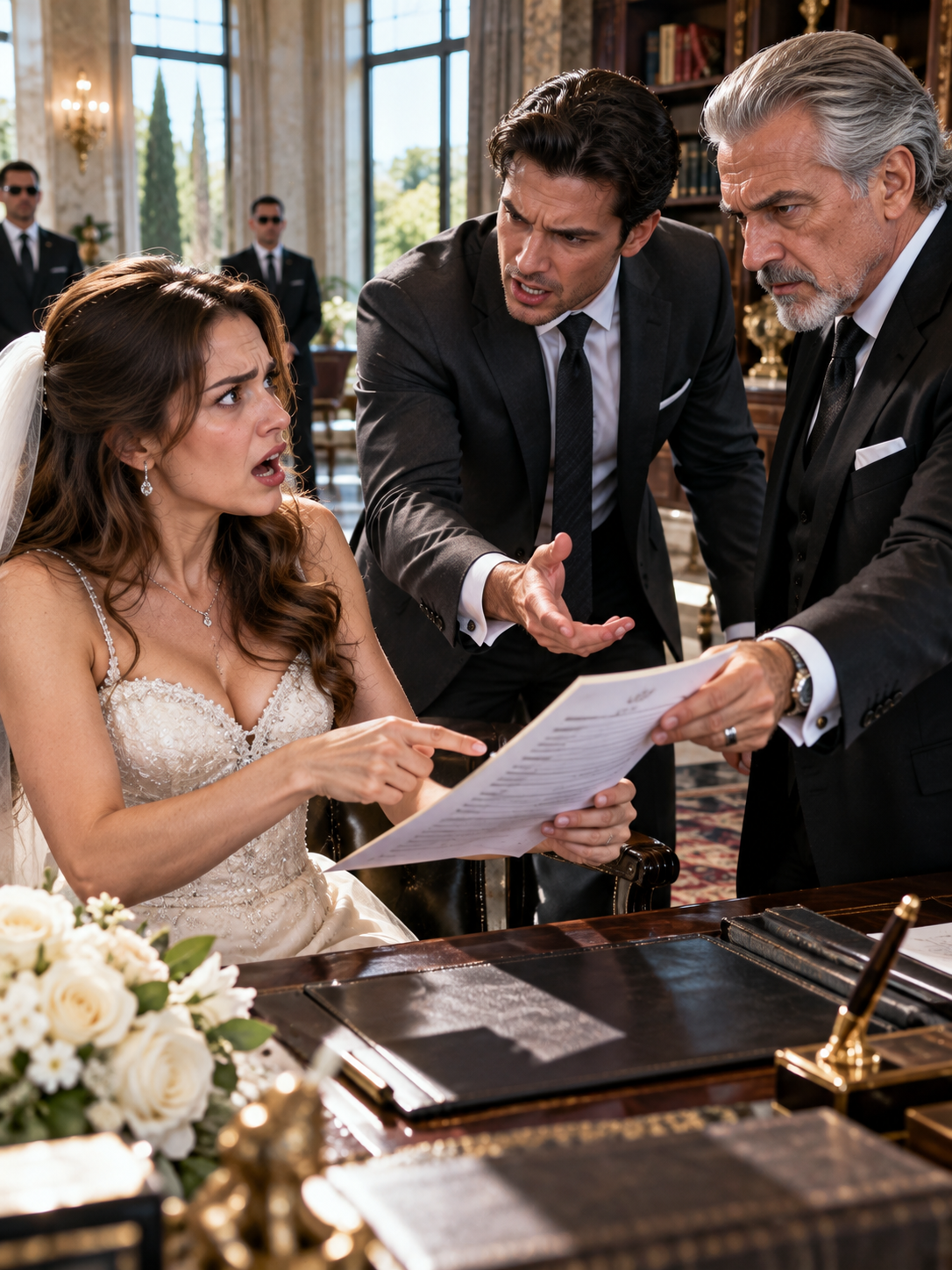
My Fiancé Changed the Groom’s Name to His Ruthless Uncle as a Joke—Then Lost His Mind When I Actually Married Him
Seven days before my wedding, I overheard my fiancé laughing about replacing his name with his powerful uncle’s on our wedding paperwork. After seven years of broken promises and ten canceled ceremonies, he believed I would panic and beg him to take me back. Instead, I accepted the change and walked toward the altar with another man. When my former fiancé discovered what I had done, he stormed into the cathedral screaming that I belonged to him. But the real surprise was what his uncle had been hiding.
Part 1
I heard my fiancé give me away as part of a bet while standing outside his private office, holding the wedding invitations I’d spent three nights addressing. “Change the groom’s name to my uncle Adrian,” Matteo Rinaldi told his friends, laughing over the sound of clinking glasses. “Clara will panic when she discovers it, and she’ll come begging me to fix everything.” Someone asked whether he was worried his uncle might actually agree to marry me, and Matteo laughed harder. “She’s waited seven years for me. She wouldn’t dare choose another man.”
I stood behind the half-open door until my fingers left deep creases in the ivory envelopes. At twenty-eight, I’d spent nearly a quarter of my life waiting for Matteo to keep his promises, including ten postponed weddings. The first cancellation came after he claimed an emergency in the family’s shipping business; the next involved a sudden trip to Rome. By the sixth, our friends had stopped asking for explanations, and by the tenth, people in Palermo were openly wondering what was wrong with me.
Matteo never corrected them, even when his friends joked about me becoming an old maid before thirty. He belonged to one of Sicily’s wealthiest and most feared families, whose influence extended from commercial ports to private security firms and businesses nobody discussed openly. His uncle Adrian Rinaldi, the family’s forty-three-year-old patriarch, had a reputation for ending disputes without ever raising his voice. People called him ruthless, although nobody seemed willing to explain what that actually meant.
I had loved Matteo since I was nineteen, when he borrowed his grandmother’s sapphire ring and slipped it onto my finger beneath the lemon trees at his family’s summer estate. “One day, you’ll be my wife,” he promised, kissing my forehead. I believed him through every missed anniversary, every humiliating postponement, and every photograph of him leaving restaurants with other women. Eventually, I stopped asking where he went because I knew the answer would somehow become my fault.
That afternoon, I returned home and found my mother examining the revised wedding documents. The preliminary ceremony paperwork now listed Adrian Rinaldi as the intended groom, exactly as Matteo had ordered, although the legal marriage arrangements had not been finalized. My mother looked devastated. “Clara, this must be some horrible mistake,” she whispered, pushing her glasses higher. “I’ll call Matteo and demand an explanation.”
“Don’t call him,” I said, taking the documents from her trembling hands. She reminded me that Adrian was considerably older, unmarried, and surrounded by intimidating rumors. I understood her fear, but I also remembered how Matteo had convinced several respectable families that pursuing me would create trouble for them. For seven years, he had made sure I remained available without ever giving me the dignity of becoming his wife.
The following morning, I requested a private meeting with Adrian’s mother, Vittoria Rinaldi. She received us in a sunlit drawing room filled with antique furniture and white camellias, listening without interruption while I explained the change. Then she set her porcelain cup down and asked the question nobody in Matteo’s circle had bothered to consider. “Clara, do you actually want to marry my son Adrian, or are you simply trying to punish my grandson?”
“I want to stop being somebody’s backup plan,” I answered. “But I won’t marry a stranger just to humiliate Matteo.” Vittoria studied me for a long moment before calling Adrian herself. He agreed to meet me privately, and we spent an hour discussing expectations, independence, and why neither of us wanted a marriage built on deception.
Adrian didn’t promise romance, and he didn’t pretend the situation was normal. “You deserve the chance to choose without pressure,” he said. “If you change your mind, I’ll make sure there’s no embarrassment or retaliation.” His calm sincerity unsettled me more than any grand declaration could have. I left that meeting knowing I wanted to learn who he really was, beyond the frightening stories told by men who feared him.
Over the next two days, we completed the necessary legal arrangements openly and voluntarily, including a new marriage application naming us both. Matteo, apparently satisfied with his prank, never bothered to inspect the updated records. Instead, he arrived at my house with Bianca Ferri, a young woman who worked in his family’s hospitality division, and demanded the sapphire ring he’d given me years earlier. “Bianca wants to try it on,” he explained, holding out his hand.
I removed the ring without arguing. When I asked him to return the antique pocket watch I’d once given him, his smile disappeared. “You’re acting like we’re breaking up,” he said, tossing the watch into my palm before leaving with Bianca. I looked at the cracked glass that had once protected his heart during a dangerous accident, remembering his promise never to disappoint me. Then I placed it in a drawer and closed it.
Four days before the wedding, Adrian sent a simple handwritten note asking whether I remained certain of my decision. I answered yes, surprised by how easily the word came. What I didn’t know was that Matteo had just discovered the official marriage application, and his reaction would expose a secret far older than his foolish bet.
Part 2
Matteo’s first call came while I was having my final dress fitting. He sounded amused rather than frightened, saying he’d heard something ridiculous about Adrian’s name appearing on the official documents. “My uncle will never marry you,” he assured me. “He’s too sensible to involve himself in our little argument.” I listened while the seamstress adjusted my veil, then asked Matteo whether he’d been the one to replace the name originally.
“Don’t be dramatic, Clara,” he answered, which was the same phrase he’d used whenever I questioned his behavior. Instead of admitting the bet, he demanded that I postpone our wedding because Bianca had arranged a countryside excursion for them. When I refused, he laughed and told me I’d regret being difficult. I hung up before he could explain what punishment he had planned.
On the wedding morning, my mother helped fasten the pearl buttons down my back. Her eyes were swollen from worrying, but she didn’t try to change my mind. “Adrian has confirmed everything with the registrar and the priest,” she told me, smoothing my sleeves. “He also asked me to remind you that you can still walk away.” I looked into the mirror and realized that nobody had offered me that freedom during my seven years with Matteo.
The cathedral stood above Palermo’s old harbor, its limestone walls bright beneath the morning sun. White camellias lined the aisle, and their clean fragrance mixed with polished wood and candle wax. Adrian waited near the altar wearing a beautifully tailored charcoal suit, his silver-threaded dark hair catching the light. When I reached him, he extended his hand without assuming I would take it, and I placed my fingers gently inside his.
The ceremony had barely begun when a commotion erupted near the entrance. Heavy doors swung open, admitting a gust of sea air and Matteo’s furious voice. “Stop this wedding! I’m supposed to be the groom!” Guests turned in their seats as Matteo hurried down the aisle, his expensive jacket wrinkled and his expression twisted with disbelief. Bianca appeared behind him, pale and visibly uncomfortable.
Adrian’s security staff blocked Matteo from approaching the altar, but he continued shouting. “Uncle, this was a joke! I changed the paperwork because I lost a bet, and Clara was supposed to beg me to fix it.” His words carried across the cathedral, confirming what I’d overheard. Several guests exchanged stunned looks, while Vittoria Rinaldi closed her eyes as though she’d expected something disgraceful.
“You publicly admit manipulating someone’s wedding as entertainment?” Adrian asked, his voice controlled. Matteo ignored him and stared directly at me. “Clara, tell everyone you love me, and we’ll get this corrected.” For a moment I saw the nineteen-year-old boy who had promised me a future beneath the lemon trees, but that memory no longer carried enough weight to make me surrender my dignity.
“I knew whose name was on the documents,” I answered. “I signed the new application myself, and Adrian agreed after speaking to me personally. This isn’t your wedding anymore.” Matteo shook his head and insisted I was only trying to make him jealous. When I told him I wasn’t marrying anyone against my wishes, the certainty in my voice seemed to frighten him more than Adrian’s presence.
“She belongs with me,” Matteo said desperately, turning toward his uncle. Adrian looked at him without anger. “Clara belongs to herself, Matteo, and she has made her decision.” Vittoria rose from the front pew and instructed her grandson to leave the ceremony peacefully. He hesitated, searching the guests for support, but even the friends who had laughed at his bet avoided his eyes.
After Matteo was escorted outside, Adrian turned toward me instead of the priest. “We can stop if this has become too much,” he whispered. I shook my head, and we continued with the vows, each of us answering clearly and willingly. When Adrian placed a simple gold band on my finger, my mother began crying quietly. For the first time, a wedding promise felt less like something I had to earn and more like a choice two adults had made together.
The reception took place at the Rinaldi family’s coastal estate, where guests whispered about Matteo while pretending to admire the flowers. Adrian and I shared a brief first dance before escaping to a quiet terrace. He apologized for his nephew’s behavior, but I told him I was finished carrying Matteo’s embarrassment. Then Adrian’s phone vibrated, and the concern that crossed his face seemed unrelated to the wedding.
“There’s something I need to tell you about Matteo,” he said, putting the phone away. “The marriage application wasn’t the first document he altered involving your name.” The sea breeze suddenly felt cold against my shoulders. I had escaped Matteo’s control over my future, but I was beginning to wonder how much of my past he’d quietly stolen.
Part 3
Adrian showed me the document the following morning over breakfast. It was a withdrawal letter submitted to a prestigious art restoration fellowship in Florence three years earlier, bearing my name beneath a signature that wasn’t mine. I recognized the opportunity immediately because I’d applied twice and assumed I’d been rejected. Instead, the program had accepted me, then received instructions declining the position from Matteo’s office.
“I didn’t know about this until my legal team reviewed some archived correspondence yesterday,” Adrian said, sliding the records toward me. “Matteo used his family’s administrative staff to send the withdrawal without your knowledge.” My hands tightened around my coffee cup. That fellowship had represented my chance to become financially independent through the conservation work I’d studied for years.
I remembered telling Matteo about the application while we were eating dinner near the harbor. He’d kissed my forehead and said my career would never matter because he’d provide everything I needed. When no acceptance arrived, he suggested I stop embarrassing myself with unrealistic ambitions. Looking at the forged letter, I finally understood that my uncertainty had been carefully cultivated.
Adrian offered to help me obtain legal advice, but I insisted on choosing my own attorney. He immediately agreed, handing me the contact details of several independent professionals rather than selecting one for me. That small courtesy mattered more than the expensive wedding gifts filling our rooms. I had spent years asking permission to exist, and I refused to repeat that mistake in another marriage.
During the next three months, I slowly reclaimed my career. I rented a small conservation studio near Palermo’s historic district and began restoring antique frames, damaged paintings, and decorative woodwork. Adrian never questioned how I spent my earnings or demanded that I abandon my work for family events. Sometimes he arrived after closing with coffee and listened while I explained why a seemingly insignificant scratch could change the history of an entire painting.
One evening, while we walked through his mother’s camellia garden, I asked why he’d agreed to marry me. Adrian stopped beside a stone fountain, where water splashed softly over worn marble. “I admired you long before this wedding,” he admitted. “I saw your restoration work at a charity exhibition five years ago, and I remembered how passionately you explained it, but you were engaged to my nephew.”
He admitted he’d wanted to know me better but refused to interfere while I believed my relationship was worth saving. “When Matteo changed the paperwork, I didn’t see an opportunity to claim you,” he said. “I saw an opportunity to ask whether you wanted a different life.” I looked at him beneath the garden lights and realized my feelings had begun changing without my permission. For once, that uncertainty felt exciting instead of frightening.
Our fragile peace ended at Vittoria’s charity gala. Matteo appeared near the ballroom entrance, looking exhausted and considerably less confident than he’d been at the cathedral. He approached me holding the old pocket watch, its cracked glass reflecting the chandeliers. “I bought it back,” he said, his voice trembling. “Clara, I’ve finally realized how much you meant to me.”
He begged me to abandon Adrian and start over with him somewhere nobody knew our history. I listened without interrupting, then told him the truth. “I didn’t stop loving you because of one bet, Matteo. I stopped a little each time you humiliated me, canceled our wedding, or made me feel worthless.” He tried to take my hand, but I stepped away before he touched me.
Adrian joined us as Matteo began pleading again. Instead of threatening his nephew, he asked whether I wanted the conversation to end, and I said yes. Matteo left looking devastated, taking the watch with him. Minutes later, Adrian received an urgent message from the shipping company’s compliance director: a questionable port agreement signed by Matteo had been uncovered, and my name appeared in its supporting documents.
Part 4
The documents arrived at our home the next morning in a sealed envelope. Matteo had entered into a risky commercial arrangement with a rival shipping group, using inflated projections and commitments he lacked authority to make. Several transactions were already under investigation, and the agreement included references to property my mother had placed in a trust for me. I stared at the address of our family’s coastal villa, wondering why a business deal involving strangers needed to mention my inheritance.
My attorney, Francesca Morelli, reviewed the papers beside Adrian’s legal counsel. She explained that Matteo couldn’t simply transfer my property, but he’d represented himself as someone who could secure my participation after our marriage. An attached internal note described me as “fully cooperative and unlikely to question family arrangements.” The words made my stomach turn because they sounded exactly like the confidence Matteo had expressed during his wedding bet.
Bianca contacted me that afternoon, asking for a meeting in a public café. She arrived without jewelry or makeup, twisting a napkin between her fingers. “Matteo told everyone you’d agree to anything if he promised to marry you,” she admitted. “When you married Adrian instead, the investors began demanding guarantees he couldn’t provide.”
I asked whether she had known about the forged fellowship withdrawal. Bianca looked down at her untouched tea before admitting she’d seen related correspondence in Matteo’s office. She said she’d believed him when he claimed I wanted to remain in Palermo. I didn’t offer forgiveness, but I asked her to provide everything she knew to the investigators. Her expression changed when she realized I wasn’t interested in trading silence for an apology.
Days later, Matteo tried to arrange another private conversation through my mother. When she refused, he sent messages insisting the business dispute was a misunderstanding and that I could solve everything by persuading Adrian to intervene. I forwarded them to Francesca without answering. The man who’d spent seven years treating me as powerless now wanted me to rescue him from his own decisions.
The situation became more serious when compliance investigators recovered correspondence indicating Matteo had offered outsiders access to private family schedules and information about my property in exchange for relief from his obligations. It wasn’t merely reckless business judgment anymore. Adrian immediately involved the proper authorities and arranged reasonable security precautions after consulting me. I agreed to the protection but refused his suggestion that I suspend work indefinitely.
The authorities questioned several people connected to the port agreement, including Bianca, who provided records showing that Matteo had authorized the questionable commitments. The shipping company suspended him from his remaining responsibilities, and Vittoria called a family meeting. I attended only because Matteo had requested my presence, claiming he wanted to explain everything before the investigation continued. By then, I knew explanations and accountability were very different things.
Matteo entered the family library looking smaller than I remembered. He admitted he’d made reckless promises, but insisted he’d never expected anyone to use my information against me. “I thought Adrian would protect you,” he said. I felt a cold certainty settle inside me: even frightened and cornered, he’d treated my safety as something another man could manage.
“That is exactly why I can never trust you,” I answered. “You were willing to gamble with my future because you believed somebody else would pay the price.” Vittoria informed him that he would no longer represent the family businesses, while Adrian confirmed that all evidence would remain available to the investigators. Nobody raised their voice, and there was no dramatic punishment beyond the consequences Matteo had brought upon himself.
When he asked whether I could ever forgive him, I said no. His face crumpled, but I didn’t move toward him or soften my answer. I had spent enough years confusing pity with love. Later that night, Adrian found me standing on the terrace, and I asked him the question I’d been avoiding since our wedding: “If I decide I need to build a life completely independent of this family, will you let me go?”
Part 5
Adrian didn’t answer immediately. He joined me beside the terrace railing, where moonlight spread across the dark Mediterranean water. “Clara, I married you because you chose me,” he said. “If you need to leave Palermo, pursue your career, or even reconsider our marriage, I won’t stand in your way.” I searched his face for the disappointment Matteo would have used against me, but Adrian simply waited for my answer.
Two weeks later, I accepted a six-month restoration fellowship in Florence, something I’d once believed was permanently beyond my reach. Adrian helped me pack but refused to interfere with the arrangements I’d made through my own studio. On the morning I left, he kissed my forehead and said, “Call because you want to, not because you think you owe me.” Standing on the station platform, I understood how different freedom felt when someone genuinely respected it.
Florence was beautiful and exhausting. I spent long days examining damaged Renaissance paintings, learning from conservators who judged me by my skills rather than my husband’s surname. My apartment was small, with uneven floors and a kitchen window overlooking a narrow cobblestone street. Every evening I made dinner, studied my notes, and occasionally called Adrian simply because I missed hearing his voice.
Meanwhile, Matteo’s financial troubles continued. Investigators established that he had misrepresented his authority and concealed significant liabilities from business partners. He eventually reached a court-approved resolution involving restitution and restrictions on his future business activities, while losing the executive position and financial privileges he’d once taken for granted. Bianca cooperated with the investigation and left the Rinaldi businesses to rebuild her own life elsewhere.
Matteo sent me a final letter through my attorney. He wrote about the empty apartment he’d rented, the friends who no longer returned his calls, and the sapphire ring he’d recovered from Bianca. “I finally understand that you were the best thing in my life,” he wrote. “If I’d married you when I promised, none of this would have happened.”
I read those sentences at my kitchen table while rain tapped against the Florence windows. He still spoke as though marrying me would have been the solution to his problems rather than acknowledging how he’d treated me. I instructed Francesca to return the letter and decline any further contact. His regret was no longer something I needed to manage, and his late declaration of love changed nothing.
When my fellowship ended, Adrian traveled to Florence to attend an exhibition featuring the work I’d helped restore. He stood quietly beside me as visitors studied a centuries-old painting, listening while I explained the careful work beneath its newly recovered colors. Later, over dinner at a small restaurant, he asked whether I wanted to return to Palermo. “Only if I can keep building my career,” I answered, and he smiled. “I wouldn’t expect anything less.”
We opened a conservation studio in Palermo the following spring, financed through my own earnings and an independent business loan. Adrian remained my husband, not my employer or my rescuer, and our marriage gradually developed into something neither of us had expected from those unusual beginnings. We argued sometimes, laughed often, and learned that affection didn’t require constant grand gestures. I fell in love with him because he listened when I spoke, respected my boundaries, and never demanded gratitude in exchange for kindness.
One afternoon, while white camellias bloomed outside our terrace, Vittoria asked whether I regretted the strange circumstances of our wedding. I thought about Matteo’s foolish bet, the cathedral doors opening, and the moment I’d finally stopped waiting for someone who enjoyed keeping me uncertain. “I regret spending seven years believing I had to earn someone’s love,” I said. “But I don’t regret choosing a better future.”
Adrian reached for my hand, and I intertwined my fingers with his, feeling the simple gold wedding band against my skin. Somewhere beyond our garden, the harbor bells rang across the water, and sunlight moved over the white stone walls of our home. Matteo had once believed that changing a name on a piece of paper could frighten me into submission. Instead, his little game had taught me the one lesson I would never forget: I was never a prize for one man to give another, and the happiest chapter of my life began when I finally chose for myself.
Legal Notice: This story is a work of fiction. Names, characters, businesses, events, and incidents are the product of the author’s imagination or are used fictitiously. Any resemblance to actual persons—living or dead—or to actual events is purely coincidental. Thank you! 💓


