
My Sister Sold 80 Tickets to a Party at My Lakefront House Without Permission—Then Froze When She Saw Police Waiting at My Gate
“I sold eighty tickets for a party in your backyard this Sunday. Clean the house and open the gate,” my sister texted. When I told her she had no permission, she laughed and challenged me to cancel it. She’d already collected thousands of dollars, advertised my private dock, and listed me as the official host without my knowledge. My mother ordered me to cooperate or lose my family. But Sunday morning, when my sister arrived with a truckload of party supplies, the police were already waiting.
Part 1
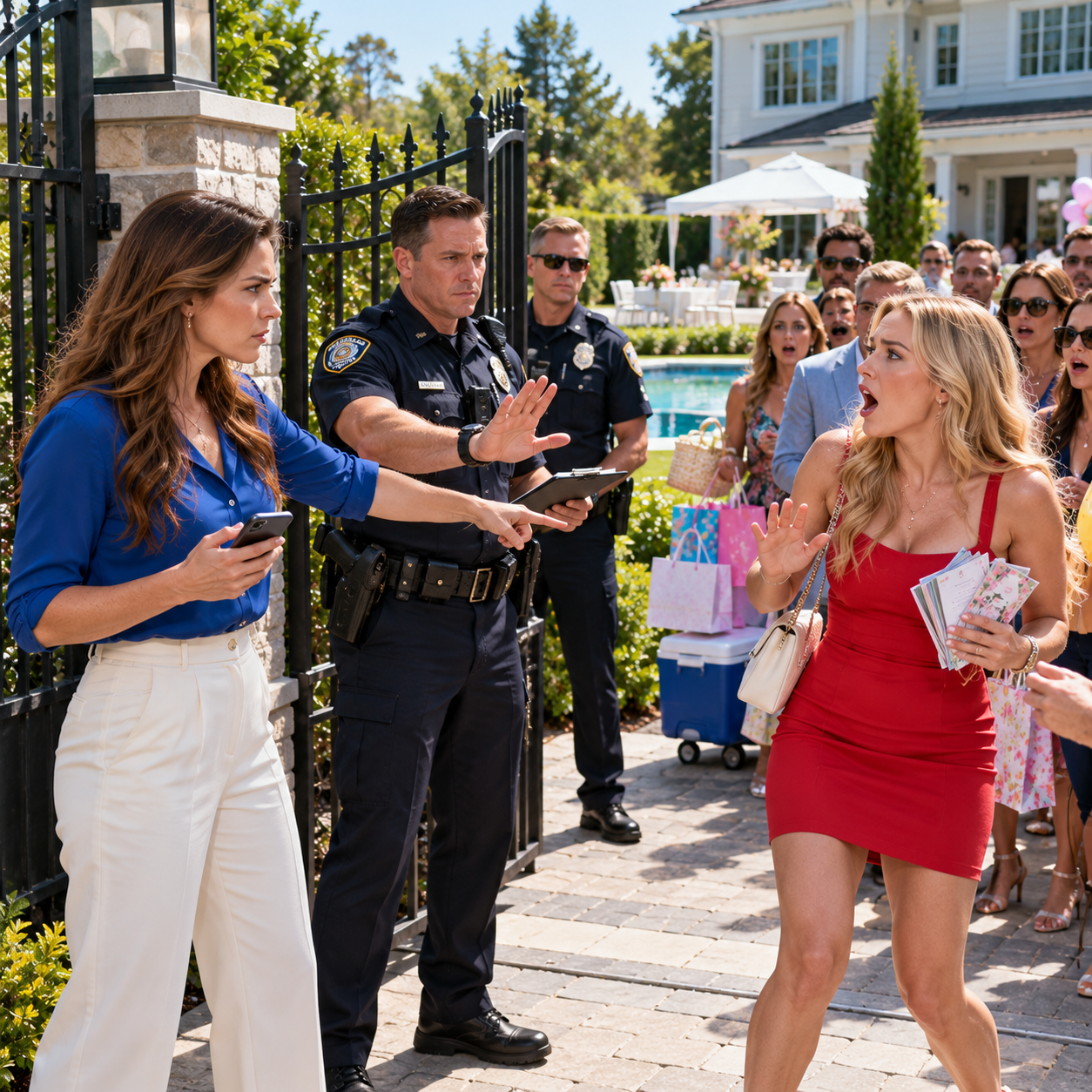
At 9:40 on Sunday morning, my younger sister stepped out of a white rental truck holding a clipboard and wearing the confident smile of someone who expected the entire world to follow her instructions. She immediately pointed toward my driveway, preparing to direct the workers unloading folding tables and sound equipment. Then she noticed the sheriff’s patrol vehicle parked beside my wooden gate. Her hand dropped, her mouth opened, and for the first time in forty-two years, I watched my sister realize she might not get what she wanted.
Five days earlier, she’d been laughing at me over the phone. My name is Meredith Collins, and I’m a forty-two-year-old notary public living in Kenmore, Washington, overlooking Lake Washington. Fourteen months earlier, after fifteen years of saving and working weekends, I’d purchased a modest three-bedroom house with a cedar dock, eighty feet of shoreline, and a backyard that sloped toward the water. The roof needed repairs, the kitchen looked twenty years out of date, and I loved every square foot.
I’d spent most of the previous summer restoring the property myself. I sanded the living room floors, painted the bedrooms, repaired the patio railing, and installed eleven stone steps leading from the backyard to the dock. My hands had developed calluses, and my savings account had become uncomfortably thin. But every evening, when the lake turned silver beneath the setting sun, I felt something I’d rarely experienced growing up: peace.
My younger sister, Brittany, had never understood why I wanted a quiet life. At thirty-six, she described herself as an entrepreneur, although her business interests changed almost as frequently as her hairstyles. She’d tried selling handmade candles, organizing corporate retreats, and running an online decorating service, each abandoned when expenses exceeded expectations. Our mother always insisted Brittany was talented and simply needed people to believe in her.
On Tuesday evening, I was washing dishes when my phone vibrated against the kitchen counter. Brittany had sent a message that read, “I sold tickets for an event in your backyard for eighty people this Sunday. Make sure the house is clean.” Before I could respond, another message arrived containing a color-coded spreadsheet with delivery times, catering instructions, parking arrangements, and a schedule running from noon until seven.
I opened the attachment and felt my stomach tighten. Rental furniture was scheduled for 10:15, refreshments at 10:45, and a catering company would arrive shortly afterward. Guests were supposed to use my downstairs bathroom, while musicians would perform on the patio overlooking the lake. Beside a column labeled “Property Owner Responsibilities,” Brittany had entered my name and assigned me the tasks of opening the gate, cleaning the house, and providing electricity.
I called her immediately. “Brittany, what is this supposed to be?” I asked, staring through the window at my small backyard. She laughed and explained that she’d organized an exclusive waterfront gathering to introduce her event-planning business to potential clients. When I asked why she’d chosen my property, she said, “Because you have a beautiful lakefront and never do anything interesting with it.”
I reminded her that my home wasn’t a commercial venue and that I’d never agreed to host strangers. Brittany sighed dramatically and claimed I’d promised months earlier that she could occasionally use the backyard for family gatherings. I remembered saying she could bring our mother over for a summer barbecue. Apparently, she’d transformed that casual invitation into permission to run a ticketed event.
“This is not happening,” I told her firmly. She answered that guests had already paid, vendors had received deposits, and canceling would damage her reputation. When I repeated that she needed to cancel, she laughed harder. “Cancel it if you dare, Meredith. Let’s see how you explain that to eighty disappointed people.”
The following morning, a stranger contacted my professional business page asking whether parking would be available near the waterfront entrance. Confused, I searched the event name from Brittany’s spreadsheet and discovered a public listing advertising an exclusive Sunday gathering for $150 per person. Seventy-one tickets were already marked sold, representing $10,650 in gross ticket sales. The listing promised catered food, live entertainment, and private access to the lake.
Then I scrolled down to the photographs. There was my cedar dock, my patio furniture, and the stone steps I’d built with my own hands. One photograph showed my kitchen through the window, including the ceramic bowl my grandmother had given me. I remembered Brittany taking pictures during a visit three weeks earlier and realized she’d been gathering promotional material.
At the bottom of the page was a section titled “Meet Your Host.”
I expected to see Brittany’s smiling photograph.
Instead, I found my full legal name, my professional notary credentials, and a statement claiming I’d personally approved the event.
And beside the host’s name was one word that made my stomach turn: “Confirmed.”
Part 2
I called Brittany again, this time with the listing open on my laptop. “Why did you put my name and professional credentials on a public advertisement?” I demanded. She claimed potential customers felt more comfortable booking events when the property owner appeared directly involved. When I asked whether she’d ever intended to request my permission, she went quiet before answering, “You would’ve said no, so I handled the difficult part myself.”
I told her to remove my information and notify every ticket holder immediately. Brittany’s tone changed from playful to threatening as she explained that refunds would destroy her new business before it launched. She reminded me that our mother had invested money in her promotional materials and that several relatives had purchased tickets. “If you embarrass me now,” she warned, “everyone will know you’re responsible for ruining this.”
After hanging up, I contacted my homeowner’s insurance agent, Rebecca Shaw, who’d handled my policy since closing. I explained the proposed gathering, the advertised refreshments, the private dock, and the number of paying guests. Rebecca asked several questions about commercial use, event insurance, and supervision near the water. When I admitted I’d authorized none of it, her response was immediate.
“Meredith, you cannot assume your regular homeowner’s policy would cover claims arising from an unauthorized commercial event,” she warned. She explained that injuries, property damage, and disputes involving paying guests could create serious complications, especially around waterfront access. She recommended documenting my refusal, notifying the organizers in writing, and seeking legal advice. By the end of our conversation, my irritation had become genuine concern.
That evening, I discovered Brittany had added me to a family group chat containing forty-one relatives and acquaintances. The messages stretched back nearly a week, with discussions about seating arrangements, decorations, and whether guests could bring additional family members. Someone had asked whether the homeowner approved of using the dock. Brittany had responded, “It’s my sister’s house, and everything is completely handled.”
I wrote one carefully worded message explaining that I’d never agreed to host the gathering and that my property would not be available Sunday. Within minutes, responses flooded the screen. One cousin accused me of selfishness, another suggested I was jealous of Brittany’s ambition, and an aunt insisted that family members were supposed to support one another. Nobody asked why Brittany had sold tickets before receiving permission.
My mother called four minutes later. “Meredith, sweetheart, what are you doing?” she asked, sounding breathless with frustration. I explained that Brittany had advertised my home, used my professional identity, and collected money from strangers without authorization. Mom dismissed those concerns and said, “Your sister is finally trying to build a future, and you’re making everything about yourself.”
I reminded her that the event involved eighty potential guests, paid admission, and access to the water. Mom argued that the gathering would last only one afternoon and suggested I should be grateful Brittany considered my property attractive enough to use. When I refused, she delivered the ultimatum I’d heard in various forms since childhood. “If you humiliate your sister, don’t expect to come to Thanksgiving.”
Afterward, I sat at my kitchen table watching two ducks drift past the dock. I remembered paying for Brittany’s community college textbooks when she unexpectedly changed programs and lending her money for a security deposit she’d never repaid. I’d canceled vacations to help Mom recover from surgery while Brittany posted photographs from weekend trips. Somehow, being the dependable daughter had turned into a permanent obligation.
Thursday morning, I began contacting the businesses named in Brittany’s spreadsheet. The rental company confirmed an order for tables and chairs, while the caterer believed the venue owner had approved access. A representative from the sound company said Brittany had described the location as an established private event property. Each conversation left me more alarmed because none of those vendors knew they were preparing for an event the homeowner had rejected.
The caterer forwarded an email attachment Brittany had supplied during booking. It contained a statement confirming that the property owner approved of vendor access, parking, and use of indoor facilities. My full name appeared at the bottom, followed by what looked like an electronic acknowledgment. I stared at the document because I’d never seen it before.
Then I noticed the contact telephone number beneath my name.
It belonged to Brittany.
She hadn’t merely assumed I would cooperate; she’d apparently arranged for every question about my permission to come directly back to her.
And I began wondering how many other documents she’d submitted in my name.
Part 3
Friday morning, I carried a binder into the local sheriff’s office containing screenshots, vendor emails, my property deed, and the messages where I’d explicitly refused permission. A deputy named Marcus Bennett listened while I explained that my sister planned to bring dozens of paying guests onto my property despite repeated objections. He reviewed the documents, then asked whether Brittany had threatened to enter by force. I told him she’d dared me to cancel and continued arranging deliveries after receiving my refusal.
Deputy Bennett explained that officers couldn’t resolve every disagreement between relatives, but they could respond if someone attempted to enter private property after being denied access. He encouraged me to keep the gate locked, notify guests and vendors that the event was unauthorized, and contact the nonemergency line if the situation escalated. He also took down the details of the disputed authorization and gave me an incident reference number. For the first time that week, I felt someone was taking my concerns seriously.
Next, I submitted a formal complaint to the ticketing platform, including the incident number and screenshots showing how my identity had been used. I asked it to remove the listing, notify customers, and investigate the payments. An account specialist initially explained that only the organizer could cancel an event, but I requested escalation because the advertised venue had never been available. After reviewing my ownership documents, the company suspended ticket sales and placed the remaining payout funds on hold while it investigated refunds.
Brittany called within an hour. “What did you do to my account?” she shouted before I could say hello. I explained that the ticketing platform had been informed the venue was unauthorized and that customers needed accurate information. She accused me of stealing her money, although I had received nothing from the event. When I asked why she’d continued advertising after being told no, she abruptly ended the call.
That afternoon, my neighbor Evelyn stopped by with an envelope she’d found wedged beneath her front door. It contained parking instructions for Sunday’s gathering, directing guests to use several residential spaces along our narrow street. Evelyn was furious because her husband used a walker, and she worried their driveway might become blocked. I apologized, showed her the cancellation notice, and promised to keep her informed.
I spent Saturday installing an additional padlock on the driveway gate and placing a simple private-property notice beside it. My attorney, whom I’d contacted after receiving the disputed authorization, helped me send a written notice to Brittany and the major vendors confirming that no event access had been granted. Most vendors acknowledged it, but the furniture company warned that its driver might still arrive because Brittany hadn’t canceled the order. Their final message said, “We cannot unload without property access, but the customer remains responsible for the booking.”
Saturday evening, Mom sent me a photograph of Brittany crying at her kitchen table. Her message read, “Look what you’ve done to your sister.” I replied that Brittany could cancel the event, notify customers, and take responsibility for arrangements she’d made without permission. Mom answered that I had become cold and selfish since buying my lake house. I didn’t respond again.
At eight-thirty Sunday morning, Deputy Bennett called to say patrol officers were checking the area because the organizer had continued encouraging people to attend. He explained that they would assess the situation and speak to anyone attempting unauthorized entry. I thanked him, put on a navy sweater, and stepped onto my porch with a mug of coffee. The lake was unusually still beneath the pale morning sky.
At nine-fifteen, a patrol vehicle arrived and stopped near the driveway entrance. Deputy Bennett stepped out, reviewed my written refusal, and asked whether I’d changed my decision. I told him I hadn’t. He nodded, returned to the roadside, and waited while I remained inside my locked gate.
Then, at 9:40, the white rental truck turned onto my street.
Brittany climbed out holding her clipboard, turned toward the workers, and raised one hand to direct them toward my driveway.
She saw the patrol vehicle before she finished her sentence.
Part 4
For several seconds, Brittany stood motionless beside the truck, her clipboard hanging loosely from one hand. The driver switched off the engine, and two workers climbed down from the cab, looking between my locked gate and the sheriff’s vehicle. Behind them, three cars pulled toward the shoulder, including my mother’s silver sedan. I watched from my porch as the morning breeze scattered a few loose papers across the pavement.
Deputy Bennett approached the truck and asked who was responsible for the delivery. Brittany recovered enough to introduce herself as the event organizer, explaining that she’d reserved the property for a private celebration. The deputy calmly told her the homeowner had expressly denied permission for the gathering. He added that equipment could not be unloaded onto my property and that everyone needed to keep the road and neighboring driveways clear.
Mom emerged from her car wearing a cream blazer and an expression of complete outrage. “Meredith!” she shouted, marching toward the gate. “You brought the police into a family disagreement?” I walked down my stone path and stopped several feet behind the locked entrance. “I told Brittany on Tuesday that she couldn’t use my property,” I answered. “She decided to bring everyone anyway.”
Brittany rushed toward us, her face flushed beneath her makeup. “This is my business launch!” she protested, waving the clipboard. “I’ve spent thousands of dollars on this, and you’ve ruined everything.” I reminded her that I’d offered multiple opportunities to cancel before Sunday. She insisted she’d believed I would eventually cooperate because I’d always helped her in the past.
The deputy asked her to step away from the gate while he clarified the situation with the delivery driver. Brittany argued that she’d already paid the rental deposit and couldn’t afford another cancellation fee. The driver checked his paperwork, called his dispatcher, and confirmed that his crew would not unload without the owner’s consent. Watching the workers climb back into the truck, Brittany looked genuinely frightened for the first time.
Then the first paying guests arrived.
A blue SUV slowed beside the patrol car, and a woman lowered her window to ask where she should park for the lakeside event. Her husband held up a phone displaying the advertisement, complete with photographs of my backyard. Deputy Bennett explained that the venue had not been authorized and directed them to the ticketing platform for refund information. The woman stared at Brittany, asked whether the entire event had been misrepresented, and drove away shaking her head.
More vehicles appeared over the following minutes, creating an awkward line of confused guests. Some had traveled nearly an hour, while others carried printed tickets and expected to attend a professionally organized gathering. Brittany hurried between cars attempting to explain, but her reassurances became increasingly contradictory. One guest asked why the official host wasn’t allowing anyone inside, and Brittany had no convincing answer.
Mom turned toward me again, tears gathering in her eyes. “Look at what you’re doing to your sister,” she demanded. “She’s going to lose everything because you couldn’t share your backyard for one afternoon.” I looked directly at her and asked whether she’d helped Brittany organize the event. Mom hesitated, then admitted she’d contributed money toward the initial promotional expenses.
“So you knew she was selling tickets?” I asked. Mom said she’d assumed I had agreed because Brittany told her everything was arranged. I reminded her about our Thursday conversation, when I’d explicitly explained that no permission existed. She looked away and claimed she hadn’t believed I would actually refuse my own family.
Brittany stepped toward the gate, gripping her clipboard so tightly the paper bent. “Just let the guests inside for a few hours,” she pleaded, suddenly abandoning her angry tone. “We can keep them away from the dock, and I’ll give you some of the money afterward.” I told her no and explained that the event should never have been advertised without my consent.
Her face hardened again. “You’re a terrible sister,” she said, her voice cracking. “I needed this business to succeed, and you’re choosing your stupid house over me.” I looked past her toward the lake, where sunlight had begun breaking through the clouds. “I chose not to let you sell something that never belonged to you,” I answered.
By eleven, the rental truck had departed, and most guests had been redirected. Deputy Bennett remained while another driver arrived, then checked that the street was clear. Mom finally led a crying Brittany toward her car, although not before announcing that I was no longer welcome at family gatherings. I watched them leave without attempting to explain myself again.
When I returned to the house, my phone displayed a message from the ticketing platform requesting additional information about the event’s authorization. Attached was a copy of the document Brittany had submitted to establish my approval. Beneath my printed name was an electronic signature I hadn’t provided.
For the first time, I understood why Brittany had been so certain she could proceed.
She hadn’t simply counted on me giving in.
She’d created paperwork suggesting I’d already agreed.
Part 5
Monday morning, I forwarded the authorization document to my attorney and the investigator handling my complaint. The signature resembled the one on my professional website, where clients could see examples of completed notarial certificates. Brittany had apparently copied it into a digital form and used her own contact information to receive verification messages. I felt physically ill realizing how much effort she’d invested in making my permission appear genuine.
My attorney advised me to preserve every message and avoid discussing the disputed paperwork directly with Brittany. The ticketing platform confirmed that it was reviewing the transactions and notifying affected customers about refunds. Some payments had already been released to Brittany before the account was suspended, complicating the process. For several weeks, I received messages from disappointed guests asking whether I could help recover their money.
I responded with the platform’s official support information and explained that I had never organized or approved the gathering. A few people were angry, but others apologized for contacting me after realizing my identity had been used without consent. One woman admitted she’d purchased two tickets because the listing identified a licensed notary as the host. That detail convinced me I’d been right to protect my professional reputation as carefully as my home.
The dispute continued through the autumn. Brittany initially claimed I’d verbally authorized the event, but our messages showed repeated refusals and her acknowledgment that I’d never agreed. Her attorney eventually contacted mine to discuss resolving the financial claims and disputed authorization. Through a written settlement, Brittany accepted responsibility for the unauthorized bookings and agreed to cooperate with the refund process and reimburse documented expenses that I had incurred.
The separate review of the questionable signature took longer, and I refused to speculate about its outcome while it remained unresolved. What mattered immediately was that customers were being directed toward refunds and that Brittany could no longer represent herself as authorized to use my property. I updated my business contact information, strengthened my account security, and made sure no public listing suggested my home was available for commercial events. I also installed a camera covering the driveway entrance.
Mom called repeatedly throughout those months. Sometimes she cried, sometimes she accused me of destroying the family, and sometimes she offered what she considered a compromise. “Brittany made a mistake,” she said during one December conversation. “You need to stop punishing her and bring everyone together for Christmas.” I asked whether Brittany had ever apologized for using my identity or trying to force eighty strangers onto my property.
Mom answered that apologies shouldn’t matter between sisters.
That was when I finally understood why Brittany had behaved the way she did. Throughout our childhood, she’d learned that making a sufficiently large problem would eventually force somebody else to solve it. I’d learned that being responsible meant surrendering my own needs to keep everyone comfortable. Neither lesson had produced a healthy relationship.
“I won’t be attending Christmas,” I told Mom. She responded that I’d regret spending the holidays alone, but I explained that being alone in my own home felt considerably better than being surrounded by people who treated my boundaries as inconveniences. When she began criticizing my character again, I ended the conversation. I didn’t block her immediately, but I stopped answering calls that repeated the same accusations.
In January, Brittany sent me a lengthy email. She described the financial damage, the humiliation of watching customers turn away, and the difficulty of rebuilding her reputation. Near the end, she wrote that she’d acted out of desperation and hoped I could eventually understand. I read it twice, noticing that she devoted several paragraphs to her losses and only one sentence to the risk she’d imposed on me.
I didn’t respond.
By spring, I’d finished repainting the downstairs bathroom and repairing the cedar railing along the dock. Evelyn and her husband came over one Saturday afternoon for coffee, bringing lemon cake from a bakery near their house. We sat on the patio watching sailboats cross the lake, and Evelyn mentioned how relieved the neighbors had been when the unauthorized event was stopped. Her husband joked that my backyard had finally become a peaceful place again.
That summer, I hosted a small gathering for twelve friends and neighbors. Everyone received a personal invitation, nobody purchased a ticket, and we kept the music low enough to hear the water against the dock. We ate grilled vegetables, homemade sandwiches, and strawberry shortcake while the evening light turned the lake copper. After everyone left, I carried the empty plates inside and realized how different the afternoon had felt from Brittany’s planned spectacle.
Nobody had demanded access, assigned me responsibilities, or assumed that my home existed for their convenience. My guests thanked me, helped clean up, and respected the boundaries I’d established. For the first time, I understood that generosity felt wonderful when it was freely given. What Brittany had demanded wasn’t generosity; it was surrender.
Nearly a year after the incident, I was sitting on the dock when a message from Mom appeared on my phone. She said Thanksgiving wouldn’t feel the same without me and suggested that enough time had passed for everyone to forget what happened. I looked at the message, remembered Brittany standing outside my gate with eighty paying guests expected to arrive, and quietly deleted it. Forgetting wasn’t the same as repairing trust.
I never received the apology I deserved, and I stopped expecting one. Brittany could rebuild her business, and Mom could continue defending her, but neither needed access to my life. I had spent too many years proving my love by absorbing consequences that belonged to other people. I wasn’t willing to spend another forty-two doing the same.
That evening, I walked down the eleven stone steps I’d built myself and sat at the end of my cedar dock. The water moved gently beneath my feet, and the distant sound of a boat engine faded toward the opposite shore. My house stood behind me, modest and imperfect, with its old roof, freshly painted rooms, and garden I’d planted with my own hands.
Brittany had dared me to cancel her party because she believed I would always choose her comfort over my own peace.
She was wrong.
I didn’t lose my family when I locked that gate. I stopped allowing people to call their demands love and my refusal selfishness.
And as the last sunlight disappeared across Lake Washington, I realized that the most valuable thing I’d protected wasn’t my house.
It was my right to decide who belonged inside it.
Legal Notice: This story is a work of fiction. Names, characters, businesses, events, and incidents are the product of the author’s imagination or are used fictitiously. Any resemblance to actual persons—living or dead—or to actual events is purely coincidental. Thank you! 💓


