
Part 2
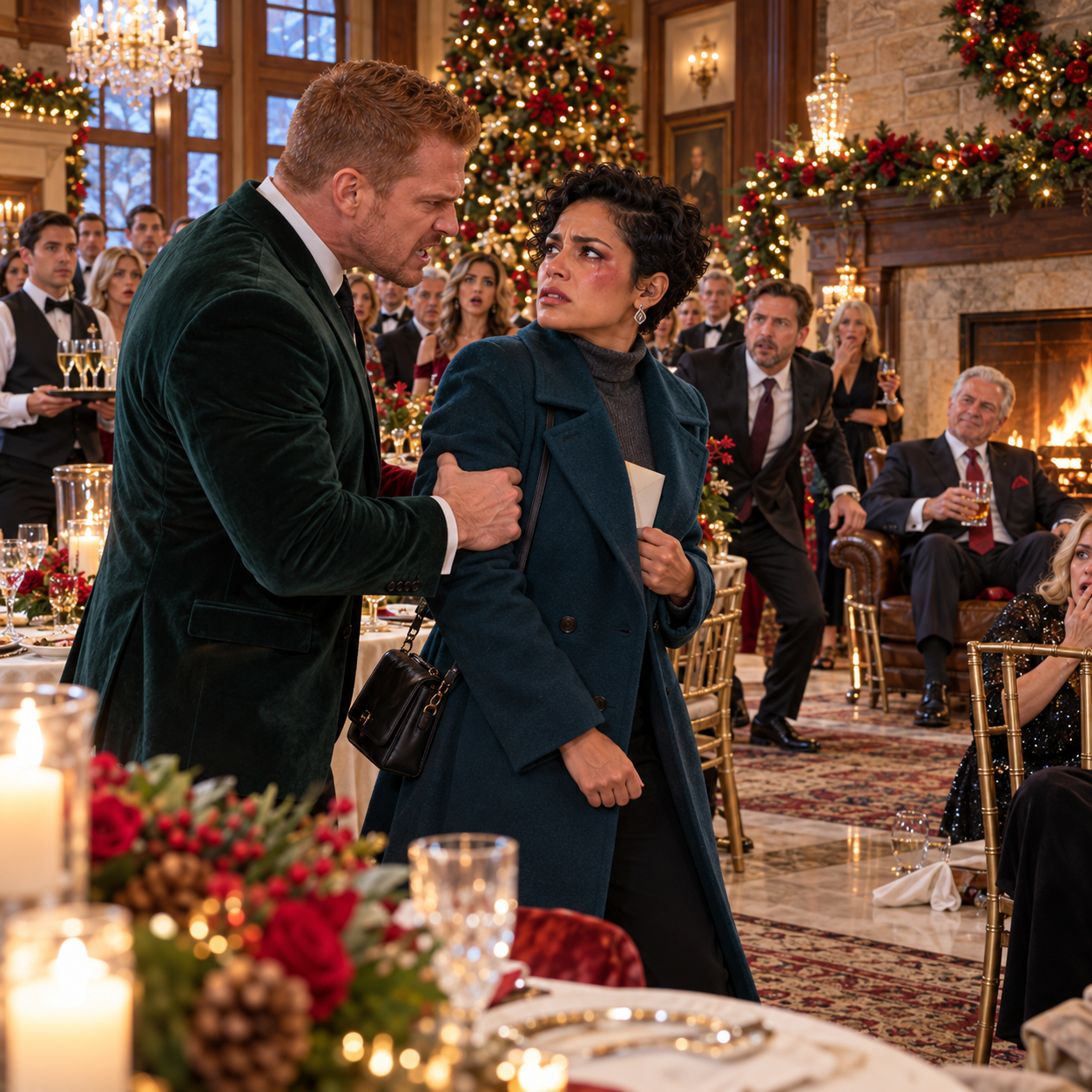
The voice was deep enough to cut through every whisper in the ballroom.
A tall man rose from a table near the fireplace. He was in his late fifties, broad-shouldered, silver-haired, and wearing a dark suit without a Christmas pin or festive tie. Two men and one woman seated near him stood as well.
I recognized all three.
Preston did not.
Not yet.
“This is a private family issue,” he said.
The man came closer.
“You struck a woman in front of dozens of witnesses and are now attempting to force her out of the building. There is nothing private about that.”
My father shot to his feet.
The bourbon in his glass splashed over his fingers.
“Governor Rowan,” he said.
The room shifted.
People who had been staring at me now turned toward Governor Elias Rowan, the man my father had spent the entire year trying to impress.
The Cedar Hollow Renewal Project was the largest public redevelopment contract in the state’s recent history. My father’s company, Mercer Civil Group, had been positioned to receive it. Preston had already ordered engraved champagne bottles displaying the project number.
The Christmas party was not truly a family celebration.
It was a victory party for money they had not yet received.
My father forced a smile.
“There has been a misunderstanding. Avery has a habit of arriving where she isn’t welcome and creating scenes.”
Governor Rowan stopped beside me rather than in front of me.
That detail mattered.
He wasn’t shielding a helpless woman. He was standing beside someone whose work he already understood.
“The only scene I witnessed,” he said, “was your son assaulting a guest.”
“She trespassed,” Preston said. “She was cut off years ago.”
I finally touched my cheek. My skin felt hot beneath my cold fingertips.
“Cut off?” I repeated.
My voice sounded steadier than I felt.
The envelope inside my coat pressed against my ribs like a second heartbeat.
Governor Rowan glanced toward the ballroom entrance.
Two state investigators stood beside the closed doors. They had arrived separately and dressed like ordinary guests, but now one of them opened his jacket enough to reveal his credentials.
Preston released me.
My father’s glass began trembling.
Governor Rowan looked directly at them.
“Ms. Mercer is not here as your dependent or your disgraced daughter,” he said. “She is here as the investigative journalist whose evidence caused the Cedar Hollow contract to be suspended this morning.”
No one screamed.
The reaction was quieter and far more revealing.
A banker near the bar lowered his phone. Two subcontractors stepped away from Preston. A city consultant stared at the nearest exit.
My father’s smile vanished.
Part 3
Then Governor Rowan delivered the sentence that made every face in the room change.
“And before this evening is over, Ms. Mercer will be presenting evidence concerning the disappearance of more than eight million dollars in public funds.”
Preston stared at me as if I had changed shape in front of him.
“You?”
It was the first honest word he had spoken since I entered.
For years, he had forwarded links to my articles in family group chats with laughing emojis. He told relatives I survived by writing “angry little blog posts.” When I won a regional reporting award, he congratulated me by asking whether the prize came with grocery money.
He didn’t know that my recent work had been hidden behind the name “Staff Investigative Team” while attorneys verified the records.
He didn’t know I had interviewed eleven former Mercer Civil employees, traced payments through five shell companies, and discovered invoices for concrete, steel, and electrical equipment that had never reached the construction sites listed on the forms.
Most importantly, he didn’t know who had given me the first ledger.
Across the ballroom, a woman in a dark green dress met my eyes.
Natalie Brooks had been my closest friend since college. For six years, she had worked as Mercer Civil’s director of compliance.
Preston smiled at her every Christmas because he believed she was loyal to him.
He had never understood that professionalism and obedience were not the same thing.
“This is absurd,” my father said.
He placed his drink on the mantel and approached Governor Rowan with the controlled expression he used when negotiating with politicians.
“Governor, you understand how ambitious reporters operate. They find routine accounting mistakes, exaggerate them, and attach dramatic language. My daughter has resented this family for years.”
“Resentment doesn’t create bank transfers,” I said.
My father turned toward me.
“It doesn’t copy inspection signatures. It doesn’t bill the state for steel that was never purchased. And it doesn’t create vendors whose listed addresses are empty lots.”
A murmur moved through the guests.
Preston took a step forward.
“You have no idea what you’re talking about.”
“Then why did you delete the December audit folder at 2:14 this afternoon?”
His mouth opened.
Nothing came out.
Natalie raised her phone.
“The deletion occurred at 2:14:09,” she said. “The request came from Preston’s executive account.”
“You’re lying,” he snapped.
“The company maintains mirrored servers to satisfy lender requirements. Deleting a folder from the primary system doesn’t erase the compliance copy.”
My father’s eyes moved toward Natalie for less than a second.
That second told me everything.
He had suspected someone inside the company was cooperating. He simply hadn’t known who.
Natalie continued.
“I preserved the original folder, the access logs, and the message instructing accounting staff to ‘clean the Christmas list before the governor arrives.’”
Several guests looked toward the decorated tables.
Preston’s face reddened.
Part 4
“You had no right to take company records,” Preston said, but the confidence had disappeared from his voice. He looked around for support and found only people suddenly fascinated by their glasses, their phones, or the snow gathering beyond the tall windows.
Natalie lowered her phone. “I didn’t take them. Preserving compliance records is literally my job.”
One of the state investigators stepped away from the door. “And destroying records connected to a pending state contract investigation can become a much more serious problem.”
Preston backed up so quickly that his heel struck the edge of a chair.
“I was only joking before,” he said. He glanced toward me, then toward Governor Rowan. “With Avery. The slap, the argument. That’s just how we are.”
The room went completely still again.
My cheek was still burning.
“No,” I said quietly. “That’s how you are.”
My mother appeared near the staircase.
Eleanor Mercer had apparently been upstairs supervising photographs with relatives when the confrontation began. She wore a dark red Christmas dress and a diamond necklace my father had given her on their thirtieth anniversary.
She looked first at Preston, then at the investigators, then at Governor Rowan standing beside me.
“What is happening?”
My father moved toward her. “Eleanor, go upstairs.”
She ignored him.
Governor Rowan turned to her.
“Your daughter’s reporting uncovered evidence that may have prevented millions of dollars in additional public funds from being diverted.”
My mother stared at me.
For most of my life, she had introduced Preston by listing his accomplishments. When people asked what I did, she usually said, “Avery writes things.”
Now her expression seemed almost frightened.
“Who…” Her voice shook. “Who is she?”
I understood what she meant.
Not who was I literally.
Who had I become while they weren’t paying attention?
Governor Rowan answered before I could.
“She is the journalist your husband’s attorneys have been trying to identify for six months.”
My mother’s face drained of color.
My father spun toward me.
For the first time that evening, I saw something beneath his anger.
Fear.
“You’ve been investigating your own family?”
“I’ve been investigating public money.”
“You could destroy everything we built.”
“If the truth destroys it,” I said, “then I didn’t build the part that was rotten.”
The investigator approached my father.
“Mr. Mercer, nobody is under arrest at this moment. However, we are asking everyone associated with Mercer Civil Group’s executive leadership to remain available for questioning.”
“At this moment?” Preston whispered.
My father shot him a look.
I reached inside my coat.
Every eye followed my hand.
Then I removed the cream-colored envelope.
Part 5
My father stared at the envelope as though it were a weapon.
“What is that?”
“The reason I came tonight.”
I opened it carefully and removed several photocopied pages. The originals were already secured elsewhere, along with digital copies in three separate locations. After fourteen months of investigating people who treated document destruction like routine housekeeping, I had learned not to carry anything irreplaceable.
The first page showed a sequence of payments totaling $8.3 million.
The second showed the five shell companies that had received them.
The third showed the ownership records.
I handed the pages to Governor Rowan.
My father’s eyes followed them.
Preston tried to laugh.
“This proves nothing.”
“Look at the fourth page,” I said.
The governor turned it over.
Silence settled over the ballroom.
One of the shell companies had been registered twelve years earlier. Another appeared seven years later. Different mailing addresses, different managers, different lawyers.
But the beneficiary listed on the oldest trust document was the same.
Avery Elizabeth Mercer.
My mother gripped the staircase railing.
I felt the same cold sensation I had experienced when Natalie first sent me the document two weeks earlier.
“I never created that company,” I said. “I never signed that trust agreement. And until this month, I had never heard its name.”
Governor Rowan looked up sharply.
My father said nothing.
Preston stopped moving.
That was when I understood the investigation was no longer only about stolen public money.
Someone had used my identity.
Someone had spent years creating a paper trail designed to lead investigators directly to me if the transfers were ever discovered.
My mother slowly sat down on the bottom stair.
“Avery,” she whispered.
I looked at my father.
He would not meet my eyes.
“Who signed it?” Governor Rowan asked.
I reached into the envelope again.
“The signature says I did.”
Preston swallowed.
“But you didn’t?”
“No.”
My father finally spoke.
“Enough.”
He sounded different now. Not angry. Not commanding.
Desperate.
He crossed the floor toward me.
“Avery, whatever you think you discovered, there are things about this family you do not understand.”
I almost laughed.
For thirty-four years, that sentence had been their favorite weapon.
Family matters were complicated.
Business matters were above my understanding.
Preston knew better.
Dad knew best.
Mom wanted peace.
And Avery should stay quiet.
I held his gaze.
“Then explain it.”
Before he could answer, Natalie’s phone vibrated.
She looked at the screen.
Her face changed.
“What?” I asked.
She turned the phone toward me.
A new file had appeared on the mirrored server less than one minute earlier.
Someone was still logged into Mercer Civil’s private system.
Someone was still inside the company network while nearly every senior executive stood in this ballroom.
The file contained only one scanned document.
Natalie opened it.
My stomach tightened.
It was an amended trust agreement.
Same shell company.
Same missing millions.
Same forged signature bearing my name.
But beneath it was a second signature I had never seen before.
Governor Rowan leaned closer.
My father went completely pale.
My mother covered her mouth.
Preston whispered, “That’s impossible.”
I looked from the signature to my father.
“Who is Daniel Mercer?”
No one answered.
Outside, snow continued falling over Mercer Ridge Resort as Christmas lights glowed across the frozen grounds.
Inside, the clock above the fireplace clicked forward.
11:57 p.m.
Three minutes until midnight.
Three minutes until my investigation went public.
And judging by the expression on my father’s face, the biggest secret in the Mercer family had nothing to do with eight million dollars.
THE END.
All characters and events in this story are fictional and created solely for storytelling and entertainment purposes.
Thank you sincerely for reading. Your feedback and support are deeply appreciated and serve as the motivation for me to continue sharing more stories with you.


