My Sister Made My Daughter the Christmas Joke—Then Learned I Owned the House
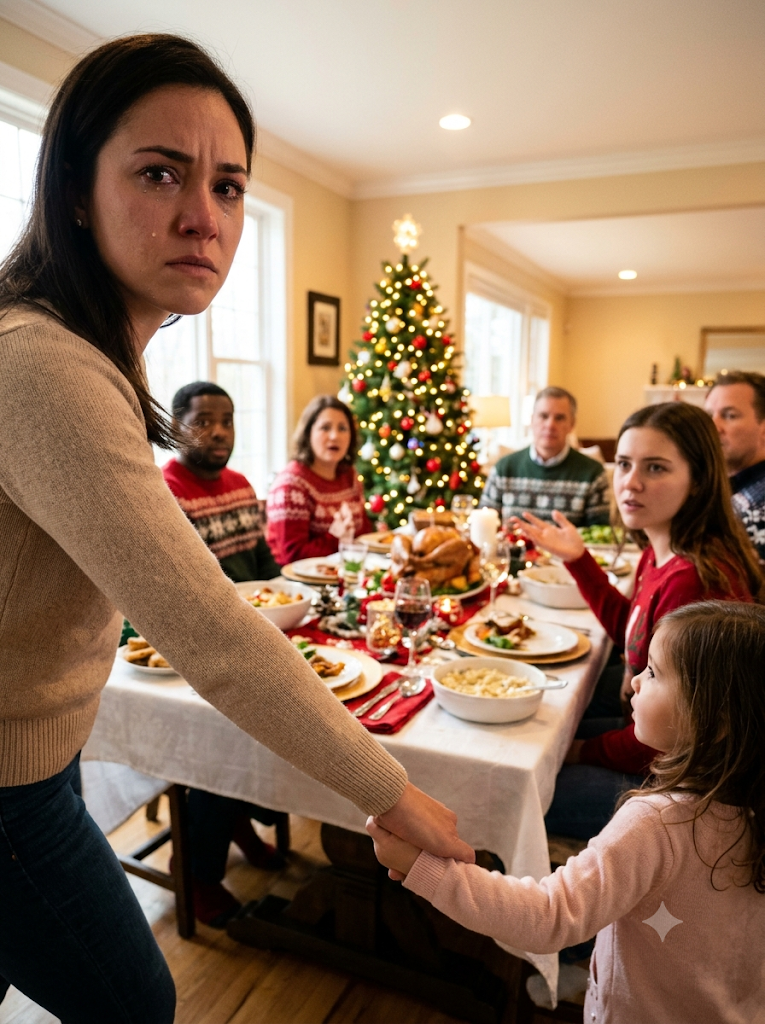
At Christmas dinner, my sister turned my eleven-year-old daughter into the family joke while my parents watched. I heard the excuse they’d used on me for decades: “It’s only teasing.” I took my daughter’s hand and left, but I didn’t cry until she whispered that maybe they were right. My sister had no idea what her cruelty would cost her, because the house where everyone laughed at my child belonged to me—and I was done paying for their approval.
Part 1
The first laugh came while my daughter held the cardboard robot she’d built for the science fair. At my sister Valerie’s Christmas Eve dinner, cinnamon candles burned and football murmured from the living room. Wren had spent six weeks teaching her robot to sort colored blocks. She placed it beside the gravy boat, hopeful enough to make me nervous.
“Look, it’s the family genius,” Valerie announced, giving her daughter Brielle a wink. Brielle, also eleven, leaned forward and said, “Does it know how to get a personality?” A few cousins laughed, and Wren’s fingers stalled on the power switch. I started to explain that the machine sorted every block correctly at school, but my mother, Helen, waved me quiet so Brielle could describe her cheerleading competition. Her cheers got applause before Wren found the robot’s power switch.
I should have intervened. Instead, I watched Wren carry the robot back to her chair, the way I’d once carried unwanted report cards. My brother Evan asked whether she planned to build herself some friends next. Dad chuckled, and Valerie said, “Don’t get offended, Leah; we’re teasing.”
Valerie proposed a game: name the person most likely to do something ridiculous. Brielle voted Wren “most likely to marry a calculator,” and Evan added “most likely to get invited to zero parties.” Wren tried to smile, her chin trembling. I looked around the table, waiting for someone to say enough.
My husband Jonah reached for Wren’s hand, but I got there first. “We’re leaving,” I said, pulling her coat from the back of her chair. Valerie rolled her eyes and told me not to ruin Christmas over harmless fun. I looked straight at my parents, who had heard every word, and neither of them stood.
Outside, wind scraped leaves across the driveway and sliced through my sweater. Jonah gathered our gifts while I buckled Wren in, the robot beside her. She stared at Valerie’s flashing porch lights as we pulled away. “I’m sorry I made it weird,” she whispered, and something in me changed shape.
I knew why she apologized. I’d been the daughter who liked circuit boards, the one whose glasses Evan hid before school pictures. Valerie was the charming favorite; I was told to “lighten up” whenever I cried. At thirty-nine, with a software career and a loving family, I still waited for my parents’ permission to matter.
Five years earlier, Valerie and her husband Scott couldn’t qualify for a mortgage. With overdue bills and a daughter who’d changed schools twice, they begged for help. I bought the house in my name and let them live there, asking only that they cover utilities. Six months became five years of payments from my account while Valerie criticized my easy desk job.
Jonah had urged me to put the arrangement in writing, but I’d refused. Driving past dark storefronts, I remembered Valerie bragging about her new kitchen island. I’d paid for the house where she humiliated my daughter. I’d mistaken being able to afford it for a reason to endure her contempt.
At home, Wren placed her robot on the hallway shelf and asked, “Do you think Brielle’s right? Maybe I’m annoying and that’s why nobody wants to hang out with me.” She said it gently, as if she were asking whether we’d run out of milk. Jonah crouched beside her, but I could barely get the words past my throat. “No, sweetheart,” I said, “and I’m sorry I let anyone make you wonder.”
When she finally slept, I opened the folder containing the house’s closing documents. My name appeared alone on the deed, and a familiar monthly debit glowed on my banking screen. Valerie had forgotten whose home she lived in; worse, I’d forgotten what it was costing my child. Tomorrow, I would find out what it would take to end both mistakes.
Part 2
On Christmas morning, Wren didn’t ask to open presents first. She asked whether she had to go to Grandma’s for New Year’s, and when I said no, she leaned against me as though she’d been holding her breath all night. Jonah heated cinnamon rolls, and the house filled with butter and sugar while I called a lawyer whose number I’d saved three years earlier. I left a message asking about ending an informal family housing arrangement, not about revenge.
By Friday, I was sitting across from attorney Carmen Ellis in a small office overlooking a snowy parking lot outside Columbus. She asked for the deed, payment records, and any texts discussing rent or duration. I expected her to say I could demand the keys immediately, but she explained that living somewhere for five years gave Valerie rights as an occupant even without a signed lease. We’d need proper notice, and if she refused to leave, a court—not my temper—would decide what happened next.
I told Carmen I’d give Valerie sixty days and follow whatever notice rules applied. “I don’t want my niece put out in the cold,” I said, tracing a scratch in the conference table. “I want my sister to stop treating my help like something she’s owed.” Carmen prepared a formal notice and warned me to keep every conversation in writing.
When Valerie called after receiving it, I heard cabinet doors slamming behind her. “You are kicking my family out because Brielle told one joke?” she shouted. I reminded her that four adults had spent dinner mocking Wren while she led the laughter. Valerie answered, “Your kid needs thicker skin,” and any remaining doubt I had disappeared.
Then she said something that made me sit upright. “Mom and Dad know this house is practically mine. I’ve been taking care of it for years.” She claimed she’d spent thousands improving it and deserved compensation. I asked her to send receipts to Carmen, and she hung up with a sharp click. Ten minutes later, my mother left a voicemail calling me vindictive and asking me to think about Brielle’s stability.
I did think about Brielle. I thought about how she’d copied Valerie’s cruel smile, and about how children learn what gets applause. But my own child had stopped speaking enthusiastically at the dinner table because she expected someone to laugh at her. I wasn’t going to teach Wren that protecting Brielle meant tolerating everything done to her.
That evening, Jonah sat beside me while I went through five years of statements. I’d paid the mortgage, taxes, insurance, and a plumbing repair after Valerie poured grease into the kitchen sink. She’d sent occasional payments labeled “utilities,” never rent, while telling our relatives she was the one maintaining the property. What hurt most wasn’t the money; it was how faithfully I’d participated in pretending she was generous for letting us visit.
The next day, my father called from his workshop, where an electric saw whined in the distance. “Your mother isn’t sleeping,” he said. “Can’t you be the bigger person?” I asked him why he’d laughed when Evan joked that Wren had no friends. The saw stopped, and he replied, “I wasn’t thinking,” which was the closest thing to an answer I’d ever received.
I told him we wouldn’t attend family gatherings again. He said I was breaking my mother’s heart and that I’d always been difficult to understand. For once, I didn’t defend my hobbies, my job, or my daughter. I thanked him for calling and ended the conversation.
On Monday, Carmen forwarded a message from a real estate broker asking me to confirm the ownership of the property. Valerie had requested an appraisal, claiming she was preparing to refinance the house to fund a renovation. She couldn’t refinance a deed she didn’t hold, but she’d been giving people the impression she did. I stared at her name beneath the request, realizing that my sister hadn’t merely forgotten my generosity—she’d started treating my property as hers to trade.
Part 3
I met Carmen the next morning with the broker’s email printed between my hands. She contacted the agency, established that Valerie had no authority to list or borrow against the property, and asked it to correct its records. There had been no loan, no forged deed, and no money taken; the danger was the story Valerie had been telling everyone. When Carmen advised me not to argue with her directly, I was almost grateful for a rule I could follow.
Valerie ignored that rule. She sent me photographs of the new kitchen island, paint receipts, and a long message claiming her improvements made the house hers in every meaningful way. “You never even lived here,” she wrote. I replied once through Carmen: any documented claims could be addressed through counsel, but the move-out deadline remained.
At school, Wren’s teacher emailed to say she’d withdrawn from the science fair’s regional round. I found her at the kitchen table turning a tiny plastic wheel between her fingers, with the unfinished robot beside her. “I don’t want everyone looking at me,” she said. I wanted to drive straight to Valerie’s and demand she hear what she’d done, but Wren needed a mother in that chair more than a confrontation at someone else’s door.
I asked her to show me how she’d programmed the color sensor. She demonstrated once, slowly, and then again with growing excitement when I deliberately mixed up the blocks. After an hour, she asked whether Jonah and I could be her audience for a practice run. It was a small request, but I heard trust returning to her voice.
Meanwhile, our family group chat became a courtroom where everyone had already chosen a side. Evan wrote that I was using money to punish relatives, and Mom posted a photo of Brielle crying beside a half-packed Christmas tree. A cousin privately messaged to ask why Valerie had told everyone she bought the house herself. That was the first time I understood how completely she’d rewritten the story of the past five years.
I forwarded the messages to Carmen, then muted the chat. Jonah took me for a walk around the neighborhood after dinner, our shoes making shallow tracks through the old snow. “You’ve spent your whole life trying to present evidence to people who don’t want to listen,” he said. “You don’t need a verdict from them.” I watched yellow kitchen windows slide past and realized I felt lighter each time I stopped explaining.
The deadline approached, and Valerie still hadn’t confirmed a moving date. Carmen explained the lawful next steps if she stayed, and I instructed her to prepare them without threats or shortcuts. I’d begun interviewing real estate agents, but I wouldn’t arrange showings until the occupants had left or agreed to them. Selling wasn’t about humiliating Valerie; it was about ending a financial connection she’d used to keep me obedient.
On the fifty-third day, a message arrived from Scott, Valerie’s husband. He’d rented a place on the other side of town and booked a truck for Saturday. “I’m sorry for Christmas,” he wrote, adding that he’d heard the insults and stayed quiet to avoid another argument with Valerie. His admission wasn’t absolution, but it meant one adult had finally described the night without calling Wren sensitive.
Saturday’s sky was the color of dishwater. I parked across from the house while Scott loaded boxes into a rented truck, and the scent of wet cardboard drifted from the open garage. My parents stood on the porch directing traffic as if this were a disaster someone else had caused. Valerie spotted me, climbed down the steps, and marched across the driveway.
“You were always jealous of me,” she said, loud enough for the neighbors to hear. “You bought a house because you couldn’t buy a place in this family.” Before I could answer, Mom came to her side and said, “You should have known money wouldn’t make you one of us.” It was the first time she’d admitted aloud what I’d spent my whole childhood suspecting—and it didn’t hurt in the way I’d expected.
Part 4
I looked at Mom beneath the porch light. “You’re right about one thing,” I said. “Money couldn’t buy me a place here.” I asked Scott to leave the keys with Carmen when the truck was packed; I wasn’t auditioning for affection again.
Dad followed me to the sidewalk with a cardboard box. He said Mom hadn’t meant it; families said careless things when upset. I reminded him that Wren had heard those things for years. “You could have stopped it,” I said. “You chose silence.”
I drove home with steady hands. Jonah had left coffee by the door, and Wren was building a paper bridge across library books. I told her Valerie’s family was moving out. “Is Grandma mad?” she asked, and I answered, “Yes, but we haven’t done anything wrong.”
The keys reached Carmen on Monday. Inside, nail holes outlined old portraits and a pale square marked where the television hung. The kitchen island was new, but the faucet leaked and a window wouldn’t latch. I documented everything, arranged repairs, and hired an agent.
Valerie sent three messages: she deserved compensation, I embarrassed our parents, and finally, “Can’t you forgive one bad night?” I saved them and let Carmen handle any legitimate claim. I had spent too many years explaining why cruelty hurt.
In spring, the house sold to a couple with a toddler and sleepy golden retriever. The woman told me she loved its bright front room. I remembered Wren gripping her robot while adults laughed. Signing felt like setting down a weight I’d carried too long.
My parents stopped calling, though relatives sent updates. Valerie and Scott took a smaller rental; she found full-time work at a dental office. Mom and Dad helped until money caused arguments there, too. I didn’t celebrate; their problems were no longer mine.
Wren, meanwhile, entered the regional science fair after her teacher agreed to give her a fresh demonstration slot. Her sorting robot developed a stubborn habit of sending yellow blocks into the blue bin, and she spent two Saturdays troubleshooting with Jonah. On presentation day, her voice shook during the introduction, but she explained the sensor error and how she’d fixed it. She didn’t win first prize; she came home grinning because two students asked if she wanted to join their robotics club.
That summer, Mom sent Wren a birthday card with twenty dollars tucked inside. Across the bottom she’d written, “Tell your mother families forgive,” using my child as a messenger for an argument I refused to have. I showed Wren the note and told her that responding was her choice, not an obligation. She handed it back and asked if our friend April could come over instead.
A year after that Christmas, we hosted dinner for a handful of friends instead of driving to Valerie’s. Jonah made too much mashed potato, and Wren showed her newest project to everyone before the pie came out. Nobody interrupted her. When a circuit failed, our friend April handed her a screwdriver and asked what she wanted to try next.
Later, as we washed dishes, Wren told me a girl at school had called her weird. “I told her she didn’t have to like my projects, but she couldn’t be mean to me,” she said, placing a plate on the drying rack. Then she added that she’d gone to sit with friends who actually enjoyed hearing about them. I kissed the top of her head and felt an old family story finally ending.
Valerie’s last card arrived that December, addressed to “My stubborn sister,” with a note that everyone missed us. I put it in the recycling without bringing it to the table. Forgiveness wasn’t a bill I owed because we shared parents, and reconciliation wasn’t a reward for apologies that never acknowledged the harm. We lit the candles, called Wren in for dinner, and let the people who loved her have the seats around us.
Legal Notice: This story is a work of fiction. Names, characters, businesses, events, and incidents are the product of the author’s imagination or are used fictitiously. Any resemblance to actual persons—living or dead—or to actual events is purely coincidental. Thank you! 💓