My Sister Finished Every Exam One Second Before Me—Until I Discovered the Secret Behind Her Perfect Scores
My younger sister beat me on twenty consecutive exams, always submitting her paper exactly one second before mine, and somehow our answers were identical down to the smallest mistakes. My teachers called me a cheater, my classmates humiliated me, and my parents threatened to take away my college future. Then, during the most important scholarship examination of our lives, I discovered something impossible about how she had been stealing my success. Instead of confronting her, I decided to give her exactly what she wanted—and watch her perfect world collapse.
Part 1: Twenty Exams, One Impossible Pattern
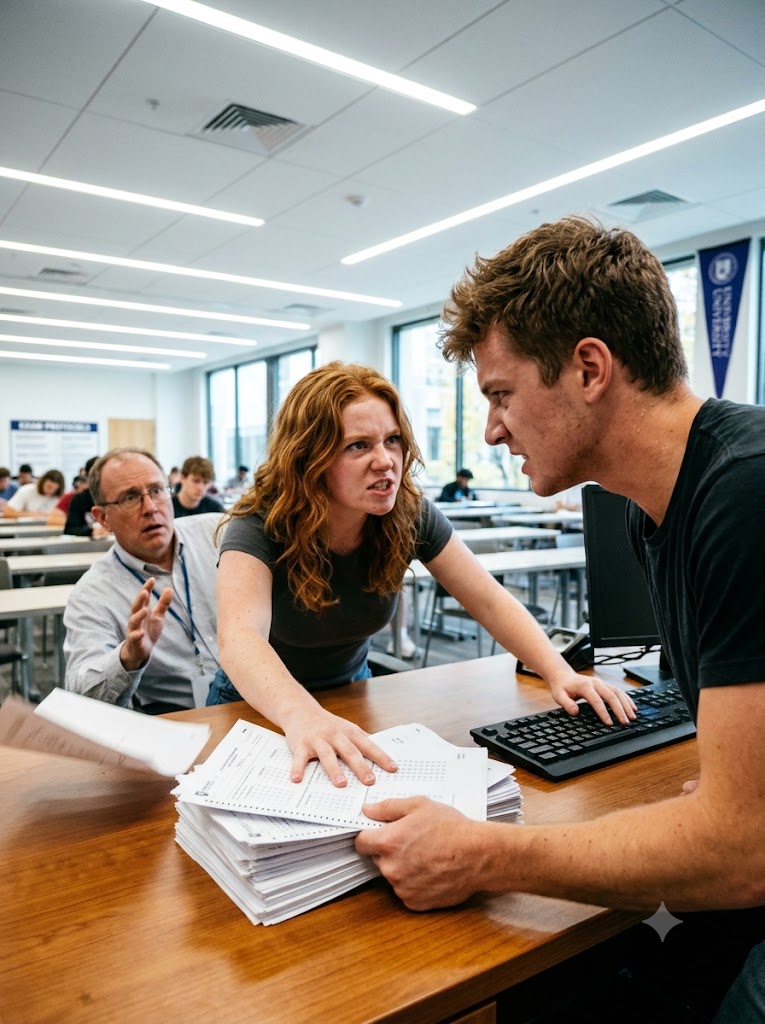
“Elise, explain why your sister finished exactly one second before you again.” Mr. Callahan dropped two exam papers onto his desk, their red markings almost perfectly identical, and stared at me as if I were a criminal being questioned. My younger sister, Tessa Ward, sat beside our parents wearing the innocent expression she’d perfected over the past year, while my father’s fingers drummed impatiently against his coffee cup. “Twenty exams, Elise,” my teacher continued, tapping the papers. “Twenty identical answer sheets, including the same unusual mistakes, and you’re still telling us you haven’t been copying?”
I had been the highest-ranking student at Crestwood High until Tessa transferred into my advanced classes the previous September. She was eleven months younger, had skipped a grade in middle school, and had always resented the attention I received for winning mathematics competitions and earning academic awards. Before her transfer, my teachers regularly encouraged me to apply to highly selective universities, and my bedroom wall was covered with certificates I’d earned through years of work. Then Tessa started finishing every exam just before me, receiving identical scores, and somehow making everyone believe that my achievements had always belonged to her.
“I have my scratch work,” I insisted, sliding a thick notebook across the desk toward Mr. Callahan. “Every calculation is there, including the mistakes, so why won’t you compare it with hers?” He glanced at the pages but explained that Tessa always submitted first, making her the more credible student in his opinion. Dad immediately agreed, while Mom stroked Tessa’s shoulder and said I needed to stop competing with my sister. When we left that meeting, the school had issued another academic integrity warning against me, and Tessa had received a recommendation for a prestigious scholarship competition.
The strangest part wasn’t that our correct answers matched, but that Tessa repeated mistakes nobody else would reasonably make. On one physics exam, I’d accidentally used a conversion factor from an old summer program, and she had written the same obscure value despite never attending that program. On another test, I’d crossed out a calculation, changed my mind, and made an arithmetic error that she reproduced exactly. Whenever I asked how she arrived at those answers, she smiled and said, “Great minds think alike, Ellie,” before walking away.
By March, students had started calling me “Copycat Ward,” and someone taped a photocopy of my academic warning to my locker. I found it after chemistry class, its corners curling beneath the fluorescent hallway lights, while two girls nearby laughed about how quickly I’d fallen from the top of our class. That evening, Dad brought Tessa a bouquet of yellow tulips to celebrate her scholarship nomination and announced that she would probably attend an Ivy League university. When I mentioned my own applications, he barely looked up from his dinner and said, “Maybe you should consider somewhere realistic.”
I stopped trying to convince them, but I never stopped collecting evidence. Every marked practice paper went into a locked storage box, alongside dated photographs of my scratch work, test schedules, and correspondence with teachers about the accusations. I noticed something else after reviewing the submission records: Tessa’s papers were consistently recorded one second before mine, regardless of whether I finished early or used the entire examination period. There was no reasonable way she could predict my timing so precisely, and the realization bothered me far more than another unfair grade.
The final examination for the prestigious Hawthorne Scholars Foundation was scheduled across two days in late spring, with the highest-ranked students competing for substantial college scholarships. Tessa had already announced that winning would secure her place among the country’s academic elite, although the competition was separate from university admissions. Before entering the examination room, she brushed past me and whispered, “Try not to embarrass yourself when there’s nobody left to copy.” I ignored her, found my assigned desk, and opened the first mathematics booklet when the proctor gave the signal.
As the paper unfolded beneath my fingers, something bright flickered in the air above my desk, like subtitles appearing across an invisible television screen. I blinked, rubbed my eyes, and watched translucent sentences drift through empty space while everyone around me continued writing. One message made my stomach tighten: “Our heroine Tessa is going to win again, because the useless older sister has no idea where her answers are coming from.” Then another appeared, and every assumption I’d made about the past year suddenly seemed dangerously incomplete.
Part 2: The Answers She Was Never Supposed to Hear
I stared at the floating sentences, wondering whether exhaustion had finally caught up with me, until another message appeared directly above Tessa’s desk. “Imagine being the chosen heroine and getting to read the supporting character’s mind whenever you need an answer.” My fingers tightened around my pencil as I slowly looked toward my sister, who was sitting three desks ahead with her head lowered. For the first time, the identical mistakes, impossible submission times, and sudden change in our academic rankings formed one terrifying explanation: Tessa hadn’t been looking at my paper because she’d been listening to my thoughts.
I decided to test the impossible theory before doing anything else, so I stared at question one and began mentally singing the alphabet instead of calculating. “A, B, C, D, E, F,” I repeated silently, adding the tune from an old children’s song, and Tessa’s pencil abruptly stopped moving. She turned slightly toward me, frowned, and pressed her fingers against her temple as though she’d heard an irritating noise. When I switched to mentally reciting random grocery items, she twisted around farther, earning a sharp warning from the proctor to keep her eyes on her own desk.
A strange excitement pushed aside my fear, because I finally understood how she’d been stealing my work and how I might stop her. Question three required a relatively simple algebraic substitution, and I could immediately see that the correct option was B. Instead of concentrating on B, I deliberately thought, “Careful, Elise, you made this mistake last time, and the correct answer is definitely D,” repeating the false conclusion while writing a temporary calculation in the margin. Tessa’s pencil started moving again, and when I quietly repeated another wrong answer in my head, she filled another bubble without showing any calculations.
I continued through the mathematics section, creating plausible mistakes in my thoughts and recording some of them as crossed-out drafts on the permitted scratch pages. The messages floating above us grew increasingly enthusiastic, praising Tessa’s remarkable speed while making cruel jokes about my apparently empty answer sheet. Fifty minutes into the ninety-minute session, she capped her pencil, gathered her papers, and confidently walked toward the proctor’s desk. She deliberately passed close enough to see my unfinished booklet, gave me a triumphant little smile, and disappeared through the door.
As soon as she left, I felt something release inside my chest, and I finally allowed myself to think through the real solutions. I worked quickly but carefully, replacing the false calculations with accurate ones and writing complete explanations for every extended-response problem. The proctor collected my booklet and scratch pages together, just as the examination rules required, leaving a clear record of how my answers had been developed. When I finished with several minutes remaining, I realized Tessa had just submitted an entire examination built from mistakes I’d invented specifically for her.
Outside the room, she was standing with several classmates, announcing that the mathematics paper had been embarrassingly easy. She caught my eye and mouthed, “That scholarship is mine,” while floating messages congratulated their chosen heroine on another effortless victory. I walked toward the exit without responding, but Tessa hurried after me and caught my sleeve near the glass doors. “You look awfully pleased with yourself,” she whispered, narrowing her eyes. “Don’t forget that everybody already knows which one of us is the cheater.”
Our parents were waiting outside, and Tessa suddenly transformed from smug victor into a trembling, injured daughter. She claimed I’d deliberately knocked over her breakfast drink that morning, leaving her too hungry to concentrate during the examination. Dad turned toward me with an expression of immediate disgust, while Mom said that if Tessa’s score suffered, I could forget about receiving financial support for college. I remembered watching Tessa spill that drink herself beside the kitchen sink, but before I could explain, Dad announced they were taking her out for lunch and told me to find my own way home.
I bought a sandwich at a nearby deli and returned for the afternoon reasoning section, where Tessa was already waiting beside my desk. “You can spend your life resenting me,” she whispered, “but I’m going to have the future you wanted.” I looked at her carefully, wondering how much she could hear when I deliberately kept my mind occupied with meaningless sounds, and noticed that her confident expression began to falter. When the afternoon examination started, I fed her another carefully constructed sequence of wrong solutions, but this time I noticed something new.
A translucent message appeared above her shoulder, different from all the others: “Why is the heroine getting so frustrated? The side character isn’t thinking normally anymore.” Tessa stopped writing and slowly turned toward me, her expression suddenly sharp with suspicion. For one frightening second, I wondered whether she’d realized I knew her secret. Then she smiled, picked up her pencil, and started copying my thoughts again.
Part 3: The Day Her Perfect Future Began Falling Apart
For the remainder of the examination, I followed the same strategy, allowing Tessa to finish early while I completed the real solutions afterward. The next day brought science, reading, and analytical writing sections, and I was careful to leave a clear record of my work for every problem. Tessa continued filling her answers with astonishing speed, occasionally glancing toward me as if confirming that the stream of information hadn’t stopped. By the final session, I was exhausted from maintaining two separate sets of calculations in my head, but I knew the danger would be worth it if the official results confirmed my theory.
When the last examination ended, Tessa ran straight into our father’s arms outside the testing center. She announced that she’d estimated a score above 730 out of 750, high enough to make her a serious contender for the foundation’s largest award. Dad hugged her while Mom promised a celebration dinner, and neither of them asked how I’d performed. As I passed, Tessa loudly accused me of trying to distract her during the examination, and Mom warned me against causing more trouble. I said nothing, because the only person who could expose Tessa now was Tessa herself.
At home, I went upstairs expecting a few hours of peace, but my bedroom door was standing open. Torn certificates covered the carpet, my competition ribbons lay tangled beneath the desk, and the study guides I’d prepared over several years had been ripped apart. Tessa leaned against the doorway chewing gum, wearing a satisfied little smile as she watched me take in the damage. “I figured you wouldn’t need those anymore,” she said, kicking a torn mathematics certificate aside. “You won’t be getting into a good university, so consider this my way of helping you clean up.”
My hands shook as I picked up the ruined papers, especially a national mathematics award I’d earned before Tessa joined my class. Then I remembered that the important evidence wasn’t hanging on my wall: everything had already been photographed and saved in two secure digital backups, while the original examination records remained locked away. I looked at Tessa and asked whether she genuinely believed destroying certificates could erase the years I’d spent earning them. Her smile vanished briefly, and she snapped, “You always think you’re better than me,” before storming downstairs.
That evening, Mr. Callahan called to congratulate Tessa on her estimated score and promise a strong college recommendation. I heard his voice through Mom’s speakerphone as he described my sister as Crestwood’s most promising student, and Dad immediately began discussing which universities should be honored to accept her. In my room, I opened the unofficial answer key and calculated my own likely score using the strictest possible marking standards. My estimate was above 730, but unlike Tessa, I’d derived every answer myself and knew exactly where I might have lost points.
Over the following week, I organized my records into a chronological file, including twenty practice examinations, the accompanying scratch work, and the warnings issued against me. I marked examples where Tessa’s answers repeated personal errors that appeared in my calculations, even when those errors contradicted the methods she normally used. I also prepared a formal request asking the school to preserve both students’ examination materials and investigate the accusations before sending any further recommendations. When I finished, the folder contained enough evidence to challenge everything Mr. Callahan had claimed about me.
The official results arrived on a bright Friday morning, and Dad summoned me downstairs as though I were being called to witness Tessa’s coronation. Mom had already reserved a table at an expensive restaurant, while Tessa sat on the couch texting friends about her expected scholarship award. She opened the score portal, entered her examination number, and smiled at me before clicking the results button. Three seconds later, her smile disappeared, and she stared at the screen with a look of absolute disbelief.
“That’s impossible,” she whispered, refreshing the page so violently that her finger struck the keyboard twice. Dad leaned over her shoulder, and Mom hurried across the living room, abandoning the coffee she’d been pouring. The number on the screen was 184 out of 750, a result far below anything Tessa had ever received before. She slowly turned toward me, and I saw something in her expression that frightened me more than her usual cruelty: she wasn’t confused about why she’d failed, but terrified that I might know exactly what she’d done.
Part 4: The Score That Exposed Her Lies
“One hundred eighty-four?” Dad repeated, staring at the screen as though saying the number aloud might somehow change it. Tessa insisted there had been a technical error, while Mom immediately started searching for the foundation’s telephone number. The floating comments above the couch were suddenly chaotic, with viewers arguing over whether their chosen heroine had been sabotaged or had simply failed without help. Then Tessa pointed at me and shouted, “She did something to my answers! She’s been jealous of me for years, and now she’s trying to destroy my future!”
I stepped closer to the laptop and suggested checking my score to see whether the system was functioning correctly. Dad reluctantly moved aside, and I entered my examination number while Tessa stood behind him with both hands clenched. The result appeared almost instantly: 743 out of 750, ranked first among all candidates in our state. Mom covered her mouth, Dad stared without blinking, and Tessa whispered, “No,” so quietly that I almost didn’t hear her. For the first time in a year, the entire family had nothing to say about my academic ability.
The silence lasted until Dad accused me of somehow interfering with the examination system. I explained that the foundation administered its own secure portal and that I couldn’t alter another candidate’s score simply because I disliked her. Tessa demanded an investigation, insisting I’d stolen examination materials in advance, and Mom supported her before asking a single question about my result. I agreed immediately, then placed my prepared evidence folder on the coffee table and said, “That’s exactly what I’ve been requesting for months.”
The following Monday, we met with Mr. Callahan, Assistant Principal Marisol Vega, and Dr. Helena Monroe, an academic integrity representative from the scholarship foundation. Dr. Monroe explained that my unusually high result had already undergone routine verification and that there was no indication of unauthorized assistance. Tessa’s low score wasn’t itself evidence of cheating, but the formal complaints from both sisters had prompted a broader review of their academic records. She asked us to explain why twenty school examinations had produced identical answers despite the students being seated several desks apart.
I opened my folder and presented dated copies of my scratch work, beginning with a physics problem where Tessa had repeated my unusual conversion error. Mr. Callahan examined the matching answers and admitted that he’d never compared the underlying calculations in detail, even after issuing my academic warnings. Assistant Principal Vega retrieved the school’s archived examination materials, revealing that Tessa had frequently submitted almost blank scratch pages while I had shown complete mathematical solutions. One case after another exposed the same pattern: my reasoning appeared on my paper, while Tessa reproduced my conclusions without showing how she’d reached them.
Dr. Monroe then showed us examples from the recent scholarship examination that made the situation even harder to explain. Tessa’s incorrect answers repeatedly matched preliminary calculations I’d written and crossed out before submitting my final solutions. The foundation hadn’t determined how she’d obtained those answers, but the pattern raised serious concerns about the independence of her work. When Dr. Monroe offered Tessa a supervised assessment in a separate room to help resolve those concerns, my sister refused and shouted that she shouldn’t have to prove anything.
“She tricked me!” Tessa screamed, pointing across the conference table as her carefully maintained composure finally collapsed. “She kept putting wrong answers in her head, making me think they were right, and then she changed them after I finished!” Mr. Callahan frowned and asked how she could possibly know what had been happening inside my mind during an examination. Tessa froze, realizing what she’d admitted, then claimed I’d whispered answers to her, although examination staff confirmed that no such communication had been observed.
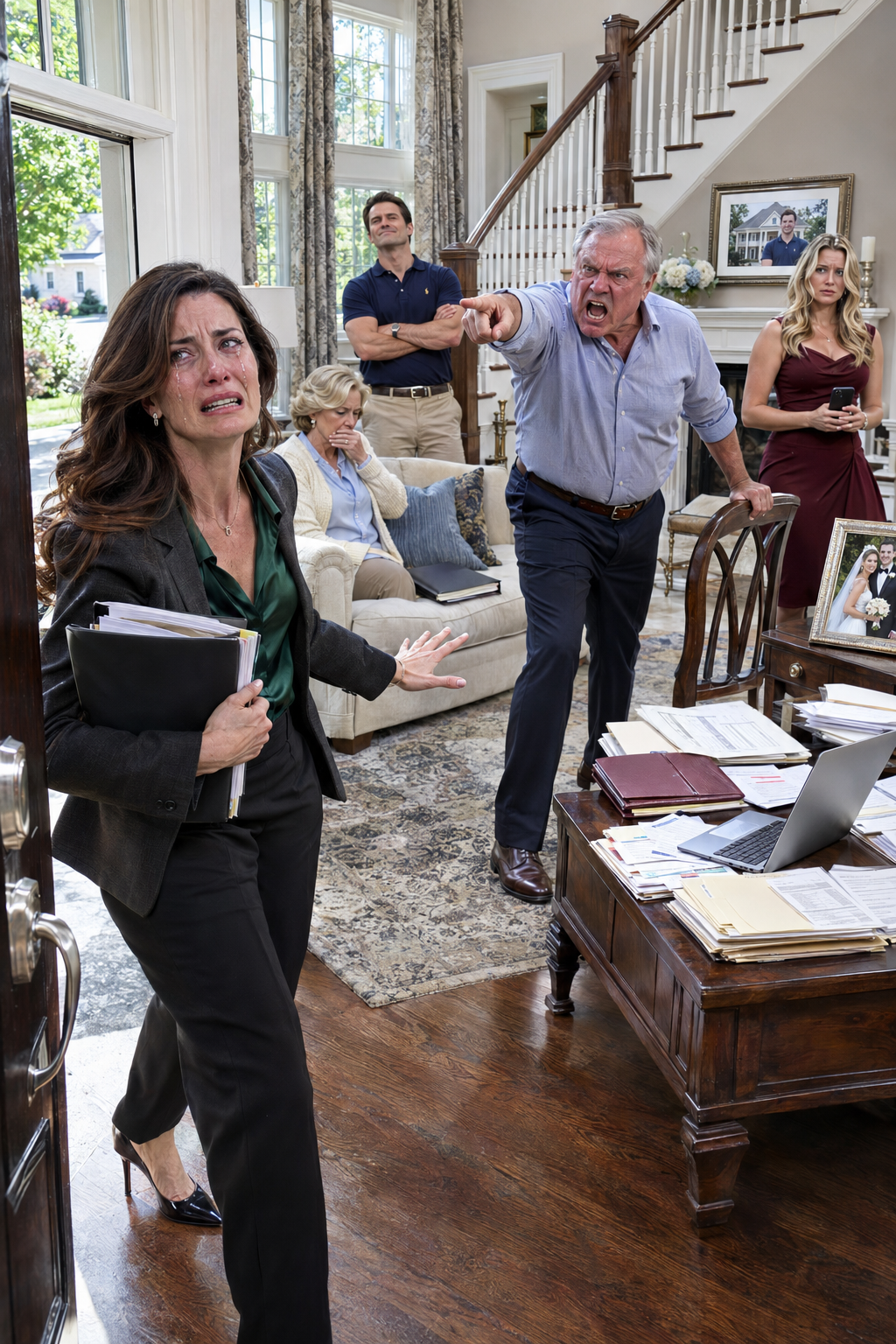
I said nothing about the floating messages or the strange ability I’d discovered, because I knew the available evidence could establish my honesty without requiring anyone to believe an impossible explanation. Assistant Principal Vega agreed to review my previous warnings for removal, while Dr. Monroe explained that Tessa’s scholarship eligibility would remain under investigation. Dad stared at the documents as though the familiar story he’d believed for a year was crumbling in front of him, but Mom reached for Tessa’s hand instead of mine. When we left the meeting, she pulled me aside and whispered, “If your sister loses her future because of this, I expect you to fix it, even if that means giving up your scholarship.”
Part 5: The Future She Couldn’t Steal
I looked at Mom, waiting for her to laugh or explain that she’d been speaking out of fear, but her expression remained completely serious. “You want me to give Tessa a scholarship I earned because she couldn’t pass the examination herself?” I asked, and she answered that family members were supposed to support one another. I reminded her that she’d threatened to make me abandon college if Tessa performed badly, yet she’d never once considered supporting me when everyone believed I was struggling. “I spent a year being punished for something I didn’t do,” I said. “I’m not sacrificing another day of my future to protect the person responsible.”
Two weeks later, the foundation completed its review after examining the examination records, consulting the school, and offering Tessa another opportunity to demonstrate her academic ability independently. She refused the additional assessment, and the foundation determined that the accumulated evidence of copied work was sufficient to disqualify her from its scholarship competition. Her original score of 184 remained unchanged, but she could no longer claim eligibility for the award. Mr. Callahan and Assistant Principal Vega also reviewed my previous academic warnings, formally removed them, and sent corrected records to the universities receiving my applications.
Mr. Callahan apologized privately after our last history class, looking more exhausted than I’d ever seen him. He admitted that he’d allowed Tessa’s reputation and her early submission times to outweigh the physical evidence I’d repeatedly offered him. “I should have examined your work instead of assuming I understood what was happening,” he said, and I believed he regretted his decisions. But I wasn’t interested in reassuring him or pretending the previous year had been a misunderstanding. “I hope you listen to the next student who asks for help,” I answered, then walked out of his classroom for the final time.
By graduation, I’d received an offer from my first-choice university, whose engineering program I’d admired for years, along with substantial financial aid. The Hawthorne Foundation also awarded me a scholarship that would help cover my remaining educational expenses, making it possible to attend without depending on my parents. When Dad heard the news, he suddenly suggested taking me to the expensive restaurant he’d reserved for Tessa’s celebration. I reminded him that he’d spent months calling me a failure and had never defended me when our family treated me like an embarrassment. He lowered his eyes and said, “We didn’t understand what was happening,” but I answered, “You never tried.”
I turned eighteen that summer and arranged to stay with my aunt until I could move into my university residence hall. Mom cried when I packed my clothes, saying that families shouldn’t fall apart over examinations, but I told her the examinations had only exposed problems that already existed. Tessa had destroyed my belongings, damaged my reputation, and stolen my work, while our parents repeatedly chose to believe her without evidence. I wasn’t going to spend my adulthood proving that I deserved the same love and respect they’d given her without question.
On the morning I left, Tessa was sitting alone on the living-room couch, staring at her silent phone. “How did you know?” she whispered as I carried my suitcase toward the front door. I stopped and looked at her, remembering the twenty identical examinations and the floating comments that had once celebrated every victory she stole. “You could hear my answers,” I said quietly, “but you never understood how I arrived at them.” Her face went pale, and I added, “You spent a year copying my thoughts instead of learning to think for yourself.”
For the first time, Tessa had no clever response, no tears prepared for our parents, and no perfect score to hide behind. The translucent comments appeared one final time, but they were no longer celebrating their chosen heroine; instead, they questioned whether I’d ever been the supporting character they imagined. I watched the glowing sentences fade into the morning sunlight until there was nothing left between me and the open doorway. Then I picked up my suitcase and walked outside, where my aunt was waiting beside her car.
Months later, I sat in a university library surrounded by textbooks, students, and the quiet sounds of a future I’d built for myself. My parents occasionally sent messages asking when I would visit, and Tessa had tried apologizing, but I kept my distance because their regret couldn’t restore the trust they’d destroyed. I no longer needed to defeat my sister, win my parents’ approval, or convince strangers that my achievements belonged to me. Tessa had stolen my answers for a year, but she had never possessed the knowledge behind them, and the life waiting ahead of me was something she could never copy.
Legal Notice: This story is a work of fiction. Names, characters, businesses, events, and incidents are the product of the author’s imagination or are used fictitiously. Any resemblance to actual persons—living or dead—or to actual events is purely coincidental. Thank you! 💓