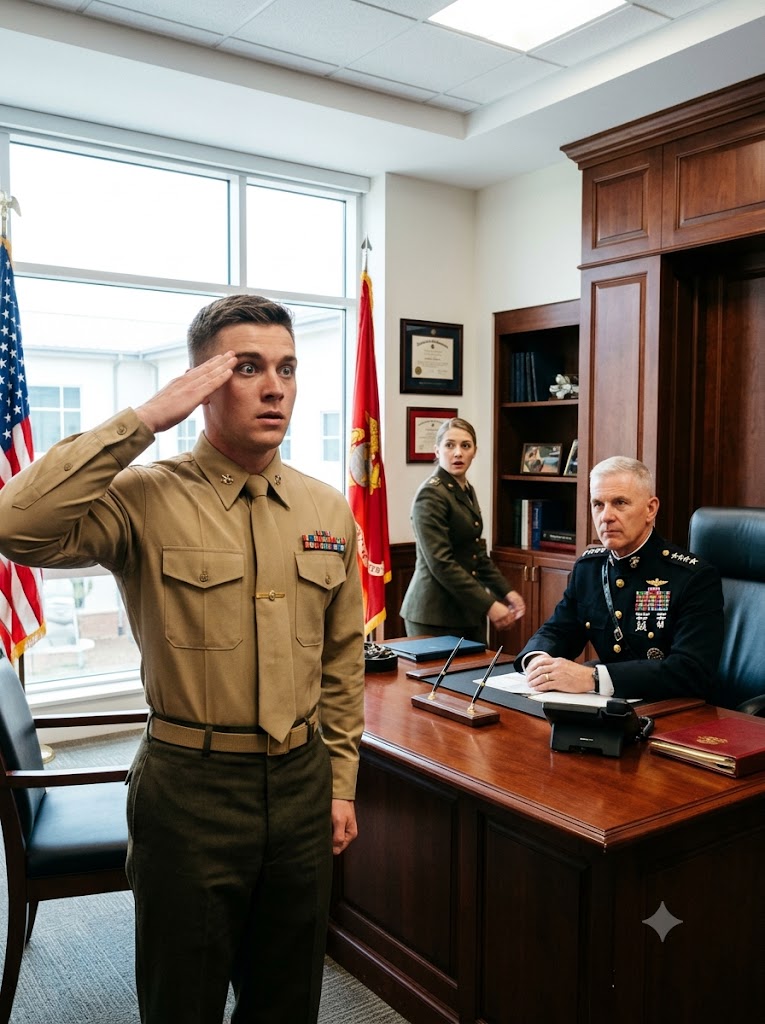
I Paid an Old Veteran’s Dinner—Then My Commanding Officer Summoned Me
The night I paid for an elderly stranger’s dinner, I thought I was helping him avoid a little embarrassment. I was a Marine corporal with a worn-out car, rent due Friday, and no reason to expect anything back. Two weeks later, I walked into my commanding officer’s office and found that stranger wearing four stars. A thick folder with my name on it lay between them. I thought I was in trouble, but the real shock was what they knew about a night I had spent months trying to forget.
Part 1
The rain made the neon DINER sign look like it was bleeding red across my windshield. I’d spent eleven hours checking supply reports at a Marine Corps logistics unit near Norfolk, Virginia, and my refrigerator held half a lemon and an expired carton of milk. So I pulled into Gracie’s, a narrow roadside diner with sticky booths, cracked red vinyl, and coffee strong enough to strip paint. I wanted meatloaf, twenty minutes of silence, and nothing else from the world.
I was halfway through dinner when the cashier tried a gray-haired man’s card for the second time. The machine chirped, she lowered her voice, and he opened a worn leather wallet with three bills tucked inside. He wore a faded Marine veteran cap and a windbreaker damp at the shoulders, and the way he stood perfectly still bothered me more than a scene would have. The cashier said, “I’m sorry, sir,” while a couple behind him pretended very hard to study the pie display.
I knew that feeling too well. My mother used to count grocery money in a checkout line while I stared at the gum rack, hoping nobody noticed. I got up, handed the cashier my card, and said, “Put his dinner on mine.” The man turned toward me and asked, “Why would you do that?” and I answered, “Because your card isn’t working tonight and mine is.”
He considered me with pale, steady eyes, then shook my hand as though we were agreeing on something important. “Are you a Marine?” he asked, although I was in jeans and a raincoat, and I told him I was Corporal Leah Benton. He repeated my name, not loudly, just carefully, and thanked me without another question. I paid my bill, stepped into the wet parking lot, and forgot the encounter by the time my windshield cleared.
Fourteen days later, Staff Sergeant Dwyer appeared at my desk with his face arranged in a way I couldn’t read. “The lieutenant colonel wants you in her office,” he said, and when I asked whether I should bring anything, he replied, “Just yourself, Benton.” I spent the walk examining every mistake I’d made that month: one mislabeled pallet, an inventory discrepancy I’d reported, and a training memo I’d challenged because the vehicle data didn’t match. I was still mentally rehearsing an apology when I knocked.
“Enter,” Lieutenant Colonel Miriam Prescott said. I stepped inside, saw the visitor seated across from her, and lost the next second of my life to pure disbelief. Gone were the wet windbreaker and faded cap; the man wore an immaculate Marine Corps uniform, and four silver stars gleamed on each shoulder. I snapped to attention so abruptly that my boot heel caught the rug, and he said, “At ease, Corporal Benton,” with the same quiet voice he’d used at the diner.
Prescott introduced him as General Everett Sloane, visiting the installation for a senior leadership event. My cheeks burned as I remembered offering him leftover pie after paying his check; he seemed to remember it too, because the corner of his mouth moved. “You didn’t know who I was,” he said, and I replied, “No, sir. I thought you were a veteran having a difficult evening.” He asked whether I’d have helped if he were a civilian, and I said yes, because I genuinely couldn’t imagine a different answer.
Then he opened the folder in front of him. I recognized my fitness scores, evaluations, and technical qualifications, but beneath them sat photographs from an emergency response exercise last winter. One showed a dark warehouse entrance, a stalled ambulance, and me pointing away from a flooded electrical room. I hadn’t seen that photograph before, and I hadn’t wanted to see that building again. General Sloane tapped the picture and said, “Your kindness got my attention, Corporal. But this incident is why your commanding officer asked you here.”
Part 2
Eight months earlier, a winter storm had knocked out power to a storage facility beside our installation. A jammed security door trapped four civilian employees and two Marines inside, and our duty section responded while local firefighters were still approaching. Water had collected beside an electrical service room, the backup generator was down, and one contractor had begun struggling to breathe. I remembered the smell of wet cardboard, the brittle snap of radio static, and the sickening thought that we’d arrived too late to help.
My supervisor injured his ankle investigating a secondary entrance, leaving the rest of us to coordinate with emergency crews. Two Marines wanted to force the electrical-room door because its control panel connected to the locked section, but I could see water under the threshold and couldn’t confirm that the power was isolated. “Nobody goes through there,” I told them, although both outranked me. One argued about losing time, and I pointed toward the maintenance corridor I’d spotted on a floor plan instead.
The firefighters took over the rescue and brought everyone out safely. My incident report credited the responders, the corpsman, the Marines who found the corridor, and my supervisor for remaining on the radio despite his injury. I mentioned myself in three sentences because I hadn’t been the one who opened the door or carried anyone outside. I thought the matter was finished until General Sloane slid a witness statement across Prescott’s desk.
“You stopped an unsafe entry when people were urging you to rush,” he said. “Why didn’t you include that judgment in your report?” I explained that I hadn’t commanded anybody and had only raised a concern, but Prescott interrupted gently: “You made a recommendation, defended it, and gave the responders another option.” My face went hot again, this time for a different reason. Being praised in that office felt more uncomfortable than being corrected.
The general turned to another page. On a field exercise, I’d requested an additional brake inspection for a convoy vehicle whose maintenance record didn’t match its condition, delaying departure long enough to make Sergeant Victor Kessler furious. Mechanics eventually found a serious fault, and the vehicle stayed behind. Another note mentioned Private First Class Rachel Ames, who’d nearly left the service during a family emergency; all I’d done was sit with her while she contacted the right support office and made a plan.
I couldn’t understand why those moments belonged in a folder alongside my fitness score. General Sloane explained that a competitive leadership-development pilot was accepting nominations from enlisted Marines who showed judgment under pressure, and that Prescott’s staff had already been reviewing my record before the diner encounter. “I asked to meet you,” he said, “but I didn’t create your recommendation. Buying my dinner won’t help you pass a board.” His words relieved me and frightened me at once, because they left me nowhere to hide behind luck.
Prescott handed me the nomination packet. It offered a chance to compete for advanced training and supervised planning assignments, not an automatic promotion, and the prerequisites would take months of preparation. “You’re capable,” she said. “You also have a habit of shrinking every time somebody notices your work.” I remembered my father leaving when I was twelve, my mother taking double shifts, and the rule I’d made for myself: ask for nothing that someone could later hold over you.
I admitted that wanting a bigger role felt selfish. Sloane listened, then asked, “If another Marine could protect people by becoming a better leader, would you tell her not to try?” I said no before I could stop myself. He gave a short nod, but Prescott’s expression grew serious as she slid over the last page. “One more thing, Benton. Your nomination has a recommendation from someone you probably think doesn’t believe in you.”
I looked down at the signature and felt my stomach drop. It belonged to Sergeant Victor Kessler, the man who’d spent months making sure I never forgot I was just a corporal.
Part 3
Kessler had supervised the convoy exercise, and I still remembered his voice cutting across the motor pool: “Benton, we are not canceling a movement because you have a feeling.” I’d shown him the mismatched inspection entries while diesel exhaust hung over the vehicles, and he’d ordered the mechanic to check the brakes only after I insisted through the proper safety channel. The fault turned out to be real. Afterward, Kessler barely spoke to me except to assign work, so seeing his signature beneath the words “strong long-term potential” made no sense.
“He recommended me?” I asked. Prescott nodded but reminded me that a recommendation could include areas for improvement, and I saw a sentence about needing more confidence when speaking to senior personnel. Sloane said, “You can respect rank without treating your judgment as worthless,” then rose because his next meeting was due. He shook my hand and left me with one instruction: “Compete on your own record. Don’t do it for me.”
By lunchtime, news of the nomination had moved through the maintenance bay faster than a bad-weather warning. Kessler caught sight of my packet and said, loud enough for the others to hear, “Apparently buying a general meatloaf is a new career strategy.” Somebody chuckled awkwardly, and I felt the old impulse to explain every detail. Instead, I asked what he needed finished for inspection; he handed me a stack of records without looking up.
That evening, the packet covered my kitchen table beside cold pasta and an electricity bill. I’d worked hard for years without asking for anything, but one sour comment made me imagine every future accomplishment being dismissed as a favor. I opened an email to Prescott and typed a request to withdraw. My cursor blinked after the word “respectfully,” and I sat there wondering whether stepping away would make me principled or merely invisible.
The next morning, Rachel Ames stopped me outside the training room. She said she’d heard Kessler telling people I wouldn’t finish the application, and I tried to shrug it off. “You helped me when my brother was in the hospital,” she said, gripping her notebook until the cover bent. “You never treated me like a problem to get rid of. If the Corps needs leaders who listen, why shouldn’t you be one?”
I deleted the withdrawal email and accepted the nomination that afternoon. Gunnery Sergeant Naomi Calder became my mentor, and she worked me harder than anybody who’d ever doubted me. She interrupted every practice briefing when I buried my recommendation beneath details, made me defend each assumption, and once counted six apologies in ten minutes. “Being cautious is useful,” she told me. “Asking permission to have an opinion is not.”
Weeks passed in a blur of dawn runs, planning exercises, and cold coffee. I learned to say “I don’t know yet” without sounding ashamed, and to present a decision with the evidence that supported it. Then Kessler summoned me into a small conference room, closed the door, and placed his original evaluation on the table. “You know why I was hard on you?” he asked, and I told him I didn’t.
He admitted receiving administrative counseling after the convoy delay because he’d pushed against a valid safety concern. “I thought you made me look incompetent,” he said, rubbing a thumb over the page, “and I was angry that you were right.” He didn’t ask to be forgiven, and I didn’t offer it; we’d both have to work professionally whether or not he liked me. Then he pointed to the final line he’d written: “Recommend challenging assignments under close supervision,” and said, “I meant that. Now prove you can handle one.”
I went into the selection board believing I’d already survived the hardest part, until the final assessment placed me on a team led by a decorated staff sergeant and handed us a plan that could put fictional evacuees in danger. Once again, the safest decision would require me to challenge somebody who outranked me.
Part 4
Twenty-four candidates reported to the assessment center on a windy Monday. Most had more years in uniform, several had overseas experience, and one staff sergeant carried a notebook packed with color-coded tabs. I had two stripes, a borrowed pen, and the strange comfort of knowing I hadn’t been given an advantage. We completed written assessments, interviews, and a timed planning exercise before evaluators divided us into teams for a simulated coastal-storm relief mission.
Our team leader, Staff Sergeant Daniel Rourke, assigned me to transportation planning. Maps covered the table, radios crackled with invented requests, and an evaluator played the role of a county emergency manager desperate for medicine and evacuation support. Rourke established priorities quickly, and for the first hour we worked well together. Then a new message declared our primary bridge unsafe while a coastal community reported that its clinic needed supplies before nightfall.
“Secondary road,” Rourke decided, tapping a route with his pencil. I checked the updated map and noticed that the road crossed the same floodplain as the bridge, with a new rain warning just beyond its eastern edge. “Staff Sergeant, that route hasn’t been confirmed safe since the latest forecast,” I said. He glanced at the clock, then at me, and answered, “We don’t have time to redesign everything.”
For a moment, I was back in the motor pool with Kessler, hearing the engines and feeling everybody waiting for me to stop objecting. I also remembered the photograph of the warehouse and the faces of those firefighters heading away from the electrical room. I took a breath and said, “If the road closes after we commit our trucks, we lose the vehicles needed for both communities. I recommend getting current road confirmation while I build an alternate delivery plan with county resources.”
Rourke asked how long it would take, and I admitted I couldn’t promise an exact answer. A nearby candidate suggested we ignore the warning because this was only an exercise, but Rourke shook his head. “Run her alternative,” he said, handing me the map. Relief lasted about thirty seconds before the evaluators introduced another complication: a medical shipment had been loaded using an outdated estimate of the community’s population.
I hadn’t spotted the mistake. Lance Corporal Owen Finch, the newest Marine on our team, pointed toward a spreadsheet and said he thought the numbers might be wrong, then immediately began apologizing. “Show us,” I told him, sliding my chair closer, and he demonstrated that the clinic would receive far fewer supplies than requested. Rourke stared at the screen, jaw tight, while the simulated deadline moved nearer. “Good catch,” he finally said. “Change the allocation. We’ll adjust the vehicles.”
The corrected plan required another phone call, a change of delivery priorities, and an uncomfortable briefing to the mock emergency manager. I delivered it myself, explained what we knew and what still needed verification, and refused to promise that the weather would cooperate. When the evaluator asked why our schedule had slipped, I said, “Because our first route wasn’t adequately verified, and we found an error in the supply estimate. We changed course before those mistakes became bigger ones.” My heart hammered, but I didn’t apologize for the answer.
At the final debrief, nobody told us whether we’d passed. Rourke shook my hand, Finch thanked me for listening, and then we were dismissed into a parking lot full of gray afternoon light. I drove home convinced the board would choose candidates with stronger records and longer service. Three days later, I sat in a crowded lecture hall as an evaluator began calling names for the advanced development placement.
The first six belonged to Marines who outranked me. Then I heard, “Corporal Leah Benton,” followed by a pause while I rose so quickly my chair scraped the floor. The evaluator looked directly at me and said, “Selected, pending final administrative approval.” I should have felt nothing but happiness, but he had another folder under his arm, and on its cover was the name of the incident I’d never wanted to revisit.
Part 5
After the announcement, the lead evaluator opened a folder containing my warehouse report. “We used this as a baseline,” he explained, “to see whether your judgment holds outside an emergency.” Our team hadn’t been flawless, and my response to Finch’s correction had mattered.
“You questioned a plan with evidence, offered an alternative, and made room for somebody junior to question your numbers,” he said, tapping the assessment sheet. “You didn’t confuse decisiveness with refusing to listen.” I thought about all the times I’d softened a recommendation before anybody challenged it, hoping to avoid seeming difficult. This time I simply said, “Thank you, sir. I’d like to keep learning how to do that better.”
I called my mother from the parking lot. She’d raised two children on a hospital receptionist’s pay and always asked whether I’d eaten before asking anything else. When I told her I’d been selected, she let out a breath and said, “Honey, you always worked so hard to make yourself useful. I’m glad somebody told you that you’re allowed to want things too.” I sat in my car with the heater blowing lukewarm air and let myself cry for a minute.
The next month brought paperwork, training, and longer days. Kessler stopped making jokes about the diner, but he never became my friend; I kept our conversations focused on duty and stopped needing his approval. Prescott signed the final authorization and invited me to her office before I left for the program. On her desk sat a small envelope with my name written in dark blue ink.
General Sloane happened to be visiting for another leadership event and had left the envelope with her. Inside was one handwritten page, not an award citation or promise of advancement. He wrote that noticing someone in difficulty was a beginning, not a credential, and that responsible leadership required competence, accountability, and the courage to hear unwelcome information. The sentence I read three times was this: “You were being considered before I knew your name; your service made this opportunity possible.”
I kept the letter between two clean sheets of paper in my desk at home. Six months later, I returned to Norfolk, still a corporal and still making mistakes, but quicker to own them. On a rainy Thursday I stopped at Gracie’s for coffee, and the waitress recognized me before I reached the counter. “You’re the Marine with the mystery gentleman,” she said, smiling, and I laughed because I hadn’t realized she’d remembered.
A young Marine in civilian clothes stood at the register, turning his debit card over in his hands after the reader rejected it. He apologized to the cashier and began searching his pockets, his ears bright red beneath a fresh haircut. I could have paid and left without a word, but I recognized the way he was staring at the floor. “Add his meal to my check,” I said, and he turned with an expression so startled that I almost smiled.
“Ma’am, you don’t have to do that,” he said. “I know,” I answered, and when he asked why, I told him his card wasn’t working and mine was. Private First Class Evan Pike was newly assigned and worried about making mistakes. I invited him to sit for a few minutes, listened while he talked, and directed him toward the people in his unit who could help him settle in.
Nobody handed me an envelope afterward. There was no commanding officer waiting outside and no general about to appear in dress uniform, only the smell of coffee and the bell over the door as Pike left. That was fine with me; I no longer needed a remarkable stranger to prove an ordinary kindness mattered. I paid for both dinners, drove through the rain, and went home to prepare for the next day’s work, knowing I could be a Marine who spoke up when it counted and still be the person who noticed somebody standing alone at a counter.
Legal Notice: This story is a work of fiction. Names, characters, businesses, events, and incidents are the product of the author’s imagination or are used fictitiously. Any resemblance to actual persons—living or dead—or to actual events is purely coincidental. Thank you! 💓