
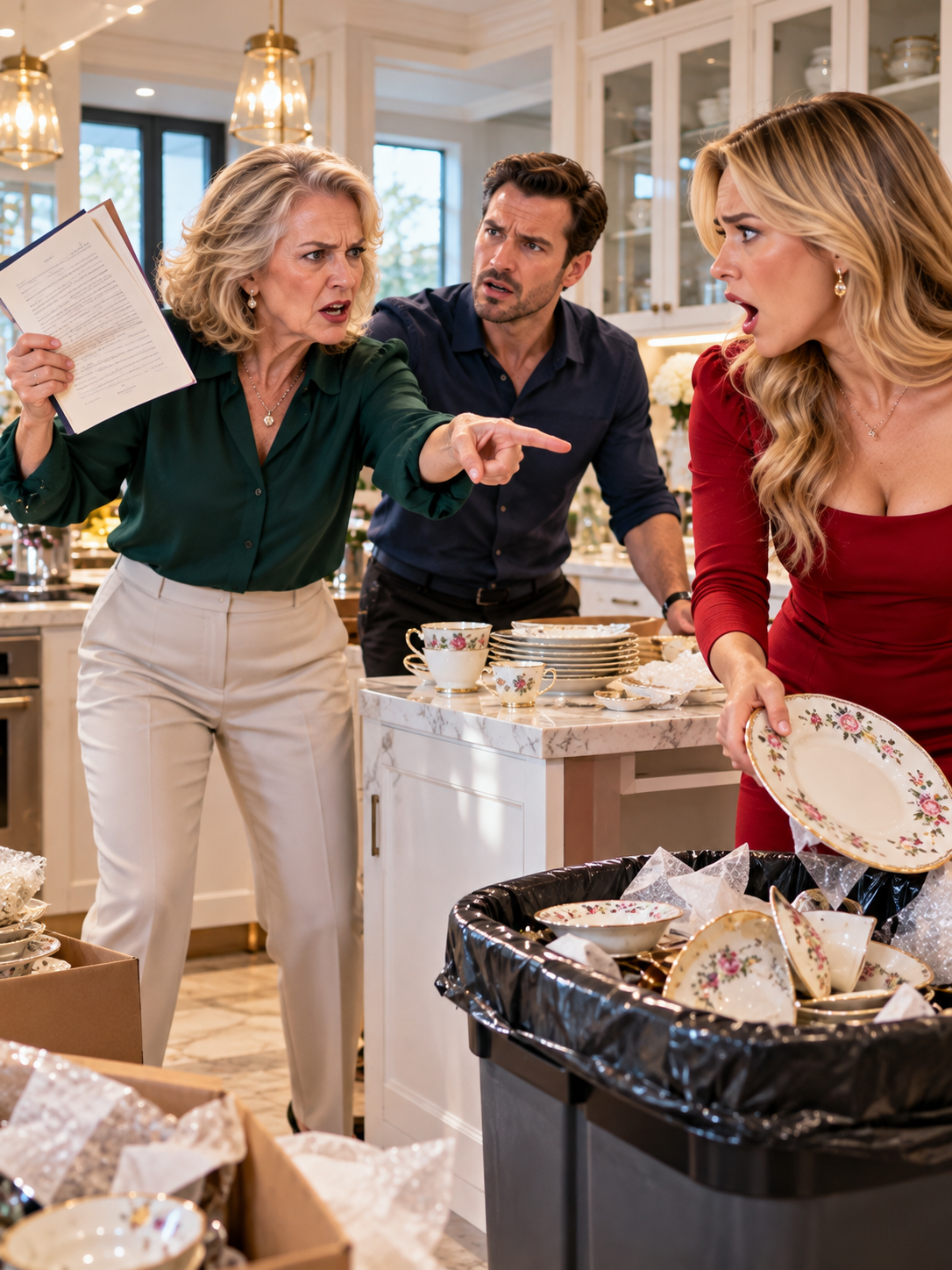
My Parents Gave My House to My Sister While I Was at Work—Then I Made Two Phone Calls
I came home from work to strangers carrying a sofa through my front door, my sister’s children racing upstairs, and a husband I’d never met arranging my furniture. My parents said my pregnant sister needed my four-bedroom house more than I did and ordered me to move out. I made two phone calls rather than scream, certain that someone would finally listen. But the truth behind those copied keys, and the money my parents had secretly accepted, made me question everything I thought I knew about my family.
Part 1
The first thing I saw was a blue sofa sticking halfway out of my front door. Two men in matching gray shirts were trying to angle it past the doorframe while my mother, Diane, pointed toward the living room as though she were directing traffic. After a twelve-hour hospital shift in Charlotte, I wondered whether I’d turned onto the wrong street. Then I saw the white mailbox I’d repaired in March and the lavender struggling beside my front steps.
My younger sister, Ashley, stood on the porch in leggings and a loose sweater, one hand resting on her pregnant stomach. When she spotted my car, she hurried down the steps without meeting my eyes. Behind her, two children thundered across the upstairs hallway, their sneakers pounding the floorboards I had refinished myself. My mother looked over the roof of my car and shouted, “Finally! Get out and help your sister instead of sitting there.”
“Help her do what?” I asked, leaving the engine running. A man I’d never seen emerged from my house with a cardboard box marked MARA—OFFICE in black marker, and I recognized Ashley’s husband, Kevin, from wedding photographs. He set the box on my porch swing and said, “We’ve got the kids’ rooms figured out, but you’re going to need to clear your desk.” He spoke as if he were discussing a delivery window.
“Why are you inside my house?” I asked, louder this time. My father, Frank, appeared behind Kevin and announced a family decision. “Ashley has two kids and another on the way,” he explained. “You live alone in four bedrooms, Mara. They’re moving in, and you’ll stay with us until you find a smaller place.” I waited for a punch line.
Seven years earlier, I’d bought this house after saving every bonus from my job in hospital administration. I’d painted the porch on weekends, replaced the water heater when it failed, and celebrated paying off the renovation loan with takeout on the kitchen floor. My parents hadn’t contributed a dollar to the down payment, mortgage, or repairs. Yet my mother folded her arms and said, “You can afford to be generous. Your sister can’t afford to be homeless.”
I knew Ashley and Kevin had lost their apartment after Kevin stopped paying rent for three months. I’d offered to help Ashley review her budget and find a place closer to the children’s school; she hadn’t answered my messages. A mover carried my graduation photograph past me. “Put that down,” I said, and he stopped immediately, looking from me to Kevin with a puzzled expression.
I stepped inside far enough to see my living room. My grandmother’s armchair had been shoved against a wall, my family photographs lay face down on the dining table, and somebody had rolled my rug into a tube. Upstairs, a child called, “Mom, can I have this bedroom?” Kevin leaned against the banister. “You don’t need this much space anyway,” he said.
“Everybody out,” I said. Ashley teared up, but Mom whispered that I was embarrassing her. “How did you even get in?” I demanded. Dad shrugged and said Mom still had the emergency key I’d given her after a plumbing leak last winter; they’d made copies so the family wouldn’t have to keep borrowing it.
The panic in my chest went cold. I stepped back into the driveway, called the police nonemergency line, and reported an unauthorized entry and an attempted move-in at my occupied home. Then I asked my security company to preserve seventy-two hours of footage and entry logs. Mom watched from the porch, rolling her eyes when I put the phone away.
“Go ahead,” Dad said. “No police officer is going to put your pregnant sister on the street.” One mover put his end of the sofa down, and the other asked Kevin whether the homeowner had actually approved the job. Kevin snapped at him to keep working, but Ashley gripped the rail and whispered: “Mom said she’d already talked to you.” Then Kevin turned to my father and asked, “What about the money we paid you?”
Part 2
The driveway fell quiet except for my ticking engine. My father shot Kevin a warning look, while Mom immediately began talking about how hard pregnancy was on Ashley and family loyalty. “What money?” I asked. Kevin opened his mouth, but Dad cut across him: “It’s none of your business, Mara. This is between us and Ashley.”
I wanted to demand an explanation, but a notification from my security company appeared on my phone. The front door had been unlocked at 9:17 that morning; twenty minutes later, the garage keypad had been used with a code I’d only given Mom for emergencies. I looked at the open garage and saw my home office desk sitting beside the lawn mower, a fresh scratch running across its top. They had never planned to ask me.
The taller mover, a broad-shouldered man named Luis, approached me with his work order. “We were told you were relocating and the family had permission to move in,” he said, keeping his voice low. The paperwork listed my address as the destination and contained a note reading OWNER APPROVAL CONFIRMED BY FAMILY. Luis folded the paper. “We’re not moving another thing until somebody shows us proof.”
Kevin heard him and stormed down the steps. “I’m paying you to do a job,” he snapped, jabbing a finger toward the truck. Luis didn’t raise his voice; he just told Kevin the crew wouldn’t risk moving anyone else’s belongings without permission. That was when my mother turned on me with a tight smile. “You always have to make everything difficult. We raised you better than this.”
A patrol car arrived a little over ten minutes later and pulled up behind the moving truck. Officer Elena Brooks stepped out, took in the sofa balanced across my threshold, and asked who had called. Mom reached her first with a polished speech about a family misunderstanding, two small children, and an expectant mother. The officer let her finish, then walked over to me and said, “Tell me who lives here and what permission you gave today.”
“I live here alone, and I gave none,” I said. I showed her my driver’s license, the county property record on my phone, and a mortgage statement bearing my name. She asked Dad where the key had come from, whether anyone already lived here, and whether I had offered a lease or a place to stay. Dad admitted the key was for emergencies and that Ashley’s belongings had arrived that morning.
“This is an occupied home, and the person who lives here says you don’t have permission,” Officer Brooks told them. “You need to stop moving things in and remove what you brought. If you believe you have a legal right to stay, you can pursue that through the proper process, but you cannot force your way into someone’s residence.” She explained that she would document the incident and expected everyone to leave without further conflict. Dad’s face lost its color.
My mother tried to argue that my parents had a right to make decisions for their children. Officer Brooks replied that being related didn’t create a right to enter somebody else’s home. Kevin muttered that he’d been promised a place to raise his family, and Ashley finally looked frightened. The movers began shifting the sofa back toward their truck, while my sister watched the home she thought was hers disappear one box at a time.
I stayed near my car as Officer Brooks took statements. Mom followed me there, tears gathering in her eyes, and whispered, “Do you realize what the neighbors will think?” Across the street, Mrs. Holloway pretended to water her flowers. “I care what happened in my house,” I said, “not how it looks from the sidewalk.”
Ashley finally approached with a manila envelope pressed against her sweater. “I thought you agreed,” she said, though her voice shook on the word thought. Inside was Dad’s receipt for eighteen thousand dollars, supposedly buying a year’s occupancy at my address. Beneath it lay a one-page agreement with a signature that looked like mine—and I knew at once where they’d gotten the sample they used.
Part 3
Last winter, when my kitchen pipe burst while I was out of town, I’d emailed Mom a signed authorization so she could let the repair crew inside. My signature on that form had an odd little loop because I’d been writing on my knee in an airport. The signature on Ashley’s agreement had the exact same loop, down to a pale dot left by the scanner. A real signature doesn’t reproduce the same accidental mark twice.
“Where did you get this?” I asked Mom, holding up the page. Her eyes flicked toward the officer, then to Dad, and she said that paperwork wasn’t important because the arrangement was about family. I turned to Ashley. “Did anyone tell you I personally agreed to rent you my house?” She stared at the receipt and said, “Mom told me she’d handle you.”
Kevin looked as though someone had pulled a chair from under him. His mother had lent them ten thousand dollars, and they’d added eight thousand in savings for a year in the house. Dad had taken the money three weeks earlier and promised them the keys. “I thought we were getting a fresh start,” Kevin said, his anger sounding suddenly exhausted.
I felt for the children watching from the upstairs landing, confused about their new rooms. But the sympathy ended where the agreement began. My sister knew I organized bills by due date and never lent my car casually. Yet she’d somehow believed I would hand over my entire house without speaking to her once.
Officer Brooks photographed the paperwork with Ashley’s permission and added its details to her report. She said the disputed signature would need further investigation. “For today, nobody is establishing a residence here against the occupant’s wishes,” she told the group. “Please keep the children away from the loading area, and let’s get everyone’s property sorted without an argument.”
I opened the front door myself and stood where I could see every box. Luis and his coworker carried the blue sofa back out, then retrieved two mattresses from the upstairs hallway. Kevin collected the kids’ bags while Ashley waited beside them, shaking with restrained tears. When the younger child asked why they couldn’t stay, I knelt and said, “The grown-ups made a mistake, sweetheart. You didn’t do anything wrong.”
My mother heard me and seized on it immediately. “Then fix their problem,” she hissed as I stood. “You have room. We don’t.” I asked why Ashley couldn’t stay in the guest room at my parents’ house, where she’d spent many weekends before getting married. Dad admitted they’d filled that room with furniture they were selling online to raise money, but he wouldn’t explain what had happened to Ashley’s eighteen thousand dollars.
The question finally made Ashley stop crying. “Dad, where is it?” she asked, keeping her voice level in the way people do when they’re close to losing control. He rubbed his forehead and said they had used part of it to get current on bills; the rest had already gone toward a loan payment. “We were going to tell you after everybody settled down,” Mom added, as though the timing were the problem.
Ashley stepped away from them, opened her phone, and scrolled with her thumb. “You told me Mara would be fine once the kids were in,” she said to Mom. A message appeared on the screen, sent the night before: “Don’t ask Mara again. Once the beds are upstairs she won’t make you move them.” I read it twice, feeling the last fragile possibility of a misunderstanding break apart.
“You knew I hadn’t agreed,” I said. Ashley couldn’t look up. “I knew you hadn’t said yes yet,” she answered, which was a distinction so small it made me feel sick. Behind us, Luis closed the moving truck, and Officer Brooks asked each person to confirm that no belongings remained inside. My sister lifted her head at last and said, “There’s one more thing Mom told me to do before you got home.”
Part 4
“She told me to unplug your security system,” Ashley said. “She was afraid you’d get an alert and come home.” Mom protested, but Ashley continued. She pointed toward the laundry room, where a little white cable dangled loose behind the shelf. Mom knew where everything was.
Officer Brooks noted the cable and asked whether my cameras saved footage remotely. They did, I explained, and the company had already preserved whatever was available. Mom insisted she’d only wanted to prevent a false alarm, but nobody answered her. Even Kevin stared at her like a stranger.
The last of Ashley’s belongings went into the truck while I checked my rooms with Luis. In the upstairs bedroom, somebody had laid out a pink blanket over my guest bed and stuck paper stars to the wall with removable tape. I peeled one off, remembering Ashley’s daughter asking for the room. Kevin apologized for scratching my desk; I said I’d document the damage.
Dad came over holding two shiny copies of my front-door key. He placed them in my palm and said, “You could have handled this privately.” “You made that impossible when you entered without asking,” I replied, closing my hand around the metal. Officer Brooks gave me the incident number and advised securing the house. My parents drove off without saying goodbye.
Ashley and Kevin left after arranging to stay in a hotel near the children’s school. I gave Ashley the address of a county housing-assistance office. She nodded; I couldn’t tell what she felt. When the last truck disappeared, I could finally see the oil stain in my driveway again, an ordinary flaw that made me strangely relieved.
I called a locksmith before going inside. As he replaced the deadbolts and reset the keypad, I photographed the damage. In my office, the bottom file drawer stood open; the folder containing last year’s plumbing claim had been pulled halfway out. The signed authorization I’d sent Mom was printed on top, and its familiar loop matched the one on the supposed occupancy agreement.
That evening, the security company sent a link to the footage it had recovered. The camera above the front door showed Dad entering with a copied key, followed by Mom carrying a tote bag and a roll of packing tape. A few minutes later, she told Ashley, “Once the children’s beds are up there, Mara won’t have the stomach to make a scene.” Dad replied, “If she says no, we’ll show her the agreement and tell her it’s already done.”
I watched again, thinking about every holiday when Mom had asked me to be the reasonable one. I’d paid Ashley’s utility bill, driven Dad to appointments, and endured jokes about my empty bedrooms. None of those acts had been invitations to claim my home. What hurt most wasn’t that my parents thought I could be bullied; it was how accurately they had predicted that I would hesitate to upset the kids.
The next morning, I emailed the recording and documents to a local attorney and asked for advice about protecting my property and identity. She told me to retain originals, keep the incident number, secure my accounts, and put my objection to any occupancy agreement in writing. I sent the notice and changed my emergency contact at work. It felt bleak to remove my parents from that form, but leaving them there would have been trust I no longer had.
By noon, distant relatives were messaging me. Aunt Claire asked why I’d thrown a pregnant woman and two children onto the street; my cousin wanted to know whether I was really suing my parents. Mom had posted a picture of the moving truck outside my home with a caption accusing me of choosing an empty house over family. I read the comments, then saw one from Ashley: “Mom, tell them what you did with our money.”
Part 5
I almost replied to every comment under Mom’s post while my phone vibrated against the kitchen counter. I wanted to mention the copied keys, stolen signature, and eighteen thousand dollars my parents had accepted. Instead, I took screenshots and called my attorney. She advised one factual statement, which I posted before putting my phone facedown.
“I own and live in this house,” I wrote. “No one had permission to enter or move in. The police documented an unauthorized entry, and I have preserved the relevant records. I hope Ashley and her children find stable housing, but my home was not available for anyone to give away.” Then Ashley posted a photograph of Dad’s receipt, complete with his handwriting and the date, and Mom deleted her post.
Aunt Claire called, sounding subdued; I could hear the evening news playing behind her. Mom had told everyone I’d promised Ashley the house and changed my mind after the movers arrived. Claire asked whether that was true, and I said no; I had never even met Kevin until I found him carrying my office supplies. She apologized, but I didn’t comfort her.
Three days later, my attorney sent the notice to my parents through certified mail and emailed me a copy. It challenged the supposed agreement, demanded that they stop representing themselves as authorized to rent my home, and required them to preserve the relevant communications. My father left a voicemail saying I was treating family like criminals. I saved it and didn’t call back.
Ashley asked to meet at a coffee shop near the hospital the following week. I agreed because I needed one answer. She arrived alone, taking the chair nearest the door, and ordered tea she never touched. “When Mom said you hadn’t agreed yet,” I asked, “why did you bring the truck anyway?”
She watched steam curl from the cup. “Because I thought once we were there, you’d let us stay,” she admitted, twisting her wedding ring. “Mom said you’ve always taken care of things, and I told myself this was just another time.” It hurt more than the forgery: the person who knew what this house meant had knowingly stolen my choice. “That’s why I can’t trust you,” I told her.
Ashley said she and Kevin had moved into a small furnished rental after his mother agreed to help with the deposit. My parents had agreed, after receiving a formal demand for an accounting, to repay them in installments and were selling their camper. She asked whether we might talk again after the baby was born. I told her I wished the children well, but I wasn’t promising a reunion or a return to how things had been.
“You could forgive me eventually,” she said, almost hopefully. “Maybe,” I answered, “but forgiveness wouldn’t mean a key, a spare bedroom, or a say in my life.” She stayed by the window as I left, her hands wrapped around the cup as if she were cold. I cried in my car because the sister I’d thought I had was gone.
I preserved the records and left the disputed signature to the authorities. I blocked my parents’ numbers after Mom sent a final message accusing me of loving a house more than my own family. I changed my security code, warned my neighbors, and chose a trusted emergency contact. The front porch got a fresh coat of paint where the movers had chipped the railing; I repaired my desk too.
One Saturday, Mrs. Holloway came over with a small pot of lavender, saying the movers had crushed the plant beside my steps. We replanted it beneath the mailbox where the morning sun could reach it, and I rehung my graduation photograph. The house was quiet except for the refrigerator humming and the rain beginning against the windows. I had paid for these walls for seven years, and keeping them meant choosing myself.
Legal Notice: This story is a work of fiction. Names, characters, businesses, events, and incidents are the product of the author’s imagination or are used fictitiously. Any resemblance to actual persons—living or dead—or to actual events is purely coincidental. Thank you! 💓
WordsCharactersReading time


