My Husband Broke My Arm and Told Me to Lie—Then the X-Ray Technician Recognized Me
The night my husband injured my arm, he leaned close and whispered, “Tell them you fell, or you’ll never hold our daughter.” Eight months pregnant, I believed he could make that threat real. At the hospital, he answered every question for me while I struggled to stay calm. Then an X-ray technician looked at my face and whispered my childhood nickname. It was my brother, the man my husband had kept me from seeing for two years—and he noticed something nobody else had.
Part 1
The first thing I remember about that Thursday night is the smell of garlic burning in a skillet. My ankles were swollen, but my husband, Blake Holloway, wanted dinner ready before his clients arrived. When I told him I couldn’t attend the restaurant meeting he’d arranged afterward, he looked at my loose maternity dress as if it were a deliberate insult. “You’ve embarrassed me enough this month, Elise,” he said, pushing his phone across the counter.
I was thirty-one, eight months pregnant, and living in a beautiful house outside Columbus, Ohio, that no longer felt like mine. Blake developed commercial properties, donated to fundraisers, and remembered everyone’s name at business dinners. In public, he pulled out my chair and talked excitedly about our daughter; at home, he checked my mileage, criticized my friends, and decided when conversations with my family were convenient. I knew both versions well.
“I just need to lie down,” I said, moving away from the kitchen island. Blake caught my wrist as I turned, and the sudden struggle ended with a sharp pain that took my breath away. I braced myself against the counter with my other hand, terrified by how quickly an ordinary argument had changed. He stared at my arm for a moment, then grabbed his keys and said we were going to the emergency department.
Before we left, Blake crouched beside me and spoke in the quiet voice he used when he wanted a threat to sound like advice. “Tell them you slipped on the stairs, or I’ll make sure they think you can’t look after this baby.” He had money, influential friends, and a talent for making me doubt my memory. I nodded because he was holding the car keys, and I wanted our daughter checked immediately.
The hospital’s entrance glowed white against the rainy parking lot, and the automatic doors released a wave of warm disinfectant-scented air. Blake guided me to reception with a hand pressed firmly between my shoulder blades, telling the nurse I’d lost my balance on the stairs. He added that pregnancy had made me unusually anxious and that he’d been doing his best to keep me comfortable. When the nurse asked where I hurt, I opened my mouth, but he answered before I could.
A young nurse named Celia bent down to my level and waited until Blake finished speaking. “Elise, I’m going to ask you directly,” she said. “Did you land on your arm, and have you noticed any change in the baby’s movement?” I said my arm hurt and the baby had been moving, carefully avoiding the first question. Celia’s eyes remained on mine for an extra second before she arranged an arm X-ray and an assessment in maternity triage.
Blake protested when a transporter came to take me to imaging without him. Celia explained that staff needed space to conduct the examination and that he could wait near reception. His smile vanished; then he leaned close enough that I smelled his mint gum. “Remember what happens if you make trouble,” he murmured, releasing my wheelchair as the transporter moved me through the doors.
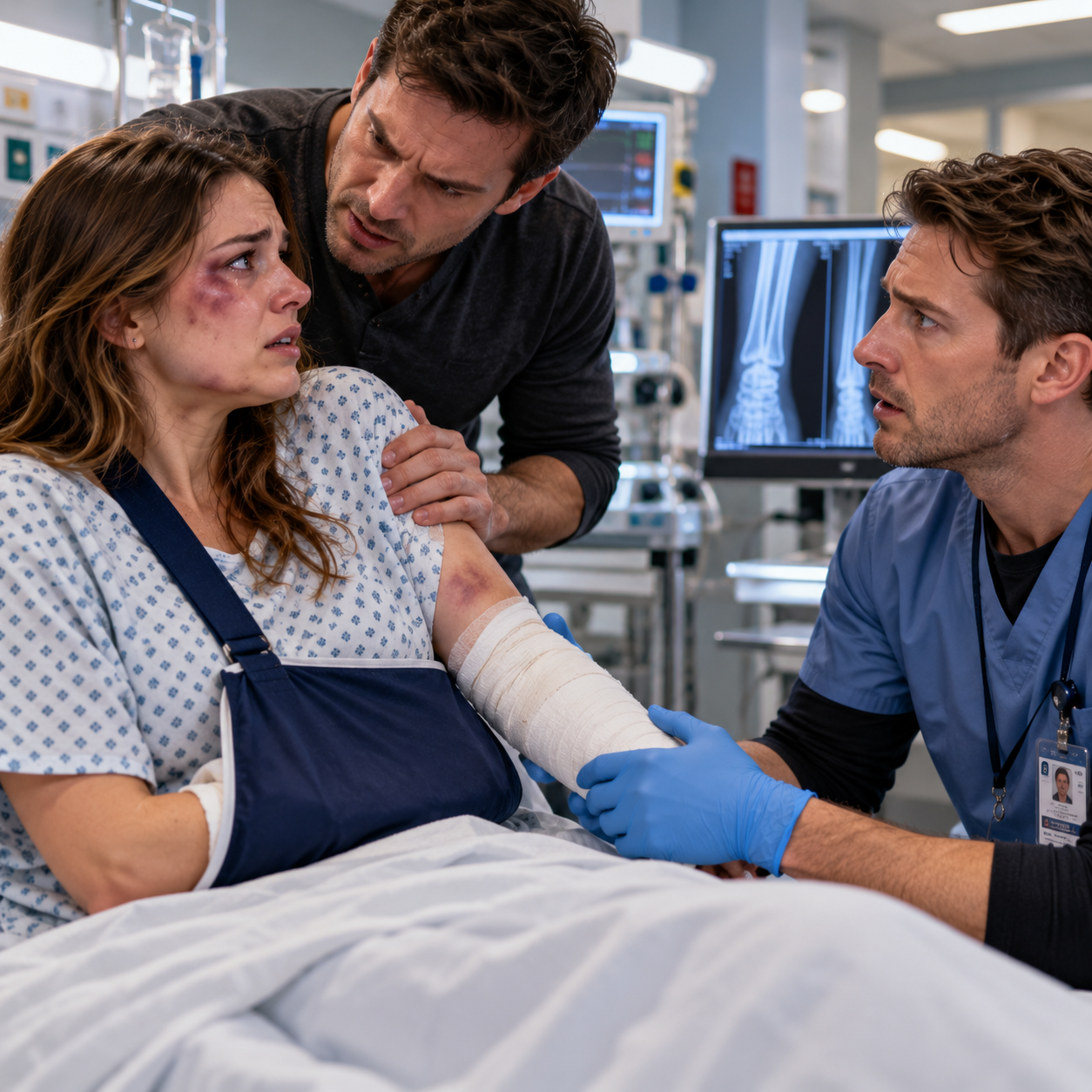
The imaging room was chilly, and the paper beneath my elbow crackled while I tried to position my aching arm. A technician approached carrying my chart, took one look at me, and stopped so abruptly that his badge swung against his scrubs. His hair was shorter, and there were faint lines beside his eyes, but I knew his voice when he said, “Ellie?” Nobody had called me that since I was a teenager.
“Gavin?” I whispered. My older brother had disappeared from my life after an argument Blake claimed Gavin had started, and I hadn’t seen him in two years. Gavin looked from my frightened face to my injured arm, then toward the closed door, his expression changing from disbelief to concern. He quietly called for another technician to complete the imaging, pulled up a chair, and asked the question I’d been afraid anyone would ask: “Did Blake do this?”
Part 2
For a second, I tried to repeat the staircase story, even with Gavin sitting close enough to see my hands trembling. I remembered him teaching me to ride a bicycle, running beside me until I stopped fearing a fall. “He told me he’d take the baby if I told anyone,” I said. Gavin’s face tightened, but he didn’t touch my injured arm or demand more details than I could give.
“You’re allowed to tell the truth, and we can get people here who know how to help,” he said. Because he was my brother, Gavin explained that another qualified technician would handle the images and the medical team would assess the injury. He asked permission to alert Celia and the social worker. I nodded, surprised by the relief of being asked what I wanted.
Within minutes, Celia returned with a physician and a social worker named Maren Brooks, whose voice was calm and whose shoes squeaked softly on the polished floor. Maren told me I could speak privately, request help contacting police, and discuss a safe place to go after treatment. She made no impossible promises about Blake’s legal rights. Instead, she asked, “What are you most frightened he might do tonight?”
“Take my daughter,” I said, resting my uninjured palm on my stomach. The physician explained that imaging confirmed a fracture requiring treatment and that maternity staff would monitor the baby’s well-being. Celia asked permission to document the visible bruising and my description of what happened; I agreed, then repeated the kitchen argument as accurately as I could. Saying the words aloud made me cry, but nobody interrupted to tell me what I must have meant.
While the team worked, Maren asked whether Blake had ever kept me from leaving home or speaking with friends. I said he called it protecting me from stress, then described the shared phone account, the canceled family visits, and the way he told me Gavin wanted nothing to do with us. Gavin stared at the floor before admitting he’d sent birthday cards and messages for months, all unanswered. I realized I had never seen a single one.
A maternity nurse wheeled in a monitor and helped me settle onto a bed in a separate evaluation room. The steady rhythm of our daughter’s heartbeat filled the space, and for the first time that night my lungs seemed able to hold a full breath. Gavin stood near the foot of the bed, blinking hard, while Maren helped me call the police to report what had happened. I asked that Blake not be told where I was being examined.
He was already demanding answers at reception. Through the hallway door, I heard his polished voice grow louder as he insisted that his wife was being kept from him unnecessarily. Security staff explained that he could wait but couldn’t enter a restricted clinical area without permission. When he began arguing with them, I expected somebody to summon me to calm him down.
Nobody did. Maren closed the door and said, “You aren’t responsible for managing his reaction.” An officer arrived to take my account when I was ready, and the physician supplied the medical findings through the appropriate process. I told the officer about Blake’s threat in the kitchen and the warning outside radiology, then asked how I could keep him from approaching me after discharge.
Maren explained options for emergency protection, victim advocacy, and safe housing, including the fact that a judge—not hospital staff—would determine any protective order. Gavin offered his guest room, but she encouraged us to make a plan that wouldn’t depend solely on a relative’s address remaining private. We discussed transportation, documents, and a confidential place to stay. I began to believe leaving might be possible, until the officer returned carrying a printed message Blake had shown reception.
It was a screenshot of a text supposedly sent from my phone that afternoon: “If anything goes wrong tonight, tell them I’m losing control again.” I had never written it, but my name appeared above the words. Blake wasn’t merely denying the injury; he was preparing a story in which nobody would believe me.
Part 3
I read the screenshot three times before realizing the message came from an old number I hadn’t used in almost a year. Blake had insisted we change carriers after claiming strangers were bothering me, and he’d kept the old phone to transfer photographs. The officer didn’t treat the screenshot as proof of anything; he asked whether I recognized the number and whether Blake could still access the device. I told him what I knew, then felt sick remembering how often my husband had called my confusion evidence of instability.
Gavin asked if I’d ever received the package he’d mailed the previous Christmas, a small box containing our mother’s silver bracelet and a letter. I shook my head, and he opened a folder on his phone showing delivery confirmation to our house. He explained that our argument two years earlier had never been what Blake told me: Gavin had questioned Blake’s treatment of me after I canceled a family gathering at the last minute. Blake subsequently told Gavin I wanted no further contact, while telling me my brother had called me ungrateful.
The memory of that cancellation came back with painful clarity: a dinner invitation I’d accepted, a flat tire Blake claimed made the trip impossible, and a furious conversation afterward. I had been ashamed to admit we were fighting, so when Blake said Gavin blamed me, I let the distance grow. “I thought you were happier without me,” Gavin said, his voice breaking. I realized the silence between us had been built from two different lies, one delivered to each of us.
Maren returned with a hospital advocate who helped me arrange a confidential place to stay after I was medically cleared. My arm was stabilized, and maternity staff wanted continued observation because of the evening’s stress and injury. I signed a release for the relevant records to be available through proper channels and asked the officer to record Gavin’s information about the old phone. Nothing felt solved, but the questions were finally moving in the right direction.
Around midnight, Blake left a voicemail using the gentle tone he’d used when we first dated. “Sweetheart, everyone is overreacting,” he said. “Let’s go home, rest, and talk about it tomorrow.” A few minutes later, another message arrived, accusing Gavin of trying to break up our marriage and warning that lawyers would be involved. I saved both without replying, while the social worker helped me understand how to preserve messages and protect access to my accounts.
The next morning, an advocate accompanied me through the process of requesting a temporary protection order. I described the injury, Blake’s threats, the hospital visit, and why I feared returning home; the court reviewed my request and issued temporary restrictions pending a hearing. I knew the order was only one part of a safety plan, not an invisible barrier that could stop every risk. Still, hearing a court official address me as someone entitled to protection made my throat tighten.
Then my bank called about an unusual request to remove my access to an account holding the savings I’d brought into the marriage. The representative said a person identifying himself as my authorized spouse had asked about changing account permissions. No change had been completed, and I confirmed that I wanted my existing protections maintained. The timing frightened me more than the amount involved: Blake had started rearranging my financial life while I was still in the hospital.
A family-law attorney referred by the advocate explained that we needed to move quickly, document the account activity, and seek appropriate temporary orders concerning finances and the coming birth. She made no guarantees about future custody, but she listened to what I wanted and explained each step without speaking over me. I signed the engagement papers with my uninjured hand. Then she turned her laptop toward me and showed me a filing Blake’s attorney had submitted that morning.
He was asking the court to consider my supposed “emotional instability” when determining the baby’s care after birth. Attached were messages I didn’t recognize and a carefully written statement that made my fear look like evidence against me.
Part 4
Seeing my private life rearranged into Blake’s polished legal language was worse than hearing him lie at the hospital. The filing described him as a patient husband who had repeatedly helped his pregnant wife through anxious episodes. It omitted my injury and his threats. My attorney, Serena Price, reminded me that an allegation in a filing was not a finding and that we had time to respond with evidence.
We made a timeline at Serena’s conference table, using my calendar, preserved messages, hospital notes, and the dates of Gavin’s unanswered attempts to reach me. The wood smelled faintly of furniture polish, and my wrist ached as I watched Serena attach labels to each document. She asked questions I could answer without guessing and left blank spaces where I couldn’t remember. Slowly, the chaotic evening became a sequence of facts nobody needed to embellish.
One detail mattered more than I’d expected. On the night of the hospital visit, Blake had told the nurse I fell down our back stairs, although we’d replaced those stairs with a ground-level patio months earlier. He had complained about the cost all summer. Serena noted the inconsistency, obtained the relevant property photographs, and cautioned me not to assume any single detail would decide the case.
The upcoming hearing terrified me anyway. I’d heard Blake persuade contractors, bankers, and friends to accept his version of events with the ease of someone choosing a restaurant. I feared his voice would drown mine out again. Serena told me we weren’t there to compete at public speaking; we were there to present evidence and ask for specific protections.
At the hearing, Blake wore a charcoal suit I’d bought him for his last birthday. He barely looked at my arm, resting in a support, but his attorney questioned whether I’d misunderstood an argument because I was under stress. Serena submitted the hospital documentation, my account to police, the chronology of his messages, and records concerning the old phone number. Gavin attended as a witness, not a medical expert.
When Blake’s attorney repeated the staircase story, Serena introduced the construction records and asked which stairs he meant. Blake shifted in his chair and said he’d been confused during an upsetting night. It wasn’t a dramatic confession, and nobody gasped, but the judge asked several follow-up questions about the discrepancies. I watched the certainty drain from Blake’s face as he realized explanations could be tested instead of automatically believed.
The court extended the protective restrictions while the relevant proceedings continued and made interim arrangements intended to protect my safety. Future parenting questions required separate consideration. Outside, Serena reminded me that these were temporary decisions, not the end of every legal problem. I understood, but I could finally walk to the car without Blake following close behind.
A month later, our daughter arrived on a bright Saturday morning, small and furious at the sudden cold air of the delivery room. I named her Clara, after my grandmother, who used to tell me that courage often sounded like a quiet voice saying no. Gavin waited outside until I invited him in, then stood beside the bassinet with tears shining on his cheeks. I held Clara carefully and told her she would never have to earn gentleness by obeying somebody else’s rules.
My relief didn’t erase the case. Blake’s lawyers continued to contest parts of my account and sought information about future parenting arrangements. I followed the court’s directions, documented every contact through my attorney, and focused on recovery and caring for Clara. Then Serena called with news that an investigator had recovered records from the old phone Blake said he’d misplaced.
The device contained drafts of several messages later presented as if I’d sent them, along with evidence that the messages had never been delivered from my current phone. I sat in Gavin’s kitchen staring at the rain on the window, understanding that Blake hadn’t simply lied in a moment of panic. He had been constructing a version of me that could be used whenever I tried to leave.
Part 5
The discovery didn’t make me feel victorious. It made me remember every time Blake had told me I was forgetful, too emotional, or incapable of handling serious decisions. For months, I’d quietly wondered whether pregnancy had changed my judgment as dramatically as he claimed. Looking at the recovered records, I finally understood how deliberately he had encouraged that doubt, and I was angry at the years I’d spent apologizing for asking ordinary questions.
Serena explained what the forensic review could and couldn’t establish, then submitted the material through the appropriate legal process. The evidence supported that some purported messages were created or handled on the old device, although decisions about intent and responsibility still belonged to investigators and the courts. The criminal case concerning my injury continued separately from the family proceedings. I learned to stop expecting one perfect courtroom scene to repair everything at once.
For a while, the ordinary tasks of rebuilding felt harder than those hearings. I had to choose a pediatrician, learn which grocery store had the quietest early-morning hours, and decide what furniture to keep from the house Blake and I once shared. My friend Tessa brought soup in glass containers, and Gavin assembled a crib in the small rental I’d found near his neighborhood. Each small decision reminded me that I had a future separate from my husband’s permission.
Gavin and I talked honestly about our lost years, but not all at once. One evening, after Clara fell asleep, he brought out the letter he’d sent with our mother’s bracelet and read it aloud. He had written that he loved me, that he was worried, and that he’d be there whenever I wanted to talk. We sat at my kitchen table until the tea went cold, grieving a relationship that hadn’t ended naturally but had been interrupted on purpose.
Blake sent an apology through his attorney months later. He said he’d been under pressure, that he’d made terrible mistakes, and that he hoped we could someday speak as two people who once loved each other. There was no request for forgiveness I could believe, because his earlier actions had shown how easily he could turn tenderness into leverage. I instructed Serena to keep all necessary communications formal and limited to the proceedings.
Eventually, we reached a divorce settlement addressing property and finances, while parenting arrangements remained subject to the court’s continuing authority. The criminal case ended with Blake accepting responsibility for the assault, and the court imposed conditions designed to protect me. Those outcomes did not return the months I’d spent afraid in my own home, but they gave me room to plan a life without negotiating every breath. I stopped checking the windows whenever a car slowed outside.
One Sunday in early spring, I carried Clara onto the porch of my rental while Gavin planted lavender beside the steps. She curled her tiny fingers around mine as a warm breeze lifted the edge of her blanket. I thought about the hospital corridor, the X-ray room, and the moment I heard a voice from my childhood say, “Ellie?” If Gavin hadn’t recognized me, perhaps Celia or Maren would still have helped; what mattered was that I finally accepted help when it reached me.
I went back to part-time work designing interiors for small commercial spaces, a career I’d set aside because Blake said I didn’t need one. My first project was a neighborhood bookstore with creaky floors and tall windows, and I cried in the parking lot after the owner approved my plans. Nobody treated those tears as proof that I was unfit for anything. They were simply what happened when I discovered I could build something again.
I don’t forgive Blake, and I don’t need to hate him every morning to know I will never return. Clara will learn the truth about our family in ways appropriate to her age, and I will follow the protections and responsibilities the law requires without pretending what happened was love. My husband once tried to make me believe that telling the truth would cost me my daughter. Instead, telling it was how I began becoming the mother—and the person—I wanted to be.
Legal Notice: This story is a work of fiction. Names, characters, businesses, events, and incidents are the product of the author’s imagination or are used fictitiously. Any resemblance to actual persons—living or dead—or to actual events is purely coincidental. Thank you! 💓