
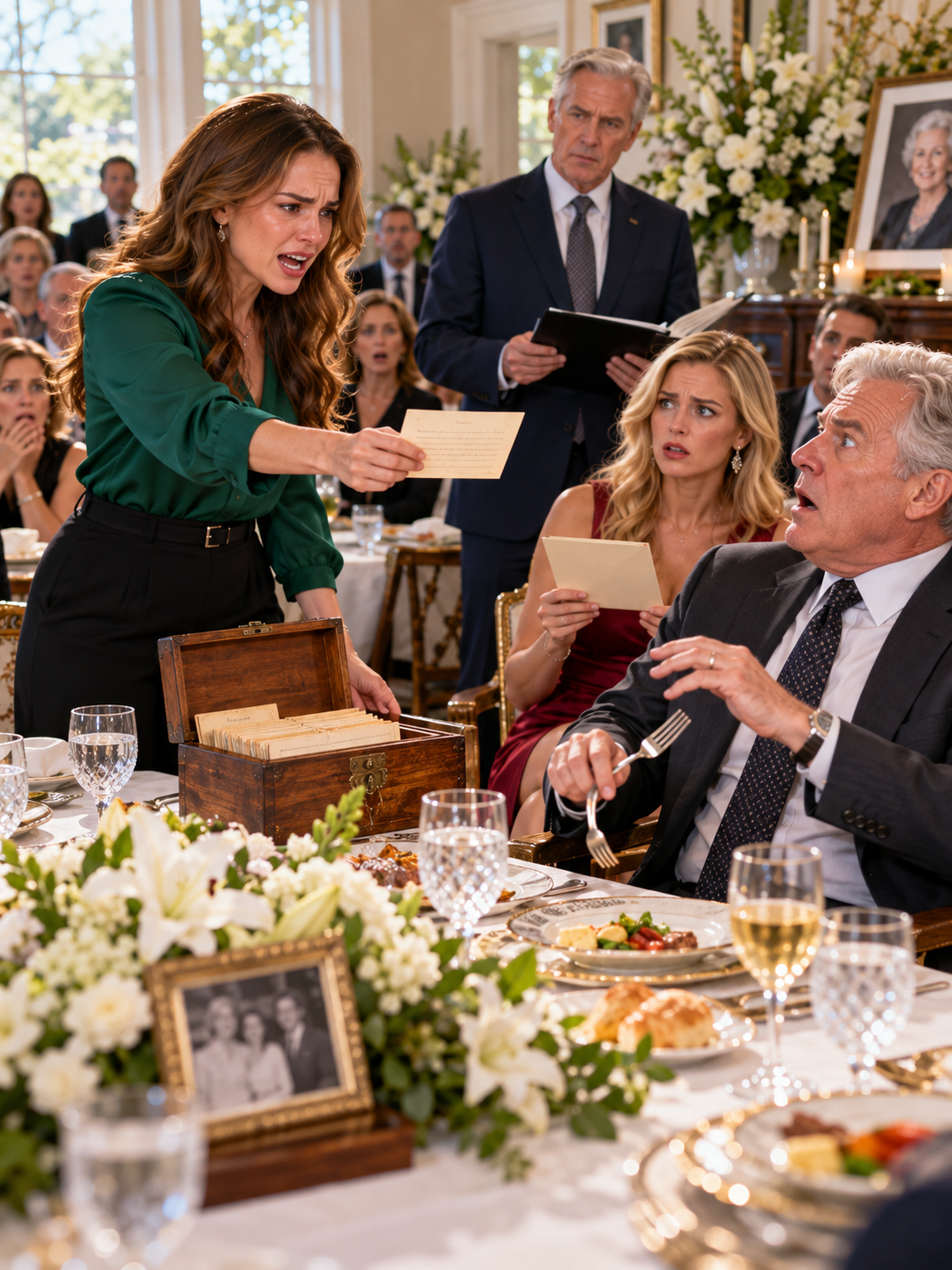
My Father Called Me “The Help” at Grandma’s Funeral—Then I Read Her Last Recipe Card Aloud
At my grandmother’s funeral lunch, my father announced that my sister had inherited the farmhouse and $400,000, while I’d been left a battered recipe box. Forty people watched him laugh and call me the family help. He even gave me three days to leave the house where I’d spent years caring for her. I said, “Okay,” because I could still hear Grandma telling me to read her cards in order. The last one wasn’t a recipe—and Dad had no idea what it contained.
Part 1
Somebody had put yellow mustard on the sandwiches at Grandma Evelyn’s funeral lunch. She hated mustard and said people ought to ask before deciding what somebody else liked. I sat beneath the fellowship hall’s humming air conditioner, staring at the untouched sandwich on my paper plate and wishing I could hear her say it.
My name is Claire Hartley. I’m thirty-four, and for the past three years I lived with Grandma on Elm Street in Lancaster, Pennsylvania. After her hip surgery, I traded my office job for remote bookkeeping and learned to help her move without making her feel helpless.
My sister, Lauren, visited twice a year with expensive flowers and a phone ready for pictures. My father, Richard, called my work “playing nurse,” although he never stayed long enough to learn which cupboard held Grandma’s tea. My mother said I was lucky to live rent-free, ignoring the groceries, repairs, and sleepless nights I covered without ever sending anyone a bill.
Grandma never confused care with weakness. On bad mornings, when her hands shook against the blue ceramic mug, she would wrap her fingers around mine and say, “You’re my hands, Claire. Don’t you dare let them make that sound small.” I remembered those words when my mother pointed me toward the back table at the funeral lunch because the front seats were “for the family receiving guests.”
Lauren was sitting up front beside her fiancé, Cole Whitman, wearing pearls Grandma had once admired through a jewelry-store window. Cole’s father, Graham, served on a bank board, which Dad mentioned repeatedly. Dad liked people with polished shoes and impressive business cards, especially when he thought they might lend him money.
Forty guests finished their coffee while Arthur Merritt, Grandma’s longtime attorney, stood by the church piano with a manila folder. He explained that Evelyn had asked for her wishes to be read in the presence of family friends. Dad straightened his jacket, and Lauren slipped her hand into Cole’s as if she were waiting to hear the results of a contest she already knew she’d won.
“To Lauren Hartley,” Mr. Merritt read, “the farmhouse on Willow Creek Road and a bequest of four hundred thousand dollars from the designated savings account.” Lauren gasped so theatrically that a woman behind me dropped her teaspoon. Mr. Merritt continued, “To my son, Richard Hartley, the Elm Street residence.”
My stomach tightened. Elm Street was the house where I had cooked oatmeal on winter mornings, washed sheets at midnight, and watched Grandma’s hydrangeas turn from white to dusty blue. Dad had never asked whether I had anywhere else to go.
“To Claire Hartley,” Mr. Merritt said, pausing long enough to look directly at me, “my wooden recipe box, including its complete contents.” The room filled with the scratch of folding chairs and one embarrassed chuckle. Dad made sure his laugh carried above all the others.
“Fitting. You always were the help.” My mother patted my wrist and suggested I could bake for Lauren’s wedding now that I had “more free time.” Lauren called across the room, “You can visit my farmhouse, Claire. Just bring pie.”
Dad leaned back and added, “You’ll be out of Mom’s house by Sunday. Realtor’s coming Monday.” I could feel the guests waiting for me to cry, but I only said, “Okay.” His smile faltered, as though my answer had stolen a scene he had rehearsed.
Mr. Merritt brought me the box himself. The brass hinge squeaked, and the inside smelled faintly of cinnamon and the cedar drawer where Grandma kept it. As he set it down, he leaned close enough for only me to hear: “Your grandmother said to read the cards in order. And whatever you do, don’t skip to dessert.”
I lifted the first three cards. In their top corners were tiny red numbers, and beneath familiar recipes Grandma had written odd little reminders about receipts, dates, and keeping copies. At the front table, Graham Whitman began tapping his glass for a toast, while I found a card behind the dessert divider labeled “Sunday Stuffing—Read Aloud.”
Part 2
Grandma’s cards had always looked like an ordinary collection of stains and measurements. Now I saw that the red numbers ran from one through twenty-six, and that every fourth card had a second line in the margin. I spread them across the table, careful not to let the condensation from my coffee touch the ink.
Number four, for apple butter, said, “March: find the statement with the missing deposit.” Number eight, for chicken potpie, said, “May: look at the farmhouse papers before anyone tells you I signed.” I had assumed the notes were part of Grandma’s increasingly complicated system for remembering household bills, but she had been much more alert than my family liked to admit.
During her final month, she had asked me for her reading glasses, the box, and Mr. Merritt’s telephone number. I brought all three and went outside while they spoke because she deserved privacy, not because I thought she had secrets. When I returned, she was smiling at the window and told me that a good cook never handed over the whole pantry to a man who couldn’t boil water.
I turned over another card and saw a little inked star beside the date of Dad’s last visit. I remembered that afternoon: his expensive cologne in Grandma’s hallway, an unfamiliar leather folder on the sideboard, and his sharp voice telling me to take a walk. Grandma had been exhausted afterward, but when I asked whether he’d upset her, she only said, “I’m checking something.”
At the front table, Dad was giving Graham Whitman a tour of his imaginary future, describing the Elm Street property as an “excellent investment opportunity.” He talked about selling it, restoring the farmhouse for Lauren, and finding me a small rental that suited my “simple lifestyle.” Lauren laughed at that last part, although she knew I had held three jobs before moving in with Grandma.
I wanted to stand up and tell them every detail of the life they had dismissed. I wanted to describe the winter Grandma couldn’t bear the sound of the furnace clicking off because she feared waking alone, and how I stayed with her until dawn. But the box under my fingers felt like an instruction, and Grandma had never wasted words when a good recipe could make the point.
“Everybody, a toast,” Graham said, raising his paper cup. He was a tall, careful man with silver hair and the distant manner of somebody who weighed every promise before speaking. “To Richard, who understands that family is an obligation, not a convenience.”
The applause came in scattered bursts. Dad lifted his fork like a little silver trophy and turned toward me with the satisfied grin I had known since childhood. Suddenly I understood why Grandma had written “Read Aloud” at the top of the last card instead of putting it in a sealed letter.
I stood, the floor cool beneath the soles of my shoes. “Grandma asked me to read something before everyone leaves,” I said, surprised that my voice reached the front of the room without breaking. Dad’s smile vanished.
“Sit down, Claire. There’s no need to make a performance out of your consolation prize.” He spoke softly, but in a room that quiet, every word traveled. Mr. Merritt stepped away from the piano and said, “Richard, this reading was one of Evelyn’s express instructions.”
I unfolded the card. Grandma’s handwriting tilted lower than it once had, but every letter was unmistakable, right down to the little loop she put beneath a capital G. I began: “Ingredients: one son holding my power of attorney, one signature I never made, and four hundred thousand dollars missing from my savings.”
Dad’s fork hit his plate with a hard, bright crack. Graham lowered his cup, and Lauren turned toward our father as though she no longer recognized his face. Before anyone could interrupt, Mr. Merritt reached into his folder and placed a second document beside my hand.
“Keep going, Claire,” he said. “That is only the beginning of what your grandmother discovered.”
Part 3
I kept my eyes on Grandma’s handwriting because looking at Dad felt impossible. “In March, Richard moved four hundred thousand dollars from my savings into an account he controlled. In May, somebody signed my name to a loan secured by the farmhouse, though I had already told him no.” The hall smelled suddenly of cooling coffee and wilted funeral flowers, ordinary things that made the words even harder to believe.
“While I was ill, my son told people I could not understand my own finances,” I read. “I understood enough to ask for statements, compare dates, and recognize a signature that wasn’t mine.” My voice grew steadier with each sentence, while Dad’s face changed from red to an awful gray.
“That’s nonsense,” he said, rising so quickly his chair tipped backward. “She was confused at the end, Arthur. You know she was.” I remembered Grandma insisting on balancing her checkbook even when her hands grew tired, and felt anger replace the embarrassment that had followed me into the hall.
“Evelyn’s capacity was independently assessed when she signed her final documents,” Mr. Merritt replied. “I also obtained contemporaneous records and statements from two members of her care team.” He didn’t call Dad a criminal; he simply laid certified copies on the table and asked everyone to let him finish.
Dad pointed at the card. “She planted this story because Claire filled her head with garbage.” My mother looked toward me for the familiar performance in which I apologized to stop the shouting, but I stayed standing. “I didn’t know about any of this until five minutes ago,” I said.
Lauren snatched the folder’s edge before Mr. Merritt could draw it back. “If Dad took that money, where is my four hundred thousand?” Her voice rose on the last word, and I watched her glance at Cole as though the wedding invitations already mailed were beginning to disappear.
“The designated account contains almost nothing,” Mr. Merritt said. “The estate has a documented claim for the withdrawn funds, but recovery is not the same as money available to distribute today.” He turned a page, then added that the farmhouse carried a disputed lien of approximately three hundred and eighty thousand dollars.
Cole whispered, “You told me it was free and clear.” Lauren didn’t answer him; she was staring at Dad, who was rubbing a thumb against his wedding ring. Three years of caring for Grandma had taught me that silence could signal pain, but this silence sounded like a bill coming due.
“I needed working capital,” Dad said finally. “A supplier collapsed, and I covered the gap. I was going to replace everything before anybody noticed.” Graham Whitman put his cup down so carefully that its paper rim barely made a sound.
“Then why did Evelyn’s signature appear on a loan she denied approving?” Graham asked. “That deserves an independent investigation, Richard. My family will not be drawn into your financing.” Dad tried to answer, but for once nobody offered him a more flattering version of what he’d said.
Mr. Merritt unfolded the document he had placed beside me. “Three weeks before her death, Evelyn executed a properly witnessed codicil. It expressly revokes Richard’s inheritance of the Elm Street house and leaves that property to Claire instead.” The room erupted, but I barely heard it over the rushing sound inside my ears.
Dad made a choking noise. “She wouldn’t cut me out.” Mr. Merritt read Grandma’s explanation aloud: “Richard has treated my home as an asset to be spent. Claire treated it as a place where I was loved.”
For a moment, I wanted to sit down and let those words hold me up. Then Lauren turned on me and demanded, “Did you talk her into that?” I looked at my sister’s furious, frightened face and understood how quickly she could forget who had been insulted first.
“No,” I said. “And I’m not going to apologize for what she chose.” Mr. Merritt closed the folder and leaned toward my recipe box. “Claire, your grandmother left you one more instruction,” he murmured. “Lift the green felt lining before Richard realizes why it’s there.”
Part 4
The felt had come loose at one corner, where Grandma used to tuck spare buttons. Underneath lay a yellowed agreement folded into quarters and a newer letter bearing her careful signature. I smoothed the agreement against the table, and a name I recognized made my breath catch: Keystone Hearth Baking Company.
Every supermarket around Lancaster sold Keystone Hearth’s shoofly pie in a brown-and-cream package. Grandma had bought one once when her hip hurt too much to stand and said, with a crooked smile, “They still use too much molasses.” I had thought she was being particular, the way she was about every pie that didn’t come out of her own oven.
The contract was dated 1987. It granted the company a continuing license to produce a recipe called Evelyn’s Sunday Shoofly Pie, with quarterly royalties and rights that could pass to a designated successor. The newer letter referred to the separate business trust holding those payments, one Grandma had established long before Dad received any authority over her personal bills.
I looked at Mr. Merritt. “She owned the recipe they sell in stores?” He nodded and showed me a schedule of royalty statements, each bearing a small amount by corporate standards but more than I could earn in several months of bookkeeping.
“Evelyn lived simply by choice,” he said. “Most of the payments stayed in the trust, beyond the accounts Richard was authorized to manage. She directed that the recipe rights and beneficial interest transfer to you under her final estate documents.” I saw Dad’s eyes flick to the pages, calculating a figure before the rest of us had understood what Grandma had done.
“She never told me about any business,” he said. His outrage sounded almost childish, as though being excluded from knowledge was the greater offense than taking money without permission. Mr. Merritt answered, “She instructed me to keep it confidential until after her death.”
In the new letter, Grandma had written that she watched me cook from her cards when it would have been easier to order takeout. She remembered how I let a neighborhood boy help roll pastry even though he spilled half the flour, and how I kept baking her favorites after she could no longer taste very much. Then came a sentence that made me stop reading: “I was not choosing the person who needed my money most. I was choosing the person who respected what I made.”
I felt tears spill down my cheeks, the first ones I had allowed myself that afternoon. Lauren saw them and snapped, “Are you crying because you got the house and a bakery fortune?” I pressed the letter flat before my hands could crumple it.
“No,” I said. “I’m crying because she was watching when the rest of you weren’t.” Cole looked away, but my sister kept staring as though every word I said was something stolen from her.
Graham turned to Dad. “You asked me to discuss financing for renovations at the farmhouse. Until the lien and the signature are investigated, that conversation is over.” Dad opened his mouth, then shut it when Graham gathered his coat and walked toward the doors.
My mother followed me into the narrow church corridor, where the radiator hissed beneath a stained-glass window. “Your father has been under tremendous pressure,” she said. “If you love your grandmother, you won’t let this ruin the family.”
I could smell her lavender perfume, the same one she wore when she told me I was being selfish for asking for one free weekend. “Grandma didn’t ruin anything,” I replied. “And I’m not the one who took the money.”
When I returned, Dad was alone beside the empty front table, twisting his car keys around one finger. “That house isn’t yours yet,” he said quietly. “A lawyer can wave paper around all he wants, but probate takes time.” I wanted to believe he was bluffing until he added, “I still have my key, Claire. I’ll be there Sunday morning.”
Part 5
On Saturday evening, I stood in Grandma’s kitchen listening to the refrigerator motor hum, holding the house key I had carried for three years. The hallway smelled of furniture polish and peppermint. I had packed my clothes because part of me still mistook Dad’s confidence for authority.
Mr. Merritt called just before sunset. As executor, he had arranged to secure the property during probate. “You have permission to remain there,” he said, “and Richard has been notified that he cannot enter or list the house on his own authority.”
I asked him whether he thought Dad would listen. After a pause, he said, “I think he’s spent a long time mistaking other people’s silence for consent.” That night, Grandma’s recipe box stayed beside my bed.
At nine Sunday morning, a silver SUV stopped beside the curb. Dad climbed out with a realtor carrying a tablet, then froze when he saw Mr. Merritt waiting on the porch beside a locksmith finishing his work. Dad gestured at the door, furious that it no longer opened for him.
Mr. Merritt showed the realtor the estate notice. She apologized to me through the screen door, folded her tablet case, and returned to her car. Dad shouted that I was turning the family against him, but for once the neighbors kept watering their flowers, and nobody treated his anger as an emergency I had to solve.
The following months were harder than the funeral lunch. Investigators reviewed the signatures, the bank suspended enforcement of the disputed farmhouse loan while the claim was examined, and the estate pursued the missing savings through attorneys. Dad sold his boat, truck, and a parcel of investment land to resolve part of the debt, then agreed to a court-supervised repayment plan for the balance.
The lender ultimately released the farmhouse lien after the forged authorization was established, while pursuing Dad separately for its losses. Lauren inherited the property, but she didn’t receive the four hundred thousand dollars she had expected; the estate could distribute only what it actually recovered. By then, her engagement had ended, and she had begun working extra shifts at the dental office instead of planning a lavish wedding.
Mom called me repeatedly. First she wanted me to “make peace,” then she wanted me to tell the attorneys that Dad had only made a mistake. When I refused, she called me ungrateful, and I stopped answering.
Lauren came to the porch one rainy afternoon with a grocery-store shoofly pie in a plastic bag. Her mascara had smudged near one eye, and she looked at the house behind me as if it might disappear. “I was awful to you,” she said. “I wanted Grandma’s money so badly that I pretended not to see what you gave her.”
I thanked her for saying it, but I didn’t invite her inside. When she asked whether I could teach her Grandma’s recipe someday, I said, “Maybe you can start by reading the cards yourself. I’m not ready to be close again.” She nodded, left the pie on the step, and walked away without arguing.
I used my first royalty payments to repair Grandma’s kitchen and rent a stall at the Saturday farmers market. I sold pies by the slice, kept my bookkeeping clients, and started a monthly baking class at the church for anyone willing to get flour on their sleeves. The recipe company continued making its packaged pies, but mine came out of Grandma’s old oven, in her dented aluminum tins.
One Saturday, a little girl in my class asked why I never called the recipes my own. I showed her the first card, where Grandma had added a line I had overlooked: “Claire, love is something you do with your hands, not something you claim with your mouth.” I stood in the warm kitchen, hearing laughter from the market outside, and finally understood that she had left me much more than a box. She had left me a life I no longer needed anyone’s permission to keep.
Legal Notice: This story is a work of fiction. Names, characters, businesses, events, and incidents are the product of the author’s imagination or are used fictitiously. Any resemblance to actual persons—living or dead—or to actual events is purely coincidental. Thank you! 💓


