
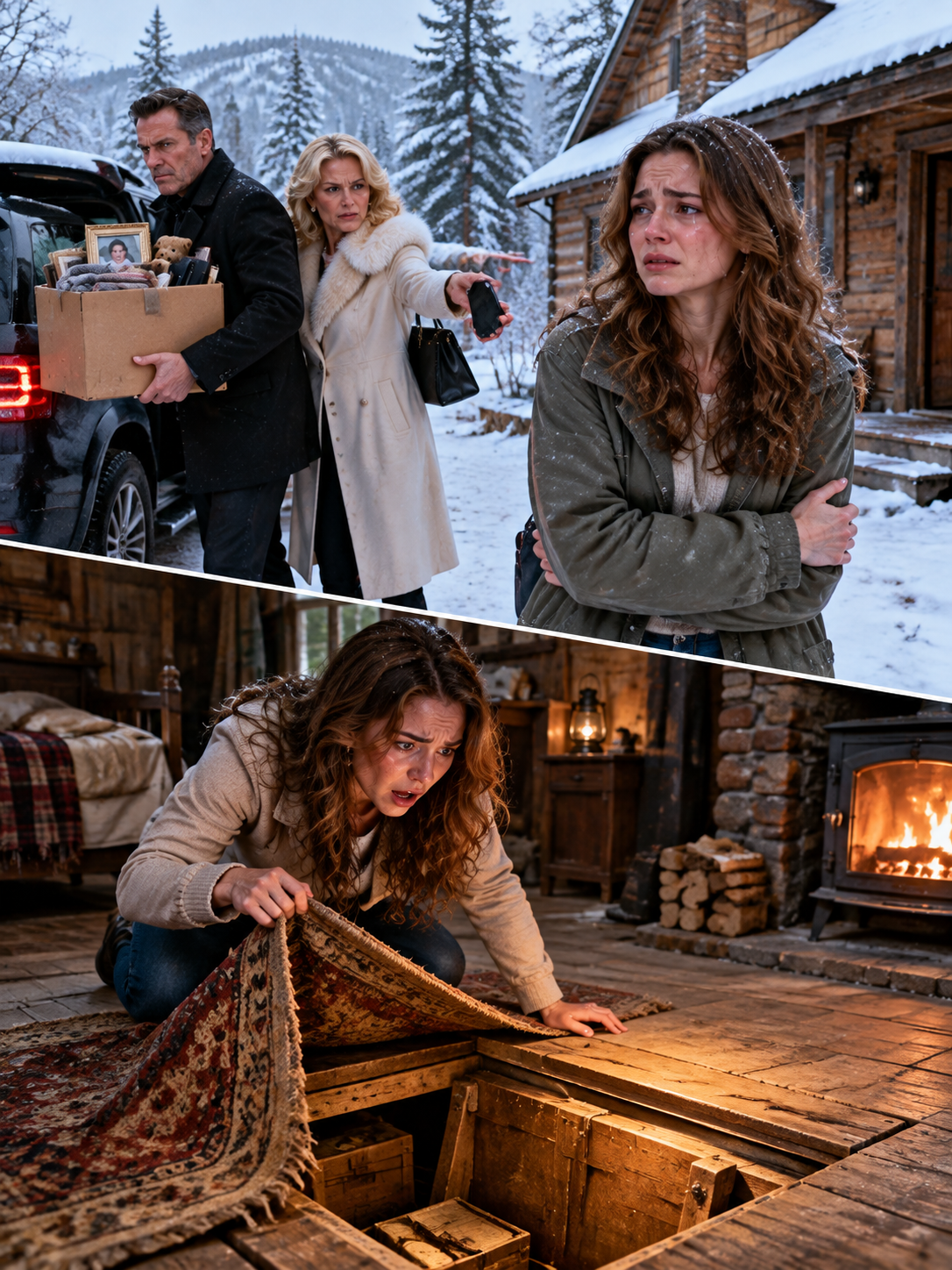
My Father Left Me to Freeze in an Abandoned Mountain Cabin. He Never Knew What My Mother Had Hidden Beneath the Floor.
At nineteen, I watched my father drive away from a freezing mountain cabin while my stepmother kept my phone, my savings, and the last possessions of my dead mother. They expected me to come crawling back, grateful for whatever conditions they imposed. Instead, a starving dog led me to a secret beneath the floorboards, and I found a message that changed everything I thought I knew about my family. But the most painful discovery wasn’t what my mother had hidden. It was what my father already knew.
Part 1
The day my father abandoned me on Bellamy Ridge, he kept rubbing his leather-gloved thumbs along the steering wheel. Snow struck the pickup windshield, and the heater smelled like burnt dust. Beside him, my stepmother, Cynthia, checked her watch.
“We’re doing you a favor, Clara,” she said. “Nineteen is old enough to learn independence.” My duffel contained four shirts, two pairs of jeans, and a toothbrush. My winter coat, work boots, and every dollar I’d earned at the Pine Creek Diner were still at home. Cynthia had emptied my closet while I was at work and called it a practical move, as though the decision had been settled long before I knew.
I had saved $2,480 in tips inside a cookie tin beneath my bed. Cynthia took it that morning, saying she would return it once I became “responsible.” When I appealed to Dad, he stared at the dashboard, just as he had whenever Cynthia made a decision since their wedding eight years ago.
The cabin appeared beyond a broken fence, its roof sagging beneath January snow. Dad pushed open the door to one room smelling of cedar and damp ashes, furnished with a woodstove, a bare iron bed, and a rusting hand pump. “There’s wood behind the shed,” he said. When I asked how I would reach my job eleven miles downhill, Cynthia answered, “You’ll have time to think about that.”
Then she demanded my phone. I refused until Dad murmured, “Don’t make this harder.” He loaded one last thing into the pickup: a taped shoebox with my name written on it in my dead mother’s handwriting. Inside were her pictures, earrings, homemade cassette tapes, and a chipped blue glass bird she’d kept on our kitchen windowsill.
“Please, not that,” I begged, following him through snow that filled my sneakers. Cynthia shut the tailgate and promised to keep it safe. Dad climbed behind the wheel without meeting my eyes. His taillights vanished among the pines before I could think of another word to say.
Before Mom died when I was nine, Dad coached softball and burned pancakes into dinosaur shapes. Afterward, Cynthia arrived and made every decision: painting over Mom’s yellow kitchen, giving my room to her son Logan, charging me rent at eighteen. Each time I complained, Dad insisted she was helping us move forward. Apparently moving forward meant leaving me behind.
By dusk, the cold had worked through my sweatshirt. I managed to light the stove with dry pine and old newspaper, ate a granola bar from my diner apron, and slept on a braided rug. Each time the fire faded, I woke shivering and fed it another log. I wondered when my coworkers would realize I was missing. The diner was the only place where people asked how my day had gone and waited for a real answer.
A whimper drew me behind the woodshed the next morning. A shepherd mix lay between stacked logs, his muzzle gray and one hind leg stiff. His worn collar said RANGER, and he watched me without growling. I divided my second and last granola bar between us, then helped him limp indoors.
Ranger slept beside the stove while I fought the hand pump for water. The cupboards held nothing edible, and I couldn’t carry an injured dog eleven miles down an icy mountain road. That evening I lay beside him, listening to the wind press against the windows. “I guess we’re both unwanted,” I whispered.
Ranger sniffed the edge of the braided rug and began scratching. Cold air seeped through the floor where his nose pointed, so I dragged the rug aside and brushed years of dust away. There was a square outline in the planks and a black iron ring sunk into one corner. My pulse beat against my throat as I hooked my fingers through it.
The hatch rose with a groan, releasing the smell of cold stone and something strangely sweet. A ladder disappeared into darkness, and Ranger barked as though he’d been waiting for me to find it. Someone had hidden an entire room beneath the cabin. Whatever was down there had been concealed for years.
Part 2
I took a candle from the mantel and climbed down the ladder, one hand sliding along cold rungs. Stone walls enclosed a cellar lined with shelves: jars of tomatoes and peaches, rice, blankets, lanterns, batteries, and a first-aid kit. Several food labels bore dates from the previous October. Some had little circles marking which supplies should be used first. Whoever had packed these shelves had planned for somebody to survive a long winter.
I nearly laughed when I spotted a forty-pound bag of dog food. Ranger thumped his tail while I hauled it upstairs. I checked the date, filled a bowl, and watched him eat before warming canned soup for myself. The first spoonful burned my tongue, and I didn’t care.
Someone had cared for this place while the world forgot it. I found a jar set apart from the others, labeled “Merry’s Plum” in blue ink, dated last September. My mother, Marianne, had been called Merry by her grandmother, and I hadn’t heard that name since her funeral. Suddenly the little cellar didn’t feel entirely abandoned.
At the far wall stood a steel document box, an iron safe, and a bundle of envelopes wrapped in green ribbon. I carried the document box upstairs and opened it beside Ranger. Inside was a folded letter marked “For Clara” in handwriting that made my chest tighten. “My darling girl,” it began, “I hope you never have to read this here.”
Mom wrote that during her illness, she watched my father retreat from difficult decisions and depend on other people. She hadn’t known who might enter our lives after she died. She feared only that his need to be cared for might become more important than caring for me. “If that happens,” she wrote, “I want you to have choices.”
The cabin belonged to her grandmother, who had built the stone cellar after losing her husband. Mom had arranged for the cabin and forty acres to pass to me through a trust, with an attorney named Ruth Kessler overseeing the documents. Dad thought the property was a worthless family shack. Mom had deliberately kept him from learning its value. That secrecy unsettled me until I remembered how Cynthia appraised every object in our house before deciding whether it was worth keeping.
“There is a neighbor named Owen Sutter,” she wrote. “He promised to check the cabin and restock the cellar every autumn.” He lived three miles down the ridge and had known her since childhood. Mom asked him to store dog food, too, because she suspected I’d always stop for a hungry animal. I glanced at Ranger, sleeping with his nose against my ankle.
The letter explained that the safe’s combination was my birthday and that its contents would be mine as an adult. There were letters for every birthday from ten through nineteen. I touched the grooves left by her pen and thought about how Cynthia had discarded Mom’s sweater, removed her photographs, and called my grief childish. Now Mom was speaking from a room Cynthia never knew existed.
I returned below and turned the safe’s wheels to 0-6-2-1, my birthday. Inside were an envelope thick with papers, a cassette player wrapped in flannel, batteries, and a photograph of Mom smiling on the cabin porch. The envelope bore my full name, Clara Marianne Reed, above the words “Bellamy Family Trust.” My hands shook as I broke the seal.
There was a deed, financial paperwork I couldn’t understand, and a list of dates when the attorney was supposed to contact me. Beside the cassette lay a note in Mom’s handwriting: “Before you decide what your father owes you, learn what became of the money intended for your care.” I’d never known there was any money. Dad had spent years telling me we could barely afford groceries.
I climbed back upstairs with the papers pressed against my chest. Outside, wind scraped ice against the window, and Ranger slept on as though nothing in the world had changed. I had arrived believing my father had taken everything I owned. Now I was holding proof that someone had kept something far bigger from me.
Part 3
I spent the morning reading the birthday letters beside the stove. At ten, Mom told me grief didn’t follow a schedule; at twelve, she hoped I’d found one true friend; at fourteen, she reminded me that quiet people could still be brave. At sixteen, she described her grandmother carrying stones from the creek to build the cellar without asking permission.
The envelope marked eighteen made me pause. “Ruth should begin contacting you this year,” Mom wrote. “Keep every letter, and ask questions if someone says money isn’t your business.” The note for nineteen said the trust would become fully mine after that birthday. I’d turned nineteen the previous June, and nobody had mentioned Ruth Kessler.
Dad sometimes opened my mail, claiming it was an accident. Cynthia controlled the household paperwork, including accounts she insisted I didn’t need to see. I remembered her telling Dad last autumn to stop answering calls from “that interfering lawyer.” He said she’d meant a customer at his insurance office, and I had believed him. Now the memory felt like a warning I’d walked straight past.
I checked the batteries twice because I couldn’t bear to damage the recording, whose old plastic smelled like the box where Mom stored our holiday decorations. I finally put the batteries in and pressed play. After a hiss of static and a distant bird call, my mother’s voice filled the headphones, warmer than the voice I held in memory. “Hi, my brave girl,” she said. I folded forward with both hands over my mouth.
She was recording on the porch in September, while the aspens turned gold. She had made plum preserves with Owen and hoped the tree would still bear fruit when I grew up. She described a wooden footbridge behind the cabin where she used to imagine the woman I’d become. She wanted me to visit it when spring arrived.
“I can’t promise nobody will disappoint you,” she said. “I can tell you their choices don’t define your worth.” She hummed the tune she sang while brushing my hair, missed a note, and laughed at herself. The tape ended after a whispered goodnight, and I replayed her laugh until I knew every breath around it.
For the first time in years, I cried without worrying Cynthia would tell me to stop. Ranger crawled across the rug and pushed his head under my arm. I held him, feeling the rough fur behind his ears and his heartbeat. Whatever was in the trust, I’d have traded it for another ordinary morning with Mom.
By the third day, the wind had settled. I cleaned a pot, dried my socks, and sorted the recently stored supplies, while Ranger ate steadily and moved more comfortably on his bad leg. Yet he kept rising to sniff the door and pacing between the stove and porch. Something outside mattered more to him than food.
On the fourth morning he barked until I opened the door, then hurried past the woodshed. I thought he wanted to go outside, but he continued downhill, stopping to look over his shoulder. When I called him back, he whined and turned onto a trail almost hidden between two pines. His urgency made me follow.
I packed water, food, a blanket, and matches, then pulled on extra socks. Snow crust broke beneath my sneakers, soaking them as Ranger limped ahead, never losing sight of me. After almost two hours, the trees opened around another cabin with a green pickup parked beside it. No smoke rose from the chimney.
Ranger clawed at the door until I pushed it open. The room smelled of stale coffee and ashes, with an overturned chair beside the cold stove. An elderly man lay under a blanket, one arm strangely still, and Ranger hurried to lick his cheek. The man’s eyes opened, and he whispered, “Merry?”
He studied my face as I knelt beside him, searching for a resemblance I had never thought much about. “No,” he murmured, voice faint but certain. “You’re her little Clara.” I knew then I’d found Owen Sutter, and that he was in serious trouble.
Part 4
Owen’s breathing was shallow, and one side of his face barely moved. I suspected a stroke, but the wall telephone was dead, and there was no cell service on the ridge. Ranger stood beside him, trembling. “How long?” I asked, and Owen managed to whisper, “Thursday.”
It was Tuesday. I got a fire going, covered him with blankets, and searched for help. His pickup keys hung beside the back door, and a wooden sled stood in the shed. I asked whether he could get into the truck, but he shook his head and pointed toward the sled.
Moving him frightened me, but leaving him was worse. I padded the sled, eased him onto it, and pulled him across packed snow toward the pickup. With a board as a ramp and Owen using his stronger arm, we managed to get him into the passenger seat. Ranger climbed into the back and refused to budge.
I drove downhill gripping the wheel until my hands cramped. I’d learned to handle icy roads while making diner deliveries, but never with somebody’s life beside me. At Pine Creek Medical Center, I ran through the doors yelling for help. A nurse rushed out with a wheelchair, and Owen disappeared into the emergency department.
Dr. Samuel Cho found me an hour later, still wearing wet sneakers. Owen had survived a stroke and severe exposure to the cold, and the team had started urgent treatment. “Bringing him here made a difference,” he said, although recovery remained uncertain. I sat by Ranger in the covered entrance and finally cried from exhaustion.
Dr. Cho asked whether I had a safe place to sleep, then helped arrange one through a hospital social worker. The social worker also called the diner so my boss would know I was safe. I asked her to contact Ruth Kessler, whose law office stood above the hardware store. The next morning, I walked into Ruth’s office carrying the trust documents in a borrowed tote bag. She recognized my face before I spoke.
Ruth was gray-haired, with reading glasses hanging from a chain. “I’ve been trying to reach you for over a year,” she said, opening a thick folder. Five certified notices were addressed to me, each signed for by Cynthia Reed. Ruth had also phoned repeatedly and twice been told I lived in Denver.
“I should have kept looking,” Ruth said without making excuses. I told her I’d been working three blocks away at the diner. She closed her eyes, then spread the trust documents across the desk. I could smell peppermint tea cooling near her elbow, and I gripped my chair to steady myself. What she showed me was more shocking than the secret cellar.
Mom’s life insurance had funded the trust with $300,000, and it had paid Dad $1,200 monthly for my care while I was a minor. Investments had grown the remaining funds, leaving approximately $258,000 in my name, plus the cabin and forty acres. I stared at the statement, remembering every time Cynthia said my needs were too expensive.
Ruth had questioned the annual expense reports for years. Bank records and missing receipts suggested that at least $43,000 meant for my care went instead toward Cynthia’s account, Logan’s tuition, and the remodeled kitchen. “We’ll seek a full accounting,” Ruth said, “and pursue repayment where the evidence supports it.” I thought of paying rent out of diner tips while Cynthia bought new appliances.
Then Ruth revealed that Dad had called her the night he left me on the mountain. He had been crying, asking whether the cellar contained food, but he hadn’t returned; Ruth’s calls to Owen went unanswered, and she had started arranging a welfare check. “Why didn’t Dad come back?” I asked. Ruth replied, “He said Cynthia wouldn’t let him.”
The radiator clicked beside her window. Dad had known I might be hungry and freezing, yet he’d stayed home because another adult told him to. Ruth reached across the desk and asked what I wanted to do. I said, “I want my mother’s things back, and this time I’m not going there alone.”
Part 5
That afternoon, Ruth drove me to Aspen Lane, with Deputy Marcus Vale following in a patrol car. Cynthia opened the door holding a coffee mug, and her face went still when she saw us. Behind her, Dad emerged from the kitchen wearing the sweater he’d worn on the mountain. He took one step toward me before I moved away.
“I want Mom’s shoebox, my savings, and my phone,” I said. Dad looked at Cynthia, which told me everything about the past decade. “Get the box,” I said. “Don’t ask her.” He went to the garage without another word.
Cynthia tried to usher us inside, but Ruth stayed on the porch and showed her the certified mail receipts. Cynthia claimed she didn’t remember signing them, then said she’d been protecting me from complicated finances. Deputy Vale explained that the missing money would be investigated and relevant records must be preserved. For once, Cynthia couldn’t talk her way around the truth.
Dad returned carrying the gray shoebox marked with my name. All eleven photographs remained, along with Mom’s earrings, cassette tapes, and the glass bird with its chipped wing. I lifted the bird toward the winter sunlight, and a blue patch appeared on the snow. Dad began crying.
“I called Ruth that night,” he said. “I was scared, Clara, and I wanted to come back.” I looked at the man who had taught me to ride a bicycle but let somebody else decide whether I deserved shelter. “But you didn’t,” I said. “Mom prepared that cabin because she worried you would choose your comfort over my safety.”
Dad said Cynthia had made everything difficult after Mom died. I reminded him that I had been nine and that grief hadn’t relieved him of the duty to protect me. “I won’t be coming back,” I said. When Cynthia called me ungrateful, Dad finally told her to stop talking, ten years too late.
The investigation lasted months. After the financial records were reviewed, Cynthia accepted responsibility under a court agreement requiring restitution for money diverted from my support. Dad returned my $2,480 in savings and apologized for his part in it. Neither payment purchased forgiveness, and when Cynthia eventually moved away with Logan, I felt only relief.
I used part of the trust to repair the cabin, install reliable heating, and enroll in community college. Owen recovered slowly but couldn’t safely return to living alone. We added a ground-floor bedroom overlooking the plum tree, and he moved in after rehabilitation. He insisted on teaching me to make jam the way Mom had.
Ranger grew stronger and learned to chase leaves despite his crooked hind leg. Owen told me the dog had left his house after the stroke and gone searching for help, somehow finding my cabin. I often thought about how close all three of us came to vanishing into that winter. We’d survived because Mom had made room for someone who might need shelter.
Dad sent occasional messages, including a photograph of his kitchen painted yellow again. I never answered. He was entitled to regret his decisions, and I was entitled to a future that didn’t include him. The money bought me independence; keeping my distance gave me peace.
In spring, I walked to the wooden bridge behind the cabin while snowmelt rushed beneath it. I held Mom’s glass bird against the sunlight and hummed the tune from her cassette. Ranger leaned against my knee while Owen watched from the path. For the first time, the song felt like a beginning rather than a goodbye.
Last October, I stocked the cellar myself with food, blankets, and plenty of dog food. At eye level, I placed a jar of plum jam made from Owen’s copy of Mom’s recipe, labeled “For whoever needs a way home.” Then I closed the hatch and spread the braided rug over it. My father had left me in that cabin believing it was the end of my life, but my mother had quietly prepared the place where it would begin.
Legal Notice: This story is a work of fiction. Names, characters, businesses, events, and incidents are the product of the author’s imagination or are used fictitiously. Any resemblance to actual persons—living or dead—or to actual events is purely coincidental. Thank you! 💓


