
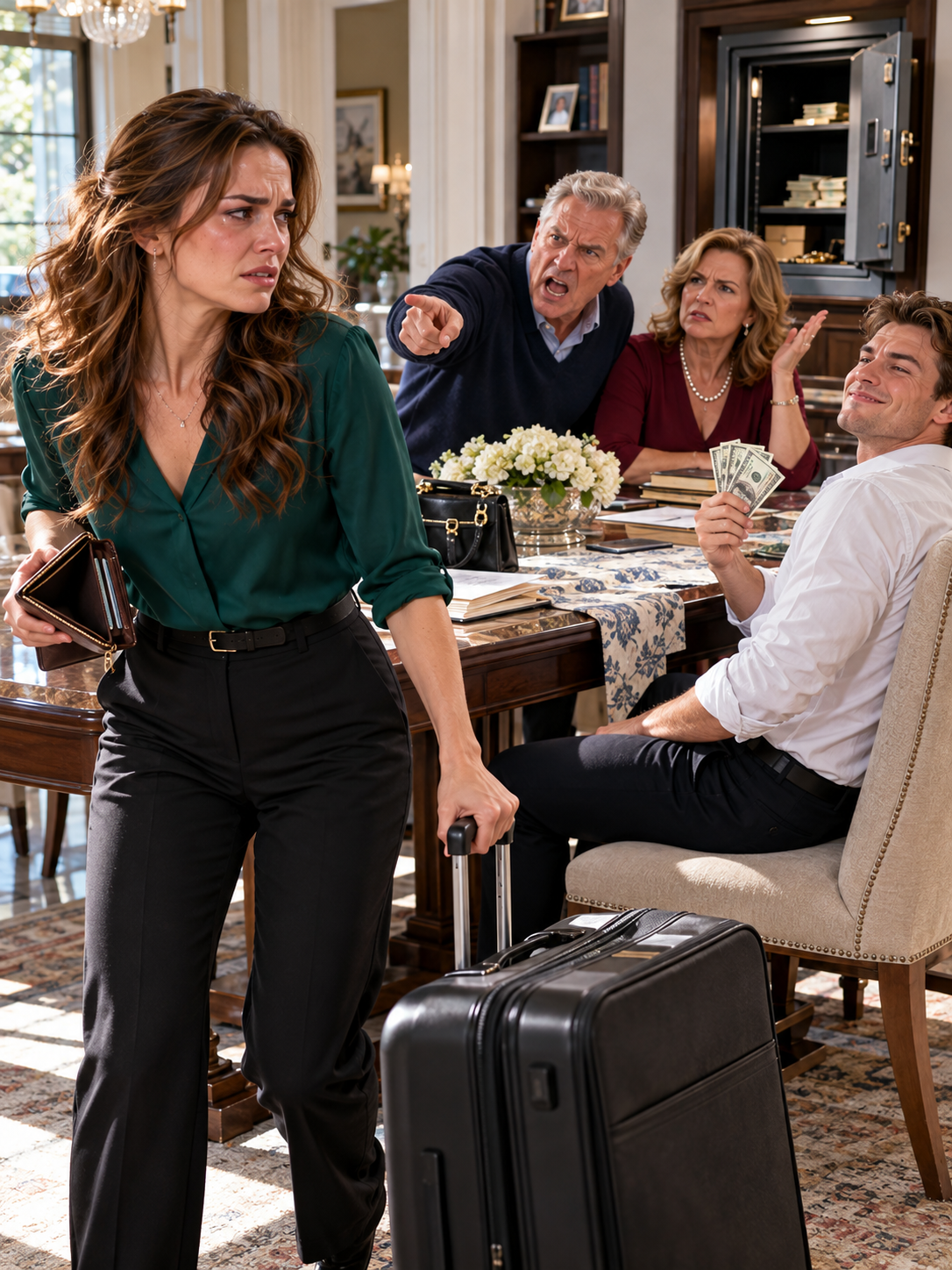
My Parents Made Me Apologize to My Brother for Stealing $400—Then $6,000 Vanished From Dad’s Safe
I caught my younger brother stealing four hundred dollars from my wallet, and my parents made me apologize to him for leaving cash where he could find it. I moved out before they could teach me another lesson about being the bigger person. Three weeks later, six thousand dollars vanished from my father’s locked safe, and suddenly everyone wanted my help. I thought the missing money would finally expose my brother. Instead, it led me to a secret my father had kept since my grandfather’s funeral.
Part 1
The Saturday my family finally lost me started with a flat tire and the smell of burnt toast. I was twenty-six, working at an accounting firm outside Columbus, Ohio, and still living at home because rent was ridiculous. Four hundred dollars in my wallet was supposed to buy two new tires for my pickup, not finance my brother’s weekend. My wallet held only a gas receipt and my driver’s license.
My brother, Mason, was downstairs eating cereal straight from the box, his bare feet on a kitchen chair. At twenty-three, he’d quit two programs and three jobs but remained the family’s favorite investment. “Did you take my cash?” I asked, keeping my voice level. He scratched his neck, gave me his practiced wounded expression, and said, “Why would you accuse me of that?”
I could have argued, but Dad had installed a hallway camera after somebody took packages from our porch. I opened the app and found footage from 2:14 that morning: Mason slipping out of my bedroom with my wallet, counting bills beneath the night-light, then returning it. My mother, Denise, watched over my shoulder as the screen turned her face the color of dishwater. She had spent years saying we should never accuse family without evidence; now we had evidence, and she looked almost offended by it. For one foolish second, I thought proof meant the rules would finally apply to both of us.
Dad arrived in his work boots, watched the clip twice, and called a family meeting. His name was Gordon Mercer, and he could turn any conversation into a hearing where he was the only judge. “Your brother’s struggling,” he said, settling into his recliner while Mason occupied the couch. “You know better than to leave temptation lying around, Evan.”
“He came into my room while I was asleep,” I said, but Mom answered as if I’d interrupted a sermon. “He’s embarrassed enough, sweetheart. You have a good job, and sometimes that makes him feel behind.” Mason looked down, though I caught the corner of his mouth lifting. Dad folded his hands and said, “I think you owe Mason an apology for creating this situation.”
They’d reversed blame before. When Mason wrecked my bicycle at thirteen, I had to apologize for refusing to share it afterward; when he missed my college graduation, they said I should appreciate that he had tried to come. I looked at the framed photographs above the fireplace, nearly all of them showing Mason with trophies or birthday cakes. Then I said, “I’m sorry I left temptation around. It won’t happen again,” and watched him grin.
Upstairs, I sat beside the humming window unit until I stopped expecting somebody to knock and tell me they’d made a mistake. I paid five hundred dollars in rent and covered the internet Mason used for gaming. My friend Ben had an empty bedroom near the interstate, so I called immediately. By lunchtime I’d sent him a deposit and started packing my clothes into two duffel bags.
Mom found me removing my framed diploma from the wall and laughed nervously. “You’re leaving over four hundred dollars?” she asked, while Dad appeared behind her and told me I was making an expensive point. I explained the money wasn’t the point, but they didn’t listen. Mason leaned in my doorway and announced that he’d planned to pay me back, though he’d just ordered expensive delivery food.
I loaded my truck on Sunday beneath a low gray sky, leaving furniture behind because it wouldn’t fit. Dad stayed at the kitchen window, Mom warned I’d be home before the rent came due, and Mason never offered to carry a bag. Ben met me outside an apartment that smelled of fresh paint and somebody else’s coffee, and handed me a key without asking for an explanation. For the first time, a door closed behind me without making me feel trapped.
That peace lasted twenty-three days. On a Tuesday evening, my phone lit up with Mom’s name, and behind her frightened voice I could hear Dad demanding, “Ask him where the money went.”
Part 2
I was standing in Ben’s narrow kitchen, stirring boxed pasta, when Mom finally said the number. “Six thousand dollars is missing from your father’s safe,” she whispered, as if speaking more loudly might make it real. Dad kept emergency cash and money for a fishing boat in a fireproof safe behind his bedroom coats. I’d seen him open it a hundred times, but he’d always shielded the dial with one shoulder.
“Have you asked Mason?” I said, turning off the burner. Mom sighed the way she used to when I pointed out a problem nobody wanted named. “He says he didn’t touch it, and your father is considering every possibility.” Then Dad took the phone and asked whether I still had my old house key, a question that made the pasta turn to paste in my mouth.
I told him the key was on the hook by my apartment door and that I hadn’t visited since moving out. “People do things when they’re upset,” he replied, and the faint television laughter behind him made his accusation sound even uglier. I reminded him that I had a paycheck, a roommate, and no reason to steal from a house I’d worked so hard to leave. “You were angry with us,” he said. “I’m asking because we have to be careful.”
Careful was a new word in the Mercer household; it had never applied to Mason. I asked Dad to check the hallway camera, but he said it had been pointed toward the ceiling for almost a week. Mason had supposedly bumped it while carrying a laundry basket, and nobody had bothered fixing it. That detail sat in my mind after the call ended, like a pebble trapped inside a shoe.
I wanted to drive over, straighten the camera, and demand that they stop treating suspicion as proof whenever it landed on me. Instead, I photographed my spare key on Ben’s hook, saved the message where I’d declined Mom’s dinner invitation, and went back to my food. Ben listened while I told him what happened, then asked a question nobody in my family ever asked: “What do you actually want to do?” I answered without thinking, “Nothing,” and realized I meant it.
The apartment wasn’t much: one bathroom with a rattling fan, a sagging couch, and a freezer that frosted over every other week. But I was studying for the remaining sections of my accounting certification, picking up weekend bookkeeping clients, and sleeping without listening for footsteps outside my door. My boss, Meredith Shaw, noticed I’d stopped looking exhausted at Monday meetings and gave me a demanding dealership account nobody else wanted. I accepted it, partly because I needed the money and partly because it felt good to be trusted.
Two weeks later, my aunt Celia called while I was balancing invoices at the dining table. She’d heard from a family friend named Russell, who owned a landscaping company, that Mason owed him three thousand dollars from a supposed business venture. Dad had quietly covered the debt, and Russell was angry enough to tell people at church. “Your father keeps insisting Mason just needs another chance,” Celia said. “I think he’s run out of chances to hand him.”
I asked whether she knew anything about the safe, but she hesitated. “Your mother says a repairman might have seen Gordon open it,” she said, and I could hear how little she believed that theory. Before hanging up, she mentioned that Dad had canceled his annual fishing trip even though he’d saved for it for years. The detail bothered me more than I expected, because that boat had been his favorite dream long before either of us was grown.
Mason texted the next morning from a number I didn’t recognize. “Can’t you just come home and calm Dad down?” he wrote, as casually as if asking me to pick up milk. I typed three different replies, erased them, and blocked the number. Then Celia sent a second message: “One more thing. Your dad’s been looking through Grandpa Art’s old estate papers again, and he doesn’t want anyone asking why.”
Part 3
My grandfather had been gone for two years, but the thought of his papers still brought back the smell of sawdust and peppermint. Arthur Mercer was a retired electrician with thick fingers and no patience for excuses. In high school, I helped him fix railings, patch his roof, and haul appliances to the dump. He never called me the successful son; he just handed me tools and expected me to finish what I started. When a repair went wrong, he showed me how to fix it instead of pretending the damage wasn’t there.
Dad told us after the funeral that Grandpa’s modest house had been sold to settle bills and there was nothing left. I believed him while finishing my bachelor’s degree at night after community college. Grandpa’s most valuable gift, as far as I knew, was a scratched pocket watch he’d pressed into my palm a week before he died. “Don’t let people confuse being dependable with being available for everything,” he’d told me.
Celia couldn’t explain Dad’s interest in the estate, and I refused to investigate rumors. At work, the dealership account was a mess of duplicated invoices and vendor credits nobody had reconciled. I untangled the errors with their bookkeeper and resolved a costly audit dispute. Meredith called me into her glass-walled office afterward and offered me a senior role with a raise large enough to make my student-loan payment seem less frightening.
On the day I accepted, I bought takeout from the Thai place beneath Ben’s apartment and invited him to share it. He raised a paper cup of soda and toasted “happiness without committee approval.” I laughed so hard rice nearly came out of my nose, then felt strangely sad that such an ordinary celebration could mean so much. At home, my promotions had been met with questions about whether Mason was feeling left behind.
I met Maya Ellison at a neighborhood trivia night Ben dragged me to in early spring. She was a physical therapist with paint on her sleeve from renovating her kitchen, and argued cheerfully about a baseball question. We started meeting for coffee, then dinners, without either of us naming it anything serious. When I told her a shortened version of the wallet story, she asked, “Did anyone ever give you your money back?” and waited through the silence that answered her.
Maya didn’t treat my family as a puzzle she was supposed to solve. She said healing required patience and honest limits. I liked the steadiness of her voice, and the fact that she changed the subject when I clearly wanted a break from mine. She didn’t ask me to heal on anyone else’s schedule. One evening she noticed Grandpa’s watch beside my keys and asked about the man who’d owned it, so I told her the good stories instead.
Meanwhile, information about Mason arrived in pieces I hadn’t requested. Russell had been repaid, but Mason still wasn’t working; Mom had taken extra shifts at the school office; Dad had stopped inviting friends over. Then my mother left a voicemail saying she missed me, followed by a second insisting I’d always been “too independent to understand family sacrifice.” I deleted both, went outside to breathe in the damp night air, and returned to my practice exam.
Four months after moving, I passed the last section of that exam, though licensing paperwork and experience verification still remained. Meredith brought supermarket cupcakes, and Ben taped a ridiculous certificate to our refrigerator. I called Celia afterward because I wanted at least one relative to hear good news without comparing me to Mason. She cried a little, then said, “Art would have made you take him out for pie.”
The following Monday, Dad called for the first time since accusing me over the safe. His voice was careful, almost formal, and he didn’t mention Mason, my job, or the missing money. “A lawyer has contacted me about your grandfather’s estate,” he said. “There’s a document with your name on it, and I need you to come sign something before your brother hears about it.”
Part 4
I didn’t go to Dad’s house. I asked for the lawyer’s name, looked up her office independently, and called her from outside work. Sylvia Reed sounded surprised I’d reached her before Dad brought me in, then scheduled a private meeting. “You are entitled to hear what the document says without anyone explaining it for you,” she told me, and I wrote the sentence on the back of a gas receipt.
Her office occupied the second floor of a brick building with uneven stairs and a view of Main Street. On her desk sat Grandpa’s will, signed three years before his death, along with records for a savings account overlooked when the estate was first administered. The bank had recently flagged the dormant funds and contacted the estate’s attorney. After expenses, the account held over forty-two thousand dollars.
I assumed she’d called because Dad needed another signature as executor. Instead, she turned the will toward me and pointed to the line naming Arthur’s son Gordon and his grandson Evan as equal beneficiaries of that account. Mason wasn’t named; Grandpa had carefully written my full middle name. My share would be approximately twenty-one thousand dollars, subject to the final accounting.
The figure should have made me think about a better truck or an apartment without a leaky faucet. I pictured Grandpa holding a crooked board while I worked the drill. Sylvia let me sit with the news before asking whether Dad had already told me about the arrangement. I could still remember Dad refusing to drive me to Grandpa’s house because helping an old man with gutters was, according to him, a waste of Saturday. “He mentioned paperwork, not an inheritance,” I answered.
She slid another page across the desk, and the room seemed to grow smaller. Dad had called the previous day asking whether my portion could be diverted to a three-way family settlement that included Mason, but Sylvia had told him the will couldn’t simply be rewritten. She stressed that people could ask questions without breaking laws; the decision about my share remained mine. I recognized the maneuver anyway, because he’d spent my childhood treating my belongings as the family’s emergency supply.
I asked how an account could disappear during the first estate administration. Sylvia showed me the original inventory Dad had filed as executor, which didn’t list it, then a bank letter sent to the estate’s mailing address months before the case closed. A delivery receipt suggested someone at the house had accepted the letter, though it didn’t establish who read it. I took copies because a question about money was still a question about facts, however much I distrusted my father. She said there could be an innocent explanation, but I was entitled to a proper accounting.
On my drive home, I pulled into a grocery-store parking lot and looked at my phone until the screen went dark. Dad had known that Grandpa loved me, but he’d spent years implying my grandfather hadn’t left anything worth remembering. I couldn’t prove he’d hidden it, and I wouldn’t invent guilt. Still, he’d tried to change its destination as soon as he learned the bank was releasing the funds.
Over the next week I signed the necessary papers after reviewing them with Sylvia, and my inheritance was deposited into a separate savings account. I kept the records, changed my passwords, and left the money untouched. Maya suggested we celebrate with pancakes, but I said I wanted to visit Grandpa’s grave first. Beside the flat stone, I laid down a small bundle of cedar shavings from my latest repair project and thanked him for seeing me clearly.
That night Dad called to say Mason was trying to turn his life around and deserved a chance to start fresh. Mom followed with an invitation to Sunday pot roast, promising my brother wanted to apologize for the four hundred dollars. “We can finally put everything behind us,” she said in a bright, strained voice. Then she added, “Of course, we’re hoping you’ll come prepared to do your part for Mason, too,” and I understood exactly why the table was being set.
Part 5
Mom had made pot roast with carrots, her usual peace offering. I arrived at five with Grandpa’s watch in my pocket and a copy of the estate inventory folded inside my jacket. Dad stared at his water; Mason wore a blue shirt and too much cologne. I intended to speak calmly and surrender nothing. The wallpaper still curled beside the kitchen light switch, exactly where I’d offered to repair it before moving out; nobody had taken me up on that offer.
After three minutes, Dad announced Mason had something to say. My brother looked straight at me and said he’d been wrong to take the cash from my wallet, and wanted to rebuild our relationship. Mom pressed a napkin to her eyes, clearly expecting a heartwarming reunion. I thanked him, though he hadn’t mentioned repayment. I noticed Mom’s hand hovering over the serving spoon, as if she were waiting for a cue before beginning the next part of their performance.
Mom proposed funding Mason’s first month’s rent and a certification course. “It wouldn’t take much out of what Grandpa left you,” she said, pushing a bowl of potatoes toward me. I said, “No. That money isn’t a family fund, and I’m not paying Mason to apologize.” Mason’s sympathetic expression vanished.
“You think you’re better than me,” Mason said, dropping his napkin. “I think you’re capable of finding a job and paying your own bills,” I replied, and Dad told me not to be cruel. I asked whether any of them had ever considered it cruel to make me apologize after being robbed. The refrigerator hummed as Mom studied the tablecloth.
Dad insisted nobody had proved who emptied his safe. “Then why did you suggest I might have done it?” I asked, reminding him of the night he’d wanted to know where my spare key was. Mason shifted in his chair and blurted, “I told you it wasn’t Evan’s fault.” Dad turned, and Mason looked afraid.
I didn’t demand a confession, but Mason gave one anyway. He’d seen Dad enter the combination while looking for an insurance document, opened the safe later, and used the cash to cover obligations he’d been too ashamed to mention. He claimed he’d planned to return it. His voice cracked as he admitted spending much of it on the failed venture that also left him owing Russell. Dad looked exhausted, not surprised; he had suspected all along.
“You let me think I was a suspect rather than confront Mason,” I told Dad. He claimed he was protecting the family; I asked why protecting Mason always meant hurting me. I laid down the inventory, naming Grandpa’s unlisted account, the bank notice, and Dad’s attempted diversion. I asked why a stranger had to tell me about Grandpa’s final gift.
Dad admitted he’d hoped I would willingly share the money if he brought everyone together first. He couldn’t explain the missing account notice, and Mom, for once, didn’t rush to invent an answer. “We were trying to give both boys a fair chance,” she whispered. “You gave Mason endless chances,” I said, standing up, “and gave me responsibilities you called love. I’m not confusing the two anymore.”
I left without hugging anyone, without accepting an apology for the dinner, and without promising another visit. Months later, Celia said Mason found warehouse work and began repaying Dad; I never checked. Mom sent occasional messages asking about my work, and Dad eventually wrote that he was proud I’d passed my exams. I didn’t answer. A late compliment couldn’t undo the past, especially when neither parent had apologized for accusing me of taking the money from the safe.
By autumn, my professional license was finalized, I had a new apartment with a working kitchen faucet, and Maya sometimes came for Sunday coffee. Grandpa’s money stayed set aside for a future home, his scratched watch beside my keys. I still missed the family I had wanted, never the one that had existed. My parents had once demanded an apology for leaving temptation within reach; what I gave them instead was the one thing they’d never taught me to claim—my own life.
Legal Notice: This story is a work of fiction. Names, characters, businesses, events, and incidents are the product of the author’s imagination or are used fictitiously. Any resemblance to actual persons—living or dead—or to actual events is purely coincidental. Thank you! 💓


