
My 5-Year-Old Son Switched Our Plates at a Family BBQ—20 Minutes Later, My Wife Collapsed and Exposed a Terrible Secret
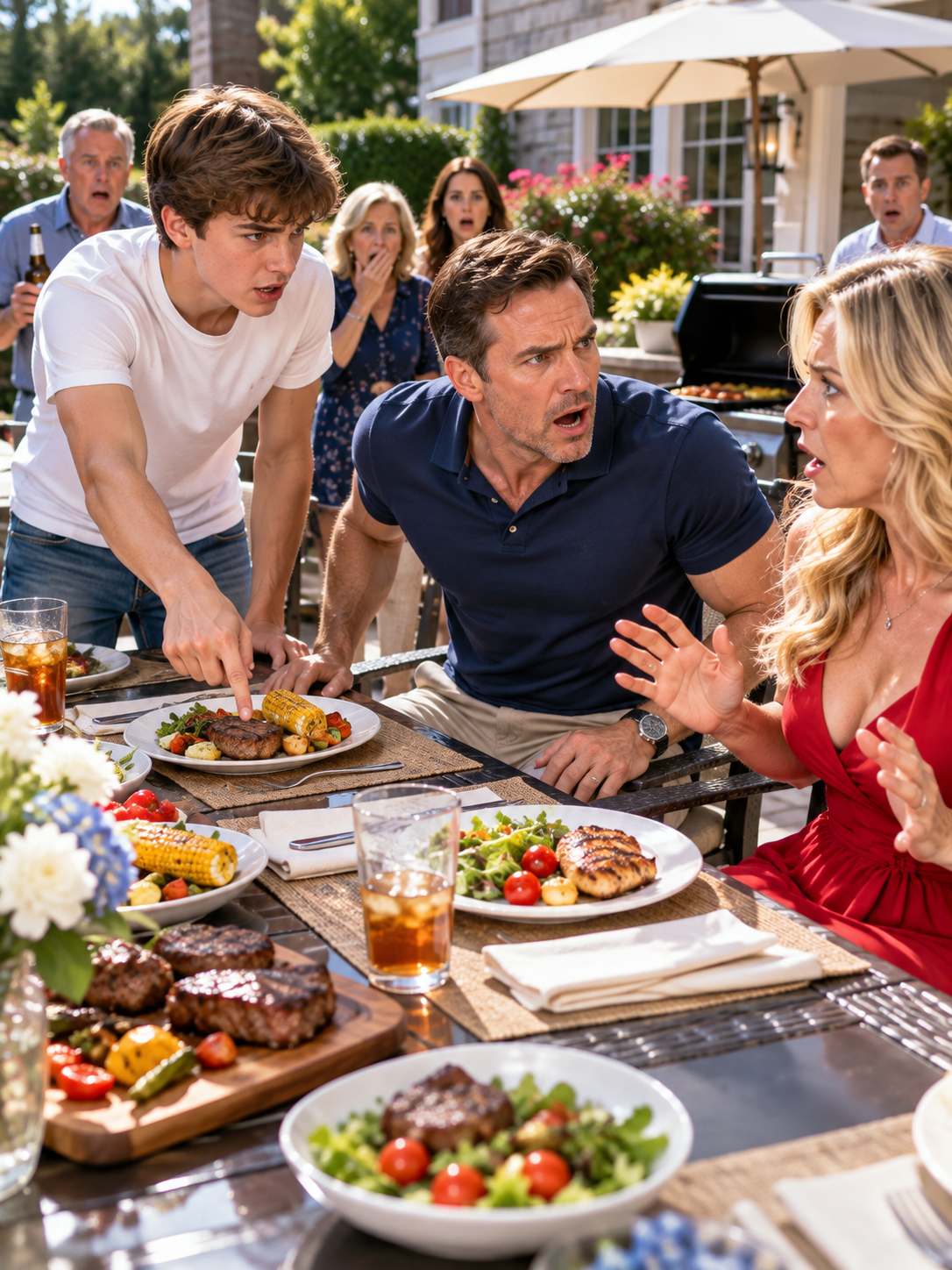
At my mother-in-law’s barbecue, my five-year-old son quietly switched my dinner plate with my wife’s and whispered, “Let Mommy eat that one, Daddy.” I laughed because I thought he was playing a game. Twenty minutes later, my wife collapsed, and the expression on my son’s face made me realize he’d been trying to warn me for months. I was a beekeeper who could recognize trouble in thousands of hives, yet I had missed the danger sitting at my own kitchen table.
Part 1
The first thing I remember is the potato salad sliding toward the edge of the table. My son, Ollie, was standing on a folding chair, struggling to switch two heavy dinner plates without spilling the beans. “Easy, buddy,” I said, reaching to help, but he planted one small palm on my plate and whispered, “Let Mommy eat that one, Daddy.” I laughed, because at five years old, Ollie still believed swapping things could change the rules of a game.
My name is Daniel Mercer, and I kept bees outside a little fruit-growing town in western Michigan. My father had started with twelve hives in a borrowed field; now I ran nearly six hundred colonies. I supplied pollination colonies, sold honey, and raised queens from Dad’s prized breeding line. I could tell which orchard needed extra colonies from the flowers along its fence, but I couldn’t tell what was happening in my own house.
Three years before that barbecue, I’d started having strange spells. Once, after Sunday lunch at my mother-in-law’s, my hands shook so badly I pulled my truck onto a gravel shoulder. On Thanksgiving, words came out of my mouth blurred and wrong, and I sat on her kitchen floor while somebody wondered aloud if I’d been drinking. By morning I was normal again, except for crushing exhaustion.
Doctors tested my heart, studied my brain, and asked about stress. Their scans looked normal, and bloodwork taken between episodes offered no clear answer. My wife, Lauren, began leaving articles about exhaustion on my pillow; her brother, Scott Vale, told relatives I sometimes had “neurological attacks.” I stopped correcting them; arguing made me sound unstable.
Scott was the family’s dependable one, the man who arrived with a tow rope when your car went into a ditch. He’d also started his own pollination company after watching mine grow, though he changed trucks more often than he talked about his bees. He asked oddly specific questions about contracts and my numbered queen tags. I mistook his curiosity for professional envy, the sort brothers-in-law are supposed to outgrow.
Lauren had grown up taking Scott’s advice as gospel. He’d helped raise her after their father left, and she never seemed able to imagine him being wrong. I worked sunrise to sunset during bloom; she resented the absences, and we blamed each other for our loneliness. Still, I believed the way she fixed my plate at every family meal was a small proof that we were all right.
The day before the barbecue, Ollie came into the honey barn while I was washing a sticky extractor. “Does Grandma’s bedtime stuff make people wobbly?” he asked, examining the soap bubbles running down my wrist. I told him never to touch grown-up things. He nodded, then asked whether he could carry the empty smoker, and I let the question vanish beneath work.
Saturday arrived bright and hot, with a lawn sprinkler ticking beside Helen Vale’s maple tree. At Scott’s birthday cookout, Helen grilled ribs beneath peppery smoke. I had driven colonies before dawn and was too tired to notice Scott watching Lauren carry our plates out of the kitchen. Ollie, though, noticed everything.
After Ollie switched the plates, Lauren returned with lemonade and sat down in her usual chair. Scott asked twice whether I was feeling all right, touching my shoulder as if he expected me to faint. “I’m fine,” I told him, suddenly annoyed, while Lauren reached across the table for her glass. Her fingers stopped short, and her smile disappeared.
She pushed back her chair, managed one unsteady step, and sank onto the grass. I knelt beside her as her face went pale and her answers became confused. The family called it the heat, but I recognized that distant look immediately; I’d seen it reflected in hospital windows after my own spells. I told somebody to call 911, and Ollie appeared beside me hugging his yellow toy truck.
He looked at his mother, then at the plates on the table, and whispered, “I told you, Daddy.” Behind him, Scott was staring at Lauren’s half-eaten food with an expression I’d never seen on his face. It wasn’t worry. It was recognition.
Part 2
The ambulance came with its siren off and left with it screaming. I followed, the smell of smoke still on my hands. At the emergency room, a nurse asked whether Lauren had a condition that affected her blood sugar. “No,” I said, and the question settled heavily in my stomach.
Dr. Priya Nair explained that Lauren had arrived with a dangerously abnormal reading, which the emergency team had treated immediately. They were testing for an outside cause. I told her about my episodes and the plates; her expression sharpened. “Did your son say why?” she asked.
I opened my mouth and realized I didn’t know. I’d given Ollie a hundred instructions that week. I hadn’t asked a single follow-up when he’d said something strange. Dr. Nair told me to let professionals speak with him and to avoid asking questions that might shape his answers.
By evening Scott had arrived with his mother and a comforting voice I suddenly couldn’t bear. He put an arm around me in the waiting room and announced that the doctors should know about my “mental lapses.” “We’re worried Daniel’s been under terrible strain,” he said to a deputy taking preliminary notes. I watched the deputy write it down, and my skin prickled.
“That’s not what happened,” I said, but Scott kept talking as if I weren’t there. He mentioned times I’d collapsed, my frustration with doctors, and a supposed fascination with Helen’s household medications. I’d once carried Helen’s groceries; apparently that counted as evidence. What sounded to me like carefully planted suspicion sounded to everyone else like family concern.
Ollie waited with my sister, Rachel, beside a vending machine that buzzed louder than the television. When I crouched to hug him, he stiffened and asked whether Mommy was going to wake up. “The doctors are helping her,” I said, “and you did nothing wrong.” Rachel took him home when visiting hours ended, leaving me alone with cold coffee and a phone full of missed calls.
Lauren regained consciousness the next afternoon, frightened and weak. Scott was already beside her bed when I arrived. Lauren looked past my shoulder instead of at me. “Scott says Ollie thinks you told him to move the plates,” she said, and for a moment I couldn’t make sense of the words.
“I didn’t know he was going to touch them,” I answered, keeping my voice low. “You know me, Lauren.” She stared at the blanket and said her brother wanted her to stay with Helen until things settled. I left because arguing beside a hospital bed would only give Scott another story to tell.
Two days later an attorney delivered notice of a temporary protective order, along with a petition requesting primary custody of Ollie. The allegations described me as unstable and claimed I’d influenced our son’s account of the barbecue. I read the pages beneath the flickering barn light. For the first time since childhood, I felt afraid of losing something more important than my livelihood.
My attorney, Rebecca Sloan, listened while I paced between pallets. “You need records that existed before the barbecue,” she told me. “Not arguments, not guesses, and not a confrontation with Scott.” She arranged an independent interview and asked for my medical records.
Rachel arrived that night carrying a casserole and a memory she could barely say aloud. In April, Ollie had told her, “Mommy puts Grandma’s stuff in Daddy’s dinner,” and she’d assumed he meant seasoning or vitamins. She’d laughed, offered him a popsicle, and forgotten it. We sat quietly until the barn’s security light snapped on outside.
I took three years of wall calendars from a filing drawer and spread them beneath the work lamp. Almost every mark I’d made for a spell sat beside a family dinner, birthday, or container of leftovers from Helen’s kitchen. I had been searching my body for a pattern while the pattern hung on a nail. Then Rachel pointed toward my business ledger and said, “Daniel, why does Scott’s company have your registration number on this invoice?”
Part 3
Rachel’s finger rested on a photocopied contract from a blueberry farm south of town. Across its upper corner was my state apiary registration number, my father’s old number. The company listed beneath it belonged to Scott. It promised eighty colonies at an impossibly low price.
Rebecca arranged to receive a copy from the grower, who had already disputed Scott’s performance. The farmer, Warren Pike, met me beside harvested blueberry bushes. “I paid for eighty and got fifty-three,” he said, showing me pictures taken during bloom. Scott had blamed a rough winter while showing Warren my credentials.
At home I checked the yard log that my foreman, Luis Herrera, maintained whenever I was ill. Sixty-two colonies had disappeared from three outlying locations during the weeks I was dealing with lawyers. Luis had assumed I’d authorized a transfer because a familiar company truck had been seen near one yard. “It looked like Scott’s,” he admitted, rubbing a thumb over the grease on his hands.
The theft report I filed felt embarrassingly small compared with the custody case, until the investigating deputy asked about queen markings. Each of my breeder queens carried a numbered colored disc, and I photographed the tags before selling or moving colonies. Luis and I compared those records with our inventory. The missing colonies weren’t anonymous boxes; they held living identification numbers.
That night I stared at the photographs of Ollie lining the refrigerator. At three, he’d counted pollen-laden bees beside me. In another, Lauren was laughing as he tried to help plant sunflowers. If Scott had exploited my business, why had my wife defended him so fiercely when everything began to unravel?
Rebecca told me the hospital investigation had produced an important finding: Lauren’s episode was consistent with exposure to a substance that can cause a dangerous metabolic reaction. The result couldn’t identify who was responsible. I sent my own historical medical records for review; my earlier tests had been taken when I was already feeling better. We had a theory, but theories couldn’t return my son.
At the next family-court hearing, Scott sat behind Lauren in a crisp blue shirt and nodded sympathetically whenever my health history came up. Rebecca presented the hospital findings and requested independent evaluation. The judge kept restrictions on contact with Lauren but authorized supervised parenting time for me and Ollie. I managed not to cry until I reached the courthouse parking garage.
Ollie met me the following Tuesday in a playroom smelling of crayons and disinfectant. We built a block tower while he described his new picture book. I wanted to ask what he’d seen, but I didn’t; the interviewer had already scheduled a formal meeting. Instead, I asked whether our tower needed another blue block, and he said, “No, Daddy, this one’s strong.”
Two weeks later, Rebecca summarized the independent interview. Ollie had described seeing Lauren put something unfamiliar into my food at several family meals, then watching adults insist everything was fine when I became sick. He had moved the plates because he didn’t want me to have another spell, not because anyone coached him. His account matched what he’d told Rachel, and hope returned.
But the files also raised another question. Scott had photographed me looking ill at gatherings and sent the pictures to growers with messages suggesting I could no longer manage my operation. Some customers had been persuaded to shift their contracts to his company, while others received certificates bearing my registration number. He wasn’t merely taking bees; he had been turning my sickness into a business strategy.
I stood in the queen-rearing yard the night Rebecca called, surrounded by the steady, low hum of colonies preparing for winter. Scott needed young queens to fill contracts he’d signed for the following spring, and I had exactly what he lacked. I also had no intention of risking another confrontation in the dark. By the time the last light faded, I knew what kind of evidence might follow stolen hives farther than my word ever could.
Part 4
Rebecca refused to let me set a trap that depended on catching Scott myself. “Your job is to protect the business, document what you own, and stay away from him,” she said. So I prepared an accessible holding yard beside a county road, filled it with sixty strong colonies, and recorded the numbered queens through our usual breeding program. My lawyer and an agricultural investigator received copies.
I also registered the inventory with the cooperative that tracked breeder stock, and installed commercially available location tags on equipment I owned. None of it guaranteed evidence. Most nights I simply checked on the colonies, watched their entrance traffic, and went home. Waiting felt different when someone else had taught my son to be afraid of a dinner plate.
The first alert came in late October, after a cold front blew leaves across the road. Equipment moved without authorization, and Rebecca called investigators. I stayed away while officers gathered footage and shipping documents. The location records eventually led to a broker’s staging lot and, weeks later, to almond orchards in California.
A state agricultural investigator met me in that orchard on a foggy January morning. The air smelled of wet bark, and rows of bare trees disappeared into white distance. The inspector opened colonies with the grower’s permission. On the third inspection, a queen moved calmly across the frame with one of my numbered discs on her back.
The investigator photographed the tag and checked the number against my records and those held by the cooperative. More matches followed, spread across several placements. A broker produced a contract signed by Scott’s company, together with documents containing my business registration information. I stared at the forms and realized Dad’s reputation had been serving as collateral for a stranger’s promises.
The evidence didn’t belong to me alone now. Growers, carriers, and inspectors independently documented the movements. Scott had counted on my supposed unreliability to explain discrepancies, but none of those independent records depended on whether I could remember a family dinner. My father’s handwriting in an old breeding ledger suddenly felt more valuable than a bank account.
While the agricultural investigation progressed, a separate inquiry examined Lauren’s hospital results and Helen’s pharmacy and household records under proper legal authority. Helen had quietly complained about unexplained discrepancies in items she kept for her own medical care. She’d thought she was becoming forgetful and hadn’t wanted anyone to know. The detective, Iris Moreno, told Rebecca the records had begun to make sense alongside Ollie’s statements.
Lauren was interviewed again without Scott or Helen beside her. She admitted that Scott had given her something he described as a harmless nighttime supplement and encouraged her to add it to my food when I seemed exhausted. She said she’d believed him because he’d been caring for her since she was a teenager. It was the first time her account acknowledged what Ollie had seen.
I listened to Rebecca relay the statement from a bench outside the courthouse. Wind rattled the dead leaves against my shoes, and I kept staring at my own hands, wondering how many dinners I’d eaten because I trusted hers. Perhaps Lauren suspected more. What I did know was that she’d watched me spend years afraid of my own health while continuing to follow her brother’s advice.
Investigators later recovered correspondence in which Scott discussed my medical reputation, upcoming contracts, and ways to make Lauren doubt my judgment. In one message, sent after the barbecue, he warned her not to mention their “sleep arrangement” to anybody. Lauren had kept it, even while supporting the petition that painted me as dangerous. Her silence had nearly taken Ollie from me.
Scott was arrested after investigators assembled the linked evidence of theft, fraud, and suspected deliberate harm. News cameras filmed his polished company sign outside the county courthouse as growers began canceling contracts. But the arrest didn’t answer the question my son would eventually ask me: “If Mommy knew I was scared, why didn’t she help you?” I had no answer that could make that betrayal smaller.
Part 5
The criminal proceedings lasted longer than one pollination season, my measure of time. My attorney fought to correct contracts and recover identifiable colonies. Some growers had suffered real losses because Scott promised hives he couldn’t deliver. I showed them my records, knowing vindication couldn’t repay them.
At a hearing that spring, Scott’s attorney suggested I’d developed the accusations after my marriage deteriorated. The prosecutor presented invoices, breeder records, messages, and independent witnesses. The story wasn’t a dispute between brothers-in-law anymore. It was fraud supported by years of making me appear unreliable.
Scott eventually pleaded guilty to multiple fraud and property offenses, along with charges arising from the deliberate interference with my health. He received a lengthy prison sentence and a restitution order. His company disappeared from the county’s pollination listings. The shiny truck that once made him look successful was sold at auction.
Lauren faced her own case. She admitted putting something in my meals without my knowledge and acknowledged that she had continued even after I experienced frightening episodes. She said Scott had lied, and prosecutors weighed her cooperation. The court imposed a custodial sentence followed by supervision, and her opportunities to see Ollie became subject to strict safeguards.
I filed for divorce as soon as my attorney advised it was appropriate. Lauren wrote about our lonely marriage, Scott’s influence, and wanting another chance. I recognized pieces of the truth in those letters, but none changed what she’d done. A lonely wife could ask for counseling, separation, or divorce; she didn’t get to secretly make her husband ill.
Helen had been furious at first, insisting Scott was incapable of hurting anyone. The findings finally shattered her certainty. She apologized to me beneath the maple tree where Lauren had fallen, twisting a tissue until it came apart. I told her I appreciated the apology, but Ollie’s relationship with her would depend on his safety and comfort, not her need to be forgiven.
Ollie returned to my home under a revised custody order. At first he insisted on sitting where he could watch anyone bring food out of the kitchen, and he wanted to know who had prepared every plate. A therapist helped us work through his fear. I stopped calling him my brave little detective; he deserved to be five, not responsible for catching adults in lies.
One rainy evening he asked why Mommy had put things in my food. We were sitting on the hallway rug with a cardboard fire truck between us, and I answered as simply as I could. “She trusted your uncle when she shouldn’t have, and she made choices that hurt me,” I said. “You tried to tell us, and I should have listened sooner.”
He rolled the truck once, then asked whether she loved him. I told him people could love somebody and still make terrible decisions, and those decisions were never the child’s responsibility. He considered that, pressed the little plastic ladder flat, and asked if I could make grilled cheese. I told him yes and let the ordinary request feel like a victory.
Two years later, our bee business was smaller but healthier. Luis became a partner, and I stopped taking contracts that kept me away every weekend. Ollie was seven, tall enough to hold a smoker carefully under supervision, and interested in why some bees carried bright orange pollen. When he asked something unexpected, I made myself look up.
One December night we loaded hives for a commercial grower heading west, the truck lights turning our breath silver. Ollie counted pallets while Luis checked the straps, and I remembered the frightened boy beside a picnic table, asking me to eat from the other plate. I could never give him back those months of fear or forgive the people who created them. But when he called, “Dad, come see this,” I put down my clipboard and went, because I finally understood that listening to my son mattered more than anything I could count.
Legal Notice: This story is a work of fiction. Names, characters, businesses, events, and incidents are the product of the author’s imagination or are used fictitiously. Any resemblance to actual persons—living or dead—or to actual events is purely coincidental. Thank you! 💓


