
My Ex-Wife Vanished at Sea—Six Months Later, I Opened a Storage Unit Under My Name and Found Our Children’s Missing Things
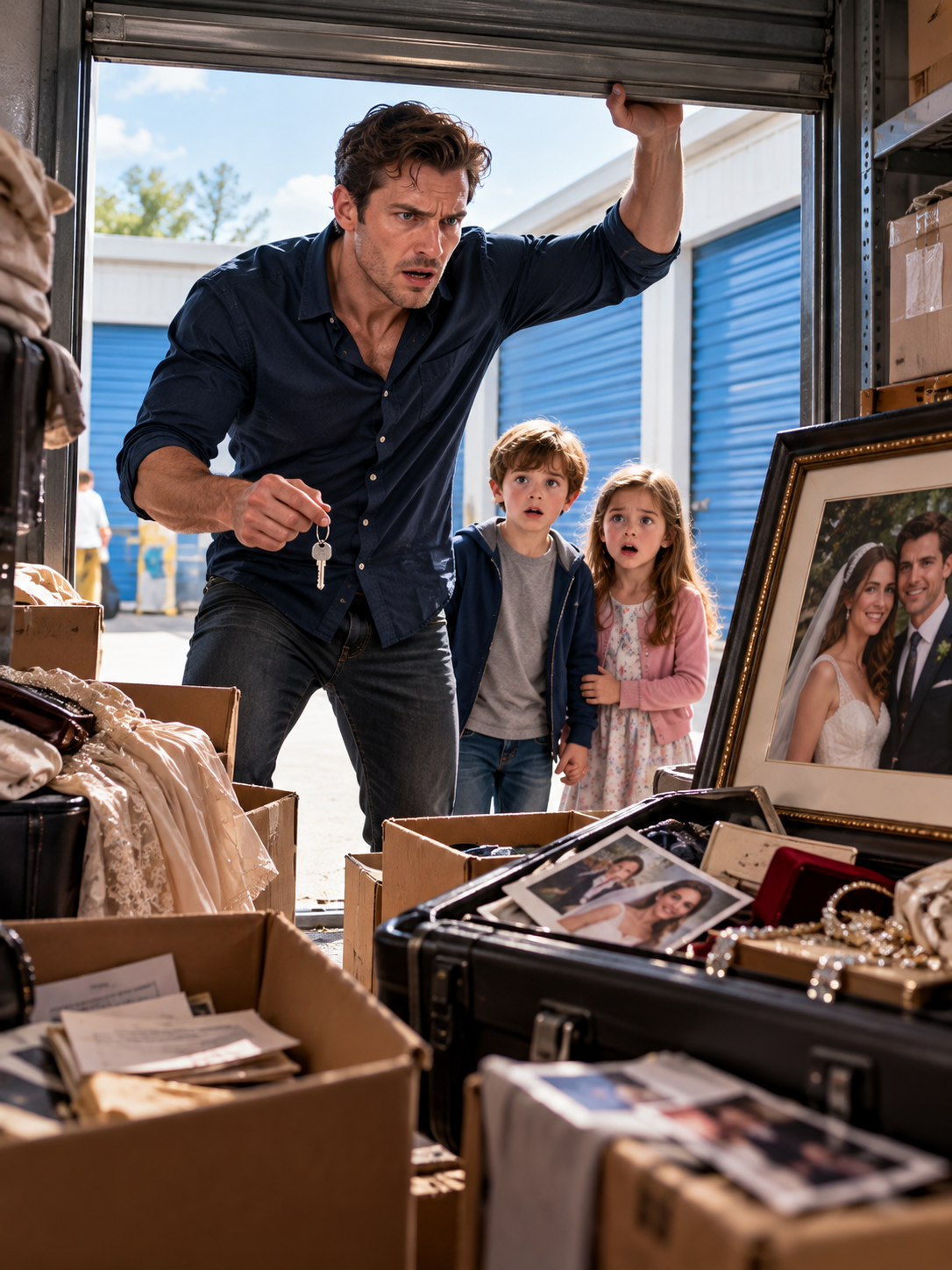
For six months, I believed my ex-wife had disappeared into the Chesapeake Bay with the man she left me for. I held our twins through their nightmares, endured accusations from her family, and tried to accept that she was gone forever. Then a storage manager called about a unit I’d never rented. Inside were my children’s missing belongings, each carefully labeled in handwriting I recognized. The final item proved someone had been watching my family—and that my ex-wife’s disappearance was only the beginning.
Part 1
The Coast Guard called at 6:47 on a Monday morning, while I was scraping burned eggs from a frying pan. My eight-year-old twins were arguing over the last strawberry yogurt, and the kitchen smelled of coffee and buttered toast. The officer asked whether I was Grant Ellison, formerly married to Laura Mercer. I put down the spatula when he mentioned an abandoned sailboat in the Chesapeake Bay.
My ex-wife had disappeared aboard a forty-foot sailboat called the Wild Juniper, owned by Vincent Voss, the yacht broker she’d left me for. The vessel had been discovered drifting south of Poplar Island, its engine idling, with nobody aboard. The inflatable dinghy was missing, and Vincent hadn’t answered his phone. When I asked about the weather, Lieutenant Daniel Cho told me Saturday night had been unusually calm.
I was forty-three, a licensed marine surveyor based in Annapolis, Maryland. My job was inspecting boats for problems that ordinary buyers couldn’t see, from weakened fiberglass to damaged steering systems. I carried a small sounding hammer that could distinguish healthy material from hidden moisture by its tone. Somehow, I’d spent fourteen years married to Laura without recognizing how badly our own foundation had deteriorated.
We had met at a waterfront restaurant when she was twenty-five, laughing because a gull had stolen half her sandwich. Eleven years later, after our twins were born, I still remembered that laugh whenever I heard her entering a room. Then Vincent hired me to inspect a boat, and Laura happened to bring lunch to the marina. I noticed the way he watched her, but never imagined she’d move into his apartment eight months afterward.
Our divorce had been finalized in February. Laura agreed that Miles and Ivy should stay with me while she adjusted to her new relationship, with alternating weekends and Wednesday dinners. She cried during nearly every custody exchange, although she never asked to come home. That final Friday, she canceled her weekend because Vincent had arranged a sailing trip south.
The Coast Guard searched for nine days. They found neither Laura nor any indication of where the missing dinghy had gone, although Vincent appeared two days later at a small marina across the bay. He claimed he’d become separated from Laura while trying to reach shore after an emergency. Investigators questioned him, but his confused account and the absence of physical evidence left more questions than answers.
When the search was suspended, Ivy stopped drawing sunshine on her pictures. She used to put a bright orange sun over every boat, even when she drew them underwater. Now her crayons produced empty decks and gray clouds, while Miles refused to wear the shark-tooth necklace his mother had bought him. I told them the truth as gently as I could, but neither wanted to hear that adults didn’t always have answers.
Laura’s mother, Diane Mercer, appeared two days later and accused me of driving her daughter away. She stood on my porch wearing a black cardigan, gripping her purse like she might swing it. I let her visit the children because they loved their grandmother, even when she blamed me. After she left, I discovered Ivy crying beside the washing machine, holding one of Laura’s old sweaters.
Three weeks later, a woman named Claire Benton from Chesapeake Harbor Mutual requested a meeting. She brought a thin insurance file and declined the coffee I’d made. Laura had married Vincent privately shortly before the trip, Claire explained, and he’d purchased a $1.2 million life insurance policy naming himself beneficiary. The policy contained an unusual disappearance provision that made the pending six-month review especially important.
“Vincent has already filed a claim,” Claire told me. “We’re examining the circumstances before making any determination.” She also asked whether Laura had expressed any intention of leaving permanently or disappearing. I explained our divorce, the custody agreement, and her planned trip. Claire wrote everything down without revealing whether she believed me.
By June, news spread that Vincent’s yacht investment business was collapsing. Several investors claimed they’d purchased shares in charter vessels that couldn’t be located. One man called my office demanding to know whether Vincent had hidden his money, as if being Laura’s ex-husband made me his accountant. I gave the caller the investigator’s contact information and returned to work.
Summer passed through baseball practices, orthodontist appointments, and awkward conversations about grief. Laura’s mother petitioned for additional visitation, claiming the children needed more connections to their maternal family. My attorney advised cooperation while the court reviewed her request. I agreed, although I couldn’t explain why Diane suddenly seemed more interested in our routines than in the children themselves.
Then, on a rainy afternoon in late September, an unfamiliar number interrupted a boat inspection. A storage manager named Arthur Phelps said Unit 218 at Harbor Point Storage was registered under my name and had fallen behind on payments. I told him I’d never rented a storage unit, but he insisted the agreement contained my signature and identification details.
Arthur hesitated before adding, “Mr. Ellison, the person who rented it paid six months in advance, and there hasn’t been a recent visit.”
He said the rental began three weeks before Laura disappeared, and for the first time in six months, I felt something more frightening than grief: the possibility that somebody had been planning this all along.
Part 2
Harbor Point Storage sat behind a tire dealership on Route 2, surrounded by chain-link fencing and faded orange doors. Arthur Phelps was a narrow-shouldered man in his seventies who smelled faintly of peppermint and machine oil. He showed me the rental agreement, including a signature that resembled mine closely enough to make my stomach tighten. The date was March 18, exactly twenty-three days before Laura’s boat disappeared.
“Who rented it?” I asked, studying the photocopied identification card attached to the paperwork. Arthur adjusted his glasses and explained that he’d handled the transaction during a busy Saturday morning. The customer wore a baseball cap, paid cash, and claimed to be storing household belongings during renovations. Security footage from that period was no longer available.
I called my attorney, Benjamin Talbot, before going farther. He advised me to photograph the paperwork and let Arthur supervise any inspection, documenting everything in case police involvement became necessary. Arthur accepted my driver’s license, checked it against the account, and led me through a corridor where fluorescent lights buzzed overhead. Unit 218 waited at the far end beneath a crooked ceiling tile.
Arthur opened the door after completing his access paperwork. Stale air drifted outward, carrying the smells of cardboard, damp cotton, and something sweet I couldn’t immediately identify. A folding cot stood against one wall, beside bottled water, a lantern, and a small wooden table. It looked less like storage than a place someone might hide between visits to the outside world.
At first, I noticed ordinary boxes and a battered suitcase. Then I saw Ivy’s lavender lunchbox sitting on a blue blanket, its broken zipper repaired with white thread. She’d lost it at school in May, and I’d bought her a replacement shaped like a butterfly. My knees weakened when I recognized the little silver star she’d glued onto the handle.
Beside it lay Miles’s shark-tooth necklace, the one that had disappeared during a July swimming trip. There was also Ivy’s yellow rain boot, a library book, and the green baseball cap Miles had lost near the playground. Each object rested neatly on the blanket, separated by several inches. Someone had arranged them like evidence in a museum.
The labels were what made me sit down. Small pieces of masking tape identified each item with a date and location, written in Laura’s unmistakable slanted handwriting. “Ivy’s lunchbox, May 14, school cubbies,” one read. Another said, “Miles’s necklace, July 22, near the dock.”
I picked up the final label before remembering Benjamin’s warning about disturbing potential evidence. It was attached to a tiny plastic bag containing a baby tooth. “September 11, playground mulch,” the label said. “She dropped it while running. Waited until they left.”
September 11 was two weeks earlier. Laura had supposedly disappeared in April, and someone who wrote exactly like her had watched our daughter lose a tooth five months afterward. I backed away from the blanket, suddenly remembering every unfamiliar car that had parked near the school and every afternoon Ivy complained about feeling watched.
I called Lieutenant Cho, who connected me with Sergeant Marisol Vega, an investigator working with Maryland’s natural resources police. She arrived with a camera, evidence supplies, and the expression of someone expecting another complicated family dispute. That changed when she read the labels. She photographed the entire room before asking me to describe every missing object without touching it.
“You’re saying these belongings vanished after your ex-wife disappeared?” she asked. I nodded and showed her photographs taken on the original dates, including Ivy holding her replacement lunchbox. Marisol examined the rental agreement and asked why someone might use my identity. I told her I didn’t know, but the possibility of being deliberately implicated was impossible to ignore.
She explained that the evidence supported several interpretations. Someone could be impersonating Laura, deliberately planting her belongings, or attempting to make me appear involved in the disappearance. My fingerprints would naturally appear on old family possessions, so she wanted a careful evidence review. “I believe you’ve found something important,” she said. “But we have to establish who put it here.”
Then I recognized the sweet smell. It came from a half-empty tube of vanilla hand cream lying beneath the cot, the same brand I’d given Laura every Christmas for years. Beside it was a small waterproof case, secured with a three-digit combination lock. Its green plastic surface showed fresh scratches around the handle.
Marisol examined the case and obtained permission to have it documented and opened through the investigation. I mentioned that Laura always used our twins’ birthday, August 16, for luggage locks. With the case properly recorded, Marisol tried 816, and the latch clicked open.
Inside lay a marine radio, a folded tide chart, and an envelope bearing a single handwritten word: “Grant.”
Marisol unfolded the letter carefully, and I saw the first sentence before she could move it out of view: “If you’ve found this, Vincent hasn’t taken me away yet.”
Part 3
The letter was four pages long, written in the cramped handwriting Laura used when she was frightened. She said Vincent had convinced her to disappear temporarily because his investors were threatening legal action. He promised they’d return after the financial problems were resolved, but instead he isolated her at a remote property and controlled her communications. “I made a terrible choice,” she wrote. “I thought I could come back before the children ever knew.”
According to Laura, Vincent had used my identification details to rent the storage unit as part of his preparations. She later began using it during rare trips into town, collecting small belongings she’d found near the children’s school and leaving clues she hoped somebody would recognize. Her letters described escalating threats whenever she mentioned contacting me. “He knows their school schedule,” one sentence read. “He says they will suffer if I tell anyone.”
I wanted to believe every word, but Marisol reminded me that we hadn’t verified who wrote the letter or when. The tide chart inside the case identified a narrow tributary of the Pocomoke River, near an isolated creek surrounded by cypress forest. A Friday morning high tide was circled in red pencil, with the words “Last chance to leave.” The date was less than two weeks away.
I called Claire Benton at Chesapeake Harbor Mutual. She explained that Vincent had requested a final determination on Laura’s insurance claim, expecting the disappearance provision to apply at the upcoming six-month review. His attorney had also asked for immediate payment if the necessary legal conditions were met. Claire’s voice tightened when I mentioned the letter. “I’ll notify our investigation department immediately,” she said.
That night, Diane arrived unexpectedly with paperwork requesting increased custody access. She’d heard rumors about the storage unit and believed someone was trying to implicate me. I showed her a photograph of Laura’s handwriting on Ivy’s lunchbox label. Diane sat on my porch steps and began crying, the petition forgotten in her lap.
“She called me in June,” Diane confessed. “I heard her breathing, and then she whispered, ‘Mom, please don’t tell anyone.’ I thought I was imagining it.” She had saved the unfamiliar number under a fake contact name. Marisol traced the number to a public telephone near Snow Hill, Maryland, not far from the creek on Laura’s chart.
The following afternoon, Claire invited Marisol and me to inspect the recovered Wild Juniper, which remained stored at a marina. I recognized an unusual fiberglass repair I’d documented during my original inspection. But the detail that caught my attention was a brownish stain above the waterline. It resembled tannin discoloration from freshwater creeks, rather than ordinary saltwater growth.
Inside the engine compartment, I pointed out dark sediment trapped in the raw-water strainer. Marisol arranged for proper samples and independent examination instead of relying on my judgment alone. The findings couldn’t identify a particular dock, but they supported the possibility that the boat had spent time in a freshwater environment. The abandonment story was beginning to look carefully manufactured.
My father, Walter Ellison, had worked Chesapeake waters for fifty years. He studied the tide chart at my kitchen table, tracing the narrow creek with one weathered finger. “A deep-draft boat can’t safely cross that entrance whenever it pleases,” he said. “Whoever circled that tide understands the water, and whoever’s hiding there won’t have many chances to leave.”
Marisol’s team investigated property records and vehicle activity around the creek. They located a remote waterfront cabin leased through a company linked to Vincent, and witnesses reported seeing a man matching his description purchasing supplies nearby. Combined with Laura’s letter and the suspicious insurance arrangements, the information justified additional surveillance and a warrant application.
I packed lunches for the twins that Thursday while pretending the coming days were ordinary. Miles wanted a dinosaur-shaped sandwich, and Ivy asked why Grandma Diane had been crying. I told them grown-ups were working through something difficult, but they were safe. The words felt fragile when Marisol called after bedtime.
“We have authorization to search the property,” she told me. “But there’s a complication.” Her officers had observed preparations suggesting Vincent might leave before the scheduled tide. The marine patrol was mobilizing, but the remote location made coordination difficult.
I looked at the photograph of Laura on our refrigerator. She was laughing beside the twins at a Fourth of July barbecue, three years before everything fell apart. For six months, I’d grieved a woman who had apparently been alive, frightened, and closer than anyone suspected. Now a search warrant existed, but it might arrive too late.
Then Marisol added, “Grant, there’s something else. We saw two people at the cabin, and the woman was moving freely around the dock. We need to determine whether she’s being held against her will—or helping him escape.”
Part 4
My father was already awake when I arrived at his house before dawn. He sat beneath the kitchen light studying old navigation charts, wearing the same faded fishing jacket he’d owned since I was in high school. Marisol had requested his assistance identifying safe approaches for the shallow-water patrol. When I asked whether I could accompany him, she reluctantly agreed to let me remain aboard the support vessel, away from any confrontation.
We launched before sunrise into a cold October mist. Cypress trees crowded the banks of the Pocomoke River, their roots rising from dark water like twisted fingers. My father’s small workboat followed the patrol vessel at a distance, carrying an officer tasked with maintaining communication. The air smelled of wet leaves, diesel exhaust, and river mud.
At the mouth of the creek, we waited while investigators approached the waterfront cabin from a separate route. High tide was approaching, and a large vessel would soon have enough water to cross the shallow entrance. Through binoculars, I saw a white sportfishing boat moored beneath a weathered wooden dock. Its name, Northern Promise, gleamed in gold lettering against the stern.
Vincent appeared carrying a canvas bag, dressed in a dark jacket and baseball cap. He looked thinner than the charming broker who’d shaken my hand three years earlier. Then Laura stepped onto the porch behind him, holding a small suitcase. Her hair was longer, her shoulders narrower, but I recognized the way she tucked loose strands behind her left ear.
For a moment, I forgot about every lie she’d told me. She was alive, standing in the pale morning light, and the twins might someday see their mother again. Then Vincent caught her by the arm and pulled her toward the boat when she hesitated. She lowered her head, and my relief turned into something much heavier.
Marisol’s team moved closer while the marine patrol held position beyond the narrow entrance. An officer announced their presence from shore and ordered Vincent to remain at the dock. Vincent rushed to the helm instead, starting both engines while Laura stood frozen beside the cabin door. The boat surged against its lines before he managed to release them.
I heard officers giving commands over the radio. Vincent steered toward the creek entrance, but the patrol vessel had already established a safe position outside the narrow channel. With nowhere to pass without risking the shallows, he slowed and began shouting that he was being harassed. An officer repeated the instructions to shut down his engines.
Laura suddenly moved toward the controls. Vincent reached for her, but she stepped away and turned off the nearest engine. The second engine slowed moments later, and officers approached once the vessel had stopped moving. I watched through binoculars as Vincent raised his hands, his expression changing from fury to the smooth, practiced smile I remembered.
By the time officers brought him ashore, that smile had disappeared. They found identification documents, financial records, and travel preparations aboard Northern Promise. Investigators also recovered devices that could help verify Laura’s account of restricted communication. Vincent was taken into custody while Laura received medical attention and spoke privately with investigators.
Marisol eventually allowed me to approach after the scene was secured. Laura stood beside an ambulance wearing a borrowed gray blanket, her face pale beneath the morning sun. She looked at me as though expecting an embrace. I stopped several feet away and asked the only question that mattered to me.
“Did you ever intend to come back for Miles and Ivy?” Laura pressed her lips together before whispering, “At first, I thought we’d be gone only a few weeks. Then Vincent said he’d ruin all of us if I tried to leave.” Tears gathered in her eyes, but I didn’t move closer. I knew she’d been frightened, yet I also knew she’d helped begin this nightmare.
She told me Vincent had promised a new life with money from his failing yacht investment scheme. Before their disappearance, she’d signed business documents she hadn’t fully understood and helped him gain access to materials in my old home office. Her voice broke when she mentioned my professional certification. “Grant, there’s something I never told you about the survey reports.”
I stared at her while morning sunlight moved across the water. She admitted she’d allowed Vincent to copy an impression of my certification seal, believing he needed it for routine paperwork. Later, she’d discovered documents bearing my name on inspections I’d never performed. Three nonexistent or misrepresented yachts had been presented to investors using those reports.
The man who stole my wife hadn’t simply destroyed my marriage. He had used her help to turn my professional reputation into part of his scheme, and somewhere beyond that creek, dozens of families believed I’d guaranteed boats that might never have existed.
Part 5
The investigation lasted almost a year, and my life became a collection of courthouse appointments, interviews, and carefully organized records. Vincent’s investment company had sold shares in a fleet of charter yachts that existed mostly on paper. Several of the supposed vessel surveys carried forged impressions of my professional seal. My attorney helped me provide original inspection files, certification records, and independent handwriting comparisons to establish that I hadn’t written or approved them.
Investigators discovered that Vincent had planned Laura’s disappearance to escape creditors and collect her insurance money. She initially cooperated, believing his promises that everything would be temporary. Once she understood the extent of his deception, he threatened her with prosecution and claimed he could use her involvement to destroy my career and take our children. Her fear was real, but so was her participation.
The insurance company rejected the claim after the evidence established that Laura was alive. Vincent eventually pleaded guilty to multiple fraud-related charges and received a substantial prison sentence. Assets recovered from his businesses contributed to restitution for the investors he’d deceived. My professional standing was restored, although I spent months answering questions about reports I had never signed.
Laura’s case was more complicated. She cooperated with investigators, accepted responsibility for her role in the fraudulent documents, and received probation and restitution obligations under a plea agreement. Family court ordered supervised contact with the twins, with any expansion dependent on their welfare and professional recommendations. None of those decisions required me to pretend she’d been innocent.
When Laura wrote asking whether we could talk privately, I agreed to one meeting at Benjamin’s office. She arrived wearing a simple blue sweater, without makeup, looking older than the woman who’d once walked away from our marriage. “I never stopped loving the children,” she said, twisting a tissue in her hands. I answered, “You may love them, Laura, but you still chose to let them believe you were gone.”
She cried and apologized for the months of fear. I listened because I wanted to understand the decisions she’d made, not because I intended to forgive them. When she asked whether we could ever be a family again, I told her our marriage had ended long before the boat disappeared. “Your future relationship with the children belongs to them and the court,” I said. “My relationship with you is over.”
Diane withdrew her custody petition and apologized for accusing me. She admitted she’d found blaming me easier than accepting what her daughter might have done. I continued allowing her to spend time with the twins because they loved her. But I made it clear that maintaining that relationship depended on honesty and respect for the children’s boundaries.
The first supervised visit took place at a family services center the following spring. Miles entered carrying a book about sharks, while Ivy held the lavender lunchbox recovered from the storage unit. I waited outside, watching clouds move across the parking lot. When they returned, Miles said his mother had listened to every shark fact, but Ivy remained silent until we’d reached the car.
“She said she was sorry,” Ivy finally whispered. “And she asked if I could forgive her.” I checked the rearview mirror and saw her looking down at the lunchbox. “What did you say?” I asked. Ivy shrugged. “I told her I don’t know yet.”
“That’s okay,” I replied. “You don’t owe anyone an answer before you’re ready.”
The following summer, I took the twins fishing with my father on his old Chesapeake workboat. Miles caught a small striped bass, and Ivy complained that the wind kept blowing her hair into her mouth. We ate sandwiches from a cooler while the afternoon sun turned the water silver. For the first time in a long while, ordinary happiness didn’t feel like something I needed to protect from an approaching disaster.
That evening, Ivy left a drawing on my desk. It showed a boat, two children, their grandfather, and a man holding a small surveyor’s hammer. Above them was a bright orange sun, the first one she’d drawn since Laura disappeared. I pinned it beside my certification and stood looking at it until the house grew quiet.
I had spent my career examining boats for hidden damage, yet I’d failed to recognize the person beside me was preparing to abandon everything we built. I couldn’t change what Laura had done, and her apologies couldn’t restore the nights our children spent crying for her. But I could give Miles and Ivy a home where nobody disappeared without explanation, and where love never required them to ignore the truth.
I never forgave Laura for that choice. I simply stopped allowing her decisions to determine the rest of our lives.
Legal Notice: This story is a work of fiction. Names, characters, businesses, events, and incidents are the product of the author’s imagination or are used fictitiously. Any resemblance to actual persons—living or dead—or to actual events is purely coincidental. Thank you! 💓


