
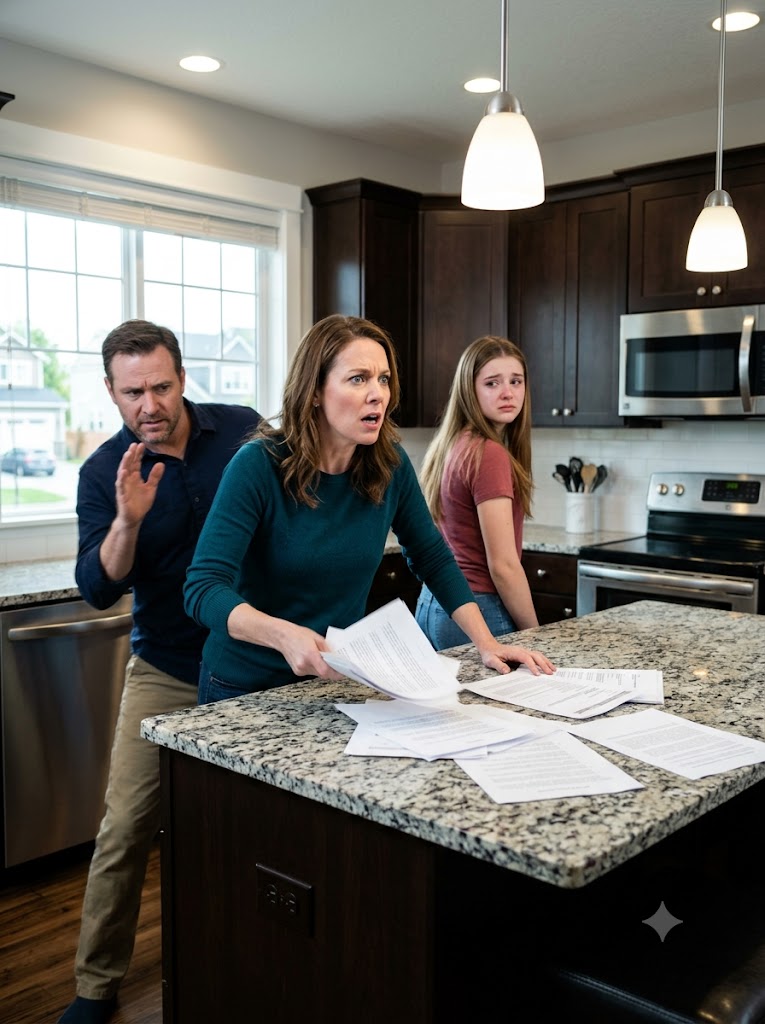
I Was Given a Second Chance to Save My Husband—Then His Student Accused Him Again
One accusation destroyed my husband’s teaching career, turned our daughter into a target, and made our neighbors shun us. Then I woke up four weeks before it happened, remembering everything. This time, when the same student begged to join his private math class, I refused to let kindness become a secret arrangement. I put every safeguard in place. When her accusation went viral anyway, I discovered someone else had prepared the story, and a forgotten detail from my first life suddenly mattered.
Part 1
The first thing I heard when I woke up was chalk tapping against a ceramic mug. My husband, Nathan Carter, was standing in our kitchen wearing his faded college sweatshirt, complaining that his AP Calculus students kept confusing derivatives with integrals. Lily ate cereal at the counter, swinging her feet and arguing about whether a homemade volcano counted as a science project. Neither had smiled this freely in a year.
I gripped the doorway until my fingers hurt. Yesterday, as far as I remembered, Nathan had been dismissed from Cedar Glen Preparatory after a student accused him of inappropriate behavior during an evening tutoring session. A local creator made the accusation viral, and Lily stopped attending school after classmates harassed her. Our refrigerator calendar now read March 3, four weeks before the scandal.
At work, I checked that date three times before opening my office door. The copier smelled of warm toner, exactly as it had on the first morning. I handled academic scheduling at Cedar Glen, a private school outside Raleigh where Nathan taught mathematics, and I knew the morning’s next visitor before she appeared. Brielle Foster, an eighteen-year-old senior, arrived clutching an SAT workbook and asked for a place in Nathan’s hundred-dollar-an-hour preparation group. In my first life, I’d paid her first fee myself.
“Please, Mrs. Carter,” she said. “If I don’t raise my score, I won’t qualify for the scholarship I need.” She described her injured father and her mother’s diner shifts while two teachers listened outside. Once, I’d bypassed the waiting list and arranged informal evening sessions. This time, I kept both hands on my desk and told her there would be no private exceptions.
Brielle glanced at the open door, then lowered her voice. “I can just watch from the back. I won’t bother him.” When I mentioned the approved program, she looked toward my colleague Daniel for help. He did, suggesting that Nathan could surely accommodate one struggling student. He’d stopped returning our calls after the scandal; now I only said, “Rules apply to everyone.”
Vice principal Gordon Whitaker appeared after hearing the raised voices. He reminded me Brielle was a priority applicant while she stood close to tears. I asked if he authorized a registered group with billing records, consent, an assistant, and a supervised room. His expression hardened at my insistence, but several parents were passing the doorway, so he agreed to the official arrangement.
I found Nathan on our back porch that evening, grading papers beneath the yellow porch light. I explained the six-student class, with an assistant present and messages confined to the school platform. He put down his pen. “Elena, you’re talking like something terrible is about to happen,” he said, and I admitted I’d had a nightmare so detailed I couldn’t shake it.
He didn’t laugh or dismiss me. He read my list, asked if someone had threatened me, and agreed to precautions he didn’t understand. “I’ll follow the procedures,” he promised, folding the page into his planner. I hoped records could protect us, although the other life had taught me how quickly frightened administrators could turn silence into apparent guilt.
Monday, I walked Brielle to Room 302, where assistant Maya Torres tracked attendance and school equipment recorded lessons. Brielle studied the printed notice explaining the recording schedule, then signed the participation form with a pen she borrowed from me. She gave me a small smile and said, “You’ve made this very official.” I answered, “That’s what makes it fair.”
For two weeks, nothing happened. Then Brielle left a workbook behind and asked to speak alone about something “personal.” Maya stayed, so Brielle changed her mind and hurried away. Watching her disappear down the stairwell with her workbook against her chest, I wondered whether I was reading ordinary teenage embarrassment through the terror of memories nobody else possessed.
That night, an unknown address emailed: “You can follow every rule and still lose everything.” It included a nighttime photograph of Room 302’s door. I stared at it until the screen went dark, realizing somebody had noticed exactly what I was trying to prevent.
Part 2
I saved the anonymous email and showed it to our technology director. He couldn’t identify the sender. Gordon Whitaker called it a tasteless prank and suggested I stop treating a student’s request for help like a security emergency. I requested preservation of the email and access logs.
Brielle behaved politely in class, scoring well on practice tests, but her requests changed shape. She requested a private scholarship meeting, then messaged Nathan late at night, saying she needed confidential support. Nathan referred her to student support, and a counselor contacted her family. Next morning, Brielle asked me, “Why does everything I say become an official report?”
“Because when someone says they’re struggling, adults need to get them help,” I replied, while a janitor’s cart squeaked past the open doorway. She looked exhausted, with dark shadows beneath her eyes; perhaps she genuinely needed more help. But she declined another counselor meeting and requested Nathan alone. I explained once more that he would not, and her expression became unreadable.
On March 27, Room 302 held an evening review session ahead of the spring exams. Maya was assisting while I helped Lily paint Styrofoam planets, leaving blue acrylic paint beneath both our fingernails. Nathan returned after ten, smelling of whiteboard cleaner and wet asphalt, and mentioned Brielle’s sore knee as he hung his coat by the laundry door. Maya had accompanied her downstairs, he assured me; the three of them had left together.
I should have slept. Instead, I searched the recording policy while the refrigerator hummed. An anonymous account had accused Cedar Glen of protecting favored teachers. The account followed local creator Taryn Foster, whose glossy videos often began with a question designed to make the answer seem obvious. Brielle’s older cousin, I remembered, had been the first person to interview her in the other life.
The following Friday, my phone began buzzing during a scheduling meeting, rattling against a tray of paper clips until everyone at the table looked up. A video showed Brielle crying in a parked car, saying Nathan had kept her alone after the March 27 session and made her feel unsafe. Taryn’s caption treated the allegation as fact, and strangers identified Nathan’s workplace, reposting an old school directory photograph alongside comments about his family. The old sickness returned; our safeguards seemed useless.
I called Nathan, who was waiting in a conference room after Gordon summoned him, while shouting and footsteps echoed beyond the closed door. He sounded frightened but controlled. “I haven’t been alone with her,” he said. “Maya was there, and you know where we were.” I told him to wait for counsel and records, then hurried past teachers staring at their phones.
Lily was in the middle-school counselor’s office, holding a crumpled note that called her father a disgusting name, while her unopened lunchbox sat beside her shoes. She had unfolded the paper until its corners tore. “Mom, is everyone going to hate us?” she asked, pressing herself against me so tightly that the zipper of her backpack caught my sleeve. I told her rumors weren’t proof and she wasn’t responsible.
Outside the administration wing, parents crowded beneath the walkway while Taryn narrated events into her phone. In her familiar cream jacket, she pointed the camera at me. “Will you support the student or protect your husband?” she called. I asked her to stop filming students and called for a fair investigation.
Inside, Gordon had placed a prepared statement in front of Nathan. It apologized for “inappropriate interactions” and offered his resignation before anyone interviewed Maya, a phrase that would sound like a confession once Taryn published it. Nathan’s hands were clenched beneath the conference table, and Brielle sat opposite him with a family representative. I pushed the paper aside and asked Gordon whether the school had preserved the original recording from March 27.
“There may not be one,” he said. “The room system was reported offline that night.” He pointed to a maintenance entry on his tablet, and I recognized Daniel’s initials beside it. Maybe someone inside the school had removed the only record that could settle this.
Part 3
I asked Gordon for a copy of the maintenance entry and refused to let Nathan sign the statement, despite his repeated request that we resolve matters before dismissal. Our attorney, Meredith Shaw, arrived carrying a rain-soaked briefcase. She demanded preservation of footage, messages, and hardware, and an outside investigation. Brielle’s representative agreed that a careful process was necessary.
Daniel met me outside the technology office with his face pale. He admitted he’d flagged Room 302 as unreliable because the camera preview had briefly frozen the previous week, but said the audio recorder was a separate device managed by the media center. “I didn’t turn anything off,” he insisted, showing me his service ticket. It was dated March 26 and concerned only a monitor.
At the media center, technician Rosa Delgado opened the equipment ledger while Meredith watched, the room smelling of dust and overheated cables. The class microphone had been checked out to Maya at 8:45 p.m., and its file was automatically transferred to a secured archive when the session ended. Only designated staff could retrieve it, with the access history recorded. The maintenance report didn’t cover that system, and Rosa had already placed a hold on the original after the complaint surfaced.
I felt the first real relief I’d experienced all morning, but Meredith stopped me from demanding an immediate public playback. Student privacy and authenticity required care, she explained. With the school’s counsel and an independent investigator present, Rosa provided the original to a qualified examiner. We listened only after the examiner documented the source and verified its continuity.
The recording began with Nathan explaining a calculus problem over the squeak of marker against glass. Chairs scraped, zippers rasped, and he reminded the students to practice before their exam. At 9:46, Brielle asked for help walking downstairs because her knee hurt, and Maya offered to escort her. Nathan’s voice remained professional as he reminded everyone that the room had to be locked when class finished.
A door slammed, followed by a long stretch of air-conditioning noise. The investigator compared the times with a hallway camera showing Nathan, Maya, and Brielle entering the elevator lobby together. “That contradicts the claim that they were alone in the room at the end of class,” he said, carefully avoiding any broader conclusion. I gripped Meredith’s sleeve because I wanted him to say the whole nightmare was finished.
Then the audio picked up a keypad beep and footsteps returning to the classroom. The service-door log showed Brielle’s temporary student access card had opened the side entrance several minutes after the others left. On the recording she muttered that she’d forgotten something, moved a chair, and apparently began a phone call. A second voice came through faintly, distorted by the room microphone, and I knew it before anyone identified it.
“Did he stay behind with you?” the voice asked. Brielle answered, “No, Maya wouldn’t leave. He never even touched my arm.” Taryn replied that they’d need another angle for the video, but the next sentence was obscured by a loud scraping sound. Meredith asked the examiner to isolate that section without altering the original, and the investigator wrote down the exact time instead of reacting to what we’d heard.
Gordon sat rigidly, his earlier confidence gone, and repeatedly straightened a sheet of paper that was already perfectly aligned. He suggested the recording might be misleading without context, which was true in principle, but he had shown no similar caution before putting a resignation letter in front of Nathan. Meredith requested an independent interview with Maya and a full review of the access logs before the school made any announcement. I looked through the glass wall and saw Nathan waiting in the corridor, unaware that his voice had just returned him to solid ground.
The examiner replayed the final seconds at normal speed. I heard Brielle say, “I can use the mark from falling off my bike,” followed by Taryn asking whether the school would settle before anyone checked. My stomach tightened, because the conversation wasn’t just about an accusation anymore; it sounded like a plan, and the woman broadcasting outrage outside had apparently helped write it.
Part 4
The investigator interviewed Brielle and Taryn separately before releasing any findings, and both were represented by counsel. I kept Lily away from comment sections as rumors multiplied. Nathan built her cardboard bridge, freezing whenever a phone rang. A premature announcement could make everything worse.
Maya’s statement supplied an important missing piece, and she delivered it without drama, sitting across from the investigator with her lesson planner open. She had noticed Brielle waiting beside the stairwell after class and offered to call her parents, but Brielle declined and said she had a ride. Records showed Brielle returning briefly through the side door, using a card that should have expired when the session ended. Nathan had signed out while Maya was still present.
On Monday, Meredith told me the independent examiner found no signs that the original file had been altered. Investigators found Taryn’s draft interview invoice and the Room 302 photograph from my anonymous warning, both dated before her video. Brielle had told a friend about the injury before March 27. The evidence pointed toward a misleading story, not a misunderstanding about where Nathan had stood or who had been present.
Cedar Glen’s board suspended Gordon from administrative duties while reviewing his attempt to secure Nathan’s resignation before checking available records. The school released a carefully worded statement saying the allegation remained under formal review and that students and staff must not be targeted, though the local news had already aired Taryn’s clip twice. It clarified that Nathan had admitted no wrongdoing. The statement didn’t erase the insults already written on Lily’s locker.
At a meeting with the middle-school principal, I laid the crumpled note on the table. “I don’t want a performance of outrage,” I said. “I want her to be able to walk to class without being frightened.” The principal documented incidents and arranged supervised transitions, then asked Lily which adult she trusted enough to approach between classes. Lily later told me one classmate had apologized privately, but another had said the internet still knew better than any investigation.
Even proof couldn’t restore trust instantly. Judith, Nathan’s mother, stopped attending her weekly community-center breakfast because acquaintances kept asking pointed questions about him. Nathan tried to reassure her, then sat alone on our back steps with his head in his hands. “I thought following every rule would be enough,” he said. I sat beside him and admitted that I had believed the same thing.
The board invited Nathan to return to teaching once the investigators completed their report, but he declined to step back into a classroom while students still repeated the accusation in whispers. Instead, he requested a written finding, corrections to the school’s public communications, and safeguards that would protect future students making genuine complaints. I loved him for remembering that a fair process mattered even after he’d almost been denied one. We found Lily a therapist and protected family dinners, replacing arguments about screenshots with stories about homework and the neighbor’s noisy dog.
Taryn finally removed her original video, replacing it with a statement that said she had shared Brielle’s account in good faith. Her followers still argued the school had silenced her, even after Taryn acknowledged that she hadn’t personally witnessed the claimed encounter. Meredith demanded preservation of all drafts, deleted posts, financial offers, and communications related to the interview. Two sponsors suspended their partnerships pending the investigation, which Taryn called unfair persecution.
That evening Brielle’s mother came to our front porch without warning. She held a paper envelope and looked as though she hadn’t slept for days. “I don’t expect you to believe me,” she said, “but I found something in Brielle’s desk, and I couldn’t keep it.” Inside were printed instructions for her interview, a list of emotional beats, and a proposed payment agreement with Taryn’s production company.
In purple ink: “If the school offers a settlement, ask for more.” Brielle’s mother began crying, saying she had thought the tutoring complaint was real until she discovered the papers. Her choice of evidence over loyalty was the first sign we might recover, even if she and her daughter would now have to live with painful consequences.
Part 5
The investigation ended in late spring with a written finding that the specific allegations against Nathan were not supported and were contradicted by the reviewed evidence. Cedar Glen corrected its earlier communications, apologized publicly for pressuring him to resign without completing its review, and offered reinstatement with back pay for missed classes. The board removed Gordon from his administrative position after reviewing emails showing how urgently he had pressed for a quiet settlement. I read the findings twice; vindication wasn’t normalcy.
Through their attorneys, Brielle and Taryn eventually acknowledged that their published account had materially misrepresented the timeline and wrongly implied an unwitnessed private encounter. Police reviewed possible offenses, but I refused to announce unfiled charges. Our civil case ended with signed retractions, compensation for documented losses, and publication agreements approved by the relevant parties. Money couldn’t recover Lily’s lost mornings.
Meredith told us that Taryn’s media business had lost contracts after sponsors learned she’d helped produce an account contradicted by the evidence. Brielle finished school under a supervised arrangement. I refused to broadcast their humiliation, even when strangers online asked me to identify everyone responsible for the cruelest comments. I’d seen what public punishment did to our daughter, and I refused to build my family’s recovery around another crowd’s entertainment.
Judith returned to her community-center breakfast and found several women eager to apologize, offering her a seat beside the window as if nothing had happened. She listened politely, then told them she needed time before she could trust them with family news again. I understood her better than I ever had. In my other life, I’d forgiven people hoping they would reconsider. This time, I kept my distance from colleagues who had pushed Nathan to resign without asking a single question.
Lily’s recovery took longer than any legal filing. Some mornings she avoided the entrance near her tormentors, preferring the quieter side path beneath the tall pine trees. Her counselor helped her handle classmates mentioning the video. By August, she invited two friends to our house for pizza, and the sound of their laughter reached the porch where Nathan and I sat.
In September, Cedar Glen introduced clearer procedures for student complaints, documented tutoring, independent review, confidential support, and emergency preservation of potentially relevant recordings. The rules took every complaint seriously while requiring evidence. Nathan accepted his teaching position again, although he chose not to offer individual evening tutoring. He missed teaching more than the money.
On his first day back, I stood outside his classroom with a paper cup of coffee going cold in my hands and the old fear still resting behind my ribs. Through the window, I watched him arrange worksheets and greet students. His glasses slipped as he wrote, and he pushed them up with a chalk-smudged finger.
He paused before starting the lesson. “In math,” he told the class, “a conclusion has to follow from the evidence, even when the answer surprises you.” Nobody applauded, and there was no dramatic confession from the back row, only a student raising her hand to ask about a minus sign. The students simply opened their notebooks, and Nathan began to teach. After everything we’d endured, the ordinary sound of pages turning seemed almost impossible to me.
When I got home, an email from Brielle waited in my personal inbox. She regretted her choices and hoped we’d understand the pressure she faced. I read it once, forwarded it to Meredith for the case file, and archived it without replying or showing it to Nathan. I wouldn’t comfort someone who had knowingly hurt us.
That evening, Nathan and Lily were in the kitchen arguing cheerfully over whether pancakes counted as dinner. I set my keys down, watched my daughter roll her eyes at her father’s terrible joke, and felt the last tightness in my chest finally loosen. In my former life, I thought kindness meant always saying yes. In this one, I learned that love could be generous and still have boundaries—and that sometimes the bravest thing you can do is insist on the truth before surrendering your life to a story someone else invented.
Legal Notice: This story is a work of fiction. Names, characters, businesses, events, and incidents are the product of the author’s imagination or are used fictitiously. Any resemblance to actual persons—living or dead—or to actual events is purely coincidental. Thank you! 💓