
I Exposed My Groom at the Altar—and His Closest Ally Helped Me Do It
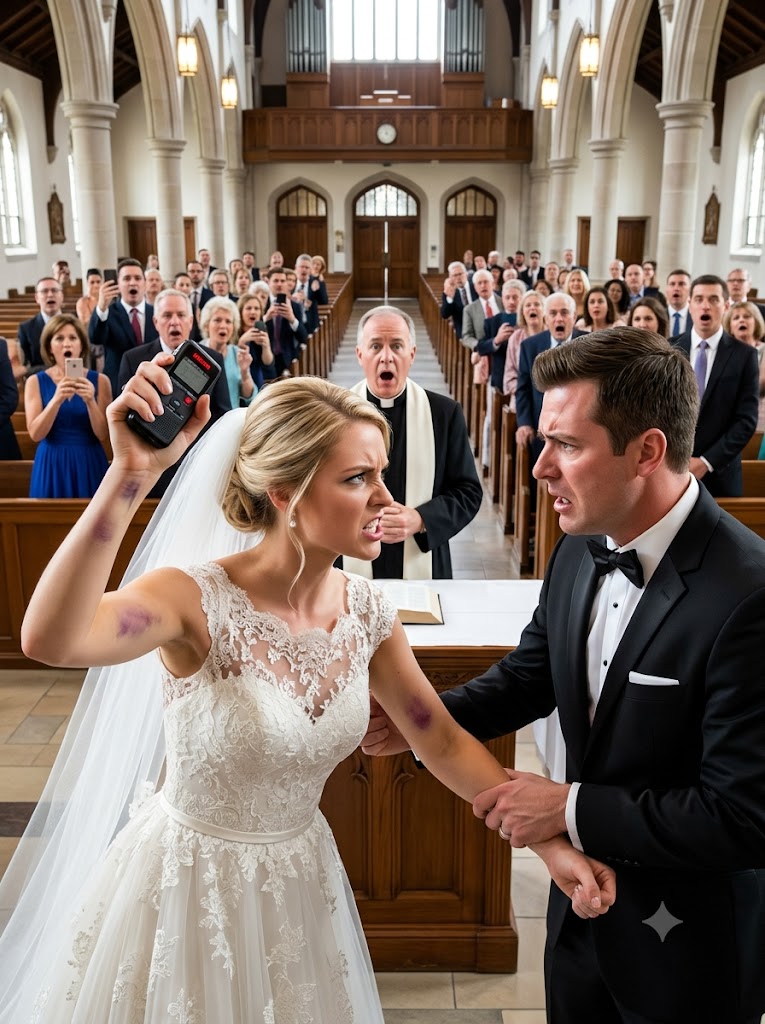
I stood beneath cathedral lights in the wedding dress Graham Sloane chose, with two hundred guests waiting for our vows. He threatened my parents’ bakery if I embarrassed him, certain I’d stay silent. He didn’t know I’d spent six weeks collecting his off-camera threats, or that my brother waited at the sound desk while an unexpected witness stood ready. Cameras streamed the wedding he believed would trap me. Before the vows, I was going to show everyone who he’d been behind closed doors.
Part 1
Graham squeezed my fingers hard enough to make my ring press into the skin beneath it. His smile stayed perfect for the cameras as silk brushed the sleeve of his tailored suit. “Remember where you belong,” he murmured. “One wrong move, Elena, and your parents lose the bakery by breakfast.”
I glanced past his shoulder at the carved wooden doors of St. Alden’s Cathedral, where daylight poured across stone. Two hundred guests filled the pews, including donors, legislators, reporters, and neighbors from my parents’ Albany block. A camera operator shifted sideways to get a clean view of my veil, and Graham’s mother adjusted her pearls with practiced disapproval. I leaned toward my fiancé and answered, “Just wait until you meet my star witness.”
His smile tightened, then recovered; Graham had made a career of performing for audiences. At thirty-nine, he was running for New York attorney general on promises of honesty, safer neighborhoods, and protecting small businesses. He’d filmed a campaign advertisement in my parents’ bakery, praising my mother’s perseverance.
I met him at a library fundraiser eighteen months earlier, where he helped me carry chairs. He remembered that I liked black coffee, listened when I talked about preserving historical photographs, and sent soup when I got sick. I mistook his attention for kindness, until his compliments turned into corrections. First he disliked my coworkers, then my hours, then the way I laughed when someone else told a joke.
The first time he frightened me, he blamed campaign pressure and brought flowers. The second time, he told me I’d misunderstood him, and I wanted badly enough to believe that I accepted it. By spring, I was measuring every sentence before speaking, listening for his car and keeping concealer everywhere. The wedding wasn’t a fresh start, as he told everyone; it was his deadline for making sure I never embarrassed him publicly.
Three months earlier, my father had called to say the bakery’s lender had changed. The new company, Crown Harbor Holdings, claimed my parents had violated a loan condition and demanded an impossible payment. Graham arrived with an attorney and a solution: he could persuade the lender to wait, provided our families “presented a united front.” Each favor brought instructions about whom I could call.
My older brother, Jonah, noticed that I stopped answering messages after dark. He visited me at work one afternoon, carrying warm cinnamon rolls. I told him I was fine, and he said, “You haven’t looked me in the eye once.” He noticed my marked wrist but only asked what I needed.
What I needed was a way out that wouldn’t leave my parents facing a locked bakery door. Jonah helped me find an attorney, preserve messages, and safely copy recordings I had made of our conversations. I learned that keeping quiet could protect evidence. I also learned that somebody inside Graham’s campaign had been asking questions about Crown Harbor.
Jonah had designed the cathedral’s sound setup for Graham’s elaborate broadcast, one of the few wedding favors he’d agreed to provide. He knew the campaign could shut down its own internet feed, so we arranged independent witnesses and secured the original files elsewhere. Rachel insisted that Reverend Mercer be warned privately; we needed a safe way to stop a marriage, not a staged ambush without protection. The minister listened to my account and asked one question: “Do you want to marry this man?” I said no.
Now the organ swelled, and the minister opened his book. Graham’s thumb pressed against the tender place on my hand, warning me to behave, as window light crossed my dress. In the front pew, Jonah lifted his eyes to mine and gave one small nod. I loosened the lace fastening at my throat, where makeup concealed marks Graham had ordered me to hide.
Jonah touched his phone, and the organ stopped in the middle of a note. A sharp hiss came through the speakers, followed by Graham’s own voice: “If you make one mistake in front of those people, I will make sure your family loses everything.” The crowd turned toward the sound booth, but I watched Graham’s expression empty. He had no idea what came next.
Part 2
The words echoed as a woman in the second row lowered her phone. Graham looked at the minister as if the man could erase what everyone heard. “Someone has tampered with the ceremony,” he announced, in his press-conference voice. I kept my hand raised between us, showing the darkened marks beneath my sleeve, and said, “No, Graham. That’s you speaking to me on Tuesday night.”
His mother sprang up, demanding that the audio be turned off, but Reverend Mercer stepped away. He knew a safety concern might interrupt the service and would stop it if I signaled Jonah. He would not marry us under threat. “There will be no vows until everyone is safe,” he said, his voice carrying farther than Graham’s mother’s protests.
The first recording continued with Graham explaining that Crown Harbor could call the bakery’s note whenever he wished. He mentioned the commercial oven my father had repaired twice, the apartment above the shop, and the retirement savings my parents had poured into the business. He’d memorized those details because he knew how they would hurt. My mother gripped my father’s arm and whispered, “He told us the lender was helping.”
Graham turned on me so abruptly that a camera operator stepped back. “You promised we would handle this privately,” he said, reaching for my elbow, as Jonah moved up the aisle. My brother placed himself beside me without touching Graham, while two cousins joined my parents in the front pew. I stopped calculating how to keep everyone calm.
A campaign aide hurried toward the sound booth, and Graham’s communications director was already tapping furiously at her phone. He’d funded three camera crews and a campaign livestream, hoping for flattering footage before the election. The official feed went dark after someone at campaign headquarters intervened, but independent reporters had their own live connections. Pew-side screens glowed as guests watched.
Before the wedding, Graham’s team had vetted everything from guest seating to the shade of my lipstick. His communications director wanted a photograph of us kissing outside the bakery, followed by an interview about how he’d “saved” our family business. I’d rehearsed that interview alone until the words made my stomach ache. Watching his aides scramble, I finally understood why he needed the wedding: a polished photograph could make a bargain struck under fear look like a love story.
I knew a viral clip wouldn’t necessarily protect me. Graham had lawyers, money, and a practiced habit of turning every accusation into an attack on his public service. My attorney, Rachel Kim, warned me that publicity might bring ugly speculation before justice. Original files were secured elsewhere, with verifiable dates.
Then Jonah played the second recording, made after a campaign dinner. In it, Graham told me to cover the marks near my collarbone and stop asking where the family’s loan documents had gone. “Nobody will believe you over me,” his voice said, followed by my own frightened answer: “I only want you to leave.” Hearing my voice shake weakened my knees.
For a moment I was back in that apartment, smelling burned toast because I’d forgotten breakfast on the stove. I’d checked the hallway twice before calling Jonah and waited barefoot on cold tile. In the cathedral, however, the sound ended, and there was no door separating me from help. I undid another fastening at my collar so the cameras could see what I had stopped trying to explain away.
Graham stared and said, “She’s under enormous stress. She’s confused.” A woman near the aisle stood and answered, “We heard what you said,” but he ignored her and gestured for his security team to clear the church. Nobody moved; the guards looked to the minister, then at one another, uncertain who had authority here. His confidence splintered.
I still needed someone to connect the threats to documents. I watched the side entrance, wondering if she’d chosen his campaign. Then the door opened, and a woman in a navy coat walked in carrying a battered leather folder. Graham saw her, whispered, “You were supposed to be in Chicago,” and took a step away from me.
Part 3
Vivian Price had managed Graham’s campaign from its first office above a dry cleaner. She knew every donor by name, guarded his schedule like a locked cabinet, and dismissed my fears as “public-life strain.” I thought she’d sacrifice me to protect him. Now she walked down the center aisle without looking at him, and cameras swiveled after her.
I distrusted her call six weeks earlier. “Your parents’ lender isn’t who Graham says it is,” she told me, offering no greeting. I suspected a trap until she named an account from Graham’s home-office invoices. “Meet me somewhere with people around,” she said. “And don’t tell him you’ve heard from me.”
We met at a twenty-four-hour diner beside the interstate, under weary fluorescent lights. Vivian brought payment instructions, corporate filings, and names removed from donor reports. She’d helped establish fundraising channels that routed money through a consultant linked to Crown Harbor. Graham cut her account access and told colleagues she needed rest.
“I signed forms I shouldn’t have signed,” she told me over untouched coffee. “I thought I was helping a campaign, and I need to tell investigators what I did.” I nearly walked away, remembering her coldness. Instead I asked whether she would testify truthfully even if it cost her career. She said: “That’s the only part of my career I can still save.”
Vivian didn’t ask me to trust an apology; she provided Rachel a sworn account and sent records to investigators. Graham’s last message to her said, “Don’t forget who made your career.” It sounded so much like his threats to me that I knew she understood.
In the cathedral, Vivian stopped beside Reverend Mercer and opened her folder. “My name is Vivian Price,” she said, her voice calm despite the shake in her hands. “Until last month, I supervised his campaign finances. I’ve given investigators records linking his associates to the company threatening the Brooks bakery.”
Graham gave a sharp laugh. “A disgruntled employee and a jealous fiancée,” he said, to a camera. “This is a coordinated smear, and I will prove it.” Vivian didn’t argue; she passed the minister a copy of a filing and asked whether he wanted her to leave. He looked at me, and I said, “Please stay,” because for once my voice was steady enough to be heard without a microphone.
Graham reached for Vivian’s folder, but she pulled it away. “Don’t touch that,” she said, silencing the shouts around us. His former crisis manager had stopped seeking his approval, even as her hands trembled.
Jonah pressed play on the third recording. Graham discussed a developer’s plans for our bakery block. “Once Elena is my wife, she’ll keep the family quiet,” he said to a business associate, who asked whether the loan pressure was necessary. Graham answered, “It’s cheaper than buying their loyalty, and the neighborhood will be ours by spring.”
Vivian had recorded that conversation herself while attending Graham’s meeting with the developer. Rachel warned us not to claim the audio proved more than it did, even though each original file came with a date and a verifiable record of its source. Vivian’s files supplied the missing connection: a company receiving campaign-connected payments shared an authorized signer with Crown Harbor’s management. Investigators would assess legality, but the threats were no misunderstanding.
The room erupted into overlapping questions, and Graham’s mother accused Vivian of betraying the family. Vivian turned toward her, eyes wet but level, and said, “I helped him because I thought he wanted to serve people.” My father stood beside my mother and removed his suit jacket. He placed it around my shoulders, covering the marks without asking me to hide them.
I slipped off my engagement ring and left it on the altar rail. “You don’t get to turn my family into campaign scenery anymore,” I told Graham, and Jonah walked beside me toward the cathedral doors. Cameras flashed, but nobody blocked my path. Outside, beneath the chilly October sky, I looked at my phone and found a message from an unknown number: “The foreclosure paperwork was filed this morning.”
Part 4
The message came with a photograph of a court filing bearing my parents’ bakery address. My veil blew against my cheek, and I couldn’t feel the cold. Graham had not been bluffing about what he could set in motion, and evidence couldn’t magically stop a lender. I handed the phone to Rachel, who had been waiting at the curb, and asked, “Can they take it today?”
“Not today,” she said after reading. “This looks like the beginning of a case, not an order to remove anyone, and we can challenge the claim.” My mother exhaled with a sound that was almost a sob, while Jonah asked Rachel to send the filing to the lawyer already reviewing the loan. We used a borrowed van; the wedding limousine belonged to Graham’s image. The van smelled of damp coats and my father’s peppermint candies.
By evening, cathedral clips reached local and national news. Some commentators called me brave, while others wondered why I’d chosen a wedding rather than a police station to make my accusations. It hurt because I’d spent months seeking a safe way out. Rachel said I owed the public honesty, not perfection.
At Jonah’s apartment, I sat wrapped in a blanket while he muted the television. Every knock in the hall made my pulse jump. Jonah offered me his spare bedroom for as long as I wanted, without asking me to be cheerful or brave. I accepted, realizing that the small freedom to say yes or no was something I’d almost forgotten.
Next morning we sorted papers above Rachel’s office. Vivian arrived with her own attorney and a separate set of documents, keeping our accounts separate. The original recordings had backups and timestamps. Rachel said any case needed evidence strong enough for scrutiny.
One witness did come forward: a former employee of the loan-servicing company who recognized the strange default notice. He’d questioned the demand because every bakery installment had cleared. He had saved messages ordering him not to contact my parents. Our attorney finally had something concrete.
The loan attorney uncovered another inconsistency: Crown Harbor’s notice cited an inspection that the bakery had never received. My father pulled out his battered appointment calendar and showed that he had been at a wholesale market on the date listed. That discrepancy alone didn’t settle the dispute, but together with the payment records it raised questions the lender would have to answer in court. Rachel warned us not to mistake promising evidence for a guarantee; careful preparation mattered more than headlines.
Graham responded through a statement alleging that I had plotted to embarrass him for money. His team circulated a cropped photo of Vivian giving me an envelope, implying a payoff. My stomach dropped when I saw it, until Vivian retrieved the original diner receipt and her own account of the meeting. It held filings, and full footage showed our papers.
That night, my father sat beside me in the bakery’s darkened kitchen while the mixers rested beneath white cloths. “I kept thinking I could fix the loan myself,” he said, rubbing flour from a crack in his thumb. “I didn’t know he’d made you responsible for our survival.” I told him the decision to threaten us belonged to Graham, not to either of us, and my father nodded as though the words needed time to settle.
The bakery opened the following morning despite the reporters stationed across the street. Regular customers came for their usual orders, paid at the counter, and asked about my parents without demanding details. Mrs. Alvarez, a Thursday regular for twenty years, left a bag of groceries and a note saying the neighborhood would stand with us. Graham had mistaken influence for the only power.
Then Rachel called with news that the court had scheduled an urgent hearing on Crown Harbor’s attempt to accelerate the debt. Its lawyers claimed a breach; we might still lose. I went home to an apartment where Graham had once insisted on keeping a key, changed the locks, and put my wedding dress in a plain cardboard box. Just before midnight, my phone flashed with a message from him: “Drop this, and I’ll make the case disappear.”
Part 5
I forwarded Graham’s message to Rachel without answering it. Three days later, I sat behind my parents in a courthouse smelling of coffee and wet wool. Our attorney submitted payment records and asked the judge to pause enforcement. The judge granted temporary relief; Mom squeezed my hand.
Outside, a reporter asked whether I considered that a victory over Graham. “It’s a chance for my parents to defend their business fairly,” I said, which was both less dramatic and more important. Vivian spoke with investigators who had requested financial records. An inquiry wasn’t a conviction, and I refused to live for his punishment.
The courthouse had no music or dramatic silence, only turning pages and precise questions. Its ordinary process steadied me more than applause. I had feared Graham’s public collapse would decide everything overnight, but our lawyer kept returning to verifiable facts. Each document mattered, and each of us was allowed to speak.
The following weeks were exhausting. My parents worked with a new lender while their attorney continued contesting Crown Harbor’s claims, and a neighborhood fundraiser sold out before noon. A forensic review found inconsistencies in the documents used to declare the loan in default. Crown Harbor withdrew its immediate demand, and my parents arranged refinancing.
Graham withdrew from the race after several senior staff members resigned, ending the campaign he had built around his spotless image. Financial investigators continued examining his dealings; he denied wrongdoing. I knew what he’d done, regardless of a future verdict. The first morning I forgot to check his messages, I cried.
Some headlines were cruel in ways I hadn’t expected. One television guest claimed I must have enjoyed humiliating a powerful man, and strangers left vicious comments on the bakery’s page. Jonah helped Mom block and document the harassment before it swallowed their mornings. I met with a counselor who helped me separate strangers’ opinions from the decisions I actually had to make.
Two months after the wedding, Graham sent a letter through his lawyer, asking for a private conversation. He called the cathedral humiliating, blamed us both, and proposed moving on. He never apologized for the threats or his private cruelty. I gave the letter to Rachel for the file and said I wasn’t interested in a meeting.
I moved into a small apartment near the state archives, where I took a full-time position restoring photographs damaged by floods. The drawers stuck when it rained, but the place was mine. On Sundays, Jonah came by with pastries and teased me about the collection of secondhand lamps I’d acquired. We talked about sports, work, and Dad’s sourdough.
In my new apartment, I pinned three photographs above the desk: Dad teaching me to roll dough, Jonah holding a ridiculous childhood trophy, and Mom laughing with flour on her cheek. None included Graham, and none needed to prove anything to an audience. I bought a cheap blue kettle, learned which floorboard squeaked, and began inviting people over without rehearsing what I’d say to them. Rebuilding a life turned out to involve hundreds of choices so small I’d once taken them for granted.
Vivian and I weren’t suddenly friends, and I didn’t pretend her past silence had been harmless. She’d protected his image, while I’d ignored warnings and hoped he would change. Neither of us had to pretend otherwise. Once, when we passed each other after a meeting with attorneys, she said, “I’m glad you got out,” and I thanked her.
In early spring, my parents unveiled a new sign above the bakery. It was simply their name, freshly painted, without the campaign slogan Graham had insisted they display the previous year. We drank coffee and ate warm rolls while neighbors crowded the sunny sidewalk. My mother asked whether I wanted to keep the wedding photographs, and I said she could save the one of us laughing together before the ceremony.
The rest went into a box I never opened again. People asked whether I regretted the public confrontation. I remembered his grip and the sound of my voice filling the cathedral. I didn’t regret ending the wedding; I regretted every day I’d believed I needed his permission to leave.
Legal Notice: This story is a work of fiction. Names, characters, businesses, events, and incidents are the product of the author’s imagination or are used fictitiously. Any resemblance to actual persons—living or dead—or to actual events is purely coincidental. Thank you! 💓


