
After Closing a $600 Million Deal, I Found My Ex-Wife Counting Coins for Two Boys Who Looked Just Like Me
I had just signed off on a $600 million Chicago real estate deal when I watched my ex-wife count pennies for two hungry little boys. Five years earlier, I had told her to leave my mansion and never come back. Now she wore shoes with splitting soles, and one of the boys had my father’s unmistakable crooked smile. I thought the worst thing I had done was abandon my marriage. Then I learned somebody had made sure I never knew what came afterward.
Part 1
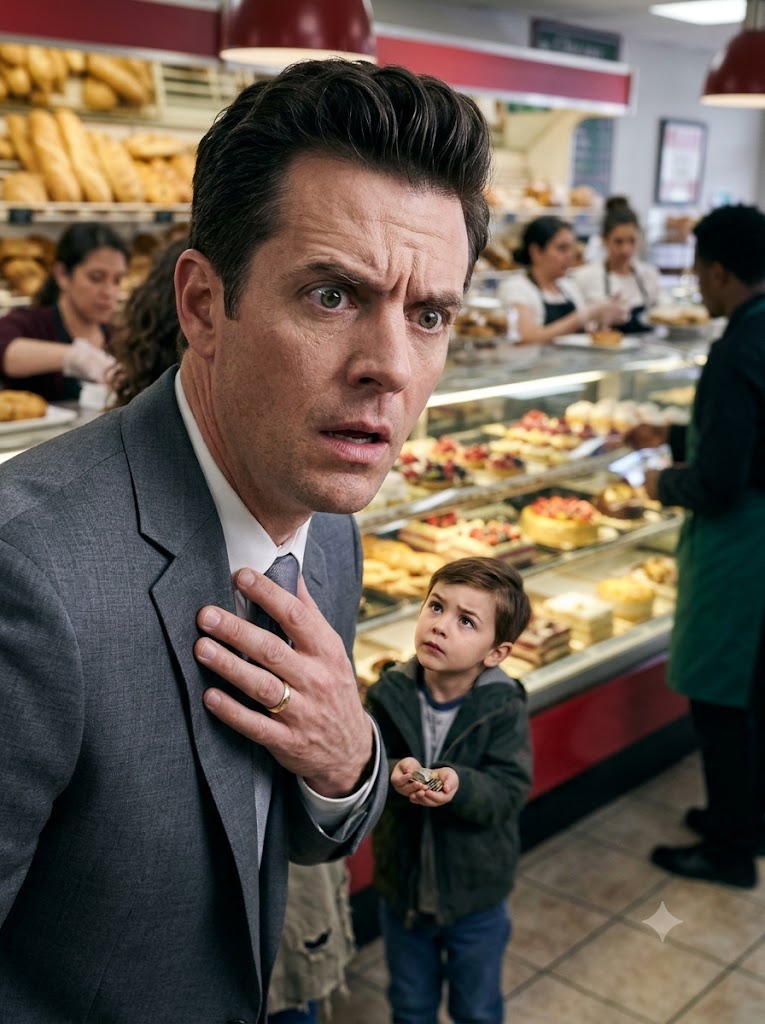
The first thing I noticed was the sound of coins hitting the bakery counter. They made a thin, embarrassed clatter beneath the espresso machine’s hiss. A woman in a crookedly buttoned gray coat stood with two boys pressed against her legs. I’d come for coffee after closing a deal for three Gold Coast towers.
“Just get one sandwich, Mom,” the boy in the blue jacket said. “Owen and I can share.” The other boy held a notebook covered with lopsided planets, his thumb pressed over a tear in the cardboard cover. “We’re fine,” their mother said, but the baker quietly added two pastries.
“Today’s special,” he announced. “Comes with lunch.” I recognized her voice before her face. My ex-wife, Leah Bennett, thanked him with painful politeness. I hadn’t seen her since she left our Lake Forest mansion with one suitcase five years earlier.
I stood by the pastry case in a wool coat that cost more than her month’s groceries. Reporters had called me a visionary over the six-hundred-million-dollar acquisition. Yet the woman who once stayed up with me drawing floor plans on napkins was apologizing to a stranger for being eighty cents short.
The boy in blue turned toward the bell above the entrance. One dark eyebrow rose while the other stayed flat. My father made that face when he doubted someone. Then the boy smiled sideways, and the resemblance stopped feeling like a coincidence.
“Leah?” I said. She turned so quickly that the paper bag crumpled between her fingers. For a second her expression was naked shock; then it closed like a door. “Grant,” she answered, and the boy asked, “Who’s that man?”
“Someone I used to know,” she said. She moved the children behind her without seeming to think about it, and I hated how naturally the gesture came. When I asked whether we could speak, she glanced toward the street and told me, “Not here. Please don’t make a scene.” The boys watched my face as though trying to understand why an ordinary bakery had suddenly become frightening.
I let them pass, then followed only as far as the window. A city bus groaned to the curb, and Leah hurried both boys aboard with one hand balancing the paper bag. The one with the notebook waved at the baker before the doors folded shut. I couldn’t remember the last time I had seen a child wave like that, with his entire arm.
I had told myself a comfortable story about our divorce. Leah taught science at a public school; I wanted her at charity dinners, investor retreats, and photographs where everyone smiled without meaning it. She missed an important gala to sit with a student whose family had been called to the hospital, and I accused her of choosing strangers over me. My mother, Celeste, said Leah had never understood what it meant to be a Mercer.
That night, I had said, “If this life embarrasses you so much, walk out and don’t come back.” Leah didn’t shout; she asked once whether I truly meant it. I said yes, and she packed while the housekeeper pretended not to hear. My mother later assured me Leah was happy to be rid of our obligations, and I accepted that version because it kept me from apologizing.
Back in my office, I ignored six messages from the acquisition team and called Marcus Lin, the attorney who now handled my private affairs. I asked him to retrieve the old divorce file, especially anything sent to me after Leah moved out. “What are we looking for?” he asked. I stared at the reflection of a small, raised eyebrow in my dark computer screen and said, “I think I might have children.”
Just before midnight, Marcus called again. He had found a sealed correspondence log from my former law firm, with several entries marked “family matter,” all dated after our separation. Every envelope had been delivered to the Mercer family office rather than to me. The signature line on the first receipt was covered by a scanning error, but Marcus had ordered the original from storage.
Part 2
By nine the next morning, I had reread the correspondence log until the dates blurred. The divorce had become final four months after Leah left, and the earliest envelope arrived three weeks later. Mother had managed our household mail. I had called that efficiency; I had never asked whose mail she kept.
Marcus couldn’t yet access the letters themselves, and I didn’t want someone following Leah home. Instead, I returned to the bakery with a folded note and asked Gus, the owner, to pass it along. He looked at my watch. “If she doesn’t want you finding her, I’m not helping you find her,” he said.
“That’s fair,” I told him. I wrote: “I owe you an apology, whether you ever want to hear it or not.” Gus took the paper without promising anything. Two days later, Leah called during a presentation.
“Gus said you didn’t ask where I live,” she began. I stepped into the hall, where the carpet swallowed the sound of my shoes. “I’m trying to stop deciding things for you,” I said. After a long silence, she told me to meet her at the public library on Saturday, alone.
Snow had turned to brown slush beside the library steps. Leah arrived with a canvas tote stuffed with marked worksheets and stayed standing until I moved away from the bench. “Those boys,” I began, but she lifted a hand. “They’re four,” she said. “Miles and Owen. And yes, Grant, there’s a reason they look like your family.”
My knees felt suddenly unreliable. She watched me absorb the news without offering comfort, and I couldn’t blame her. “Why didn’t you tell me?” slipped out before I could stop it. Her face hardened. “I did. I told your lawyer, I sent letters, and I called the number I’d used when we were married.”
I told her about the envelopes that had gone to the family office, and she stared at a bus turning the corner. “After the second letter, somebody called and said I’d be dragged into court if I kept trying,” she said. “I was pregnant, sick, and teaching until I could barely stand. Then the boys arrived early, and I spent weeks in the hospital learning what every alarm meant.”
I wanted to reach for her, but she had made the distance between us clear. “I never received those letters,” I said. “That doesn’t excuse what I said when you left.” She rubbed the frayed handle of her tote and answered, “No. It doesn’t.”
She told me she had kept her job when she could, taken tutoring shifts, and paid off one medical bill only to find another underneath. A new owner had recently announced a rent increase at her building, and she was comparing apartments farther from the twins’ school. “I don’t need a speech about how you can rescue us,” she said. “I need to know whether you’ll disappear when this becomes inconvenient.”
“I want to do right by them,” I answered. “That starts with respecting what you decide.” She said the boys knew they had a father somewhere but hadn’t asked much yet. If I wanted to meet them, we would first agree on a careful plan with someone who understood young children.
Before leaving, Leah took a photograph from her tote and placed it beside me. Two tiny babies lay under knitted blankets in a hospital room, their feet scarcely longer than my thumb. On the back she had written their names and a date eight months after our separation. “I carried this to the mailbox every time I tried again,” she said.
I sat there until the library lights blinked on, listening to a child reading aloud behind a glass door. When Marcus finally called, he sounded older than he had on Friday. The original receipt had been recovered, along with a memo instructing staff to redirect future messages from Leah. “Grant,” he said, “your mother’s full signature is on the instruction.”
Part 3
Marcus spread the documents across my conference table. There were five letters from Leah, two notes from a hospital social worker, and a delivery instruction on cream stationery. The first said she was pregnant with twins. The last asked whether the boys could be added to the health insurance I’d once promised would cover her.
Every envelope bore the same receiving stamp: the Mercer family office. Beneath the handwritten instruction to keep the correspondence from my desk was Celeste Mercer’s unmistakable signature. A former junior associate had included a memo about a twenty-thousand-dollar payment from a family-controlled corporate account. Marcus had requested an internal review.
“Did he ever tell Leah that I didn’t want contact?” I asked. Marcus turned over a copy of a formal warning letter. It told Leah that further attempts to reach me could trigger expensive legal action concerning the children, though no court had issued such an order. I read the sentence twice, remembering Leah on the library steps. “She thought I sent that,” I said.
Mother was arranging white orchids when I reached her office at the family headquarters. The place smelled of polished wood and citrus cleaner, and a portrait of my father hung above the mantel. She saw the papers in my hand. “So you’ve finally heard from your former wife,” she said.
“Those are my sons,” I answered. Her scissors stopped halfway through an orchid stem, although her expression barely shifted. “You cannot be certain without testing,” she said. “And even if they are, you’ve built something valuable. You cannot let an old mistake take it from you.”
I placed the hospital letter on her desk. “You knew two babies were struggling, and you hid it from me.” She set down the scissors with absurd care. “I prevented an unsuitable woman from using children as leverage,” she replied. “Your father would have understood.”
“No,” I said, and my voice surprised us both. “He used to drive twenty miles to see me play baseball, even when I sat on the bench.” Mother crossed her arms and reminded me that she held a board seat, controlled several foundation relationships, and knew our investors. For the first time, I heard her threats without translating them into concern.
I told her an independent committee would review the payment and her use of company resources. Pending that review, I would ask the board to suspend her access to corporate accounts and confidential personnel files. I also said she was not to contact Leah or the boys. “You can’t erase your own mother,” she whispered, and I answered, “I can stop letting you decide who deserves to be family.”
Outside, I sat in my car with the heat running and cried harder than I had at my father’s funeral. I hadn’t written the threatening letter, but I had given Celeste the keys to every room in my life. I had made Leah believe that a request for help would only bring punishment. I couldn’t tell myself that ignorance made me innocent.
That evening, I asked Leah whether I could send her copies of the letters. She agreed, then called back an hour later with a voice so steady it frightened me. “I never wanted you punished for being rich,” she said. “I wanted you to know they existed, and I wanted them to feel safe.”
“I know,” I said, sitting on the kitchen floor of a house too big for one man. She told me the boys had been drawing their family in class and had started leaving a blank space beside her in the pictures. “Don’t fill that space just because you’re ashamed,” she warned. “Only do it if you intend to stay.”
I promised nothing I couldn’t control, then asked whether we could arrange a conversation with a family counselor before telling the twins. Leah said she would think about it. Ten minutes later, Marcus sent a message marked urgent: Celeste’s communications adviser had drafted a story accusing Leah of deliberately hiding my heirs. The draft was scheduled to reach a gossip columnist in the morning.
Part 4
I called the communications adviser. She claimed the gossip story was merely a contingency plan, but Marcus had its delivery email and photograph. It showed Leah and the twins outside their apartment. My anger went cold when I realized Mother hadn’t only intercepted letters; she had kept watching them.
I told the adviser she had no authority to speak for Mercer Properties and ordered a stop to distribution in the company’s name. The columnist agreed not to publish the children’s photograph. But an anonymous post about my supposed “secret heirs” appeared anyway, and Leah found it before I could call. Her message contained six words: “You said you would protect them.”
I drove to the library and waited for permission to meet. When Leah arrived, she held her phone so tightly her knuckles had gone white. “Parents read these things,” she said. “The boys could hear about their father from strangers.” I offered to make a public statement, and she immediately shook her head.
“No photographs. No names. No interview,” she said. I agreed and authorized a short response denying the story’s false allegations without mentioning the children. Marcus helped Leah secure independent legal advice, paid for on terms her attorney approved. For once, my job was not to control the outcome; it was to give her choices.
At headquarters, the independent committee examined the corporate payment and heard from the former associate. The records supported that Celeste had directed company money toward suppressing Leah’s messages. The board voted to remove her access to its accounts and ask her to step aside from her directorship during the review. My mother’s portrait remained in the lobby, but her security badge no longer opened the executive floor.
She called from a private number that afternoon. “You’re humiliating this family for a woman who left you,” she said. I answered, “You threatened her when our children needed help.” Mother tried to argue about the company, then my inheritance, and Father’s memory. I ended the call when she asked whether the boys were “even worth this trouble.”
Leah’s attorney arranged an agreement to address parental responsibilities, financial support, and a gradual introduction. I provided complete financial records and signed an interim support arrangement without demanding visits in exchange. Leah also agreed to a properly arranged paternity test, not because Celeste deserved proof, but to protect the children. Waiting for the result felt endless.
In the meantime, Leah allowed me to meet the boys at a Saturday astronomy activity in the library. Miles wore the blue jacket from the bakery, its zipper repaired with red fabric. Owen carried the battered planet notebook and asked whether I knew why Saturn had rings. I admitted I didn’t know enough, and he offered to teach me if I held his paper steady.
For forty minutes, we made crooked planets from colored paper and glue. My shirt cuff collected a purple fingerprint, and I left it there for the rest of the day, smiling whenever I caught sight of it. Miles informed me that the sun was not actually yellow like the crayons suggested, and Owen corrected the number of moons on a poster. Leah watched from the other side of the table, wary but no longer standing between us. When the children went to wash their hands, she said, “They liked you, but please don’t treat that as permission to rush.”
The test results arrived on a Thursday. Marcus gave me the sealed report, and I opened it beside Leah in the counselor’s office. The conclusion confirmed what those familiar faces had already made me suspect: I was their biological father. Leah exhaled, slowly, like someone setting down a burden she had carried too long.
We told the boys together, using the simple words the counselor recommended. Owen asked whether I could help with his planet project, and Miles wanted to know whether fathers were supposed to attend school concerts. I said I wanted to, whenever their mother and they were comfortable. Then Miles studied my face with my father’s raised eyebrow and asked, “Are you going to leave again?”
Part 5
Miles’s question landed harder than anything Celeste had said. I crouched beside his chair. “I wasn’t there when you were babies,” I said, “and that was wrong. I didn’t know where you were, but I should have tried harder to understand why your mom left.” Leah studied my face.
“Will you come to my concert?” Miles asked. “If you want me there, yes,” I answered. Owen promptly asked for help with Jupiter. Outside, Leah said, “Don’t promise something because it sounds beautiful. Promise it because your calendar will change.”
So I changed it. I started small: Wednesday library visits, Saturday breakfasts when Leah agreed, and counseling appointments. I learned that Owen hated the rough seam inside his winter gloves and Miles slept with a flashlight under his pillow. Sometimes I left without arguing for another hour.
The first concert was held in a school cafeteria that smelled of floor wax and reheated pizza. I sat in the second row while Miles spotted me and nearly forgot his song. Leah was beside me, smiling in spite of herself. I remembered canceling her school fundraiser for a shareholder dinner years ago, and wondered how I’d ever convinced myself an investor’s applause mattered more than this. Afterward, they showed me a crooked cardboard solar system.
Meanwhile, the review at Mercer Properties concluded that Celeste had improperly authorized the payment used to suppress Leah’s messages. Following proper procedures, the board removed her from her directorship and required repayment of the misused funds. The lawyers preserved the records, and we changed the firm’s reporting procedures. I knew corporate accountability could not return the childhood moments I’d missed.
Celeste sent a letter to my home on thick stationery. She said she had sacrificed everything for my future and accused me of choosing strangers over blood. She added, “When you have your own family, perhaps you’ll understand.” I asked Marcus to remind her not to contact Leah or the boys.
I did not invite her to meet the boys, and I did not bargain over photographs or holiday visits. She continued to have her own resources and her own life, but not authority over mine. Colleagues called our separation a tragedy; I remembered the hidden letters. A tragedy would have been learning the truth and repeating the same mistake.
Leah’s attorney helped us formalize a parenting schedule and appropriate financial support, including outstanding expenses from the boys’ earliest years. Leah used the breathing room to reduce her tutoring hours and move into a brighter apartment a few blocks from the school, one she chose herself. I offered to help with the move; she let me carry boxes, not make decisions. At the top of the stairs, she handed me a lamp and said, “You still don’t get to run my life.”
“I know,” I replied, and meant it. Months later, I asked whether she thought we might ever start over. She looked across the kitchen, where Miles and Owen were arguing about which planet deserved the biggest sticker. “I’m glad you’re becoming their father,” she said. “But I’m not coming back to being your wife.”
For once, I didn’t argue with a boundary simply because it hurt. I had loved Leah badly, and she had rebuilt herself without me. My task was to give our sons a dependable father, not to ask their mother to heal my loneliness. I went home that night to my quiet house and felt the cost of my choices without trying to transfer it to anyone else.
Fourteen months after the bakery encounter, the boys and I met Leah there for breakfast before a trip to the planetarium. Gus brought out four croissants and winked at Owen, who immediately explained the difference between a meteor and a meteorite. Leah paid for her coffee; I bought the boys’ food; nobody counted coins. When Miles reached across the table and took my hand, I finally understood that being a father wasn’t something my money could announce—it was something I had to keep showing up to do.
Legal Notice: This story is a work of fiction. Names, characters, businesses, events, and incidents are the product of the author’s imagination or are used fictitiously. Any resemblance to actual persons—living or dead—or to actual events is purely coincidental. Thank you! 💓


