
Chapter 2
Richard had known this day might come.
Three nights before he died, when the cancer had reduced his strong voice to a whisper, he squeezed my hand and told me not to underestimate what money could do to frightened people. Caroline had been visiting every afternoon then, bringing flowers, asking about medications, and carefully avoiding any conversation about the estate.
“They think you’ll fold,” Richard told me.
“Who is they?”
He smiled faintly. “You know.”
I did.
Richard loved our daughter more than anything, but love had never blinded him. Over the years, Caroline and Grant borrowed money for renovations, vacations, private school tuition, a failed restaurant investment, and a luxury SUV they insisted was necessary for Grant’s business image. Richard kept records of every loan.
More than two hundred thousand dollars went out.
Almost none came back.
Whenever I suggested they should learn to live within their means, Caroline laughed and called me old-fashioned. Grant was more polished. He always thanked us warmly before asking for the next favor.
Richard saw it all.
The morning after he warned me, he asked me to open the drawer beside his bed. Inside was an envelope with my name written in his shaky handwriting.
“Not until you need it,” he said.
I waited until the lawsuit arrived.
Inside the envelope was a note containing one name.
Evelyn Parker.
Beneath it, Richard had written, She’ll remember who you are.
I certainly remembered Evelyn. Four decades earlier, she had been Evelyn Carter, the quickest mind in our law-school class and one of the few people who could regularly beat me in moot court. We had not been close friends, but we had respected each other, and our careers crossed several times before marriage changed the direction of mine.
I had practiced law for fourteen years.
Not small-town divorces or routine paperwork, either. I handled financial fraud, white-collar criminal defense, and complicated civil litigation. Before I turned forty, newspapers had described me as relentless, severe, brilliant, difficult, and once, rather dramatically, “a velvet hammer in sensible heels.”
Then Caroline was born.
Richard never asked me to quit. I chose to step away, first for a year and then another, until being home became the life I wanted more than the courtroom. I kept my license active, attended continuing legal education programs, read new decisions, and handled portions of our family’s legal and financial planning quietly behind the scenes.
Caroline knew none of that.
The night I found Evelyn’s name in Richard’s envelope, I called her chambers. I did not discuss the facts of the case. I only identified myself and asked whether our distant professional history created a conflict.
Her voice changed when she heard my maiden name.
“Laura Morgan?”
“Hello, Evelyn.”
There was a long silence. “Good Lord. Caroline Bennett is your daughter?”
“She is.”
“Does her lawyer know who you are?”
“No.”
Another silence followed, and then Evelyn said carefully, “Keep this conversation procedural, Laura.”
“Of course.”
She explained that our old professional acquaintance did not automatically require her withdrawal, though either side could raise the issue if they wished. Then she asked whether I had counsel.
“I’m representing myself.”
That got a sigh. “You’ve been away from litigation a long time.”
“I’ve been away from a courtroom. That’s not the same thing.”
I could almost hear her remembering.
For the next several weeks, I prepared. I studied Keller’s record, reviewed guardianship and competency law, organized Richard’s medical records and estate documents, and obtained statements from people who regularly dealt with me. I could have hired an excellent attorney, but I wanted Caroline’s lawyers to reveal their case before they understood mine.
So at my deposition, I answered only what was asked.
When Keller slowly explained basic legal terms to me, I thanked him.
When he asked how a woman with “no professional background” understood Richard’s business interests, I said I had always been good with numbers.
When Caroline called to explain how comfortable my life would be once she and Grant took charge, I listened.
I also learned something unpleasant.
Grant had been telling Caroline that I would lose Richard’s fortune within a year. He convinced her the lawsuit was practically an act of rescue. Yet whenever he spoke privately in my home, his concern sounded less like protection and more like possession.
He talked about “unlocking assets.”
He talked about “finally restructuring the portfolio.”
Once, while Caroline stepped outside to answer a call, he stood at my kitchen counter and said, “Laura, there comes a point when older people need to let the next generation take over.”
I looked at him. “I’m sixty-six, Grant. Not ninety-six.”
He smiled. “You know what I mean.”
Unfortunately for him, I did.
My state allowed a participant in a conversation to record it, and I had begun documenting discussions in my own home after the petition arrived. I hoped the recordings would prove nothing except that I had been overly suspicious.
Instead, Grant eventually gave me exactly what I feared he would.
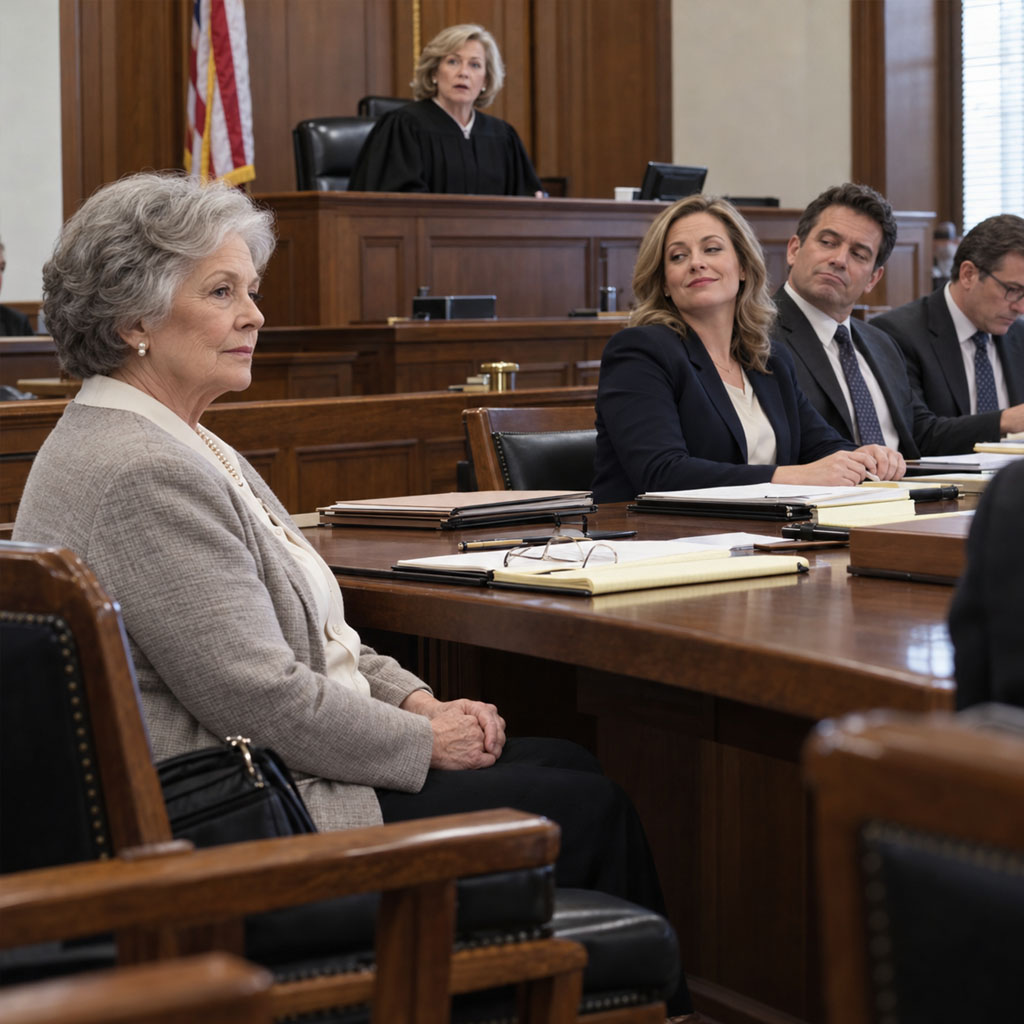
On the morning of the hearing, I wore an old navy dress, left my professional briefcase at home, and carried everything important inside my purse. Caroline laughed when she saw me because, to her, I looked exactly as helpless as she needed me to be.
Keller rose and addressed the court.
“Your Honor, this matter concerns an elderly widow who has recently inherited an unusually large estate under circumstances her family believes warrant immediate scrutiny.”
Elderly.
I almost smiled.
He described my wrong turn while driving. My problems with streaming television. My questions about money transfers. He referred repeatedly to my lack of business experience and warned that without intervention, millions of dollars could be placed at risk.
Judge Parker listened without expression.
Then she looked at me.
“Mrs. Bennett, you are appearing without counsel?”
“Yes, Your Honor.”
“Do you understand that your daughter is asking this court to determine whether you have the capacity to manage your financial affairs?”
“I do.”
Keller stood. “Your Honor, that answer alone shouldn’t be interpreted as evidence of competency.”
“No one said it should,” Judge Parker replied.
I kept my eyes lowered.
Then Keller made his first serious mistake.
He said there was “substantial reason to question” whether Richard’s will genuinely reflected his independent wishes.
I stood.
“Your Honor, may I ask counsel to clarify that allegation?”
Keller glanced at me, irritated. “This is not cross-examination, Mrs. Bennett.”
“I understand that.”
His expression suggested he doubted it.
Judge Parker nodded. “Proceed with the question.”
I turned toward Keller.
“Are you alleging that my husband’s signature was forged?”
He hesitated. “We’re suggesting the circumstances were questionable.”
“The will was executed before witnesses, notarized, reviewed by independent estate counsel, and supported by prior drafts showing substantially the same disposition. Which circumstance are you questioning?”
The courtroom became quiet.
Keller’s face changed slightly.
“Mrs. Bennett may have been coached,” he said.
“By whom?” Judge Parker asked.
Keller had no answer.
I reached into my purse.
“Your Honor, perhaps this is the appropriate moment to clear up one misconception.”
I placed my current bar card on the clerk’s desk.
“My legal name is Laura Morgan Bennett. I’ve been a licensed attorney for forty-one years.”
Behind me, someone gasped.
Caroline whispered, “What?”
I turned.
She was staring at me as though the mother she had known all her life had vanished while she wasn’t looking.
Grant no longer looked amused.
Chapter 3
Thomas Keller asked for a recess.
Judge Parker denied him.
“You filed an emergency petition,” she said. “You represented that delay could place Mrs. Bennett’s assets in danger. We will proceed.”
Keller tried to recover quickly. He pointed out that I had not practiced actively in decades, which was true. He argued that past intelligence did not prove present capacity, which was also true.
So I agreed with him.
“Mr. Keller is correct, Your Honor. A law degree from forty years ago would not prove my current mental fitness.”
Caroline looked startled again.
I continued. “Which raises the obvious question. What current medical evidence has the petitioner offered to prove my current mental unfitness?”
Keller shuffled through his papers.
“We have observations from immediate family.”
“Any physician?”
“No.”
“Neurologist?”
“We’ve requested an evaluation.”
“Psychologist?”
“Not yet.”
I looked at the judge. “So they want the evaluation because they claim I’m incompetent, and they claim I’m incompetent because they want the evaluation.”
Keller objected.
Judge Parker overruled him.
Then Keller called Caroline.
My daughter walked to the witness stand with none of the confidence she had carried into the courthouse. She swore to tell the truth, sat down, and kept her eyes on her attorney.
Keller asked her to describe my supposed decline.
Caroline mentioned the wrong turn.
“There was road construction,” I said when my turn came to question her. “Do you remember that?”
She nodded reluctantly.
“And the television problem?”
“You asked Ethan for help.”
“Yes. Your seventeen-year-old son enjoys technology. I asked him to show me how the new system worked. Did I ask him twice?”
“No.”
“Did I forget what he showed me?”
“No.”
“Did I ever fail to recognize you?”
“No.”
“Forget where I lived?”
“No.”
“Miss appointments?”
“No.”
“Leave appliances burning?”
“No.”
Keller objected that I was trivializing genuine family concerns.
I looked at Caroline.
“Did you speak to my doctor before filing this petition?”
“No.”
“Any neighbor?”
“No.”
“My accountant?”
“No.”
“Richard’s attorney?”
“No.”
“Anyone who saw me regularly besides you and Grant?”
She looked down. “No.”
I paused.
“Before filing the petition, did you ask me to undergo a medical examination because you were worried about my health?”
Caroline’s mouth opened, then closed.
“No.”
“Did you ask whether I needed help?”
“We tried to help with the money.”
“That’s not what I asked. Did you ask whether I needed help?”
“No.”
The answer barely carried across the room.
For the first time since Richard died, I saw shame on my daughter’s face.
Keller called for another recess. This time Judge Parker granted ten minutes.
In the hallway, Caroline stayed close to the courtroom doors while Grant argued with Keller several yards away. Their voices were low, but their body language said enough. Grant stabbed a finger toward the courtroom. Keller repeatedly shook his head.
Then Keller approached me alone.
“Mrs. Bennett, my clients may be willing to resolve this.”
“What resolution?”
“The petition could be withdrawn in exchange for a family settlement.”
I almost admired the speed with which concern for my mental health had become negotiation over money.
“What kind of settlement?”
“A distribution to your daughter reflecting what she reasonably expected from her father’s estate.”
“She expected millions.”
“She’s his only child.”
“And I’m his wife.”
“No one’s disputing that.”
“Your petition does exactly that, Mr. Keller.”
His jaw tightened. “Litigation can permanently damage families.”
“So can accusing your mother of dementia because you don’t like a will.”
He lowered his voice. “You made your point.”
“No. You haven’t heard my point yet.”
When we returned, Caroline asked to speak privately with me before testimony resumed. Judge Parker allowed a brief conversation in the hallway with counsel nearby.
Caroline looked tired.
“Why didn’t you tell me?”
“About being a lawyer?”
“About any of it.”
I studied her face. For once, she was not angry. She looked wounded.
“When you were little, you asked me what I did, and I told you I was your mother. That answer made you happy.”
“I was five.”
“Exactly.”
“What about later?”
“Later, you stopped asking.”
She flinched.
“I thought Dad handled everything.”
“Your father handled plenty. So did I.”
“Why pretend you didn’t understand online banking?”
“At first, I wasn’t pretending. I disliked the new system. After the lawsuit threat started, I began paying attention to what happened when people thought I needed help.”
Her eyes filled. “So you tested me.”
“I gave you opportunities.”
“That’s the same thing.”
“No, Caroline. A test has a desired answer. I desperately wanted no answer at all.”
Before she could respond, Grant came down the hallway.
“Don’t talk to her without me.”
Caroline turned. “She’s my mother.”
“She’s opposing us in litigation.”
The sentence landed between them.
Us.
Not you.
Caroline stared at him.
Something shifted.
That evening, she called me.
For nearly an hour, we spoke more honestly than we had in years. She admitted Grant had pushed the idea that Richard’s estate should have passed directly to them. He told her my questions and grief were proof that I couldn’t cope. He said they were protecting the family legacy.
“Did you believe him?” I asked.
“Yes.”
“Why?”
She was silent.
Then she said, “Because I wanted the money.”
There it was.
Not manipulation. Not confusion. Not Grant alone.
Choice.
“I’m sorry,” she whispered.
“I believe you’re sorry.”
“Can we stop?”
“You can.”
“What do you mean?”
“You can withdraw your petition.”
“What about Grant?”
“That’s your question to answer, not mine.”
When the call ended, I sat in Richard’s study staring at our wedding picture. I had spent years cushioning Caroline from consequences because I called it love. Richard had warned me that protection could become permission if it lasted too long.
The next morning, Caroline came to court alone.
Grant arrived twenty minutes later with a second lawyer.
And when I saw the new attorney carrying an amended petition, I knew Grant had decided that if he could no longer prove I was helpless, he would try to prove I was dangerous.
Chapter 4
Grant’s new attorney, Daniel Reeves, was younger than Keller and considerably more aggressive.
He approached the bench and argued that my conduct showed calculated deception. According to his new theory, a woman who intentionally allowed her family to believe she needed help, then used their reactions against them, demonstrated “disturbing manipulative behavior” inconsistent with responsible stewardship of a major estate.
Judge Parker stared at him.
“Mr. Reeves, yesterday your side argued Mrs. Bennett was cognitively incapable of understanding complex financial matters.”
“New information has come to light.”
“And today you’re arguing she is so strategically sophisticated that her intelligence itself is evidence of unfitness.”
Reeves paused. “We’re arguing that the pattern is concerning.”
I stood.
“Your Honor, I would like to respond.”
“Briefly.”
I faced Reeves. “If I fail to understand my finances, I’m incompetent. If I understand them well enough to defend myself, I’m manipulative. Under counsel’s theory, is there any behavior available to me that proves I am fit?”
A few people in the gallery murmured.
Reeves said, “You deliberately misled your daughter.”
“I allowed my daughter to continue believing assumptions she had held for years.”
“That’s deception.”
“Is failing to announce one’s résumé at Thanksgiving grounds for guardianship now?”
Judge Parker covered what might have been the beginning of a smile.
Reeves changed direction. He insisted my behavior had damaged family relationships and demonstrated poor judgment. I let him speak until he had committed himself completely to the idea that my secrecy was the central issue.
Then I opened my purse.
“Your Honor, since counsel has placed family motives and judgment directly at issue, I have documents responsive to that theory.”
Reeves objected immediately.
Judge Parker examined the records before ruling.
They showed seven years of loans from Richard and me to Caroline and Grant. Kitchen renovations. Credit-card debt. Tuition. A luxury vehicle. Investment losses. Emergency cash after Grant’s consulting business nearly collapsed.
Total outstanding balance: $218,400.
Caroline covered her mouth.
Grant leaned toward Reeves, furious.
“These records,” I said, “are part of the reason Richard structured his estate as he did. He was not punishing our daughter. He was refusing to fund an established pattern.”
Reeves argued that debt did not prove malicious intent.
“I agree,” I said.
He frowned, apparently expecting a fight.
“Debt alone proves nothing about intent. That’s why I brought something else.”
I placed my phone on the table.
The conversation had occurred in my kitchen three weeks after Richard’s funeral. I had been present for part of it, then stepped into the adjoining pantry while Grant and Caroline continued talking. Under the law where we lived, because I was a participant when the recording began and remained within the conversation, the recording had been lawfully made.
The judge reviewed the legal issue before allowing the relevant portion.
Grant’s recorded voice filled the courtroom.
He was telling Caroline that once a court put someone else in charge of my finances, the estate could be “managed properly.” He talked about refinancing property, restructuring investments, selling the bay house, and using income from the estate to support what he called “family obligations.”
Then Caroline asked, “What about Mom?”
Grant answered, “She’ll have everything she needs. She doesn’t need sixty million dollars to sit around reading and feeding birds.”
Caroline’s recorded voice came next.
“And if she fights?”
Grant laughed.
“Laura doesn’t fight.”
The recording stopped.
No one moved.
Grant looked at me with a kind of disbelief, as though he still couldn’t understand how the quiet woman from holiday dinners had become his opponent.
Reeves rose. “This proves exactly what we’ve said. Mrs. Bennett orchestrated circumstances to gather material against her own family.”
“No,” Caroline said.
Everyone turned.
She was standing beside Keller’s table, pale but steady.
“Caroline,” Grant warned.
She ignored him.
“No, Your Honor. She didn’t make us say those things.”
Grant’s face hardened. “Sit down.”
Caroline looked at him.
For years, I had watched my daughter shrink in tiny ways around her husband without understanding how far it had gone. She always checked his expression before ordering at restaurants. She changed opinions when his voice sharpened. She defended his spending even when it frightened her.
Now she did something I had not seen her do in a long time.
She stood straighter.
“I said sit down,” Grant repeated.
“And I said she didn’t make us do anything.”
Judge Parker ordered everyone to remain calm.
Caroline turned toward me.
“I wanted Dad’s money. Grant encouraged it, but I wanted it. I convinced myself Mom couldn’t handle the estate because that made what we were doing sound respectable.”
Keller whispered urgently to her, but she shook her head.
“I don’t want the petition anymore.”
Grant shot to his feet. “You can’t just quit.”
“It’s my petition.”
“It’s our future.”
Caroline looked at him for several seconds.
Then she said, “That’s the problem.”
Judge Parker called a recess so the attorneys could determine the procedural effect of Caroline withdrawing her claims while Grant attempted to preserve whatever standing he believed he had.
I remained at my table.
Caroline walked toward me but stopped several feet away.
“Mom.”
I looked up.
“I’m sorry.”
“I know.”
Tears slipped down her face. “I don’t expect you to forgive me.”
“Good.”
She blinked.
I softened my voice. “Because if you expect forgiveness, then you’re still asking me to give you something. Right now, you need to decide what you’re willing to give.”
“What?”
“Truth. Accountability. Time.”
She nodded slowly.
Behind her, Grant was arguing with both lawyers.
I watched him for a moment and finally understood that defeating the petition was no longer the most important thing happening in that courtroom.
My daughter was seeing her marriage clearly for the first time.
Chapter 5
When court resumed, Caroline formally asked to withdraw.
Grant’s attorney tried to argue that Grant had an independent financial interest in Richard’s estate through marriage and prior family arrangements. Judge Parker disposed of that argument quickly. Expectation was not ownership, marriage to an heir was not inheritance, and disappointment did not create legal standing.
Then she addressed the original petition.
“The record before this court contains no medical evidence establishing incapacity, substantial evidence demonstrating Mrs. Bennett’s understanding of her assets and legal affairs, and testimony severely undermining the motives underlying this action.”
Grant stared straight ahead.
Judge Parker continued.
“Mrs. Bennett’s decision to conceal parts of her professional history from her family may be unusual. It is not evidence of incapacity. Her decision to document conversations after litigation was threatened may be cautious, perhaps even guarded. It is not proof that she is unable to manage her own life.”
She looked at me.
“Mrs. Bennett, this court finds no basis to interfere with your control of your property or finances.”
Then she looked toward Caroline and Grant.
“Families often come into this courtroom believing money is the issue before me. Frequently, money is merely the thing that exposes the issue that was already there.”
No one spoke.
“This petition is dismissed.”
The gavel came down.
Just like that, the legal battle ended.
The family battle did not.
Grant left the courthouse without Caroline. He walked past reporters from a local business journal who had apparently learned that Richard Bennett’s estate was involved in a competency dispute. I declined every interview.
Caroline remained on a bench near the elevators.
When I passed, she stood.
“Can I come home with you?”
The question took me back thirty years.
For a moment, I saw the little girl who used to appear beside my bed during thunderstorms carrying a blanket and asking whether she could sleep between Richard and me.
But she was not that little girl anymore.
And I could not keep treating her as though she were.
“You can come for coffee,” I said.
She nodded. “Coffee is good.”
At my house, we sat at the kitchen table where I had read her petition weeks earlier.
Caroline cried. She apologized. Then she apologized without crying, which meant more to me.
She told me that Grant had spent years measuring success by what other people owned. Every promotion required a better car. Every neighbor’s renovation required a bigger one. Every vacation became a competition. Caroline had participated willingly until debt turned their lifestyle into a trap.
“When Dad left everything to you,” she said, “I didn’t hear him saying you were capable. I heard him saying I wasn’t loved.”
“He loved you deeply.”
“Then why not leave me anything?”
“He left you a letter.”
Her eyes lifted.
“I couldn’t read it.”
“Why?”
“Because I was angry.”
I went to Richard’s study and brought back the envelope.
Caroline opened it at the table.
I never asked what every line said. Some things belonged between a father and his daughter.
But I watched her face change as she read.
At one point, she pressed her hand to her mouth.
Near the end, she whispered, “Oh, Daddy.”
When she finished, she sat silently for several minutes.
Finally, she slid one page toward me.
Richard had written one sentence larger than the others.
Your mother gave up applause so you could grow up hearing her voice at home; never mistake quiet sacrifice for weakness.
Caroline put her head in her hands.
“I didn’t know.”
“You didn’t ask.”
“I know.”
That was the beginning.
Not forgiveness.
Beginning.
Within two months, Caroline separated from Grant. I did not encourage divorce, reconciliation, or anything in between. Her marriage belonged to her, and one lesson both of us had to learn was that love did not give us the right to manage another adult’s choices.
She found a small apartment and started meeting with a financial counselor. For the first time since college, she built a budget without asking Richard, me, or a bank to rescue her.
She also began repaying the old loans.
The first check was for only three hundred dollars.
I cried when I opened it.
Not because I needed the money, but because for the first time the amount did not matter.
Six months after the hearing, I sold the large house. Too many rooms held Richard’s voice, and grief had taught me that memory did not need square footage.
I bought a cottage overlooking the water where mornings were quiet and gulls argued over the shoreline. I kept Richard’s desk, our wedding photograph, and three shelves of law books.
The rest I gave away.
I also made a decision about the estate.
Half of Richard’s fortune went into a foundation providing legal help to older adults facing financial exploitation, coercive guardianship disputes, and family pressure over property. I hired excellent lawyers and insisted they never assume a frightened person was confused simply because that person spoke softly.
People sometimes asked whether I created the foundation because of Caroline.
The truthful answer was partly.
I created it because of everyone who had spent a lifetime being underestimated and reached an age when other people began confusing gray hair with diminished worth.
The remaining half of the estate stayed with me.
I traveled some. I read constantly. I advised the foundation’s attorneys when they asked, though I refused every suggestion that I return to full-time practice.
I’d already had two careers.
I had been Laura Morgan, the courtroom lawyer who knew how to dismantle an argument.
Then I had been Laura Bennett, wife and mother, the woman who packed lunches and waited up when her daughter came home late.
Neither woman was more real than the other.
That had been Caroline’s mistake.
Maybe it had been mine, too.
A year after the hearing, Caroline came to the cottage for Thanksgiving. She arrived early carrying a pie she had baked herself and a folder containing the latest record of her loan repayments.
“You don’t have to show me this every time,” I said.
“I know.”
“Then why do you?”
She smiled. “Because I’m proud of it.”
That afternoon, we walked along the shore while cold wind pushed the waves against the rocks. Caroline slipped her arm through mine.
“Do you hate me for what I did?”
“No.”
“How can you not?”
I considered the question.
“Because I remember all of you. The selfish woman in that courtroom is part of you. So is the little girl who brought injured birds into my kitchen. So is the mother who loves her son. So is the woman walking beside me now, trying to become better than she was.”
She looked toward the water.
“Dad knew, didn’t he?”
“Knew what?”
“That I’d have to lose something before I understood what mattered.”
I smiled.
“Your father was annoyingly wise when he wanted to be.”
She laughed, and for a second Richard seemed close enough to hear us.
Caroline never inherited the fortune she expected.
She inherited something harder.
The chance to grow up after she believed she already had.
And I learned something, too. Strength isn’t proving that no one can hurt you. It isn’t humiliating the people who misjudged you, and it isn’t winning every fight simply because you can.
Sometimes strength is standing in front of someone you love and refusing to let their worst choice become the only thing you ever see in them.
But strength is also refusing to surrender your dignity just to keep the peace.
The morning I walked into that courtroom, my daughter laughed because she thought she knew exactly who I was.
By the time we walked out, neither of us did.
Perhaps that was the greatest inheritance Richard left us.
Not the houses.
Not the investments.
Not sixty million dollars.
He left us the truth, and eventually, we became strong enough to live with it.
THE END.
⚠️ All characters and events are fictional. Do not imitate or apply them in real life. 😌😌😌


