
Chapter 2
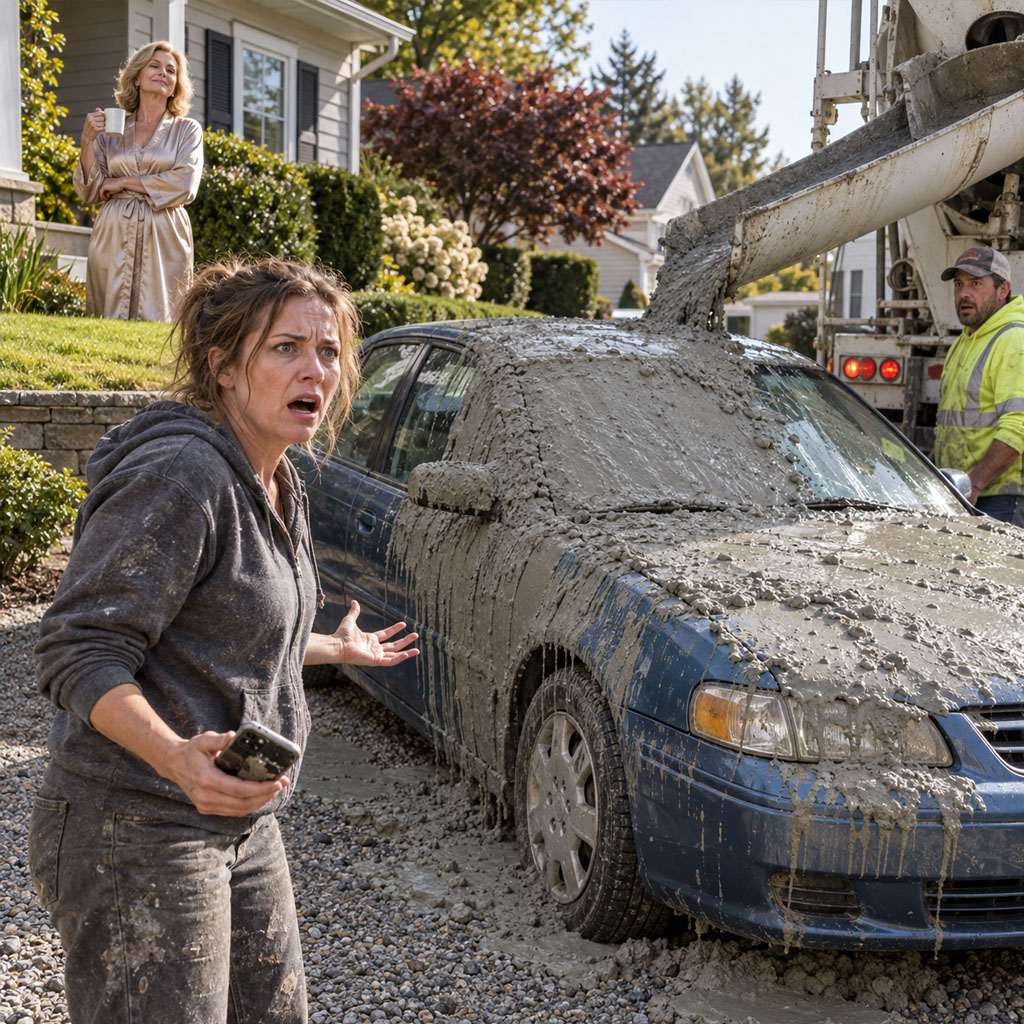
My daughter’s words cut through the noise of the concrete truck.
For a moment, I forgot about my ruined car. Emma had never met anyone who frightened her more than Cheryl, yet there she stood, barefoot on the gravel, speaking with the calm determination I’d often seen in my father.
“Emma, sweetheart, what are you talking about?” I asked.
She pressed the tablet against her chest. “Grandpa knew why she wanted his house, Mom. And I know, too.”
Across the road, neighbors were gathering outside. Mrs. Burke stood beside her mailbox with a bathrobe wrapped tightly around her. The Patterson family watched from their porch, while Walter remained beside my concrete-covered Chevy with his useless hose hanging from one hand.
Cheryl glanced between Emma and the approaching county inspectors.
“Someone needs to take that child inside,” she announced. “She’s clearly confused.”
“She’s standing on her own property,” Walter replied. “And I believe she has something to say.”
Inspector Alvarez approached Cheryl’s front door with two other county employees. He attached an orange notice to the glass beside her doorbell.
“Mrs. Hartley,” he called, “we’ve confirmed an unauthorized balcony addition and an encroachment onto the county right-of-way. The balcony is subject to immediate restrictions pending further review.”
Cheryl’s smile vanished.
“That’s ridiculous! Do you have any idea who paid for the new library roof in this town?”
“Yes, ma’am,” Alvarez answered evenly. “But that doesn’t change the survey.”
She hurried uphill, demanding to speak with his supervisor. Her coffee spilled down the front of her expensive robe, but she appeared not to notice.
Walter turned toward me.
“Looks like somebody finally read the paperwork.”
I wanted to enjoy the moment. Instead, I stared at my Malibu, now resembling an enormous gray sculpture, and wondered how I would get Emma to school on Monday.
A sheriff’s cruiser arrived eleven minutes later, followed by a second patrol vehicle.
Sergeant Daniel Brooks, a broad-shouldered man with silver hair and a tired expression, listened while the concrete truck driver explained what had happened.
“My name’s Ray Dunbar,” the driver said. “I own Dunbar Ready-Mix. Mrs. Hartley hired us to remove an abandoned vehicle by covering it with leftover concrete. She told me the property was being cleared for landscaping.”
Sergeant Brooks frowned. “You agreed to pour concrete onto a vehicle without verifying who owned it?”
Ray lowered his eyes. “I believed her. I’ve done work at her place before. She gave me twenty-four hundred dollars and said everything had been arranged.”
I watched him struggle to explain himself. I believed he regretted what he’d done, but remorse wouldn’t replace the vehicle that had carried my daughter through almost every difficult year of her life.
Cheryl returned wearing a cream blouse and a dark skirt. Her hair was neatly brushed, and her expression had changed from triumph to carefully practiced concern.
“Officers, thank goodness you’re here,” she said. “This has all been a terrible misunderstanding. I ordered a decorative concrete feature for my garden. I’m afraid Mr. Dunbar misunderstood my instructions.”
Ray stared at her. “You pointed right at that blue car!”
“Please don’t raise your voice,” Cheryl replied. “You’re obviously upset.”
I recognized her technique immediately. She spoke gently enough to make anyone who challenged her appear unreasonable.
Sergeant Brooks looked from one person to another. “We’ll need statements from everybody involved.”
Emma stepped forward.
“Officer, I have a video.”
The younger deputy crouched beside her. “What kind of video?”
“One where Mrs. Hartley tells the man what to do,” Emma explained. “You can see her face, and you can hear her talking.”
Cheryl gave a sharp laugh.
“An eight-year-old with a toy tablet? Surely we have more important things to discuss.”
Sergeant Brooks held out his hand without answering her. Emma kept the tablet in her own hands but angled the screen so both officers could watch.
The recording had been made from her upstairs bedroom window that morning.
On the screen, the concrete truck backed into our driveway. Cheryl stepped into view wearing her champagne-colored robe. Her voice came through clearly enough for everyone standing nearby to hear.
“That’s the one, Ray. The old blue Chevy. Just get it covered before the owner starts making trouble.”
The driver asked whether she was certain the vehicle had been abandoned.
Cheryl answered with a dismissive laugh.
“It’s an eyesore. I’ve told you that. I paid you to handle it, not ask questions.”
The recording continued as she handed Ray an envelope and pointed toward the Malibu.
When Emma stopped the video, the silence was extraordinary.
A bird called from somewhere near the lake. The truck engine idled softly. Nobody looked at Cheryl.
Finally, she spoke.
“That recording has been manipulated.”
Sergeant Brooks looked at the tablet. “We’ll preserve the original and have it examined, ma’am.”
“She’s a child! Her mother has obviously coached her!”
Emma’s chin trembled, but her voice remained steady.
“Mom didn’t even know I was filming.”
I knelt beside her. “Why were you watching from your window, honey?”
“Because Wednesday night she said the car would disappear Friday,” Emma answered. “And because Grandpa always said people should tell the truth.”
I wrapped my arm around her shoulders.
Then she said something that made my stomach tighten.
“There’s another recording. I took it yesterday when Mrs. Hartley was talking on her patio. She said some things about Grandpa. I didn’t understand all of them, but I knew they were bad.”
She tapped the screen again.
At first, the recording showed only the distant lights of Cheryl’s mansion and the darkening lake. Then the glass patio door opened, and Cheryl stepped outside holding a telephone.
Her voice drifted clearly through the quiet evening.
“Dale, quit worrying. I’ve handled people like this before.”
A man’s voice answered, too faint to understand.
Cheryl laughed.
“The daughter is even easier than Frank was. Single mother, one terrible car, no husband, hardly any savings. Take away her transportation, keep pressure on her job, and she’ll eventually accept the offer.”
I felt my chest tighten.
The recording continued.
“The Brennans folded. The Castellanos folded. Frank was the only stubborn one. Twenty-three complaints in two years, and he still wouldn’t sell.”
Walter made a soft sound beside me.
“Twenty-three?” he whispered.
Cheryl’s voice became colder.
“The old man knew exactly what I wanted. That dock is the whole project, Dale. Without it, your development has beautiful lake views but limited direct access to the water. With it, we can build fourteen premium units instead of eight.”
The man responded.
“I don’t care what your lawyers say,” Cheryl continued. “The grandfathered dock rights are valuable because the county stopped issuing new permits years ago. Frank had one, and he wouldn’t part with it.”
My father’s dock.
Not the shabby house. Not the trees. Not even the shoreline itself.
The dock.
Cheryl had spent years making my father’s life miserable because he owned something money couldn’t easily replace.
Then her voice softened into something even uglier.
“He kept saying the place would belong to his daughter. Well, now it does. And she’s already overwhelmed. The child welfare report rattled her. The complaint at her office rattled her. One more push and she’ll sell.”
The man said something I couldn’t make out.
Cheryl responded with a small, impatient sigh.
“Please, Dale. I’m not responsible for Frank’s heart. But he made life harder for himself by refusing a perfectly reasonable offer. I told him all that stress would disappear if he simply signed the papers.”
I couldn’t hear anything except the blood pounding in my ears.
Dad had never told me about twenty-three complaints.
He’d never mentioned Cheryl’s offers or threats. Every Sunday evening, when I called him, he asked about Emma, my job, and the old Chevy.
“I’m fine, Nora,” he always said.
I had believed him.
On the tablet, Cheryl continued speaking.
“Friday morning, Ray brings the truck. After that, we’ll see how long the daughter holds out. By June, she’ll be ready to negotiate.”
Emma stopped the recording.
For several seconds, nobody moved.
Then Sergeant Brooks looked directly at Cheryl.
“Mrs. Hartley, who is Dale?”
Cheryl’s face changed.
Not dramatically. There was no theatrical gasp or sudden outburst. Her eyes simply lost their confidence.
“That’s a private business conversation,” she said.
“One that appears relevant to what happened here,” the sergeant replied.
She turned toward me, her expression hardening.
“Your father could have avoided all of this, Nora. He had every opportunity.”
The words struck me harder than I expected.
For years, I’d thought of Dad sitting on his porch drinking coffee, listening to baseball games on his little radio, enjoying the peaceful retirement he’d earned after decades of climbing power poles.
Now I pictured him sitting in that same chair while a wealthy neighbor watched from the hill, looking for another way to make him leave.
Sergeant Brooks stepped forward.
“Mrs. Hartley, we’re going to need you to come with us while we investigate the destruction of this vehicle.”
She straightened her shoulders.
“You can’t possibly be serious.”
“I’m very serious, ma’am.”
As the deputies escorted her toward their cruiser, she looked back at me.
“You’re making a terrible mistake.”
For the first time since I’d moved to Lake Marlowe, I wasn’t frightened of her.
“No, Cheryl,” I answered. “I think my father spent years refusing to make one.”
Chapter 3
The moment the patrol car disappeared around the bend, my knees nearly gave way.
Walter caught my elbow and guided me toward the porch steps. Emma climbed into my lap, still holding her tablet, and tucked her head beneath my chin.
“Did I do the right thing, Mom?” she whispered.
I kissed her hair. “You told the truth, sweetheart. That was the right thing.”
But inside, I was struggling with something much larger than relief.
I’d spent six weeks thinking Cheryl hated my rusty car and our modest little house. I now understood that her cruelty was calculated. Every insult, every complaint, every false accusation had been designed to make our lives so exhausting that selling seemed like an escape.
And she’d done the same thing to Dad.
I sat on the steps, staring at the remains of my Malibu. Concrete had hardened around the hood and doors. There was no chance of saving it.
Walter sat beside me without speaking.
After a while, he said, “Frank never wanted you worrying about that woman.”
“You knew she was bothering him.”
“I knew about some complaints. Not twenty-three. He always told me he had everything under control.” Walter rubbed his forehead. “I should’ve asked more questions.”
“So should I.”
He shook his head. “Your father was proud, Nora. Sometimes proud people make it awfully difficult to help them.”
I remembered an envelope I’d left unopened on top of the refrigerator.
It had arrived from the coroner’s office in March. Inside were Dad’s personal belongings, collected after Walter found him on the front porch the morning he died.
I’d been unable to bring myself to open it.
Now I wondered whether it contained the answer to another mystery.
For years, Dad had kept a small metal lockbox bolted beneath the porch bench. I’d found it shortly after moving in, but none of the house keys opened it.
That evening, after the towing company removed my car, I made grilled cheese sandwiches for Emma and myself. She barely touched hers.
“Are we going to lose the house?” she asked.
“No, honey.”
“Even if Mrs. Hartley has a lot of money?”
I looked into her worried face.
“Having money doesn’t give somebody the right to take what belongs to another person. There are laws about that, and we’re going to let the authorities do their jobs.”
She thought about this for a moment.
“Grandpa wouldn’t have sold it, would he?”
“No,” I answered. “I don’t believe he would.”
After Emma went to bed, I brought the coroner’s envelope to the kitchen table.
I opened it carefully with a butter knife.
Inside lay Dad’s brown leather wallet, his old Timex watch, a folded handkerchief, and his familiar ring of keys. For several minutes, I simply held the watch.
As a child, I’d listened to it ticking whenever Dad carried me upstairs after I’d fallen asleep on the couch. That small, steady sound had always meant I was safe.
One key on the ring was smaller than the others.
I knew immediately where it belonged.
Outside, the evening air smelled of lake water and freshly cut grass. I knelt beside the porch bench and slipped the little brass key into the lockbox.
It turned smoothly.
Inside was a thick green binder.
One word had been written across the cover in Dad’s careful block letters.
PAPERWORK.
I carried it down to the dock and sat where he used to sit on summer evenings.
The binder contained copies of complaints, inspection reports, property documents, and correspondence dating back more than two years.
Twenty-three complaints, exactly as Cheryl had said.
Some concerned Dad’s septic system. Others claimed his dock was unsafe, his trees obstructed visibility, or his house violated neighborhood appearance standards. Nearly every complaint had been investigated and dismissed.
Dad had saved each response.
In the margins, he’d written dates, names, and brief observations.
“Inspector polite. No violation.”
“Third complaint about same tree.”
“Cheryl offered to purchase again. Declined.”
I turned the pages with shaking hands.
There were copies of two written offers, one for $140,000 and another for $190,000. Both were well below the property’s assessed value.
Beneath each offer, Dad had written the same answer.
“No, thank you. Frank Parker.”
Near the back of the binder was a hand-drawn map of Lake Marlowe. Eleven private docks were circled in blue. Ours was marked in red.
Beneath the map, Dad had written:
“She wants the water rights, not the cabin. Protect the dock.”
Then I found the letter.
It was folded inside a plastic sleeve, addressed simply to Nora.
My hands shook so badly that I had to rest the paper on my knees.
“Dear Nora,” it began. “If you’re reading this, I suppose I finally ran out of time to explain a few things. I’m sorry about that. I didn’t want to add anything to the worries you already carry.”
I swallowed hard and continued.
“Cheryl keeps trying to buy this place, and she doesn’t take no very well. I know why she wants it. But I bought this house because it gave your mother and me somewhere peaceful to raise you, and I kept it because I wanted you and Emma to have that same chance.”
The words blurred through my tears.
“Don’t let anybody tell you that you don’t belong somewhere just because you don’t have as much money as they do. You belong wherever you work honestly, treat people decently, and build a life for the people you love.”
I pressed my fingers against my mouth.
“There are twelve frogs living beneath the porch this year. I named a few, but I expect Emma will come up with better names. Tell her the heron comes back every April, just like clockwork.”
The final paragraph was the hardest.
“Nora, you spend so much of your life taking care of everybody else. You need somewhere you can rest. That’s what I want this place to be for you. If things get difficult, ask Walter for help. And remember, you don’t have to carry everything alone. Love, Dad.”
I held the letter against my chest and cried.
Not the quiet tears I’d shed at his funeral. These were the kind that left me breathless, grieving all the conversations we’d never had.
I remembered his Sunday calls and how often I’d rushed through them because dinner was cooking or laundry needed folding. I remembered the day he hugged me beside the Malibu and held on a little longer than usual.
I’d told him I needed to get home.
He’d smiled and let go.
I couldn’t change any of that.
What hurt most was realizing how much he’d hidden to protect me. He’d been fighting an exhausting battle with Cheryl while telling me everything was fine.
I didn’t know whether that stress had affected his health. His death had been attributed to natural causes, and there was no reason to claim otherwise.
But I knew he’d spent part of his retirement defending the home he loved instead of simply enjoying it.
Around midnight, Walter found me sitting on the dock.
He carried two cans of root beer and lowered himself carefully beside me.
“Your dad always called this place his office,” he said.
I gave a small, broken laugh. “He really was doing paperwork.”
Walter nodded.
“He was the most stubborn decent man I ever met. And he’d be proud of you, Nora.”
“I should’ve been here more.”
“Maybe. We all have things we’d do differently.” He looked toward the house, where Emma’s bedroom light had finally gone out. “But you’re here now, and you’ve got a daughter who notices things the rest of us miss.”
We sat together until the night grew cool.
For the first time since Dad died, I didn’t feel completely alone in the house he’d left me.
Chapter 4
The investigation moved faster than I’d expected, although the legal proceedings would take months.
Ray Dunbar cooperated with the authorities. He provided payment records, messages from Cheryl, and the job instructions she’d given him. His testimony supported what Emma’s morning recording had shown.
Investigators also examined the threatening letter supposedly sent by the law firm. Additional records connected Cheryl to a pattern of complaints against several former neighbors.
The prosecutor, Rhonda Vasquez, called me personally.
“Mrs. Parker, we’re reviewing a number of allegations, including deliberate property destruction, forged correspondence, and false reporting. I can’t promise how every part of this will resolve, but you’ve provided us with important evidence.”
“What about the man she was speaking to?” I asked.
“Dale Whitaker is a real estate developer. We’re reviewing his involvement separately.”
Dale operated a company that planned expensive lakefront condominiums. Cheryl’s hillside property and Dad’s shoreline lot would have given the project the waterfront access it needed.
The proposed development had been quietly discussed for years.
My father had stood between Cheryl and a deal worth millions.
When the local newspaper reported the investigation, something unexpected happened.
Other families began contacting me.
Lena Brennan, who had moved away from Lake Marlowe three years earlier, called from Pennsylvania.
“We left because we couldn’t stand it anymore,” she told me, crying. “Cheryl complained to my husband’s employer, called inspectors to our house, and frightened our children. We thought nobody would believe us.”
Another former neighbor, Matteo Castellano, mailed a thick packet containing copies of letters and inspection notices.
“My wife kept everything,” he wrote. “We always wondered whether those records would matter someday.”
Within weeks, more than a dozen residents had provided statements about their experiences.
Some had been threatened. Others had endured repeated complaints or pressure to sell their properties.
I realized Cheryl’s power had depended partly on keeping people isolated. Each family thought its situation was unique, never knowing how many others had experienced similar treatment.
When people finally began talking to one another, that isolation disappeared.
At work, my supervisor officially closed the ethics complaint against me.
“Nora, I owe you an apology,” Gary said, handing me a copy of the closure letter. “We should have recognized what was happening sooner.”
I appreciated his words more than he knew. I’d spent weeks wondering whether one malicious phone call might cost me the job that paid our bills.
My coworkers found another way to help.
Denise, who had worked at the next desk for seven years, quietly organized a collection for a replacement car.
When she handed me an envelope containing $2,300, I immediately tried to return it.
“Absolutely not,” she said. “You have spent years covering shifts when somebody’s sick, bringing meals when people have family emergencies, and helping everyone else. Now you’re going to let us help you.”
I started crying right there beside the office printer.
She hugged me.
“Besides, we are all tired of hearing you say that old Chevy had another hundred thousand miles in it.”
I laughed through my tears.
With the money from my coworkers and some savings, I bought a used silver Honda Fit. It wasn’t glamorous, but it was dependable and affordable.
When Emma climbed into the passenger seat, she examined the dashboard carefully.
“Grandpa would like this car,” she announced. “It’s small, but it looks determined.”
I couldn’t have described it better myself.
Meanwhile, the county completed its review of Cheryl’s property.
Her retaining wall extended onto public land and required correction. The unpermitted glass balcony was ordered out of use and later dismantled after the necessary proceedings.
Walter watched the workers from his porch, sipping coffee.
“Funny thing,” he told me one afternoon. “She spent years complaining about your car spoiling her view. Now she has a perfectly clear view of the consequences.”
I tried not to laugh.
I wasn’t interested in celebrating Cheryl’s financial losses. I wanted to feel safe in my own home, and I wanted Emma to grow up knowing that cruelty didn’t have to be accepted simply because someone powerful was responsible.
But Cheryl wasn’t ready to accept what had happened.
Two weeks after the investigation began, her attorney sent me a letter threatening legal action over Emma’s recordings and disputing our dock rights.
I forwarded the letter to the prosecutor and obtained legal advice before responding.
I also made sure Emma understood that what she’d done had helped us, but that she must never put herself in danger to gather evidence.
“You don’t have to catch bad people, honey,” I explained. “That’s what grown-ups and the authorities are for. Your job is to tell me when something feels wrong.”
She nodded solemnly.
“Can I still film Barry?”
Barry was the frog she’d discovered under our porch during our first visit.
“Barry is welcome to all the publicity he wants.”
One evening in June, I looked outside and saw Cheryl standing near the entrance to my driveway.
She wore a plain gray sweatshirt, and her carefully styled hair was pulled back. Without her expensive clothes and confident smile, she looked like an ordinary, exhausted woman.
I remained on the porch.
“You’re not supposed to be here, Cheryl.”
“I know,” she answered quietly. “I only wanted to talk.”
“Then talk from there.”
She looked toward the lake.
“Your father and I weren’t always enemies. We had conversations. I think, eventually, he might have agreed to sell.”
I studied her face.
Even now, she was trying to rewrite what had happened.
“He left records,” I told her. “Every offer. Every complaint. Every time he told you no.”
Her expression changed.
For a moment, something that might have been regret crossed her features.
Then she looked away.
“He didn’t understand what that land could have become.”
“He understood exactly what it already was.”
She said nothing.
I stepped closer to the porch railing.
“To you, it was a business opportunity. To him, it was his home. That should have been enough.”
Cheryl stood quietly for another moment.
Then she turned and walked back toward the hill.
I never spoke to her again.
Chapter 5
In July, Cheryl Hartley entered a guilty plea to several charges, including malicious destruction of property, forgery, and false reporting.
The court imposed a custodial sentence, probation following her release, and restitution. A protective order also restricted her contact with Emma and me.
I attended the sentencing because I wanted the judge to understand what had been lost.
Not just a car.
Not just money.
I wanted someone to recognize the fear that had entered our home, the trouble at my workplace, and the sadness of discovering what my father had endured during his final years.
When the judge allowed me to speak, I stood with Dad’s letter folded inside my purse.
“My father was a quiet man,” I said. “He worked hard, paid his bills, and treated his neighbors with respect. Mrs. Hartley mistook his kindness for weakness, and she mistook my limited income for a reason I wouldn’t stand up for myself.”
I looked toward Emma, seated beside Walter.
“I don’t want revenge. I want my daughter to grow up knowing that people cannot buy the right to frighten others out of their homes.”
My voice trembled, but I finished.
“And I want our family to be left in peace.”
Emma reached for my hand when I returned to my seat.
“Grandpa would’ve liked that speech,” she whispered.
“How do you know?”
“Because you didn’t yell. You just told the truth.”
I squeezed her fingers and thought of the green notebook Walter had given me.
Fifteen months later, our lives look very different.
Cheryl’s mansion was sold to a young family named Reyes. They have a little boy, a golden retriever, and a habit of waving whenever they see us outside.
The new owners built a simple wooden deck where the glass balcony used to be. Their little boy sometimes shouts hello to Emma across the yards.
She always shouts back.
The legal restitution and civil settlement helped cover repairs to our aging roof and septic system. We fixed the loose porch boards, painted the kitchen, and planted flowers beside the gravel driveway.
The silver Honda sits where my Malibu once stood.
I kept the Chevy’s old license plate and mounted it inside our garage. Every time I see it, I remember the hospital trips, grocery runs, and long drives during which Emma sang along to songs she barely knew.
That car carried us through years when we had very little.
I won’t forget it simply because something newer took its place.
Emma is nine now. She’s grown several inches, learned to swim, and begun fishing from Grandpa’s dock.
She’s terrible at casting.
Her line frequently lands in the bushes, and she’s convinced the fish know when she’s coming.
Walter insists she’ll improve with practice, although he usually spends more time untangling her fishing line than holding his own rod.
Barry the frog still lives in a comfortable terrarium by her bedroom window. Emma remains fascinated by every creature she finds near the water, and her tablet still has the same dinosaur stickers.
The screen has been repaired.
She continues recording birds, frogs, sunsets, and Walter’s attempts to teach her fishing tricks.
But I’ve noticed something else about her.
When another child is excluded or treated unfairly, Emma notices. She doesn’t always make a speech or rush into an argument. Sometimes she simply sits beside the person who’s been left out.
I think Dad would have loved that about her.
For a long time, I wondered how things might have been different if I’d asked more questions during those Sunday telephone calls.
What if I’d noticed the exhaustion in Dad’s voice?
What if I’d driven to the lake more often?
What if I’d asked him to show me the paperwork he was always joking about?
Those questions still visit me occasionally, especially in the evenings when the house is quiet.
But I’ve learned that loving someone doesn’t mean being able to prevent every hardship they endure.
Dad made his own choices.
He chose to protect me from a difficult situation because he knew I was already juggling work, motherhood, and financial worries. I wish he’d told me the truth, but I also understand why he kept saying everything was fine.
What I can do now is honor what he taught me.
I can listen more carefully.
I can ask people I love whether they really are all right.
I can accept help when it’s offered and remind Emma that asking for help is not a sign of weakness.
Most importantly, I can make our home the place Dad wanted it to be.
A place where nobody has to earn the right to belong.
Sometimes, on Sunday evenings, I sit on the porch at exactly six o’clock.
For eleven years, Dad called me at that hour. I can still remember the sound of his voice when I answered, usually while trying to finish some household chore.
“Hey, sweetheart. How’s my favorite girl?”
I’d laugh and remind him he only had one daughter.
“Doesn’t mean you aren’t my favorite,” he’d reply.
Now the telephone stays quiet.
Emma usually joins me with a blanket wrapped around her shoulders. We sit together watching the sunlight turn the lake gold.
One Sunday, she asked me a question I’ve thought about many times since.
“Mom, do you think Grandpa knew how much we loved him?”
I looked toward the dock, where his fishing chair still stood beneath the little wooden shelter.
“I think he knew, honey.”
“But we didn’t tell him every day.”
“No,” I admitted. “We didn’t.”
She rested her head against my shoulder.
“Maybe we should tell each other every day now.”
I pulled her closer.
“That’s a wonderful idea.”
She was quiet for a moment, listening to the frogs calling near the water.
“Mom?”
“Yes, sweetheart?”
“I love you.”
I kissed the top of her head.
“I love you, too.”
Across the lake, a heron lifted slowly into the evening sky, its broad wings carrying it toward the distant trees.
It had returned in April, exactly as Dad promised.
I watched it disappear and remembered something else he’d written in his letter.
He hadn’t asked me to make the property more valuable. He hadn’t wanted me to build anything impressive or prove that our family deserved a place among wealthy neighbors.
He’d simply wanted us to have somewhere peaceful to rest.
For years, Cheryl Hartley believed that owning the biggest house and having the most money made her the most important person on our street.
She noticed my old car, my modest salary, and the little cabin she considered an embarrassment.
But she never understood what those things represented.
That battered Chevrolet meant independence.
That weathered cabin meant family.
And that small wooden dock meant a father had spent his working life creating something beautiful to leave behind for his daughter and granddaughter.
Cheryl saw everything in terms of what it might be worth.
Dad saw it in terms of whom it might shelter.
In the end, that difference mattered more than all the money in the world.
Because money can buy a beautiful house overlooking a lake.
It cannot buy the love that makes a house a home.
Every Sunday at six, I still imagine Dad’s telephone ringing. I picture him sitting on the porch in his old flannel shirt, coffee cup in one hand, smiling as I tell him about Emma’s latest adventures.
I tell him the house is safe.
I tell him we’re happy.
And I tell him something I wish I’d said more often when he could answer.
“Dad, you don’t have to worry about us anymore. We’re home.”
THE END. ⚠️ All characters and events are fictional. Do not imitate or apply them in real life. 😌😌😌


