Chapter 2
The following morning, I called my mother while Nick was still asleep.
“Mom, I have a strange question. Has anything ever been broken or gone missing around Rachel’s kids? Something you might have dismissed as an accident?”
There was a pause.
Then she mentioned a garden gnome.
Two summers earlier, she’d found the ceramic decoration smashed in the middle of her yard. It had happened shortly after she’d told Rachel that Greg traveled too much and that she needed to find more help with the boys.
My mother had assumed raccoons were responsible.
“Did Rachel ever say anything about it?” I asked.
“She laughed and said those boys were probably getting too wild. I didn’t think much of it.”
I thanked her and ended the call.
Next, I contacted Nick’s aunt Deborah. I pretended to be asking for the recipe for her chicken casserole, then casually mentioned that I was trying to remember whether anything had ever been damaged during one of our family gatherings.
Twenty minutes later, Deborah mentioned her porch swing.
The chain had snapped a few days after she’d told Rachel that Sam needed more structure at school.
Three separate incidents.
Three different people.
Each time, something valuable was damaged shortly after Rachel felt criticized. Each time, there was a convenient explanation: children, weather, animals, or simple bad luck.
I began building a timeline.
I didn’t tell Nick immediately. He had a habit of avoiding conflict, especially when it involved his sister. I knew that if I presented him with a theory before I had enough evidence, he’d spend days trying to convince himself that there was another explanation.
I wanted to give him facts, not suspicions.
There was another problem.
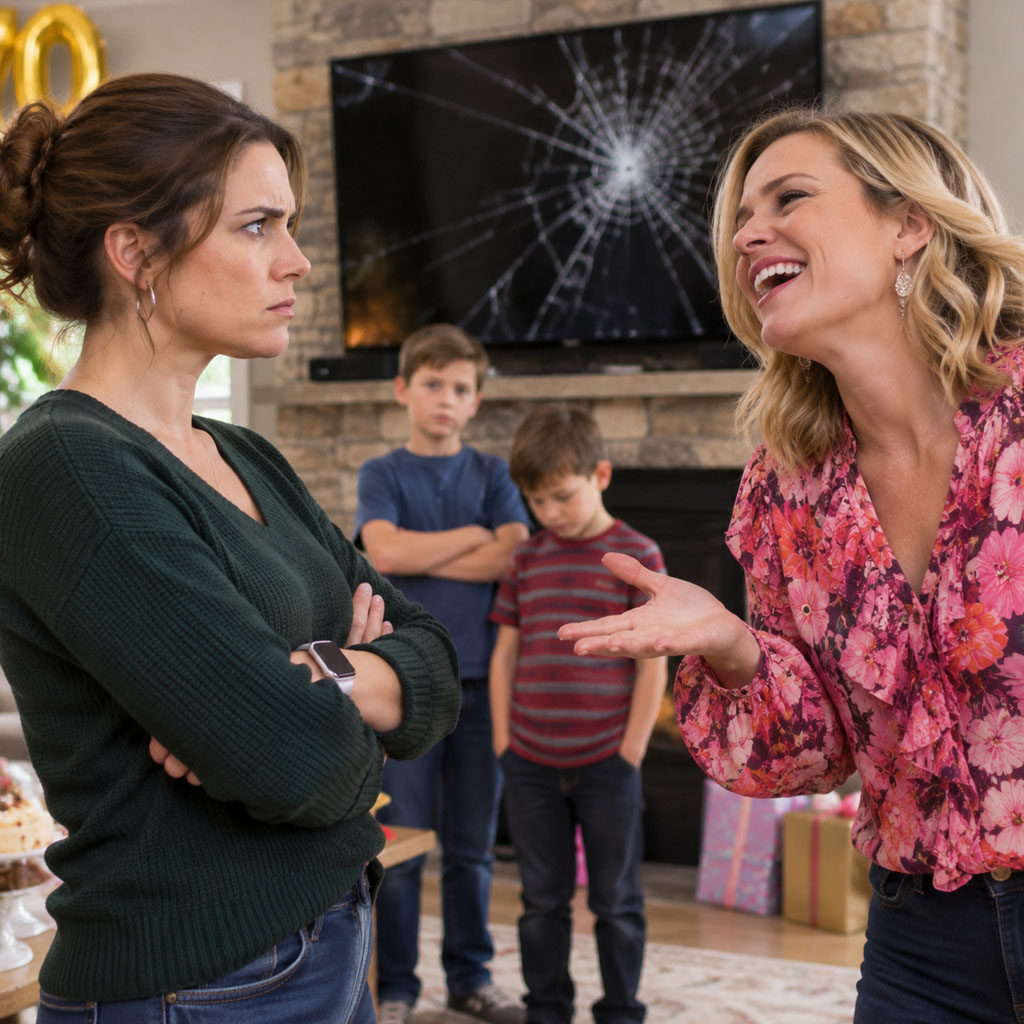
When we’d purchased the television, we’d paid an additional $90 for an accidental damage protection plan. After the party, I contacted the retailer and filed a claim.
Within two days, a replacement television arrived.
The damaged one was scheduled for recycling, but I asked the delivery driver to leave it in our garage. I told him we might donate it for parts.
He shrugged and propped it against the wall beside the lawn mower.
The old television still powered on, even though its screen was cracked. I kept it because something in my professional instincts told me not to dispose of it yet.
Then, lying awake one night, I realized I had a problem.
I’d filed an accidental damage claim and received a replacement for damage that I now had proof was intentional.
When I submitted the claim, I believed the boys had broken the television accidentally. But the moment I discovered the truth, I had an obligation to correct the information.
I couldn’t ignore that.
For eleven years, I’d investigated people who failed to disclose important information because it benefited them. I wasn’t about to become one of those people.
I got out of bed, went into the kitchen, and opened a blank document.
I recorded the exact date I filed the claim, the date I discovered the footage, and what I intended to do next.
The following morning, I spoke with my sister-in-law over coffee.
“Rachel, can I ask you something? Did anything happen with the boys before the television broke? Sam seemed a little strange afterward.”
Her eyes narrowed slightly.
“Strange how?”
“I don’t know. He seemed nervous.”
She laughed.
“Candace, they’re children. They get excited at parties. I don’t psychoanalyze every little mood swing.”
Then she added something I hadn’t expected.
“Honestly, I think Sam has been struggling because Greg travels so much. If you’re going to make a big deal out of a broken television, maybe you should consider what those boys are dealing with instead of interrogating their mother.”
It was a clever response.
She redirected the conversation toward her husband’s absence and her son’s emotional needs. Anyone who continued questioning her would risk appearing insensitive.
Two years earlier, I probably would have apologized.
Instead, I nodded.
“That’s fair. I was just wondering.”
Her shoulders relaxed.
She believed she’d closed the subject.
I drove home and sat in my car for eleven minutes before going inside. I needed my expression to look normal when Nick saw me.
That Wednesday evening, after our children had gone to spend the night with their grandmother, I placed my laptop on the kitchen table.
“There’s something you need to see.”
Nick looked concerned.
“What happened?”
I didn’t answer. I simply played the recording.
He watched his sister lean toward Sam. He heard her instructions. Then he watched his nephew destroy our television.
For nearly a minute, Nick said nothing.
Finally, he lowered his head into his hands.
“The garden gnome,” he whispered.
I looked at him.
“You remember that?”
“Of course. Mom was upset about it for weeks. I remember Rachel saying the boys probably knocked it over.”
“Did you suspect something?”
He rubbed his forehead.
“I don’t know. With Rachel, you learn not to ask too many questions. You start to recognize the signs, but you also know that questioning her means an argument that never ends.”
He looked at the frozen image on the screen.
“Why would she do this?”
“Because someone criticized her. Because she wanted to prove she could get away with it. I don’t know yet.”
I told him about the gnome, the porch swing, and the timeline.
Then I explained the insurance claim.
Nick listened carefully as I described why accepting payment on an accidental damage claim after learning the damage was deliberate could create a problem.
“So we might have to pay the money back?”
“Maybe. But that’s not the biggest issue. I need to correct the claim before anyone else discovers the truth.”
He nodded slowly.
“What do we do?”
“Tomorrow, I’m speaking with my supervisor. Then I want a lawyer to explain our options.”
Nick looked at me for a long time.
“You’re not trying to ruin my sister’s life, are you?”
“No,” I said. “I’m trying to make sure she stops using everyone else’s silence as permission.”
He reached across the table and took my hand.
For the first time since the party, I felt that we were facing this together.
Chapter 3
My supervisor, Margaret O’Leary, had worked in insurance for twenty-two years. She had managed our regional high-value claims division for nearly a decade and had seen just about every questionable situation imaginable.
I went to her office Thursday morning and explained everything.
She listened without interrupting.
When I finished, she folded her hands on the desk.
“Two separate issues, Candace. And I want you to understand them separately.”
She explained that I had filed the claim in good faith based on the information available at the time. However, once I discovered evidence that the damage had been intentional, I had an obligation to notify the insurance company.
“You call the claims integrity department today,” she said. “Give them the footage. Explain exactly when you learned what happened. Let them decide whether the claim needs to be reclassified or whether any money needs to be recovered.”
“Could I get into trouble?”
“You’re doing the right thing now. Don’t turn a straightforward disclosure into a bigger problem by delaying it.”
Then she addressed the second issue.
“An adult directing two children to deliberately destroy someone else’s property is not simply an insurance matter. Depending on the state, there may be civil consequences. And if there’s ever a question involving custody or the children’s welfare, documented behavior like this could become relevant.”
I looked down at my hands.
“I don’t want to destroy her family over a television.”
“Then don’t make that your goal,” Margaret replied. “Ask for accuracy. Report what happened. What other people decide to do with the information isn’t yours to control.”
I appreciated that advice.
That afternoon, I called the claims integrity department and spoke with a representative named Aaron.
I gave him the claim number, explained what I’d discovered, and uploaded the original footage through the company’s secure portal.
He was professional and calm.
“Based on what you’re describing, the claim may be reclassified rather than automatically reversed,” he explained. “The policyholder filed based on the facts known at the time. Intentional damage by a third party can sometimes fall under a different provision of the policy.”
“Even if the person responsible directed children to do it?”
“That will be part of the review. Depending on the circumstances, the insurer may also consider recovery from the responsible party.”
He gave me a case number and said I should expect an update within five to seven business days.
I thanked him and ended the call.
The process was less dramatic than I’d imagined. No accusations, no threats, no immediate consequences. Just a record of what had happened and a promise that it would be reviewed.
The next step was Nick’s idea.
He arranged a consultation with Robert Chen, a family law attorney who had helped one of his coworkers through a difficult custody dispute.
We weren’t looking to sue Rachel. We wanted to know where we stood.
Robert reviewed the footage and listened to our explanation.
“You may have grounds for a civil claim against her personally,” he said. “But for a $2,000 television, litigation could easily cost more than the property itself.”
“Then what would you recommend?” Nick asked.
Robert leaned back.
“There’s a broader issue here. Family courts are concerned when adults repeatedly involve children in destructive or manipulative behavior. I’m not saying this one incident automatically becomes a custody matter. But if there’s an established pattern, you want a clear, contemporaneous record.”
I thought about the gnome and Deborah’s porch swing.
“What about the boys?” I asked.
“They’re children. They followed instructions from their mother. That doesn’t make the behavior acceptable, but the adults need to remember who was responsible for the decision.”
His words stayed with me.
That evening, I contacted a child and family therapist named Denise Barrett. Priya had recommended her because she’d helped another family navigate a difficult situation involving children caught between adults.
I explained what had happened and asked whether children could be affected by being encouraged to do something destructive as a way of earning parental approval.
Denise was thoughtful.
“At seven and nine, children are developmentally inclined to trust and obey their parents. They may understand that breaking something is wrong, but they don’t necessarily understand the larger purpose behind an adult’s instructions.”
“Could it affect them later?”
“It can teach them the wrong lesson about approval. They may begin to associate being praised with doing whatever a trusted adult asks, even when the action hurts someone else.”
I felt a heaviness in my chest.
“What should we do?”
“Don’t interrogate them. Don’t shame them. Don’t make them feel they’re on trial. The healthiest response is for the adults to make it clear that what happened was wrong, while reassuring the boys that they are loved and aren’t responsible for their mother’s choices.”
I thanked her.
That conversation changed how I thought about Saturday.
The dinner couldn’t be about humiliating two children or forcing them to choose between their parents and the rest of the family.
It had to be about the adult who had put them in that position.
Priya arranged for Sam and Wyatt to spend Saturday afternoon at her house with her own children. She told Rachel it would give the adults time to talk without chasing children away from the furniture.
Greg confirmed he would attend.
That mattered.
For years, he’d been away so often that Rachel had effectively controlled the family narrative. If something went wrong, she explained it before anyone else had a chance to ask questions.
I wanted him in the room when the truth came out.
Saturday morning arrived with an uncomfortable quiet.
I catered the dinner again. Chicken, rice, fresh bread, and the same dessert Rachel always complimented. Nick’s parents were coming, along with my mother, my parents, Deborah, Priya, and Greg.
I hadn’t told anyone precisely what I planned to show them.
Nick knew there would be a recording, but I wanted the moment to unfold naturally.
Rachel arrived wearing a confident smile.
She took her seat at the head of the dining table and began eating as though she were hosting the event.
“So,” she said, cutting into her chicken, “have you two figured out how you’re covering the television? Because honestly, I think it’s ridiculous that we’re still discussing this.”
Nick’s jaw tightened.
I put down my fork.
“Actually, Rachel, there’s something I’d like everyone to see.”
She rolled her eyes.
“Oh, Candace. Please. Are we really doing this again?”
“It’ll only take a minute.”
I stood and walked toward the living room.
The old television was still there, the damaged screen resting against the wall. I’d arranged it so that everyone could see the picture clearly enough.
I connected my laptop.
Rachel looked irritated.
“What exactly are you doing?”
I pressed play.
Chapter 4
The room filled with the sound of Rachel’s voice.
“When I say go, kick it hard at the TV. Aim for the middle.”
Her words came through the speakers with perfect clarity.
Sam nodded on the screen. Wyatt bounced excitedly beside him. Then the ball struck the television, and the screen shattered.
The recording continued.
Rachel’s voice returned.
“Well done, you two. You’re both getting new toys. And remember, don’t tell anyone what we talked about.”
Her fork struck the plate.
The room went silent.
For several seconds, nobody moved.
Then Greg spoke.
“Rachel?”
She stared at the screen.
“That’s not what happened.”
Greg looked from the laptop to his wife.
“Are those the boys?”
“Of course they’re the boys, but you don’t understand. This has been edited.”
I remained standing.
“It’s fifty-one seconds of unedited footage from our home security system. I have the original file, its metadata, and three separate backups.”
“You’ve been spying on us?” she snapped.
“The camera was installed in our living room. It recorded the party. You instructed your sons to damage our property.”
Rachel looked around the table.
“That’s insane, Candace. I would never tell my boys to do something like that.”
Her voice was smooth, almost rehearsed.
I had heard that tone before. It was the voice she used whenever someone questioned her version of events.
I didn’t blink.
“All right,” I said. “My mistake.”
Her shoulders relaxed slightly.
She thought I was backing down.
But I wasn’t asking her to admit anything anymore.
I had already corrected the insurance claim. The carrier had the footage. I’d spoken with my supervisor, an attorney, and a child therapist. Everything was documented.
I looked around the table.
“I’m not asking anyone here to punish Rachel. I’m not demanding that Greg make a decision tonight. But I’m finished pretending this was an accident, and I’m finished listening to Rachel ask how we’re going to pay for damage she deliberately arranged.”
Rachel’s face changed.
For once, she had no immediate answer.
“I wanted them to feel included,” she said quietly.
Nick finally spoke.
“You wanted them to feel included in what? Destroying their aunt’s property?”
“You don’t understand, Nick.”
“Then explain it.”
She looked toward her brother.
“I was upset. Candace was criticizing me, making comments about my parenting. I wanted to show that she wasn’t better than me. I wanted to prove that she couldn’t control everything.”
I felt my stomach tighten.
“So you used your sons?”
“I wasn’t trying to hurt anyone.”
“You told a nine-year-old where to aim,” Nick said.
His voice was shaking.
“That’s not including them, Rachel. That’s teaching them that hurting someone is a game as long as their mother promises them a reward.”
Rachel’s eyes filled with tears.
For a moment, I wondered whether she was finally feeling genuine regret.
Then she looked at Greg.
“You’re not going to believe her over me, are you?”
Greg didn’t answer immediately.
He had been traveling for work for years, trusting Rachel to manage their home and raise their children. He’d missed school events, family dinners, and ordinary afternoons because he believed his absence was temporary and his wife had everything under control.
Now he was watching his sister-in-law’s footage and realizing that the woman he loved had involved their children in something he couldn’t explain away.
“Did you tell them to do it?” he asked.
Rachel looked down.
“Greg, it wasn’t that simple.”
“Did you tell them?”
She didn’t answer.
He slowly pushed his chair back.
“I’m going to get the boys from Priya’s. Then you and I need to have a conversation.”
Rachel reached for his arm.
“Don’t make this into something it isn’t.”
He gently moved away.
“I’m not making it anything. I’m looking at what you did.”
He left without raising his voice.
Rachel remained seated for several moments.
Nobody spoke.
Then she stood, collected her purse, and walked toward the door.
She didn’t apologize.
She didn’t ask about the boys.
She simply left.
Nobody followed her.
After the door closed, my mother began crying quietly. Deborah reached across the table and held her hand.
Nick sat down beside me.
“I’m sorry,” he whispered.
I shook my head.
“You don’t have to apologize for her.”
“I should have listened sooner.”
He looked at the damaged television.
“I think I’ve spent my whole life pretending Rachel’s behavior wasn’t as bad as it was because I didn’t want to break the family.”
I put my hand over his.
“Maybe the family needed to stop pretending.”
He nodded.
For the first time that evening, I felt the tension leave my shoulders.
We hadn’t won anything.
We had simply stopped participating in a lie.
Chapter 5
Four months have passed since that dinner.
Greg and Rachel are attending marriage counseling. Denise Barrett couldn’t take their case because she already knew members of the family, but she referred them to a colleague who specializes in family systems and situations where one parent has spent years managing appearances rather than addressing behavior.
I don’t know what happens during those sessions, and I have deliberately avoided asking.
It’s their marriage, their family, and their responsibility to work through what happened.
Sam and Wyatt are doing well, as far as anyone can tell. Priya still has them over most weekends, and they’ve returned to the ordinary concerns of childhood: school projects, soccer games, video games, and arguments over who gets the biggest piece of birthday cake.
Nobody has criticized either boy about the television.
Not once.
That was important to me.
They were seven and nine when their mother gave them those instructions. They deserved guidance, not humiliation. They needed adults who would teach them that doing something wrong didn’t make them bad children, and that love shouldn’t depend on obedience to every request.
The insurance review closed exactly as Margaret predicted.
The claim was reclassified rather than reversed. The company noted that the original filing had been made in good faith and that I had promptly disclosed the new evidence once I discovered it.
Aaron sent the follow-up email on the fifth business day.
I appreciated that more than I expected.
Sometimes it’s reassuring when a process works the way it’s supposed to.
Rachel and I haven’t spoken since the dinner.
Nick still communicates with her occasionally. Their conversations are brief and careful, usually about family arrangements or the boys.
A few weeks after everything happened, he told me something while we were cleaning up after dinner.
“I think I’ve spent most of my life letting Rachel get away with things because I thought confronting her would hurt the family more than whatever she’d done.”
I asked him whether he still believed that.
He considered the question.
“No,” he finally said. “I don’t think it broke the family. I think it just stopped the family from lying to itself.”
I understood what he meant.
For years, we’d mistaken silence for peace. We’d mistaken avoiding arguments for maintaining relationships. And we’d allowed Rachel’s explanations to become more important than the feelings of the people she’d hurt.
That had to change.
I still have all three copies of the security footage. I haven’t watched them again, and I don’t bring them up during family gatherings.
The new television works perfectly.
Sometimes, when I’m sitting in the living room with Nick, I catch myself looking at the screen and remembering that afternoon. I remember the crack, the silence, and the way Rachel rushed to explain everything before anyone could ask a question.
But I also remember something else.
Wyatt’s innocent question about the LEGO set.
He hadn’t been trying to hurt anyone. He had simply wanted his mother’s approval and believed he’d done something that would make her proud.
That’s the part I hope he never forgets to question as he grows older.
A few weeks ago, Sam came over with a drawing he’d made at school. It was a picture of our house, complete with the new television visible through the living room window.
“Look, Aunt Candace,” he said. “I drew your family.”
I smiled and examined the picture.
“That’s very good, sweetheart.”
He hesitated.
“Are you still mad at me?”
I put the drawing down and knelt beside him.
“No, honey. I’m not mad at you.”
“But I broke your TV.”
“You did something you shouldn’t have done. But you’re a good kid, Sam, and I love you. What matters is that you learn to make better choices next time.”
He nodded, looking relieved.
Then he asked whether he could have another piece of cake.
I laughed and told him he could.
When he ran back into the kitchen, I stayed where I was for a moment.
I thought about the garden gnome, the broken porch swing, and all the little incidents that people had dismissed because confronting Rachel seemed too difficult.
The television had cost us $2,000.
But the real damage had been the years we’d spent allowing someone to confuse family loyalty with unconditional silence.
I couldn’t change those years.
I couldn’t undo what had happened to Sam and Wyatt.
But I could choose what happened next.
And I could make sure the boys grew up knowing that love wasn’t something they had to earn by doing whatever someone told them.
That evening, Nick and I watched an old movie on our new television. Halfway through, he reached for my hand.
“Do you think things will ever be the same?” he asked.
I considered the question.
“No,” I said. “But maybe they don’t need to be.”
He squeezed my hand.
Outside, the evening was quiet. Inside, the television glowed across the living room, showing a story about people who had made mistakes and were trying to find their way back to one another.
For the first time in a long while, our family gatherings felt smaller, quieter, and more honest.
And I realized that sometimes the most important thing you can do for a family isn’t to keep everyone happy.
It’s to stop asking the innocent to pay for someone else’s choices.
THE END.
⚠️ All characters and events are fictional. Do not imitate or apply them in real life. 😌😌😌