Chapter 2
At 7:15 Wednesday morning, I was sitting behind the steering wheel of my school bus, checking the lights and tires before my first route, when my phone rang again.
The caller was Josette Arseneau from the Acadiana Food Pantry. Josette had coordinated our Thanksgiving donations for nine years. Every fall, she and I debated how many canned yams three hundred people could reasonably eat, and every fall, we somehow managed to agree.
“Yvette, I need to ask you something strange.”
“That’s a worrying way to start a conversation.”
“Charlene Thibodeau called me last night. She said she’s taking over the Thanksgiving dinner at Bethel and wants to move your food pickup to the church’s account.”
I sat up straighter.
The pantry had promised us forty-two turkeys, canned vegetables, rolls from a local bakery, and hundreds of paper plates. The pickup was scheduled for two that afternoon.
“She wants to collect everything in the church van,” Josette continued. “She says she’s in charge now. Is that true?”
“I gave her the keys to the kitchen. That’s all.”
“Good. Because the donation account isn’t registered to Bethel. It’s registered to the Fontenot Table, and you’re the authorized contact. I can’t release food donated to one organization to another organization just because someone tells me she’s taking over.”
I looked through the windshield at the empty school parking lot.
“Wait. The Fontenot Table?”
“Yes, Yvette. The nonprofit Odile established decades ago. The same one you’ve signed renewal forms for every September.”
I remembered the forms. I had treated them like routine paperwork, no more important than the inspection sheets I completed for my bus.
“Charlene wanted the donation moved?”
“She did. When I told her I couldn’t do that, she said she’d buy everything herself. Then she asked whether I knew you were divorced.”
I closed my eyes.
“What did you tell her?”
“I told her I knew you could feed three hundred people with forty-two turkeys. That’s the information I need for my records.”
A laugh escaped me before I could stop it.
Josette laughed, too, but her voice soon softened.
“The food is still yours to collect, Yvette. The truck is coming at two. Where should we deliver it?”
I looked across the street at Bethel Fellowship, its windows reflecting the pale morning sun.
I didn’t have a kitchen anymore. I didn’t have keys to the pantry or the cooler. I didn’t even have a place to put forty-two turkeys.
“Can I call you back in an hour?”
As I hung up, I saw Mr. Purvis crossing the school parking lot with his lunchbox tucked beneath one arm. He managed the Northside Elementary cafeteria and had been cooking lunches for six hundred children a day for thirty-two years.
He was also a widower, a patient man, and the kind of person who could make a roomful of arguing adults quiet down simply by looking at them over his glasses.
Every Thanksgiving since 1998, he had washed pots for Miss Odile’s dinner.
I lowered the bus window.
“Mr. Purvis! How big is your oven?”
He stopped. Then a slow smile appeared beneath his gray mustache.
“Big enough, Yvette. Big enough.”
Northside Elementary had two commercial ovens, a walk-in cooler, industrial sinks, and a tilt skillet large enough to cook eighty pounds of food at once. The cafeteria sat empty on Thanksgiving, and the school district allowed approved nonprofit community groups to use its facilities on holidays.
All we needed was a sponsor, an approved building-use form, and a valid food permit.
Mr. Purvis agreed to sponsor us. The principal signed the paperwork at 10:15 that morning, after I explained what had happened.
“Just save me a plate,” she said.
At 10:30, I called Josette.
“Send the truck to Northside Elementary.”
“Across the street from Bethel?”
“That’s the one.”
She laughed so hard I had to hold the phone away from my ear.
By lunchtime, I had another problem.
Remy came home carrying his backpack and holding his phone out in front of him.
“Mom, look at this.”
The local television station had posted a preview of its Thanksgiving coverage. The headline read, “Bethel’s First Lady Feeds 300: A Lafayette Tradition.”
Beneath it was a photograph taken the previous year. Remy had taken that picture on my phone, and I had uploaded it to the church’s social media page.
In the original, I stood in the middle of the serving line, laughing with a ladle in my hand. In the television station’s version, the photograph had been cropped so tightly that my face and most of my body had disappeared.
Only the steam, the serving pans, and the line of hungry people remained.
The caption quoted Charlene.
“This dinner has always been close to my heart. It’s what our church family is all about.”
She had been at Bethel for five months. She had never cooked the dinner, served a plate, or delivered food to a shut-in.
Remy lowered his phone.
“She cut you out, Mama.”
His voice was quiet, but that made it hurt more.
“She cut your face out of the picture I took.”
I sat at the kitchen table, looking at the photograph until the words blurred.
That afternoon, I called the church office to confirm the sixty home-delivery meals. The secretary, a kind young woman named Beth, sounded uncomfortable.
“Mrs. Thibodeau hired a caterer in Broussard,” she explained. “They’re preparing everything for Thursday, but they won’t deliver to homes.”
“What about the people on our list?”
“Mrs. Thibodeau said this year’s dinner will be sit-down only. She thinks having volunteers drive around town creates a liability issue.”
I waited for her to explain why those people suddenly mattered less than everyone else.
Instead, she added, “She also said the camera crew needs to see a full fellowship hall.”
I thought about the elderly man on Breaux Bridge Highway who depended on oxygen and rarely left his trailer. Every year, I carried his plate to the door myself. He always asked for extra cranberry sauce and apologized for making me walk up his gravel driveway.
There were fifty-nine other people like him.
“Thank you, Beth,” I said, and hung up.
Remy stood in the doorway.
“What do we do?”
I picked up my keys from the kitchen counter.
“Get your shoes on. Then text the youth group. Tell them anybody who can peel a potato needs to be at Northside Elementary at six.”
Within an hour, the messages had spread through the church and across the school bus lot. By six-thirty, thirty-one people had gathered in the cafeteria.
Nine of Tuesday’s fourteen volunteers showed up. Eleven teenagers arrived with their parents. Three bus drivers came straight from work, still wearing their reflective jackets.
The food pantry truck backed up to the cafeteria doors at two o’clock, just as promised. Forty-two turkeys, sixty cases of canned goods, three hundred and sixty rolls, and stacks of paper plates were unloaded onto the steel tables.
The driver had to pass Bethel Fellowship to reach the school entrance.
I saw a curtain move in the pastor’s office window.
Then I turned back to the work waiting for us.
We had three hundred people to feed, sixty meals to deliver, and less than a day to prepare everything.
For the first time since Charlene had taken my keys, I stopped wondering whether I belonged in that kitchen.
I began figuring out how to make it work.
Chapter 3
By eight o’clock Wednesday night, the cafeteria smelled like butter, onions, celery, and home.
The teenagers peeled sweet potatoes, sometimes taking off more skin than potato. Mr. Purvis supervised the industrial equipment with the solemn concentration of a man conducting an orchestra. The bus drivers washed greens in the deep steel sinks, and I prepared the cornbread dressing exactly as Miss Odile had taught me.
“You’re putting too much sage in that bowl,” Mr. Purvis said, peering over my shoulder.
I turned to him.
“Are you trying to get yourself banned from my kitchen?”
“Just making an observation.”
“Then observe quietly.”
He chuckled and returned to his pans.
We worked until eleven, preparing what we could ahead of time. Remy moved between the tables with a clipboard, checking off jobs and making sure the younger children stayed away from the hot ovens.
At eight-thirty, the cafeteria door opened.
Charlene stepped inside without removing her coat. She surveyed the room: the turkeys arranged in roasting pans, the volunteers washing vegetables, the young people laughing as they worked.
For a moment, she looked genuinely surprised.
Then she walked toward me.
“Miss Yvette, this is a little sad, isn’t it?”
I kept stirring the dressing mixture.
“What’s sad?”
“People come to Bethel on Thanksgiving. They don’t come to a school cafeteria.”
She glanced at the rows of stainless-steel tables.
“Tomorrow, they’ll arrive at our fellowship hall. The caterer will be ready, the television crew will be there, and everything will look beautiful. I simply don’t want you to be embarrassed when nobody crosses the street.”
I tasted the dressing and added a little more broth.
“Then we’ll take meals to the people who can’t come.”
Charlene gave a small, sympathetic smile.
“We’ll pray for your little dinner.”
She left before I could answer.
Remy was standing beside the sink. He muttered something in Cajun French that would have earned him a lecture at home, but I pretended not to hear it.
Ten minutes later, my phone rang again.
This time it was Reverend Alcide Thibodeau, Charlene’s husband and our pastor.
His voice sounded weary.
“Yvette, Charlene told me what’s happening. I wish you’d come to me before making another arrangement.”
I stared at the row of turkeys.
“Your wife removed my name from the board in front of fourteen volunteers, Reverend. You were in your office. You could have come out.”
He didn’t answer immediately.
“She has a vision for the church,” he finally said. “She wants to reach young families. The television segment is part of that. I know things could have been handled better, but two dinners across the street from each other will divide the congregation.”
“I didn’t create two dinners. I handed over my keys and went home. The food pantry called me because the donations are registered under my name.”
“Your name?”
“Mine and the Fontenot Table’s. Miss Odile arranged it that way in 2015.”
There was a long silence.
“I didn’t know that,” he said.
“I know.”
I heard him breathe into the phone.
“Good night, Yvette.”
“Good night, Reverend.”
I returned to the dressing.
He hadn’t defended his wife, but he hadn’t defended me, either. Sometimes silence could be its own decision.
I went home shortly after midnight and set my alarm for four.
Thanksgiving morning arrived cold and bright. The temperature was fifty-one degrees, which in Lafayette felt cold enough to justify a winter coat and a complaint to the weather service.
By six, steam clouded the cafeteria windows. Mr. Purvis stood beside the dish machine singing “Amazing Grace” in a low, steady voice. The turkeys roasted, the greens simmered, and the sweet potatoes were ready for their final seasoning.
At nine, we began assembling the sixty delivery meals.
Each foam container received turkey, dressing, greens, sweet potatoes, a roll, and a slice of sweet potato pie. The bus drivers divided the routes, checking addresses against the list I had maintained for eleven years.
I handed one container to a driver named Denise.
“Breaux Bridge Highway. The gentleman in the trailer likes extra cranberry sauce.”
Denise tucked the container carefully into her insulated carrier.
“Got it.”
At ten-thirty, we had enough food ready to serve three hundred people. The tables were clean, and someone had placed a small paper turkey on every one. The children had taped a butcher-paper sign to the entrance.
THANKSGIVING DINNER. EVERYBODY WELCOME. FREE.
A child had drawn a turkey wearing sunglasses in the corner.
I laughed when I saw it.
“That’s a very confident turkey,” I told Remy.
“He knows he’s got a good cook.”
For the first time in two days, my son looked happy.
Then I stepped outside.
Across Johnston Street, a line had formed at Bethel Fellowship. It stretched from the church doors down the front steps and along the sidewalk.
There were families with young children, older men in their good jackets, mothers holding babies, and several men I recognized from the shelter on Jefferson Street.
Three hundred people, perhaps more.
The same people who had come to our dinner for years.
A white television van was parked near the church entrance. A cameraman stood beside the steps, his equipment pointed toward the fellowship hall. Charlene stood near him in a cream-colored suit, smiling and welcoming guests.
I watched the line for a long moment.
Mr. Purvis came outside and stood beside me.
“Well,” he said slowly, “that’s that.”
I swallowed.
“At least the home deliveries went out.”
He rested a hand on the railing.
“Yvette, you can’t measure a meal by who shows up first.”
I wanted to believe him, but it was difficult to look across the street at three hundred familiar faces and not wonder whether I had made a terrible mistake.
Then an old brown Buick pulled up beside the church.
Remy came running out of the passenger side. I hadn’t even realized he’d left the cafeteria. He hurried around to the rear door and opened it, offering his arm to someone inside.
A tiny woman in a purple hat emerged, leaning heavily on a cane.
Miss Odile Fontenot had arrived for Thanksgiving dinner.
Chapter 4
I couldn’t hear what happened on the church steps from across Johnston Street, but I saw the crowd shift around Miss Odile as she made her way toward the entrance.
People who had known her for decades stepped aside. Someone began clapping. Others joined in until the sound carried across the road.
Charlene descended two steps, her smile widening for the camera.
“Miss Odile! What a blessing. You’re our guest of honor today. We’ve reserved a table for you right up front.”
Miss Odile stopped at the bottom step.
She looked at Charlene, then at the cameraman, and finally at the long line of people waiting to enter the church.
“Charlene,” she said, in a voice that carried farther than anyone expected, “where is Yvette?”
Charlene’s smile held.
“Miss Yvette is having her own little dinner across the street. We decided this year that we needed a family woman as the face of our table.”
Miss Odile nodded as if Charlene had just explained the price of a pound of butter.
Then she turned toward the crowd.
“My husband and I started that Thanksgiving dinner in our living room in 1971. I handed it over to Yvette in 2015. The permit is hers, the donations are hers, and the nonprofit is hers. This church has always lent us a place to cook. It never owned the table.”
She lifted her cane and pointed across Johnston Street.
“Follow me, everybody.”
Then she began walking.
Eighty-eight years old, barely ninety pounds, and moving at a pace that would have tested the patience of a garden snail, Miss Odile stepped off the curb with Remy holding her arm.
A car stopped. Then another. Traffic came to a standstill in both directions.
Nobody honked.
This was Lafayette, after all. People might argue about football, politics, or the proper amount of spice in a pot of gumbo, but nobody was going to honk at an elderly woman in a purple hat on Thanksgiving.
The line followed her.
First came the older men who remembered her husband. Then the families with babies, the men from the shelter, and the rest of the crowd. One by one, they left the church sidewalk and crossed the street.
The cameraman turned and filmed the entire procession.
I stood frozen on the cafeteria steps as three hundred people walked toward us behind a woman who had started feeding the hungry before I was old enough to drive.
Mr. Purvis put his hand on my shoulder.
“Yvette, you’d better get to the front of your line.”
I wiped my face with my apron and went inside.
Miss Odile reached the cafeteria last. Remy helped her up the steps, and when she stood in front of me, she was breathing hard. Her purple hat had slipped crookedly over one ear.
She looked past me toward the serving line.
“Too much sage?”
I laughed through my tears.
“No, ma’am. Just right.”
“I’ll be the judge of that.”
She took my arm and went inside.
We fed 309 people that day.
The children collected the paper turkeys after the first round of guests and placed them on the tables again for the late arrivals. Mr. Purvis carved turkey until his wrists ached. The teenagers carried pitchers of water, and the bus drivers returned from their delivery routes with empty insulated carriers.
About twenty minutes after we began serving, Charlene walked into the cafeteria.
She had left the cameraman across the street. Her face was tight, and she moved quickly past the crowded tables until she reached me at the serving line.
“You stole this dinner,” she said quietly.
I held the serving spoon over a pan of greens.
“I’m sorry?”
“You planned this. You and that old woman. You made me look ridiculous on television.”
“I gave you my keys, Charlene.”
“You knew the food pantry wouldn’t release the donations.”
“I didn’t know they’d call me. But those donations were registered to the Fontenot Table, not Bethel. The paperwork has been in your kitchen for eleven years.”
She opened her mouth, then closed it.
“I didn’t plan any of this,” I continued. “I just wasn’t willing to let three hundred people go hungry because someone decided a divorced woman wasn’t the right picture for a church dinner.”
Charlene glanced around the room.
Miss Odile sat near the front, tasting her dressing with her eyes closed. The teenagers were laughing as they refilled the rolls. Near the entrance, two volunteers were helping an elderly couple find their seats.
For a moment, Charlene seemed unable to decide what to say.
Then her expression softened into the careful smile I knew so well.
“Yvette, let’s be sensible. The news crew is still outside. We can call this one community dinner in two buildings. I’ll give the interview, and you can continue cooking. Nobody needs to look bad.”
“I’m not hiding anybody.”
She stiffened.
“You already did that. You cropped me out of my own son’s photograph.”
Her face changed. She hadn’t known I’d seen the original.
Before she could respond, Reverend Alcide entered the cafeteria.
He had crossed the street behind the crowd. His good suit was still buttoned, and his reading glasses rested on his forehead. He stopped beside Charlene and surveyed the room.
“You told me the dinner was a church ministry,” Charlene said to him. “You told me to take charge.”
“I told you it was important to the church. I never told you to remove Yvette.”
“You could have stopped me.”
“Yes,” he said. “I should have.”
He looked at me.
“But you’re the one who took her name off the board, Charlene.”
For several seconds, the couple stood beside the serving line, each waiting for the other to say something that might make the moment easier.
I kept serving.
Finally, Reverend Alcide removed his suit jacket and folded it over the back of a chair.
“Miss Yvette, do you need someone to carve?”
“Mr. Purvis has the knife. Ask him nicely.”
The pastor walked over to Mr. Purvis, who handed him an apron and began explaining the proper way to carve a turkey. The instructions were so detailed that I suspected Mr. Purvis was making a point.
The reverend listened to every word.
Charlene remained at the end of the serving line for another minute. Then she turned and walked out without saying goodbye.
Across the street, the caterer she’d hired had prepared enough food for three hundred people. With most of the guests gone, his trays remained untouched in the fellowship hall.
Around one o’clock, Remy went over and spoke to him. A few minutes later, the caterer appeared at our door looking nervous and apologetic.
“He says he has macaroni and cheese and green bean casserole,” Remy announced. “Can we use them?”
I looked at the crowded cafeteria.
“Tell him to bring everything over.”
We accepted the food, thanked him, and found places for the extra trays. By four, the last guest had eaten. We packed the remaining food into containers and sent a second round of deliveries to the women’s shelter on Jefferson Street and the fire station on Pink Hook Road.
Nothing went to waste.
Miss Odile wouldn’t have allowed it.
At five, after the final pot had been washed, I drove her home. She fell asleep in the passenger seat, her purple hat resting in her lap. When we reached her house, I helped her up the porch steps.
She held my arm and looked back toward the street.
“You know what Clovis used to say?”
“The table belongs to the person who sets it.”
She nodded.
“Don’t you forget that, Yvette. Not for a pretty suit.”
I smiled and kissed her cheek.
I thought the hardest part was over.
Two weeks later, a long white envelope from the school district arrived in my mailbox.
My name was typed beneath the district seal. Inside was a letter requesting that I attend a meeting with Human Resources on December 9.
Someone had filed a formal complaint accusing me of using school property for a religious event without permission and diverting a church’s food donations to a public school.
My stomach dropped.
My bus job paid our rent. It provided our health insurance and covered Remy’s orthodontic bills. I had spent sixteen years building a good record with the district, and now someone was questioning whether I had abused my position.
I sat on the kitchen floor with my back against the cabinets, holding the letter in both hands.
Remy came home and found me there.
He read the letter without saying anything. Then he picked up the phone and called Mr. Purvis.
“Come over,” he said. “Please. It’s about Mom.”
At seven o’clock, Mr. Purvis arrived carrying a shoebox.
He placed it on my kitchen table and lifted the lid.
Inside were neatly arranged copies of the school district’s building-use form, the health department permit, the food pantry’s donation records, and the district’s own policy governing holiday use of school facilities by nonprofit community groups.
“I’ve worked for this district for thirty-two years,” he said. “I know where they keep the rules.”
He slid the papers toward me.
“Let’s make sure they read every one of them.”
Chapter 5
The Human Resources office occupied a quiet corner of the district’s central building. The meeting room had a long table, fluorescent lights, and a coffee pot that smelled as though it had been brewing since the previous administration.
The officer handling my case was a woman named Della Delahoussaye. She wore reading glasses on a chain and had the patient expression of someone who had heard every possible excuse from every possible employee.
Mr. Purvis sat beside me wearing a tie.
I’d known him for years and had never seen him in one.
Ms. Delahoussaye read the complaint aloud, then looked over her glasses.
“Mrs. Boudreaux, did you hold a church service in the Northside Elementary cafeteria on Thanksgiving Day?”
“No, ma’am. I organized a free community dinner. Anyone could come, and nobody was required to participate in any religious activity.”
Mr. Purvis cleared his throat.
“I sang ‘Amazing Grace’ over the dish machine, but I don’t believe that qualifies as a service.”
For the first time, Ms. Delahoussaye’s mouth twitched toward a smile.
He slid the shoebox folder across the table.
She read the approved building-use form first. Then she examined the health permit and the food pantry’s donation records. Finally, she opened the district’s written policy on nonprofit community use of school buildings during holidays.
She took her time.
“The principal approved the facility use,” she said. “The Fontenot Table is a registered nonprofit organization, and the food permit was valid. The donations were made to that organization, not to Bethel Fellowship Church.”
She closed the folder.
“The complaint states that you diverted food belonging to a church. Based on these documents, that allegation is incorrect. This complaint is closed. You’ll receive written confirmation.”
I let out a breath I hadn’t realized I was holding.
Sixteen years of driving children to school had taught me to stay calm in difficult situations. Apparently, it had not taught me how to remain calm when someone threatened the only livelihood my son and I depended on.
Ms. Delahoussaye removed her glasses.
“Off the record, Mrs. Boudreaux, my mother was in that line on the news. She’s eighty-one and has been attending Bethel’s Thanksgiving dinner for twenty years.”
I looked at her.
“She told me she followed the old woman in the purple hat across the street. She said it was the best dressing she’d tasted since 1971.”
She stood and gathered the papers.
“Thank you for feeding my mother.”
Before I could answer, Mr. Purvis spoke.
“Bring her next year. We’ll save her a seat.”
When I left the building, the December air felt lighter than it had in weeks.
The following Sunday, I almost didn’t go to church.
I sat in my car in the Bethel parking lot for ten minutes, watching people enter through the front doors. I wondered whether anyone would look at me differently. I wondered whether Charlene would still be there and whether I could sit through a service without remembering the sound of that thumbtack hitting the floor.
Remy finally turned toward me.
“Miss Odile is going to ask where you are.”
That settled it.
We went inside and took our usual seats, not in the back but in the pew we’d occupied for years. Miss Odile sat at the end, wearing her purple hat.
Reverend Alcide stepped to the pulpit. He didn’t open his Bible right away. Instead, he placed both hands on the wooden lectern and looked out over the congregation.
“Before the sermon, I need to say something to this church and to one person in it.”
The room grew quiet.
“Three weeks ago, a woman who had prepared our Thanksgiving dinner for eleven years had her name removed from the kitchen board. She was told that we needed a family woman to represent our table.”
He paused.
“Those were my wife’s words. I didn’t say them, but I was in my office down the hall, and I didn’t come out to stop them. That makes me responsible, too.”
I stared at the back of the pew in front of me.
“Two weeks ago, someone from this church filed a complaint against that same woman with her employer. I learned about it on Friday. I want everyone here to understand that this was wrong, and it will never happen again while I serve as pastor.”
His voice grew rough.
“Yvette Boudreaux, I’m sorry. This church owes you an apology.”
He looked across the congregation.
“And for the record, Jesus fed five thousand people without asking a single one of them whether they were married.”
Miss Odile called out, “Amen!” so loudly that a baby in the back began to cry.
Then the entire congregation answered her.
I cried quietly, with Remy’s hand resting on my arm. It wasn’t because the pastor’s apology erased what had happened. It didn’t. But hearing someone acknowledge the harm, in the same room where it had been done, mattered more than I had expected.
Charlene sat in the front pew, her back straight and her hands folded. She didn’t turn around.
After the service, she stood at the door greeting people as she always did. When I reached her, she extended her hand.
For a moment, neither of us spoke.
Then she said, “Yvette.”
Not Miss Yvette. Just Yvette.
I shook her hand.
It wasn’t forgiveness, and it wasn’t friendship. But it was a beginning, however small.
On Christmas Eve, Miss Odile invited me to her house. She told me to come alone, and when I arrived, she was sitting at the same kitchen table where I’d signed the paperwork ten years earlier.
Two cups of coffee stood beside a small wooden box with a brass latch.
“Sit down, child.”
I took the chair across from her.
She pushed the box toward me.
Inside were dozens of recipe cards, yellowed at the edges and stained with the marks of decades of cooking. There were recipes for gumbo, pralines, fig preserves, bread pudding, and dishes I’d never learned to make.
On top lay a card labeled CORNBREAD DRESSING FOR THE TABLE.
I recognized Miss Odile’s handwriting immediately. It was steadier than it was now, the letters firm and rounded.
The ingredients and instructions were written in blue ink. At the bottom, someone had added a line in tiny, slanted handwriting.
Odile, less sage. Love, C.
I laughed, then began to cry.
Miss Odile passed me a paper napkin and waited until I could speak.
“Clovis wrote that in 1972,” she said. “After our second Thanksgiving dinner. He thought I used too much sage.”
“He was right.”
“He was. I just didn’t tell him that until much later.”
She tapped the recipe card.
“The whole box is yours now. I don’t have a daughter, Yvette. But I have you.”
I tried to protest.
“Miss Odile, I can’t take all these family recipes.”
“You can. You fed three hundred people in a school cafeteria with two days’ notice and no kitchen keys. I think you can manage a wooden box.”
I looked down at the cards.
For eleven years, I had thought of myself as someone who helped Miss Odile preserve a tradition. I hadn’t understood that she had been preparing me to carry it forward long after she could no longer lift the heavy pots herself.
I took the box home and placed it on the shelf above my stove.
Every Thanksgiving, I bring that dressing card down to the counter, even though I know the recipe by heart. I like to see Clovis’s little correction at the bottom. It reminds me that even the people who begin a tradition must learn from the people who carry it on.
The following September, Reverend Alcide came to my office at Bethel. He left the door open and asked whether I would consider bringing the Fontenot Table’s dinner back to the fellowship hall.
“The church will lend us the space,” he said. “The way it always has. The table belongs to the people who cook it.”
I considered his request.
“One condition.”
He nodded.
“Northside Elementary remains our second kitchen. Mr. Purvis’s ovens are too useful to give up, and we have more people to feed every year.”
He smiled.
“Agreed.”
By the following November, we were preparing food for 340 people. Josette sent fifty turkeys instead of forty-two, and her delivery slip included a handwritten note: For the woman whose name is on the form.
The television station returned, too. They had aired the footage of the Thanksgiving crowd crossing Johnston Street behind Miss Odile, and the story had attracted more attention than anything else they’d posted that year.
This time, they interviewed Miss Odile.
She spent eleven minutes explaining how the dinner had begun in her living room, then informed the reporter that his tie was crooked.
Some things never change.
Ms. Delahoussaye brought her mother, and Mr. Purvis saved them seats near the front, just as he had promised. Remy, now thirteen, helped the younger volunteers set out the paper turkeys.
And Charlene signed up to work the welcome table.
Nobody asked her to do it. She wrote her own name on the volunteer board and spent five hours greeting guests, handing out name tags, and remembering the children’s names.
She was good at it.
She was still particular about grammar and still had opinions about the church photo directory. We never became friends, and I didn’t pretend that one difficult year could be erased by a few hours of good manners.
But that afternoon, after the last plate had been served, she came into the kitchen and stood in the doorway.
“Is the dressing Odile’s recipe?” she asked.
“It’s Clovis’s correction.”
She nodded.
Then she picked up a dish towel and began drying pots beside Mr. Purvis.
She worked for an hour without saying another word.
Sometimes, that’s the most a person can offer. Sometimes, it’s enough to let them begin.
The corkboard still hangs beside the kitchen pass-through at Bethel. Every November, we pin up the volunteer cards beneath their familiar headings: turkeys, dressing, greens, serving line, deliveries, and cleanup.
But the head cook card is no longer there.
In October, Remy and the youth group painted the kitchen door white with blue trim. Across the top, they carefully painted three words in blue lettering.
Yvette’s Kitchen.
Underneath, in smaller letters, they added: Founded by Odile and Clovis Fontenot, 1971.
Remy painted the letters himself. He told me the curly Y was the hardest part, and he made the group repaint it twice before he was satisfied.
I hadn’t asked for a sign. I would never have asked for one.
But when I walked into the kitchen at four-thirty on Thanksgiving morning and saw it for the first time, I sat down on an overturned bucket and cried for ten minutes.
Then I turned on the ovens.
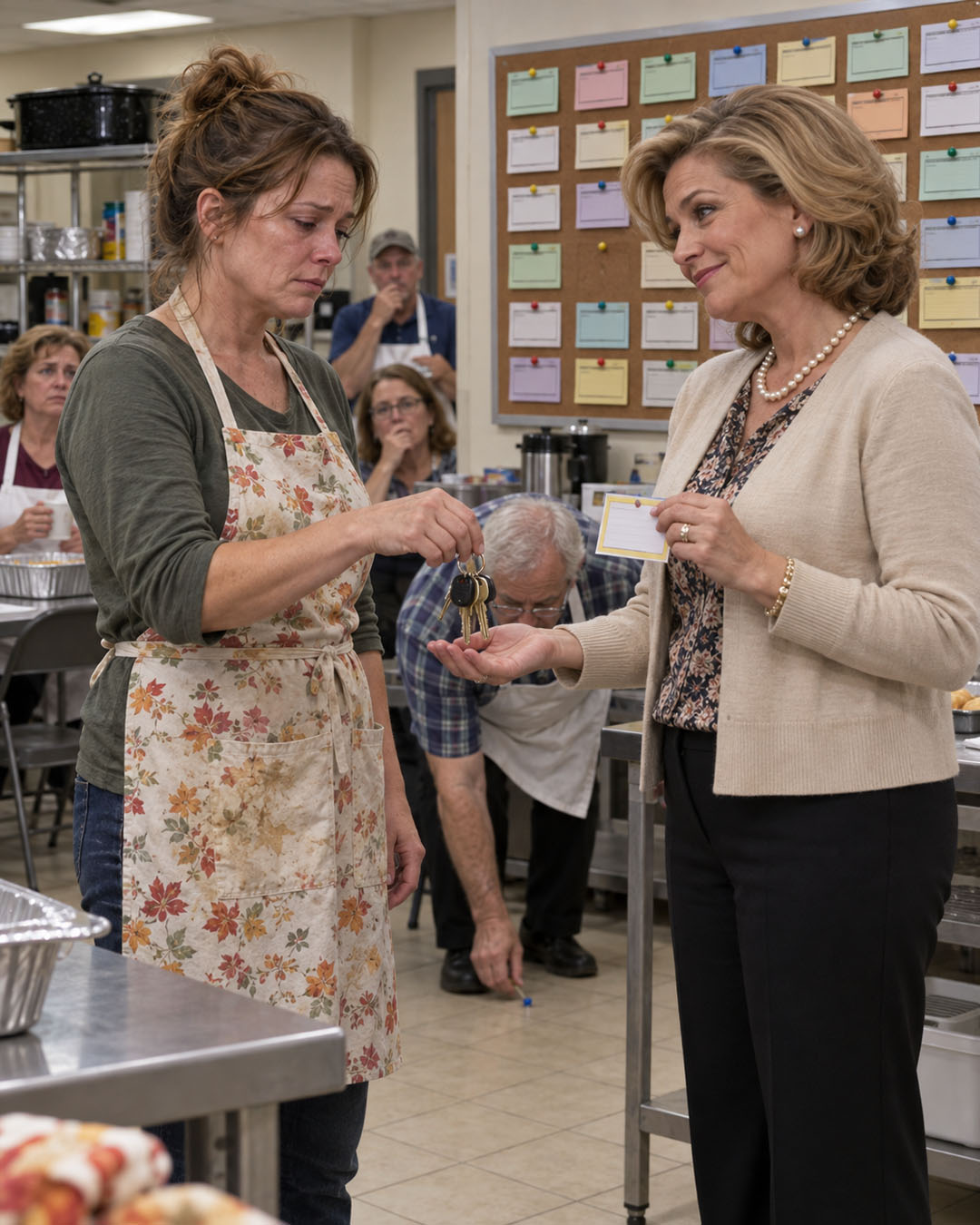
I still think about that corkboard sometimes. I remember Charlene reaching up, the thumbtack rolling across the floor, and my name card held between her fingers like a receipt she didn’t want.
She believed that belonging was a picture you could arrange. She thought a name on a wall could be removed and replaced with one that looked better to the people watching.
But a table isn’t a picture.
A table is the hands that peel potatoes, wash greens three times, and lift heavy roasting pans from hot ovens. It’s the neighbor who drives a meal to an elderly man’s trailer without being asked. It’s the teenager who shows up after school because somebody told him a hungry person needs help.
Those hands don’t come from a photo directory.
They come from showing up.
Miss Odile is eighty-nine now. She still arrives every Thanksgiving wearing her purple hat, and she still insists on tasting the dressing before we’re allowed to serve it.
She closes her eyes, takes a bite, and chews slowly. Then she opens them and looks at me with the same expression she wore when I was a young woman learning to cook beside her.
“Too much sage, Cher.”
I laugh.
“Not this year, Miss Odile.”
She takes another bite, considers it carefully, and reaches for the serving spoon.
“Maybe not. Give me another helping.”
And I do.
Because that is what I learned when the pastor’s wife took my keys. A person can take a key, remove a name, crop a photograph, or decide that someone else’s life doesn’t fit the picture they want to show the world.
But they cannot make a table stop belonging to the people who gather around it.
They cannot erase eleven years of work by pulling a thumbtack from a corkboard.
And they cannot turn away three hundred hungry people without discovering that love has a way of finding another door.
THE END.\
⚠️ All characters and events are fictional. Do not imitate or apply them in real life. 😌😌😌