
Chapter 2
My father wasn’t the only person who expected me to keep the peace. My mother had perfected a different kind of pressure, one that never sounded like an order and rarely ended without me giving her what she wanted.
When Ethan and I discussed the wedding budget with both sets of parents, the total came to thirty-four thousand dollars. We planned to pay ten thousand ourselves, Ethan’s parents offered twelve thousand, and my parents pledged the remaining twelve thousand. They were generous offers, and I thanked them sincerely.
Then my mother folded her hands on the diner table and said, “Of course, with that kind of contribution, Gary will want to give a toast.”
Ethan and I had already agreed to keep the speeches short and avoid turning our wedding into another family roast. I explained that we’d rather not have my father at the microphone, but my mother immediately grew tearful.
“A father speaks at his daughter’s wedding,” she said. “That’s just how it’s done.”
Ethan offered to cover their contribution himself, but my mother looked devastated. She said she couldn’t believe we’d rather write her a check than allow my father to say a few loving words. My father sat beside her, staring at the table, while she made it clear that refusing his speech would mean rejecting everything my parents had done for me.
I gave in. My father could speak for sixty seconds, provided he wrote the speech in advance and let me read it first.
“Of course, sweetheart,” my mother said, her tears disappearing almost as quickly as they’d arrived. “That’s all we’re asking.”
In May, my father paid a five-thousand-dollar deposit to the Hawthorne Event Center. The remaining seven thousand dollars would be due on the wedding day, and he promised to bring the check himself.
I wanted to believe that agreement would be enough. Instead, in July, he posted an old photograph of me at four years old, standing on the hood of his Buick in a sagging diaper and one sandal, with ice cream smeared through my hair. He tagged my future in-laws and dozens of people from the Elks Lodge, adding a caption about saving the date and saving the rubber sheets.
By the time I saw it, more than two hundred comments had appeared. Half were laughing faces, and the others praised my father for being hilarious.
I called him from a hospital stairwell and asked him to take it down. He told me it was only a cute picture, and when I reminded him that I’d asked him to stop embarrassing me, he said I was reading too much into it.
My mother had seen the post, too. She told me my grandmother loved that photograph and would be devastated if it disappeared. I pictured my eighty-three-year-old grandmother feeling blamed for something she hadn’t done, so I let the post remain.
That night, Ethan listened as I explained why I’d given in again. He didn’t raise his voice or tell me what to do. He simply took my hand and said, “Every time you set a limit, somebody cries, and every time somebody cries, the limit disappears. Have you noticed?”
I didn’t answer because I had.
In August, Ethan received an excellent job offer from an aerospace firm in Seattle. The position came with a fifteen-thousand-dollar relocation package, and his salary would be ninety-eight thousand a year. We decided to move two weeks after our honeymoon.
I dreaded telling my parents. At Sunday dinner, my father slapped the table and announced that I’d last until Thanksgiving before crying my way home. My mother said nothing at first, carefully smoothing her napkin before smiling tightly.
“Well,” she said, “we’ll see how that goes.”
I barely noticed the comment. I was too busy trying to keep the dinner pleasant.
In September, Ethan and I met with Pastor Daniels to finalize the ceremony. When we reached the traditional question about objections to the marriage, Ethan looked at me and asked whether we really needed it. Pastor Daniels offered to remove the line, and I immediately agreed.
Then I called my mother to tell her. Her voice became so thin that I rushed to her house, where I found her sitting on the couch, breathing shallowly and clutching her chest. My father paced behind her, looking frightened.
I drove her to urgent care. Forty minutes later, the doctor told us her tests showed no signs of a cardiac event and that stress was the likely explanation. My mother lay on the examination table, pale beneath the fluorescent lights, and reached for my hand.
“Tradition is the only thing I’ve ever asked of you,” she whispered. “Your grandmother has waited her whole life to hear that line at a wedding. I don’t understand why you’re ashamed of us.”
I felt terrible. Even though the doctor had reassured us, I couldn’t shake the fear that I might hurt my mother by refusing her request. So I texted Pastor Daniels and asked him to restore the line.
My mother thanked me and suggested she handle the family seating. She would sit directly in front of my father, with my grandmother in the front row, so she could keep an eye on him.
I agreed, believing she was trying to help.
The following Sunday, I invited my father to our apartment for coffee. I told him I wanted to make peace before the wedding, and he arrived carrying donuts with the relaxed smile of a man who believed everything had already been settled.
I placed my phone on the table between us and opened the voice recorder. In Ohio, I understood that I could record a conversation I was participating in, and I wanted a clear record of what he promised me.
“Dad, I need you to listen carefully,” I said. “No jokes, no speeches, no pranks. Not one.”
He rolled his eyes. “You’re already acting like a wedding dictator.”
“I’m serious.”
“I know you’re serious. You always are.” He brushed sugar from his fingers. “What about my toast?”
“We had a deal. Sixty seconds, written down, and I approve it first. But Harold told me you’ve been planning a surprise.”
My father’s smile faltered for the briefest moment. Then he laughed.
“Harold’s got a big mouth.”
“Promise me you’ll behave.”
He sighed as if I were asking him to perform an impossible task. Finally, he put down his donut and looked directly at me.
“Fine. I’ll behave. You have my word.”
“Say it again, Dad. So Mom doesn’t worry.”
He repeated the promise, then patted my hand. “You worry too much, kiddo. It’s going to be a great day. People are going to love it.”
I saved the recording, emailed a copy to Ethan, and uploaded another to a secure cloud folder. I hated that I needed evidence against my own father, but I was tired of being told that I had misunderstood things I had experienced myself.
Then I called my cousin Mia, a wedding videographer who had known me since childhood. I asked her to keep her camera on my father throughout the day, from his arrival until he left.
“Don’t ask why,” I told her.
“I won’t,” she answered. “For what it’s worth, I’ve been waiting for someone to do something about Uncle Gary since I was fifteen.”
I also asked my brother Jake to stay close to Dad and told the DJ, Kevin, that my father was not to have a microphone under any circumstances.
By the morning of October eleventh, everything seemed to be working. My father arrived in his charcoal suit, shook the pastor’s hand, posed politely for photographs, and even delivered the final seven-thousand-dollar payment to the venue.
My mother came to the bridal suite and gently adjusted my hair. In the mirror, we looked so much alike that I felt a rush of affection.
“See?” she whispered. “He’s trying. He really is.”
I leaned my head against her waist as I had when I was little. I wanted more than anything to believe that my wedding could simply be a wedding.
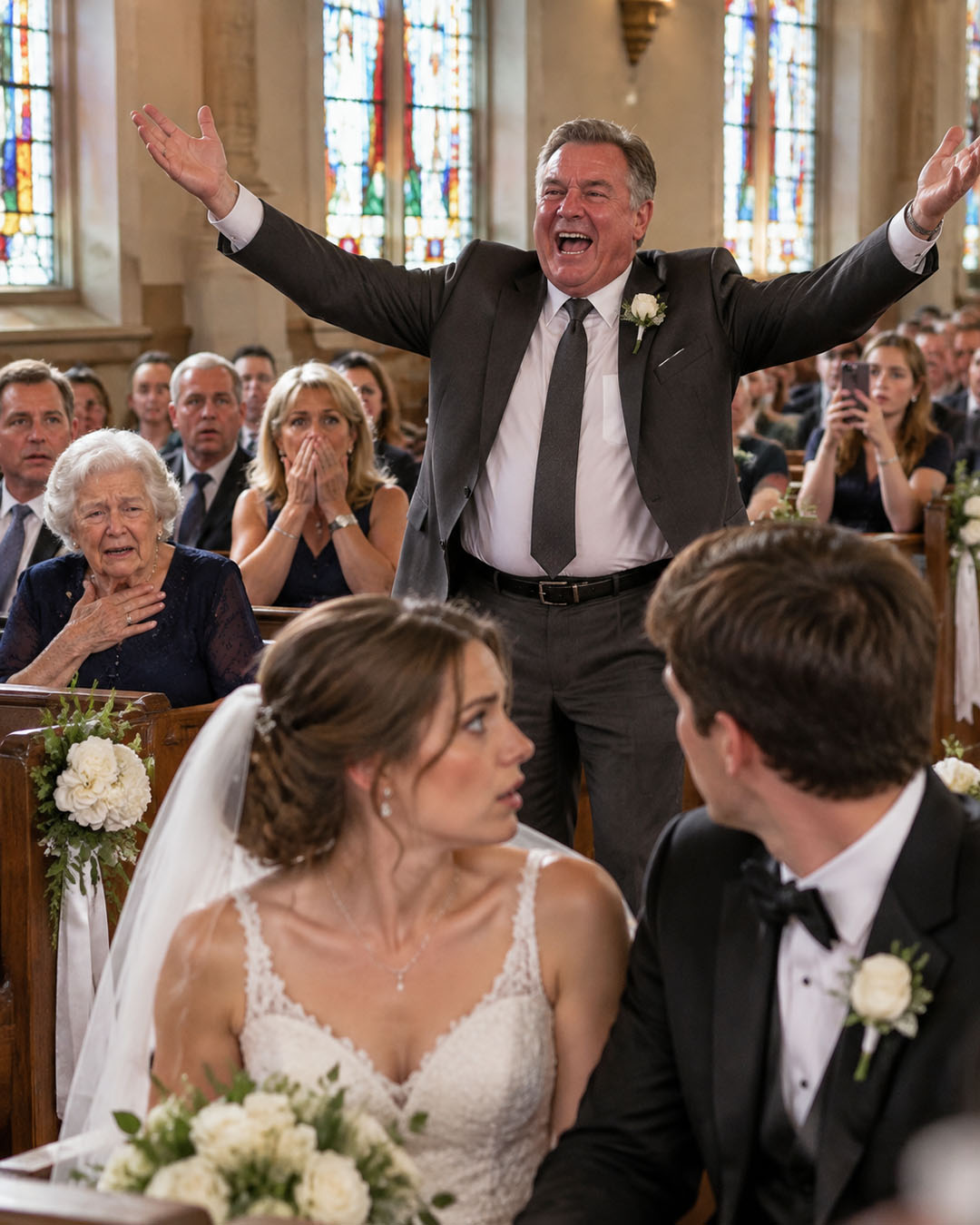
At two o’clock, the organ began playing. Guests filled the pews, Ethan waited at the altar, and my mother took her place in the second row with my father directly behind her.
When Pastor Daniels asked whether anyone objected, my father stood up and screamed his one word.
“STOP!”
He laughed, expecting applause.
I turned to Ethan, whispered that it wasn’t time yet, and asked the pastor to continue. We exchanged our vows, walked out of the church as husband and wife, and moved on to the reception.
My father followed us, still telling anyone who would listen that his joke had been brilliant. The room at the Hawthorne Event Center was beautiful, with white tablecloths, eucalyptus centerpieces, and warm lights strung across the ceiling. Two hundred guests gathered in uneasy clusters, unsure whether they were allowed to enjoy themselves.
At 6:35, my mother approached Jake and asked him to fetch my grandmother’s blue cardigan from the car. She said the room was chilly and that Grandma would need it. Jake glanced toward our father, who was laughing with the bartender, then reluctantly left.
Six minutes later, my father approached the DJ booth.
“Come on, Kevin,” he said, reaching for the microphone. “I’m the father of the bride. Surely I get sixty seconds.”
Kevin refused, reminding him that he had been instructed not to hand over the microphone. My father laughed, reached across the table, and grabbed it himself.
“Relax, everybody!” he announced from the dance floor. “You’re acting like I robbed a bank. Learn to laugh!”
Ethan crossed the room and calmly took the microphone from him.
“Gary, that wasn’t funny. It was cruel, and you need to leave.”
My father snorted. “You can’t kick me out of my own daughter’s wedding.”
“Watch me.”
A murmur moved through the room. Then my mother rushed onto the dance floor, crying and pleading that my father hadn’t meant it. She repeated the sentence I’d heard throughout my childhood, the sentence that had always erased the consequences of his behavior.
“He didn’t mean it! He didn’t mean it!”
I stood and walked toward them. Ethan handed me the microphone, and I looked directly at my father.
“Before you go, Dad, I have a little entertainment of my own.”
Kevin pressed a button on his laptop. The large projector screen behind the head table flickered on, and my father’s voice filled the room.
“Fine. I’ll behave. You have my word.”
Then the screen showed Mia’s footage from the church: my father rising from his seat, shouting, laughing, and waiting for the room to applaud.
When the clip ended, I asked Kevin to play it again.
My father’s face turned pale. “You set me up!”
“No, Dad,” I replied. “You set yourself up. I just pressed record.”
A few guests began clapping. Then more joined them, until the sound filled the room. My father looked around for someone who would defend him, but the people who had laughed at his jokes for years were finally seeing what those jokes had cost.
The venue manager approached and quietly asked him to leave. My father lowered his head and started toward the doors, with my mother following behind him, still crying.
I thought it was over.
Then Mia caught my arm near the coat check. Her face had gone white, and she was holding her phone against her chest.
“Wait,” she whispered. “You need to watch the end of my video.”
Chapter 3
Mia pulled me into a quiet alcove and opened the recording from the church. She rewound it to the moment before my father stood, then paused the image on the second row.
My mother was sitting directly in front of him. Unlike everyone else in the church, she wasn’t startled when he rose. She wasn’t covering her mouth or looking toward the pastor.
She was looking straight at my father.
Her lips formed one word.
Now.
Mia played it again, and the same word appeared on my mother’s lips. Then she showed me another clip, recorded twelve minutes before the ceremony, in the church vestibule. My father stood near the entrance while my mother straightened his tie.
“When he asks the question, you stand,” my mother said in a calm, measured voice. “Wait for the silence, then wait one more second. Then you say it.”
My father shifted nervously. “She made me promise to behave.”
“She made you promise to be quiet,” my mother replied. “She didn’t make you promise to be afraid of her.”
She patted his lapel and smiled. “It’s one joke, Gary. Everyone will laugh, and it’ll be over. In five years, it’ll be a funny story. She’ll be mad for a week, and then she’ll come home to me like she always does.”
My father gave a nervous laugh. My mother kissed his cheek.
“Have I ever steered you wrong?”
Mia stopped the video. Her hands were shaking.
“There was more,” she said. “I went back through the engagement-party footage, too.”
She opened another file. The picture showed my father standing with a microphone at the Elks Lodge, preparing to tell the story about the rubber sheets. The camera had been near the centerpiece, close enough to capture a quiet comment from my mother.
“Tell them about the sheets, Gary,” she murmured. “Everyone loves that one.”
For several seconds, I couldn’t speak. The stories that had followed me since childhood, the ones that had made me dread family gatherings, hadn’t been my father’s inventions alone. My mother had been supplying the material, encouraging the performances, and comforting me afterward.
Every time I’d reached for a door, she’d helped him close it. When I’d cried about Colorado, she’d convinced me that staying home was the sensible choice. When I’d considered leaving for Chicago for a clinical rotation, she’d asked whether I really needed to go so far away.
She hadn’t simply been protecting me from my father.
She had been using him to keep me close.
I looked across the ballroom toward the double doors. My father stood just inside them, his shoulders bowed, while my mother watched me with a faint, unsettling smile.
“Does Ethan know?” Mia asked.
“Not yet.”
“What are you going to do?”
I took the phone from her. My hands were trembling, but my voice was steady when I answered.
“I’m going to finish it.”
I walked across the dance floor. Guests fell quiet as I approached the doors, and the venue manager stopped my father from leaving for a moment. My mother turned toward me, and her expression changed instantly. The smile disappeared, her eyes filled with tears, and her lower lip began to tremble.
“Sweetheart,” she whispered. “This isn’t the time. Let’s talk tomorrow.”
“I think everyone would like to hear it now.”
I asked her what she’d said to my father before the ceremony. She claimed she’d told him to sit down, but Mia’s video showed otherwise.
“You were smiling, Mom. You told him when to stand.”
My mother raised her voice, accusing me of twisting things and trying to ruin her in front of strangers. She reminded everyone how she’d cared for me when I was sick, how she’d attended my school events, and how she’d always been there when I needed her.
Then Pastor Daniels stood from his table.
“I’m sorry,” he said quietly. “I think it’s important that I speak.”
He explained that my mother had called his office four times in September to confirm that the objection question would remain in the ceremony. During the third call, she’d specifically asked him to leave a long pause after asking the question.
He’d assumed she was sentimental about tradition. He hadn’t understood the significance until that afternoon.
My mother stared at him, her face growing pale.
“That’s tradition,” she whispered. “I wanted tradition.”
“Then let’s hear the rest,” I said.
Kevin played the vestibule recording through the ballroom speakers. My mother’s voice filled the room, explaining when my father should stand and how quickly I would forgive him.
When the recording ended, my father slowly turned toward her.
“You said it would be funny,” he said. “You told me she’d thank us. You told me it would bring everyone together.”
“Gary, stop talking,” my mother snapped.
“You wrote the stories,” he said, his voice shaking. “You always told me what to say. You told me to make the jokes.”
“Shut up!”
It was the first time I could remember hearing my mother scream.
She pointed at him, then looked at me, her face flushed with anger and fear. “He’s a fool! I made him funny. I made him into something people liked. And now you want to leave Ohio with a man from Seattle without even looking back!”
Her voice cracked.
“Everyone leaves. I wanted one thing that stayed.”
For a moment, I understood her fear. She had built her life around the belief that if I stayed close enough, she would never have to lose me. But understanding why someone hurts you doesn’t erase the hurt, and it doesn’t make you responsible for healing them.
“Mom,” I said, “I needed you on my side before I got hurt, not after.”
She stared at me, tears spilling down her cheeks.
“You wrote those stories, and I carried them for twenty-eight years. I thought you were the person who protected me. I thought you were the one person who understood how much it hurt.”
I swallowed hard.
“I will never be grateful for being rescued from something you helped create. I love you, Mom. I do. But I’m done being small so you can feel big.”
She opened her mouth, but nothing came out.
I turned to the venue manager. “Please escort them both out. I need a few minutes with my husband.”
My father left first, shuffling through the doors without looking back. My mother followed, stopping once to glance over her shoulder at me. Her mascara had run, and her pearls hung crookedly around her neck.
For a moment, I thought she might finally say something honest.
Instead, the doors closed behind her.
I turned and saw Ethan waiting for me. He took my hand, kissed my forehead, and led me to the dance floor. Kevin played the slow song we’d chosen months earlier, and the guests stood around us in a quiet circle.
Halfway through the song, Ruth tapped her cane against the floor in time with the music. My grandmother began humming, and soon several guests joined in. By the end of the song, people were dancing again.
Jake gave the toast my father had been promised. It lasted forty seconds.
“I laughed at the wrong things my whole life,” he said, his voice breaking. “I did it because I didn’t know what else to do. I’m sorry to my sister, who finally didn’t.”
Then he sat down and covered his face with his hands.
It wasn’t the wedding I’d planned. But for the first time in my life, I felt as though the people in the room were seeing me rather than the role my family had assigned me.
Chapter 4
The consequences arrived quickly. On Monday morning, the venue manager called to tell us that my father had stopped payment on the seven-thousand-dollar check he’d delivered the day before. The venue still needed its balance, and Ethan and I had to cover it from our savings.
We had planned a ten-day honeymoon in Maui, but the resort deposit and flights were already nonrefundable. We kept the flights as credit and spent four rainy nights in a cabin in Hocking Hills, the same place where Ethan had proposed.
I didn’t regret a single dollar. I was sorry we lost the trip, but I was no longer willing to purchase peace by sacrificing my dignity.
On Wednesday, a lawyer my father had hired sent a letter demanding that I delete the recordings and pay fifteen thousand dollars for violating his privacy. Ethan’s cousin Priya, a litigator in Columbus, read the letter at our kitchen table and laughed for nearly a minute.
She drafted a brief response explaining that I had recorded a conversation I participated in and that the wedding footage had been captured by an invited videographer. We never heard from the lawyer again.
The family divided into camps. My aunt accused Mia of betraying her own relatives, while several cousins said I’d humiliated my father. Two women from my mother’s church sent long messages about forgiveness and the importance of family.
I didn’t respond. I was tired of explaining why the person who had been embarrassed for twenty-eight years was finally allowed to say she’d had enough.
Uncle Harold drove to my father’s house and sat with him in the garage for three hours. Later, he told me what he’d said.
“I laughed for thirty years because it was easier than admitting those jokes weren’t funny. That’s on me, too, Gary. But you don’t get to keep going.”
My grandmother called me the following Tuesday. Her voice was thin but steady.
“I knew something was wrong with the way your mother handled you,” she said. “Not everything, but enough. Your mother learned some of those habits from me, and I’m sorry I never questioned them.”
She admitted she’d spent years telling herself that this was simply how marriages worked, that a wife kept the peace and a daughter stayed close. Now she wanted to do better with whatever time she had left.
I told her I’d like that.
Ten days after the wedding, my mother sent an email to forty-two relatives titled “What Really Happened on October 11th.” She claimed I’d edited the video, manipulated Ethan’s family against my parents, and deliberately ambushed my father. She also said she was suffering from chest pains and feared the stress might damage her health.
Within two hours, Mia replied to everyone with the full, unedited footage. The recording included the church vestibule conversation, my father’s outburst, and the moment my mother silently signaled him to stand.
Nobody responded to the email.
Two nights later, Jake called me at midnight. Mom had gone to the emergency room because she’d complained of chest pain. He sat with her for four hours while doctors ran tests, all of which came back normal. They sent her home with advice about managing stress.
When Jake called me from the parking lot, he sounded exhausted.
“I asked her if she was okay,” he said. “She asked whether you had sent me.”
He paused, and I heard him trying to steady his breathing.
“Not once did she ask if I was okay. I think I’m done, too.”
I let him cry. I didn’t tell him what he should feel or ask him to make a decision before he was ready. For the first time, my brother and I could talk about our childhood without either of us having to protect our parents from the truth.
The hardest part came four nights into our honeymoon. Ethan was asleep, rain was beating against the cabin roof, and I was scrolling through old voicemails on my phone when I found one from my mother.
It was from two years earlier, an ordinary Tuesday afternoon.
“Hi, sweetheart. I’m just leaving school, and I saw a little girl in a pink raincoat who reminded me of you. I wanted to hear your voice. Call me when you can. Love you. Bye.”
The message lasted forty-one seconds. I listened to it three times, then sat by the window and cried so hard I had to cover my mouth.
I knew what other people would say. They would tell me that my mother had manipulated me, that I should stop missing her, or that I ought to be grateful the truth had finally come out.
But none of those things could explain the ache in my chest.
My mother had loved me. She had braided my hair, brought me soup when I was sick, and waited outside school events to take me home. She had remembered my favorite foods and called to ask about my day. Those moments had been real.
So had the betrayal.
She loved me the way someone loves something they’re terrified of losing. She had convinced herself that if I stayed small, I would stay close, and she had been willing to hurt me to keep that arrangement intact.
I wasn’t crying for the mother who had stood behind my father’s jokes. I was crying for the mother I had believed she was, the woman I thought would have cheered when I left for Colorado or encouraged me to take the Chicago rotation.
I had spent years trying to earn a freedom she had never intended to give me.
That was the real loss. It wasn’t the money or the wedding. It was the realization that the person I had trusted most had helped create the very pain she’d comforted me through.
We moved to Seattle on November nineteenth, two days later than planned. Ethan and I settled into a narrow brick apartment in Ballard, where we had a view of a parking structure and one stubborn tomato plant on the balcony. I began working at Seattle Children’s, treating children who were learning to walk again after injuries or serious illnesses.
Some of them fell repeatedly before they could take a few steps without help. I’d kneel beside them and tell them there was no shame in trying again.
I was beginning to understand that I deserved the same kindness.
My father mailed me a handwritten letter the following December. It was three pages long, written in the blocky capital letters he used on checks, and it contained not a single joke.
He admitted that he’d spent thirty years confusing laughter with love. He wrote that Uncle Harold had encouraged him to see a counselor, and that he’d taken his Toastmaster plaque off the garage wall. He didn’t ask me to forgive him or demand that I come home for Christmas.
I read the letter twice before calling him.
We speak every other Sunday now, usually for about twenty minutes. We talk about the Cincinnati Reds, his knee, and the weather. He has never told another embarrassing story about me, and when he doesn’t know what to say, he allows the silence to remain.
I’m not sure we’ll ever have the relationship we might have had if he’d treated me differently. But he is trying, and his efforts no longer require me to pretend the past didn’t happen.
My mother and I haven’t spoken in two years. She sends a card every Christmas, and I’ve opened only the first one. It said she was sorry I’d misunderstood what happened at the wedding.
I put it in a shoebox in the closet with the others. Someday, I may read them. Someday, I may not.
People still ask whether I regret playing the recordings in front of two hundred guests. Some think I should have confronted my parents privately. Others believe that a wedding is no place for family conflict.
I understand those opinions. I never wanted to humiliate my father, and I never expected to discover that my mother had been directing him all along. But I also know what would have happened if I’d remained silent.
He would have told another story. My mother would have comforted me afterward. I would have apologized for being upset, and everyone would have returned to their lives as though nothing had happened.
I didn’t want revenge as much as I wanted to take away the sentence that had kept everything the same.
“He didn’t mean it.”
Those words had protected my father from accountability and my mother from having to admit what she’d done. They had taught me that love required me to accept humiliation, that setting boundaries was selfish, and that other people’s tears mattered more than my own.
I don’t believe that anymore.
Real love doesn’t ask you to become smaller so someone else can feel secure. It doesn’t use guilt to keep you close or disguise cruelty as humor. It can survive disappointment, honest conversations, and the freedom to become someone your family never expected you to be.
My father called it a little joke. He stood in a church and broke a sacred silence because he expected two hundred people to laugh with him.
I turned that joke into the worst night of his life, and I would make the same choice again.
But I want to be honest about what it cost me. I lost the version of my mother I had carried in my heart for twenty-eight years, and some nights I still listen to that forty-one-second voicemail about the little girl in the pink raincoat.
I keep it because both things are true. My mother loved me, and she hurt me. I can miss her without pretending she did nothing wrong, and I can wish things had been different without surrendering the life I’ve finally begun to build.
Sometimes, freedom doesn’t arrive with a triumphant speech or a perfect ending. Sometimes, it begins with a quiet decision to stop explaining your pain to people who benefit from pretending they don’t understand it.
My wedding day taught me that I could love my family without giving them control over my future. It taught me that forgiveness, if it ever comes, doesn’t have to mean returning to the same arrangement that hurt me.
And most importantly, it taught me that I no longer have to earn my place at the table by making myself the punchline.
THE END.
⚠️ All characters and events are fictional. Do not imitate or apply them in real life. 😌😌😌


