Chapter 2
The following week showed me exactly what my future would look like if I gave in.
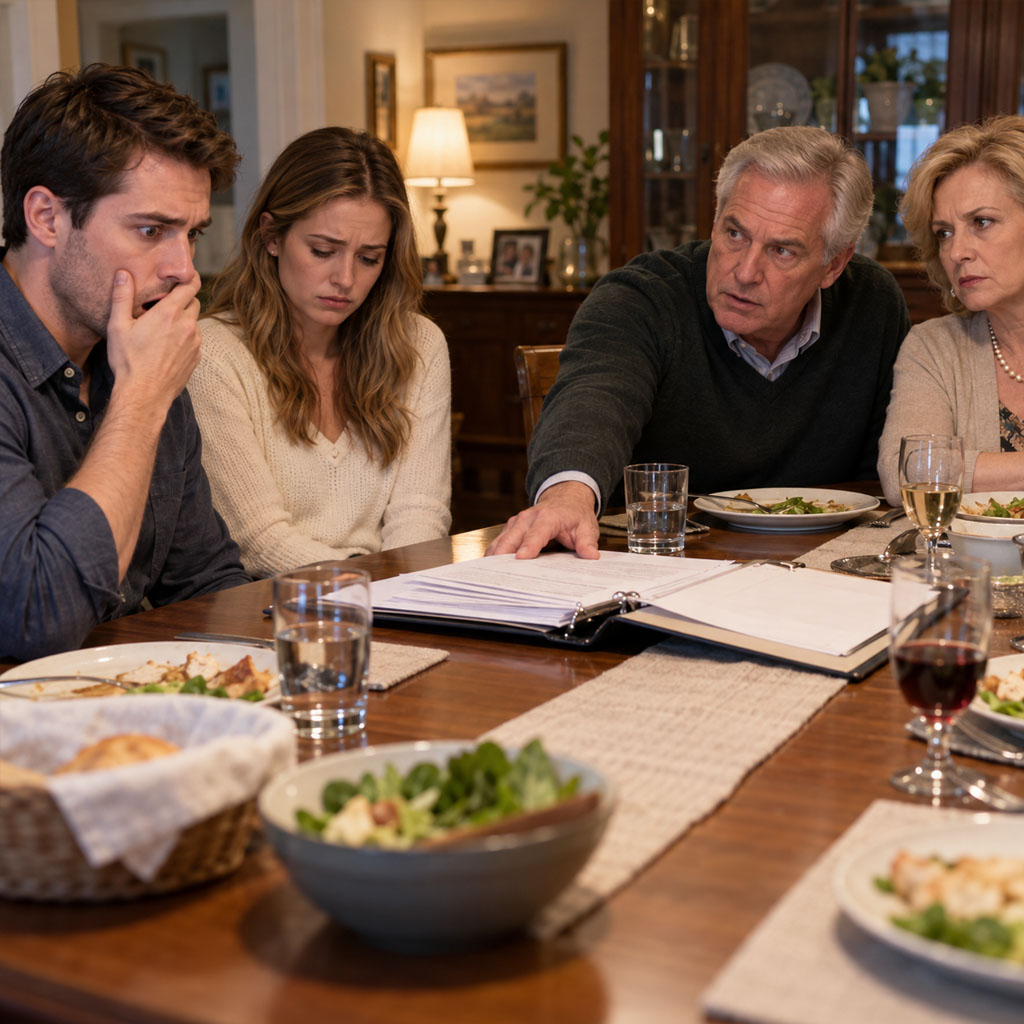
Diane invited us to dinner “to clear the air,” and within twenty minutes she was explaining how much raising Emily had cost them. She mentioned tuition, dance lessons, braces, summer camps, college fees, and the used Honda they bought Emily when she turned 18.
I listened until she said, “We gave our daughter every advantage. I don’t think it’s unreasonable to expect the man benefiting from that investment to show some gratitude.”
I put down my fork.
“Benefiting from that investment?”
Diane blinked. “You know what I mean.”
“I hope I don’t.”
Emily touched my arm. “Mark.”
“No, I’d actually like her to explain.”
Richard pushed back from the table. “Don’t speak to my wife that way.”
“I’m speaking calmly.”
“You’re being disrespectful.”
I looked at him. “Respect seems to mean giving you money whenever you use the word.”
His jaw tightened.
Richard then delivered a speech about tradition. According to him, his own father-in-law had received financial help from Richard after he married Diane. That proved, in his mind, that I was simply being asked to continue a family custom.
“What exactly did you do for Diane’s parents?” I asked.
Richard paused.
Diane answered for him. “He helped them with a down payment.”
“How much?”
“That’s private.”
“You’re asking me for $76,000.”
“That’s different.”
“Apparently.”
Richard leaned across the table. “You’re too focused on numbers.”
I almost laughed. “You brought me a payment schedule.”
His face flushed.
Then he said the sentence that changed something in me permanently.
“You’re still thinking like a boy. One day, when you understand what it means to be a man responsible for a family, you’ll see this differently.”
I stood.
Emily grabbed my wrist. “Where are you going?”
“Home.”
“We came together.”
“I’ll wait in the car.”
Richard gave a short, humorless laugh. “Running away from a difficult conversation. Very mature.”
I looked at him.
“No, Richard. I’m leaving before I say something I can’t take back.”
The drive home was silent until Emily finally exploded.
“You embarrassed my parents.”
I glanced at her. “That’s what you took from tonight?”
“You didn’t have to talk to them like that.”
“They called me a boy because I won’t pay their mortgage.”
“They’re frustrated.”
“So am I.”
She turned toward the passenger window.
I kept both hands on the steering wheel.
“Emily, answer one question honestly. If your parents told you tomorrow that I needed to pay off their car, would you support that too?”
“That’s ridiculous.”
“Why?”
“Because it’s different.”
“What if they wanted $20,000 for home renovations?”
“Mark.”
“What if they decided we should pay for their vacations?”
“You’re exaggerating.”
“I’m trying to find the boundary.”
She said nothing.
I looked over briefly. “Where is it?”
“I don’t know.”
That frightened me more than if she had named a number.
A few days later, Diane called while I was driving home from work.
“I’d like to speak frankly,” she said.
“You usually do.”
She ignored that. “If you refuse to help with something this basic, how are Richard and I supposed to trust you to take care of Emily?”
“My commitment to Emily has nothing to do with your mortgage.”
“It has everything to do with it.”
“No, it doesn’t.”
“People in our family are already asking questions.”
“What people?”
“Aunts. Cousins. Close friends.”
“You discussed my finances with your relatives?”
She went quiet.
I pulled into my driveway and shut off the engine.
“Diane?”
“We’re only concerned.”
“No. You’re pressuring me.”
“You’re being selfish.”
“And you’re asking someone who isn’t even married to your daughter yet to give you $76,000.”
“It wouldn’t ruin you.”
The sentence landed with startling clarity.
Not We need help.
Not We’re struggling.
Not Would you consider helping?
It wouldn’t ruin you.
I ended the call.
That night I told Emily what her mother had said.
She shrugged.
“Mom gets dramatic.”
“Your mother is telling relatives about my finances.”
“She probably didn’t give details.”
“She called my refusal selfish.”
“You knew she was upset.”
I stared at the woman I had planned to spend my life with.
“Why is everyone allowed to be upset except me?”
Emily’s expression softened for a moment. “I know this is stressful.”
“It’s not stressful. It’s revealing.”
“What’s that supposed to mean?”
“It means I’m beginning to understand that this isn’t about a mortgage.”
She looked away.
I noticed it immediately.
“What?”
“Nothing.”
“Emily.”
“Just stop analyzing everything.”
Something in her voice made me suspicious.
The next morning, I remembered the folder Richard had brought to the café. He had been strangely protective of it, keeping one hand on it almost the entire meeting. But when we left, I had noticed him return to the table because he thought he had forgotten something.
At the time, I assumed he recovered it.
Now I wasn’t sure.
I called the café.
“Hi,” I said. “I met someone there last week, and he may have left a dark brown folder.”
The manager asked for a description, then told me they had one in the lost-and-found.
I drove over after work.
The folder contained mortgage statements, printed budgets, receipts, and handwritten notes. I flipped through the papers looking for nothing in particular until one receipt caught my attention.
$18,400.
Alder Grove Recovery Center.
I had never heard of it.
At home, I searched the name.
Alder Grove was a private residential treatment facility specializing in addiction recovery, including compulsive gambling.
I sat very still.
Then I went back through the folder.
Another payment.
Then another.
More than $40,000 altogether.
Beside one receipt, Richard had written in blue ink:
Need remaining balance handled before wedding expenses hit.
I read that sentence twice.
Then I found another page containing a rough list of possible sources of money.
Savings.
Home equity.
Emily?
Mark contribution after engagement.
Frame as family obligation.
I felt physically cold.
Frame as family obligation.
The mortgage had never been the real issue.
The so-called tradition had been invented because Richard and Diane were trying to replace money Richard had lost—or spent—during his gambling crisis.
And Emily had known enough to tell me to stop asking questions.
I drove to her apartment.
She opened the door wearing sweatpants and an old college sweatshirt. The moment she saw the papers in my hand, the color left her face.
“What is that?”
“You tell me.”
I held up the Alder Grove receipt.
Her lips parted.
That was all the answer I needed.
“You knew.”
“Mark—”
“You knew.”
She closed her eyes.
“My dad had a gambling problem.”
“How long?”
“A few years, on and off. It got really bad last year.”
“And he went to treatment.”
“Yes.”
“And it cost tens of thousands of dollars.”
“Yes.”
“Did he lose money gambling too?”
She sat down slowly.
“A lot.”
“How much?”
“I don’t know exactly.”
“Try.”
“Maybe $90,000. Maybe more.”
I felt as if the floor had shifted.
“So they’re in financial trouble.”
“They’re managing.”
“By trying to take my savings.”
“That’s not fair.”
I held up the handwritten page.
“‘Frame as family obligation.’ Your father wrote that.”
Emily covered her mouth.
“Did you know he planned to lie to me?”
“I knew they didn’t want to tell you about the gambling.”
“That isn’t what I asked.”
She began crying.
I hated seeing her cry. Even then, after everything, some instinct in me wanted to sit beside her and tell her we would work it out.
But I didn’t.
Because I finally understood that comforting her had become another way of avoiding the truth.
“Did you know?”
Her voice came out barely above a whisper.
“Yes.”
Chapter 3
For several seconds, neither of us spoke.
I heard the refrigerator hum in the kitchen. Somewhere outside, a dog barked twice. Ordinary sounds continued while my engagement quietly collapsed in front of me.
“How long?” I asked.
Emily wiped her cheeks. “My parents talked to me about it after you proposed.”
“So before they started making all those comments?”
“Yes.”
“Before your mother told me a real man supports his wife’s family?”
She nodded.
“Before your father brought the mortgage papers to the café?”
Another nod.
“And you watched them do it.”
“I didn’t know it would become this intense.”
“You knew the reason was fake.”
“They were embarrassed.”
I stared at her.
“Embarrassed?”
“My dad was ashamed. He spent his whole career giving people financial advice. He didn’t want anyone knowing he lost control.”
“So the solution was to lie to me.”
“They were desperate.”
“And you helped them.”
“I didn’t help them.”
“You stayed silent while they manipulated me.”
“I was trying to keep the peace.”
That phrase finally broke whatever hope I had left.
“Peace for whom?”
Emily looked at me helplessly.
“Because it wasn’t peace for me. Your parents insulted me. They questioned whether I was good enough for you. They told relatives I was selfish. Your father prepared a payment plan for my money. And every time I came to you, you defended them.”
“I love them.”
“I never asked you not to love them.”
“They’re my parents.”
“And I was supposed to become your husband.”
She began crying harder.
I lowered my voice.
“You were supposed to be the person I could trust.”
“I’m sorry.”
“Are you sorry they lied, or sorry I found out?”
She didn’t answer.
I left.
The next morning, I called my father.
Dad was 67 and had spent 35 years repairing heating and air-conditioning systems before retiring. He had no fancy financial vocabulary. He never lectured anyone about investments or status. But he understood people.
He listened without interrupting.
When I finished, there was a long silence.
“Son,” he finally said, “a family can survive money problems. It can survive embarrassment. Sometimes it can even survive addiction if people get help and tell the truth.”
I waited.
“But what they’re asking you to survive is dishonesty.”
I leaned back in my chair.
Dad continued. “Richard made mistakes. Going to treatment was the right thing. Nobody should shame him for getting help. But getting help doesn’t give him the right to make you pay for his past, especially by deceiving you.”
“I know.”
“And Emily?”
I closed my eyes.
“I don’t know if I can trust her anymore.”
“That sounds like you do know.”
Two nights later, I asked Emily to meet me at her parents’ house. I wanted one conversation with all three of them present. No separate stories. No private excuses.
Richard opened the door wearing the same expression he always wore when preparing to control a room.
“Mark,” he said. “Come in.”
Diane smiled too brightly. “We’re glad you finally agreed to talk.”
Emily was already sitting in the living room.
I remained standing.
Richard gestured toward a chair. “Have a seat.”
“I’m fine.”
I placed copies of the Alder Grove receipts and Richard’s handwritten notes on the coffee table.
For the first time since I had met him, Richard looked afraid.
Diane’s eyes widened.
Emily stared at the floor.
Richard recovered first.
“Where did you get these?”
“The folder you left at the café.”
“That was private property.”
“You were using the information in that folder to convince me to give you money.”
“You had no right to go through it.”
“You had no right to invent a family tradition so I’d cover the consequences of your gambling.”
Diane stood quickly. “Lower your voice.”
“My voice is fine.”
Richard picked up the handwritten page and glanced toward Emily.
“Did you tell him?”
“No,” she whispered.
He turned back to me.
“This is none of your business.”
I actually laughed.
“You spent a month trying to make it my financial responsibility.”
“You don’t understand what happened.”
“Then explain it.”
His mouth tightened.
Diane stepped in. “Richard went through a difficult period. He recognized the problem and got professional help.”
“And I respect that.”
That surprised them.
I continued. “Getting treatment was the responsible thing to do. Lying to me afterward wasn’t.”
Richard’s face reddened. “You think you’re better than me?”
“No.”
“You’re standing in my home judging me.”
“I’m standing in your home because you tried to make me pay your debts.”
“We needed help.”
“Then you should have asked.”
“You would have said no.”
“Yes.”
His eyes narrowed.
“And that’s why you lied,” I said. “You knew I had the right to say no, and you decided my answer didn’t matter.”
Diane began to cry.
“We sacrificed everything for Emily.”
I looked at her.
“She’s your daughter.”
“We paid for private school. We paid for college. We gave her opportunities we never had.”
“That was your choice as parents.”
“You don’t understand.”
“I understand perfectly. You believe raising your daughter created a debt, and you expected her future husband to repay it.”
“That’s not what we’re saying.”
“It’s exactly what you’ve been saying.”
Richard slammed one hand onto the arm of his chair.
“You want to join this family without contributing anything.”
I stared at him.
“I was going to marry your daughter. Build a home with her. Raise children with her. Stand beside her through sickness, grief, job losses, aging parents, and whatever else life brought us. If that counts as nothing because I won’t write you a check, then we have very different ideas about family.”
Nobody answered.
I turned to Emily.
“This is where I need you to speak.”
She looked up.
I waited.
“Tell them what they did was wrong.”
Her eyes filled again. “Mark, please.”
“No. Tell them.”
“They shouldn’t have lied.”
Richard scoffed.
Emily immediately looked toward him.
“Dad, I’m not saying—”
There it was.
Even now.
Even after everything.
She was protecting him from the consequences of hearing one honest sentence.
I took off the engagement ring I had been carrying in my pocket. Emily had returned it to me the night before, saying she needed “space” until things settled down. Now I placed it beside Richard’s papers.
“I’m done.”
Emily stood. “What?”
“I can’t marry you.”
“Mark, don’t do this because of one mistake.”
“One mistake?”
Her face crumpled.
“I love you.”
“I love the woman I thought you were.”
“That’s cruel.”
“No. Cruel was watching your parents break me down for weeks while knowing they were lying.”
Diane stepped forward. “You are throwing away a good woman because you’re stubborn.”
I looked at her.
“No. I’m walking away because she had every opportunity to tell me the truth and chose your approval instead.”
Richard stood.
“If you walk out that door, don’t come back.”
“I wasn’t planning to.”
His face darkened. “Maybe you were never good enough for her.”
That hurt.
But not as much as it would have a month earlier.
Because by then, I understood something Richard did not.
A person who demands your surrender as proof of love will never be satisfied by one surrender.
I walked out.
For the first time in weeks, the air outside felt clean.
Then my phone rang.
It was a coworker named Greg.
“Hey, Mark,” he said cautiously. “This is kind of awkward, but did your fiancée’s dad call the office?”
I stopped beside my truck.
“What?”
“Some guy named Richard Bennett called earlier. Asked whether you were having financial problems. Asked if you’d ever had complaints about handling project budgets.”
My stomach dropped.
“He called my employer?”
“Yeah. I figured you should know.”
That was when sadness stopped being the strongest thing I felt.
Richard hadn’t accepted that I could say no.
He had decided to punish me for it.
Chapter 4
I met Emily the next afternoon at a coffee shop halfway between our homes.
She looked exhausted.
I probably did too.
“We need to stop this,” I said before she could speak.
“I told Dad not to call your work.”
“You knew?”
“He told me afterward.”
“And what did you say?”
“That he shouldn’t have done it.”
“Shouldn’t have?”
“What do you want me to say?”
“I want you to understand that your father tried to interfere with my livelihood because I refused to pay his debt.”
“He was angry.”
“So was I. I didn’t call his former clients and tell them he had a gambling problem.”
Emily flinched.
I immediately regretted the sharpness of the sentence, but not the point.
“This has gone too far,” I said. “No more discussions about the wedding. No more time apart. No more hoping something changes.”
She stared at me.
“We’re done.”
Her lower lip trembled.
“You don’t mean that.”
“I do.”
“After everything we had?”
“That’s why it hurts.”
She reached across the table.
I moved my hand away.
“Forget your parents for one minute,” I said. “This is about you and me. You knew they were deceiving me. You let them question my character, pressure me, and plan how to take money we had discussed using for our own home.”
“I was scared.”
“Of them?”
She hesitated.
“Yes.”
That answer softened something in me, but it didn’t repair anything.
“Then I hope someday you learn how to stand up to them.”
Her tears spilled over.
“But I can’t spend the rest of my life waiting for that day.”
“I never wanted to hurt you.”
“I believe you.”
She looked surprised.
I continued. “But people can hurt you without wanting to. They can stay silent because speaking is uncomfortable. They can choose peace with one person knowing someone else will pay the price. Intentions matter, Emily, but choices matter more.”
She covered her face.
For several minutes, we sat in silence.
Then she whispered, “I’m sorry.”
“I know.”
I stood.
“Tell your parents not to contact me again.”
She nodded.
I walked away from the woman I had intended to marry and sat in my truck for almost twenty minutes before I could drive.
The grief came in waves after that.
I grieved Emily. I grieved the wedding we had planned, the house we had talked about, the children whose names we had jokingly argued over. I even grieved Richard and Diane, because once there had been evenings when I enjoyed sitting on their patio, listening to Richard tell stories and Diane complain about her roses.
But grief became easier to carry when the phone calls started.
Unknown numbers.
Voicemails.
Messages accusing me of abandoning family responsibilities.
One text read, You don’t get to make promises and walk away when sacrifice is required.
Another said, Someday you’ll understand what you destroyed.
I blocked the numbers.
More appeared.
Then Diane began posting online.
At first, she was vague.
“Character is revealed when commitment becomes inconvenient.”
Then:
“Some people want the benefits of family without understanding duty.”
Eventually, she named enough details that mutual friends knew she meant me.
She accused me of humiliating Emily, wasting deposits, abandoning wedding plans, and refusing to support a family that had “welcomed me like a son.”
What she did not mention was the $76,000 demand.
She did not mention Richard’s gambling.
She did not mention Alder Grove.
She certainly did not mention the note instructing him to frame his debt as a family obligation.
Friends started contacting me.
Some were curious.
Some were concerned.
A few believed Diane.
I resisted the urge to respond publicly.
Then Richard left a voicemail saying, “You think you can damage our daughter and walk away clean. It doesn’t work like that.”
I finally called an attorney.
Her name was Susan Keller, a calm woman in her late 50s who listened to the entire story without interrupting.
“Save everything,” she said.
“I have.”
“Texts?”
“Yes.”
“Voicemails?”
“Yes.”
“Screenshots of social media posts?”
“Most of them.”
“Get the rest.”
She advised me not to argue publicly and prepared a formal letter demanding that Richard and Diane stop contacting me, stop contacting my employer, and stop making false claims about my financial or professional conduct.
The letter worked for exactly five days.
Then Diane published another post.
This one said I had “betrayed a private family struggle” and implied I was threatening them because I feared the truth.
I stared at the screen.
For weeks, I had protected them.
I had told only my father, my attorney, and a few close friends what had really happened. I didn’t want Richard’s addiction becoming neighborhood gossip. Whatever he had done to me, I believed seeking treatment should not become a source of public shame.
But Diane had now transformed my silence into a weapon.
So I responded once.
Carefully.
I did not mention Richard’s diagnosis or treatment details. I did not insult anyone. I did not publish private financial documents.
I wrote only the truth that concerned me.
I explained that my engagement ended after I was asked to assume approximately $76,000 of debt belonging to my former fiancée’s parents. I stated that the request had been presented as a supposed family tradition, that I later learned the explanation was false, and that my former fiancée had known the real circumstances while allowing the pressure to continue.
I added that after I refused, a member of the family contacted my workplace about my finances.
Then I wrote:
I will not debate private matters online. I will not insult anyone involved. I wish Emily well, and I sincerely hope her family finds stability and healing. But I will not accept public accusations for refusing financial demands that were never mine to carry.
I posted it.
Then I closed my laptop.
Within an hour, my phone began buzzing.
This time, the messages were different.
Friends apologized.
A cousin of Emily’s sent me a private note saying, I knew something wasn’t right with the “tradition” story. Nobody in this family has ever heard of that.
Another relative wrote, Richard never paid Diane’s parents’ mortgage. He gave them $5,000 toward a down payment in 1994. That’s it.
That confirmed what I had already suspected.
There had never been a tradition.
Only a story designed to make refusal feel shameful.
Diane deleted her posts two days later.
Richard stopped calling after Susan sent a second letter.
And then, unexpectedly, Emily contacted me.
Not by phone.
She mailed a handwritten letter.
I almost threw it away unopened.
Instead, I sat at my kitchen table and read it.
She did not ask me to come back.
She did not defend her parents.
She wrote that losing me had forced her to look at things she had spent years refusing to see. Her father’s gambling had frightened the whole family. Her mother had become obsessed with keeping up appearances. Emily had learned to survive by avoiding conflict, agreeing with whoever was most upset, and hoping problems disappeared on their own.
She wrote:
I told myself I was protecting my family. What I was really doing was helping them avoid consequences. And I expected you to carry the consequences instead.
I stopped reading for a moment.
That sentence hurt because it was the first time she had fully understood.
Emily ended the letter by saying she had moved into her own apartment, started counseling, and told her parents she would no longer lie for them or borrow money for them.
Then she wrote:
You were right to leave. I wish I had become brave enough before you had to.
I folded the letter and sat there for a long time.
Part of me wondered whether this was the moment in a movie when two people rushed back together.
But real life is not obligated to provide romantic symmetry.
Some lessons arrive after the relationship they might have saved.
I wrote Emily one short reply.
I told her I was glad she was taking care of herself. I told her I sincerely wished her well.
And I told her I believed ending our engagement was still the right decision.
She never contacted me again.
Months passed.
I canceled the wedding vendors, recovered what deposits I could, and returned the gifts that had already arrived. My father helped me haul several boxes back to stores one Saturday, and afterward we sat at a diner eating cheeseburgers like we had when I was 17.
“You doing okay?” he asked.
“Better.”
He nodded.
Then he smiled. “Still have your house money?”
I laughed.
“Every dollar.”
A year later, I used some of it for a down payment on a small brick house with a maple tree in the front yard and a screened porch out back.
It wasn’t the house Emily and I had once imagined.
It was mine.
On the evening I received the keys, Dad came over with two folding chairs and a six-pack of root beer. We sat on the empty porch while the sun dropped behind the houses across the street.
I thought about how close I had come to confusing love with surrender.
There is nothing wrong with helping family. There is nothing shameful about addiction, treatment, financial trouble, or asking for support when life collapses. Families survive hard seasons because people help one another every day.
But help must be asked for honestly.
Love cannot be demanded as payment.
Respect cannot be measured by how much manipulation a person is willing to tolerate.
And marriage cannot survive when one partner expects the other to stand alone against the very people who are supposed to become family.
I once thought canceling my wedding meant I had failed.
Eventually, I understood that sometimes walking away from the wrong future is how you protect the right one.
I lost a fiancée.
I lost the family I thought I was gaining.
I lost deposits, friendships, plans, and months of peace.
But I kept my self-respect.
And in the end, that was the one thing no relationship had the right to ask me to mortgage.
THE END.
⚠️ All characters and events are fictional. Do not imitate or apply them in real life. 😌😌😌