
Chapter 2
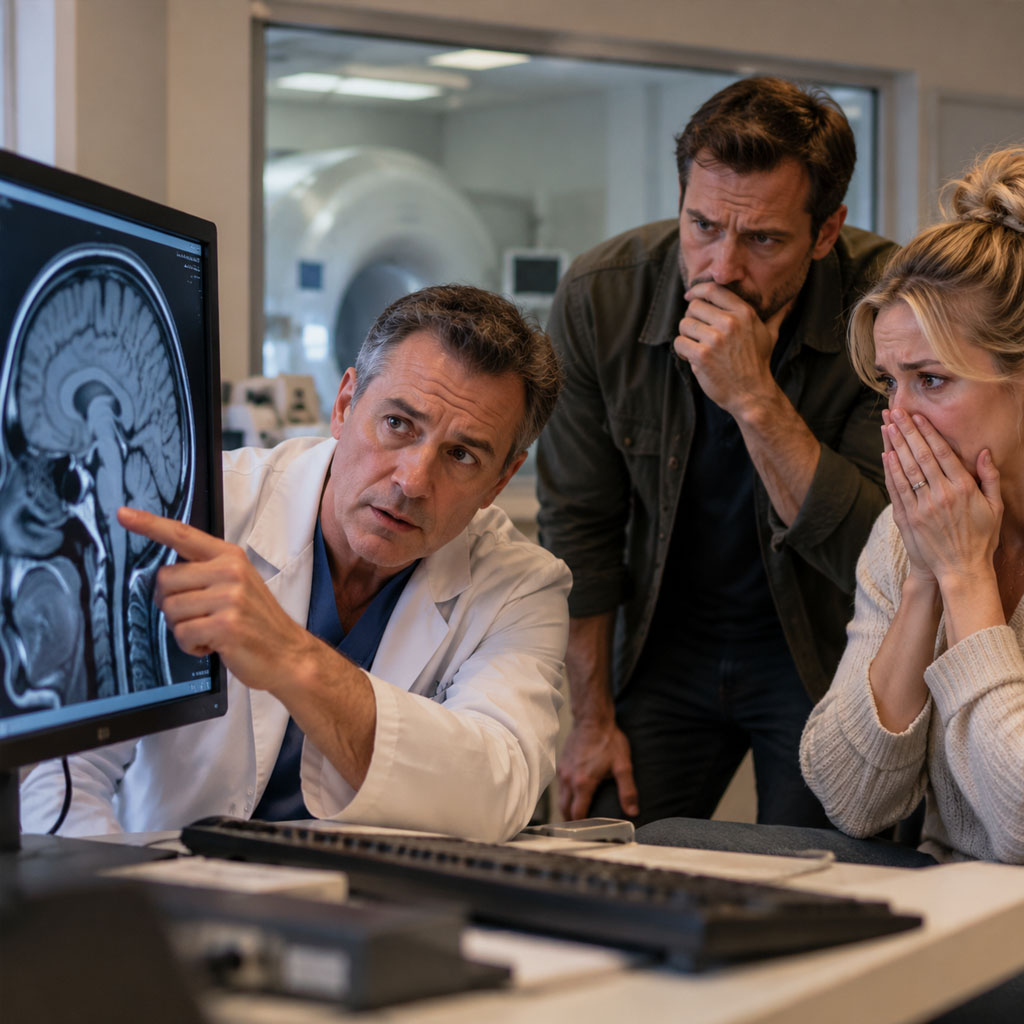
I followed Dr. Norton into the control room.
He turned a monitor toward me. On it was an X-ray showing the side and front of Mason’s skull.
At first, I couldn’t understand what I was looking at.
Then he pointed behind Mason’s right ear.
There was a bright white disc about the size of a quarter. A thin wire came out of it, curved beneath the scalp, passed through a small round opening in the skull, and continued deep into the center of the brain.
I leaned closer.
“What is that?”
Dr. Norton spoke slowly.
“The disc appears to be a pulse generator. It’s a small battery-powered device placed beneath the skin. The wire is an electrode lead. It passes through the skull and into a structure deep inside the brain.”
I looked at him.
“You’re telling me someone put that in my son’s head?”
“That’s what the images suggest.”
He pointed to the small opening in the bone.
“This is called a burr hole. It’s made by a neurosurgeon during an operation. This wasn’t done during a routine visit to urgent care.”
My mouth went dry.
“He had stitches in February. He fell at school.”
Dr. Norton didn’t answer immediately.
“Mr. Hayes, this would have required a surgical procedure under general anesthesia. A fall from playground equipment doesn’t explain it.”
I looked again at the wire.
“Why isn’t there a record?”
“That’s what concerns me. Our hospital has no record of it. The pediatrician’s records apparently don’t mention it, either. And the MRI safety form you completed says he has no implanted device.”
Then Dr. Norton zoomed in on the disc.
“There are identifying letters here. LW-07. I don’t recognize the manufacturer.”
He paused.
“Whatever this is, it doesn’t appear to be a standard commercial device.”
I couldn’t speak.
Then footsteps sounded in the hallway.
Vicki appeared in the doorway, still wearing her work clothes, her hospital identification badge hanging around her neck.
She looked at me.
Then at the screen.
For a fraction of a second, her face changed.
It wasn’t confusion.
It wasn’t shock.
It was something much colder.
“Don’t touch it,” she said. “Nobody touches that device.”
Dr. Norton stood.
“Are you the child’s mother?”
“Yes. I’m calling Drew.”
“Who is Drew?”
“His surgeon. He’s managing the study. This is an investigational device, and Mason is enrolled in a research program. You don’t need to interfere with it.”
Dr. Norton kept his voice controlled.
“Who performed the surgery?”
“Dr. Drew Harrington.”
I recognized the name. Vicki worked at Keystone Surgical Suites, where a pediatric neurosurgeon named Drew Harrington rented operating time twice a week.
I turned toward my wife.
“What did you do?”
She looked at me with an expression I’d seen countless times before: the tired, reasonable mother who supposedly knew what was best for everyone.
“I took care of our son,” she replied. “Which is more than you’ve done this year.”
I felt the words land, but I didn’t answer.
She continued.
“Mason has absence seizures. Forty or fifty a day. Sometimes he stares into space and doesn’t respond. You’d know that if you were home more often.”
“I’ve never seen him have one.”
“Because you’re never here!”
She pulled out her phone and showed me a video.
Mason was sitting at the kitchen table with a bowl of cereal. He raised his spoon halfway to his mouth, then suddenly stopped.
His eyes fixed on nothing.
His body became perfectly still.
After twelve seconds, he blinked and continued eating.
My stomach tightened.
I’d seen that exact expression on the bathroom floor a few hours earlier.
“I have more than sixty videos,” Vicki said. “All dated. Dr. Harrington reviewed them. The medications weren’t working. This device is the only thing that helps.”
“What does it do?”
“It reads his brain activity and interrupts a seizure before it develops. It’s advanced technology. It’s helping children who don’t respond to ordinary treatment.”
She looked at Dr. Norton.
“I want him transferred back to Keystone. His surgeon needs to adjust the device.”
Dr. Norton shook his head.
“Your son has swelling behind both eyes and a device in his brain that we weren’t told about. He is being admitted. Our pediatric neurosurgery team will evaluate him.”
Vicki’s expression tightened.
Drew Harrington arrived about fifty minutes later.
He was in his mid-forties, tall, well dressed, and carried a slim black tablet and a leather equipment case. He walked directly to Vicki, briefly touched her waist as he leaned toward her, and spoke quietly.
I noticed.
So did my mother, Sharon, who had driven from Liberal as soon as I’d called her.
Harrington turned toward me and offered his hand.
“Mr. Hayes. Drew Harrington. I’m sorry you’re finding out about the study this way.”
I didn’t shake his hand.
He explained that Mason was patient number seven in an early feasibility study for a device called the Lullwave LOL system. According to him, it was designed to help children with severe absence epilepsy.
He said the procedure had been conducted under a federal investigational device exemption and that all necessary consent forms had been completed.
“Your wife wanted to spare you the stress,” he said. “She explained that you work away from home most of the year.”
I stared at him.
“He’s been vomiting for months. Are the headaches part of your study?”
“Some adjustment discomfort is possible. The electrode can irritate nearby tissue. Usually, it’s a matter of adjusting the stimulation.”
He lifted his leather case.
“I can reprogram it right now.”
I stepped between him and Mason’s bed.
“Nobody touches my son until another doctor examines him.”
Harrington gave me a patient smile.
“Of course.”
At eleven, Dr. Teresa Fuller, the chief of pediatric neurosurgery at Prairie Mercy, arrived.
She had already reviewed the X-rays and ordered a CT scan, which could safely examine the area without using the MRI magnet.
She explained that the electrode had shifted slightly. There was also a collection of fluid around its tip and along part of the track through the brain.
“It could be inflammation or a low-grade infection,” she said. “Either way, it’s creating pressure in an area where pressure is dangerous.”
She looked directly at me.
“Your son is not pretending to be sick. He’s in real pain.”
I felt my knees weaken.
For six months, I’d been told my boy was exaggerating.
Now a doctor was telling me the pain had a physical cause.
Harrington immediately offered to take Mason back to Keystone for a revision.
Dr. Fuller refused.
“He is not stable for transport to an outpatient facility. He needs to remain here.”
Harrington reminded her that Vicki had legal authority to make medical decisions.
And that was where the situation became more complicated.
A hospital administrator explained that Vicki had signed the consent form as Mason’s legal guardian. Under Kansas law, either parent could generally authorize treatment for a child. If two parents disagreed, the dispute might have to be resolved in court.
A sheriff’s detective named Paul Anderson came to the hospital after Dr. Norton contacted the child protection hotline.
He listened to my explanation, examined the paperwork, and reviewed the videos Vicki had provided.
Then he spoke to me privately.
“Mr. Hayes, I understand why you’re upset. But your wife says your son has seizures. The surgeon says he’s being treated for them. There are signed consent forms and a research authorization.”
He tapped his notebook.
“I can’t arrest a surgeon because a father has a bad feeling. Find me something concrete, and call me.”
By seven that evening, I understood that I was losing control of the situation.
Vicki left the hospital with Harrington.
They walked down the corridor together, their shoulders nearly touching. She didn’t look back toward Mason’s room.
My mother watched them go.
Then she quietly said, “Colin, something is terribly wrong here.”
I sat beside my son.
He had received medication for the pain, and his face had regained some color. He looked at me for a long moment before asking a question.
“Are you mad at me?”
I took his hand.
“Never. Why would I be mad at you?”
“Because I said I fell off the monkey bars.”
I felt my chest tighten.
“You didn’t fall?”
He shook his head.
“Mom said it was a secret. She said if I told you, you’d be sad and quit your job, and then we’d lose the house.”
I leaned closer.
“What happened, Mason?”
He looked at the door.
Then he whispered, “It was the purple room.”
I waited.
“Can I tell you now?”
“Yes, buddy. You can tell me anything.”
What he told me over the next hour changed everything I thought I knew about my family.
The statue game had started the previous fall.
Vicki called it a special game. Whenever she said the word “lighthouse,” Mason had to freeze wherever he was.
He had to stare straight ahead without blinking, moving, or answering questions.
He was supposed to count to twelve in his head.
If he did it correctly, she filmed him and gave him a dollar. If he completed ten rounds in a week, he received a new Lego set.
At first, he thought it was fun.
His mother praised him for being so good at holding still. She told him he was helping doctors understand a medical problem.
Sometimes she asked him to do it at breakfast. Sometimes during homework. Sometimes in the car.
He became very good at it.
Then, in January, she took him to a building with a silver wave on the door. A woman attached small sensors to his head and told him to sit still.
He didn’t mind.
He was good at that game.
In February, Vicki woke him before sunrise and took him to the purple room at her workplace. Drew Harrington was there.
He gave Mason a mask that smelled like strawberries and told him to count backward from 100.
Mason remembered reaching 96.
Then he woke up with a bandage behind his ear and a terrible headache.
His mother told him he was a hero.
She said he had helped sick children and that he must never tell his father because his father would become upset and lose his job.
So Mason told everyone he’d fallen from the playground equipment.
I held his hand and tried to keep my face calm.
“You did nothing wrong,” I told him. “You’re nine years old. Adults are supposed to protect children. You shouldn’t have to keep secrets to protect us.”
He looked at me.
“Am I going to lose my house?”
I swallowed.
“We’ll figure everything out. You don’t have to worry about the house.”
Chapter 3
The following morning, I called Ruth Shepard, a family attorney in Wichita.
She was sixty-four, had practiced family law for decades, and had a reputation for being direct. She listened to everything without interrupting, including a recording I’d made of Mason explaining the lighthouse game in his own words.
When I finished, she removed her glasses.
“I believe your concern is genuine,” she said. “But I need you to understand what we’re up against.”
She explained that Vicki’s attorney would argue I was an absent father who had suddenly returned angry and was trying to interfere with medical treatment.
They would point to the sixty videos of Mason’s supposed seizures. They would produce the research consent forms, the surgeon’s credentials, and the EEG report.
“They’ll say you coached your son,” Ruth continued. “They’ll say he’s frightened and wants to please you. They’ll say you have no medical training and that you’re reacting emotionally because your wife is involved with another man.”
I looked at her.
“She’s involved with Harrington?”
Ruth paused.
“Colin, I don’t think you need me to explain what you saw at the hospital.”
I lowered my eyes.
She was right.
But that wasn’t what mattered most.
“Mason is sick. That’s what I need to prove.”
“Then we need evidence that can stand on its own.”
We didn’t have long to wait for Vicki’s next move.
On Monday, her lawyer filed an emergency motion in Sedgwick County District Court requesting temporary sole custody and exclusive medical decision-making authority.
The filing accused me of obstructing necessary treatment and behaving aggressively toward Mason’s surgeon.
Attached were fourteen pages from Harrington describing the diagnosis, the failed medications, and the experimental procedure.
There were also three important exhibits.
The signed consent form.
A collection of Mason’s videos.
And an EEG dated January 22 that supposedly showed the electrical pattern associated with childhood absence epilepsy.
The hearing was scheduled for Thursday morning.
That night, I went home to collect clothes and paperwork.
Vicki had moved out.
Her side of the closet was empty, and several drawers had been cleared. The family calendar still hung on the refrigerator, organized in her usual three colors.
I stood there looking at it.
Then I noticed something written in green marker on the last Saturday of September.
“M revision — Keystone, 7 a.m. Nothing before.”
I checked the date.
It was only days away.
She had scheduled another procedure for Mason weeks earlier.
Before the emergency room visit. Before I discovered the device. Before I knew anything about the headaches.
She had planned to take him back into surgery.
I photographed the calendar.
Then I opened our joint bank account on my laptop.
Vicki had handled the household finances for years, and I rarely examined every transaction. I trusted her to pay the bills while I was working away.
But now I looked carefully.
Starting the previous October, there had been a monthly deposit of $2,500 from an unfamiliar company called LW Neuro Clinical LLC.
Twelve payments.
Thirty thousand dollars in total.
The memo line described the money as a participant travel stipend.
There had been no travel.
The deposits had been transferred in portions to a credit card I had never seen.
I printed the statements.
Then I called Mason’s pediatrician.
The receptionist sounded confused when I asked for the April appointment Vicki had supposedly mentioned.
She checked the records.
There was no April visit.
In fact, Mason hadn’t been seen there for anything beyond a routine sports physical the previous year.
There were no documented headaches. No neurological assessment. No specialist referral.
Vicki had never taken him.
I sat in the kitchen staring at the paperwork.
The story she’d told me for months was beginning to fall apart.
Then I searched for Lullwave Neuro.
The company’s website looked expensive. It showed smiling children, silver waves, and photographs of modern medical equipment.
A business journal article from June described the company as a promising Kansas medical technology startup.
It was reportedly negotiating an acquisition with CardiSpan Medical, a Minneapolis company interested in expanding into brain-related devices.
The potential sale price was $180 million.
The article said the acquisition depended on Lullwave completing a pediatric feasibility milestone.
Nine implanted children by the end of September.
I checked the date.
September 21.
Mason was patient number seven.
I read the article again.
Then I understood why the surgeon had been so eager to keep the study moving.
If Lullwave completed its target, the company could become extraordinarily valuable.
I returned to the hospital and showed Ruth the financial records.
She studied the deposits.
“That money needs explaining,” she said.
I nodded.
But the court hearing was only two days away, and Vicki’s attorney had something much stronger than bank statements.
He had an EEG.
I had never examined one before.
It was a sheet of paper covered with twenty-one rows of wavy lines, each representing electrical activity recorded from a different part of the brain.
The report described a repeating pattern of sharp peaks and valleys.
According to Harrington, it was classic evidence of absence epilepsy.
I looked at it for a long time.
Something about it bothered me.
But I couldn’t explain why.
On Thursday morning, I sat beside Ruth in a small beige courtroom.
Vicki was at the other table wearing a soft gray cardigan. Her hair was neatly arranged, and she looked exhausted in the way a mother might look after months of caring for a sick child alone.
Her lawyer was young, polished, and confident.
Harrington testified by video.
He described the study as promising, explained the technology in simple terms, and spoke about Mason’s supposed seizures with the concern of a physician who wanted to help a child.
He said he had tried repeatedly to meet with me, but I had physically prevented him from approaching his patient.
Ruth played the recording of Mason explaining the lighthouse game.
The judge watched quietly.
Then Vicki’s lawyer stood.
He argued that the recording had been made by an angry father only days after returning from a long work assignment. He pointed out that Mason was nine years old, had received medication, and was being questioned by a parent who clearly had an interest in the outcome.
Then he held up a thick binder.
“Your Honor, we have sixty-two dated recordings showing the child’s episodes over five months, reviewed by a board-certified pediatric neurosurgeon. We also have a preoperative EEG confirming the diagnosis.”
He glanced toward me.
“The father has suspicions. We have medical evidence.”
The judge ruled from the bench.
Temporary medical decision-making authority would remain with Vicki pending a full hearing in forty-five days. A guardian ad litem would be appointed to represent Mason’s interests.
My visits would be supervised because of the conflict surrounding the hospital treatment.
I sat motionless.
Ruth touched my arm.
Outside the courtroom, Vicki stopped beside me.
For the first time in months, she looked relaxed.
“You know what your problem is, Colin?” she said quietly. “You think you can show up seven days a month and suddenly decide how everything should be done.”
I said nothing.
“I’m the one who’s been here. I’m the one who made the decisions. By the end of the month, Drew will be a very rich man, Mason will have the best care money can buy, and you’ll be back in Texas looking at your little squiggles.”
I stared at her.
“He was never sick the way you said he was.”
She smiled.
“Prove it.”
Then she walked away.
That afternoon, Dr. Fuller asked me to meet her in a small consultation room.
She closed the door.
“Your wife has requested a transfer. She wants to take Mason to Keystone for Saturday’s procedure.”
I felt my stomach tighten.
“What kind of procedure?”
“The paperwork calls it an explant and revision. That usually means removing the device and sending it back to the manufacturer for analysis.”
“Can you stop her?”
“Not without a court order. The judge has given her medical authority.”
Dr. Fuller looked at me carefully.
“If the device goes back to the company’s laboratory, you may never get to see it again. Neither will independent investigators. Whatever information is stored inside it could be lost.”
I leaned forward.
“Then how do I stop this?”
She hesitated.
“The strongest evidence they have is the EEG. If a neurologist examines a genuine recording and sees that pattern, it’s difficult to challenge. But if the recording isn’t genuine, you need to prove that.”
I returned to the hospital room.
Mason was sleeping.
I sat beside him, took out the EEG printout, and stared at those rows of lines again.
I had spent twenty-two years reading seismic records.
And suddenly, I knew what was bothering me.
Chapter 4
I drove to the parking garage and sat in my truck with the EEG on my lap.
My old supervisor, Harry, had taught me how to recognize fraudulent seismic records when I was a young field technician.
He had been a chain-smoking New Mexican who believed most problems could be solved with patience, a flashlight, and a healthy suspicion of people who claimed everything was perfect.
His favorite saying was simple.
“Signal repeats. Noise never does.”
When a seismic crew shook the ground, the reflected signal from the rock came back in a recognizable pattern. But background noise changed every time.
A passing truck, wind against a sensor, an animal moving through the field.
Those things were random.
Years earlier, Harry had caught a dishonest observer copying a clean recording and labeling it as a separate shot. The main signal matched, but so did every little irregularity in the background.
That was how he caught him.
You could reproduce the main information.
You couldn’t reproduce the same accidental noise.
I opened my laptop and searched for Harrington’s presentations.
Eventually, I found a PDF from a medical technology investor conference held in Kansas City the previous May.
It contained thirty-one slides about Lullwave’s research.
On slide fourteen, Harrington had included an example of a preoperative EEG.
The caption read:
“Patient Three, female, age eight. Classic three-hertz spike-and-wave.”
I stared at the page.
Then I printed it at the same scale as Mason’s EEG report.
I placed both sheets against the windshield of my truck and held them up to the orange light of the parking garage.
At first, I compared the obvious peaks.
They matched.
Then I looked closer.
On one channel, fourteen seconds into the recording, there was a single sharp vertical spike. It looked like a loose sensor had briefly shifted.
The same spike appeared on both pages.
At the bottom of the recording, there was a ragged burst of interference, probably caused by muscle movement.
It was identical, down to the smallest irregular line.
I shifted one sheet slightly to the left.
Then I moved it back.
The entire recording lined up.
Not just the seizure pattern.
Every bit of background noise.
My son’s supposed EEG was not his.
It was a copy of another child’s recording with a different name typed at the top.
I sat there shaking.
The court had accepted that document as evidence.
Harrington had sworn to its accuracy.
And my son was scheduled to undergo another brain operation on Saturday morning.
I checked the time.
11:52 p.m.
I called Harry in Hobbs, New Mexico.
He answered after nine rings.
“Colin Hayes? Somebody dead?”
I told him everything.
Then I sent him photographs of the two EEG pages.
He was silent for several minutes.
Finally, he spoke.
“That’s a duplicate. Clean as anything I ever caught.”
I closed my eyes.
“But listen,” he continued. “A photograph of two papers against a windshield isn’t enough. Lawyers will call it a trick. You need the original digital records, compared by a computer. Something that measures the recordings point by point.”
I looked again at the investor article.
“Where would I get those?”
“Harrington’s computers, probably. Or whoever’s reviewing the company’s books before that sale.”
I remembered the acquisition article.
A company wasn’t going to pay $180 million without examining the research data.
At two in the morning, I found the name of the person responsible for clinical due diligence at CardiSpan Medical.
Her name was Zoe Maxwell.
I sent her a short email.
I explained that my son was patient seven in the Lullwave study and that the EEG submitted in court appeared to be identical to a recording from patient three in Harrington’s investor presentation.
I attached photographs of both pages.
The subject line read:
Patient Three and Patient Seven Have the Same Noise.
I barely slept.
At 6:40 the following morning, my phone rang.
It was Zoe.
Her voice was calm and precise.
“Mr. Hayes, I’ve looked at the images you sent. We have access to Lullwave’s clinical data room because of the proposed acquisition. I’ve asked our analytics team to compare the original EEG files.”
I sat upright.
“What did they find?”
“We ran a cross-correlation test. It compares the recordings point by point and measures how closely they match.”
She paused.
“Two recordings from different brains should not have identical background noise.”
I gripped the phone.
“What about Mason’s?”
“Your son’s file and patient three’s file have a correlation of .998. That’s essentially the same recording. The only meaningful difference is the patient information at the top.”
I closed my eyes.
Then she said something that made me grip the steering wheel.
“We expanded the review to the other children.”
I couldn’t speak.
“Patients four through seven all have the same EEG as patient three. The two children scheduled for implantation next week also have that same recording.”
“All of them?”
“Yes.”
I felt sick.
“Who is patient three?”
“A little girl from Joplin, Missouri. She has a genuine diagnosis of absence epilepsy. As far as we can establish, she’s the only child in the study who actually had the condition.”
I stared through the windshield.
Harrington had used one child’s genuine medical recording to justify brain surgery on five other children.
And he was preparing to do it to two more.
Zoe continued.
“CardiSpan’s general counsel has been notified. We’re terminating the proposed acquisition and reporting the findings to the FDA.”
I swallowed.
“There’s something else I need.”
“Tell me.”
“A court gave my wife temporary authority over my son’s medical care yesterday. She’s taking him for another surgery tomorrow morning.”
Zoe was quiet for a moment.
“Give me your attorney’s contact information. I’ll have our legal department prepare a sworn declaration with the original data and the analysis.”
I called Ruth.
She didn’t waste time.
By early afternoon, she had a signed declaration from Zoe, complete with correlation charts and supporting digital records.
Dr. Fuller also prepared a statement explaining that, given the new evidence, the planned procedure at Keystone could destroy important evidence and expose Mason to further unnecessary surgery.
Ruth called Detective Anderson.
He reviewed the documents in his office.
Then he sat down.
“Well,” he said, “that’s not a feeling.”
At 5:30 Friday evening, the duty judge heard our emergency motion.
He studied Zoe’s declaration, examined the comparison charts, and reviewed Dr. Fuller’s statement.
Then he reversed his earlier ruling.
Temporary custody and full medical decision-making authority were transferred to me immediately.
No further procedure could be performed without approval from Prairie Mercy’s chief of pediatric neurosurgery.
The device was to be removed only at Prairie Mercy and preserved as evidence.
I thought we had finally stopped it.
Then I returned to Mason’s hospital room.
It was empty.
The night nurse looked close to tears.
“Your wife came at 8:15 with a discharge-against-medical-advice form. She took him.”
I pulled out my phone.
Vicki’s number was turned off.
Her new apartment was dark when I drove past.
Keystone was locked.
I called Ruth.
Then I called Detective Anderson.
At 11:40, my phone rang from a number I hadn’t seen in years.
It was Faith Snyder, Vicki’s mother.
She and I had never been close. She had never approved of our marriage and had rarely had anything kind to say to me.
Her voice was trembling.
“Colin, she’s got Mason at Drew’s house.”
I stopped walking.
“What?”
“Vicki called me. She asked me to watch him afterward. She said they’d moved the surgery up to dawn so everything would be finished before the lawyers got involved.”
I felt the blood drain from my face.
“Faith, does she know about the court order?”
“I don’t know. She sounded frightened. Colin, I didn’t know about any of this. I swear I didn’t.”
I looked at the clock.
There were only a few hours until morning.
“Send me the address.”
She did.
I called Anderson immediately.
He told me to meet him at Keystone.
At 5:08 Saturday morning, a sheriff’s vehicle and my pickup pulled into the parking lot of the surgical center.
A black Range Rover was already there.
It had a Lullwave sticker on the back window.
Anderson entered first, carrying the signed court order. A uniformed deputy followed him, and I went in behind them.
The reception desk was empty.
We followed the sound of voices down a hallway.
Then we reached a room with a door marked PRE-OP.
Anderson pushed it open.
The ceiling lights were purple.
Mason was lying on a gurney in a hospital gown. An IV had been placed in his hand, and a patch of hair behind his right ear had been shaved.
Someone had drawn a surgical mark on his scalp.
He wasn’t asleep yet.
When he saw me, his eyes widened.
Then his entire body went rigid.
He stared straight ahead, perfectly still.
A statue.
I crossed the room.
“Hey, buddy.”
He didn’t move.
I knelt beside him and spoke as gently as I could.
“Lighthouse is over, Mason. You don’t have to do that anymore.”
His eyes shifted toward me.
“You’re allowed to move.”
He blinked.
Then he burst into tears and reached for me.
Chapter 5
I lifted Mason from the gurney carefully, keeping his IV line clear.
Behind us, Harrington entered through the inner door wearing surgical scrubs and a cap. Vicki followed him, also dressed for the procedure.
Detective Anderson held up the court order.
“Doctor, this child is now in his father’s custody. The court has prohibited any surgical procedure without authorization from Prairie Mercy.”
Harrington stopped.
“This is a routine revision. Everything has been legally consented to.”
“Not anymore,” Anderson replied.
Harrington looked toward Vicki.
She seemed unable to decide whom to address.
Then his phone buzzed.
Once.
Twice.
A third time.
He pulled it from his pocket and looked at the screen.
I watched his expression change.
The message was from CardiSpan Medical. It was a formal termination notice concerning the proposed acquisition, with confirmation that the company had notified federal regulators.
The color disappeared from his face.
Vicki read the message over his shoulder.
Then she turned toward the detective.
“He told me the study was legitimate,” she said. “I didn’t know about the EEG. He showed me the results. He said Mason needed the treatment.”
Harrington looked at her.
“She brought him to me,” he said. “She filmed the episodes. What was I supposed to think?”
For a moment, the two of them stared at each other.
Then they began talking over one another, each trying to explain why the other was responsible.
I didn’t stay to listen.
I carried Mason out through the waiting room and into the early morning air.
The sky was gray, and the parking lot was nearly empty.
My son held on to my neck.
“Dad?”
“I’m here.”
“Am I in trouble?”
I stopped beside the truck.
“No, buddy. You’re not in trouble. Not now. Not ever for any of this.”
Three days later, Dr. Fuller removed the device in a proper operating room at Prairie Mercy.
A federal investigator was present to take custody of the equipment.
The procedure went as planned.
Mason would need time to recover from the surgery and from the months of pain. The doctors explained that the tissue around the electrode had become irritated, which accounted for the headaches, vomiting, and pressure behind his eyes.
But the device itself contained something far more disturbing.
When the investigators downloaded its stored information, they discovered that it hadn’t been operating the way Harrington had described.
The Lullwave device was supposed to monitor brain activity. When it detected a seizure beginning, it was designed to send a small electrical pulse intended to interrupt it.
That was the entire purpose of the technology.
But Mason’s device had not been listening for seizures.
It had been programmed to send a pulse every ninety seconds.
Day and night.
For seven months.
Each time it fired, the device recorded an entry in its internal memory:
“Seizure detected. Seizure interrupted.”
By the time investigators examined it, the device had recorded more than 160,000 supposed seizures stopped.
Those numbers had appeared on Harrington’s investor presentations.
They were the impressive graphs that made Lullwave look like a medical breakthrough.
He hadn’t simply falsified the diagnosis.
He had manufactured the evidence that his treatment worked.
And he’d used Mason’s body to produce it.
The headaches, Dr. Fuller explained, were likely the result of the tissue around the electrode becoming increasingly irritated.
I sat beside Mason’s bed while she explained it.
My son was asleep, his face finally relaxed.
I looked at him and felt an anger so deep that I couldn’t put it into words.
But I also felt something else.
Relief.
For the first time in months, there was a clear explanation for what had happened to him. The lies were being uncovered, and the people responsible could no longer hide behind impressive paperwork.
The investigation moved quickly.
The FDA shut down the Lullwave study.
Federal investigators and the Kansas Attorney General opened separate cases. The remaining children in the program were located, and their families were contacted.
Over the following month, five more children from Kansas, Missouri, and Oklahoma had their devices removed at Prairie Mercy.
None of those children had epilepsy.
They had all been enrolled using false medical information.
Harrington was arrested at his home in October. Federal charges included health care fraud and falsifying clinical research data. State prosecutors also charged him with multiple counts involving unlawful and harmful medical procedures on children.
His medical license was suspended.
Lullwave collapsed.
The investors who had once considered paying $180 million for the company began pursuing legal claims instead.
Then the investigation turned toward Vicki.
I had known she was involved in the study, but I hadn’t understood how much.
She hadn’t simply enrolled Mason.
Investigators discovered that she had used her position at Keystone to identify other families. She had access to patient information and insurance records through her job.
She approached parents who were struggling to find answers for children with unusual symptoms.
Some were single parents. Some had limited resources. Some had been waiting months for specialist appointments.
She introduced them to Harrington.
He offered promises of advanced treatment and hope.
For every child she recruited, Vicki received $5,000.
She had recruited three of the other families herself.
The monthly payments in our bank account had been only part of the money she received.
When the case went to court, Vicki pleaded guilty to child endangerment and conspiracy. She was sentenced to seven years in prison.
I received full custody of Mason.
Faith testified at the sentencing hearing.
Afterward, something unexpected happened.
She began visiting us every other Sunday.
Usually, she brought a homemade pie and sat quietly at the kitchen table while Mason showed her his thunder rocks.
She never tried to excuse what her daughter had done.
Sometimes she’d look at him and begin crying.
Once, she told me she wished she’d noticed something sooner.
I told her that the responsibility belonged to the adults who had made those decisions, not to the child who had been told to keep them secret.
She nodded.
We never became particularly close, but we learned to sit in the same room without anger.
I also had to make some difficult decisions about my own life.
The seismic job paid well, but it required me to be away for most of the month. I couldn’t continue that schedule while Mason needed me.
My old observer, Kenny Walsh, took over as party chief.
I accepted a desk position processing seismic records for the company.
The pay was a little more than half of what I’d been making.
We sold the house with the maple tree.
It had four bedrooms, a finished basement, and the kind of backyard I’d always wanted when I was a boy.
But it was also the house where Mason had learned to keep secrets.
We moved into a rented duplex nine minutes from Prairie Mercy. The backyard was barely large enough for a picnic table and a patch of grass.
Mason placed his jar of thunder rocks on the kitchen windowsill.
He seemed pleased with that.
The hardest part of recovery wasn’t the surgery.
It was the statues.
For months, certain sounds made Mason freeze.
A door closing too loudly. Someone raising their voice. A sudden announcement over a speaker.
He would become still, his eyes fixed ahead, and sometimes he’d remain that way until someone gently called his name.
We found a therapist named Dr. Hollis who worked with children recovering from frightening experiences.
She taught Mason that he was safe, that his body belonged to him, and that he didn’t have to perform for anyone.
She also taught me something.
A child who has been instructed to keep a secret by someone he depends on may believe the secret is his responsibility.
Mason had been carrying that burden for months.
He needed to understand that none of it had been his fault.
I started playing a different version of the statue game with him.
In my version, there was no special word.
There was no prize.
And there were no cameras.
Sometimes Mason would freeze in the middle of the living room, holding a toy or standing on one foot.
Then he’d laugh and move again.
The important rule was that he could stop whenever he wanted.
Nobody could tell him otherwise.
Nobody could demand that he hold still.
One afternoon, he asked me whether I thought he’d ever be able to play the old game without getting scared.
I sat beside him on the floor.
“Maybe someday,” I said. “But you don’t have to play it if you don’t want to.”
He considered that.
“Can I make up a new game instead?”
“Absolutely.”
He thought for a moment.
“How about we both pretend we’re tornadoes, and whoever can make the biggest noise wins?”
I laughed.
“That sounds like a terrible game for the neighbors.”
He laughed too.
And for the first time in a long while, the sound came easily.
A year after the night I found him on the bathroom floor, I drove Mason back to Prairie Mercy for a follow-up MRI.
The hospital looked much as it had before. The paper cranes still hung in the glass atrium, and the prairie mural still covered the basement corridor.
Jeff, the technician, remembered Mason.
“Good to see you again, young man. What movie are we watching today?”
“Stormchasers,” Mason answered.
Jeff smiled.
“Thought you might say that.”
Mason climbed onto the table, put on the special goggles, and settled into position.
I waited outside the control room.
The machine began its familiar knocking.
It continued for half an hour.
Nobody stopped the scan.
Nobody rushed down the hallway.
Nobody called for another doctor.
When it was finished, Dr. Norton came out himself.
He wasn’t pale this time.
He carried a tablet and sat beside us in the waiting area.
“Would you like to see the pictures?”
Mason nodded.
Dr. Norton turned the screen toward him.
There was the familiar gray image of a child’s skull, the curve of the jaw, the teeth, and the round shape of the head.
Behind the right ear was a small indentation where the surgical opening had been.
But there was nothing else.
No disc.
No wire.
No bright little beads running into the middle of his brain.
“Everything looks good,” Dr. Norton said. “There’s nothing in there now except you.”
Mason studied the picture carefully.
Then he wiggled his fingers.
He wiggled his toes.
He made an enormous, ridiculous face and held it for a second.
Then he laughed.
“Not a statue,” he said.
I put my arm around his shoulders.
“Not a statue,” I agreed.
We walked out together.
On the way to the parking lot, Mason asked whether we could stop somewhere for ice cream.
I told him we could.
He wanted chocolate with sprinkles.
We sat at a little table outside the shop, watching cars pass while the afternoon sun warmed the sidewalk.
He told me about a science project at school. He was making a model tornado using a plastic bottle and some food coloring.
He talked for nearly twenty minutes without mentioning the hospital.
I listened.
I didn’t check my phone.
I didn’t think about work waiting on my desk or the money we’d lost or the house we’d sold.
I just listened to my son.
There was one thing I had learned from the entire ordeal.
The false evidence had been remarkably perfect.
The recordings matched. The numbers looked impressive. The reports were neatly prepared. The doctor’s explanations sounded convincing.
Everything was arranged to make the story easy to believe.
But the real suffering had never been neat.
Mason’s headaches came on different days and at different times. Sometimes he was fine at school and miserable at home. Sometimes he woke up in the middle of the night crying. Sometimes he couldn’t explain what hurt.
Those inconsistencies had been used against him.
People had decided that because his symptoms weren’t predictable, they weren’t real.
I thought about all the times I’d heard him describe the zipper and told him to take medicine and go back to bed.
I thought about the times Vicki had told me he was exaggerating, and how quickly I’d accepted her explanation because I was tired and far away.
I couldn’t change those months.
But I could change what happened next.
I could be there when he woke up frightened.
I could take him to appointments.
I could listen when he said something hurt.
And I could make sure he never again believed that telling the truth would cost his family a home.
As we walked back to the truck, Mason reached for my hand.
“Dad?”
“Yeah, buddy?”
“Do you think the thunder rocks are real?”
I looked at the little glass jar he was carrying.
“Of course they’re real.”
“But they’re just regular rocks.”
I smiled.
“Sometimes ordinary things have the best stories.”
He thought about that for a moment, then climbed into the passenger seat.
I started the engine.
For once, I had nowhere else I needed to be.
THE END.\
⚠️ All characters and events are fictional. Do not imitate or apply them in real life. 😌😌😌


