
Chapter 2
Mary Ann’s house was three bus rides away, and by the time I reached her street, the afternoon had turned bitterly cold. I had spent the journey imagining what Arthur might say, whether he would let me enter the house, and whether the note was simply the final kindness of a lonely old woman who had wanted to give me something to remember her by. But when I reached the porch, I found black contractor bags piled beside the front door, bulging with fabric and household belongings.
A length of pale silk protruded from one of the bags. I recognized the quality immediately from the gowns Mary Ann had shown me in her sewing room, the delicate material she handled as if every inch carried a memory. Someone had begun throwing away her life’s work before the grief surrounding her death had even settled.
Arthur Malone stood on the porch steps with his arms crossed. He was in his mid-sixties, broad-shouldered and carefully dressed, with the rigid posture of a man who expected other people to step aside when he entered a room. His gaze moved from my face to the sewing box beneath my arm, and his mouth tightened.
“Bold of you to show up here,” he said.
“How long has she been gone?”
“That’s none of your business.”
“Four days,” I said quietly, counting backward from the date he’d given me. “And you’re already packing up her belongings.”
“She was my aunt. I’m handling her affairs.”
“I came for something she left me.”
Arthur laughed, but there was no humor in it. “She left you nothing. I’ve been through the house, and there’s nothing with your name on it. Whatever story you tell yourself about your relationship with her, it doesn’t change that.”
I could have turned around. I could have gone home and called a lawyer before taking another step, which would have been the sensible thing to do. Instead, I remembered the note and the certainty in Mary Ann’s handwriting, and I knew I couldn’t leave without at least trying.
“She told me where to look,” I said.
Arthur stepped sideways, blocking the doorway. “You’re not going inside.”
I was five feet four inches tall, and I had never been especially good at standing up to someone who used his size to make a point. For a moment, I stood frozen on the porch, aware of a neighbor washing his car two houses away and a woman walking a dog across the street. Then Arthur glanced in their direction, and I slipped beneath his arm and stepped through the door.
“Hey!” he shouted, following me. “You touch one thing in this house, and I’ll have you arrested.”
“Then call the police,” I said, walking toward the hallway. “I’d be happy to explain why you’re putting your aunt’s belongings into garbage bags before the estate has been properly settled.”
I didn’t know whether the law applied exactly as I suggested, but my paralegal training had taught me that estate property couldn’t simply be treated as someone’s personal trash because they were related to the deceased. Arthur stopped behind me, apparently considering whether the argument was worth having in front of the neighbors.
I kept walking.
The sewing room looked as though someone had searched it in a hurry. Drawers stood partly open, pattern books were stacked at odd angles, and a bolt of blue fabric had been pulled halfway from a shelf. Arthur had clearly been looking for something, but he hadn’t found what he wanted.
In the corner stood a mahogany cabinet about four feet high, its surface polished smooth by decades of careful use. I took the brass key from my pocket and slid it into the lock. It turned so easily that I wondered whether Mary Ann had tested it recently, preparing for the moment when someone would finally need to open it.
Inside lay a thick cream-colored envelope.
My name was written across the front in Mary Ann’s handwriting, with a small star drawn beside it. I knelt on the floor because my legs had begun to tremble, and I carefully broke the seal. There were four pages inside, covered with dense text, official stamps, dates, and signatures.
The first page stated that Mary Ann had transferred ownership of her Chicago boutique and the commercial building that housed it to me eight months earlier. The property included the shop on West Armitage Avenue and the small apartment above it. The transfer had been properly recorded and notarized, and a signed statement from her geriatric psychiatrist confirmed that she had been mentally competent when she executed the documents.
I read the pages again, moving more slowly this time. The business and building were not merely promised to me in a will that might be challenged after her death; the papers described a lifetime transfer that had already taken effect. The dates, signatures, and supporting documents had been arranged with extraordinary care.
Mary Ann had planned this long before I answered her flyer.
I could hear Arthur breathing in the doorway, but I couldn’t bring myself to look at him. The woman who had paid me to share Sunday meals had quietly arranged a future for me while I was still trying to figure out how to pay my rent.
“That’s not legal,” Arthur said finally. “She wasn’t competent.”
I held up the page bearing the psychiatrist’s signature. “The transfer was notarized eight months ago. Her doctor certified that she understood what she was doing. Your attorney is welcome to review everything.”
He stepped into the room and reached for the envelope. “Give me that.”
I stood, pressing the documents against my chest. My hands were shaking, but I met his eyes and refused to step back.
“No.”
For the first time since I’d met him, Arthur seemed unsure what to say. His authority had depended on my willingness to accept his version of events, and I had finally found something he couldn’t dismiss with a sharp voice or a threatening gesture.
He pointed toward the hallway. “Get out of my aunt’s house. I’ll be back with my attorney.”
I walked toward the door, stopping only when I passed the bags of fabric on the porch.
“And Arthur,” I said, turning to face him, “those gowns belong to the estate. You should probably leave them alone until everything has been reviewed.”
He didn’t answer. I stepped down onto the sidewalk and walked to the bus stop, holding the envelope with both hands as if it were something fragile.
Only when I reached my room and locked the door behind me did I allow myself to sit down. I called Angela Park, an attorney who had supervised me during my brief time at the law firm. She had always been direct, fair, and unimpressed by people who used intimidation in place of an argument.
“Angela,” I said when she answered, “I need your help with something that is going to sound strange.”
“Renata, I’ve been practicing law for sixteen years. Strange is part of the job. Tell me what happened.”
I explained everything, from the Sunday arrangement to the sewing box and the documents in the cabinet. Angela listened without interrupting, then asked me to send her photographs of every page. I spent the next hour scanning the papers and checking each image before sending it to her.
She called me back that evening.
“The documents appear to be properly executed,” she said. “We’ll verify the property records and review the transfer in detail, but this looks like a lifetime conveyance rather than a gift made through her will. If the public records confirm what I’m seeing, Arthur doesn’t get to undo it simply because he dislikes the outcome.”
I closed my eyes, letting the words settle. For the first time since the phone call that morning, I felt a little of the ground return beneath my feet.
“There is one more thing,” Angela continued. “If he challenges her competency, we’ll need to be prepared to show that she understood the transaction. The medical certification is helpful, and the notarized timeline is even more helpful. Whoever prepared these documents anticipated a dispute.”
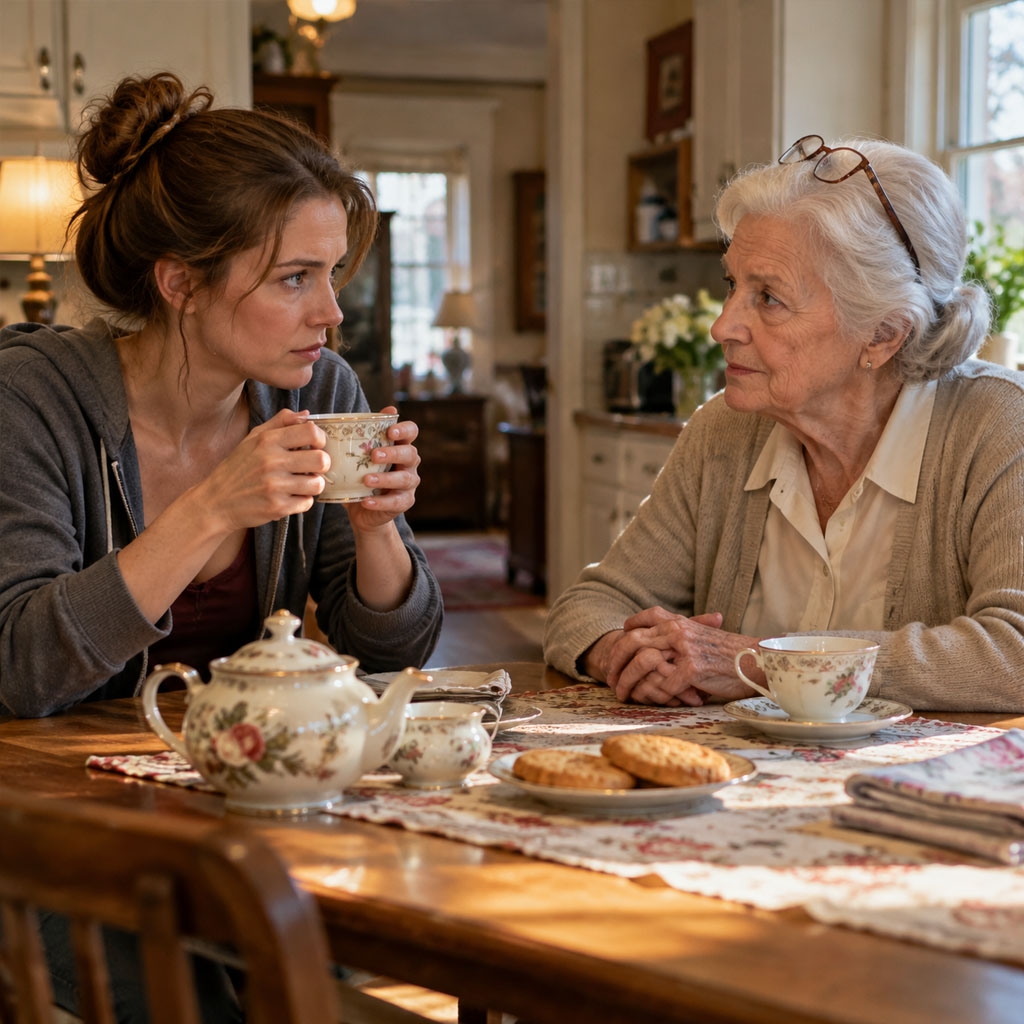
I thought of Mary Ann sitting at her kitchen table, watching me over the rim of her teacup. She had never told me about the boutique transfer or suggested that I might inherit anything. She had simply watched me return every Sunday, listening to her stories and drinking her bitter tea without complaint.
Now I understood that her quiet attention had been part of a much longer plan.
Chapter 3
Arthur hired an attorney named David Reese, who sent Angela a letter questioning Mary Ann’s mental capacity and suggesting that I had manipulated her into transferring the property. Angela responded with a detailed letter of her own, attaching the notarized documents, the doctor’s certification, and the public records confirming the transfer. She also pointed out that Arthur had visited his aunt only twice during the previous year, a fact that raised questions about how closely he had observed her day-to-day condition.
David Reese never sent another letter challenging the transfer.
That didn’t mean everything was settled overnight. The estate still had to go through probate, and Angela needed time to confirm the status of the business accounts, property taxes, and outstanding obligations. I used part of the money I’d saved from my Sunday visits to pay her retainer, keeping the rest in a separate envelope in my dresser drawer.
I had never thought of the four hundred dollars as money I truly deserved. It had paid my rent and groceries, but it had also brought me to Mary Ann’s table, where I had learned what it felt like to be expected somewhere. Now, when I counted what remained, I thought less about the bills themselves than about the Sundays they represented.
Three weeks after Mary Ann’s death, I took the Blue Line into the city and walked down West Armitage Avenue. The air was cold enough to make my eyes water, and the wind pushed fallen leaves along the curb. Then I saw the deep green awning and the gold lettering beneath it: Mary Ann’s.
A single burgundy evening gown stood in the display window, its collar decorated with tiny hand-stitched details that caught the light. The shop looked quiet but cared for, with warm illumination behind the glass and fabric arranged in orderly rows. A man stood outside the door, his fingers stained faintly with dye and his eyes fixed on me with an expression of recognition.
“Renata Cross?” he asked.
“Yes.”
He offered his hand. “Simon Okafor. Mary Ann told me I’d know you when I saw you.”
There was something in the way he said it that made me pause. He wasn’t greeting a stranger who had arrived to claim a building; he was welcoming someone whose arrival had been anticipated for a long time. I shook his hand, and he opened the door for me.
Inside, the shop smelled of lavender, cedar, and freshly pressed fabric. Silk hung from tall racks in every color imaginable, and half-finished gowns stood on wooden forms around the workroom. A broad table was covered with paper patterns, pins, and pieces of muslin, and two cups had been set beside a kettle in the back.
Simon showed me the business records first. For three years, he had been overseeing the boutique’s daily operations while Mary Ann’s health declined. He had kept meticulous accounts of orders, suppliers, payroll, and customer deposits, and the business was still functioning, though the margins were narrow.
“She wanted you to understand what you were receiving,” he explained. “Not just the building, but the work. The customers, the obligations, the people who depend on this place.”
I appreciated that he hadn’t treated the transfer as a lottery ticket. The shop was valuable, but it was also a living business that required care, judgment, and effort. I had no experience running a boutique, and the thought of making decisions that affected employees and customers frightened me more than I wanted to admit.
Simon seemed to understand.
“Mary Ann didn’t expect you to know everything,” he said. “She expected you to be willing to learn. She believed people could grow into responsibilities if someone gave them the chance.”
He took me upstairs to the apartment above the shop. It was small but bright, with tall windows overlooking the street and a closet filled with Mary Ann’s personal fabric collection, sorted by weight, season, and color. I stood in the middle of the room and imagined waking up there, hearing the city outside the window, knowing that I had a place of my own that no landlord could take away simply because the rent had increased.
“She talked about you for nearly a year before you called the number on that flyer,” Simon said.
I turned toward him. “A year?”
“She had heard about the flyer from a neighbor’s daughter who thought the idea was unusual. Mary Ann said she needed someone who would tell her the truth, even when the tea was bitter.” He smiled faintly. “She interviewed four other women before you. None of them lasted beyond the third Sunday.”
“Why me?”
Simon looked toward the workroom below us, where sunlight fell across a table covered with pattern pieces.
“She said you drank every drop,” he replied. “Even when it was too strong. She thought that meant you weren’t afraid to accept something as it was, without pretending it was better than it was.”
I sat down on the edge of a chair. I had spent so many years believing that the most important things about me were the things I lacked: a family, a stable home, money in the bank, someone who would notice if I didn’t come back. Mary Ann had seen something else, something that had been there all along but that I had never learned to recognize in myself.
Before I could ask another question, Simon went downstairs and returned with a second envelope. It was made from heavy ivory paper, and the handwriting on the front was different from Mary Ann’s. My name was written in rounded letters, and a return address in Bridgeview appeared in the upper corner.
“She gave me very specific instructions,” Simon said. “I was to hand you this only after you arrived here and saw the shop. She said you’d understand why the order mattered.”
I held the envelope without opening it. The first letter had given me a business and a building, but something about this one felt more personal, as if it had been waiting for me in a place where money and legal documents couldn’t explain it.
I broke the seal.
Inside was a letter from a woman named Irena Vogt, who was seventy-one and had known Mary Ann for more than forty years. Irena wrote about their childhoods in Eastern Europe, their immigration to Chicago, and the hardships they had endured while trying to build lives in a country where they knew few people and had very little money.
Then she described a woman who had arrived in Chicago in 1974 with a six-year-old daughter. That woman had worked long hours, taken whatever jobs she could find, and gradually built a stable life for herself and her child. Mary Ann had known them both and had watched the daughter grow up, but their story had ended in tragedy when illness and circumstances took the young woman away far too soon.
I read the paragraph again, then turned the page.
Irena’s letter contained a name, a date, and a connection to my own childhood that I had never known existed. It explained why Mary Ann had been so interested in my story without asking direct questions, why she had watched me with such careful attention, and why she had spent months preparing a future for me before I ever stepped into her house.
I won’t repeat every detail of that letter. Some things are too personal to become a story for strangers, and some truths need time to settle before they can be understood. What I can say is that Mary Ann’s generosity had grown out of a history that reached much farther back than our twelve Sundays together.
She had not chosen me merely because I was punctual or because I drank my tea without complaint. She had recognized something in my life that connected to a loss she had carried for decades, and she had quietly arranged a way to turn that sorrow into something useful and lasting.
I sat in Simon’s workshop for a long time, holding the letter while the city moved outside the window. He brought me a fresh cup of tea and set it beside me without asking questions. The kettle clicked off, and the quiet room filled with the ordinary sounds of fabric shifting on its racks and traffic moving along the street.
For the first time, I understood why Mary Ann had insisted that the money wasn’t the point.
She had been giving me more than four hundred dollars a week. She had been giving me a place to belong, a chance to be trusted, and a future that did not depend on my ability to survive one more temporary arrangement. She had been repairing something in both of our lives, using the patience and precision she had brought to every gown she had ever made.
I folded Irena’s letter carefully and placed it back in the envelope. There were still questions I needed to ask, and the connection it described would take time for me to understand. But I no longer felt as though I had stumbled into a gift I hadn’t earned.
Mary Ann had seen me clearly. She had given me the opportunity to decide what to do with what she had left.
Chapter 4
The months that followed were not easy, but they were the first months of my life in which difficulty came with a sense of possibility. Angela completed the legal work, confirmed the transfer, and helped me understand the obligations attached to the property. Arthur sent one final letter through his attorney suggesting a cash settlement in exchange for abandoning any future challenges, but Angela told me I was under no obligation to accept.
I asked her to respond with one word.
“No.”
I didn’t want to spend the rest of my life negotiating with a man who believed family ties entitled him to decide what Mary Ann’s life had meant. He had been free to visit her, listen to her, and learn what mattered to her while she was alive. He had chosen not to do those things, and I refused to let his anger become the center of the future she had given me.
In March, I moved into the apartment above the boutique. The first night, I unpacked my clothes into the closet and placed my old duffel bag in a corner, where I could see it without having to use it. I slept with the window cracked open just enough to hear the city, and when morning light fell across the floor, I woke with a feeling I couldn’t quite name.
It was peace, perhaps, though not the kind that comes when every problem has been solved. I still had bills to pay, business decisions to make, and an unfamiliar future waiting downstairs. But I had a key to my own front door, a window that faced the street, and a room full of work that I could help preserve.
Simon taught me the practical side of running the boutique. I learned how to review supplier invoices, schedule fittings, track orders, and make sure customers understood the time and labor involved in a custom garment. I also learned that owning a business meant accepting responsibility for the people who worked there, not simply collecting whatever profit remained at the end of the month.
Mary Ann’s name stayed above the door. I added my own beside it, at Simon’s insistence, so the awning read: Mary Ann’s, continued by Renata Cross. He said Mary Ann would have wanted the acknowledgment to be visible, and by then I had learned that when Simon spoke about her wishes, he was usually right.
Business improved slowly. We took on two apprentices in the spring: Tomas, a nineteen-year-old from Pilsen who could spot a flaw in a pattern from across the room, and Dalia, a woman in her thirties who had wanted to learn garment construction for years but had never been able to afford formal training. Both arrived with more determination than experience, and I recognized something familiar in the way they approached their work.
They were hungry for a chance. I made sure they had one.
We didn’t become wealthy overnight, and there were weeks when I worried about whether the boutique could cover every expense. But we kept our promises, treated customers honestly, and refused to sacrifice the quality of our work simply to make the numbers look better. Slowly, the business became more stable, and the shop began to feel less like a responsibility I’d inherited and more like a future I was helping build.
The tin sewing box remained on the windowsill in my apartment. I kept the false bottom open and the little brass key on my key ring, even though the cabinet it unlocked was now left open most of the time. I wanted to remember that the box had been designed with a hidden compartment, that someone had thought carefully about what I might need and had prepared it long before I knew there was anything waiting for me.
I had spent my childhood learning how to leave. Mary Ann had spent the last year of her life preparing a place where I could stay.
Sometimes, when the shop was quiet and the afternoon light fell across the worktables, I imagined her sitting in the kitchen of her old house with a cup of bitter tea. I could almost hear her telling me not to become sentimental about things that still required work, and I could picture the slight smile she would give me if she saw how carefully I had arranged the patterns on the table.
I still drank every drop of my tea.
I also began to understand that the most important inheritance wasn’t the building or the business. Those things gave me security, but they weren’t the reason I kept the sewing box beside my window. The real gift was the experience of being seen by someone who understood that a person’s past did not have to determine the shape of her future.
Mary Ann had never asked me to pretend to be her granddaughter. She had never demanded that I call her family or perform affection in exchange for money. She had simply invited me to sit at her table, allowed trust to grow at its own pace, and given me the dignity of an honest arrangement.
The rest had happened quietly, one Sunday at a time.
I still think about the man who called me a con artist the morning Mary Ann died. I think about how quickly he decided that my grief must be false because he couldn’t imagine that anyone would spend time with an elderly woman without expecting a reward. He had looked at the money and missed the relationship, just as he had looked at his aunt’s belongings and seen only things to be claimed or discarded.
I don’t know whether Arthur ever understood what he had lost. I hope that one day he does, though I no longer need his understanding to feel certain about my place in Mary Ann’s story.
I know what she gave me, and I know what I intend to do with it.
The boutique is still open. Simon continues to guide the work, the apprentices are growing more skilled every month, and customers still come through the door hoping to find a gown that makes an important day feel even more special. Some know Mary Ann’s history; others know only that the shop has a reputation for careful work and honest service.
When someone asks why I kept the old name instead of starting fresh, I tell them that some things are worth continuing. A good business is one of them, but so is the kindness of someone who believes in another person’s future before that person can believe in it herself.
The sewing box is still on my windowsill, its roses faded and its corners worn smooth. I have kept it empty except for the false bottom, the little brass key, and Mary Ann’s note. I don’t need to open it often anymore, but I like knowing that the mechanism is there, waiting, proof that something hidden can be found if you take the time to feel for the ridge and press where it matters.
I used to believe that family was something other people were given at birth, while people like me were expected to make do with whatever kindness happened to come our way. Mary Ann taught me that belonging can be built deliberately, through small acts of care repeated until they become a life. She showed me that a future can be prepared quietly, without promises or speeches, by someone who sees what you might become.
I began visiting her for four hundred dollars a week. I stayed because I wanted to hear her stories, share her meals, and make sure that when Sunday came, she wouldn’t have to sit alone at her kitchen table. In the end, she left me a business, a home, a connection to a history I had never known, and something even more valuable than all three.
She left me with the certainty that I was worth making room for.
And every morning, when I unlock the shop and turn on the lights, I try to make room for someone else.
THE END.
⚠️ All characters and events are fictional. Do not imitate or apply them in real life. 😌😌😌


