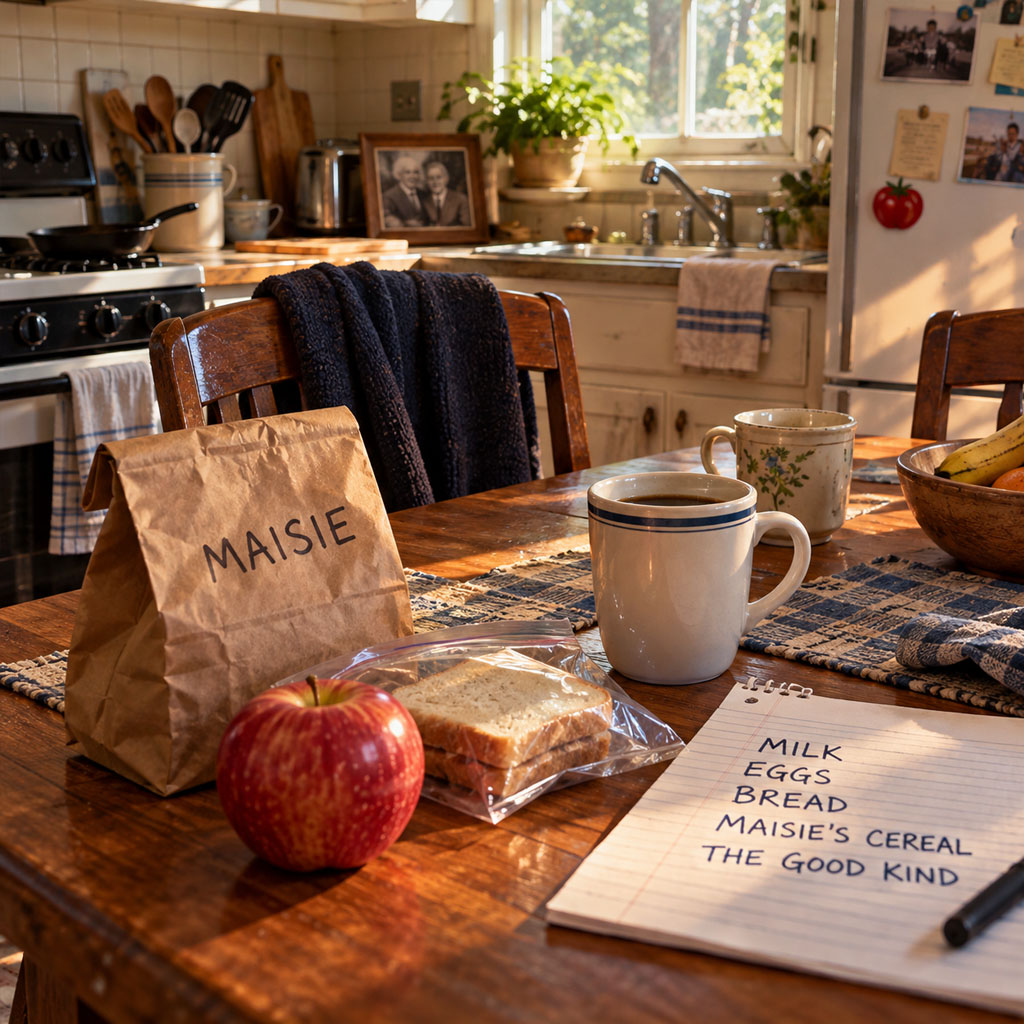
Chapter 2
After my parents left, I opened Facebook.
Mom had posted before midnight: Dad passed peacefully in memory care, surrounded by family. Thank you to everyone who supported his care journey.
Grandpa had never spent one night in memory care. He had died in his own living room.
I scrolled farther and found a fundraiser created the year before. HELP US GIVE DAD THE CARE HE DESERVES. It claimed his advanced Alzheimer’s required an expensive residential facility. More than a hundred people had donated almost nineteen thousand dollars.
One sentence made my stomach turn.
Our daughter Maggie helps when she can.
I had lived with Grandpa since I was ten.
I had become a county 911 dispatcher partly because caring for him taught me how to stay calm when somebody else’s world was falling apart. I cut my hours when hospice came. Bonnie covered the nights I worked. My parents visited Easter and Thanksgiving, stayed about two hours, took photographs, and drove home.
Yet online, Mom was the devoted daughter-in-law carrying an impossible burden.
Then I saw the fundraiser date.
Donations had been turned off June 28.
Exactly one week after Grandpa had asked me to stretch the old phone cord from the kitchen to his hospital bed and dial Dad’s number. He told me to leave the room, but his voice carried through the doorway.
“Take it down, Craig, or I’ll tell the whole church myself.”
Now I understood.
The next morning, Connie Rhodes, the manager at Grandpa’s bank, called.
“He left something for you.”
Inside her office, she handed me a sealed envelope marked FOR MAGGIE, AFTER.
It contained years of transfers from Grandpa’s checking account to an account associated with Mom. Nearly twenty thousand dollars had moved after she installed mobile banking on his phone “to protect him from scams.”
A note in Grandpa’s handwriting was clipped to the pages.
I KNEW. I LET IT GO ON. THE WHY IS IN THE CEDAR CHEST.
“He knew?” I asked.
Connie nodded sadly. “For years. I wanted him to report it. He refused.”
“Why?”
“He said it was his family and his decision.”
That afternoon we met at the funeral home. Mom arrived with a legal pad already outlining her speech.
“I’ll need ten minutes after the opening prayer.”
The funeral director cleared his throat. “Mrs. Bennett, Walter updated his instructions in July. Pastor Dale will begin with a message Walter prepared.”
Mom’s pen froze.
“What message?”
“I haven’t heard it.”
Her eyes swung toward me.
“What did you do?”
“Nothing.”
That was what frightened her most.
Grandpa had done it himself.
At Friday visitation, Mom stood beside the casket telling her church friends how wonderful the “memory-care staff” had been. People from Grandpa’s neighborhood exchanged looks. Men who had known him from the post office stopped talking when she passed.
An eighty-year-old woman named Arlene Tucker found me near the guest book.
“I gave two hundred dollars to that fundraiser,” she whispered. “Walter delivered my mail for thirty years.”
“Come tomorrow,” I told her. “Sit near the front.”
Late that evening I saw Dad alone beside the casket.
“I’m sorry, Dad,” he whispered.
For once, he sounded like a son instead of somebody’s husband.
Chapter 3
Walnut Street Baptist Church was nearly full Saturday morning.
Grandpa’s faded blue postal cap rested on the closed casket. Mom sat in the front pew with her speech folded across her lap. Just before the organ stopped, she leaned toward me.
“Don’t embarrass this family.”
Pastor Dale walked to the pulpit carrying a small black recorder.
“A few weeks ago,” he said, “Walter asked me to record something at his kitchen table. He wanted to speak first.”
The church went silent.
Then Grandpa’s voice came through the speakers.
Slow. Thin. Clear.
He gave the date. He named the people sitting with him. He said he knew exactly where he was and exactly what he was saying.
Then he thanked the town he had served for decades.
Finally, his voice changed.
“Some of you gave money because you were told I lived in memory care. I never did. I stayed in my own home, and my granddaughter Maggie cared for me. I never received that money.”
No one moved.
“My son and his wife live forty minutes away. I’m not saying that to shame anybody. I’m saying it because it’s true.”
My hands began trembling.
Then he said, “Maggie, honey, the rest is in the chest. You don’t have to say anything today. I’m saying it for you.”
The recording clicked off.
Behind us, a pew creaked.
Arlene stood with her grandson supporting her elbow.
“Denise,” she said to my mother, “I gave you two hundred dollars for Walter’s care. I’d like it returned.”
A man in the rear stood next. “So would I.”
Then another person.
And another.
Mom shot to her feet. Her speech slid to the floor.
“He had Alzheimer’s! He didn’t know what he was saying.”
Pastor Dale looked directly at her.
“I sat with him for more than an hour that morning. So did Bonnie. He knew.”
Mom turned toward Dad, waiting for him to defend her.
He stared at the floor.
For perhaps the first time in their marriage, his silence didn’t protect her.
She slowly sat down.
When Pastor Dale later invited family remarks, Mom shook her head.
So did I.
Grandpa had given me permission to be silent, and I finally understood that silence and helplessness were not the same thing.
After the burial, Mom announced she was coming to Grandpa’s house for Grandma June’s belongings.
I let her.
Because Grandpa’s instruction had been precise.
After they put me in the ground, open the cedar chest.
Back at the house, Mom barely made it through the door before turning on me.
“Do you understand what happened today? In front of everyone?”
Bonnie answered before I could.
“About time everyone heard the truth.”
Mom snapped, “We never abandoned Maggie. We sent her Christmas presents every year.”
Bonnie’s expression changed.
“Walter bought every one.”
The room became still.
“The blue notebook in 2008,” Bonnie continued. “The red scarf the next year. All of them. He wrapped them at my kitchen table.”
I remembered those tags.
TO MAGGIE, FROM MOM AND DAD.
Always the same block capitals Grandpa used on his grocery lists.
I went upstairs and brought down the cedar chest.
Inside were receipts for six Christmas gifts.
Beside them lay practice gift tags.
Grandpa had written my parents’ names over and over until the lie looked believable.
Then I found a check register.
July 2008.
Thirty thousand dollars paid to my father.
Memo: HOUSE. MAGGIE’S ROOM BY CHRISTMAS.
I looked at Dad.
“Where was my room?”
His lips barely moved.
“Denise’s office.”
Mom said his name sharply, but something in him had finally cracked.
“Dad helped us buy the house,” he said. “We told him we’d come back for you.”
“But you didn’t.”
“No.”
Chapter 4
Under the checkbook were nine small spiral notebooks.
Grandpa had documented everything.
March 2009: Denise called. Maggie read the numbers. Didn’t ask about her birthday.
May 2010: Moved pension to credit union. Leave small amount in old account. Let her take it. It’s the only way she calls.
I read that entry three times.
All those years I had believed I helped Mom steal from him. I had carried that shame since I was sixteen, when I finally refused to give her a new card number and the Sunday calls immediately stopped.
But Grandpa had known.
He moved his savings somewhere safe and left limited money in the account Mom could reach.
He had paid for my mother’s phone calls.
For me.
Another entry read: Maggie said no. Proud of her. Calls stopped. She knows now.
Years later, when Mom gained access through his phone, he wrote: Let it go. Price of Easter.
And near the end:
No more. She used my name to take from my friends, and Maggie deserves to stop waiting.
I closed the notebook.
Dad had sunk into a chair.
“You took his money for the house,” I said. “You promised to come back for me.”
He covered his mouth.
Mom crossed her arms. “You were better off here. Look at you. You turned out fine.”
“I turned out fine because Grandpa stayed. Not because you left.”
I handed Dad an envelope with his name on it.
“Grandpa wanted you to have this. Take it and go.”
Mom stared at the records covering the table. For once she had no speech ready.
After they left, I heard their car back down the driveway.
I did not turn on the porch light.
The fundraiser collapsed within days. Donors demanded refunds. Screenshots spread among people who knew Grandpa had never lived anywhere but Walnut Street.
By early September, Mom had returned every donation.
She texted me once.
You ruined my career over a misunderstanding. Your grandfather was confused.
I blocked her.
Grandpa’s will left me the house. The savings at the credit union, accumulated over thirty-seven years of carrying mail and living carefully, passed directly to me.
Dad never challenged anything.
Then one Sunday at exactly seven, the kitchen phone rang.
I almost let it go.
“Hello?”
“Maggie.”
Dad.
Only Dad.
“I read his letter,” he said.
I waited.
“He wrote that he wasn’t angry anymore. He said he was sorry I never learned to stand up.”
Dad’s voice broke.
“I let her decide everything. Where we lived. What we spent. Who we saw.” He swallowed hard. “I let her decide you.”
“I know.”
“I’m not asking you for anything.”
That sentence hurt more than an apology.
“Can I call again sometime?”
I looked at the stool where ten-year-old me used to sit before seven every Sunday, feet swinging, hungry for four minutes of somebody pretending to miss her.
“Not yet,” I said. “Maybe someday.”
When I hung up, I realized something.
It was the first Sunday call from one of my parents that had not asked me to give something away.
Chapter 5
Grandpa had left one envelope for me and one small present wrapped in red paper.
I waited until the final Sunday of September to open them.
At 6:50 p.m., I sat at the kitchen table with the cedar chest in front of me.
His letter was written slowly in pencil.
He reminded me to water the tomatoes. He told me Bonnie would pretend she didn’t want help with her gutters, so I should help anyway.
Then I reached the part he must have known I needed.
You were never the reason they didn’t come.
I stopped reading.
I let them take some money because I wanted you to hear your mother’s voice. That was my choice. I’m sorry I let it go on so long.
For eighteen years, I had carried guilt that belonged to grown people.
Grandpa had carried some, too.
Love had not made every choice he made perfect. But even when his memory developed holes, even when names and years sometimes slipped away from him, one thing had stayed fixed: he kept trying to make sure a little girl did not believe she was unwanted.
I opened the red package.
Inside was the original gift tag from Christmas 2008.
TO MAGGIE, FROM MOM AND DAD.
Beneath it was a brand-new porch-light bulb.
And a final note.
They didn’t come.
I did.
Every year.
You don’t have to wait anymore.
At seven o’clock, I looked toward the wall phone.
It didn’t ring.
This time I wasn’t disappointed.
I unplugged it.
I wound the long curly cord around my hand and placed the phone inside the cedar chest with Grandpa’s notebooks, the Christmas receipts, the old photograph, and all those carefully constructed lies that had once protected a child.
Some things deserve to be remembered without being repeated.
After sunset, I changed the porch-light bulb.
The new one glowed warm against the white railing.
For eighteen years, that light had meant maybe tonight somebody will come for me.
I grabbed my car keys.
Instead of sitting by the window, I walked outside.
Grandpa was buried five minutes away beside Grandma June beneath an old oak tree. I sat in the grass near his headstone while the late-summer insects hummed in the fading light.
“I opened everything,” I told him.
I told him the fundraiser money had been returned. I told him about Dad’s phone call. I told him I had unplugged the beige phone.
Then I smiled.
“Forty minutes was nothing, Grandpa. You were right.”
The cemetery was quiet.
“It just wasn’t nothing to them.”
On the drive home, I turned onto Walnut Street and saw the porch light from the stop sign.
One small yellow glow.
No car waited in the driveway. No one was coming to pick me up. No promise was hanging over tomorrow.
And for the first time, none of that felt like rejection.
I pulled into the driveway, shut off the engine, and looked at Grandpa’s house.
My house now.
Home.
I finally understood why he had kept that porch light burning through all those Christmas Eves. Maybe at first he had hoped my parents would come. Maybe later he knew they wouldn’t.
But a porch light was never only for the people arriving.
Sometimes it was for the person already there.
Grandpa had spent eighteen years teaching me the difference between relatives and family. Relatives shared my name, made promises, posed for photographs, and lived forty minutes away.
Family packed my lunch.
Family learned the school schedule.
Family burned grilled cheese, forgot where the keys were, remembered my favorite cereal, sat through eye appointments, kept receipts, wrote everything down, and left a light burning.
Grandpa had been losing pieces of his memory for years.
But he never lost me.
And as I walked up the porch steps beneath that new light, I stopped waiting for the people who had chosen not to come.
I put my key in the door.
Then I went home.
THE END.
⚠️ All characters and events are fictional. Do not imitate or apply them in real life. 😌😌😌