
Chapter 2
Six months earlier, Dana stood on my porch in the pouring rain, three months pregnant and shivering beneath a thin jacket. She was thirty-one, beautiful in the way she’d always been beautiful, with copper hair plastered to her cheeks and green eyes that could make even a stranger want to rescue her. When she looked at me and whispered, “Lena, I don’t have anywhere else to go,” I opened the door without asking another question.
I’d been doing that for twenty-six years.
Our father died when I was fifteen, after suffering a stroke while driving his truck home from work. Dana was seven, wearing a pink raincoat and clutching a stuffed rabbit when I found her in the hospital hallway, asking whether Daddy would be coming home. Our mother, Gail, collapsed under the weight of her grief, and I became the person who made dinner, checked homework, signed permission slips, and held my little sister when nightmares woke her.
I loved her fiercely, but somewhere along the way, I confused loving her with saving her from every consequence. I paid her apartment deposit when she was nineteen, covered eleven thousand dollars in credit-card debt when she was twenty-three, and flew to Denver to bring her home after a boyfriend abandoned her without a phone or a way to pay for a ride. Every time, she’d cry against my shoulder and promise she would change.
Every time, I believed her.
By the time Dana arrived at my house that April night, I was the principal of Maple Grove Elementary School, married to Reed for nine years, and quietly grieving the children we’d never been able to have. We’d endured four years of fertility treatments, two failed rounds of treatment, and three heartbreaking losses before our doctor gently explained that our chances of becoming biological parents were very small.
The guest room where I put Dana was the room I’d once imagined turning into a nursery. I had painted its walls a soft blue and kept a small box of baby things tucked in the closet, although I’d stopped opening it months earlier. When my sister arrived pregnant, I felt an ache I was ashamed to admit, but I swallowed it and helped her unpack.
She told me the father was a man she’d met in Austin. He’d seemed kind until she mentioned the pregnancy, then disappeared. She didn’t want to give me his name, and she begged me never to ask again. I accepted her story because she was crying, because she was my sister, and because I wanted to believe that helping her might somehow quiet the sadness inside me.
Reed was kind to her, too. He drove her to prenatal appointments whenever my school responsibilities kept me away, picked up groceries she could tolerate during the worst of her morning sickness, and helped her assemble a crib she bought secondhand. I thanked him for being such a good brother-in-law, never imagining that every Thursday trip to the clinic was bringing him closer to a truth he desperately wished he could avoid.
Then the little things began.
In June, I found a gold bracelet on the dresser in Dana’s room. It was delicate, with a small engraved bar bearing the initials R.W. I assumed it belonged to Reed, but when I asked him about it, he studied the bracelet for a long moment and told me it wasn’t his.
In July, I discovered a $2,400 transfer from our joint account to Dana, labeled rent. Reed explained that she needed money for an apartment after the baby arrived and that he’d helped her without wanting to worry me. I was irritated that he hadn’t discussed it with me, but I let it go.
Then there were the late-night phone calls.
One evening, I walked into the kitchen and heard Dana speaking in a voice so intimate I barely recognized it. “I know, my love,” she whispered. “Soon. Just a little longer.” When she noticed me in the doorway, she ended the call and tucked her phone beneath a dish towel.
“Who was that?” I asked.
“A friend from Austin,” she replied, smiling as if the matter were settled.
Around the same time, my father-in-law began withdrawing from our family. Richard had been a county judge for more than thirty years, a dignified man with silver hair, a gentle sense of humor, and an almost stubborn belief that every problem could be solved if people were honest with one another. When I married Reed, Richard walked me down the aisle because my father was gone, and afterward he’d hugged me and said, “Take care of each other. That’s the whole secret to a good marriage.”
His wife, Helen, had died two years earlier after a brief, devastating illness. I had watched grief hollow him out, and when I suggested that Dana work as his part-time assistant, I believed I was helping them both. She could organize his paperwork and correspondence while he had someone around to talk to.
For ten months, the arrangement seemed to work beautifully. Richard started eating properly again, laughed at family dinners, and spoke about Dana’s cleverness with an affection that warmed me. When she abruptly quit and supposedly left for Austin, I assumed she’d found another opportunity.
I didn’t know she had been staying at a motel two towns away, or that Richard had been paying her bills.
One August night, I returned from a school fundraiser and saw his silver sedan parked across the street from our house. The engine was off, and he sat behind the wheel staring at the illuminated window of Dana’s bedroom. When I waved, he didn’t respond. He simply started the car and drove away slowly.
The following morning, a card arrived in the mail. There was no occasion written on the envelope, only my name in Richard’s familiar handwriting. Inside, he had written four words: You were always my daughter.
I cried when I read them, thinking of Helen and all the ways grief could change a person. I placed the card on our mantel and never asked him what he meant.
By September, I could no longer ignore my suspicions. One night, I stood in our bedroom with the gold bracelet clenched in my fist and asked Reed the question I’d been dreading.
“Is Dana’s baby yours?”
His face went through several expressions so quickly that I couldn’t make sense of any of them. He looked shocked, then devastated, then strangely determined.
“No,” he said. “Lena, I swear on my mother’s grave that I’ve never touched your sister.”
“Then why are you paying her rent? Why are you driving her to appointments? Why do you sit awake at two in the morning looking like you’re carrying the weight of the world?”
He closed his eyes. “I can’t tell you yet.”
I stared at him in disbelief. “I’m your wife, Reed. What could possibly be so important that you can’t tell me the truth?”
“Give me until the baby comes,” he pleaded. “Eight weeks, maybe less. I know how terrible this sounds, but I need you to trust me. If you still want me gone after I explain everything, I’ll leave without arguing.”
I wanted to scream at him. Instead, I agreed to wait, and the weeks that followed became the loneliest of my marriage. We slept in the same bed but turned away from each other, and I began to question every kindness I’d ever witnessed between him and Dana.
Then, over breakfast in late September, my sister announced that she had chosen a name for her baby boy.
“Whit,” she said, resting a hand on her belly. “Short for Whitaker.”
Reed set down his fork.
I forced a smile. “That’s a lovely way to honor Reed’s family.”
Dana buttered her toast and looked directly at me. “Oh, I’m not honoring Reed. Not exactly.”
When Reed left the table, I watched him walk into the garage and close the door behind him. My sister continued eating as if she’d merely commented on the weather.
A few weeks later, she announced that she wanted to organize a proper birthday dinner for me. She booked a private room at Carmine’s, invited forty friends and relatives, and insisted that Richard attend because she had something important to say.
When I told Reed, he listened without interrupting. Finally, he looked at me and said, “Wear your green dress. Whatever happens that night, remember that I love you.”
I asked him what he meant, but he only shook his head.
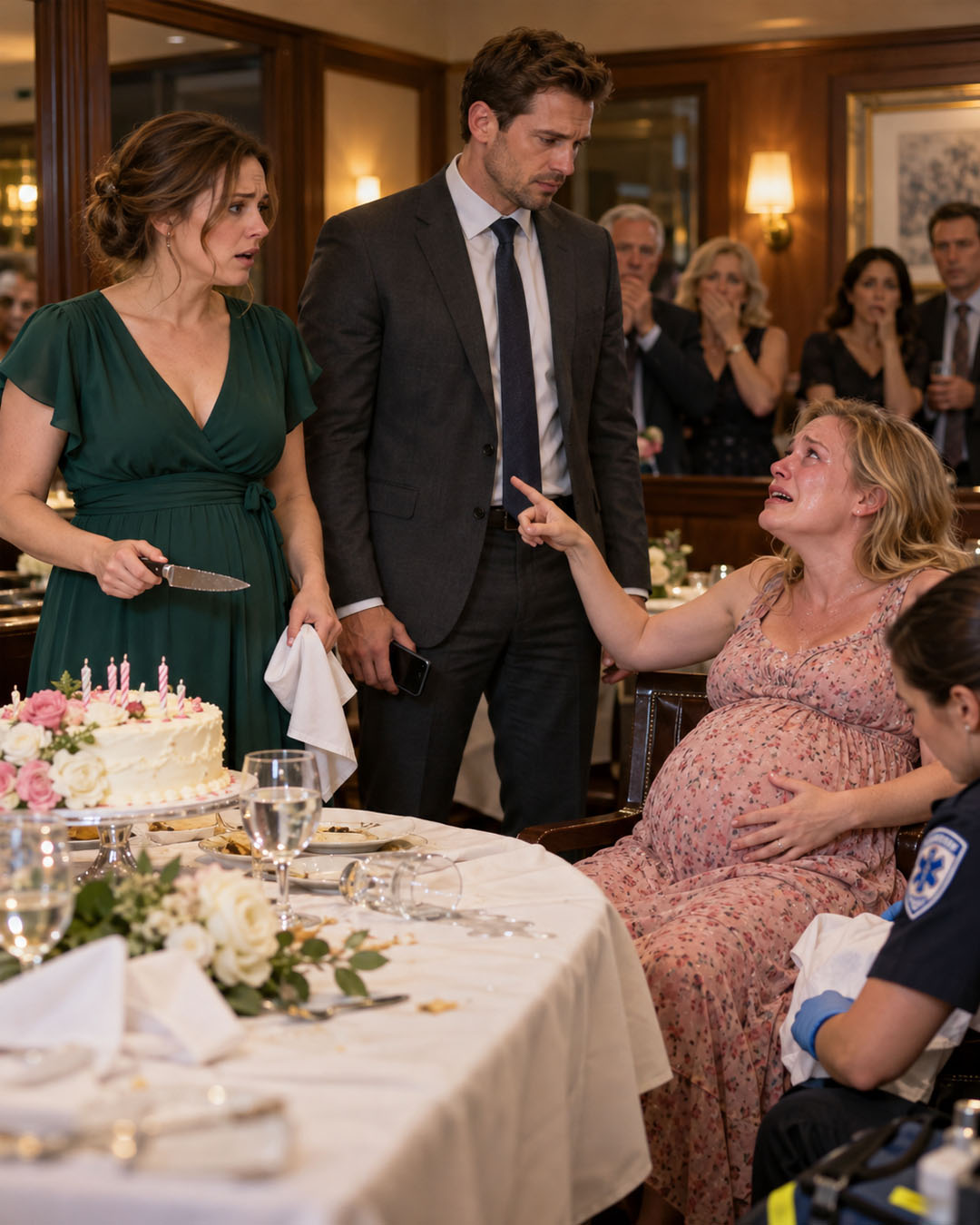
Now, standing in the hospital-bound chaos of that birthday dinner, I finally understood why he’d been counting down the weeks.
Chapter 3
The ambulance doors closed behind Dana, and Reed and I followed in his truck. I sat beside him with my hands folded in my lap, staring through the windshield as the flashing red lights ahead of us reflected off the road. I had a hundred questions, but only one mattered enough to say aloud.
“How long have you known?”
“Since May sixth,” he answered. “The day Dana came out of her prenatal appointment and told me who the father was.”
He gripped the steering wheel so tightly that his knuckles turned white. He explained that Dana had broken down in the passenger seat, confessing that she could no longer carry the secret alone. She told him about Richard, about their relationship, and about the child she was expecting.
Reed said he’d felt physically sick. He drove straight to his father’s condominium by the river, where he found Richard sitting in the dark, wearing Helen’s old cardigan and staring at a photograph on the kitchen counter. When Reed confronted him, the older man covered his face and wept.
“He begged me not to tell you yet,” Reed said. “He wanted to tell you himself, but he was ashamed. He said he’d already lost Helen and couldn’t bear the thought of losing you, too.”
I turned toward my husband. “So you decided to keep it from me?”
“I thought I was protecting you. You’d lost three pregnancies, Lena. I watched you blame yourself for something that wasn’t your fault, and I couldn’t imagine telling you that the child you wanted so badly was coming into the world under these circumstances.”
His words hurt because I knew he had meant them as an act of love. They hurt even more because he had decided, without asking me, that I was too fragile to face the truth.
“But why the money?” I asked. “Why the bracelet?”
“Your father-in-law asked me to help with Dana’s expenses. He reimbursed me every month, and I kept the checks. The bracelet was his gift to her in January, before she quit working for him. She left it where you would find it because she wanted you to think it was mine.”
I stared out the window, trying to reconcile the woman I’d spent my life protecting with the person Reed was describing.
“And the man from Austin?”
“There was no man from Austin,” he said. “She’d been staying in a motel nearby. Richard paid for the room and sent her money, hoping she’d agree to end the relationship and make a plan for the baby. But she kept asking for more.”
The money wasn’t enough anymore. Dana had learned that Richard’s estate was worth several million dollars, including the condominium, a house on the lake, and the savings he’d built over decades. She wanted a permanent place in his will, a substantial monthly allowance, and legal recognition of her child’s paternity.
When Richard hesitated, she threatened to tell everyone the baby was Reed’s.
“She knew what that would do to you,” Reed said. “She knew you’d never recover from believing your husband had betrayed you with your own sister. She was going to use your pain to force my father to give her what she wanted.”
“And you recorded her?”
“I went to his condo with him in August. I planned to give the recording to his attorney, not play it at your birthday. But tonight, when she pointed at me in front of everyone, I knew she was going to tell her version first. I couldn’t let her leave you with that lie.”
I sat silently for several miles, listening to the engine and the wipers moving across the windshield. I understood why Reed had kept his promise to Richard, but understanding didn’t make the secrecy hurt any less.
“You asked me to trust you for eight weeks,” I said. “You let me believe I might lose my marriage, and you watched me suffer beside you.”
“I know,” he whispered. “I was wrong to decide what you could bear. I should have found another way.”
I placed my hand over his on the steering wheel. “I don’t know how to forgive that yet. But I believe you.”
He began to cry, and for the first time in months, I reached for him without feeling afraid.
At St. Mary’s Hospital, nurses hurried Dana into a delivery room while Reed and I waited in the corridor. Richard sat several chairs away, his shoulders bent beneath his charcoal overcoat, looking like a man who had aged ten years in an hour. Nobody spoke to him, and he made no attempt to join us.
At 2:14 a.m., a nurse emerged with news that Dana had delivered a healthy boy weighing just over six pounds. She was recovering well, and the baby was doing fine. The nurse said Dana was asking for me.
I stood outside her room for several seconds before entering. My sister lay propped against white pillows, her copper hair damp against her forehead, holding a tiny boy wrapped in a striped blanket. When she saw me, her face crumpled.
“Lena, I’m sorry,” she whispered. “I didn’t mean for everything to happen like that.”
I looked at the baby, who had a small, determined chin and a head of dark hair. I felt grief for the life I’d imagined, wonder at the tiny person sleeping in my sister’s arms, and an ache so deep that I couldn’t separate one feeling from another.
Dana began crying again. “You humiliated me in front of everybody. You could have waited until after the dinner. I was going to explain it privately.”
I looked at her for a long moment. “You were going to tell forty people that my husband had fathered your child. You were going to let me believe he’d betrayed me so you could pressure Richard into giving you his money. What part of that did you imagine would be private?”
She looked down at the baby.
“Richard loved you more than he ever loved me,” she said finally. “He always said you were the daughter he wished he’d had. You had Reed, your house, your career. Everything you touched seemed to work out, and I was always the one who needed help.”
I pulled a chair beside her bed, though I didn’t sit down. “You think I never struggled? You think I didn’t cry every time another treatment failed, or every time I wondered whether I’d ever have a child of my own? You saw me keep going, Dana. You didn’t see what it cost me.”
She held the baby closer. “I hated that I needed you. Every time you helped me, I felt smaller.”
“I got tired a long time ago,” I said. “I was fifteen when Dad died, and I spent the next twenty-six years believing that if I was strong enough, nobody else in our family would fall apart. I never told you how exhausted I was because I thought you needed me to be the person who could fix everything.”
Her eyes filled with tears.
“But I made a mistake,” I continued. “I taught you that love meant somebody would always clean up after you. I thought I was keeping you safe, but I was also keeping you from learning how to stand on your own.”
“What happens now?” she asked.
I looked at the child in her arms and felt my heart soften despite everything. “I love you, and I will love your son. But you will not live in my house, and I will not cover up your choices anymore. If you want a relationship with me, it has to be built on honesty.”
Dana began to sob. This time, I didn’t rush to comfort her or promise that everything would be all right. I stood quietly beside the bed until the nurse came in, then walked into the corridor where Reed was waiting with his arms open.
I fell against him and cried for the first time in six months without trying to make my grief look manageable.
Chapter 4
Richard was still sitting in the corridor when dawn began to brighten the hospital windows. He rose as I approached, straightening his coat with the same formal dignity he’d worn in court for thirty-one years. For the first time since I’d known him, he seemed unable to find the right words.
“Lena, I have no right to ask you for anything,” he said.
“No,” I answered. “You don’t.”
He nodded, accepting the truth without argument. He told me he had been lonely after Helen died, and that Dana had made him feel young and useful when he could barely bring himself to get out of bed. He knew their relationship was wrong, he said, and he knew the moment the pregnancy was revealed that he’d allowed his loneliness to become an excuse for betraying everyone who trusted him.
“I thought about my reputation,” he admitted. “I thought about my estate, about what people would say, about everything except the people I was hurting. I was a judge, and I knew better. But knowing better didn’t make me brave.”
I remembered the card he’d sent me, the one that said I had always been his daughter. I asked whether it had been a goodbye.
“It was a confession I didn’t have the courage to make,” he replied.
I couldn’t forgive him that morning. I told him he needed to acknowledge his son publicly and legally, provide for the child’s future, and accept the consequences of his choices. I also told him to step down from the county bar foundation and the church council, where his reputation had given him influence and respect.
He agreed to everything.
“This isn’t revenge, Richard,” I told him. “It’s accountability. If you want any hope of rebuilding your life, you have to stop hiding behind the man everyone thinks you are and start being honest about the man you actually are.”
He lowered his head, and for once I didn’t offer to make the conversation easier for him.
My mother spent the night under observation after the shock of the dinner caused her blood pressure to rise. By morning, she was resting comfortably, and I sat beside her bed holding her hand while she cried about the years she’d spent grieving our father instead of helping us grieve together.
“I let you raise your sister,” she whispered. “You were a child yourself, and I let you believe you had to hold everything together.”
I squeezed her hand. “We all did the best we knew how. But we can’t keep living as if I’m responsible for saving everyone.”
She nodded, and for the first time, I saw relief in her face. We were two women who had spent decades trying to be strong for the people around us, finally learning that love didn’t require either of us to carry the whole family alone.
The following months were difficult, but the truth remained the truth. A DNA test confirmed Richard’s paternity, and he acknowledged the child in court on December first. With the help of his attorney, he established a trust for the boy’s education and long-term care, ensuring that the child would never have to pay for the mistakes of the adults who brought him into the world.
Richard resigned from his public positions and wrote a letter to the county newspaper admitting that he’d abused the trust placed in him. He didn’t call his behavior a misunderstanding or a mistake. He named the harm he’d caused and accepted that some people would never look at him the same way again.
He now lives alone in his condominium by the river. Reed visits him occasionally, though their relationship is strained, and Richard sees his son under a supervised visitation arrangement while the family works through the legal and personal complications. I don’t visit him, at least not yet. Some wounds need more time than a sincere apology can provide.
Dana moved into an apartment across town and began working part-time at a veterinary clinic. As part of a court-supervised agreement, she entered counseling and completed a residential treatment program. She had to learn how to manage money, keep a job, and take responsibility for her decisions without expecting me to step in whenever things became uncomfortable.
Her progress was slow. Some weeks, she called me with genuine remorse, and other weeks, she became angry that I wasn’t willing to pretend the past hadn’t happened. I learned to listen without rescuing her and to end conversations when she tried to turn my boundaries into proof that I didn’t love her.
The first birthday card she sent me said only, “I’m sorry.” The next year, it said, “I’m trying.” I kept both cards in my desk drawer, not because they erased anything, but because they reminded me that change often begins with small, imperfect steps.
I also learned that forgiveness wasn’t a single moment in a hospital corridor. It was a decision I could make without pretending that trust had already been restored. I could wish Dana well without letting her back into every corner of my life, and I could love Richard’s child without accepting Richard’s behavior.
Reed and I began marriage counseling. We talked about the secret he’d kept, the fear that had driven him to keep it, and the loneliness I’d felt while wondering whether my own husband had betrayed me. He admitted that he’d been wrong to decide what I could bear, and I admitted that my fear of abandonment had made every unexplained silence feel like proof that someone was preparing to leave me.
One evening, near the end of our counseling, Reed reached for my hand across our kitchen table.
“I thought protecting you meant keeping the truth away from you,” he said. “Now I understand that protecting our marriage means letting you stand beside me, even when the truth is ugly.”
I squeezed his fingers. “And I need to remember that being strong doesn’t mean pretending I don’t need anyone.”
We had lost something during those six months, but we had also found a more honest way to love each other. We stopped treating difficult conversations like dangers to avoid and started treating them as the work of being married.
The following spring, we attended a foster-care information meeting at a church basement. We hadn’t planned to adopt that night, and we weren’t sure we were ready to begin another journey toward parenthood. But a social worker named Marisol told us about a seven-year-old girl in a group home who loved drawing horses and had asked whether anyone ever came back for children her age.
The following week, we met her.
She entered the room wearing a faded pink raincoat and holding a stuffed rabbit with one ear missing. When she looked at me, I recognized the same frightened question I’d seen in Dana’s eyes years earlier, when we were children in a hospital hallway and neither of us knew what the future would bring.
“Are you the lady who’s going to be my mom?” she asked.
I looked at Reed. Tears were already running down his cheeks, and he gave me the smallest, bravest nod.
I knelt in front of her and answered honestly. “I’d really like to try, if you’ll let us.”
Her name was Mazie. She moved in with us a few months later, and the adoption became final the following spring. She still sleeps with her rabbit, still asks questions when she’s afraid, and still wears the pink raincoat whenever the weather turns gray. Every night, when I tuck her into bed, she asks whether we’re going to stay.
And every night, I tell her the truth.
“We’re here, sweetheart. We’re not going anywhere.”
Dana sees her son regularly, and over time, our relationship has become more honest, if not quite the same as it was before. I see the little boy often, too, and he has Richard’s chin, Reed’s ears, and a laugh that makes everyone in the room smile. He calls me Aunt Lena, and I hold him whenever he reaches for me, loving him without pretending that love gives me ownership over his life.
On my birthday, a year after that terrible dinner, Dana sent me a card that read, “Thank you for loving me enough to stop saving me from myself. I’m still learning, but I’m trying.”
I cried when I read it, then placed it beside the two earlier cards in my drawer. I didn’t take it as a promise that everything would be healed or that the past had somehow become harmless. I took it as what it was: a small, honest step from a woman who was finally learning that love was not a debt to collect or a rescue to demand.
Sometimes I still think about that night at Carmine’s, about the candles on my cake and the paramedic asking for a father’s name. I remember my sister pointing at Reed, the room going silent, and the way my husband knelt on the floor to tell a truth that none of us wanted to hear.
I used to believe that being the strong one meant absorbing every blow so the people I loved wouldn’t have to feel it. Now I understand that love without honesty can become a cage, and kindness without boundaries can keep people trapped in the very patterns that hurt them.
My sister tried to destroy my marriage to protect her own interests. My father-in-law betrayed the trust I had placed in him. My husband kept a devastating secret because he thought he was protecting me, and I learned that even a loving intention can cause pain when it takes away another person’s right to choose.
None of us came through that night unchanged.
But the little girl in the pink raincoat taught me something I had spent my entire life trying to learn. You don’t have to save everyone to deserve love, and you don’t have to be perfect to give it. Sometimes the bravest thing you can do is tell the truth, set a boundary, and leave room for someone to become better without letting them hurt you again.
My sister expected me to break that night. She believed that if she put me in enough pain, she could control what happened next.
She never imagined that the truth would set me free in a way no amount of pretending ever could.
And when I look at Mazie sleeping peacefully in the room that once held all my unspoken grief, I know that the family I spent years trying to save wasn’t necessarily the family I was meant to have.
Sometimes life takes away the future you planned so you can finally recognize the one waiting for you.
THE END.
⚠️ All characters and events are fictional. Do not imitate or apply them in real life. 😌😌😌


