Chapter 2
The following weeks were among the loneliest of my life.
Relatives began sending messages asking why I was trying to spoil Lauren’s wedding.
One cousin accused me of being selfish. Another suggested I should apologize to Aunt Denise for creating unnecessary stress.
Nobody asked whether I’d received an invitation.
Nobody questioned the story they’d been told.
My mother apparently explained that I’d been offered a place at the wedding but refused because I couldn’t stand seeing Lauren happy.
The lie spread quickly.
Then it reached my business.
A longtime client unexpectedly canceled a project we’d been developing for three months.
Their marketing director wrote that they were concerned about my ability to collaborate professionally.
I stared at the email.
I’d worked with that company for four years without a single complaint.
A few days later, another prospective client backed out of a contract.
I eventually learned that the first company’s director knew my uncle through a local business association.
The second client attended church with Aunt Denise.
I couldn’t prove my relatives had interfered, but the timing frightened me.
For the first time, their judgment threatened something I’d built entirely on my own.
I began sleeping badly.
I’d wake at three in the morning and replay conversations from twenty years earlier, looking for whatever I’d done to deserve being treated this way.
Then my best friend, Hannah, came over carrying takeout Chinese food and two enormous slices of chocolate cake.
She’d known me since college.
Unlike my family, she had watched me build my business from nothing.
I told her everything.
She listened until I finished, then put down her fork.
“Claire, can I ask you something?”
“Sure.”
“If a client treated you the way your family treats you, would you keep working for them?”
“Of course not.”
“Why?”
“Because I respect myself.”
Hannah nodded.
“Then maybe it’s time to apply that same standard outside your office.”
I looked down.
“They’re my family.”
“I know. That’s why it hurts. But being related doesn’t give people permission to treat you badly.”
I began crying.
Not because she’d said anything cruel.
Because she’d said something I desperately needed to hear.
For years, I’d treated acceptance from my family like a prize I could earn if I worked hard enough, behaved carefully enough, and never complained.
But the rules kept changing.
Whenever I achieved something, the standard moved higher.
Whenever Lauren achieved something, the family celebrated.
That evening, Hannah suggested I take a break.
She was a professional photographer with a job coming up in Santa Barbara.
“Come with me,” she said. “A few days by the ocean might do you good.”
I almost refused.
Deadlines were piling up.
Then I remembered that the wedding wasn’t for another several weeks and realized I had absolutely no reason to stay home worrying about people who’d asked me not to attend.
So I went.
Santa Barbara was beautiful in the spring.
The ocean glittered beneath clear blue skies, and bougainvillea spilled over white garden walls.
Hannah spent her mornings photographing a restored coastal property while I worked remotely from a small café overlooking the harbor.
On our second afternoon, we wandered into a bookstore near the marina.
That was where I met Daniel Rivera.
He was forty, had kind brown eyes, and owned the shop with his older sister.
He recommended a novel I hadn’t read and asked whether I was visiting.
I told him about my design work.
Instead of calling it a hobby, he seemed genuinely interested.
He asked about typography, branding, and the difference between designing for restaurants and corporate clients.
Nobody in my family had ever asked me those questions.
We talked until Hannah came looking for me.
Before I left, Daniel invited us to a small art exhibition he was helping organize that evening.
We went.
Over the next several days, we had coffee twice, shared dinner with friends, and walked along the beach talking about our lives.
Daniel had restored an old seaside cottage that had belonged to his grandfather.
He showed me photographs of the renovation.
I’d never heard a man speak so lovingly about wooden floors and old windows.
When I returned to Portland, we stayed in touch.
At first, we exchanged messages.
Then we began talking every evening.
There was no dramatic declaration.
Just the steady comfort of being understood.
Meanwhile, I decided to stop defending myself to relatives who had already decided what to believe.
I didn’t announce the decision.
I simply stopped responding to accusations.
I focused on my clients, updated my portfolio, and began attending professional networking events again.
Within a month, I’d signed three new projects.
One involved designing the visual identity for a small group of boutique hotels.
Another came from a national home furnishings company.
The third was a wedding stationery project recommended by a photographer friend.
For the first time in weeks, I felt like myself.
Then Daniel called one Sunday evening.
“Claire, I’ve been thinking about something.”
“That sounds dangerous.”
He laughed.
“My sister and I are hosting a small gathering at the cottage in May. Some friends, a few artists, good food. Would you help me make it beautiful?”
I smiled.
“Are you asking me to work?”
“I’m asking whether you’d like to create something with me.”
I liked the difference.
We began planning an intimate seaside celebration.
There would be eighteen guests, a long dinner table beneath the trees, flowers from a local grower, and music played by friends.
Hannah offered to photograph everything.
I designed handmade invitations, place cards, and menus.
Daniel handled the food and accommodations.
It was meant to celebrate the cottage’s restoration, the creative community that had helped with it, and the people who’d become important to us.
We chose May 15.
I booked my travel and sent invitations to close friends.
For the first time since the bridal shower photographs, I had something wonderful to anticipate.
Then Aunt Denise called.
“What exactly do you think you’re doing?”
I was sitting at my desk reviewing a client’s design revisions.
“Working, Aunt Denise.”
“Don’t be clever. I’m talking about this ridiculous party you’re planning.”
I frowned.
“How do you know about that?”
“Hannah posted photographs of the invitations online.”
“And?”
“And you scheduled it for Lauren’s wedding day!”
I sat up.
“Lauren’s wedding is in June.”
Denise went silent.
Then she said, “The date was moved. Everyone knows that.”
My heart sank.
“Everyone?”
“May fifteenth. The Grand Monarch Hotel. We’ve been planning the change for weeks.”
Of course.
Everyone had been informed.
Everyone except me.
“You need to cancel your party,” Denise continued. “You’re putting relatives in an impossible position.”
I stared at the handmade invitation lying beside my keyboard.
For a moment, my old instincts returned.
Apologize.
Change the date.
Make everyone comfortable.
Then I remembered Hannah’s question.
Would I accept this treatment from anyone else?
“No,” I said.
Denise went quiet.
“Excuse me?”
“I’m not canceling. I didn’t know about the date change, and my plans have nothing to do with Lauren.”
“You’re deliberately trying to compete with her.”
“No. I’m celebrating something in my own life.”
“You’ll embarrass this family.”
I took a slow breath.
“Aunt Denise, you’ve made it very clear that I’m not part of the wedding. So my plans shouldn’t concern you.”
I ended the call.
For several minutes, I sat motionless.
My hands were shaking.
But underneath the fear was a feeling I hadn’t experienced in years.
Freedom.
Chapter 3
The family reaction was immediate.
My mother called three times that evening.
I let the calls go unanswered.
The next morning, she sent a message demanding to know why I was causing problems during Lauren’s special time.
Then Aunt Denise announced in a family group chat that I was organizing a competing celebration because I couldn’t tolerate being excluded.
I almost replied.
Instead, I closed the conversation and finished a client presentation.
A week later, my cousin Rebecca contacted me privately.
Rebecca was forty-five, a school librarian, and one of the few relatives who’d always treated me kindly.
“Claire, Grandma’s asking questions,” she said.
“About what?”
“Why you weren’t invited. Denise told different people different stories, and now they don’t match.”
I rubbed my forehead.
“What has Lauren been saying?”
“That’s the strange part. She told me you were invited but refused. Then she told Uncle Robert that your invitation was never mailed because of a misunderstanding.”
I gave a humorless laugh.
“Those are two very different explanations.”
“I know.”
Rebecca hesitated.
“Claire, I’m sorry. I should have asked you directly.”
Her apology meant more than she realized.
A few days later, Grandma called again.
This time, she sounded uncertain rather than disappointed.
“Sweetheart, I’d like to hear what happened from you.”
I explained the bridal shower, my mother’s response, Aunt Denise’s message, and the wedding exclusion.
Grandma listened quietly.
When I finished, she sighed.
“Your grandfather used to say that pride makes fools of otherwise sensible people.”
I smiled sadly.
“He was probably right.”
“I don’t understand why they treated you this way.”
“Neither do I, Grandma.”
There was a long pause.
Then she asked, “Are you happy, sweetheart?”
The question caught me off guard.
For so long, my family had asked whether my business was successful, whether I’d found a husband, and whether I intended to have children before it was too late.
Nobody had asked whether I was happy.
“I’m getting there,” I said.
“Good. That’s what matters.”
Three days before the seaside gathering, my mother arrived at my condo with Aunt Denise.
They hadn’t called ahead.
I opened the door and found them standing side by side, looking as though they’d come to negotiate a business dispute.
“We need to talk,” Mom announced.
I let them inside.
Denise immediately noticed the invitation samples spread across my dining table.
She picked one up.
“Well, you’ve certainly gone to a lot of trouble.”
“It’s my work,” I said.
Mom sat down.
“Claire, we’d like to offer a compromise.”
I waited.
“You can come to Lauren’s reception,” she said. “Not the ceremony, but the evening celebration.”
I stared at her.
“And in exchange?”
Denise answered.
“You cancel your gathering.”
I almost couldn’t believe it.
They’d excluded me, lied about it, and then offered me a partial invitation on the condition that I abandon my own plans.
Mom leaned forward.
“Your grandmother is upset. At her age, she doesn’t need this kind of stress.”
I took a seat across from them.
“Grandma called me last week.”
Mom blinked.
“What did she say?”
“She asked whether I was happy.”
Neither woman responded.
I reached for a portfolio on the table and opened it.
Inside were designs I’d created over the previous eight years.
National advertising campaigns.
Restaurant branding.
Luxury hotel identities.
Award-winning packaging.
I turned the pages slowly.
“This is my business,” I said. “The one you’ve always called a hobby.”
Denise glanced at the work without much interest.
“Nobody’s denying you’re talented.”
“You’ve been dismissing what I do since I graduated college.”
Mom looked uncomfortable.
“Claire, we were only worried about your future.”
“I bought my home. I support myself. I employ other people. What exactly were you worried about?”
She didn’t answer.
I turned to another page.
It showed the seaside gathering plans.
A long wooden table.
Handmade stationery.
Amber and sage flowers.
Soft lantern light beneath olive trees.
“Daniel and I planned this before I knew Lauren’s date had changed,” I explained. “It’s a small celebration with people who care about one another. I’m not asking anyone to choose between us.”
Denise folded her arms.
“Lauren’s wedding has two hundred guests and costs ninety-five thousand dollars. That’s what a proper celebration looks like.”
I closed the portfolio.
“Then I hope she enjoys every minute of it.”
My answer seemed to frustrate her more than an argument would have.
“You’re impossible.”
She grabbed her purse and stood.
“This entire situation is embarrassing.”
I remained seated.
“Then perhaps you should stop talking about it.”
She walked out, slamming the door behind her.
Mom stayed.
For several minutes, she looked at the portfolio.
Then she asked quietly, “Have we really made you feel so unwanted?”
I felt tears rise.
“Mom, you didn’t just make me feel unwanted. You told me I wasn’t wanted.”
She looked down.
“I never meant for things to get this far.”
“But they did.”
I wasn’t angry anymore.
That surprised me.
I was simply tired of pretending that years of small cruelties hadn’t added up to something enormous.
Mom reached toward my hand.
I didn’t pull away.
But I didn’t pretend everything was fixed, either.
“I need time,” I told her. “And I need you to understand that an invitation offered because people are questioning your behavior isn’t the same as being welcomed.”
She nodded slowly.
When she left, I stood on my balcony and watched the evening sky turn pink.
A red cardinal landed briefly on the railing.
It reminded me of the bird I’d seen the morning I discovered the bridal shower photographs.
Back then, I’d felt trapped inside other people’s opinions.
Now, for the first time, I understood that I could leave that cage whenever I chose.
Chapter 4
May 15 arrived beneath a cloudless California sky.
I woke early in Daniel’s seaside cottage, where sunlight spilled across polished wooden floors and ocean breezes moved through the open windows.
Hannah was already outside photographing the garden.
The long dining table stood beneath a canopy of olive branches, dressed in cream linens and simple ceramic vases filled with garden roses.
Every detail had been chosen because it meant something.
Not because it would impress strangers.
Daniel found me standing beside the table.
“You’re quiet,” he said.
“Just thinking.”
“About your family?”
“A little.”
He took my hand.
“Would you like to change anything?”
I looked around.
The flowers.
The handmade menus.
The place cards bearing the names of people who’d chosen to be there.
“No,” I said. “It’s perfect.”
Guests began arriving just before sunset.
Hannah’s parents came from Sacramento.
Daniel’s sister brought homemade lemon cake.
My friend Thomas arrived with carefully selected California wines.
Rebecca surprised me by driving down from Portland.
She hugged me tightly.
“I hope it’s okay that I’m here.”
“Of course it is.”
She smiled.
“I wanted to celebrate with someone who always made room for me.”
The words touched me deeply.
At six, we gathered beneath the olive trees.
Daniel welcomed everyone and thanked the craftspeople, friends, and neighbors who’d helped restore the cottage.
Then he turned toward me.
“There’s one person I especially want to thank.”
I felt my cheeks warm.
“Claire helped me see this place not just as an old house but as a home worth sharing. She has a gift for recognizing beauty in things other people overlook.”
He paused.
“And she deserves to be surrounded by people who recognize the beauty in her.”
I hadn’t expected the words.
Tears blurred my vision.
Daniel squeezed my hand.
Then everyone raised their glasses.
No expensive ballroom.
No elaborate chandeliers.
No two-hundred-person guest list.
Just eighteen people beneath the evening sky, sharing good food and genuine affection.
That night, after dinner, Hannah showed me a few photographs.
In one, I was laughing beside Daniel, my head tipped back and my eyes closed.
I barely recognized the woman in the picture.
She looked relaxed.
Happy.
Free.
Across the state, Lauren’s wedding was taking place at the Grand Monarch Hotel.
I knew because Rebecca had received messages from relatives earlier that afternoon.
I didn’t ask about the ceremony.
I didn’t check social media.
For once, I let someone else’s celebration belong entirely to them.
The following morning, I received a message from Grandma.
“I hope yesterday was beautiful, sweetheart. I’m sorry I couldn’t be there. I love you.”
I smiled and sent her a photograph of the dinner table.
“It was wonderful, Grandma. I love you too.”
That was enough.
Two weeks later, Hannah submitted photographs from our gathering to a design publication.
The editor loved them.
She asked whether I’d consider writing about creating meaningful celebrations on modest budgets.
I agreed.
The feature appeared online in June.
It highlighted my design work, the restored cottage, and the idea that thoughtful details could matter more than extravagant spending.
Within days, the article was shared thousands of times.
New clients began contacting my studio.
A regional magazine requested an interview.
A wedding planning company asked whether I’d consider developing an exclusive stationery collection.
For the first time, I found myself turning down projects because my schedule was full.
Hannah called one evening, laughing.
“Claire, you’re going to need a bigger office.”
I looked around my condo.
“Maybe.”
“And an assistant.”
“I already have two.”
“Then you’re going to need two more.”
We laughed together.
But the success wasn’t what mattered most.
What mattered was that I’d stopped waiting for my family to declare my work valuable.
Other people had recognized it without needing permission.
Then Aunt Denise sent a letter.
It arrived in a cream envelope, written in the same elegant handwriting she’d used for years.
She said the publicity surrounding my celebration was disrespectful to Lauren.
She suggested I decline further interviews out of consideration for my cousin’s feelings.
I read the letter once.
Then I put it away.
I didn’t call Denise.
I didn’t argue.
I didn’t explain why my career wasn’t an attack on Lauren’s marriage.
For once, I understood that silence could be a boundary rather than surrender.
A few weeks later, Lauren contacted me.
Her message was brief.
“Claire, can we talk? Just us?”
I agreed to meet her at a café the following Saturday.
She arrived looking nervous.
We hadn’t been alone together in years.
For several minutes, we talked about ordinary things.
Then she put down her coffee.
“I owe you an apology.”
I looked at her.
She continued.
“I knew Mom wasn’t inviting you. I let her convince me it was easier that way.”
“Why?”
Lauren twisted her wedding ring.
“Because she said you were always jealous of me.”
I waited.
“And I believed her,” she admitted. “I think I liked believing her. It made me feel important.”
Her honesty surprised me.
“I never wanted to compete with you, Lauren.”
She nodded.
“I know that now.”
She looked out the window.
“My wedding was beautiful. But I spent months hearing Mom talk about you instead of enjoying the planning.”
I gave a small, sad smile.
“That sounds familiar.”
Lauren wiped her eyes.
“I’m sorry I didn’t stand up for you.”
I believed she meant it.
But apologies couldn’t erase years of hurt.
“Thank you for saying that,” I told her. “I hope you’re happy, Lauren. I really do.”
She reached across the table.
“Could we start over?”
I considered the question.
“Maybe. But slowly.”
She nodded.
“I understand.”
For the first time in our adult lives, we left a conversation without trying to prove which of us had done better.
It felt like a beginning.
Chapter 5
By autumn, my life had changed in ways I never could have predicted.
My design studio had expanded, and I hired another full-time employee.
Hannah and I collaborated on several creative projects, including a showcase featuring thirty independent designers.
Daniel and I continued seeing each other.
We split our time between Portland and Santa Barbara, learning how to build something steady without rushing it.
He never asked me to become someone different.
And I never felt that I needed to.
One afternoon, as we sat on the cottage porch, he handed me a cup of coffee.
“You know what I like most about you?” he asked.
“My excellent taste in men?”
He laughed.
“That too.”
Then he grew serious.
“You notice people. You make them feel important without making them earn it.”
I looked toward the ocean.
For years, I’d believed that being overlooked meant something was wrong with me.
Now I was beginning to understand that sometimes it said more about the people doing the overlooking.
That winter, I moved into a bright apartment near my new studio.
The walls were covered with framed designs, photographs from our seaside celebration, and small pieces of artwork friends had given me.
There was one photograph of my grandmother.
She was sitting in her garden, wearing a blue cardigan and smiling at the camera.
I visited her whenever I could.
She never asked me to apologize for the wedding.
Instead, she wanted to hear about my work.
She asked thoughtful questions and listened to the answers.
One Sunday, while we shared tea, she took my hand.
“Claire, I wish I’d spoken up years ago.”
“You didn’t know everything, Grandma.”
“I knew enough to see you were treated differently.”
Her eyes filled.
“I should have said something.”
I squeezed her hand.
“You’re saying something now.”
She smiled.
“Your grandfather would have been proud of you.”
I looked away before she could see me cry.
A month later, my mother asked whether we could have lunch.
I agreed.
She arrived carrying a small box.
Inside was my old statewide art competition certificate, carefully placed in a wooden frame.
“I found this when I was cleaning the attic,” she said.
I stared at it.
I hadn’t seen it in nearly twenty years.
“You were so proud that day,” Mom whispered.
“I was.”
She looked down.
“I should have been prouder.”
We sat quietly.
Then she said, “I let Denise influence how I treated you. And sometimes I resented that you built a life I didn’t understand.”
I hadn’t expected those words.
“Mom, I never needed you to understand every part of my work.”
“What did you need?”
I took a breath.
“I needed you to be happy for me.”
She began crying.
“I’m sorry, Claire.”
I believed her.
But I also knew that a relationship damaged over decades wouldn’t heal in one afternoon.
“I’d like us to try again,” I said. “But things have to be different.”
She nodded.
“I know.”
Over time, she made an effort.
She attended one of my design exhibitions.
She asked about my clients.
And when Aunt Denise made a cutting remark at a family gathering, Mom told her to stop.
It was a small moment.
But small moments had caused much of the damage.
Perhaps small moments could also help repair it.
Aunt Denise never truly apologized.
She continued insisting that the entire situation had been exaggerated.
I stopped expecting anything different from her.
Lauren and I exchanged occasional messages and met for coffee when our schedules allowed.
Our relationship wasn’t close, but it had become honest.
That was more valuable than pretending everything had always been wonderful.
The following spring, Daniel invited me to the cottage for dinner.
When I arrived, the long wooden table was set for two.
There were flowers in a simple glass vase and a small chocolate cake beside the window.
“What’s the occasion?” I asked.
He smiled.
“One year since you walked into my bookstore.”
I laughed.
“You remembered?”
“Of course.”
We ate dinner as the sun set over the Pacific.
Afterward, he took my hand.
“Claire, I don’t know exactly what the future holds. But I know I want to keep building it with you.”
I looked at him.
For the first time in my life, I wasn’t frightened by the possibility of belonging somewhere.
Not because I needed someone to complete me.
Because I’d finally learned that love didn’t have to involve proving myself worthy of it.
“I’d like that,” I whispered.
He kissed my forehead.
And in that quiet moment, I understood how much had changed.
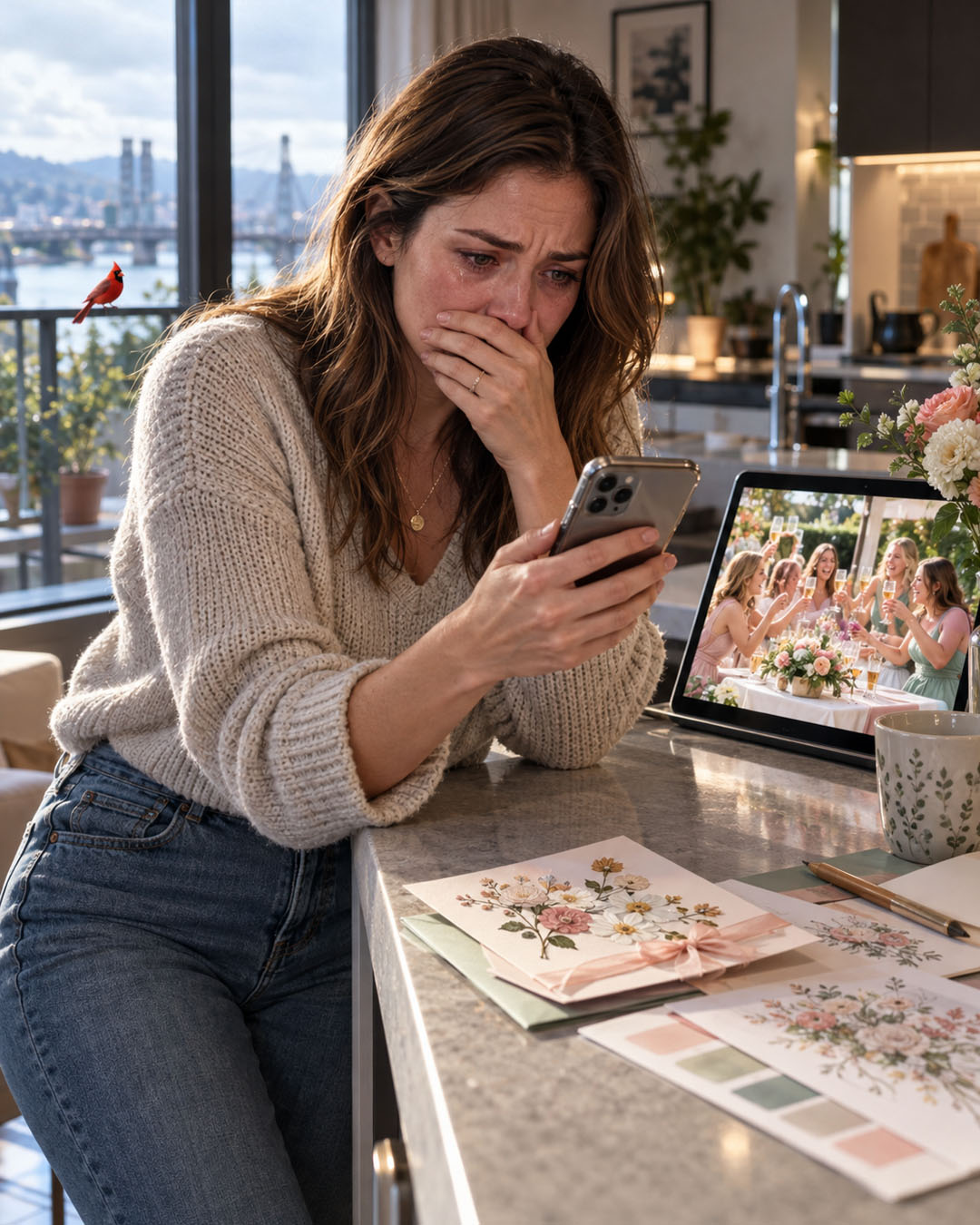
A year earlier, I’d stood in my kitchen surrounded by pieces of a broken coffee cup, staring at photographs of a celebration I hadn’t been allowed to attend.
I’d believed my absence from that wedding meant I was unimportant.
I’d believed my family had the power to define my worth.
But the truth had been waiting for me all along.
I wasn’t less valuable because they overlooked me.
My accomplishments weren’t smaller because they refused to celebrate them.
And my life wasn’t incomplete because I wasn’t included in someone else’s perfect picture.
I had spent years knocking on a door that never fully opened.
When I finally stopped knocking, I discovered an entire world waiting outside.
A world filled with friends who showed up without being asked.
People who praised my work without comparing it to anyone else’s.
A man who loved my independence instead of feeling threatened by it.
And a grandmother who reminded me that it was never too late for honesty.
Sometimes I still think about Lauren’s wedding.
I imagine the ballroom, the flowers, the elegant dinner, and all the relatives who gathered beneath glittering chandeliers.
I hope she remembers it with happiness.
I truly do.
But I also remember the evening beneath the olive trees, when eighteen people raised their glasses and celebrated the simple pleasure of being together.
Nobody there needed to make someone else feel small.
Nobody had to prove they deserved a seat.
They were invited because they were loved.
And that was the difference.
I used to believe family meant the people who shared your last name, attended the same holidays, and appeared beside you in photographs.
Now I understand that family is also found in the people who make room for you, respect your boundaries, and celebrate your happiness without feeling diminished by it.
Some of those people are related to us.
Others come into our lives unexpectedly.
Both kinds of love can be real.
And both deserve care.
Today, the photograph from our seaside celebration hangs above my desk.
In it, I’m standing beside Daniel, laughing beneath the warm California sun.
Whenever I look at that picture, I remember the woman I was before everything happened.
The woman who apologized for succeeding.
Who stayed quiet to keep the peace.
Who believed that if she could just be good enough, everyone would finally welcome her.
I wish I could tell that woman something.
I’d tell her that she was already enough.
That the people who truly loved her would never require her to disappear so someone else could shine.
And that losing her place at one table might be the very thing that would lead her to a life where she no longer had to ask permission to belong.
My family didn’t invite me to my cousin’s wedding because they believed my presence would ruin her special day.
For a while, I let that rejection break my heart.
Then I stopped chasing an invitation that was never coming.
I built a beautiful life instead.
And the greatest surprise of all was discovering that the happiness I’d spent years begging my family to give me was something I could finally create for myself.
THE END. ⚠️ All characters and events are fictional. Do not imitate or apply them in real life. 😌😌😌