Chapter 2
I contacted a forensic accountant named Renee Walsh in Jacksonville. She had more than twenty years of experience investigating financial misconduct involving small and midsize businesses.
I gave her the documents, the photographs, and everything I’d collected.
“Don’t confront anybody yet,” she advised. “If this is coordinated, they’ll start covering their tracks the moment they realize you’re looking.”
That was exactly what I intended to avoid.
While Renee worked, I decided to test Karen.
One morning over breakfast, I casually mentioned the storage yard in Pooler.
“One of the guys told me we’ve got material sitting at an off-site location. Do you know anything about that?”
Karen didn’t hesitate.
“That’s overflow from the Savannah River Bridge job. We didn’t have enough room at the shop. I told you about it in January.”
She said it so confidently that I almost questioned my own memory.
But I knew she’d never mentioned it.
“I must have forgotten,” I replied.
She took another sip of coffee and returned to her paperwork.
By the following week, the storage yard deliveries had been reclassified under a legitimate project code in our accounting system.
She was cleaning up the records.
Unfortunately for her, Renee had already copied the originals.
Two weeks later, Renee called and asked me to come to her office.
She had prepared a thick report.
The fake equipment rentals totaled more than $48,000. Inflated invoices from legitimate suppliers added another substantial amount. There were suspicious fuel reimbursements, padded payroll entries for employees who hadn’t worked the dates listed, and several client payments redirected to an account that didn’t belong to Tidewater.
The garnet scheme alone accounted for another $28,000.
The redirected payments went to a credit union account in Hinesville.
The account belonged to Sheldon Pratt.
I stared at the report.
Renee continued explaining the numbers, but for a moment, I couldn’t hear her.
Shell.
My best friend.
The man who had once given me a place to sleep when I had nowhere else to go.
According to Renee’s findings, approximately $211,000 had been taken from the company over eleven months.
It required two kinds of knowledge to pull off the operation. Someone had to understand the company’s finances, while someone else needed to know enough about field operations to make false purchases and invoices look believable.
Karen handled the books.
Shell understood the jobs.
They had been working together.
Renee also discovered that Low Country Equipment Solutions had been registered using the identity of Karen’s cousin, Kaylee, a 23-year-old nursing student in Statesboro.
I sat in silence.
I wasn’t just dealing with theft. I was dealing with two people who knew me well enough to understand exactly how much I trusted them.
I hired an attorney named Warren Gatch, a Savannah litigation specialist who handled business disputes and ownership conflicts.
He reviewed the report, the original operating agreement, and the revised agreement Karen had wanted me to sign.
“You haven’t signed this new version, correct?” he asked.
“No.”
“Good. Don’t sign anything. And don’t let them know what we have.”
He explained that the original agreement contained important protections requiring mutual written consent for certain business arrangements. It also prohibited either partner from holding undisclosed financial interests in companies doing business with Tidewater.
Those provisions would matter.
Then I arranged for a security camera to be installed in the office. It covered a common area, with proper notice posted. It recorded video only.
Three days later, I reviewed the footage.
Karen had stayed late on a Thursday evening. She wasn’t working at her desk. She was pacing near the filing cabinet, talking on her phone and laughing.
I couldn’t hear the conversation, but something about her expression made me uncomfortable.
The following morning, I was resetting a vendor login on the shared company iPad when a message preview appeared.
It was from Shell.
One sentence was visible.
“He still has no idea about any of it. I almost feel bad. Almost.”
I felt the blood drain from my face.
Four days later, I received another reason to stop trusting my own home.
That evening, I was staying at a motel in Jesup because I had told Karen I was inspecting a pipeline project early the following morning. Around 9 p.m., I checked the office camera.
Shell had arrived.
Karen was already there.
For twenty minutes, they reviewed documents and moved papers around. Then they began kissing.
What I saw next made me lower the phone.
They were having an affair.
Not a moment of drunken stupidity. Not some isolated mistake.
They were completely comfortable together, in the office I had built, behind my back.
I kept watching.
They printed several pages and placed them in the output tray. I zoomed in as far as I could.
It was the revised operating agreement.
The same document Karen had brought to our kitchen.
They were preparing another version.
I sat on the motel bed, staring at the screen.
They weren’t just stealing money and sleeping together. They were trying to arrange things so they could force me out of my own company.
I had spent years sharing meals with these people, trusting them with my livelihood, and welcoming Shell into my home.
Now I was watching them plan how to take everything.
I didn’t sleep that night.
During the following week, Warren and I organized the evidence. We saved the financial records, downloaded the camera footage, and prepared for a legal fight.
Then one of my foremen, a reliable man named Tully, mentioned something that caught my attention.
“Hey, Gavin, did you know Karen’s been handling the Port Authority schedule directly?”
I looked up.
“What do you mean?”
“She called the project manager. Said you were overloaded with bids and that she and Shell would be coordinating things for the next quarter.”
I called the project manager myself.
He confirmed it.
Karen had been gradually moving me out of the company’s most important client relationships. She was preparing the customers to work directly with her and Shell, making my eventual removal appear like a normal management change.
They were trying to take my business piece by piece.
I thanked the project manager and told him I’d be handling the contracts personally from then on.
That evening, I went home.
Karen was making dinner.
She had prepared grilled shrimp, rice, and vegetables. She seemed unusually cheerful.
“Gavin, I have some news.”
I sat down.
She smiled and placed her hand over mine.
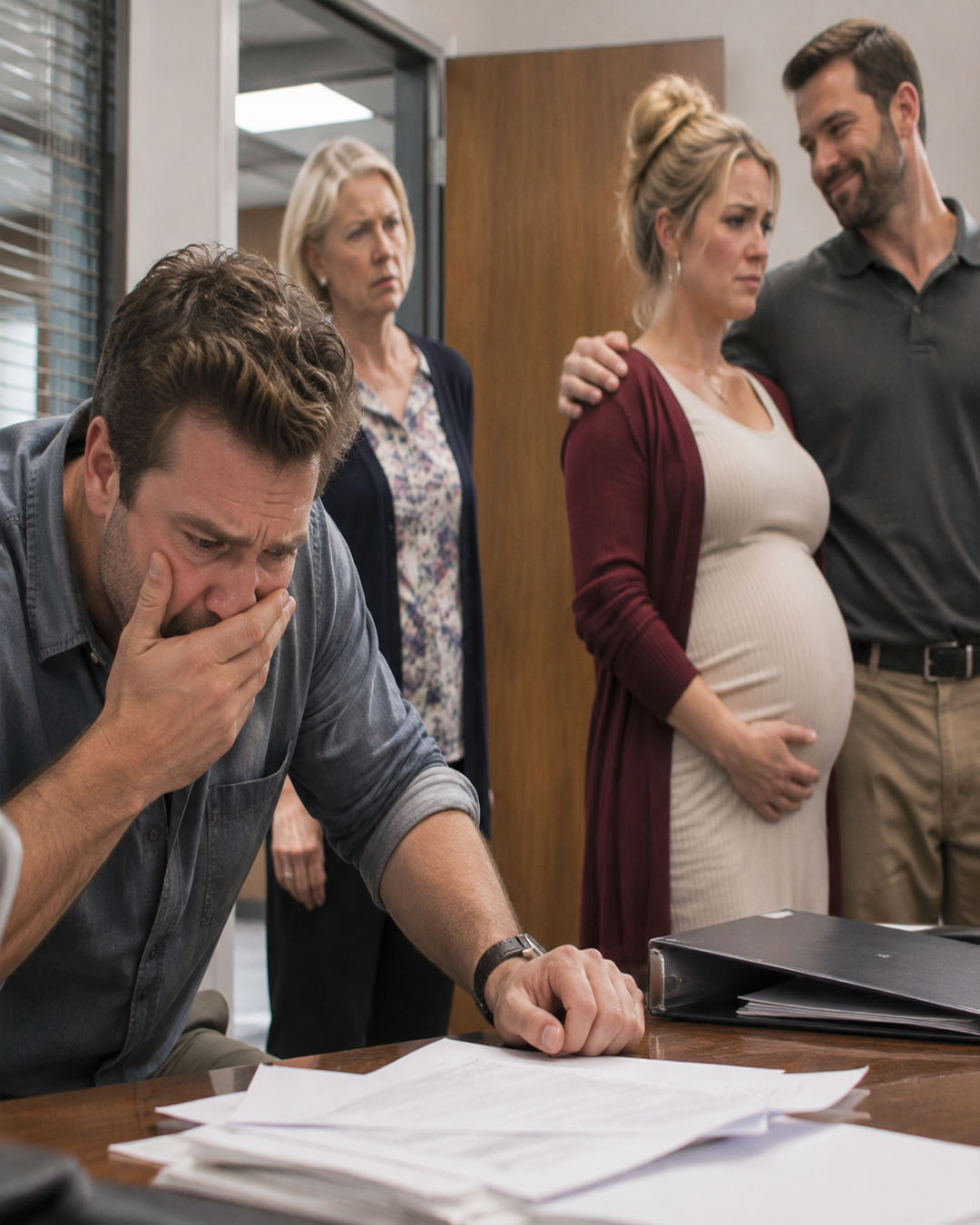
“I’m pregnant. Eight weeks.”
For a few seconds, I couldn’t move.
Eight weeks.
I did the math immediately.
Eight weeks earlier, I had been in Waycross for a five-day pipeline inspection. I’d been away from Monday through Friday. Karen had told me she wasn’t feeling well and had stayed home from work.
She hadn’t been sick.
She had been with Shell.
I looked at my wife, the woman who had been stealing from my company and betraying our marriage, and realized she was now expecting his child.
She waited for my reaction.
I forced a smile.
“That’s wonderful news.”
I hugged her and congratulated her. I even told her we’d have plenty to talk about once I got through the next few weeks of work.
She appeared relieved.
I wasn’t going to give her any reason to suspect what I knew.
The next morning, I visited a clinic for a full health screening. Then I met Warren again.
We discussed every legal step, from protecting the company to handling the divorce and establishing paternity.
Nothing would be rushed.
I wanted every document prepared, every piece of evidence secured, and every decision reviewed before I made a move.
There was only one person I still needed to talk to.
My mother.
Chapter 3
My mother lived in Guyton, about forty-five minutes from my house. It was the same modest ranch where I’d grown up after my father left when I was six.
She had raised me alone, working at a feed store for more than twenty years. She never remarried, rarely complained, and had always told me that family was the most important thing a man could have.
I drove over on a Saturday afternoon.
She was sitting on the porch with a glass of sweet tea when I arrived.
“Well, look who’s here!” she said, smiling.
I sat beside her.
For several minutes, we talked about ordinary things. Her neighbors, the weather, and a repair she needed around the house.
Then I told her everything.
I explained the financial fraud, the affair, the revised operating agreement, and Karen’s pregnancy. I showed her Renee’s report and the dates proving I had been out of town when the baby was conceived.
I didn’t show her the surveillance footage.
I didn’t think she needed to see it.
She listened without interrupting.
When I finished, she remained quiet for a long time.
Then she asked a question I wasn’t expecting.
“How far along is Karen?”
“Ten weeks now.”
My mother folded her hands in her lap.
“I’ve been waiting a long time for you to have a child, Gavin. You know that.”
I nodded.
“I know, Mom.”
She looked toward the yard.
“Here’s what I think. Forget the DNA. Forget what happened between Karen and Sheldon. Raise that baby as your own.”
I stared at her.
“What?”
“Let me be a grandmother. That’s what matters. A child doesn’t deserve to suffer because two adults made mistakes.”
I couldn’t believe what I was hearing.
“Mom, that isn’t my child.”
“But it could still be your family.”
“Sheldon got my wife pregnant. He’s been stealing from me. They’re trying to take my company. And you want me to raise his baby?”
She leaned forward.
“You’re a good man. You could give that child a better life than either of them could.”
I shook my head.
“That’s not my responsibility.”
She continued, saying she’d help with the baby and be there whenever I needed her. She said children shouldn’t be punished for the circumstances of their birth.
I agreed with that part.
But then she said something that made my blood run cold.
“Sometimes being a man means accepting things you don’t like for the sake of family.”
I stood up.
“Are you seriously asking me to pretend none of this happened?”
She looked hurt.
“I’m asking you to think about what matters.”
I looked at her for several seconds.
The woman who had taught me to stand up for myself was asking me to accept betrayal, raise another man’s child, and quietly absorb the financial damage because she wanted a grandchild.
I couldn’t understand it.
“I’m not raising that baby, Mom. Don’t ask me again.”
She called after me as I walked toward my truck.
I heard her voice crack.
But I didn’t turn around.
The drive home was silent.
When I arrived, I went into the hallway and removed every framed photograph of my mother from the walls. There were four of them. I placed them in a cardboard box, taped it shut, and left it in the garage.
For the next two days, she called repeatedly.
First, she apologized. Then she explained that she hadn’t meant it the way it sounded. Later, she doubled down and said I was being selfish. Finally, she sent a long message saying she was frightened of losing her only son.
I read every message.
I didn’t respond.
My mother had been financially dependent on me for several years. Since retiring, she’d received help with her rent, electricity, and other monthly expenses. I had also kept her on my family phone plan.
I had never complained about helping her.
But now I couldn’t ignore the fact that she had asked me to sacrifice my own future while showing no concern for what had been done to me.
I canceled the automatic payments for her electricity, removed her from my phone plan, and stopped the monthly transfer.
Within a week, she noticed.
She called fourteen times in one day.
I didn’t answer.
Then she drove to my house. I wasn’t home, so she went to the office and asked Karen where I was.
Karen told her I was on a job site.
That was the last time I had any direct contact with my mother for a long while.
Meanwhile, Warren and I were preparing our next steps.
We had enough evidence to act.
Monday morning, he filed an emergency motion seeking a temporary restraining order to freeze Tidewater’s business accounts pending a forensic audit. The filing included Renee’s report, bank statements, supplier records, and an affidavit from Dale confirming the unusual material deliveries.
It also requested temporary sole operational control of the company for me and restricted Karen and Shell from accessing the premises.
The judge signed the order before lunchtime.
I read it twice.
For the first time in months, I could breathe.
That afternoon, I walked into the office carrying two sealed envelopes.
Karen was sitting at her desk, processing invoices.
I placed one envelope in front of her.
“What’s this?” she asked.
“Something you need to read.”
She opened it.
Inside was a formal termination notice, effective immediately, along with a demand for repayment of the misappropriated company funds.
She read the first page.
Then the second.
When she reached the summary of the financial investigation, her face went completely white.
I watched her eyes move down the page.
Low Country Equipment Solutions.
The redirected payments.
The inflated invoices.
The $211,000.
She looked up at me.
“Gavin, we need to talk.”
I said nothing.
“Please. There’s been a misunderstanding.”
I turned and walked out.
Two of my employees were standing in the shop bay, watching through the open doorway.
Nobody said a word.
I had finally stopped asking the people who betrayed me to explain themselves.
Chapter 4
Tuesday morning, a locksmith arrived at the shop at six o’clock.
With the court order in hand, we changed every exterior lock and reset the alarm codes. Warren also filed a civil lawsuit against Sheldon for fraud, breach of fiduciary duty, conversion, and unjust enrichment.
The lawsuit sought repayment of the stolen money, additional damages, and the forfeiture of his ownership interest in Tidewater.
Shell was served at his duplex shortly after seven.
By lunchtime, he had called me eleven times.
I ignored every call.
Around two in the afternoon, he showed up at the shop.
He tried the front door.
It wouldn’t open.
I watched from inside as he pulled the handle again, then began pounding on the glass.
He spotted me through the blinds.
“GAVIN! OPEN THIS DOOR!”
I stood there for a moment.
This was the man who had once shared his last dollar with me. The man who had stood beside me at my wedding. The man who had helped me build Tidewater from the ground up.
Now he was standing outside, demanding access to the company he had helped steal.
I turned away and returned to my desk.
I had a water tower project to bid on in Effingham County.
Wednesday morning, I filed for divorce.
The petition included evidence of Karen’s affair and financial misconduct. Warren explained that Georgia’s no-fault divorce rules did not prevent a judge from considering financial misconduct and other relevant circumstances when dividing marital property.
We also took steps to secure the house.
New locks were installed, and the garage access code was changed. I wasn’t interested in coming home to another unpleasant surprise.
That evening, Karen arrived.
I saw her car pull into the driveway.
She tried the front door, then knocked. When nobody answered, she began calling my name.
I watched from a window at the back of the house.
She eventually sat on the porch steps.
She wasn’t crying.
She was thinking.
I could almost see her trying to calculate her next move.
After about an hour, she left.
The following morning, divorce papers were delivered through the proper legal process.
Meanwhile, Renee’s findings were submitted to the Chatham County District Attorney’s Office for review. The suspected offenses included theft by deception, conversion, and the unauthorized use of another person’s identity to establish the shell company.
Warren warned me that a criminal investigation could take time and that prosecution wasn’t guaranteed.
I understood.
My immediate priority was protecting the business and making sure our employees didn’t lose their jobs because of what Karen and Shell had done.
That Friday, I met with every major client.
I explained that there had been serious internal financial irregularities and that my business partner was no longer involved in operations. I assured them that every existing contract would be honored and that our crews would continue working without interruption.
The Port Authority project manager listened carefully.
“I appreciate you coming to me directly,” he said. “We’ve worked with Tidewater for years. We want to keep working with Tidewater.”
He shook my hand.
Not one client left.
But Karen wasn’t finished.
Later that afternoon, Warren called me.
“She’s making a demand,” he said.
I asked what kind.
“Her attorney says she’ll claim the unborn child is yours unless you agree to a more favorable divorce settlement.”
I closed my eyes.
There it was.
Karen wanted the house, 60 percent of the business value, and eighteen months of spousal support. In exchange, she would supposedly avoid pursuing a paternity claim.
She was using the pregnancy as leverage.
Warren asked how I wanted to respond.
I gave him three instructions.
First, I would not sign the birth certificate or any document that could be interpreted as accepting legal paternity. We would request court-ordered DNA testing after the baby was born.
Second, any attempt to establish paternity through knowingly false representations would be challenged legally.
Third, we had documented evidence showing I was more than a hundred miles away during the likely conception period.
We had hotel receipts, work records, travel documentation, and surveillance footage establishing the affair.
Warren sent the response to her attorney.
Within forty-eight hours, the threat disappeared.
By Friday evening, Shell had lost access to the company, its bank accounts, and its clients. He was facing a civil claim seeking repayment of more than $200,000, additional damages, and legal expenses.
Karen had lost her position and access to the financial records she had used to steal from the company.
And the pregnancy could no longer be used to force me into a settlement.
I went home that night and sat on the dock behind the house.
The tide was moving slowly across the marsh. The air smelled of saltwater and wet grass, and the evening was quiet.
For months, my entire life had been consumed by suspicion, anger, and paperwork.
That was the first evening I felt like I could breathe again.
But the legal fight wasn’t over.
The next several months brought temporary court hearings, financial disclosures, and arguments over ownership.
The judge granted me exclusive possession of the house and temporary control of Tidewater. Joint accounts remained frozen while the financial investigation continued.
Karen’s attorney argued that she deserved a substantial share of the business because she had worked there and was pregnant.
Warren responded with the forensic accounting report.
The judge was not impressed by her attempt to use the company’s financial value as though the missing money had never existed.
The final divorce hearing was postponed until after the baby arrived so the question of paternity could be settled.
Then, a few months later, Karen gave birth to a little boy.
He had a serious congenital heart condition and needed surgery soon after delivery. His medical needs were substantial, and the doctors explained that he would require ongoing specialist care.
When Warren told me, I felt a heaviness I couldn’t quite explain.
I didn’t wish the child any harm.
He hadn’t chosen his parents or the circumstances surrounding his birth.
But I also knew that feeling sympathy for him didn’t make me his father.
Within days, Warren filed the request for court-ordered DNA testing.
I waited for the results.
Chapter 5
The test confirmed what I had known from the beginning.
The baby was not mine.
Sheldon Pratt was his biological father.
The court entered an order establishing that I had no legal parental responsibility for the child. Because I had never signed the birth certificate or accepted legal paternity, the process was straightforward once the results were available.
I remember sitting in Warren’s office when he handed me the paperwork.
“That’s settled,” he said.
I nodded.
There was no celebration. No victory speech.
Just a sense that one more piece of my life had finally been put back where it belonged.
The divorce decree came shortly afterward.
I kept the house, Tidewater, and 80 percent of the marital assets. Karen received her vehicle and personal belongings. The court denied her request for alimony, taking her documented role in the financial misconduct into account.
She had arrived at the hospital in Savannah without a husband, without a job, and without the comfortable financial life she’d once enjoyed.
Shell wasn’t there.
My mother wasn’t there.
Even her cousin Kaylee, whose identity had been used to register Low Country Equipment Solutions, had cut contact with her after learning what had happened.
The civil case against Shell took longer.
His attorney argued that some of the transactions had been legitimate and that the original operating agreement was unclear about certain responsibilities.
Warren had an answer for that.
The original agreement contained an explicit requirement for mutual written consent on significant vendor relationships and prohibited undisclosed financial interests in companies doing business with Tidewater.
Shell had violated those provisions repeatedly.
Renee’s report documented the transactions down to the individual invoices.
Eventually, Shell settled.
He agreed to repay the full amount taken from the company, along with an additional $60,000 in damages. He signed over his truck, his boat, and his savings, then agreed to a five-year payment plan for the remaining balance.
A lien was attached to the settlement to protect my interests.
The district attorney’s office ultimately declined to prosecute. They cited limited resources and other priorities, something Warren had warned me could happen.
I wasn’t happy about it, but the civil judgment remained on the public record.
And in the industrial contracting business, reputation matters.
Shell tried to start his own coatings operation.
Nobody wanted to hire him.
One of my employees later told me that Shell had approached a paper mill in Rincon with a bid package. It was the same facility where Tidewater had recently secured a maintenance contract.
The plant manager looked at the proposal, recognized the name, and handed it back.
He told Shell to leave the property.
Shell sat in his truck for twenty minutes before driving away.
Eventually, he took work with a commercial roofing crew. The pay was modest, and the hours were long.
About a year and a half after I locked him out of Tidewater, he suffered a serious back injury when part of a staging platform collapsed at a job site in Brunswick.
He fell several feet onto a concrete surface and injured two discs in his lower back.
The recovery was difficult.
He eventually received surgery through a charitable care program, but he never regained his previous mobility. He couldn’t climb scaffolding or carry heavy equipment anymore.
The man who had once carried blasting equipment up industrial structures as though it weighed nothing now struggled with ordinary physical tasks.
Last I heard, he was living in a trailer park outside Jesup and receiving disability payments.
I didn’t feel pleased about it.
I didn’t feel responsible for it, either.
He had made his decisions.
Karen’s situation was difficult in a different way.
She filed for child support against Shell. The court calculated payments based on his actual income, which was now extremely limited.
The amount came to $214 per month.
That was hardly enough for a baby with a serious heart condition and ongoing medical needs.
Karen moved in with a high school friend, but the arrangement lasted only two months. The responsibilities of caring for a newborn, combined with her financial problems, strained the friendship beyond repair.
She eventually moved into an apartment complex in Midway.
I learned about it because she tried to list me as an emergency contact on the baby’s medical paperwork.
A hospital employee called to verify the information.
I explained that I had no relationship with the mother or child and asked that my details be removed.
That was the end of my involvement.
My mother eventually tried contacting Karen once, but Karen told her to stay away.
Even the people who had defended them seemed unwilling to remain connected to the consequences of their choices.
As for Tidewater, the business began recovering faster than I’d expected.
I restructured it as a single-member LLC and hired a new bookkeeper named Odell, a retired Navy chief who had spent twenty years managing supply logistics aboard destroyers.
He was methodical, cautious, and about as exciting as a spreadsheet.
Exactly what I needed.
I also hired a full-time office administrator named Priya to handle scheduling, client communications, and daily paperwork.
I kept the original field crews.
Those men had worked hard for years, and they deserved stability. Most knew something serious had happened, but nobody asked unnecessary questions.
We simply went back to work.
Without Karen’s inflated invoices and Shell’s diverted materials, I discovered that our actual profit margins were better than I’d realized.
We won three new contracts, including a maintenance agreement with a paper mill and a five-year county bridge maintenance program.
Revenue eventually climbed past $3.5 million.
We now had twelve full-time employees, two spray rigs, and a business with no outstanding debt.
I also paid off the house.
The home on Isle of Hope was still mine, and I had made sure it no longer carried the feeling of the marriage that had ended there.
I replaced the furniture, repainted the rooms, and removed every reminder of Karen.
The old photographs of my mother remained in the garage.
I didn’t throw them away.
I simply didn’t feel the need to look at them.
Eight months after the divorce became final, I met a woman named Josephine.
She worked as a marine surveyor for cargo insurance companies. We met through a mutual acquaintance at a small gathering in Savannah.
She was thoughtful, independent, and refreshingly direct.
She didn’t care about how much money I made or how impressive my company looked on paper. She wanted to know whether I enjoyed my work, whether I liked fishing, and why I had a photograph of an old shrimp boat hanging in my office.
We started seeing each other.
Two years later, we were still together, living in the Isle of Hope house.
For the first time in a long while, I felt comfortable making plans for the future.
My mother is still alive, as far as I know.
Over the years, she’s tried reaching out a few times. Letters came, messages arrived through relatives, and once she left a voicemail on an old number.
She said she was sorry.
I believe she meant it.
But forgiveness doesn’t always mean returning to the relationship you had before. Sometimes an apology arrives after the damage has already changed everything.
I haven’t reopened that door.
Shell contacted me once, too.
About a year ago, a handwritten letter arrived at the company office. His name was on the envelope.
I recognized the handwriting immediately.
For several minutes, I held it in my hands.
I wondered whether he wanted to apologize, explain himself, or ask for something. Perhaps he wanted to remind me of the years we’d spent building Tidewater together.
I never found out.
I put the letter through the office shredder without opening it.
Sometimes I think about that phone call from Dale, the supplier who noticed our unusual garnet orders.
What if he hadn’t called?
How long would Karen and Shell have continued? How much more money would they have taken? Would they eventually have succeeded in forcing me out of the company?
I don’t know.
I do know that the greatest mistake I made wasn’t trusting my wife or my best friend.
Trusting people is part of building a life. Without it, you can’t have a marriage, a friendship, or a successful business.
My mistake was believing that the history I shared with someone guaranteed they would never betray me.
It didn’t.
And my mother’s response taught me something just as important.
Being someone’s child doesn’t mean you must accept every decision they make. Being someone’s friend doesn’t mean you have to protect them from the consequences of their actions. And being a decent man doesn’t mean sacrificing your entire future to prove that you’re capable of forgiveness.
The baby deserved kindness and proper care. That never meant I had to pretend he was mine.
Karen and Shell deserved to answer for what they had done. That didn’t require me to destroy myself in the process.
Today, I still run Tidewater. I still walk through the shop every morning, check on the crews, review the bids, and make sure the materials match the invoices.
I still live in the house I worked so hard to protect.
And sometimes, when the evening tide rolls across the marsh, Josephine and I sit on the dock and watch the water change color as the sun goes down.
There’s no arguing over bank statements. No secret phone calls. No wondering whether someone sitting across my dinner table is planning to take my livelihood.
Just peace.
I once believed that having a successful business, a wife, a lifelong friend, and a mother who loved me meant I had built a secure life.
I was wrong about some of those people.
But I wasn’t wrong about the life I wanted.
I built Tidewater with my own hands. I protected the people who depended on it. I refused to accept a betrayal as the price of keeping a family together.
And I finally learned that sometimes the strongest thing a man can do is walk away from the people who expect him to tolerate everything.
I lost a wife, a business partner, and eventually my relationship with my mother.
But I kept my dignity, my home, my employees’ livelihoods, and the future I’d worked twelve years to build.
That was enough.
THE END.
⚠️ All characters and events are fictional. Do not imitate or apply them in real life. 😌😌😌