
Chapter 2
By January, my Sunday video calls with Ava had dwindled from forty minutes to nine. My mother always had an explanation ready. Ava was at choir, Ava was napping, Ava was visiting Kayla, or Ava had already gone to bed. The reasons changed, but the cheerful tone never did.
On January 22, my phone rang at two in the morning, Kuwait time. The caller was Barbara Reeves, a counselor at Maple Ridge Elementary. She apologized for calling so late, then told me she’d been meeting with Ava twice a week since October.
“I’m concerned about three things,” she said. “I’d like you to hear them in order.”
I sat up and reached for my notebook.
First, Ava’s school lunch account had been overdrawn since November. The balance was negative $212, and she had been receiving the cafeteria’s basic backup meal. Other children knew which tray belonged to a student whose account had run out of money.
Second, Ava’s sneakers had worn through at the toes. When Mrs. Reeves asked about new shoes, Ava said her grandmother told her she’d grow into the ones she had. The shoes were a size and a half too small.
I stared at the notebook where I’d recorded the $1,200 monthly allotment. That money was supposed to pay for Ava’s food, clothes, and school needs.
“What was the third thing?” I asked.
Mrs. Reeves paused. “Ava told me her grandfather says she’s not a real Hayes. She said real Hayes children get to stay in the house when there’s yelling, but she has to leave because she’s only a guest.”
I could hear my own breathing in the quiet room. I thanked her and wrote down everything she had said, then called my father during the early evening in Ohio.
He answered with the relaxed voice of a man sitting down to dinner.
“Dad, I’ve spoken with Ava’s school counselor.”
“Barbara Reeves? That busybody calls your mother every other week.”
“She says Ava’s lunch account is overdrawn, her shoes don’t fit, and you’ve told her she isn’t a real Hayes.”
“I never said that.”
“Ava told her you did.”
“Megan, do you know what your daughter does? She tells stories. She tells them to get attention.” I heard a fork scrape against a plate. “She told her teacher we don’t feed her. Does that sound like a house where she isn’t fed?”
“Her lunch account is negative $212.”
“Then the school billed it wrong.”
“Her shoes are too small.”
“She’s a growing girl.”
He spoke more softly then, with the patience of a man explaining something obvious to a child. “I’m worried about her, Megan. She lies, and you don’t see it because you’re not here. I don’t know where she gets it.”
I wrote down his words, including the final remark. The phrase stayed with me long after I ended the call, because it was no longer a careless insult. He was building a story about my daughter, one that would make it easier to dismiss anything she said.
Three days later, my mother called at four in the morning, crying. She told me Dad had been having a difficult week and that his doctor was concerned about his blood pressure. He had undergone a heart procedure two years earlier, she reminded me, and she was frightened that all my questions might make him ill.
“You’ll give your father a heart attack,” she said. “He’s sixty-three, Megan. He’s done so much for Ava, and you’re treating him like a criminal.”
I sat on the edge of my bunk and felt the weight of her words settle over me. If I pushed harder, I feared I might somehow be responsible for Dad’s health. If I stayed quiet, my daughter would continue living in a house where she was told she didn’t belong.
The next morning, I called Captain Dana Morgan, an old friend from Fort Knox who had gone on to become an Army attorney. I told her what I’d heard from the counselor and what my parents had said in response.
“Do you have documentation?” she asked.
“I have a notebook.”
“Good. Keep writing. Dates, times, direct quotes, and who was present. Don’t threaten anyone, and don’t make accusations you can’t prove. Be warm, be boring, and let them keep talking.”
“They’re hurting my daughter.”
“Then we’ll establish what happened. Proof ends arguments. Anger prolongs them.”
In March, Dad began attending the Sunday video calls himself. He leaned toward the laptop one evening and announced that the $1,200 I sent wasn’t enough to cover Ava’s actual expenses. He claimed he’d spent an additional $9,000 since April and wanted another $600 each month.
“Send me the receipts,” I said.
“Receipts?” He laughed without humor. “From your own parents? After everything we’ve done for you?”
“I’m asking for the same documentation I’d ask a landlord.”
“I’m not your landlord, Megan. I’m your father. The money isn’t the point. The point is that you don’t trust me.”
The following week, Kayla sent me a text message that I saved immediately. “She’s eight, not three. She needs to learn her place. Honestly, Mom and Dad should just adopt her. Then she’d have a real family. You’re never around anyway.”
I read it four times. Then I put the phone down and opened the photographs Kayla had posted on social media that spring. One showed her family at Disney World, enjoying a three-day vacation in a hotel suite. Another showed a newly installed quartz kitchen countertop, with the caption, “Finally treating ourselves.”
I didn’t accuse anyone of anything. I simply recorded what I saw and kept the photographs.
The call that finally broke through my denial came on the first Sunday in April. My mother held the laptop while Ava sat stiffly beside her, wearing a gray sweatshirt zipped to her chin even though the house was warm.
“Hi, baby,” I said. “How’s school?”
“Fine.”
“Are you getting good lunches?”
“Yes.”
“Is Grandpa being nice to you?”
My mother leaned into the frame. “Of course he is. Say hi to Mommy, Ava.”
Ava looked at my mother, then back at the screen. Her expression barely changed, but she moved her lips without making a sound.
I had learned to read lips in noisy military settings, and I watched the recording afterward frame by frame to make sure I’d understood her correctly.
She had said, “Don’t call Grandpa. He sends me away.”
Then my mother announced that the call was over, and the screen went black.
I didn’t sleep that night. At six the next morning, I walked across the compound to Colonel Raymond Delgado’s office and placed a request for early return on his desk. I attached Ava’s drawing, the counselor’s notes, and copies of my notebooks. He read everything in silence, then signed the request that afternoon.
“Go get your kid, Lieutenant.”
Captain Morgan told me not to notify my parents. We needed a clean filing, she explained, and if they knew I was coming home, they might coach Ava, change their stories, or destroy evidence before the court could act.
I contacted Ruth Dobbins, a seventy-four-year-old retired nurse who lived next door to my parents. She had known me since I was a baby, and I had her number from my mother’s Christmas card list.
When I asked if she’d noticed anything unusual, her voice grew hesitant.
“Our bedroom shares a wall with your parents’ house,” she said. “I hear shouting most nights around eight. Mostly your father. Then a door closes, and everything goes quiet.”
She also mentioned a doorbell camera she’d installed after some neighborhood break-ins. It faced her driveway but captured much of my parents’ front porch and walkway. The device stored thirty days of footage before recording over it.
I wrote down the information and moved on. I would regret not asking for that footage sooner, but at the time, I was focused on the court petition that would bring Ava home.
I arrived in Ohio on Tuesday, June 10, without telling my family. Dana had arranged for the necessary paperwork to be filed the following Monday, after the school counselor’s records arrived and Ruth’s statement could be notarized. I was supposed to wait five days.
For two days, I followed the plan. On Wednesday night, I drove past my parents’ house, saw the porch light shining, and parked around the corner. I sat in the dark for twenty minutes, looking toward the window of the bedroom that used to be mine.
I didn’t stop. I didn’t knock. I drove back to the hotel because I had promised Dana I wouldn’t alert my parents before the filing.
On Thursday afternoon, the weather radio on my phone issued a severe thunderstorm warning for Franklin County. Winds could reach seventy miles per hour, and the forecast warned of flash flooding. I watched the trees bend outside my hotel window and told myself that storms passed, that my daughter was indoors, and that I would be able to take her home in a few days.
At 10:02 p.m., an unfamiliar Ohio number appeared on my phone.
I nearly let it ring. Then I remembered the spare military ID card I had pinned inside Ava’s backpack and answered.
“Lieutenant Megan Hayes?” a woman asked. “My name is Priya Nair. I’m a registered nurse at Grove City Children’s Medical Center. I’m calling about your daughter, Ava.”
I was already reaching for my car keys when she told me where Ava had been found.
Chapter 3
I drove through the storm with both hands gripping the steering wheel. At the first red light, I called Dana, who answered before the first ring had finished.
“Tell me.”
I gave her the facts in nine short sentences: Ava, eight years old, found in a drainage culvert, dangerously cold, now at the hospital. My parents were her temporary guardians, and I was back in Ohio.
Dana’s response was immediate. “Don’t argue with your parents. Don’t accuse them of anything. Call the county child-protection hotline, tell them exactly what happened, and then go be her mother. I’ll coordinate with the police.”
At 10:09 p.m., I called the hotline from a stoplight on Stringtown Road. A woman named Denise Park took my information and told me an investigator would meet me at the hospital. I gave her my name, my rank, Ava’s name, and my parents’ address, spelling Larkspur twice.
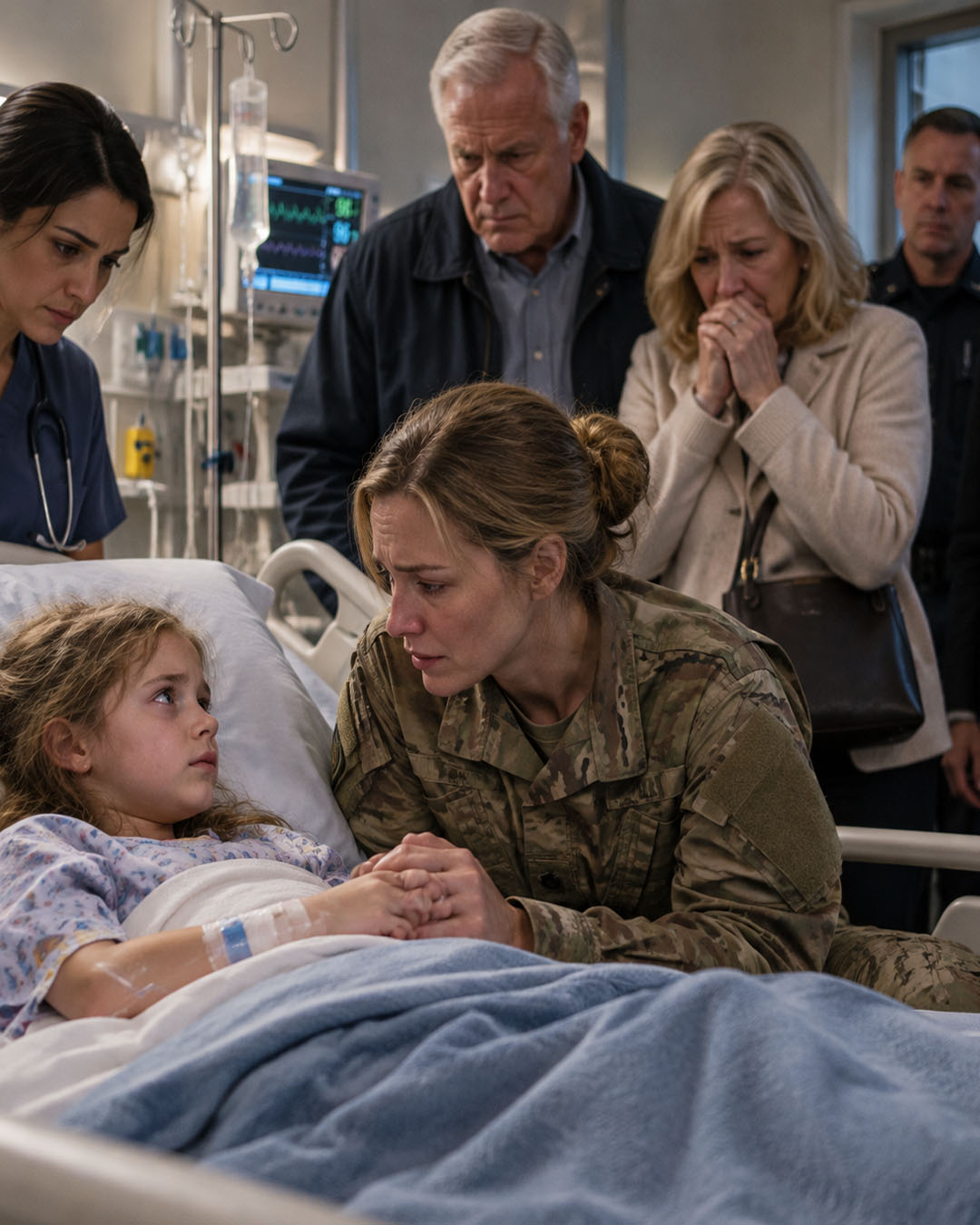
By the time my father entered Ava’s room at 10:44, I had already spoken with Priya, contacted the county, and arranged for the officer to take statements. My father had expected to arrive first with a story that would explain everything away. Instead, he found me beside the bed, still wearing my uniform, with a police officer and an investigator waiting in the hallway.
He told Officer Tom Whitaker that Ava had stolen her grandmother’s pearl necklace and run away when they caught her. He claimed they’d tried to stop her but couldn’t reach her before she disappeared into the storm.
“That child lies,” he added. “I’m sorry to say it, but she does. Ask anyone.”
I closed my eyes as I heard his voice through the hallway wall. The accusation was familiar, and that was precisely what made it so dangerous. He had spent months preparing the people around him to doubt Ava before she ever had the chance to explain herself.
Around midnight, Ava woke fully enough to tell us what had happened. Denise sat beside the bed and wrote down her words, while Priya continued checking her temperature and replacing the warm blankets.
Ava explained that she’d been doing her math homework in the back bedroom when Jason came looking for his baseball glove. He opened her closet, looked through her drawers, and stood beside her backpack while she was away from the room.
Later, Grandma announced that her pearl necklace was missing. When Ava returned from the bathroom, Jason was standing near the backpack, and she saw him close its zipper.
“Grandpa,” Jason had said, “I saw Ava put something in her backpack.”
My father hadn’t asked when Jason saw it or what he’d actually witnessed. He marched down the hallway, grabbed Ava’s backpack, and emptied it onto the floor. The pearls bounced across the boards, and Ava began to cry.
“I didn’t take them,” she told him. “Jason put them in there. I saw him.”
“Jason doesn’t lie,” Dad answered.
My mother held the necklace against her chest without saying anything. Kayla stood in the doorway with her arms crossed and said, “Maybe now she’ll learn.”
Then my father walked to the front door and opened it. Rain blew across the porch and into the house, and Ava asked for her shoes. He didn’t answer. She asked for her yellow raincoat, the one she’d worn to school for two winters, but he remained beside the open door.
“Get out,” he told her. “I don’t need a lying granddaughter.”
Ava stepped into the storm at 7:41 p.m. She wore star-print pajamas, and she had no shoes, no coat, and no way to call me. The wind drove rain against her face as she walked away from the house, waiting for someone to change their mind and call her back inside.
No one did.
She made it to the drainage culvert near the retention pond and crawled inside to escape the wind. The water was rising, and the concrete was cold beneath her feet. She stayed there until a passing police officer noticed something moving in the darkness and stopped to investigate.
The officer found her frightened and shivering, and he called for emergency medical help. At the hospital, Priya learned Ava’s name from the identification card pinned inside her backpack and contacted me using the number I’d written on the back.
When Ava finished telling the story, she looked at me as though she needed to know whether I’d heard every word.
“You believe me, right, Mommy?”
I leaned close enough that she could feel my hand against her cheek. “I believe you. I believed you before you ever had to explain anything.”
She closed her eyes, and for the first time since I’d arrived, her fingers relaxed around mine.
On Friday morning, Judge Marlene Astro signed an emergency order suspending contact between Ava and my parents. By Saturday, Ruth had given a notarized statement, and her account of the family’s behavior matched Ava’s description of what happened that night.
Ava was discharged on Sunday with hospital socks and a stuffed bear Priya had found in a supply closet. I carried her to my hotel room, where she slept for long stretches beneath a clean blanket while I sat nearby, listening to her breathe.
At three in the morning, she woke and asked whether Grandpa was coming.
“No,” I said. “No one is coming.”
“Is it because I lied?”
I turned on the bedside lamp and sat beside her. “Ava, look at me. You did not lie about the necklace, and you did not lie about what happened. Grandpa is wrong, and I’m going to prove it.”
She studied my face for a long time before settling back against the pillow. I stayed awake until sunrise.
On Monday, county investigator Carla Bennett began interviewing my family. She was a quiet woman with a gray bob and a voice that never rose for effect. When she finished speaking with my parents, she pulled me aside in the corridor and opened her notebook.
“Your father told me he instructed Ava to sit on the porch,” she said. “He repeated that twice. Your mother gave a different account. She said Ava went outside for some air and chose to leave.”
“They can’t both be telling the truth,” I said.
“No,” Ms. Bennett agreed. “And I want to know why their stories differ.”
She arranged an interview with Jason for Tuesday afternoon. Kayla was asked to wait outside, while Brent sat in the lobby with his elbows on his knees, staring at the carpet. I watched from behind a one-way mirror with Dana, feeling as though I were standing outside my own life.
Ms. Bennett began with easy questions about baseball, school, and Jason’s favorite pizza. Then she asked him to describe the afternoon of the storm from the beginning, as if he were watching a movie.
“Where were you standing when you saw Ava put something in her backpack?” she asked.
“In the kitchen,” Jason replied.
She nodded and wrote nothing. “What could you see from there?”
“The hallway,” he said, then hesitated. “Actually, I was in the hallway. Or maybe by the television.”
Dana leaned toward me. “Three different answers,” she whispered.
Ms. Bennett allowed the silence to stretch until Jason began squeezing a rubber ball in his hands. His eyes filled with tears, and his voice grew small.
“Jason, nobody in this room is asking you to be perfect,” she said. “I just need the truth.”
He stared at the table.
Then he whispered, “Mom told me if Ava got in trouble, Grandpa would send her away.”
My chest tightened so sharply that I had to grip the edge of the chair. Before Jason could say anything else, the door opened, and Kayla pushed past the deputy in the hallway.
“He’s confused!” she shouted. “He’s ten years old. He doesn’t know what he’s saying!”
Ms. Bennett turned toward her without changing her expression. “Ma’am, please step outside.”
Kayla kept protesting until the deputy escorted her into the corridor. Jason remained at the table, tears running down his cheeks, holding the rubber ball as though it were the only thing keeping him together.
I had spent months trying to prove that my daughter deserved to be believed. Now I was watching another child struggle under the weight of an adult’s decisions, and I understood that whatever happened next would change more than one family.
Chapter 4
The final meeting took place Wednesday morning in a conference room on the third floor of the county building. My parents sat beside their attorney, Gerald Holloway, a silver-haired man who kept clicking his pen. I sat opposite them with Dana in her dress uniform, while Ms. Bennett opened a folder and reviewed the findings.
My father had dressed for church. He wore his good watch and kept his jaw clenched, as though he were preparing to dispute an invoice from a difficult customer.
“What happened was a discipline matter,” he began. “A girl stole from her grandmother, was corrected, and ran away in a fit. You’re turning a family issue into a witch hunt.”
Ms. Bennett did not raise her voice. “Your granddaughter arrived at the hospital with a dangerously low body temperature and injuries to both feet. She was found hiding in a drainage culvert during a severe thunderstorm.”
My mother covered her face. “It was one mistake,” she murmured. “We didn’t know she’d go that far.”
I looked at her and spoke as carefully as I could. “My only mistake was trusting you. I won’t make it twice.”
My father leaned toward me, his eyes hard and wet. “You’d throw away your own family?”
I thought about Ava’s drawing, the white space separating her from everyone else. I remembered the mittens in the grocery bag and the empty chairs at Thanksgiving. Most of all, I remembered my daughter standing barefoot in a doorway, waiting for an adult to tell her she was still wanted.
“You threw my daughter into a storm, Dad,” I said. “I’m building her a roof.”
Ms. Bennett read the findings into the record. The county had substantiated neglect and emotional maltreatment, and it recommended that the temporary guardianship be revoked and full custody returned to me. Unsupervised contact between Ava and my parents would remain suspended pending further proceedings.
My father pushed back his chair and reached for his jacket. “We’re done here.”
“Mr. Hayes,” Ms. Bennett said. “There’s one more thing.”
She placed a small black flash drive on the table.
“Mrs. Dobbins’s doorbell camera records motion and audio. She provided the footage on Friday. It captured the afternoon before the incident as well as the night Ava left your house.”
My mother stopped crying.
Ms. Bennett turned the laptop toward us and opened the first clip. The image showed the familiar porch, the hydrangeas, and the walkway where I’d learned to ride a bicycle. A timestamp in the corner read June 12, 3:52 p.m.
Kayla’s silver SUV was parked at the curb. She stood beside Jason near the bushes, where they apparently believed no one could see them.
“Say it back to me,” Kayla said.
“I put Grandma’s necklace in Ava’s backpack,” Jason replied.
“When she goes to the bathroom. Then what?”
“Then I tell Grandpa I saw her put something in it.”
“And if he asks where you were standing?”
Jason hesitated. “I don’t know.”
“The kitchen,” Kayla instructed. “Pick one story and stick with it.”
She crouched in front of her son and placed her hands on his shoulders. Her voice was soft, almost kind, the same voice she’d used to remind him to buckle his seat belt.
“Jason, this is important for our family. Mrs. Reeves keeps calling Grandma because Ava tells stories at school. If Grandpa catches her stealing, nobody will believe a word that girl says. Not the school, not the counselor, not Aunt Megan, not a judge.”
“But what if she cries?”
“She always cries. That’s why it works.”
Jason looked toward the grass. “Will Grandpa send her away?”
“If she gets in enough trouble,” Kayla said, “yes. And that’s better for everybody.”
The room seemed to shrink around me. I had suspected my parents of mistreating Ava, but I had not known that my own sister had deliberately arranged for her to be accused of theft. Kayla hadn’t simply failed to protect my daughter. She had taught her son how to make the accusation stick.
The clip ended, and Ms. Bennett opened the next one.
The timestamp read 7:41 p.m. Rain swept across the porch, and my father appeared in the doorway. Ava stood on the mat in front of him, her arms wrapped around herself.
“I asked for my shoes, Grandpa,” she said.
“I said get out.”
“It’s raining.”
“Then you should have thought of that.”
Ava stepped outside, and the door closed behind her.
My mother pressed both hands to her mouth. My father stared at the screen without blinking.
At 7:51, the front door opened again. My mother came outside wearing house slippers, carrying a flashlight in one hand and Ava’s yellow raincoat in the other. She looked down the street, then walked away from the porch.
At 7:54, she disappeared from view. Twelve minutes later, she returned alone. The raincoat and flashlight were gone.
She stopped at the bottom of the steps, covered her mouth, and stood there for forty-one seconds. Then she went inside.
Ms. Bennett paused the recording. “Mrs. Hayes, can you explain what happened?”
My mother looked at my father, who had turned toward her for the first time that morning.
“Linda,” he said quietly. “Where were you?”
She began to cry again, but this time the tears did not stop her from speaking.
“I went looking for her,” she said. “I found the culvert. I could hear Ava breathing inside, but she wouldn’t come out when I called her name.”
“Why didn’t you bring her home?” I asked.
My mother stared at the table. “She was afraid of me. I left the raincoat near the opening and told her I’d come back.”
“But you didn’t.”
She shook her head.
“I thought if I told Richard where she was, he’d say she could stay there until morning. And if I argued, he’d say I was taking her side. I thought he’d throw us both out.”
The confession settled over the room more heavily than any accusation could have. My mother had found my eight-year-old daughter hiding in a storm drain and had walked away because she was afraid of her husband.
“You could have called 911,” I said. “You could have called me. You could have called Ruth. You could have done a hundred things.”
“I know.”
“No, Mom. You know now. That night, you chose to go back into a warm house while your granddaughter was still outside.”
My father stood abruptly, his chair scraping the floor. “This is a setup. That girl has been telling lies for months, and now my own wife is—”
“Richard,” his attorney warned.
But my father had lost control of the room. He reached toward the laptop, and Mr. Holloway caught his sleeve before he could knock it from the table. For the first time, I saw the people around him stop treating him like a man whose wishes should always be obeyed.
The door opened, and Kayla rushed inside, with Brent following behind her. She had apparently heard enough through the corridor to know what was happening.
“You can’t use that video!” she shouted. “That’s a child in a driveway. You’re taking everything out of context.”
Then she turned toward me, her face flushed with anger. “You’ve been gone fourteen months. Who fed her? Who took her to the dentist? Who went to those school meetings while you played soldier across the ocean?”
“I sent twelve hundred dollars every month.”
“Twelve hundred is nothing!” she shouted. “You don’t know what it costs to run a household.”
She was crying now, but she continued talking. She complained about Brent’s reduced hours, the roof repairs, and the home-equity loan. Then she said the sentence that revealed what all her anger had been protecting.
“That money was ours. We earned it.”
She stopped, realizing too late what she’d admitted.
Dana opened her folder and began laying out the bank statements. The account receiving my allotment had a second debit card, issued in Kayla’s name. Over fourteen months, $16,800 had gone into the account, but only $2,640 could reasonably be attributed to Ava’s needs.
The rest had paid for Disney World, the new kitchen counter, a home-equity loan, part of Brent’s truck expenses, and a weekend at a lake house in Michigan.
I looked at Kayla, remembering how she had insisted that Ava needed to learn her place. She had taken money meant for a child and spent it on a life she wanted, while that same child went to school in shoes that no longer fit.
“Ava is not a guest in this family,” I said. “She never was. She’s a Hayes, and she is the only Hayes in that house who understood what the name was supposed to mean.”
My father stared at me.
“It means standing beside someone when it’s raining,” I continued. “You taught her the opposite, and she learned it so well that when Grandma came to the culvert, Ava was too frightened to come out.”
I turned to my mother. “I can understand being afraid. I’ve been afraid, too. But you stood at the opening of that culvert and chose to go back to the kitchen. That’s the part I can’t forgive.”
“I came back for her,” Mom whispered.
“No. You came back for the house.”
Then I looked at my father. I remembered the man who had taught me to ride a bicycle and patiently explained how to change a tire. I remembered him showing up at my high school graduation and standing beside me when I left for ROTC.
“You were a good father when I was a girl with your last name and nothing to prove,” I told him. “I’ll keep those memories, but that’s the only part of you I’m keeping.”
He opened his mouth, then closed it again.
“Don’t call Ava. Don’t write to her. Don’t go near her school. When she’s old enough, she’ll decide whether she wants a relationship with any of you. That decision belongs to her.”
I walked toward the door, but I heard my father speak behind me.
“I thought she was lying.”
I stopped without turning around.
“You never asked,” I said.
Then I left.
Chapter 5
Ava and I moved into a rental house in Radcliff, Kentucky, on July 3. Colonel Delgado approved a stateside reassignment to Fort Knox, and his note in my personnel file said only that my family circumstances warranted stability. I didn’t read it until later, but I was grateful that someone had understood what I needed without asking me to justify it.
The house had yellow kitchen cabinets, a small backyard, and a red front door that Ava immediately declared her favorite part. We bought a new bed, hung her school photographs on the wall, and put Mister the Rabbit on her pillow. For the first time in fourteen months, I could tuck her in at night without wondering what might happen after I left the room.
She began seeing a child psychologist named Dr. Imani Okoye, who kept a bowl of smooth stones on her desk. Ava liked turning the stones over in her hands while she talked, and Dr. Okoye never rushed her to finish a story before she was ready.
One Tuesday in August, I was waiting in the lobby when Dr. Okoye asked me to join them. Ava sat cross-legged on the couch, holding a small gray stone.
“I want to tell you about Grandma’s flashlight,” she said.
I sat beside her.
“I saw the light coming down the street while I was in the pipe. I heard Grandma say my name three times, but I didn’t answer.”
“Why not, baby?”
“Because Grandma was in the kitchen when Grandpa told me to leave. She didn’t tell him to stop, either.” Ava turned the stone over in her hands. “I thought if I came out, she’d take me home, and Grandpa would say I was lying about the coat, too.”
“What coat?”
“The yellow one. Grandma left it by the water and said she’d be right back. But she went away, and I was scared to get the coat because the water was moving.”
She looked up at me, her eyes full of a question that no child should have to ask.
“Was it my fault I didn’t come out?”
“No,” I said immediately. “A grown-up is supposed to come get you. If a grown-up is too scared to do the right thing, that’s a grown-up problem. It’s never a child’s problem.”
Ava nodded slowly and leaned against my arm. I held her hand until the session ended, then sat in my car in the parking lot and cried for twenty minutes. I didn’t try to hide it from anyone passing by.
The legal proceedings continued throughout the summer. My father pleaded guilty to a misdemeanor related to endangering a child and received eighteen months of probation, a required parenting course, and a permanent no-contact order covering Ava and me. My mother received a similar plea with twelve months of probation, mandatory counseling, and the same restrictions.
Kayla faced no criminal charge for coaching Jason to lie, but the county substantiated emotional maltreatment, and she could no longer work in her dental office’s children’s program. Jason was placed under monitoring for twelve months so he could receive support outside the influence of the adults who had involved him in their conflict.
Dana filed a civil claim to recover the money taken from the account. Kayla fought it for six weeks, but Brent eventually submitted an affidavit confirming what he knew about the finances. The court ordered Kayla to repay $14,160 at $400 a month, and every payment went into a college savings account for Ava.
I never spent a cent of it.
Kayla also filed a petition seeking visitation for herself and my parents. The judge, Alvin Reyes, asked one question: “Ms. Callahan, is the video authentic?”
Kayla asked to consult her attorney.
The judge denied the petition.
My father later violated the no-contact order by driving to Maple Ridge Elementary, the school Ava had attended before I brought her home. He sat in the pickup lane for forty minutes with the engine running, waiting for a granddaughter who no longer attended the school. When a security guard asked him whom he was waiting for, Dad couldn’t answer with her current school or even explain why he had come.
A deputy filed a report, and the judge ordered him to serve ten days in county jail over two weekends.
I didn’t celebrate. I didn’t feel victorious. I felt tired, and I felt sad that a man who had once taught me so much about responsibility had needed a judge to explain what it meant.
My mother sent a fourteen-page letter to Dana’s office in August. Because of the no-contact order, she couldn’t send it directly to me, so Dana asked whether I wanted to receive it.
“I don’t know,” I told her.
“I’ll hold it until you’re ready.”
A few weeks later, I asked her to send it. I read it at the kitchen table while Ava slept upstairs, with a cup of tea growing cold beside me.
Mom wrote about her marriage and the years she’d spent learning to read my father’s silences like changes in the weather. She described the small compromises she’d made to avoid his anger, the arguments she’d swallowed, and the times she’d convinced herself that keeping the peace was the same thing as protecting her family.
Near the end, she wrote, “I stood at that pipe, and I could not make my feet go the last ten steps.”
She never said plainly that she was sorry for leaving Ava outside. She never asked what she could do to make things right, and she never acknowledged how long she’d allowed her fear to shape our family.
I put the pages down and looked out at the maple tree beyond the kitchen window. I remembered Mom cutting the crusts off my sandwiches when I was a little girl, braiding my hair for school pictures, and driving through the snow to bring me something I’d forgotten. I remembered the woman who had loved me in the ways she knew how.
Then I understood what I had been grieving all my life. It wasn’t simply my mother. It was the mother I had invented, the woman who would have walked into that storm and told my father he was wrong. I had spent thirty-one years believing she would always choose her children over her fear, and that belief had been part of what made me trust her with Ava.
I didn’t burn the letter, and I didn’t answer it. I placed it in a box with my green notebooks and closed the lid.
That autumn, Ruth Dobbins began sending Ava a card every Sunday. Sometimes it held a cartoon bird, sometimes a recipe for lemon bars, and sometimes a photograph of the flowers in her garden. She always wrote the same line at the bottom: “Tell Ava the camera is still on.”
At first, I thought she was joking about the doorbell camera. Then I realized she was asking for forgiveness. She had heard the shouting through the shared wall for months and had wondered whether it was her place to intervene.
I wrote back and told her she’d helped save my daughter’s life. I meant every word.
One afternoon, Ruth called and said she had a message from Jason. He had asked her to tell Ava that he was sorry for putting the necklace in her backpack.
“He said he didn’t know it would get so cold,” Ruth explained.
I set the phone down and stood with my hands flat against the kitchen counter. I felt anger, sadness, and something like pity all at once. Jason had been ten years old, and his mother had given him a job no child should have been asked to do.
That night, I wrote him a letter. I didn’t excuse what he’d done, but I told him that he had been a child caught in an adult’s choices. I told him he didn’t have to spend the rest of his life carrying their decisions as if they belonged to him. If he was truly sorry, I wrote, then he could begin by choosing honesty from that day forward.
I sent the letter to Brent, who had moved into his brother’s basement in Hilliard after the family fell apart. I never learned whether Jason read it, but I chose to believe he did.
The months passed. Ava learned to ride a bicycle without training wheels, started taking clarinet lessons, and developed a fierce attachment to a pair of bright orange sneakers she’d picked out herself at the exchange. She wore them around the house for two days before I finally convinced her to take them off at bedtime.
We returned to our Friday-night tradition of pancakes for dinner. Mister the Rabbit stayed on her pillow, grayer than he used to be, and Ava still preferred to sleep with the hallway light on. Dr. Okoye said there was nothing wrong with that.
“Healing doesn’t mean forgetting where the dark is,” she told me. “It means learning that you don’t have to face it alone.”
I made captain in March. Dana pinned the new rank on my uniform herself, then cried and immediately denied she’d done it. My life was becoming steadier, and Ava was beginning to laugh without looking around the room to see whether someone approved.
Brent sent Jason’s school picture every September. The boy was growing taller, all elbows and knees, with a gap between his front teeth and a baseball glove tucked under one arm. I hadn’t seen him since the investigation, but I hoped he was learning to become a better person than the adults who had failed him.
My father sold his business to a man from Marysville. My mother left the church office, and I heard through relatives that she had moved into my aunt Joyce’s guest room in Columbus. Joyce had chosen to distance herself from both of my parents, and the house on Larkspur Drive eventually went on the market.
A young couple with a baby bought it. They painted the front door red.
I don’t know whether my parents are still married. I’ve decided I don’t need to know.
On Ava’s ninth birthday, March 19, I made her a cake with a pink rose on top. The rose was crooked, just as the one on her eighth birthday cake had been.
“It’s beautiful,” I told her.
She studied it, then looked at me with a grin. “You did that on purpose, didn’t you?”
“A little.”
She laughed, and her whole face lit up. I stood there watching her, astonished by how much joy could live inside such a small sound.
The following week, she brought home a drawing from art class. The assignment had been to draw her family, and she placed it on the refrigerator without saying anything. I stood in front of it for a long time, a dish towel still in my hand.
There was our yellow house with its red front door. A tall figure in a green uniform stood beside a small girl with brown hair, and a gray rabbit rested near their feet. In one corner, a white-haired woman stood waving from the neighboring yard, and another figure with a mustache held up a card.
Ava had drawn Ruth Dobbins and my Uncle Pete, who had asked permission to send her a birthday card with a stamp he promised to put on himself.
The figures were holding hands in a long, uneven chain. There were no gaps between them.
At the bottom, in her careful handwriting, Ava had written, “My family.”
I waited until she went upstairs before I let myself cry.
I’ve thought about that night in the hospital many times, especially the moment my father walked into the room and saw me beside Ava’s bed. He looked at my uniform, then at the police officer and the county investigator, and realized that I had already made the call.
He probably thought the call was the one I made at 10:09 p.m. on Stringtown Road. In a literal sense, he was right. That was when I contacted the county hotline and asked for help.
But the real call came months earlier, in a bunk in Kuwait, when I opened a cardboard envelope and saw my daughter standing alone in a sea of white paper. It came when I bought a $3.49 notebook and began recording every troubling conversation. It came when I stopped treating my father’s anger as proof that I’d done something wrong.
I made the call when I decided that no sentence a child spoke would ever again be dismissed simply because an adult found it inconvenient. A drawing could be a statement. Silence could be an answer. Fear could be a warning, and when my daughter told me she was afraid, I would believe her the first time.
I lost a father that summer, though not all at once. I lost him over years, one careless remark at a time, and I simply didn’t recognize the full extent of it until the camera footage showed me what he’d done.
I lost a mother, too, but not the real woman. I lost the mother I’d imagined, the one who would have stepped between a child and a storm without calculating the cost to herself. I loved that imagined woman for thirty-one years, and it took me far too long to understand that she had never truly existed.
Some mornings, I still reach for my phone around nine o’clock, expecting to call my parents after breakfast. For half a second, my hand forgets what happened, and then it remembers. I put the phone down, make coffee, and listen to Ava humming in the kitchen.
The green notebook remains on my nightstand. It is the last one I filled, and I have written only one line in it since that summer, complete with the date and time.
She was right. I believed her.
Tonight, rain is tapping against the roof, the first thunderstorm we’ve had since that Thursday in June. Ava is curled up on the couch in her orange sneakers because she wanted to prove she could wear them through the thunder without being afraid. I brought her a blanket and sat beside her while she read.
She leaned against my arm without looking up. Outside, the porch light shone against the wet steps, and the rain grew louder.
I thought about my father’s words, the ones he had spoken while pointing into the darkness: “I don’t need a lying granddaughter.”
He had been wrong about the lie. He had been wrong about what a family needed. But he’d been right about one thing, though he never understood what it meant.
A Hayes name is earned.
My daughter earned hers in a drainage culvert, holding her own feet and waiting for someone to come. I earned mine at a red light with a phone in my hand, choosing to protect her even if it meant losing the people who had raised me.
A family isn’t simply the people who share your blood, your surname, or your childhood memories. It’s the people who stand beside you when life turns cruel, the people who believe you when telling the truth costs them something, and the people who come looking when you cannot find your own way home.
Most of all, a family is whoever comes out into the rain when you cannot come out yourself.
I reached for Ava’s hand. She squeezed my fingers, then returned to her book, perfectly content to let the storm pass outside while we stayed warm beneath our roof.
I had already made the call.
THE END.
⚠️ All characters and events are fictional. Do not imitate or apply them in real life. 😌😌😌


