
Chapter 2
The next two weeks were among the loneliest of my life. I went through the full donor evaluation at the transplant center, including blood work, imaging, meetings with a surgeon, and an appointment with a psychologist. I wanted to make an informed decision, even though my family had already decided what my answer should be.
At the end of the evaluation, I met with a woman named Ms. Alvarez, my independent donor advocate. Her job was to protect my interests rather than Marcus’s, the hospital’s, or my family’s.
“Dana,” she told me, “you can withdraw from this process at any point before surgery, for any reason. You don’t have to justify your decision to anyone. If you decide not to proceed, we can simply tell the recipient’s team that you’re not moving forward.”
I cried in that room because, for the first time in weeks, someone had said the word no without treating it like a moral failure.
I spent eleven days reading the medical information and considering what donation would mean. Living with one kidney is entirely possible for many healthy people, and transplantation can be life-changing for the recipient. But surgery carries risks, recovery takes time, and donation involves a permanent change to the donor’s body.
I wasn’t afraid of helping Marcus. I was devastated that nobody had asked whether I wanted to.
If I agreed now, it would no longer feel like a gift freely given. It would feel like a debt collected by people who had already spent the proceeds.
So I told my family no.
I said it gently at my mother’s house on a Sunday afternoon. “I love Marcus, and I want him to get better. But I can’t donate my kidney. I’m sorry.”
Kendra gave a short, disbelieving laugh. “Your body isn’t so precious that you can let someone die.”
“I’m not volunteering to let anyone die,” I said. “I’m choosing not to undergo major surgery.”
Mom looked at me as if I had confessed to something shameful. “You’re choosing his death.”
Marcus was still receiving dialysis, and his doctors had not told us he was out of options. But Kendra spoke as though my decision had already written his obituary.
“If he dies,” she said, standing so quickly that her chair struck the wall, “you’ll have to live with that for the rest of your life.”
I left before the argument could get worse. I sat in my car with my hands shaking and told myself they would calm down eventually. Families fought. People said terrible things when they were frightened. Surely my mother and sister would remember that they loved me.
The first Sunday in June proved how wrong I was.
Evan offered to stay home with me, but I couldn’t bear the thought of hiding from a congregation I had attended for thirty years. I put on my blue dress, took his hand, and walked into Grace Fellowship.
Conversations stopped as we passed. Beverly avoided my eyes, and a woman who had known me since childhood pulled her little girl closer when I approached the pew.
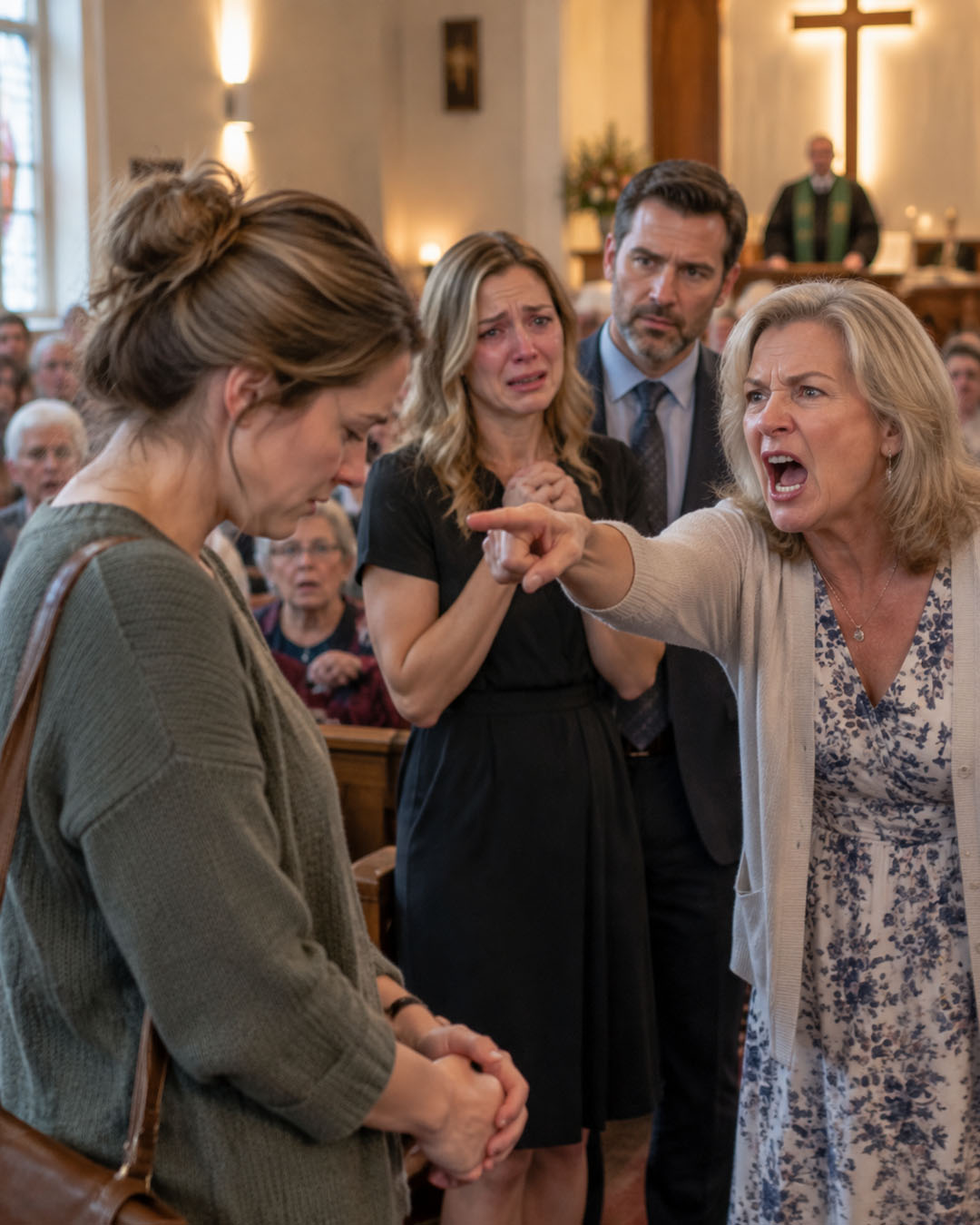
After the sermon, Pastor Hadley announced that my mother wanted to share a burden with the congregation. Mom walked to the front in her gray suit and pearls, holding the microphone with both hands.
“Church,” she began, “I need you to pray for my daughter, Dana.”
Three hundred people turned toward me.
She explained that our family had prayed for Marcus, that God had provided a compatible donor, and that I had refused to help him. Her voice trembled with what sounded like grief, and that made the words even harder to hear.
“My daughter has the power to save that man,” she said. “She knows what he is going through, and she has said no. I’ve thought about what to call someone who watches another person suffer when they could help, and there’s only one word I can think of.”
She took a breath.
“I’ve raised a murderer.”
The sanctuary went so quiet I could hear the ventilation system humming overhead. Someone whispered a prayer, another person murmured agreement, and Pastor Hadley bowed his head to ask God to soften my heart.
Nobody asked whether I had been given a choice.
When the service ended, people passed me without speaking. In the parking lot, Kendra told me she hoped I could live with myself. Mom followed, her eyes red and her face set in a way I had never seen before.
“Don’t come for Thanksgiving,” she said. “Don’t come for Christmas. Don’t call me.”
“Mom, please.”
“I don’t have a daughter named Dana.”
By the time I reached my apartment, my phone had filled with messages. The church prayer chain had sent an urgent request asking everyone to pray that my heart would be softened, and Pastor Hadley had emailed to tell me to take a season away from my Sunday school duties.
One parent from my actual school even messaged to say she felt uncomfortable about her son being in my classroom the following year.
That night, I lay on the living room floor with my dog resting his head on my stomach. Evan sat beside me, holding my hand while I wondered whether three hundred people could all be wrong about one woman.
Then, at 11:40, my phone lit up with a message from Marcus.
“Please don’t answer your mom or Kendra tonight. Can we meet tomorrow? Somewhere private. And please don’t tell them.”
I stared at the screen for a full minute.
I expected him to beg me to change my mind. I expected him to tell me how frightened he was, how much he needed my help, and how I had failed him.
Instead, he asked to meet at a diner forty minutes outside town, after his dialysis appointment. When he arrived the next afternoon, he looked older than thirty-eight, his flannel shirt hanging loosely from his shoulders and his bandaged arm resting against his chest.
He slid into the booth and looked at me with exhausted eyes.
“Dana,” he said, “I’m so sorry.”
I opened my mouth, but he raised his hand.
“No. I’m not here to ask you for a kidney. I’m here because you deserve to know what your family hasn’t told you.”
He took a slow breath.
“In April, my transplant coordinator explained a program that could help us. It’s called paired kidney donation. Kendra could donate to a compatible stranger, and that stranger’s donor could give me a kidney. The program matches people in a chain, so the blood types work out.”
I felt a chill run through me.
“What did Kendra say?”
Marcus looked down at the table.
“She said she wasn’t going under the knife for a stranger. Then she told me not to worry because she had another plan.”
He looked up at me.
“She said, ‘We have Dana.’”
Chapter 3
For several seconds, I couldn’t find my voice. I had spent weeks believing that Kendra was desperate, that Mom was frightened, and that their pressure came from a place of helpless love. Marcus had just shown me that my sister had been offered another way to help him and had refused because it required the same sacrifice she demanded from me.
“She could have donated to someone else?” I asked.
“Yes. And the transplant team believed paired donation could give me a much faster opportunity than waiting alone. It wasn’t a guarantee, but it was a real option. Kendra rejected it before we even left the appointment.”
“And Mom?”
Marcus rubbed his face. “I asked the transplant coordinator whether there was a strict age cutoff for donors. She said there wasn’t. Healthy people in their sixties are evaluated all the time, sometimes older, depending on their health. I asked whether my mother-in-law had ever contacted the center.”
He paused.
“She hadn’t. Not once.”
I remembered Mom’s hand pressed dramatically against her chest as she declared she would give him both kidneys if she could. She had never been told she couldn’t. She had simply never gone to find out.
“Why tell me now?” I asked.
“Because they’re planning another service this Sunday. They’re calling it Healing Sunday. Your mother and Kendra want the pastor to invite you up front and ask you to reconsider in front of the whole congregation.”
My stomach tightened.
“They want me to say yes into a microphone?”
Marcus nodded. “They want me sitting in the front row, looking as sick as possible. I told them I’d be there, but I can’t keep pretending this is okay.”
He told me that Kendra had been tracking his phone without his knowledge and had discovered our meeting. She had threatened to leave him if he spoke publicly about the paired-donation option. She had also threatened to contact the transplant center and claim he wasn’t committed to treatment, though he doubted she could simply remove him from the waiting list.
“I don’t know what will happen to my marriage,” he admitted. “But I can’t let them destroy you to make themselves feel better.”
I reached across the table and took his hand.
“You don’t have to apologize for any of this.”
“I know. But I am sorry.”
We sat quietly for a moment. Then I told him I would attend Sunday’s service, but I wouldn’t walk up front to defend myself. The congregation had already heard my mother’s story. I wanted them to hear the truth, too.
“I’m not going to fight her for the microphone,” I said. “I’m going to let her speak. Then I’m going to ask a few questions.”
For the first time in weeks, Marcus smiled.
“You’re going to let them dig their own hole.”
“Something like that.”
Before we parted, he told me one more thing. The church had raised $41,000 through its special offering, believing the money would support our family’s recovery after my donation. I couldn’t imagine how anyone had thought it was acceptable to collect money for a surgery I had never agreed to undergo.
That Friday afternoon, I was leaving school when a gray-haired woman in sensible shoes approached my car. It took me a moment to recognize Pat Okafor, my mother’s longtime walking partner.
“Dana, I need five minutes,” she said.
Pat had walked with Mom at 5:45 every morning for eleven years. She was a familiar face at church, but she rarely spoke during services, and I had always assumed she preferred to stay out of other people’s business.
She crossed her arms and studied me.
“Did anyone at the transplant center ever tell you your mother had been tested?”
“No. Marcus says she never even called.”
Pat nodded slowly.
“I thought so. There’s something you should know about me. I worked as a transplant coordinator for twenty-eight years. I managed donor evaluations and sat with families through some of the hardest decisions of their lives.”
I stared at her.
“Why have you never said anything?”
“When I retired, I decided I didn’t want my old job following me into church. People hear you’re a transplant coordinator, and suddenly every conversation becomes a medical consultation. I wanted to be Pat, not the person everyone asked about their kidneys.”
She looked away for a moment.
“But I can’t stay quiet anymore. I know your mother, Dana. I’ve walked beside her through grief and hard times. In January, during one of our walks, she told me something that I’ve kept to myself ever since.”
“What did she say?”
“That’s for her to explain. I won’t betray a confidence just because I’m angry.”
Pat took a breath.
“On Sunday, I’d like to ask your mother some questions in front of everyone. I don’t want to humiliate her. I want the truth to be heard. Will you let me?”
I thought about the sanctuary, the accusing faces, and the way my mother had used her position in the church to turn my private medical decision into a public trial.
“Yes,” I said. “But I don’t want anyone to hurt her.”
“Neither do I,” Pat replied. “The truth is going to hurt enough.”
That Saturday, Pastor Hadley emailed me with a formal warning. If I remained unwilling to reconsider the donation after Healing Sunday, the church elders would begin a disciplinary process that could end with my removal from membership.
I forwarded the message to Evan and Marcus, then hung my blue dress where I could see it.
I didn’t sleep much that night.
By nine fifteen Sunday morning, the church parking lot was full. The overflow room had been opened, and folding chairs lined the back wall. People from other congregations had come, drawn by the prayer chain’s invitation to a special service for Marcus.
A glittering banner behind the pulpit read, “Praying for Marcus.”
Evan held my hand as we walked to the second row. Marcus was seated in the front pew beside Kendra, who had dressed in cream and kept her hand tightly wrapped around his arm. Mom sat across the aisle in her gray suit and pearls, looking composed and almost cheerful.
Pat sat in the third row with her purse on her knees.
The service began with worship, followed by a long prayer. Pastor Hadley preached about sacrifice, love, and the duty to care for others. Each passage seemed aimed at me, but I kept my eyes forward and said nothing.
Finally, he invited my mother to speak.
Mom walked to the front, took the microphone, and turned toward the congregation.
“Thank you all for coming,” she began. “Last time I stood here, I spoke out of pain. I called my own daughter a terrible name, and I want to be honest about why. I was afraid for Marcus, and I’m still afraid.”
Her voice softened as she looked at me.
“Dana, sweetheart, you can end this today. Come forward, say yes, and we’ll put all of this behind us. Everyone here will support you. You won’t have to carry this burden alone.”
Five hundred people turned to look at me.
I stood, and Evan squeezed my hand before letting me go.
I walked slowly down the center aisle, my shoes sounding unusually loud against the carpet. Mom smiled tearfully and held out the microphone as though she had already won.
I accepted it.
“Thank you, Mom,” I said. “I’m going to answer you. But before I do, I have three questions, and I would like you to answer them because this entire congregation has already heard your version of the story.”
Her smile tightened.
“Of course, Dana.”
I looked directly at her.
“First, how many miles do you walk every morning?”
She blinked. “Three. Why?”
“Second, what was your blood pressure at your last checkup?”
Her chin lifted with familiar pride. “One hundred eighteen over seventy-four. My doctor said it was excellent.”
“And third,” I asked, “which doctor told you that you were too old to donate a kidney?”
For the first time, my mother had no answer.
Chapter 4
Mom shifted the microphone in her hands. “Many doctors,” she said finally. “It’s common knowledge that older people can’t do these things.”
“Can you name one?”
Her expression hardened. “I don’t have to defend myself to you.”
Kendra jumped to her feet. “This is a circus! Marcus is suffering, and you’re standing up there playing games!”
I turned toward the front pew.
“Marcus, may I?”
He gently removed Kendra’s hand from his arm and stood. It took him a moment to straighten, but he walked to the front without assistance and accepted the microphone from me.
“I never asked Dana for a kidney,” he said. His voice was quiet, but the sanctuary was so still that everyone heard him. “I never asked anybody here for one. I asked my wife to let me wait my turn and trust the medical team.”
He explained the paired-donation program and how Kendra had rejected it. He told the congregation that she had said she wouldn’t undergo surgery for a stranger, then announced that we had Dana. He described how the family had arranged the bulletin and the fundraising appeal before I had even completed my evaluation.
Kendra shouted at him to sit down.
Marcus continued.
“I love my wife. I love Dana. But I can’t let you call someone a murderer because she won’t give up an organ. No one should have to prove their love by undergoing surgery they don’t want.”
Pastor Hadley stepped forward, raising both hands.
“Brother Marcus, perhaps this isn’t the appropriate time—”
“Let the man speak, Tom,” called an elderly voice from the back.
It was Deacon Roy Fitch, an eighty-one-year-old Korean War veteran who had served the church for decades. He stood with one hand resting on his cane, and the pastor fell silent.
Then Pat Okafor raised her hand.
“Linda,” she said, standing in the third row, “I’m sorry. I love you, and I don’t want to embarrass you. But there’s something the congregation needs to understand.”
Mom’s face had gone pale.
“Pat, please don’t.”
“For twenty-eight years, I coordinated kidney transplants. There is no absolute age cutoff that automatically disqualifies someone from donating. Healthy people in their sixties are evaluated regularly, and some people older than that may qualify, depending on their health.”
Pat paused and looked toward the front.
“Linda has told us for years that she has excellent blood pressure, that she walks three miles every morning, and that she donates blood every spring. She told me herself that her blood type is O. Those facts don’t guarantee she’d qualify as a donor, but she could have been evaluated.”
Mom gripped the microphone stand.
Pat continued, her voice growing unsteady.
“No doctor told Linda she was too old. She never went through an evaluation. She never contacted the transplant center to ask whether she could donate.”
A murmur passed through the congregation.
“Pat, you have no right,” Mom whispered.
“I kept a confidence for six months because you asked me to. In January, during our walk, you stopped and told me you were frightened of surgery. You said you couldn’t bear the thought of being put under anesthesia and waking up with an incision. I told you that fear was normal, and you made me promise not to tell anyone.”
Pat swallowed.
“I kept that promise until you stood in this church and called your daughter a murderer for being afraid of the very same thing.”
The room fell silent again.
I watched my mother’s face, waiting for anger or another accusation. Instead, something in her expression seemed to give way. For a moment, she looked less like the formidable woman who ran the prayer chain and more like the frightened young widow I remembered from the years after my father died.
Deacon Roy spoke gently.
“Linda, you told all of us you would give both your kidneys if the doctors let you.”
Mom stared at him.
“I couldn’t,” she whispered.
Her shoulders began to shake.
“I tried to call the transplant center. Three times. Every time, I hung up. I’m sixty-one, and I’ve never even had stitches. I kept imagining the surgery, and I was terrified. I told myself I couldn’t do it, and then I looked at Dana.”
She turned toward me, tears running down her cheeks.
“She was young. She was healthy. She was a match, and I thought she could do what I couldn’t. If she said yes, I wouldn’t have to face the possibility that I might have to do it myself.”
Kendra stood motionless, her hands hanging at her sides.
Mom looked down at the floor.
“I told myself I was doing it for Marcus. I told myself that if Dana refused, she was selfish, because I couldn’t bear to admit that I was frightened, too. I made her into the bad daughter so I wouldn’t have to look at my own fear.”
Nobody spoke.
Marcus looked at Kendra with a sadness that seemed deeper than anger.
“There is still a paired-donation program,” he said softly. “You could still choose to be evaluated, if you wanted to.”
Kendra stared at him for a long moment. Then she turned and walked up the aisle, her heels clicking against the floor. The heavy oak doors swung shut behind her.
Marcus handed the microphone back to me.
I looked at my mother, then at the hundreds of people who had come expecting to watch me surrender my decision.
“I never got to answer,” I said.
The congregation turned toward me.
“My answer is still no. It was always going to be no, because nobody asked me what I wanted. You announced my surgery, collected money in my name, and called me a murderer when I wouldn’t do what you expected.”
I paused, trying to keep my voice steady.
“I love Marcus. I want him to get better. But loving someone doesn’t mean I surrender the right to make decisions about my own body. And being frightened doesn’t make me a bad person.”
I placed the microphone on the stand.
“I hope you all remember that the next time you decide someone else’s sacrifice is easy to demand.”
Then I walked back to Evan.
People who had spent weeks judging me suddenly found the floor fascinating. The woman who had pulled her daughter away from me in the aisle sat with her cheeks bright red. Pastor Hadley looked as though he wanted to speak, but no words came.
Evan took my hand, and we walked out into the sunlight.
We were halfway across the parking lot when I heard footsteps behind us.
It was Mom.
Her pearls were crooked, and her makeup had run. She stopped several feet away, breathing hard, as though crossing the parking lot had required every bit of courage she possessed.
“I’m going to call them tomorrow,” she said.
I turned toward her. “Call whom?”
“The transplant center. Pat said she’d drive me.”
I stared at her, uncertain what to say.
“I’m not asking you to forgive me,” she continued. “I just wanted you to hear it from me first.”
Then she turned and walked back toward the church.
I wanted to believe that was the beginning of an apology. But my mother had spent sixty-one years learning how to avoid admitting she was wrong, and one difficult Sunday wasn’t going to change everything.
She didn’t call that evening.
She didn’t call the following morning to say she was sorry.
But at 5:45 Monday morning, Pat pulled into my mother’s driveway. At 7:10, Marcus sent me a photograph of his phone showing a call to the transplant center that had lasted forty-one minutes.
Mom had finally asked for an evaluation.
Chapter 5
My mother’s donor evaluation took nearly a month. She went through the same process I had completed: blood tests, imaging, consultations with the surgical team, and a psychological assessment. Pat accompanied her to appointments, and Mom approached each one with the determination of someone marching toward something she still feared.
The doctors found that she was remarkably healthy for her age. Her blood pressure was excellent, she had no obvious medical reason that automatically ruled her out, and her test results showed that she was compatible with Marcus.
She was a match.
The surgery took place in late August. I drove to the hospital the night before and joined Pat, Evan, and Deacon Roy in the waiting room. Pastor Hadley came, too, although I was not ready to have a long conversation with him. He tried to apologize for the service, and I told him I appreciated the effort, even though I wasn’t sure I could forgive him yet.
Kendra arrived shortly before the operation. She sat across the room from me, her hands folded tightly in her lap, and neither of us spoke. We were both waiting to learn whether Marcus would get the chance to live without dialysis and whether Mom would come through the surgery safely.
When the surgeon finally appeared, he told us the transplant had been successful. Marcus was recovering, and Mom was stable.
Kendra covered her face with both hands and began to cry.
I wanted to comfort her. I wanted to tell her that we could put everything behind us and become a family again. But I knew that one successful operation couldn’t erase the months of manipulation, blame, and public humiliation.
I stayed in the room.
That was all I could offer her then.
Marcus recovered steadily. Six weeks later, he was no longer receiving dialysis, and the gray color had begun to leave his face. He started regaining weight and energy, and the doctors were pleased with his progress.
One Saturday morning, he showed up at my apartment carrying a toolbox and a plank of walnut.
“I heard you needed a bookshelf,” he said.
I laughed, then cried so hard that he had to set the toolbox down and hug me.
The church eventually voted to put the $41,000 offering toward Marcus’s medical expenses and donate the remainder to the hospital’s patient assistance fund. The elders held the meeting without Mom, who had resigned from the prayer chain. The congregation had begun to understand that compassion could not be measured by how loudly someone demanded sacrifice from another person.
Pastor Hadley asked whether I would return to teaching Sunday school.
I told him no.
I didn’t hate the church, and I didn’t believe every person there was cruel. But I no longer felt safe in a place where people had accepted my mother’s accusation without asking whether it was true. Faith, I had learned, could be a source of comfort, but it could also be used to silence people who were afraid to disagree.
Evan and I began spending Sundays at a small diner near the river. We drank coffee, shared pancakes, and took our dog for long walks afterward. For the first time in years, my weekends belonged to me.
The mother of the child who had questioned whether I should teach her son eventually emailed me an apology. I read it twice and chose not to respond. She might have been genuinely sorry, but I wasn’t obligated to make her feel better about a decision she’d made without knowing the facts.
My relationship with Kendra remained strained. We exchanged a few messages about Marcus’s recovery, but neither of us was ready to discuss what had happened. I knew she had been frightened, too, and I knew she loved her husband. But she had refused an available avenue to help him, then tried to make me feel responsible for the consequences.
Understanding her fear didn’t mean I had to excuse her choices.
Mom was more difficult.
She never called to apologize for the word she had used in church. She never acknowledged the humiliation of being condemned in front of people I had known since childhood. She did, however, complete the evaluation, undergo surgery, and donate a kidney to Marcus.
When I visited her in the recovery room, she was pale and groggy, with an IV in each hand. She squinted at me and complained in a small, irritated voice that nobody had warned her about the gas pains.
“It was in the pamphlet, Mom,” I said.
She closed her eyes.
“I guess I should have read it.”
Then she drifted off to sleep.
That was the closest I ever came to hearing her admit that she had been wrong. It wasn’t the apology I deserved, and it didn’t repair the damage she’d done. But it was a small crack in the wall she had spent her life building, and I decided I could live with that for now.
Months later, I sometimes thought about that Sunday morning. I remembered my mother holding the microphone, the congregation turning toward me, and the terrible weight of hearing someone who had raised me declare me a murderer because I had refused to give away an organ.
I also remembered Pat standing up in the third row, speaking quietly but refusing to retreat. I remembered Marcus telling the truth even though it threatened his marriage. And I remembered the moment I realized that I could love my family without letting them decide what I owed them.
I never donated my kidney.
I didn’t need to.
My mother was healthy enough to be evaluated, and she chose to undergo the surgery herself. Marcus recovered, and the people who had once treated me as though I were responsible for his suffering had to confront the fact that the solution had never depended on forcing me to say yes.
I still love my mother. I still care about my sister. And I still hope that one day we will be able to sit together without pretending that nothing happened.
But I no longer confuse love with obedience, and I no longer believe that saying no makes me a bad person.
Sometimes, the hardest decision is not the one that saves another person’s life. It’s the one that forces everyone around you to recognize that your life belongs to you, too.
THE END.
⚠️ All characters and events are fictional. Do not imitate or apply them in real life. 😌😌😌


