
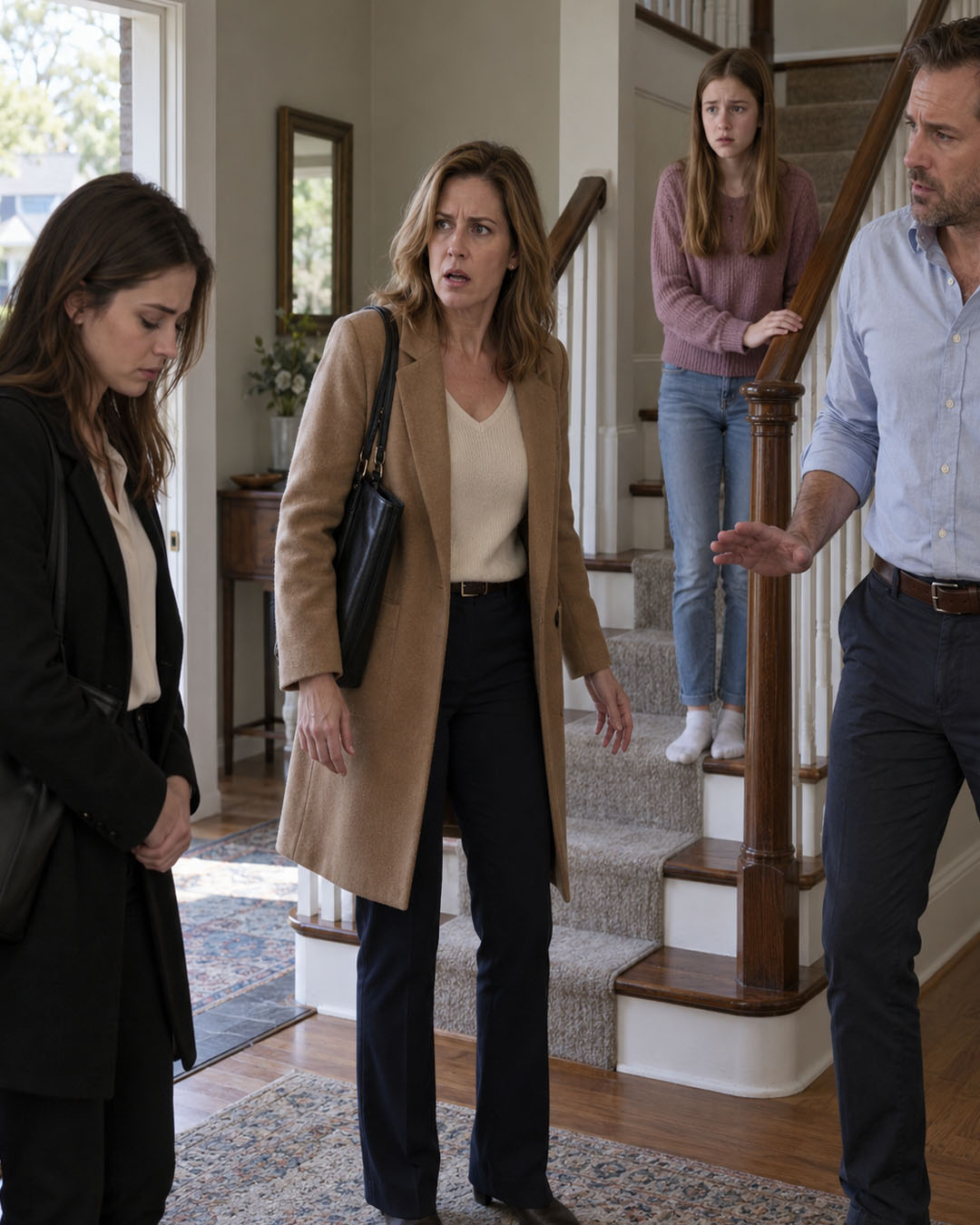
Chapter 2
By my senior year of high school, I had become pretty good at pretending our family situation didn’t bother me.
Then Mom got sick.
It started with exhaustion. She would come home from work and sit at the kitchen table without taking off her coat. Then came bruises she couldn’t explain and a fever she insisted was probably something she’d picked up at the office.
Mom had always been the kind of woman who believed illness should schedule itself around her responsibilities.
One Tuesday morning, she went to a doctor’s appointment.
That afternoon, she called me from the hospital.
“I’m going to be here for a little while,” she said in a careful, steady voice. “Your Aunt Diane is coming to stay with you.”
Then she added, “Please eat something other than cereal.”
My aunt arrived with a suitcase and immediately took charge of everything. She bought groceries, handled the bills, informed my school, and made sure I had rides to the hospital.
I went to class every day, but I rarely remembered what the teachers said. Sometimes I’d look down at my worksheet and realize I’d written the same word six times.
After school, I’d sit beside Mom’s hospital bed.
She complained about the food, which tasted like wet cardboard, and sometimes we laughed about ordinary things. Once, she asked me to describe a teacher’s ridiculous shoes. I spent ten minutes doing impressions until she finally smiled.
Those moments became precious.
Dad knew she was hospitalized. I told him myself.
He sent a message saying he’d keep us in his prayers.
A few days later, he called to ask whether I knew where Mom kept the paperwork for the house.
I stared at my phone.
“I don’t know.”
Then I hung up.
He sent another message saying he was only trying to help.
For six weeks, doctors did everything they could. My aunt stayed calm, and I tried to follow her example.
I was angry at everyone and everything. The hospital vending machine. The parking garage. The endless waiting rooms. Even myself whenever I felt relieved that my aunt said I could stay home and sleep instead of visiting.
Mom died early on a Thursday morning.
Aunt Diane came into my bedroom before sunrise and sat on the edge of my bed.
She didn’t need to explain.
I asked her to repeat what she’d said because the words didn’t make sense the first time.
The funeral passed in fragments. A woman from Mom’s office telling me she’d traded shifts to attend. A cake nobody touched in our kitchen. My father’s hand resting on my back while he hugged me in the receiving line.
“I’m here now,” he whispered. “You don’t have to worry about being alone.”
I hugged him back.
I wish I didn’t feel embarrassed admitting that, but I did. After everything, I still wanted my father.
Mom had made arrangements I hadn’t fully understood.
A few days after the funeral, her lawyer came to the house to review her will and the trust she’d established. When I turned sixteen, she’d updated the documents during one of those appointments she described as boring but necessary.
The house and most of her savings were meant for me.
Aunt Diane had been appointed to oversee the trust and protect the assets until I was old enough to manage them responsibly. The college funds had restrictions, too.
The lawyer explained everything in plain English.
Dad was my surviving parent, but that didn’t automatically make him the owner of Mom’s property.
The trust controlled the house.
I was supposed to remain there safely while finishing school, with my aunt overseeing the arrangements.
Dad sat across the table, looking increasingly uncomfortable.
He asked about repair costs, who controlled the accounts, and whether my aunt could make decisions without consulting him.
Then he asked how many bedrooms the house had.
It was strange. He’d lived there for years.
Two days after the funeral, he called.
I was sorting through Mom’s scarves when I answered, expecting him to ask how I was doing.
Instead, he announced that he and his girlfriend had decided to get married.
“Losing your mother reminded me that life is short,” he said. “We shouldn’t waste time. Rachel and I want to make this official.”
I held one of Mom’s scarves against my chest.
He continued explaining that Rachel wanted things settled before the children got older.
“And now we can all live together as a proper family. It’ll be good for everybody.”
I couldn’t believe what I was hearing.
“You called me two days after Mom’s funeral to tell me you’re getting married?”
“Don’t make this about timing, Delaney. Rachel can be there for you, too. You need a mother figure.”
I looked around the bedroom.
Mom’s perfume was still on the dresser. Her slippers were beside the closet. Her hairbrush was sitting exactly where she’d left it.
“I have a mother,” I said. “She’s dead.”
Then I ended the call.
I went to their engagement party anyway.
Aunt Diane offered to drive me and promised we’d leave whenever I wanted. The party was held in a rented room above a small restaurant, decorated with inexpensive flowers and balloons.
Dad hugged me when I arrived.
He introduced me as his beautiful daughter, and for a few minutes, I thought perhaps he was genuinely trying.
Then he made a toast.
He talked about finally getting the family life he should have had from the beginning. He described his first marriage as years of trying to make two incompatible people happy.
Now, he said, he’d found someone who appreciated him.
He talked about not wasting another minute on the past.
People raised their plastic cups.
I stood there listening to strangers applaud a speech that made my mother’s life sound like a mistake.
I put down my drink and went for my coat.
Rachel caught up with me near the door.
“Leaving now would be disrespectful,” she whispered.
I looked at her.
“Tonight isn’t about your mother. Can’t you just let your dad have one happy evening?”
“Have as many happy evenings as you want,” I said. “But I’m not going to be used as a decoration.”
Dad appeared behind her.
“What is going on?”
“I’m leaving.”
He shook his head.
“You’re acting just like your mother whenever you don’t get your way.”
That was when I started crying.
Not quietly, either. I couldn’t get a full sentence out.
I told him I hoped he’d enjoyed telling an entire room of people that Mom had been a waste of his time.
Aunt Diane appeared beside me, took my coat, helped me into it, and led me outside.
During the drive home, I kept apologizing for embarrassing her.
She eventually pulled into a parking lot and turned off the engine.
“Honey, you didn’t embarrass me.”
She paused.
“He did.”
Dad and Rachel married a few weeks later in another town.
I wasn’t invited because he hadn’t bothered to tell me the date had changed. I found out through photographs somebody sent me.
He looked happy. Rachel looked happy. The children wore matching outfits and carried little flowers.
I stared at the pictures longer than I wanted to admit.
Rachel had chosen a shade of blue almost identical to the color Mom used for our family photographs.
Three days later, Dad came to the house.
He said he needed to discuss our living arrangements.
His lease was ending. Money was tight. Rachel had reduced her work hours after their second child, and childcare costs were becoming difficult to manage.
He looked around the living room.
“It doesn’t make sense to keep paying rent when you’ve got so much space here.”
Aunt Diane reminded him that the house was held in trust for me and that any long-term arrangement needed to be approved by her.
Dad called that ridiculous.
“We’re family,” he said. “This shouldn’t be a business transaction.”
Then he turned to me.
“If you really want me in your life, this is your chance to show it.”
And I wanted him in my life.
That was the part he understood better than anyone.
Chapter 3
Aunt Diane asked me privately what I wanted.
I told her it might be nice to have people in the house. Maybe the children would make it feel less empty. Maybe Dad and I could finally rebuild something.
I also reminded her that Dad had promised my bedroom would stay exactly as it was.
My aunt looked concerned, but she agreed to a short trial arrangement.
She made sure no documents gave Dad ownership or permanent residency rights. She would return to her own home once they moved in, but she’d keep a key and check on me regularly.
Dad called her overprotective.
I called her dramatic.
Looking back, she was the only adult in the room who seemed to understand what could go wrong.
I helped carry boxes on moving day.
I wanted to be mature about it. I wanted to believe this was a fresh start.
But watching strangers move furniture through the living room where Mom and I used to watch terrible cooking shows felt awful.
My half brother, Noah, stopped in the hallway in front of a framed photograph of Mom holding me as a baby.
“Who’s that?” he asked.
“My mom.”
He studied the photograph.
“She looks nice.”
Before I could say anything else, Rachel appeared behind him.
“Come on, sweetheart. We need to make room for our pictures.”
Later, I found several of Mom’s photographs stacked in the garage on top of an old storage bin.
There were family pictures, a photograph of Mom’s parents on their wedding day, and one from my elementary school graduation. One frame had a chipped corner.
I carried everything upstairs and then went to ask Rachel why she’d moved them.
“I’m organizing,” she said. “I didn’t throw anything away.”
“Why were they in the garage?”
She folded her arms.
“Delaney, there are going to be five of us living here. We can’t have every wall covered in reminders of someone who’s gone.”
“Those reminders are my mom.”
“She’s not the only person who matters now.”
Dad heard us and immediately told me to stop picking fights on moving day.
I waited for him to look at the photographs.
He didn’t.
“If you want a few pictures in your room, that’s fine,” he said. “But don’t turn everything into an argument.”
I carried the frames upstairs and leaned them against my bedroom wall.
I couldn’t bring myself to put them away.
That evening, Dad announced another family decision.
The house had three bedrooms. He and Rachel would take the main bedroom. The children needed their own rooms.
I assumed Noah and his little sister, Lily, would share the spare bedroom.
Rachel disagreed.
Noah was starting school soon and needed quiet. Lily was still young and woke during the night. Separate rooms would be better.
I looked at Dad.
He nodded.
“We’ve figured out a comfortable arrangement for you in the living room until you graduate.”
I laughed because I genuinely thought he was joking.
“You’re putting me on the couch?”
“Only temporarily,” he replied. “You’ll be eighteen soon and probably heading off to college.”
Rachel suggested buying a folding privacy screen.
She said it as though she were offering me a generous upgrade.
I asked why the children couldn’t share a room for a few months.
Dad sighed.
“Little kids need stability, Delaney. You need to stop being selfish.”
I stared at him.
“I just lost my mother. Does that count as needing anything?”
His expression hardened.
“Don’t bring her into every conversation.”
Then Rachel brought up childcare.
They were planning to stop paying the woman who watched the children after school. Since I’d be home most afternoons, I could take over.
I told them I had classes, homework, and plans to apply for part-time jobs.
Rachel smiled.
“You can do those things while keeping an eye on the kids.”
Dad added that family members helped each other.
“You’re not paying bills, so this is your chance to contribute.”
I couldn’t believe he was saying that.
I wasn’t paying bills because I was seventeen and finishing high school in the house my mother had left me.
He was living there without paying rent, but somehow I was the one who needed to contribute.
I tried to explain calmly that the house wasn’t theirs to reorganize.
Then Dad pushed his chair back so hard it scraped against the floor.
“As long as you’re a minor, I’m your father, and you’ll follow my rules.”
“What happens if I don’t?”
He looked straight at me.
“Then you can find somewhere else to stay.”
Rachel began discussing which furniture needed to be moved upstairs.
I went to my bedroom, closed the door, and sat on the bed beside Mom’s photographs.
My hands were shaking.
I kept imagining someone opening the drawers where I still kept her sweaters. I imagined coming home from school and finding my room emptied.
Finally, I called Aunt Diane.
I tried to explain everything without crying, but I barely managed to get the words out.
“They want my room.”
She didn’t ask me to calm down.
“Don’t move a single thing. I’m coming in the morning.”
Then she asked whether I felt safe staying there that night.
I told her I did, although I locked my bedroom door anyway.
Aunt Diane arrived before breakfast carrying a folder.
Dad was in the kitchen drinking coffee.
He smiled when he saw her.
“Hope you’re not here to make a fuss.”
Rachel immediately announced that we’d already settled the bedroom issue.
I looked at her.
“No. You announced it. That’s different.”
My voice shook, but I didn’t take the words back.
Aunt Diane placed the trust paperwork on the table.
She explained that Dad had been permitted to stay temporarily because I wanted to try living together. That permission did not give him the right to take over the house or make decisions about my living arrangements.
Dad reminded her that he was my legal parent.
She nodded.
“I’m not questioning that. But being her parent doesn’t give you the right to use property held for her in a way that harms her.”
Rachel argued that the younger children were innocent and needed beds.
Aunt Diane agreed.
“So does Delaney.”
That silenced her.
My aunt explained that she would be contacting the lawyer again if they continued treating the temporary arrangement as permanent.
Dad suddenly became reasonable.
“If she’d just explained herself without shouting, we could have worked this out.”
I wanted to scream.
I’d explained myself. I’d asked politely. I’d offered compromises. I’d done everything except agree to disappear.
Instead, I went upstairs and moved a chair in front of my bedroom door.
It wasn’t particularly mature.
But it made me feel better.
They backed down.
I kept my bedroom, and Noah and Lily shared the spare room. Dad offered an apology that included the words, “If you felt threatened.”
I accepted it because I was exhausted.
He also agreed that if the arrangement didn’t work, they’d make other housing plans.
Aunt Diane wasn’t convinced.
Before leaving, she hugged me.
“You can love someone and still refuse to let them use you.”
I nodded.
I thought I understood.
But I still wanted Dad to choose me.
That weekend, Rachel posted in a local parents’ Facebook group.
She described a nearly grown stepdaughter who refused to give up her bedroom for two little children. She left out the fact that the house belonged to me.
A woman who had worked with Mom recognized the situation and sent a screenshot to my aunt.
I was humiliated.
“Please don’t make another scene,” I begged.
Aunt Diane saved the screenshot.
She didn’t respond publicly.
The temporary arrangement was supposed to last only a few weeks. I kept asking my aunt to give it more time because admitting I’d made a mistake felt almost as painful as the situation itself.
I also started therapy through a referral from my school counselor.
During my first appointment, I spent most of the session insisting I was fine, except for the obvious fact that my mother was dead.
The therapist asked me what I felt when Dad became angry.
I said I felt responsible for making him calm down.
Then I started crying so hard I couldn’t finish the sentence.
We worked on that for weeks.
I began understanding something I had never wanted to accept: I couldn’t perform my way into becoming a daughter my father would treat properly.
Chapter 4
By winter, Dad’s drinking had returned.
It wasn’t another dramatic incident like the music festival. It was smaller, quieter things.
The smell coming from his travel mug in the evening. The way he’d fall asleep halfway through a children’s movie. The slurred words he tried to disguise as tiredness.
Rachel would hurry the children upstairs whenever Noah asked why Dad was talking funny.
Then she’d look at me as though I’d somehow taught him to notice.
I told my aunt and my counselor.
Dad eventually found out.
He accused me of trying to turn everyone against him.
Rachel continued insisting that he was simply exhausted from work.
But the situation became harder to ignore.
One afternoon, she threw away an old grocery list written in Mom’s handwriting because it was just trash.
I spent an embarrassing amount of time searching through the kitchen garbage until I found it.
Dad watched me.
“Delaney, your mother is gone. Grief isn’t a reason to make everyone else uncomfortable forever.”
I looked at him.
For the first time, I didn’t feel like arguing.
I went to Aunt Diane and told her I wanted them out after I turned eighteen.
She didn’t celebrate or congratulate me for finally standing up to him.
She simply asked whether I was certain.
Then she explained what would happen, what legal steps would be necessary, and how difficult things might become.
I told her I was certain.
I was scared.
But I meant it.
The lawyer sent written notice ending the family’s temporary permission to stay. My aunt already had authority under the trust to protect the house, so the process was handled through the proper legal channels.
My eighteenth birthday wasn’t what made the notice possible.
I’d asked my aunt to give Dad time to leave voluntarily, so she began the formal process months before I turned eighteen.
Dad received the notice.
He called it a cruel joke and threw his copy onto the kitchen counter.
When Aunt Diane tried to discuss a moving plan, he refused.
“I’m the parent. I’m not going anywhere. I won’t put my children on the street.”
The lawyer explained the next steps.
Dad ignored the notice, so the matter went before a court.
I signed the documents I needed to sign and tried to concentrate on my exams.
Dad attended the hearing and argued that we were a family and that Aunt Diane was manipulating me.
The court gave him time to leave.
He still refused.
The scheduled enforcement appointment was set for the Wednesday after my eighteenth birthday.
The paperwork mattered, not the birthday itself. Dad had received notice, attended the hearing, and had been given time to make arrangements.
There were some ugly moments along the way.
Dad asked me to sign a letter saying I wanted him and his family to remain permanently.
I refused.
One evening, I overheard him arguing with Rachel in the kitchen.
She was furious.
“You told me she would agree once she turned eighteen.”
Dad told her to lower her voice.
“You said you had this handled. I gave up our old lease because you promised we could stay here.”
He blamed Aunt Diane.
Then he blamed me.
I stood in the hallway, listening.
And suddenly, something became painfully clear.
They hadn’t misunderstood the ownership situation.
They hadn’t believed the house automatically belonged to Dad because he was my parent.
They knew exactly whose house it was.
They had simply expected to wear me down until I gave them what they wanted.
That realization hurt more than I expected.
A few nights later, Dad came into my room.
He sat on the edge of my bed and started crying.
He said money was tight. He couldn’t afford another rental deposit. Rachel wasn’t making enough, and the children needed stability.
He said he didn’t know what was going to happen to them.
I listened.
Part of me wanted to offer another six months.
I even typed a message to Aunt Diane suggesting we reconsider the deadline.
Then I deleted it.
My aunt had already offered to help Dad find affordable housing. He had refused.
The following evening, she stopped by with a new phone because mine was barely holding a charge.
She also brought takeout.
We ate in my bedroom with the door closed.
“The court order is still in effect,” she reminded me. “If they haven’t left, the scheduled enforcement will go ahead.”
I nodded.
Then I asked the question I’d been carrying for months.
“Am I a terrible person?”
She put down her fork.
“You’re a grieving teenager trying to keep her own bedroom. I think the terrible-person position has already been filled.”
I laughed.
Then I cried.
Sometimes those two things are practically the same.
I turned eighteen on a Tuesday.
Aunt Diane took me to breakfast before school. Dad didn’t wish me a happy birthday until dinner.
He handed me a card with some cash inside.
“I hope this is the year you learn how important family is,” he said.
I thanked him because Noah and Lily were watching.
Rachel asked whether I wanted cake, then admitted she’d forgotten to buy one.
I told her it was fine.
I didn’t want a cake.
I wanted Wednesday morning to be over.
Dad stayed up late watching television.
I went to bed early and kept my phone beside me.
Chapter 5
The next morning, someone knocked on the front door.
Dad came downstairs barefoot, irritated at being woken up.
When he opened it, a civil deputy stood on the porch holding a folder.
Aunt Diane was beside him, along with the lawyer’s representative.
Dad stared at the paperwork.
Then he looked at me.
“You actually did this?”
I had imagined that moment dozens of times.
I’d pictured myself delivering some perfect speech about everything he’d done. I’d imagined telling him exactly how much he’d hurt me.
But standing there, I couldn’t find anything worth saying.
“You knew the date,” I replied.
Rachel appeared in the hallway wearing her robe.
“Why are there people in my house?”
The deputy calmly explained that he was there to carry out the court’s order.
Dad called it harassment.
Rachel called me heartless.
Then she turned on him.
“You said she wouldn’t go through with it!”
Dad told her not to start.
“You told me you handled this!”
They began arguing right there in front of the deputy.
Nobody was dragged away in handcuffs. The family was given time to collect essential belongings and arrange a later pickup for the remaining furniture.
But the argument continued.
Noah started crying because everyone was shouting. Lily clung to her mother’s leg.
I went into the kitchen and gripped the counter.
I hadn’t wanted the children to witness any of this.
Their parents could have avoided the entire scene by leaving when they were given notice.
Instead, Dad kept shouting that I was destroying the family.
I picked up Lily’s stuffed animal from the couch and handed it to her.
She looked up at me with wet eyes.
“Can I come visit again?”
I swallowed.
“I don’t know, sweetheart. I don’t want to promise something I can’t be sure about.”
She hugged the stuffed animal and followed her mother.
They gathered their bags, the children’s belongings, and whatever furniture they could safely move.
I’d started recording a little of the doorway exchange on my new phone because I was afraid Dad would later describe the morning differently.
As he stood near the door, he looked at me for a long moment.
“Your mother would be ashamed of you.”
The words landed exactly where he intended.
Before I could answer, Aunt Diane stepped forward.
“Don’t speak for your ex-wife. You didn’t listen to her when she was alive.”
Dad looked at her but said nothing.
Then he walked out.
I watched the cars pull away.
I expected to feel victorious.
Instead, I sat down on the floor in the empty hallway and sobbed.
Not because I wanted him back.
Because I’d wanted a father who would never make me choose between having him in my life and keeping the last place where I still felt close to my mother.
Aunt Diane sat beside me.
She didn’t tell me everything would be wonderful now. She didn’t give me a speech about being strong.
She simply stayed.
The next few weeks were filled with ordinary problems.
A faucet leaked. The utility bills were higher than I’d expected. I had to learn how much groceries cost and why a simple trip to the hardware store could somehow take an entire afternoon.
My aunt helped me work out a budget using the trust support.
I applied for a receptionist position at a neighborhood medical clinic and decided to postpone college until the following term.
When I received my first paycheck, I was thrilled.
Then I went grocery shopping.
Apparently, adulthood involved getting excited about earning money and immediately spending most of it on laundry detergent.
I was learning.
Then the court papers arrived.
Dad had challenged the way the order was carried out. He claimed he hadn’t been given enough time to leave and argued that because I’d been a minor when the notice began, he should have been allowed to remain in the house as my parent.
I panicked.
For several nights, I imagined losing the house, losing Mom’s savings, and somehow destroying everything she’d worked so hard to protect.
Aunt Diane sat me down.
“We followed the lawyer’s advice. We have the notices, the hearing records, and the documentation. We’ll answer the claims properly.”
She reminded me that we didn’t need to fight Dad through text messages or arguments in the kitchen.
The lawyer handled the formal responses.
There were fees and stressful weeks. Nothing disappeared overnight.
But as the documents were reviewed, it became increasingly difficult for Dad to pretend he hadn’t known what was happening.
Eventually, he withdrew his challenges rather than spend more money pursuing them.
I didn’t receive a huge settlement.
I didn’t win some dramatic courtroom victory.
I kept living in my house.
That was all I had wanted.
Rachel, however, wasn’t finished telling her side of the story.
She returned to the same local parents’ Facebook group and wrote a long post about a spoiled stepdaughter who had thrown two innocent children out of their home.
People initially sympathized with her.
Then the woman who had known Mom from work replied.
She posted a screenshot of Rachel’s earlier complaint, the one about me refusing to give up my bedroom.
She also pointed out that the house had belonged to my mother before she married Dad.
Suddenly, the comments changed.
People began asking why two adults had expected a grieving teenager to surrender her bedroom in a house she had inherited.
Rachel tried to explain that her original post had been taken out of context.
But she’d written it herself.
Eventually, she deleted both posts.
Relatives started asking questions.
Nobody became famous. Nobody lost a job. There wasn’t some enormous public scandal.
Rachel simply had to face people who knew she’d misrepresented what happened.
I hated that my family’s business had become a neighborhood discussion.
Still, it felt good that I hadn’t needed to defend myself publicly.
I drafted a response anyway.
It was long, angry, and surprisingly funny in a few places. I had enough material to write an entire essay.
Then I remembered Noah.
He might grow up someday and find strangers laughing about his parents.
I deleted the draft.
Aunt Diane reminded me that protecting my peace didn’t require convincing everybody that I was right.
For once, I listened before making things worse.
Dad and Rachel eventually rented a smaller place.
Rachel had to take on more hours at work, and they resumed paying for childcare.
Those were ordinary expenses they’d tried to avoid by moving into my house and expecting me to watch their children for free.
The legal challenges had also cost them money.
According to Aunt Diane, the financial pressure didn’t make Dad stop drinking.
Eventually, Rachel took the children to stay with relatives after Dad fell asleep when he was supposed to pick Noah up.
Nobody was hurt, but she refused to pretend it was acceptable.
For once, she didn’t make excuses for him.
Dad eventually entered a treatment program.
I heard about it through Aunt Diane.
By the time graduation arrived, he sent me a message.
He said he was getting help and hoped we could start fresh.
I read it several times.
Part of me wanted to ask whether he remembered the music festival. Whether he remembered leaving me in a parking lot. Whether he remembered asking a twelve-year-old girl to protect his marriage by keeping his affair secret.
I wrote several replies.
I sent none of them.
I was glad he was getting treatment. I genuinely was.
Noah and Lily deserved a father who was sober and present. They deserved to grow up without having to wonder whether the adults around them were telling the truth.
But recovery didn’t erase what had happened before he walked through those treatment center doors.
And I didn’t owe him access to me as a reward for finally taking care of himself.
I told Aunt Diane I wasn’t ready to see him.
She didn’t try to change my mind.
She didn’t tell me that forgiveness was necessary or that family should always come first.
She just said, “You get to decide what feels safe for you.”
I still don’t know whether I’ll feel differently years from now.
I’m not making promises about that, either.
I still live in Mom’s house.
The spare bedroom has become a study. I keep Noah and Lily’s little drawings in a folder because those children aren’t the people who hurt me.
I don’t blame them for what their parents did.
The photographs of Mom are back in the hallway. Even the one with the chipped corner.
I got the receptionist job, started taking classes at the local community college, and slowly learned how to manage the house.
There are nights when living independently feels wonderful.
There are other nights when I’m eating noodles over the kitchen sink while trying to figure out why the electricity bill is so high.
Both can be true.
Sometimes, I still reach for my phone because something ordinary happens and I want to tell Mom.
A rude customer at work. A funny thing a professor said. The fact that I finally fixed the faucet without having to call a plumber.
Those moments hurt in a way the arguments never did.
I miss her voice. I miss the way she asked whether I’d eaten. I miss knowing that when I came home, somebody would notice.
But I’ve learned something important about the house she left me.
It was never just about the bedrooms, the furniture, or the money.
It was the place where I’d been allowed to be her daughter without having to earn the right.
Dad once told me I needed to understand how important family was.
He was right about one thing.
Family matters.
But family isn’t an excuse to take someone’s home, dismiss their grief, or make them feel guilty for protecting themselves.
It isn’t a reason to hand a teenager responsibilities that belong to adults.
And it certainly isn’t something you get to demand while refusing to show the same care in return.
I don’t hate my father.
I hope he gets better. I hope he becomes the kind of man his younger children can depend on.
Maybe someday we’ll have a conversation.
Maybe we won’t.
Either way, my life doesn’t have to remain on hold while I wait for him to become the father I needed.
One evening, after work and class, I came home carrying a bag of groceries.
The house was quiet.
I placed my keys in the little dish by the entrance, the one Mom used to keep there. I kicked off my shoes, put the milk away, and glanced at the photographs in the hallway.
Mom was smiling in the picture from my elementary school graduation.
I stopped for a moment.
“I got through another day,” I whispered.
Then I went upstairs.
My bedroom door was exactly where it had always been. My mother’s scarves were still folded in the drawer, and the photographs I’d rescued from the garage were arranged along the shelf.
Nobody had moved them.
Nobody had told me to make room for somebody else.
I closed my bedroom door, set my phone on the nightstand, and sat on the bed.
For years, I’d thought the hardest thing about losing my mother was that she wasn’t coming back.
I was wrong.
The hardest thing was learning that some people would use that loss to convince me I no longer had a place in the world.
But Mom had made sure I did.
She’d planned ahead. She’d protected the house. She’d left me a home and enough support to begin building a life of my own.
And now, when I walk through the front door, I don’t have to wonder whether I’m welcome.
I don’t have to ask permission to sleep in my own bedroom.
I don’t have to prove that I deserve to be there.
I put my keys down beside Mom’s little dish, look once more at her photograph, and turn off the hallway light.
For the first time in a long time, home feels like home again.
THE END.
⚠️ All characters and events are fictional. Do not imitate or apply them in real life. 😌😌😌


