
Chapter 2
Miles called me at seven the next morning, exactly as promised. He had been my attorney since before Stuart’s company existed, and he had learned long ago that I did not call him before business hours unless something genuinely required his attention.
“Tell me what you need,” he said.
“I want Stuart removed from every officer position he holds in the company. I want his authorized-user status suspended, his building access revoked, and a formal review opened into every transaction I’ve flagged.”
“Do you have documentation for all of it?”
“I have the statements, receipts, lease payments, and the internal records. I’ve also saved the original files in a separate location.”
“Good. Don’t delete anything, don’t alter the originals, and don’t contact him about the investigation.” I heard papers moving on his end of the call. “We’ll have to follow the operating agreement and any applicable notice requirements. If he challenges the decision, we want the process to be as clean as the evidence.”
“When can we act?”
“Thursday morning, assuming the documents are ready and the bank can implement the restrictions.”
“That’s the day he leaves for Cabo.”
Miles paused. “You want to wait until he’s traveling?”
“I want the company protected before he can move any more money. His travel plans are his business. The company’s money is mine to safeguard.”
“Understood. I’ll prepare everything for your approval.”
After we hung up, I called Nadia.
She arrived less than an hour later, carrying a grocery bag, two coffees, and the sort of quiet determination that had carried me through more difficult days than either of us liked to remember.
She took one look at me and set the coffees down.
“Tell me everything.”
So I did.
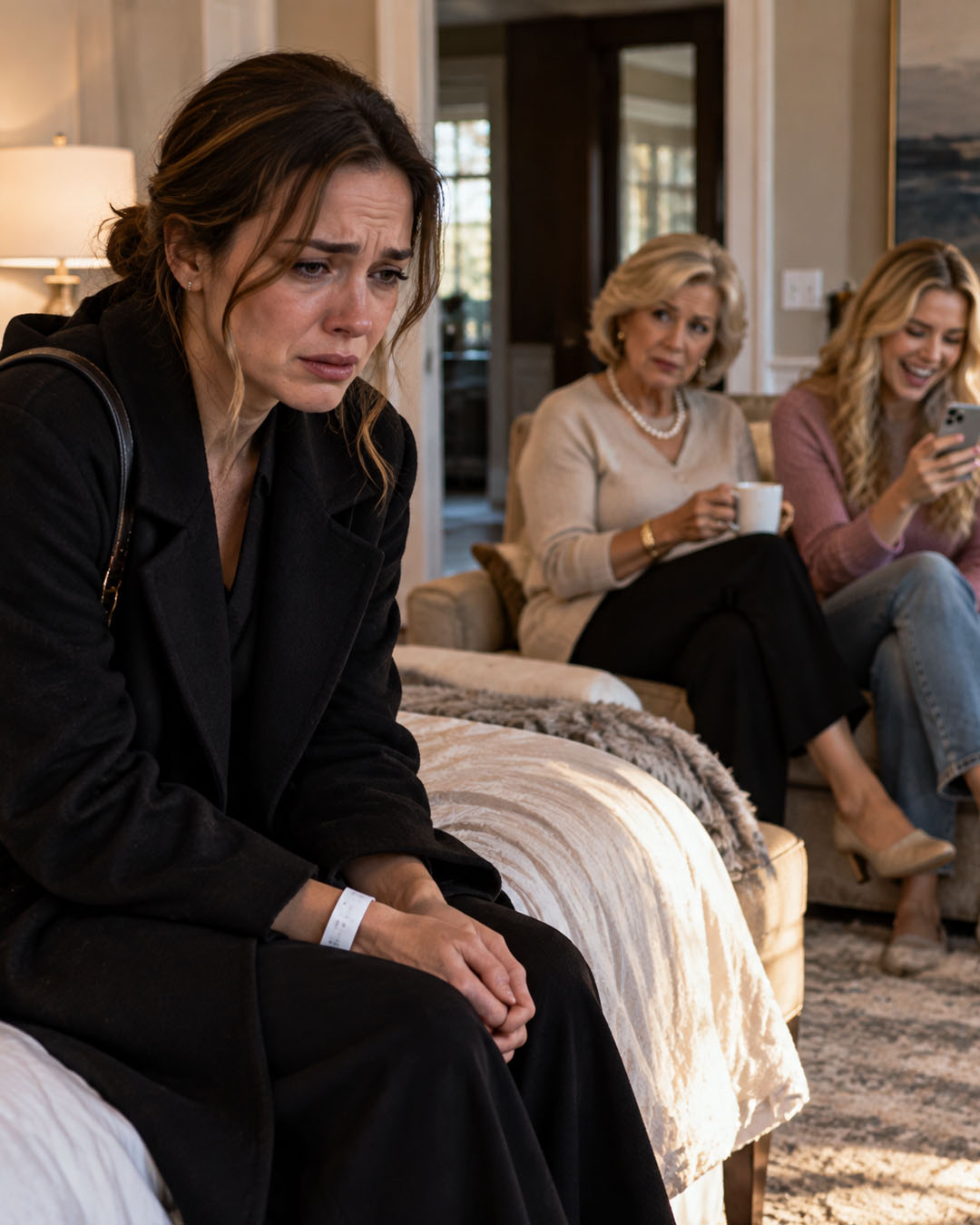
I told her about the clinic, the affair, the financial records, and Stuart’s decision to leave me alone while I recovered. I told her about the way Roberta had spoken to me, and how Skye had continued scrolling through her phone as if I had merely announced a canceled dinner reservation.
When I finished, Nadia remained quiet for a moment.
“How long have you known about Tatum?”
“Two weeks.”
“And you didn’t tell me?”
“I couldn’t make sense of it yet.”
She reached across the table and covered my hand with hers.
“All right,” she said. “What do you need?”
The simplicity of that question nearly undid me. She wasn’t asking me to justify my silence or explain why I had stayed. She was simply offering to help.
“I need somewhere to stay after the house sells. I need someone to be here while I arrange everything, and I need a real estate attorney who can move quickly.”
“My sister-in-law, Brooke, handles property transactions. I’ll call her.” Nadia squeezed my hand. “And you can stay with me, or with your parents. You don’t have to decide that today.”
I had already decided something else.
The townhouse had been mine long before Stuart and I married. It held years of memories, but many of those memories had become tangled with disappointment. I could not imagine spending another night there, waiting for a husband who had demonstrated so clearly that my pain would never outrank his convenience.
By late afternoon, Brooke had reviewed the deed and confirmed that the property was titled solely in my name. Stuart had no ownership interest in it, and no marital claim that would prevent a sale under the circumstances she had reviewed. She advised me to follow the proper disclosure and closing requirements, which I agreed to do.
“I need a clean cash transaction,” I told her. “As quickly as the law and the paperwork allow.”
Brooke studied me carefully.
“I have a client who’s been looking in this neighborhood for months. He’s been trying to find a townhouse with this kind of layout, and he’s prepared to move quickly if the title checks out.”
“What would a realistic timeline look like?”
“If he likes the property and his attorney clears the documents, we might have an agreement within a day or two. The closing will depend on the title work and the lender or cash buyer’s requirements.”
“Call him.”
She did.
By Wednesday afternoon, the buyer had made an offer. It was below the price I might have obtained through a conventional listing, but it was fair enough for a fast transaction, and the buyer was prepared to proceed without financing. Brooke reviewed the terms with me, explained the consequences, and made certain I understood every deadline before I signed.
The earnest-money deposit was wired into my designated account that evening.
Closing was scheduled for Saturday.
I did not tell Stuart. I did not tell Roberta or Skye. There was no reason to involve them in a transaction they had no authority to control, and I would not jeopardize a lawful sale simply because my husband might object to losing a place he had treated as his own.
That night, after the others had gone to bed, I packed four boxes.
My clothing went into the first. My work files and laptop went into the second. The third held family photographs, my grandmother’s small wooden jewelry box, and the certified copy of my grandfather’s will.
The fourth box took the longest.
At the top of the guest room closet, wrapped in tissue paper inside a cedar-lined box, lay the ivory baby outfit I had bought after my pregnancy test turned positive. The fabric was soft against my fingers, and the pearl buttons were so small that I had to look twice to count them.
I sat on the floor with the outfit in my lap.
I had purchased it on a Tuesday afternoon, alone, in a little children’s boutique two blocks from the fertility clinic. I had told the saleswoman that I was buying a gift, unable to say the truth aloud without feeling that I might somehow jinx it.
I had imagined bringing it home and showing Stuart. I had imagined the expression on his face when he understood that our long wait was finally over.
Instead, I folded it carefully, wrapped it again, and placed it beside my grandmother’s things.
Then I closed the box.
On Thursday morning, I was already in my car when Stuart, Roberta, and Skye came downstairs with their luggage. I watched from across the street as they loaded their bags into a waiting rideshare.
Roberta was talking animatedly, pointing toward the airport-bound traffic. Skye held her phone up for a photograph. Stuart wore the charcoal blazer he reserved for important meetings and expensive dinners.
A few minutes later, another car pulled up.
Tatum stepped out wearing oversized sunglasses and carrying a designer suitcase. She kissed Stuart on the cheek before the driver opened the trunk for her luggage. Roberta greeted her with a warmth I had never received from the woman, and Skye immediately began showing her something on her phone.
Then they were gone.
I remained in my car until the street was empty.
I had not imagined Tatum’s presence on that flight. I had known it was coming, but seeing it with my own eyes still hurt in a way that surprised me. Even after the affair, even after the financial discoveries, some small part of me had hoped that Stuart might hesitate before making his betrayal so public.
He had not hesitated.
I drove downtown to Miles’s office.
By the time the family reached the airport, the corporate paperwork had been executed in accordance with the company’s governing documents. Stuart’s officer appointments had been revoked, his authorized access to company accounts suspended, and the building’s security team had been instructed to deactivate his credentials.
The bank had also received notice of the disputed transactions and the request for a formal review.
I met with the commercial relationship manager, Vera Collins, that afternoon. I had worked with her for four years, and she knew me as the person who handled the company’s finances rather than the woman who occasionally appeared beside Stuart at corporate events.
She read the transaction summary in silence.
When she finished, she removed her glasses and looked at me.
“These are substantial expenditures, and several appear inconsistent with the descriptions provided. We’ll need the supporting records, but I can flag the commercial accounts and begin the review today.”
“Please do.”
“Have you retained counsel?”
“Yes. Miles Thornton is handling the corporate matter, and my family attorney is reviewing the personal side.”
“Good. Any restrictions involving jointly held personal accounts will have to follow the bank’s procedures and any applicable court orders. We can’t simply treat disputed personal funds as company property.”
“I understand.”
Vera nodded and began entering notes into the system.
That distinction mattered. I wasn’t interested in punishing Stuart by pretending I had powers I did not possess. I wanted to protect the business, preserve the evidence, and make certain every disputed dollar was accounted for through the proper channels.
By midafternoon, the commercial review was underway.
I drove back to the townhouse, where a locksmith replaced the locks on the doors at my direction. Nadia arrived with her overnight bag and helped me check each room, making sure I had taken everything that belonged to me.
Before leaving, I stood in the empty bedroom.
The bed was made. The curtains were drawn. There was no photograph of Stuart on the nightstand, no tie draped over a chair, no shoes abandoned beside the closet.
I had expected to feel triumphant.
Instead, I felt as though I had walked out of a hospital carrying a second kind of loss, one that would take much longer to understand.
That evening, I drove to my parents’ house.
My father was in the backyard tending the vegetable beds he had maintained for decades. He wore his old canvas jacket, the one with the fraying collar he refused to replace because he believed that if something still worked, there was no reason to discard it.
When he saw me, he set down his trowel.
“Come inside, sweetheart.”
My mother, June, was standing at the stove. She turned, saw my face, and crossed the kitchen before I could say a word. I fell into her arms, and the composure I had maintained for three days finally gave way.
“I lost the baby,” I whispered. “And Stuart left for Mexico.”
She held me without asking a single question.
My father made coffee and set two mugs on the table. He waited while I told them everything, beginning with the positive pregnancy test and ending with the financial records.
When I finished, he sat quietly for a moment.
“The company documents are still in your name?”
“Every one of them.”
“And the loan?”
“The original note is in the cabinet. The wire transfers match the amount, and Stuart signed as the borrower.”
My father nodded.
“Then we have a clear starting point. I’ll have my attorney review the records and prepare a supplemental declaration for the divorce proceedings. We won’t make accusations we can’t support, and we won’t leave any room for confusion about what was borrowed.”
My mother refilled my coffee.
“You can stay here as long as you need,” she said.
For the first time in days, I allowed myself to stop thinking about the next task. I sat at the kitchen table and listened to the rain beginning against the windows, surrounded by people who did not need me to be useful before they could love me.
Later that evening, Miles sent me an update.
The commercial card restrictions had taken effect, and the bank had confirmed that the formal review was proceeding. My attorney was also pursuing the appropriate legal relief concerning the personal accounts, with any restrictions subject to the court’s authorization.
I put my phone facedown on the nightstand.
Somewhere in Cabo, Stuart was about to discover that the money he had treated as an endless supply was no longer available at the touch of a card.
For the first time since I had learned the baby was gone, I slept for several hours without waking.
Chapter 3
Stuart’s first call came at 10:12 on Thursday morning.
I was sitting at my parents’ kitchen table, reviewing the company’s cash-flow projections, when his name appeared on my screen. I watched it ring until the call ended, then returned to the spreadsheet.
A minute later, he called again.
Then again.
I did not answer.
His first voicemail was carefully controlled. He complained about a card that had been declined at the resort and suggested that the bank had made a mistake. The second was less polished, and the third contained a demand that I call him immediately because he needed access to the company account.
I listened to each message once and forwarded them to Miles.
Then Tatum called.
I had never saved her number, but it appeared in the email records I had reviewed. I let the call go unanswered, too.
By lunchtime, Stuart had contacted the bank, the company’s office manager, and two employees who had no authority to restore his access. According to Miles, he had initially claimed that the restrictions were the result of an administrative error.
When he learned that the company had formally removed his officer privileges, his tone changed.
He began telling people that I had lost my judgment after a personal tragedy and was making irrational business decisions. One employee called Miles to ask whether the company was in danger of closing.
Miles assured him that operations would continue under my direction and that the review was intended to protect the firm’s assets.
The company had legitimate obligations to its employees and clients. I would not let Stuart’s misconduct destroy the livelihoods of people who had done nothing wrong.
By Friday morning, I had spoken with our senior account managers and reviewed the service commitments for every major client. I explained that the company was implementing a governance change, that all existing contracts remained in force, and that a new approval process would apply to discretionary spending.
No one needed to know the details of my marriage. The employees needed to know that their paychecks and their work were secure.
Meanwhile, the financial review was uncovering more discrepancies.
Some expenses had been approved under vague descriptions that concealed their actual purpose. Others had been divided across several transactions, making them less obvious during ordinary monthly reconciliation. The records did not yet establish the final legal classification of every charge, but the pattern was serious enough to warrant a formal investigation.
I gave the investigators the original records and explained how I had identified the transactions. I also provided the contracts and operating documents showing who had authority to approve company spending.
The evidence would have to speak for itself.
On Saturday, Brooke called to confirm that the townhouse closing had been completed after the required checks and signatures. The remaining proceeds were being transferred according to the settlement documents, and the sale was recorded in the proper manner.
I thanked her and sat quietly for a long time.
The townhouse was gone.
So was the imagined nursery, the breakfast table where I had pictured a child sitting in a high chair, and the quiet life I had once believed Stuart and I would build there. Selling the property had been the right decision for me, but that did not make the memories disappear.
My father found me in the living room with my hands folded in my lap.
“Regretting it?” he asked.
“Not exactly.”
He sat in the chair opposite mine.
“Sometimes the right decision still hurts. People think that if you’re certain about what you’re doing, you shouldn’t grieve what you’re leaving behind.”
“I keep thinking about the baby,” I said. “About how I was supposed to bring that little outfit home and put it in the nursery.”
My father lowered his eyes.
“I know.”
“I don’t know how to separate losing the baby from losing everything else.”
“You may not be able to separate them neatly,” he said. “Grief doesn’t work like an accounting ledger. You don’t put one loss in a column and another in the next column and expect the totals to explain how you feel.”
I looked at him, and he reached across the small table between us.
“You don’t have to be strong every minute, Evelyn. You’ve done enough for today.”
I leaned back in the chair and let myself cry.
For the next two days, I focused on small things. I ate breakfast with my mother, walked through the neighborhood when the weather cleared, and spent time with Nadia, who had brought over a stack of old photographs from our college days.
We laughed at a few of them, then grew quiet when we reached the pictures from my wedding.
“I thought he loved you,” Nadia said.
“So did I.”
“Maybe he did, in whatever way he understands love. But that doesn’t make what he did acceptable.”
I considered that for a while.
“I don’t need to decide whether any part of it was real,” I finally said. “I just need to decide what I’m willing to live with now.”
Nadia nodded.
“That sounds like you.”
On Monday morning, Miles called with news that Stuart had retained an attorney. His lawyer had requested the corporate records, challenged the removal of his officer privileges, and argued that Stuart had played a substantial role in building the firm’s reputation.
Miles responded with the operating agreement, the formation documents, the client contracts, and the records of the original loan.
“His contributions to the company can be reviewed on their actual merits,” Miles told me. “But the ownership documents are clear. We will not confuse public visibility with legal ownership.”
Stuart’s attorney also questioned the townhouse sale. Brooke supplied the deed, the contract, the closing statement, and the required transaction records. The sale had been completed through the proper process, and the documents supported my ownership.
The legal fight would continue, but I no longer had to guess where I stood.
That afternoon, the bank’s review team asked for additional documentation concerning several charges, including the apartment lease and the jewelry purchases. I provided what I had, along with the company’s expense policies and the correspondence that showed the stated business purposes did not match the available records.
I did not know how long the investigation would take. I did not know what charges, if any, might ultimately be filed. I only knew that I had handed the evidence to the people responsible for examining it, and I intended to let them do their work.
Then Nadia called.
“Evelyn, you need to know something. They’re back at the townhouse.”
I stood up so quickly that my chair scraped the floor.
“Who?”
“Stuart, Roberta, and Skye. They’re at the front entrance, trying to get inside. The new owner has already changed the access information, and the building manager won’t let them through.”
I closed my eyes briefly.
“Are they bothering the new owner?”
“Not directly. They’re arguing with security and asking where you’ve gone. Roberta is furious. Skye looks like she might cry, and Stuart keeps insisting that you can’t possibly have sold the house without his permission.”
I looked toward the window.
“Tell the building manager to contact the police if they refuse to leave. Don’t open the door, and don’t give them any information about where I am.”
“Already done. But Stuart said he’s coming to your parents’ house.”
I ended the call and walked into my father’s study.
He was reviewing documents at his desk. When I told him what had happened, he set down his pen.
“Have you spoken to your attorney?”
“Not yet.”
“Then let’s do that before anyone comes here.”
Miles and my family-law attorney, Anita Brooks, arranged the next steps. Given the circumstances, they sought appropriate protective relief and documented the unwanted contact. The court reviewed the application, and temporary restrictions were issued and served in accordance with the applicable procedures.
My parents also hired a private security service for the property while the matter was pending. The guards were professional and discreet, and they had clear instructions to contact law enforcement rather than engage in arguments.
That evening, I sat with Anita in the study and reviewed the divorce petition.
The financial records would be attached as supporting documentation. The promissory note would establish the original loan. The townhouse documents would demonstrate my separate ownership, and the corporate records would establish the firm’s legal structure.
I also included a written account of the events surrounding the pregnancy loss and Stuart’s departure, along with the messages and other records that supported the timeline.
I was not trying to turn my pain into a weapon. I was making sure the court understood the circumstances in which our marriage had broken down.
When we finished, Anita closed the folder.
“You’ve been thorough,” she said. “Now you need to give yourself some time to recover. This case won’t be resolved overnight.”
“I know.”
“Do you have somewhere you feel safe?”
I looked toward the kitchen, where my mother was preparing dinner and my father was setting the table.
“Yes,” I said. “I do.”
For the first time in weeks, the answer came without hesitation.
Chapter 4
The rain began again on Tuesday afternoon.
I was in my father’s study when my mother appeared at the doorway. She had been watching the driveway from the kitchen window, and there was something careful in the way she held herself.
“Evelyn, there are three people at the front gate.”
I stood.
“Did security call the police?”
“They’re handling it. Your father thought you should know before anyone approaches the house.”
I put on my coat and picked up the folder Anita had prepared. My father followed me into the front hall, but he did not try to stop me.
“You don’t have to speak to them,” he said.
“I know. But I want to.”
The security guards stood on either side of the closed iron gate. Beyond it, Stuart was holding an umbrella that had turned inside out in the wind. Roberta stood beside him, her silver hair damp and flattened against her head. Skye remained a few steps behind them, clutching her handbag against her coat.
Stuart saw me and stepped forward.
“Evelyn. Thank God. Please, we need to talk.”
He said my name with an unfamiliar urgency. For years, he had called me babe or hey, reserving my actual name for formal occasions when other people were listening. Hearing it now made me realize how long it had been since he had spoken to me as though I were a person whose feelings mattered.
“Five minutes,” he said. “That’s all I’m asking.”
I stopped on my side of the gate.
“Do you remember what I asked you the morning after the procedure?”
His expression shifted.
“I know you were upset, but—”
“I asked you to stay with me. I told you I had just lost our baby. I told you I was frightened, and that the doctor wanted me to rest. You told me to call Nadia because you had a trip to take.”
He opened his mouth, but I continued.
“You went to Cabo with your mother, your sister, and your mistress. You did it knowing I was recovering from a medical procedure, and you did it without even pretending that my grief mattered to you.”
“That’s not fair,” he said. “You know how complicated things have been between us.”
“Complicated?” I repeated. “Is that what you call an affair? Is that what you call spending company money on an apartment for another woman?”
His face went pale.
Roberta gripped the gate.
“Evelyn, please. I know I said things I shouldn’t have said. I was upset, and I didn’t understand how serious—”
“You told me my loss was nature’s way of correcting a mistake,” I said. “You told me not to get attached to a baby I had spent eight years hoping for. You said those things while I was standing in my own kitchen wearing a hospital bracelet.”
Roberta began to cry.
“I was wrong. I was cruel. I know that now.”
I looked at her for a long moment.
“I hope you understand why I won’t pretend those words never happened.”
Skye lowered her head. For once, there was no phone in her hand, no smile on her face, no casual remark waiting to be delivered.
“I shouldn’t have laughed,” she said quietly. “I didn’t know what to say.”
“You could have put your phone down,” I answered. “You could have asked if I needed anything. You could have shown me the smallest amount of kindness.”
She nodded, unable to meet my eyes.
Stuart stepped closer to the gate.
“Look, I made mistakes. I understand that. But selling the house and cutting off my access to the company? You can’t just erase four years of my life.”
“I haven’t erased anything. The company documents establish who owns the business, and the financial records establish why your access was suspended. The review will determine what happened to the money.”
“You know I built that company with you.”
“You helped build the client relationships. I developed the systems, secured the contracts, and supplied the capital through the business structure my father required. You had opportunities to establish a formal ownership interest. You never did.”
“Because we were married!”
“And because you were comfortable letting me carry the responsibility while you took the credit.”
The rain tapped against the umbrella above him.
I opened the folder and removed an envelope bearing Miles’s law firm address. Inside were the divorce petition and the formal notice of the financial claims being pursued through the appropriate channels.
“This is for you and your attorney,” I said, passing it through the opening between the gateposts. “It contains the documentation for the $420,000 loan from my parents, the company’s ownership records, and the transaction summary covering the disputed expenditures. The authorities have received the relevant records, and you’ll be contacted through the proper process if they need to interview you.”
Stuart stared at the envelope.
“You reported me?”
“I reported the transactions. What happens next depends on the evidence and the investigators.”
He looked down at the papers, then back at me.
“What about the company? What am I supposed to do now?”
“You’ll have to discuss that with your attorney.”
“Evelyn, I have clients. I have a reputation. You can’t expect me to walk away from everything.”
“I expect you to answer for what you did, just as I would if I had done it.”
For a moment, he looked as though he might argue. Then his shoulders dropped, and the confident expression he had worn for years began to disappear.
“I don’t have anywhere to go,” he said.
The words struck me harder than I expected.
Not because I wanted him back, and not because I suddenly felt responsible for his situation. It was the realization that he had spent years assuming someone else would always be there to absorb the consequences of his choices.
His mother had done it. I had done it. The company had done it.
Now there was no one left to protect him from the results of his own decisions.
“You have your attorney,” I said. “You have your belongings. You have the opportunity to tell the truth and cooperate with the process. That’s what you have.”
Roberta reached for the gate again.
“Surely there is room for forgiveness. We’re family, Evelyn. Whatever happened, we were all going through a difficult time.”
I looked at her.
“Family is not a word you can use to demand access to someone you’ve hurt. It’s a responsibility. You had the chance to treat me like family when I needed you most.”
She fell silent.
Skye wiped her face with the sleeve of her coat. Stuart stood between them, holding the envelope as though it weighed far more than paper.
Then he said the one thing I had been waiting to hear without knowing it.
“I loved you.”
I let the words settle.
“Maybe you did,” I said. “But love that only works when it costs you nothing isn’t enough to build a marriage on.”
He looked at me for a long time, and I saw the moment he understood that there would be no dramatic reconciliation, no tearful embrace, no return to the life he had expected to resume when his vacation ended.
I stepped back from the gate.
“Please leave. Any further contact needs to go through our attorneys.”
Roberta began speaking again, but I no longer listened. The security guards moved into position, and Stuart finally turned away. Skye followed him, and Roberta walked after them, her shoulders shaking beneath her wet coat.
Stuart called my name once more.
I did not turn around.
The gate closed with a quiet metallic click, and the sound was so ordinary that it almost surprised me. I had expected the moment to feel like a victory, as if some invisible weight would lift from my chest the instant he was gone.
Instead, I felt tired.
My father was waiting on the porch. He held the door open, and I walked inside.
The kitchen smelled of rosemary chicken and warm bread. My mother had set out three plates, and a pot of tea was waiting on the counter. She looked at my face but asked no questions until I had taken off my coat and sat down.
“Do you want to talk about it?” she asked.
“Not yet.”
“All right.”
She returned to the stove.
That was the kindness I needed: no demands, no expectations, no insistence that I explain my feelings before I was ready to understand them myself.
Later that evening, Miles called to tell me that the financial investigation was continuing and that the authorities would determine what further steps were warranted. Anita confirmed that the preliminary divorce hearing had been scheduled for the following month.
I thanked them both and placed my phone on the table.
There would be more paperwork. There would be arguments over money, questions about the business, and difficult conversations about the marriage. Stuart might continue to challenge decisions he had once accepted without hesitation, and the legal process would take time.
But I no longer felt as though I was standing in the middle of a room that might collapse if I stopped holding it together.
I was allowed to let go of things that were no longer mine to carry.
Chapter 5
The weeks that followed were quieter than I had expected.
Stuart’s attorney submitted a response to the divorce petition, disputing parts of the financial claims and arguing that his role in building the consulting firm deserved consideration. Miles responded with the operating agreement, the formation documents, and the records showing that the original capital had been provided through a documented loan from my parents.
The company’s review continued under the supervision of the appropriate professionals. Investigators requested additional records, interviewed relevant employees, and examined the transactions that had raised concerns. I cooperated fully, but I stopped checking my phone every few minutes for updates.
The process would move at its own pace.
I had spent years believing that if I worked hard enough, anticipated every problem, and stayed calm through every disappointment, I could keep my life from falling apart. I was beginning to understand that some things were never within my control, no matter how carefully I planned.
My marriage was one of them.
The pregnancy was another.
At my follow-up appointment, Dr. Bennett reviewed my recovery and answered my questions about what to expect physically. She spoke gently, reminding me that pregnancy loss was not a personal failure and that I had not caused what happened by working, worrying, or hoping too much.
I listened, though accepting her words was harder than understanding them.
For a long time, I had treated motherhood like a destination that would eventually reward me for being patient. I had followed every instruction, taken every medication, and arranged my life around appointments. When the pregnancy ended, part of me felt as though I had failed an examination I had been preparing for all my adult life.
Dr. Bennett told me that grief did not follow a schedule and that I did not have to make immediate decisions about the future.
For now, she said, I needed to recover.
So I began doing exactly that.
I slept when I was tired. I ate meals at regular hours. I took walks with Nadia and sat with my mother in the garden. Some mornings, I felt almost like myself, and then a passing stroller or the sight of a tiny pair of shoes in a store window would leave me struggling to breathe through another wave of sadness.
I stopped judging those moments.
My parents’ house became a place where I could be quiet without anyone mistaking silence for agreement. My father continued working in his garden, and my mother continued cooking enough food for an army, insisting that leftovers were useful even when there were only three of us.
One afternoon, my father found me sitting on the back steps with the cedar box beside me.
“Would you like me to take that inside?” he asked.
“No. I’m all right.”
He sat down beside me.
I opened the box and lifted the tiny ivory outfit from the tissue paper. The pearl buttons caught the late-afternoon light, and I traced the edge of one sleeve with my thumb.
“I keep wondering whether I’ll ever be able to look at this without hurting.”
My father watched the garden for a while before answering.
“Maybe it will always hurt a little. That doesn’t mean you’ll always feel the way you do today.”
I turned the outfit over in my hands.
“I bought it before I knew whether everything would be okay.”
“You bought it because you had hope.”
“And now I don’t know what to do with that hope.”
He looked at me.
“You don’t have to throw it away just because one part of your life didn’t turn out the way you wanted.”
I began to cry, but this time I did not try to stop myself.
My father placed his hand over mine and sat quietly until the tears passed.
That evening, I carried the box into my room and placed it on the shelf beside my grandmother’s photographs. I did not hide it at the back of the closet. I did not leave it open on the dresser, either.
I simply gave it a place.
It was the first small decision I had made about the baby that did not feel like a punishment.
The divorce proceedings continued into the following months. Stuart eventually agreed to negotiate through counsel rather than continue making demands directly to me. His claims concerning the business were examined against the company’s legal documents, and the original loan from my parents remained part of the financial dispute.
The investigation into the disputed expenditures proceeded separately. I learned not to confuse an allegation with a final finding, or an official inquiry with a completed case. The records mattered, the law mattered, and the people responsible for examining the evidence needed time to do their work.
I no longer needed to know every outcome before I could begin living again.
The consulting firm survived.
With the employees’ help, I reorganized the approval process, established clearer spending limits, and required supporting documentation for discretionary expenses. I met with our largest clients personally, not to tell them about my marriage, but to explain the company’s plans and answer their questions.
Several clients told me they had always appreciated the quality of our work but had rarely spoken with the person responsible for its underlying systems.
One of them, a woman named Margaret Lewis, shook my hand after a meeting and said, “You have a very clear way of thinking about difficult problems.”
I smiled politely, but her words stayed with me.
For years, I had been content to work behind the scenes while Stuart took the credit. I had told myself that recognition did not matter as long as the company succeeded and our family was secure.
Now I was learning that being invisible was not the same as being generous.
I began taking a more public role in the business. I attended conferences, led client presentations, and introduced myself without mentioning Stuart or apologizing for being the person in charge.
It felt strange at first.
Then it felt natural.
I also moved into a smaller apartment near my office. It had two bedrooms, large windows, and a narrow balcony where I could grow herbs in pots. There was no nursery, no enormous bedroom with an empty side of the bed, and no reminder of the life I had expected to return to.
There was simply a place where I could wake up in the morning and decide what I wanted the day to hold.
One Saturday, Nadia helped me unpack the last box from my parents’ house. We hung photographs in the living room and arranged my grandmother’s things on a small shelf.
When we finished, she stepped back and looked around.
“It feels like you.”
I glanced at the room.
“I think that’s what I was missing.”
“What?”
“A place where I don’t have to keep proving that I’m worth staying for.”
Nadia’s expression softened.
“You never had to prove that.”
“I know that now.”
We sat on the floor with takeout containers between us, talking about ordinary things until the afternoon light faded. It was not a dramatic turning point. No one appeared at the door to apologize, and no great revelation changed the course of my life.
But I laughed that afternoon without feeling guilty about it.
For the first time in months, the sound surprised me.
Nearly a year after the day at the clinic, I found myself standing in the apartment’s spare room, holding the cedar box in my hands. The room had become my home office, with a desk beneath the window and shelves filled with books and business records.
I placed the box on the highest shelf.
Then I took it down again.
I opened the lid and unfolded the tissue paper, revealing the little ivory outfit. The pearl buttons were still as bright as they had been the day I bought it, and the cotton still felt soft beneath my fingers.
I had thought for months about whether keeping it meant I was refusing to move forward. I had worried that the box was a place where I would keep returning to the worst day of my life.
But as I stood there in the afternoon light, I understood something I had been unable to explain to myself before.
The outfit did not belong to the marriage that had ended. It did not belong to Stuart, or to his mother, or to the house I had sold. It belonged to a small, brief possibility that I had loved with my whole heart.
That love had been real, even though the future I imagined had never arrived.
I folded the outfit carefully and placed it back in the box. Then I set the box on the shelf where I could see it whenever I wanted to.
I did not need to hide it.
I did not need to make it a monument to my suffering, either.
It was simply part of my life.
Sometimes I still thought about the morning I had driven home from the clinic, the hospital bracelet around my wrist and my husband’s phone going unanswered. I remembered the laughter in the kitchen, the coldness of Roberta’s voice, and the way Skye had looked at her phone instead of looking at me.
I remembered Stuart telling me that I could call a friend because he had a dinner to attend.
Those memories still hurt.
But they no longer had the power to tell me who I was.
I was not the woman who had been left alone because her grief was inconvenient. I was not the wife whose husband had mistaken patience for permission. I was not a failed mother because a pregnancy had ended, and I was not a failure because my marriage could not survive the truth.
I was a woman who had suffered a loss she never deserved, discovered a betrayal she could no longer ignore, and made difficult decisions while her heart was breaking.
I was also a woman who had learned that survival did not always look like a triumphant speech or a dramatic departure.
Sometimes it looked like getting out of bed. Sometimes it meant answering a doctor’s questions, signing a document, or accepting a meal from someone who loved you. Sometimes it meant closing a door without shouting and refusing to reopen it just because the person on the other side had finally become unhappy.
I had spent years being quiet because I believed that love required patience, that family required sacrifice, and that loyalty meant giving people another chance even when they had done nothing to deserve one.
I no longer believed that.
There is a difference between staying quiet because you are afraid and staying quiet because you are gathering the strength to make a decision. There is a difference between forgiveness and allowing someone to hurt you again. And there is a difference between loving someone and agreeing to disappear so that their life can remain comfortable.
Stuart had counted on my silence. He had assumed that because I had endured the disappointments of our marriage, I would continue enduring whatever came next.
He had mistaken my willingness to love him for an inability to live without him.
He was wrong.
I did not know what the future would bring. I did not know whether I would ever become a mother, whether I would fall in love again, or how long it would take for the ache of that lost pregnancy to soften into something I could carry without feeling its weight every day.
I had stopped demanding those answers from myself.
For now, I had work I believed in, parents who welcomed me without conditions, a friend who understood the value of simply sitting beside someone in pain, and a home that belonged entirely to me.
That evening, I made dinner for one and ate beside the open balcony door. The air smelled of rain and fresh soil, and somewhere down on the street, a child was laughing while a parent called him home.
I listened for a moment, then returned to my meal.
The sadness was still there. So was the love I had felt for the child I would never meet, and the grief for the marriage I had once believed would last a lifetime.
But there was something else beside those feelings now.
Room.
Room to breathe, to think, to make mistakes, to hope again when I was ready. Room to build a life that did not depend on someone else’s willingness to treat me with kindness.
I had lost a baby. I had lost a marriage. I had sold the house that held so many of my memories, and I had watched the future I imagined disappear.
Yet I had not lost myself.
And after everything, that was the one thing I would never again surrender.
THE END.
⚠️ All characters and events are fictional. Do not imitate or apply them in real life. 😌😌😌


