Chapter 2
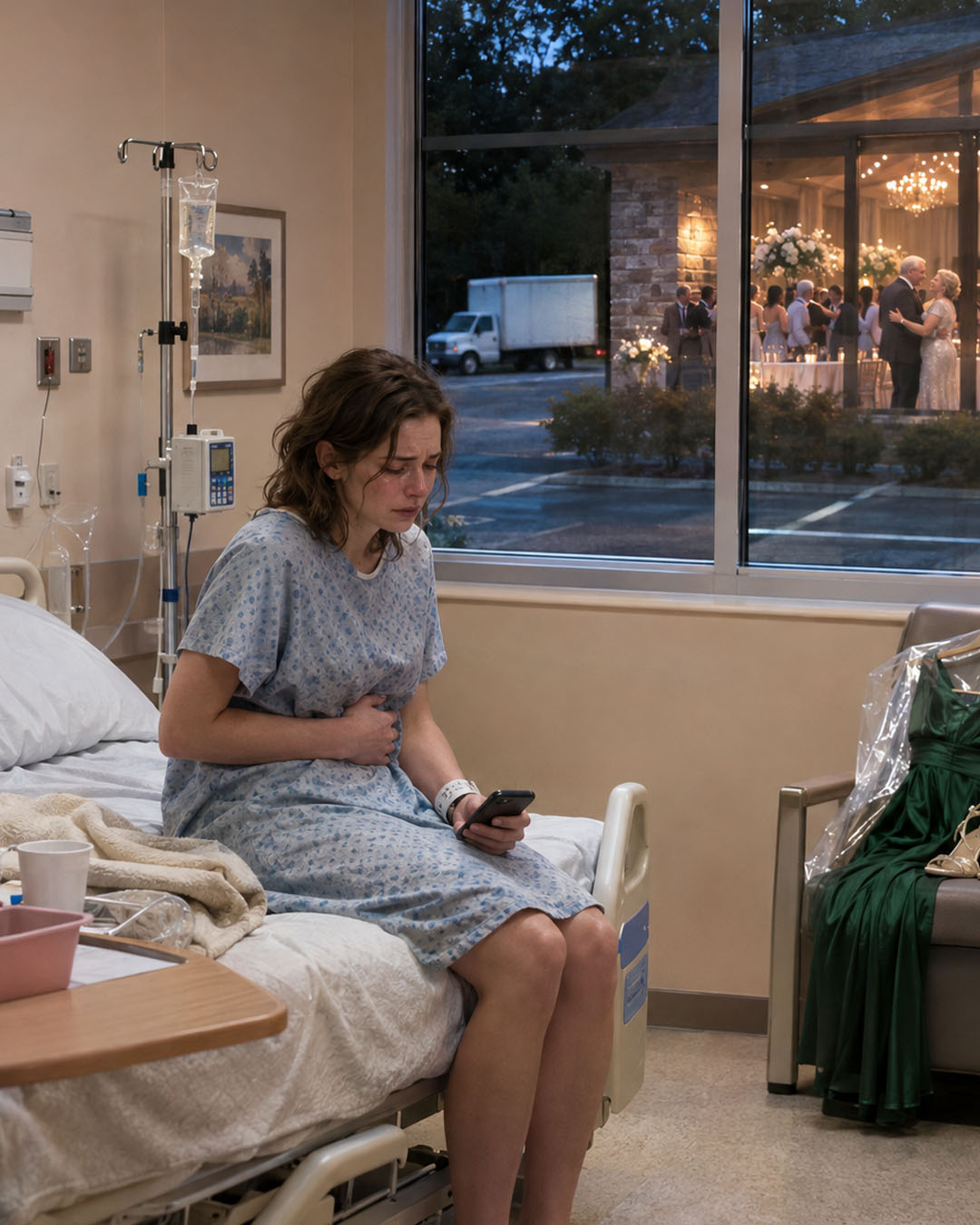
When I woke up, the room was dark except for a strip of orange light coming through the window.
It was around 5:30 in the evening.
My throat felt raw, my abdomen hurt, and there were tubes attached to my arms. A monitor beeped steadily beside the bed.
I was in the intensive care unit.
D was sitting in a chair near the window, still wearing her scrubs.
“Your shift ended hours ago,” I croaked.
She smiled.
“Overtime. My cat doesn’t care what time I get home.”
Dr. Anand came in a few minutes later. He explained that the surgery had been difficult. The infection had spread throughout my abdomen, and the doctors had needed to clean everything carefully.
They had started strong antibiotics, but the next several hours would be important.
“Your blood pressure and temperature need to remain stable,” he said. “You came in later than we would have liked. A few more hours could have made this much worse.”
A few more hours.
I thought about the highway, the truck, and all the times I’d told myself to keep driving because I didn’t want to disrupt anyone’s plans.
After the doctor left, I asked D for my phone.
There were no missed calls from my parents.
One message from Mom had arrived at 4:52.
“Hope you’re feeling better. Don’t worry about today. We’ll talk tomorrow.”
She hadn’t asked whether the surgery was successful.
She hadn’t asked whether I was alive.
I turned the phone facedown on my chest.
D watched me quietly.
Then she removed her glasses.
“Nora, there’s something I need to tell you.”
I looked at her.
“I called your emergency contact myself this afternoon. The hospital had been trying to reach your family.”
My stomach tightened.
“Who answered?”
“Your mother.”
I waited.
D took a breath.
“I told her I was calling from Cutler’s Bend Regional. I explained that you’d undergone emergency surgery for a ruptured appendix and that you were in intensive care with sepsis.”
“What did she say?”
D looked toward the window before answering.
“She asked me, ‘Is she dying?’”
My mouth went dry.
“What did you tell her?”
“I told her I couldn’t promise anything. I explained that the next several hours were critical and that if she wanted to be here, she should come now.”
I gripped the blanket.
“And?”
D’s voice remained gentle.
“She said, ‘Then we’ll come tomorrow. I’m at my son’s wedding.’”
For a moment, I couldn’t hear anything except the monitor.
Tomorrow.
My mother had been told her daughter might die, and she had chosen tomorrow.
I didn’t scream. I didn’t throw my phone. I didn’t even ask D to repeat herself.
Something inside me simply went quiet.
For years, a small part of me had continued hoping that if something were serious enough, my parents would finally put everything aside and come.
Now I had my answer.
D picked up the dry-erase marker beside the whiteboard.
Under the section labeled YOUR SUPPORT PERSON, she wrote her name.
D.
“There,” she said. “It’s temporary, but it’s true.”
That was when I began to cry.
Not quietly, either. My whole body shook, and the pain in my abdomen made every breath difficult. D moved her chair closer and rested a hand on my arm.
She didn’t tell me to stop crying.
She didn’t say my mother probably meant well.
She simply stayed.
Around 11:00 that night, my condition suddenly worsened.
I began shaking uncontrollably. D checked my temperature, then immediately looked at the monitor.
104.2 degrees.
My heart was racing, and my blood pressure was dropping.
She pressed the emergency button.
Within minutes, the room filled with medical staff. They adjusted my medications, started additional fluids, and ran more tests. I heard words like rapid response and lactate, but they seemed to come from very far away.
I was slipping in and out of awareness.
In my fever, I imagined I was back in my workshop. Grandma Ruth stood behind me while I worked on her old Baldwin piano. I could almost smell the lemon polish and hear the soft movement of the keys.
Then I heard D.
“Nora. Stay with me, sweetheart. I’m right here.”
She began talking about her orange tabby cat, Biscuit, who apparently stole socks and slept on the clean laundry.
She told me about her first year as a nurse, the patients she’d remembered, and the difficult nights she’d never forgotten.
She talked for nearly an hour.
She never let go of my hand.
By midnight, my fever began to fall. Around 12:30, my blood pressure steadied. The doctors finally left the room, and the frantic activity settled into the quiet rhythm of the monitors.
D looked exhausted.
“You scared me,” she whispered.
“Sorry,” I managed.
Her expression changed.
“Don’t you apologize.”
I closed my eyes.
“You’ve been apologizing your whole life, haven’t you?”
I didn’t answer.
At 1:10 in the morning, a man’s voice suddenly echoed down the hallway.
“Where is she? Where’s my sister?”
The door opened.
Evan stood there wearing his wedding tuxedo, although his jacket was missing and his bow tie hung loose around his neck.
His hair was disheveled. His eyes were red, and tears were running down his face.
Behind him stood Claire, still wearing her wedding gown. The long lace train was gathered in her arms, and beneath the dress were a pair of white sneakers.
For several seconds, nobody moved.
Then Evan saw the tubes, the monitors, and the bandage across my abdomen.
He crossed the room, dropped to his knees beside my bed, and took my hand.
“Nora,” he whispered. “Oh, God, Nora.”
He pressed my hand against his forehead.
“I didn’t know. I swear I didn’t know.”
Claire covered her mouth.
“I found your message,” she said. “About an hour ago.”
I looked between them, confused.
Then she told me what had happened.
Chapter 3
Claire’s phone had been locked away with her maid of honor during the wedding, as was customary at the lodge. She hadn’t checked it until late that evening, when she went to the bathroom to change out of her wedding dress.
There were dozens of messages.
Most were congratulations.
One was from me.
I’d sent it at 12:35, shortly before surgery.
“In a hospital in West Virginia. Going into surgery. Congratulations. I love you both. Please don’t tell Evan until tomorrow. I don’t want to ruin your day.”
Claire read it once.
Then again.
Then a third time.
She walked out of the bathroom and found Evan on the dance floor.
“Evan, we need to leave. Right now.”
He looked at her.
“What happened?”
“Your sister is in the hospital.”
He stared at her.
“What? No. Mom said Nora wasn’t coming. Mom said she decided to skip the wedding.”
Claire’s expression changed.
“What do you mean your mother said that?”
It was then that the pieces began falling into place.
The previous evening, Mom had told Claire that I’d decided not to attend the wedding. Claire had even sent me a message asking whether everything was all right, but I had gone to sleep early and never saw it.
When my seat remained empty at the ceremony, Claire assumed I had changed my mind.
She had no idea I’d been lying in a hospital bed.
My mother had known about my emergency since 11:00 that morning. By 6:00 that evening, she knew I was in intensive care with sepsis.
She hadn’t told my brother.
She hadn’t told his bride.
She hadn’t told anyone.
Evan and Claire didn’t stop to confront her. They didn’t say goodbye to the guests or wait for the reception to end.
They simply walked out.
They drove through the night in their wedding clothes, covering the distance between the lodge and the hospital as quickly as they safely could.
Evan kept holding my hand while Claire pulled a chair beside the bed.
D brought them coffee and blankets.
For a while, nobody said much.
Then I suddenly remembered something.
“The truck.”
Evan looked up.
“What truck?”
“The little white moving truck. The piano is in it.”
He frowned.
“Piano?”
“My wedding present. Grandma’s Baldwin.”
D leaned forward.
“Don’t worry. The sheriff’s deputy had it moved to our hospital parking lot. Security has been watching it.”
Apparently, as the paramedics loaded me into the ambulance, I had grabbed Tyler’s sleeve and begged him not to let anyone touch the piano.
A security guard named Walter had taken the request seriously.
At about 2:00 in the morning, Evan went downstairs with Walter and a nurse carrying a flashlight.
They opened the back of the truck.
Under the moving blankets stood Grandma Ruth’s restored Baldwin.
Evan pulled one blanket aside.
He saw the scratch on the left side.
Then he ran his hand over the wood.
He sat down on the truck’s bumper and began to cry.
Walter, a 60-year-old security guard who had probably seen more heartbreak than most people could imagine, took off his own jacket and placed it around my brother’s shoulders.
When Evan returned to my room, he couldn’t speak for several minutes.
Finally, he sat beside me.
“You did all that for me?”
I smiled weakly.
“I did it for the little boy who sat on Grandma’s lap.”
He looked down at my bandaged abdomen.
“And you almost died getting it here.”
“Not quite. I was still driving.”
He laughed through his tears.
That night, I forgave my brother.
He hadn’t known. He hadn’t ignored my calls. He hadn’t chosen a party over my life.
He had simply grown up in the same family I had, believing the version of events our mother presented.
For the first time in our lives, Evan put me first.
He spent the rest of the night in a plastic chair beside my bed, his wedding ring catching the fluorescent light whenever he moved.
Claire slept in another chair, her wedding dress folded across her knees.
At 10:40 Sunday morning, my parents arrived.
They carried grocery-store carnations and a balloon that read GET WELL SOON.
Mom was still wearing her pale blue pantsuit from the wedding. Her hair was styled, although she looked tired.
Dad walked behind her, holding his car keys.
Evan was waiting outside my room with Claire.
I could hear them through the open door.
Mom spoke first.
“Oh, Evan, honey. You left without telling anyone. We were so worried. Everyone at the reception was asking where you went.”
Evan’s reply was quiet.
“You knew.”
Mom hesitated.
“Knew what?”
“You knew Nora was in the hospital. You knew before the ceremony. You knew before I got married.”
There was a long silence.
Then Mom said, “Evan, I didn’t think it was that serious.”
D had returned for the morning shift. She was standing at the nurses’ station a few feet away.
She walked over holding a printed sheet.
“Mrs. Hail, I’m Dolores Puit. We spoke yesterday at approximately 6:12 in the evening. I told you your daughter was in intensive care with sepsis and that you should come immediately. Do you remember that conversation?”
I imagined Mom’s face going pale.
D continued.
“You asked me whether Nora was dying. I told you the next several hours were critical.”
Nobody spoke.
Then my mother said something that made my chest tighten.
“She does this,” she said defensively. “Nora always has a crisis at the worst possible time. I thought she was upset about the wedding. I thought answering would only encourage it.”
Evan’s voice rose.
“Mom, she was unconscious!”
“I didn’t know that.”
“You didn’t ask!”
My mother had no answer.
I took a breath and called from my bed.
“Evan, let them come in.”
They entered.
Mom stood at the foot of my bed, still holding the carnations. Dad stood behind her, looking at the floor.
I was weak, frightened, and still recovering from surgery.
But I knew I needed to speak.
“You were told I might die,” I said. “And you decided tomorrow was good enough.”
Mom’s eyes filled with tears.
“Nora, that’s not fair.”
“I don’t know what that says about how you love me. But I know what it says about my place in this family. And I’m finished pretending it means something different.”
She began crying.
I didn’t comfort her.
I didn’t apologize for making her uncomfortable.
“Please leave,” I said.
Mom stood there for another moment, as if waiting for me to change my mind.
I didn’t.
Evan walked them to the elevator.
Dad looked back at me once. His eyes were wet, but he said nothing.
Then he followed my mother.
Chapter 4
I spent six days in the hospital.
Evan and Claire postponed their honeymoon and stayed at a motel across the street for the first three nights. Claire brought me clean pajamas, a proper toothbrush, and the kind of small comforts that suddenly seemed more valuable than anything expensive.
Evan read to me from a terrible mystery novel, changing his voice for every character until I begged him to stop.
D came by every day, even when she wasn’t scheduled to work.
On the fourth evening, she told me something about her own family.
“I had a son,” she said. “His name is Marcus. We haven’t spoken in twelve years.”
She stared at her hands.
“When he was 19, he was in a serious car accident. He broke his pelvis and injured his lung. The hospital called me while I was working a double shift.”
She paused.
“I told them I’d come afterward. I thought I had time. I was the person everyone depended on, the one who always held things together.”
Her voice grew softer.
“By the time I got there, he’d been alone for nine hours. He never forgave me.”
I didn’t know what to say.
She looked at me.
“I’ve spent twelve years sitting in other people’s hospital rooms, trying to make up for that one night. You think I stayed late for you? Honey, you gave me a chance to do something right.”
I reached for her hand.
“Call him.”
“He won’t answer.”
“Then leave a message. Tell him you’re sorry. Don’t ask him to forgive you. Just tell him the truth.”
She squeezed my fingers.
“I’ll think about it.”
I went home to Pittsburgh on the seventh day.
Evan drove the moving truck back himself, with Grandma Ruth’s piano still safely inside. He and Claire followed me home.
We returned the truck to my friend Pete with a full tank of gas and a case of beer.
For three weeks, I didn’t speak to my parents.
Mom sent long messages filled with words like misunderstanding, stress, and unfortunate timing. She repeatedly suggested that perhaps I would see things differently once I was feeling better.
I didn’t respond.
Then, one gray afternoon in November, I was sanding the lid of an old spinet piano when the workshop door opened.
My father stood in the doorway.
Frank Hail was 66 years old, retired from his career as an insurance adjuster. He was a quiet man who had rarely raised his voice in our house.
He wore his good coat and held his hat in both hands.
“Dad? What are you doing here?”
“I drove six hours.”
He looked uncomfortable.
“I told your mother I was going to the hardware store.”
I put down the sandpaper.
He didn’t sit.
“Nora, can I tell you what happened that day? All of it? You don’t have to say anything.”
I nodded.
He took a breath.
“When your first message came through, your mother was in the bridal suite with some of the cousins. She read it aloud. Then she said, ‘Oh, here we go again.’”
His voice began to shake.
“I told her that sepsis was serious. I said we needed to go. She told me you did this whenever something important happened and that we’d check after the ceremony.”
He rubbed his forehead.
“After the ceremony, I brought it up again. She said we should wait until after the first dance. Then it was the cake. Then the hospital called, and she said it was too late to drive that far and we’d go in the morning.”
I stared at him.
“And you stayed?”
He nodded.
“I walked out to the parking lot around 5:45. I had my keys in my hand. I stood beside the car telling myself to get in. Just get in and go to your daughter.”
He swallowed.
“Then someone came outside and said they needed me for family photographs. So I went back.”
I couldn’t speak.
He continued.
“I went out again after nine. I stood there for almost ten minutes. I thought about leaving. I thought about what your mother would say. I thought about the argument waiting for me if I walked away.”
His hands trembled.
“And I was a coward. I put my keys back in my pocket and went inside. I danced with my wife.”
He finally looked at me.
“I want you to understand that I’m not blaming your mother for everything. I let her make decisions for this family for 34 years. I called it keeping the peace. I told myself that avoiding an argument was a kind of love.”
He shook his head.
“It wasn’t love. It was hiding. I’ve been hiding in every room you ever needed me in.”
The workshop seemed unusually quiet.
I looked at the man who had taught me to ride a bicycle, who had attended my school concerts, who had once helped me carry a piano up three flights of stairs.
“Dad, I’m angry with you.”
He nodded.
“You should be.”
“Maybe more than I’m angry with Mom.”
His face crumpled.
“With Mom, I always knew where I stood. But I thought you were different. I thought you were safe.”
He lowered his head.
“I know.”
I didn’t hug him.
I want to be honest about that. An apology doesn’t erase a lifetime of disappointment, and a visit to a workshop doesn’t repair every broken relationship.
But after a long silence, I pulled out a stool.
“Sit down, Dad.”
He did.
I handed him a soft cloth, a bottle of polish, and a small piece of walnut.
“Show me what you can do with your hands.”
For the next hour, we worked without talking.
He polished that little piece of wood until it shone.
When he finally stood to leave, he held his hat against his chest.
“Can I come back?”
“Call first.”
“I will.”
And he did.
Every week.
Chapter 5
My mother took longer.
She called every Sunday for nine weeks. I let the phone ring.
She wrote letters, but the first few were mostly explanations. She talked about the stress of planning the wedding, how much pressure she’d been under, and how independent I’d always been.
She said she had forgotten that I could be vulnerable.
Then, in January, a different letter arrived.
It was handwritten and only one page long.
I still have it.
“Nora,
I’ve been trying to understand why I did what I did.
I think when you were little and got sick, you rarely cried. I decided that meant you were all right. I built years of my life around that decision because it was easier than admitting you might need me.
Evan always showed his feelings. I could see when he was hurt, and I knew how to comfort him. You hid yours, and I let you hide because your quietness was convenient for me.
I am deeply sorry.
I’m not asking you to tell me it’s okay. It wasn’t.
Mom.”
I read that letter eleven times.
Eleven.
The same number of calls I’d made from the hospital.
When I noticed the coincidence, I laughed and cried at the same time.
I didn’t call her immediately.
Another month passed before I finally picked up the phone.
“I’ll meet you somewhere public,” I told her.
We chose a diner halfway between Pittsburgh and Greenville.
She arrived without makeup, wearing a simple sweater. She looked smaller than I remembered. Both hands wrapped around a coffee cup, as if she needed something to hold.
We talked for an hour.
I told her what I needed.
“I have one rule, Mom. If I tell you I’m in the hospital, you get in the car. No questions. No waiting until after the ceremony. No deciding whether it’s serious enough. You come.”
She looked down.
“Nora, I—”
“If you can’t promise that, we can’t have the relationship you want.”
The waitress came by and refilled our coffee.
My mother stared at the table for a long time.
Then she lifted her chin.
“I promise.”
I watched her carefully.
“And I’ll prove it,” she added. “However long it takes.”
I didn’t immediately believe her.
Promises were easy. What mattered was what happened afterward.
She wasn’t suddenly a perfect mother. She still said the wrong things sometimes. She still talked about Evan more than she realized.
But the following spring, I needed a minor outpatient procedure.
It wasn’t dangerous, and I didn’t ask anyone to come.
I mentioned it casually in a text.
Two hours later, my mother walked into the waiting room carrying a thermos of soup and a paperback book.
She had driven six hours.
She sat through the entire procedure.
When I woke up, she was beside my bed.
“I’m not leaving,” she said.
I looked at her, then closed my eyes.
“Thank you, Mom.”
It wasn’t everything.
But it was a beginning.
In December, Evan and Claire invited me to their house to install Grandma Ruth’s Baldwin piano in their front room. Six friends helped us move it, and the process involved more swearing than I care to remember.
Evan insisted on handling the final tuning himself.
When the piano was finally in place, everyone went into the kitchen for dinner.
Evan remained in the living room.
He sat on the bench and rested his hands on the keys.
Then he played the little song he’d learned as a boy on Grandma’s lap.
He played it slowly. A few notes were wrong, and his hands trembled.
Claire stood in the doorway.
I stood beside her.
When he finished, he didn’t turn around.
“She’d be so proud of you,” he whispered.
I smiled.
“She’d be proud of you, too.”
He shook his head.
“I don’t deserve you.”
“That’s not how it works, Evan.”
For a moment, we were quiet.
Then he pointed toward the side of the piano.
“Can you at least explain why you left that scratch? It’s pretty noticeable.”
I laughed.
“Because it’s part of the story.”
He nodded.
He understood.
And that was enough.
There was one more person I wanted to hear from.
In March, a package arrived at my workshop. It was from D.
Inside was a card with a painting of an orange cat on the front and a photograph tucked inside.
D was sitting on a park bench beside a tall man in his thirties. He had her gray-green eyes. Between them sat a little girl wearing a yellow raincoat and holding a bright orange kite.
On the back, D had written:
“His name is Marcus. This is June.
I left him a voicemail. He called me back nine days later.
I didn’t wait for tomorrow.
I cried for ten minutes at my kitchen table.”
I called her immediately.
We talked for two hours.
A few months later, D visited Pittsburgh, and I invited her to dinner at Evan and Claire’s house.
She sat beside little June on the piano bench while Evan patiently taught her to play a single note.
June giggled every time she pressed the key.
Marcus stood in the corner with his arms crossed, watching his mother.
He wasn’t smiling exactly. He wasn’t ready to pretend that twelve years of hurt had disappeared.
But he was there.
And sometimes being there is the first step toward something better.
When D hugged me goodbye that evening, she whispered something I have carried with me ever since.
“You know, Nora, you were the easiest patient I’ve ever had and the strongest. Don’t ever mistake those two things again.”
I think about that sentence often.
For most of my life, I believed love meant being easy to love.
I thought it meant never asking too much, never making trouble, never interrupting someone else’s happiness. I thought that if I needed nothing, I would always have a place in the family.
But that isn’t what love means.
Love isn’t measured by how quietly you can suffer.
It isn’t measured by how many times you swallow your tears so someone else can enjoy their celebration.
And it certainly isn’t measured by how convenient you are to the people who claim to care about you.
The people who truly love you are the ones who show up when things become difficult.
Sometimes they’re your parents.
Sometimes they’re your siblings.
Sometimes they’re a bride in a wedding dress and white sneakers, a teenage gas station employee who stops to help a stranger, or a 63-year-old nurse who stays long after her shift ends because she refuses to let someone face a frightening night alone.
Sometimes the family you were born into learns, slowly and imperfectly, how to become the family you needed all along.
I still keep the whiteboard marker D used that night.
She let me take it home.
It sits in a small jar on my workbench beside my piano-tuning tools.
Every now and then, when I’m working late and the workshop is quiet, I look at it and remember what she wrote.
Your support person: D.
It was temporary.
But it was true.
My parents danced at my brother’s wedding while I lay in a hospital bed, fighting an infection that could have taken my life.
My father had the keys in his hand twice and walked back inside.
My mother chose the reception over the hospital.
Those things happened, and I will never pretend they didn’t.
But I also learned that forgiveness doesn’t mean erasing what happened. It means allowing people to take responsibility, while remembering that you have every right to protect yourself.
My father learned to show up.
My mother learned that the daughter who rarely asked for anything still needed her.
My brother learned that loving someone means making room for their pain, even on the happiest day of your life.
And I learned something that took me 31 years to understand.
I was never difficult to love.
I had simply spent too many years making it easy for people not to notice when I needed love.
These days, when someone asks how I’m doing, I try to answer honestly.
Sometimes I’m fine.
Sometimes I’m tired.
Sometimes I need help.
And I no longer apologize for saying so.
Because the most important question isn’t who stands beside you when the music plays and everyone is smiling.
It’s who gets in the car when the phone rings in the middle of the celebration.
It’s who walks into the hospital room.
It’s who pulls up a chair at 1:00 in the morning and stays.
And it’s who understands that being the strong one doesn’t mean you should ever have to be alone.
THE END.\
⚠️ All characters and events are fictional. Do not imitate or apply them in real life. 😌😌😌