
Chapter 2
The research facility sat in the Nevada desert, far from the nearest city. Floodlights illuminated low concrete buildings, three layers of security fencing, and the mountains beyond the runway.
My quarters consisted of a narrow bed, a metal desk, a locker, and a radiator that rattled whenever I turned on the hot water.
I placed my mother’s telescope against the wall.
Then I sat on the floor and cried.
I cried for the little girl who had learned to surrender everything to keep a family together. I cried for the woman who had spent three years loving a man who had apparently regarded her devotion as a convenient arrangement. Most of all, I cried because the people I had called family had looked at my mother’s most treasured possession and seen nothing worth protecting.
Eventually, the tears stopped.
I washed my face, opened my security file, and began reading.
At seven the next morning, I entered Aether’s computation room.
Six senior scientists were waiting. A deep-space probe intended for the Jupiter system had been stalled for two and a half years. The orbital correction calculations kept drifting beyond the acceptable error margin, and every conventional method had failed.
“Dr. Vance,” said Dr. Miller, the deputy team lead, “we’re hoping you can find something we’ve missed.”
“Send me the complete data.”
For two hours, I examined the equations.
Then I found the problem.
The existing model relied on an iterative method that became unstable when the probe passed through the combined gravitational influence of Jupiter and Saturn. The team had been trying to correct the symptoms instead of replacing the underlying mathematical framework.
I sketched a new approach and began rebuilding the calculations using Hamiltonian mechanics and a symplectic integration method.
For the next several days, I barely left my workstation.
By the fifth day, I had been working for forty-six hours straight. My right wrist began trembling, and sharp pain traveled up my forearm whenever I typed. I tried to hide it beneath the desk.
Commander Reed appeared beside me with two cups of water.
“Forty-six hours,” he observed.
“I’ve nearly finished.”
“That’s not what I asked.”
I looked at him. “You didn’t ask a question.”
His gaze settled briefly on my concealed hand. Then he turned toward my screens.
“Sixth-order expansion?”
“The fourth-order model can’t handle the gravitational perturbations near Jupiter’s limiting region. I’m extending it to the sixth order.”
He studied the equations without speaking.
Finally, he nodded. “Continue. But if your hand gets worse, you stop.”
After he left, I completed the final set of calculations and ran the simulation.
The result appeared on the screen.
An orbital correction error of 0.001 arcseconds—ten times more precise than the team’s target.
I leaned back, exhausted.
Then I noticed the envelope Commander Reed had left beside my keyboard.
Inside were old, yellowed observation logs from a classified satellite program conducted in the 1990s. The handwriting was neat, the calculations extraordinarily precise, and every page bore the same signature.
Margaret Wheeler.
My mother’s name before she married Arthur.
I stared at the first page until the numbers blurred.
Commander Reed returned a few minutes later. He stood quietly beside my desk while I turned the pages.
“Your mother was one of the most accurate orbital analysts of her generation,” he said. “She produced results by hand that other stations couldn’t match with their equipment. Her records helped establish calibration standards for early weather satellites.”
I swallowed.
“Why didn’t anyone tell me?”
“Perhaps the people around you didn’t know. Or perhaps they never bothered to ask.”
He pointed to a small note on the back of the final page.
The moon is so bright tonight. My little Sloan must be able to see it, too.
My mother’s affectionate nickname for me.
I pressed my fingers against the paper.
For years, I had believed her work had meant nothing. Arthur had dismissed her research as impractical, just as he dismissed mine. He had told me that people who spent their lives studying the stars would never accomplish anything useful.
Yet here, in a classified federal archive, my mother’s calculations had survived long after the people who mocked her had forgotten what she could do.
I carefully closed the ledger.
Commander Reed watched me for a moment.
“What you do and what she did are the same thing,” he said. “Don’t waste another minute looking down at people who can’t recognize your value.”
That afternoon, the team approved my new orbital framework.
For the first time in my life, no one asked me to give credit to someone else.
Chapter 3
Back in Seattle, Declan assumed I would return within two days.
He had always considered my independence a temporary inconvenience. I would leave when we argued, spend a night alone, and eventually return because he believed I had nowhere else to go.
But by the third day, my phone number had been disconnected.
When he called my former institute, the administrator informed him that Dr. Sloan Vance had been reassigned to a classified federal program.
Declan laughed in disbelief.
“Sloan? She’s a researcher. What could possibly be classified about her?”
“I’m sorry, Mr. Hayes. That’s all we’re authorized to disclose.”
He drove to my apartment that evening.
The place was empty. My clothes, books, kitchen supplies, and personal documents were gone. I had canceled the lease and arranged for my belongings to be transferred before entering the program.
The only thing I had left behind was the apartment key.
For the first time, Declan began to feel uneasy.
He called Brenda.
“Have you heard from Sloan?”
“No. She took that old telescope and stormed out. Why?”
“She has no phone, no social media, and no job at the institute. Her entire apartment is empty.”
Brenda went quiet.
Tyler tried using his contacts at the local police department to locate me, but my records were protected by federal clearance restrictions.
Arthur frowned when he heard the news.
“She can’t simply disappear. She’s my daughter.”
“Then why don’t you know where she is?” Tyler asked.
No one answered.
Within a week, Declan discovered that my former studio account had lost access to several technical archives. He was angry, but the studio still had years of my work stored on its shared server.
He turned his attention to the business.
Khloe’s online aerospace channel had become popular, and Apex Aerospace had offered Hayes Orbital Media a $3 million contract. The company wanted Khloe to act as a technical consultant for a commercial suborbital launch.
There was only one problem.
Khloe could explain basic aerospace concepts on camera, but she couldn’t perform the advanced calculations the contract required.
For three years, I had written her scripts, developed her technical presentations, and checked the equations behind her videos. She had memorized enough terminology to sound knowledgeable, and the audience had never questioned her credentials.
Now she had to prove she could do the work.
One afternoon, she opened the studio’s shared drive and found a folder containing an unfinished model I had created shortly before leaving.
The file was clearly labeled:
INCOMPLETE. DO NOT USE EXTERNALLY. PROJECT AETHER INTERNAL REFERENCE ONLY.
Khloe stared at it.
Then she copied the folder onto a flash drive.
When she showed the model to Declan, he was impressed by the sophistication of its equations.
“Can you adapt this for Apex?”
“I think so,” she said.
She changed two parameters: the intended orbital altitude and the reentry angle. The underlying calculations remained untouched because she didn’t understand them.
When Apex’s engineers reviewed the model, they praised its advanced mathematical architecture. They also asked for validation data.
Declan told Khloe to generate it herself.
“You have the formulas. Just run the simulation.”
“But Sloan marked it incomplete.”
“She left it on our company server. She didn’t delete it or password-protect it. We have every right to use what she created for the studio.”
Khloe hesitated.
Declan leaned forward.
“This contract is worth millions. Do you want to throw that away because of a label on a file?”
She thought about the engagement ring, the country club reception, and the future she had imagined with Declan.
Then she sent the model to Apex.
A week later, Arthur received a bank statement showing that Khloe had earned hundreds of thousands of dollars from sponsorships and advance payments.
He smiled over his coffee.
“Our little genius has finally made something of herself.”
Brenda began preparing the engagement party invitations.
When someone suggested sending one to me, she shook her head.
“If Sloan wants to come home, she’ll come home. She always does.”
Declan agreed.
He had no idea that I was already working on a mission that would carry a spacecraft toward Jupiter.
Nor did any of them realize that the file Khloe had stolen could soon bring their entire business crashing down.
Chapter 4
Seven days after joining Aether, I presented the revised orbital framework to the full engineering team.
The room fell silent when the verification results appeared on the screen.
Dr. Miller checked the calculations twice. A veteran orbital mechanic named Dr. Evans leaned forward, studied the equations, and finally slapped the table.
“This is it. We should have abandoned the old framework years ago.”
Commander Reed reviewed the results himself.
“Approved,” he said. “Dr. Vance will have full technical authority over orbital calculations from this point forward.”
There was no ceremony, no applause, and no grand speech. Just a decision based on the quality of my work.
For someone who had spent years being told to step aside, that was enough.
Two weeks later, the Aether control room was filled with scientists, engineers, and military personnel preparing for the launch of the deep-space probe.
The spacecraft’s trajectory had been calculated to extraordinary precision. It would use a lunar gravity assist, travel toward Mars, and ultimately enter the Jupiter system.
The final countdown began.
I sat at the main console, watching the telemetry readings.
“Guidance is green,” the flight controller announced. “Trajectory parameters nominal.”
At ignition, the floor vibrated beneath our feet. The rocket climbed into the night, leaving a bright trail across the desert sky.
I kept my hand on the control console, monitoring each stage separation and correction.
Fourteen seconds after entering the final sequence, the guidance system confirmed the expected result.
Deviation: zero.
The room erupted.
Scientists who had struggled with the problem for years stood cheering. Dr. Miller nearly knocked his glasses off as he leaned over the monitors. Dr. Evans shouted something that no one could understand.
I barely heard them.
The probe had separated successfully and begun its journey toward Jupiter.
Commander Reed stood behind my chair.
“Fourteen seconds,” he said.
I looked up.
“From the moment you entered the final sequence to the confirmation.”
“You gave me twenty.”
“The calculations were good enough to deserve a better deadline.”
It was the closest thing to a joke I had heard from him.
I turned back toward the screen, hiding the small smile that appeared on my face.
For the first time in months, perhaps years, I felt entirely present in my own life.
Then, eleven days after Aether’s successful launch, the news arrived.
Apex Aerospace’s commercial rocket had exploded during its suborbital flight.
The vehicle had lost control shortly after its second-stage ignition. Faulty thermal calculations had caused the flight computer to make an incorrect correction, and the automated range-safety system had destroyed the rocket over an unpopulated stretch of the Pacific Ocean.
No one on the ground had been injured, but the financial damage was enormous.
The investigation quickly uncovered the source of the problem.
Apex had used Khloe’s technical model, which contained unfinished calculations and fourteen interdependent variables that had never been properly calibrated.
The same model had originated on my old studio server.
Within three days, Apex terminated its partnership with Hayes Orbital Media and demanded $120 million in damages. NASA requested the original source code and documentation.
Declan read the letters in his office, tapping his fingers against the desk.
Then he saw the first line of the source code.
Author: SLV.
Status: Incomplete. Do not use externally.
Internal reference only. Project Aether.
He turned toward Khloe.
“Did you know what this was?”
Her face went pale.
“I didn’t know it belonged to a classified project.”
“But you knew it was marked incomplete.”
She said nothing.
“You submitted it to a rocket company as your own technical work.”
“You told me to use it!”
Declan’s expression changed.
For the first time, he was looking at Khloe not as the woman he had chosen over me, but as someone whose decisions might destroy everything he owned.
And now the federal government wanted answers.
Chapter 5
The FBI arrived at Hayes Orbital Media a week later.
Khloe was questioned separately. Under examination, she admitted copying the unfinished model and submitting it to Apex. The investigators also recovered the studio’s server logs and my original documentation.
Declan tried to distance himself from the technical decisions.
“I handled the business side,” he told the agents. “Khloe was responsible for the engineering.”
But the contract carried his signature as CEO and guarantor. More importantly, the investigators found an email I had sent him fourteen months earlier.
It stated plainly that all files in my technical folder were my exclusive intellectual property and were prohibited from commercial use.
Declan had opened and read the email.
He had simply chosen to ignore it.
Commander Reed traveled to Seattle to assist the investigation. When he entered the interrogation room, the FBI agents stood immediately.
He placed a classified folder on the table in front of Declan.
“I’m Commander Gideon Reed, director of Project Aether.”
Declan stared at the seal on the cover.
“You stole work from my chief scientist,” Gideon said. “And you used it for commercial gain after receiving written notice that it wasn’t yours to use.”
He explained that the code contained digital watermarks, cryptographic identifiers, and timestamped records linking it to my original work. The evidence established when the files had been created, who had copied them, and where they had been used.
Declan’s excuses collapsed one by one.
“Where is Sloan?” he finally asked.
Gideon closed the folder.
“Her location is classified.”
“She was my girlfriend.”
“That doesn’t give you access to a federal program.”
Declan’s face reddened.
“She wouldn’t have done this to us if she’d simply talked to me.”
Gideon regarded him without emotion.
“She did talk to you. You chose not to listen.”
He left the room.
Back in Nevada, I was reviewing telemetry when Sarah, the team’s administrative coordinator, told me Commander Reed wanted to see me.
He was waiting in his office with a preliminary investigative report.
“Your stepsister has admitted copying the file,” he said. “Declan is facing charges as well.”
I looked down at the document.
There was my name, recorded as the original author of the stolen work. For the first time, an official record described what I had created without attaching someone else’s name to it.
“I didn’t create those watermarks because I expected something like this to happen,” I told him.
“I know.”
“I just wanted my work documented properly.”
“And it was.”
He turned the report toward me. The Department of Justice intended to pursue criminal charges and support my civil claims.
“You don’t have to handle this alone, Dr. Vance.”
I looked at him.
He wasn’t offering sympathy or making promises he couldn’t keep. He was simply telling me that the truth would be defended.
“Thank you,” I said.
His expression softened almost imperceptibly.
“Don’t thank me. You got a spacecraft to Jupiter. I’m just making sure the people who stole your work answer for it.”
For once, accepting help didn’t feel like surrendering my independence.
It felt like standing beside someone who respected it.
Chapter 6
The engagement party took place as planned, although the atmosphere was no longer quite as celebratory.
Arthur and Brenda still believed the family could weather the trouble. Khloe’s contract had not yet been formally terminated, and Apex’s engineers were attempting to salvage the model by recalibrating its equations.
Declan insisted the company would survive.
Then the engineers discovered that the model’s fourteen interdependent variables could not be corrected independently. Each adjustment affected the others, and the unfinished framework required a complete mathematical reconstruction.
The professor Declan hired to review the work gave him a blunt assessment.
“The underlying theory is exceptional, but the person who developed it is the only one likely to understand all its dependencies. Rebuilding this from scratch could take months.”
Declan demanded that Khloe explain the calculations.
She couldn’t.
Finally, she admitted the truth.
“Sloan wrote the scripts. She built the technical presentations. She did the equations for the exhibition. I presented the work.”
Declan stared at her.
“Everything?”
Khloe nodded.
He looked toward the window, his jaw tightening.
For three years, he had accepted my work while dismissing my ambitions. He had praised Khloe for accomplishments I had produced and called me unimportant when I asked for recognition.
Now the very thing he had treated as worthless was the only thing that could save his business.
Apex’s engineers continued trying to salvage the project because the framework was far more advanced than anything they had developed themselves. They reduced some of the discrepancies, but the safety margins remained unacceptable.
The company gave Hayes Orbital Media a final deadline.
Meanwhile, the federal investigation moved forward.
Apex’s technical records showed that Khloe had altered two surface parameters while leaving the underlying equations untouched. The recovered source code matched my original file exactly, including the warnings she had ignored.
The case was no longer merely about a failed business deal.
It concerned the unauthorized use of restricted federal technical information and the deliberate misrepresentation of unfinished calculations as a validated commercial system.
Arthur attempted to argue that my work belonged to the Vance family because I had helped the studio for years.
The legal response was straightforward: I had created the work independently, and the studio had no ownership rights merely because I was related to its owners.
Brenda stopped talking about the engagement party.
Tyler, who had once barely looked up from his phone when I entered a room, began asking whether anyone had heard from me.
No one had.
My civilian identity had been removed from accessible records, my phone number was disconnected, and my location remained classified.
The family that had always assumed I would come crawling back had finally discovered that they could not simply summon me when they needed something.
They couldn’t even find me.
In Nevada, the Aether probe continued its journey.
Every day, I checked its trajectory and made small adjustments as new telemetry arrived. The work demanded concentration, patience, and the willingness to admit uncertainty.
It was nothing like the life I had left behind.
There, I had been expected to make sacrifices without question.
Here, when a calculation needed correcting, people asked for evidence. When a decision was made, someone took responsibility. And when I spoke, my colleagues listened.
For the first time, I was not trying to earn my place in a family.
I was doing the work I had been born to do.
Chapter 7
Three months later, I received a summons to testify at a federal hearing in Washington, D.C.
The purpose was to establish the chain of custody for the stolen file and determine responsibility for the Apex 3 failure.
I reviewed my evidence carefully: the original drafts, source-code records, digital watermarks, and the email in which I had explicitly restricted commercial use.
The night before the hearing, Commander Reed asked whether I wanted to rehearse my testimony.
“No.”
“Why not?”
“Because if I tell you what I’m going to say, you’ll try to improve it.”
The corner of his mouth moved slightly.
“I wouldn’t dare.”
The hearing room was packed with federal officials, aerospace executives, attorneys, and reporters. Declan sat at the defendant’s table in a wrinkled suit. Khloe looked exhausted, with a detention-center processing band around her wrist. Arthur sat beside them, his hair nearly white.
Brenda watched from the back of the room.
When the judge called my name, I walked to the witness stand and opened my laptop.
“Good morning. I’m Dr. Sloan Vance, chief orbital dynamicist for Project Aether.”
I explained the origin of the file, the purpose of the unfinished framework, and the warnings attached to it. I showed the court the original code beside the code recovered from the Apex 3 flight computer.
The digital watermark matched completely.
I explained that the model had been designed for a different mission and had never been validated for the commercial launch. Fourteen interdependent variables remained uncalibrated, making the system unsuitable for the flight profile Khloe had submitted.
“The underlying framework was not the problem,” I said. “The problem was representing unfinished work as a validated model and using it without understanding the calculations.”
I described the rocket’s loss of control and the activation of its automated safety system. The vehicle had been destroyed over the ocean, avoiding injuries on the ground, but the incident had caused approximately $240 million in direct economic damage.
Then I closed my laptop.
“This was preventable. The file said it was incomplete. It said not to use it externally. Those warnings were ignored.”
I did not look at Declan or Khloe.
My testimony was about facts, not revenge.
The judge reviewed the evidence and announced the preliminary rulings.
Khloe was indicted on charges related to the theft and unauthorized commercial use of restricted technical information. She remained in federal custody.
Declan was indicted for his role in authorizing the commercial use of the file despite having received written notice of its restrictions. He was released on bail pending trial.
Arthur’s claim that my work belonged to the family was rejected. His financial role in the studio and his statements to investigators also became part of the proceedings.
Hayes Orbital Media’s assets were frozen pending the civil judgment, and Apex pursued restitution for the losses.
The courtroom fell silent.
Arthur lowered his head into his hands. Khloe began to cry. Declan sat motionless, staring at the table.
I felt no triumph.
I had not wanted anyone’s life destroyed. I had wanted my work respected, my boundaries honored, and my future left in my own hands.
The consequences belonged to the people who had made their choices.
As the hearing adjourned, reporters crowded the exits. I slipped through a side corridor with Gideon and two federal agents.
I had a folder of new telemetry readings under my arm.
The probe was approaching its next orbital correction window, and solar activity had shifted slightly beyond the predicted range.
“There’s a small deviation developing,” I told Gideon. “If we don’t correct it, the accumulated error could affect the Jupiter arrival window.”
“How much?”
“Four thousandths of a degree.”
He glanced at the report.
“Single burn or two?”
“I’ll calculate the fuel margin first.”
We continued down the corridor.
Behind us, Declan called my name.
I didn’t stop.
He reached for my sleeve, but Gideon stepped between us, guiding me smoothly around him without interrupting our conversation.
“Mr. Hayes,” a marshal said, “we need you to come with us.”
I kept walking.
The numbers in my folder mattered. The mission mattered. My colleagues were counting on me.
For the first time, a man who had once occupied nearly every corner of my life was no longer important enough to interrupt my work.
Chapter 8
The weeks after the hearing were busy.
Aether continued its journey toward Jupiter, and the investigation into the Apex failure proceeded through the courts. My legal team prepared the civil claim, supported by the federal evidence chain.
The original file’s watermarks had been embedded long before the dispute began. The timestamps and server records showed that I had created the model independently and explicitly prohibited its commercial use.
Gideon told me the evidence was unusually strong.
“You anticipated this?” he asked one afternoon.
“No. I anticipated that someone might try to claim my work. That’s why I documented it.”
He nodded.
“Good practice.”
That was all he said, but I understood the difference between his response and the reactions I had received at home. He didn’t treat my caution as selfishness or my competence as a threat.
He treated both as ordinary professional judgment.
Several months later, I returned to Washington for another hearing. This time, I felt no need to rehearse my testimony or prepare myself emotionally for seeing Arthur, Declan, and Khloe.
They had their attorneys. I had my evidence.
The legal process would determine the appropriate consequences, and I would continue my work.
After the hearing, I walked beside Gideon toward the waiting government vehicle. Reporters were still gathered near the courthouse entrance, but I ignored their questions.
My attention was on the latest trajectory report.
“We’re arriving at Jupiter seventeen hours ahead of schedule,” I told him.
“Why?”
“The lunar gravity assist performed slightly better than the baseline prediction. The original trajectory had enough margin to accommodate the difference.”
He glanced at the figures.
“You added an extra significant digit to the gravitational constant.”
I looked at him sideways. “You checked my calculations again.”
“Commander’s privilege.”
“Until what time?”
“Two in the morning, apparently.”
I laughed.
It surprised me how natural the sound felt.
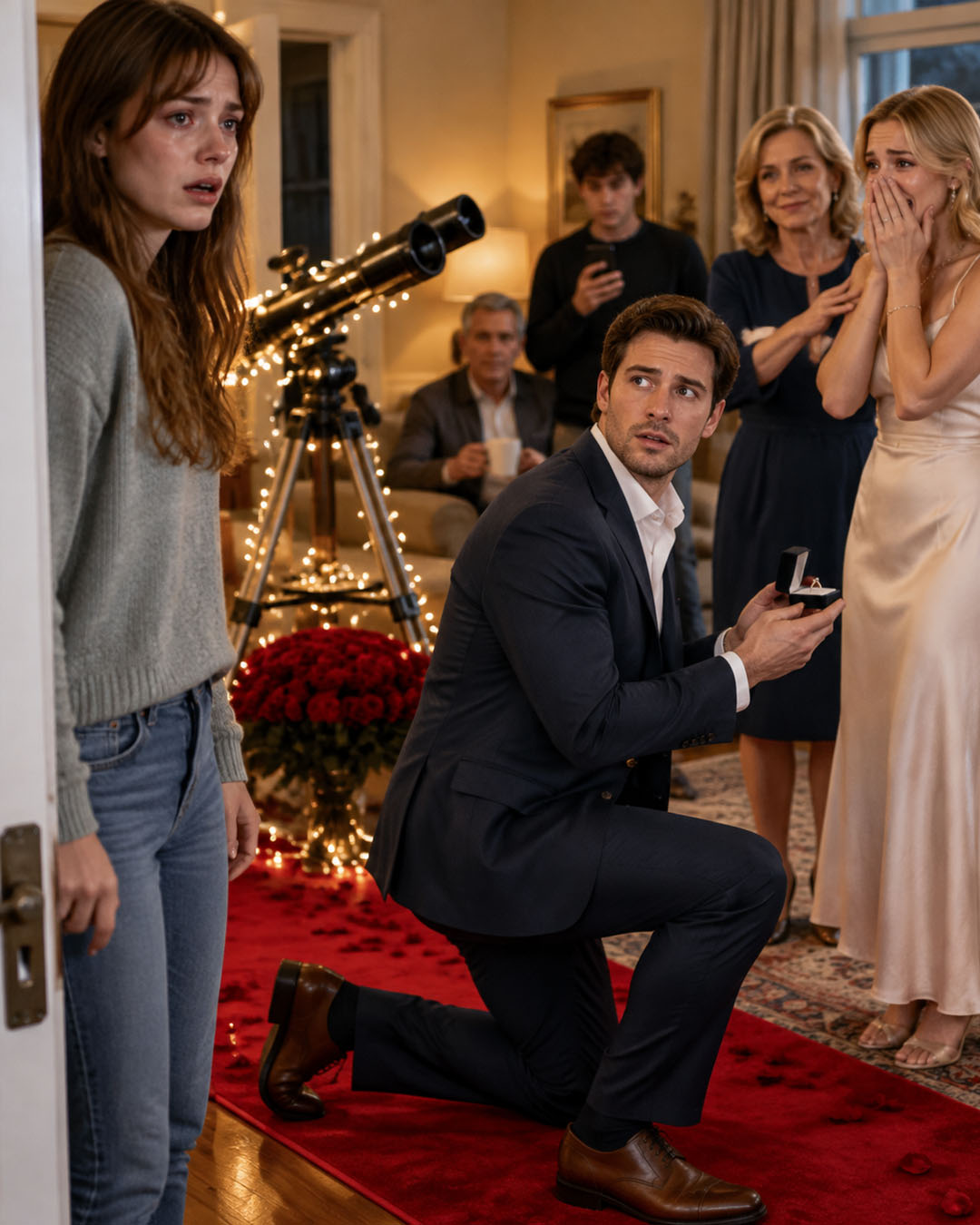
We reached the vehicle, but before getting in, I looked back at the courthouse. For a moment, I thought about the living room in Seattle, the red carpet, and the cheap lights wrapped around my mother’s telescope.
I remembered the copper key touching the wooden table.
I remembered telling Dr. Harrison there was no one I needed to say goodbye to.
At the time, I had believed those words meant I had nothing left.
Now I understood that I had been saying goodbye to a life in which love was measured by how much I could surrender. I was leaving behind the belief that family ties gave other people the right to take what I had earned.
I had not stopped caring about the people I once loved. I had simply stopped allowing their choices to determine my worth.
I turned away from the courthouse and climbed into the vehicle.
Gideon settled into the seat beside me, opened his briefcase, and took out a report.
“Phase Three planning,” he said. “Once Aether reaches Jupiter, we need to begin designing the Europa observation orbit.”
“I’ve been thinking about that,” I replied. “A tidal resonance orbit could let us study the thinner regions of Europa’s ice crust without spending as much fuel on station keeping.”
He stopped turning the pages.
“You’ve already started the calculations?”
“Not yet. I wanted to discuss the concept first.”
He studied me for a moment, then nodded.
“Write it.”
“It could take a week.”
“Then I’ll expect it in a week.”
I smiled and opened my folder.
Outside, the Washington skyline passed behind the tinted windows. Soon we would return to Nevada, to the quiet laboratories and the vast desert sky. Far above us, a small spacecraft was traveling toward a distant world, following a path I had helped calculate.
My mother’s telescope rested safely in my quarters at the base. I had cleaned the sticky residue from its barrel and carefully repaired the focusing mechanism. Some nights, when the work was finished, I carried it outside and pointed it toward the moon.
I could never recover the years I had spent trying to make myself worthy of people who refused to see me.
But I could decide what to do with the years ahead.
I could protect my work. I could choose my companions. I could build a life in which kindness did not require self-erasure and love did not come with an invoice for everything I had given away.
Gideon turned a page.
I began calculating the Europa trajectory.
Neither of us spoke for several minutes. The only sounds were the quiet rustle of paper and the steady hum of the engine.
For once, silence did not mean rejection.
It meant I was exactly where I belonged.
THE END.
⚠️ All characters and events are fictional. Do not imitate or apply them in real life. 😌😌😌


