
Chapter 2
The county Child Advocacy Center looked deliberately ordinary. There was a fish tank, soft furniture, children’s books, and nothing that suggested frightened parents had sat in those same chairs waiting for answers they might spend the rest of their lives wishing they had never needed.
A specialist named Elena Alvarez spoke to Hannah alone while Detective Shaw and I watched from the next room.
Hannah hugged a stuffed otter.
“There’s a man named Mr. B,” she said.
Ms. Alvarez kept her voice gentle. “Where does Mr. B live?”
“In the wall by my bed.”
I gripped the edge of my chair.
Hannah said she had first heard him when she was five. During thunderstorms, he sometimes read stories through the wall. If she woke from a nightmare, he whispered her name.
“Did you ever see him?”
“No. He’s shy.”
“Did he ever come into your room?”
Hannah shook her head.
“Did he ever touch you?”
“No. He’s not allowed out.”
Relief came through me so quickly it almost hurt, although the horror remained.
“Who said he wasn’t allowed out?”
“Mommy.”
My hands went numb.
Hannah looked embarrassed.
“Mom says the wall is his house and we’re the guests. Well, not really guests. We live in the big part and he lives in the little part.”
She explained that Sarah often asked about Mr. B during her custody weeks. Sarah had even told her to draw him the picture hanging above his cot.
“Why were you told not to tell your dad?”
Hannah frowned as though the question were complicated.
“Mommy said Daddy works all night and he feels bad because he can’t read to me when I’m scared. So Mr. B helps. She said if Daddy knew, he’d be sad.”
“Did you do anything wrong?” Ms. Alvarez asked.
Hannah’s chin began to tremble.
“Am I in trouble?”
“No, sweetheart. Not at all.”
I left the observation room.
In the hallway, I put my forehead against the wall and fought to breathe.
I remembered a night two years earlier when I had come home from work around dawn and found Sarah holding Hannah’s baby monitor. She told me our daughter’s nightmares were worse and promised she would handle them.
“You do enough,” Sarah had said. “Let me take this part.”
I had kissed her forehead.
I had thanked her.
Detective Shaw joined me later.
“We identified him,” she said. “Bradley Atkins. Forty-four. Fraud arrests, failed online business, no stable address for several years.”
“Where is he?”
“We’re looking.”
Then she hesitated.
“Sarah is at your house.”
I stared at her.
“She showed up with an attorney. She’s claiming officers can’t remove anything without permission.”
“It’s my house.”
“That’s where we have a problem.”
During the divorce, Sarah had agreed that I would receive the house. She had volunteered to handle the deed paperwork because she understood county records better than I did.
The transfer document had been signed.
Stamped.
Prepared.
But never filed.
Legally, Sarah still owned half the house.
“If she’s still an owner,” I said slowly, “she could say she gave Brad permission to be there.”
Detective Shaw nodded.
“And his lawyer could argue he wasn’t trespassing.”
My phone rang.
Unknown number.
I almost ignored it.
Then I answered.
“Marcus.”
The man’s voice was relaxed, almost friendly.
“Who is this?”
“You know.”
Brad Atkins.
The man from the wall.
My anger arrived so fast my vision blurred, but some instinct told me not to shout. I pressed the record button on my phone.
“You were in my daughter’s bedroom.”
“No. I was beside it. Important distinction.”
“You watched her.”
“I never hurt that child. Not once.”
“You put cameras in my house.”
“Sarah knew.”
There was satisfaction in his voice.
“She designed the room before the foundation was finished. Said every house needed an escape hatch.”
“How long?”
Silence.
Then:
“Three and a half years.”
I shut my eyes.
Three and a half years.
He had lived behind our walls while Sarah and I were still married.
While I worked nights.
While Hannah slept a few inches away.
“Why are you calling me?”
“Because Sarah is pretending she doesn’t know me.”
His charm cracked.
“She told me to hide. Then she arrived with some expensive lawyer and started calling me a trespasser. I did her taxes, Marcus. Fixed things. Helped with Hannah. I gave that woman years.”
“You expect sympathy?”
“No. I expect fairness.”
He laughed bitterly.
“I recorded everything.”
I opened my eyes.
“What?”
“Eleven hard drives. Conversations. Wednesdays. Her plans.”
“What plans?”
“For Hannah. For custody. For your house.”
Wind moved dry leaves across the parking lot.
“Give them to police.”
“No.”
“What do you want?”
“A platform. I’ve spent my life being ignored. I’m done with that.”
The call ended.
I stood staring at my phone.
For the first time that day, I possessed something Sarah did not control.
A recording.
Henry Parnell, a 73-year-old attorney Detective Shaw recommended, listened to it twice.
“Back this up,” he told me. “Don’t edit it, don’t post it, don’t threaten anyone with it. That fool just admitted years of surveillance and named your ex-wife.”
When we returned to Sorrel Lane, Sarah was waiting beside her Volvo.
She wore a camel coat and dark-framed glasses, looking as composed as she had the day she signed our divorce papers.
“Marcus,” she said softly. “I am so sorry.”
“You texted him at 8:52.”
Her face barely moved.
“Texted who?”
“Brad.”
She tilted her head.
“You’ve been through something terrifying. Maybe you should rest.”
Then her attorney stepped forward and handed me an envelope.
Sarah was asking a judge for emergency primary custody of Hannah.
The petition described my home as unsafe.
It called me unstable.
It said I had violently destroyed a wall during an inspection while an unknown trespasser occupied the property due to my negligence.
The hearing was Friday.
I looked at Sarah.
“You built that room.”
Her eyes filled with beautifully measured concern.
“I designed a mechanical chase.”
“You knew he was in it.”
“I don’t know who you’re talking about.”
Then she leaned closer.
“Marcus, be very careful what you say on the phone this week. Stress can make people sound irrational.”
She drove away.
Henry watched her taillights disappear.
“She’s afraid of the phone,” he said.
That night, police searched Brad’s storage unit.
They found camping supplies and nine empty hard-drive cases numbered 1 through 11.
Two drives were missing.
By Wednesday morning, a local newspaper had published Sarah’s version first: exhausted night-shift father loses control during routine inspection.
The hidden room was barely mentioned.
The cameras were not.
At Henry’s kitchen table, I stared at the article until the words blurred.
Then I thought about Brad.
A failed podcaster who had spent years secretly recording his own life.
“He wants an audience,” I said.
Henry looked at me.
“Yes.”
I folded the newspaper.
“Then let’s give him one.”
Chapter 3
Brad called at 1:00 the next morning.
I told him to meet me at Doyle’s Diner off Route 9, a place where nurses, truckers, cops, and bakers ate breakfast while the rest of the county slept.
Detective Shaw sat three booths away in a baseball cap.
Another officer waited outside.
Brad arrived at 2:40.
He was taller than I expected, with thinning sandy hair and the nervous confidence of someone who wanted every room to notice him while pretending he did not care.
He slid into the booth.
“Bread man,” he said. “Strange finally seeing you face-to-face.”
I wrapped both hands around my coffee.
“You wanted somebody to listen.”
His expression brightened.
“Exactly.”
I slid Sarah’s custody petition toward him.
“Read paragraph four.”
He did.
The paragraph stated that Sarah Weaver had no knowledge of Bradley Atkins, whom it described as an unstable transient who had secretly occupied the house.
Brad read it twice.
“She said that?”
“Under oath in writing.”
“I did her taxes.”
I said nothing.
“I cooked for her. I fixed her sink. I read to Hannah.”
His voice cracked.
“She cried when I read Charlotte’s Web. She said I did the voices better than anybody.”
“Then why is she telling a judge she’s never met you?”
The question worked better than anger could have.
Brad’s face changed.
“Because she was always going to leave me behind.”
He reached inside his jacket.
Detective Shaw shifted in her booth.
Brad placed a small black drive on the table.
“I recorded everything because someday I was going to make a show out of it.”
“What’s on there?”
“The truth.”
He tapped the drive.
“Track nine.”
Detective Shaw spent the next day reviewing the recordings with investigators.
I heard only part of track nine.
That was enough.
Sarah’s voice came from the speakers as calmly as if she were explaining blueprints to a contractor.
She described a custody strategy.
Push me until I reacted.
Keep Hannah anxious at night.
Use my work schedule to show that I was absent.
Make the house itself seem unsafe.
Then, at the emergency hearing, Hannah would say Daddy slept while she cried and there was a frightening man in the house.
Both statements would contain enough truth to sound convincing.
Brad protested once on the recording.
“She’s eight, Sarah.”
Sarah answered, “She’s old enough to remember what we need her to remember.”
My stomach turned.
The plan went even further.
Because the deed had never been filed, Sarah still legally owned half the property. After winning custody, she intended to force the sale.
A developer had already expressed interest in the lot.
Brad believed he would eventually leave with her.
Listening to the recording, Detective Shaw realized the cruelest part before anyone else did.
Sarah never intended to take Brad anywhere.
He was not her partner.
He was another hidden tool she planned to discard when he had served his purpose.
Friday morning, the county courthouse smelled of floor wax and old heating pipes.
Hannah stayed with Henry’s daughter.
Sarah sat at the opposite table in a navy suit and pearl earrings.
She looked composed.
Of course she did.
She had spent years designing spaces other people could not see.
Sarah testified first.
She told the judge she had loved me once but our marriage had become lonely because I worked nights.
She said discovering that a stranger had occupied a hidden utility area horrified her.
Her attorney asked, “Before this week, had you ever met Bradley Atkins?”
“Never.”
“Spoken to him?”
“Never.”
“Communicated with him?”
“No.”
“Would you recognize him if you saw him?”
“I don’t believe so.”
Henry rose slowly.
“Mrs. Weaver, you understand you are under oath?”
“Yes.”
“And your testimony is that you had no relationship with Bradley Atkins?”
“That is correct.”
Henry turned toward the judge.
“Your Honor, I would like to play approximately four minutes of authenticated audio relevant to the safety of this child.”
Sarah’s attorney jumped up.
He objected.
Authentication.
Chain of custody.
Ambush.
Henry waited.
Then he explained that Detective Shaw could establish custody of the evidence and the man who made the recording was present to authenticate it.
Sarah’s face changed.
Every head turned.
Brad sat in the second row between two deputies wearing a gray suit that looked rented.
He smiled.
The judge allowed the recording.
Sarah’s voice filled the courtroom.
“After Friday, nobody’s going to ask about the wall. We just have to get Hannah to say it the right way.”
Brad’s recorded voice answered.
“She’s eight.”
Sarah responded.
“Then read her the story tonight. The dark one. Keep her awake a little longer.”
Nobody moved.
I stared at my hands.
When the recording stopped, Henry faced Sarah.
“Do you recognize the woman speaking?”
“It’s altered.”
Detective Shaw testified that the recording metadata matched the dates Brad provided. Other recordings included Sarah using his name repeatedly. Messages recovered from the laptop showed communication between their accounts.
The judge removed his glasses.
“Mrs. Weaver, you have testified that you had never heard the name Bradley Atkins. I’m giving you an opportunity to correct your testimony.”
Sarah looked at her attorney.
For the first time since I had known her, she seemed to have no prepared expression available.
Then she folded her hands.
“I’d like to speak privately with counsel.”
The judge denied her emergency custody petition immediately.
Temporary sole custody of Hannah remained with me.
Sarah’s visitation became supervised.
She was ordered not to enter Sorrel Lane.
The investigation continued from there.
There was no dramatic shouting in the hallway.
No television-style confrontation.
Detective Shaw simply approached Sarah and told her she needed to come with them.
Sarah looked at me once.
I expected anger.
What I saw instead was disbelief.
She had designed every room.
Measured every reaction.
Planned every exit.
She simply had not planned for a building inspector with a tape measure.
Chapter 4
The legal consequences unfolded over the following months.
Sarah faced charges tied to her false testimony, the concealed surveillance, and the scheme involving Hannah. Her architectural licensing board opened its own investigation after learning she had signed plans describing a habitable hidden room as a mechanical chase.
Dave Mason wrote the complaint himself.
He told me later it was the first formal complaint he had filed against another professional in 22 years.
Her license was eventually revoked.
Brad cooperated with prosecutors.
He accepted responsibility for the cameras and years of concealed living inside the house. Whatever story he had once told himself about being a helpful secret companion collapsed when investigators laid out what those cameras represented.
He had wanted an audience.
In the end, the only audience that mattered was a judge.
The podcast he dreamed of making never happened.
Henry had never promised him one.
At the diner, I had only promised to listen.
I did not feel clever about that.
I felt tired.
People sometimes imagine surviving betrayal means winning some final confrontation. In reality, the hardest part came afterward, when there was nobody left to defeat and Hannah still woke at two in the morning.
She refused to sleep in her room for four months.
I stopped working nights.
The day shift paid less, so I sold my truck and picked up a bread-delivery route to local schools.
Some evenings my back hurt so badly I ate dinner standing at the kitchen counter.
I did not regret it.
At night, Hannah slept on a mattress beside my bed with her rabbit tucked under one arm.
Sometimes she woke and whispered, “Daddy?”
“I’m here.”
“Are the walls quiet?”
That question broke something in me every time.
But I never lied.
“I checked them today, Bug.”
“All of them?”
“All of them.”
“And they’re just walls?”
“They’re just walls.”
In January, I opened the hidden passage myself.
I removed the insulation.
The blankets.
The false panels.
Every camera wire.
Every nail.
Every trace of the place where Brad had lived.
I expected destroying it to make me feel better.
It didn’t.
Then Hannah came upstairs carrying a sketchbook.
“What if we put something here?” she asked.
“Like what?”
“A reading place.”
So we built one.
Nothing fancy.
A window seat with a thick cushion, open shelves for books, and a wide section of honest wall where the hidden room had once begun.
I made sure there were no concealed cavities.
No false panels.
Nothing behind it except studs.
Hannah chose the books.
Sometimes I read to her.
My animal voices were terrible.
She informed me regularly that my badger sounded like a tired cowboy.
I considered that progress.
On a cold Tuesday in February, a white city truck pulled into the driveway.
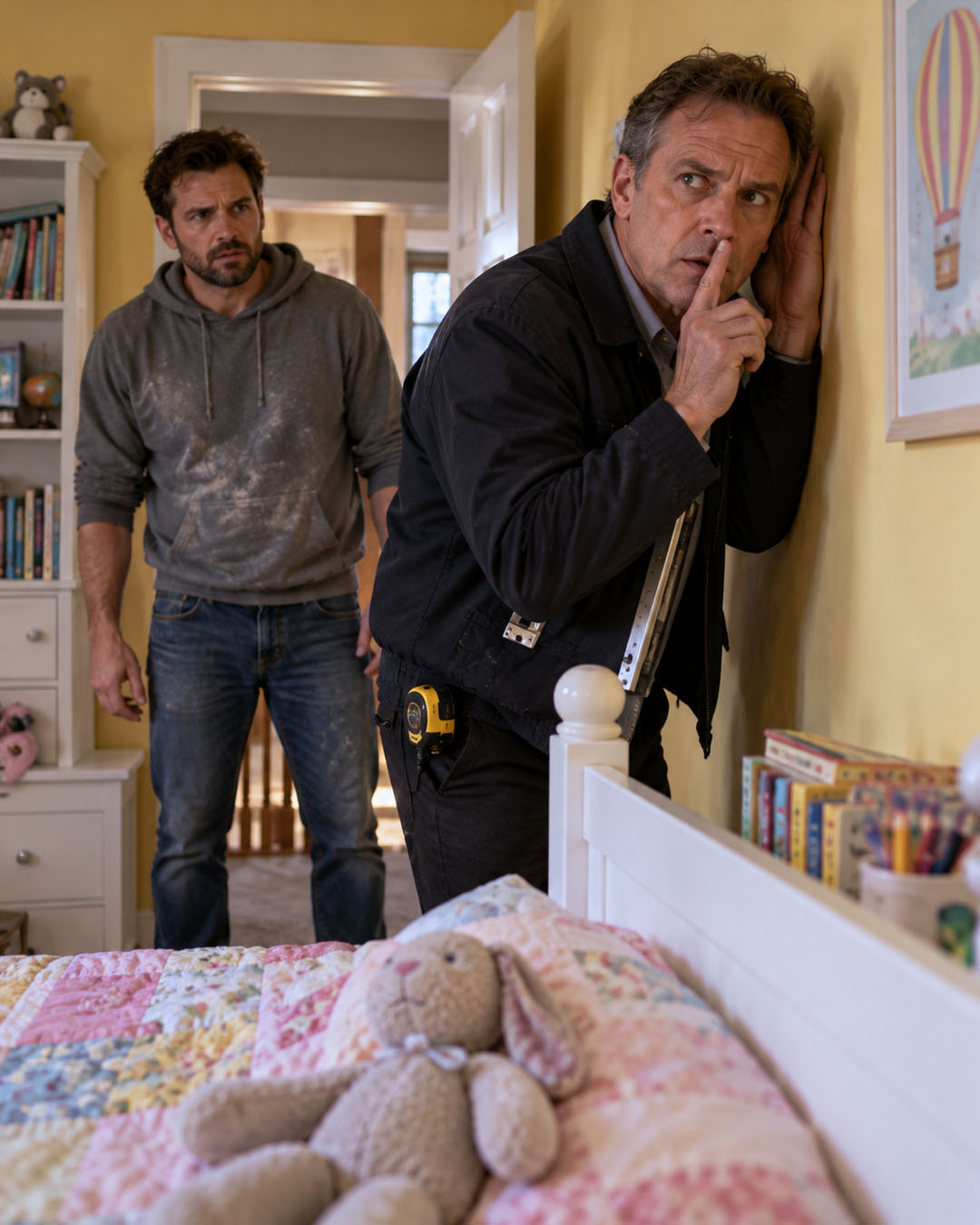
Dave Mason climbed out carrying the same metal clipboard and long measuring tape.
He stood on the sidewalk staring at the house.
“You coming in?” I called.
He looked toward Hannah’s window.
“I was thinking about it.”
“I made coffee.”
“That’s what you said last time.”
Despite himself, he smiled.
He began outside.
The tape ran along the foundation.
“Fifty-eight feet.”
Then he came in.
Kitchen.
Hallway.
Family room.
Stairs.
Hannah’s bedroom.
The balloon print was back on the wall because Hannah had decided she liked it and refused to let what happened take it from her.
Dave hooked the tape against one end of the room and walked.
The metal blade slid across the floor with a soft whisper.
Then it locked.
He looked down.
For several seconds, he said nothing.
My chest tightened.
“Well?”
He glanced at me.
“Fifty-eight.”
I laughed.
I had not meant to.
The sound simply came out.
“Matches?”
“Matches.”
He signed the final inspection.
A permit that had remained open for a decade was finally closed.
After Dave left, I stood in Hannah’s room looking at the wall.
For years, I believed owning a house meant having your name on paperwork.
Then I learned how little paper knows.
A person can own property without understanding what happens inside it. Someone can stand in your kitchen, share your bed, kiss you goodbye, and still know passages through your life you have never measured.
That frightened me for a long time.
Eventually, I understood the lesson was not to become suspicious of everyone.
It was to pay attention.
To listen when something does not add up.
To know the people you love well enough to notice when fear has entered their voice.
To understand that trust should never require blindness.
Hannah is older now.
She remembers less of that year than I do, which I consider a mercy.
Sarah remains part of her life under boundaries established by people wiser than any of us were back then. I never taught Hannah to hate her mother. Children should not be asked to carry adult anger simply because adults are too tired to carry it themselves.
What I taught her instead was that secrets meant to protect bad behavior are not kindness.
That she can always tell me when something feels strange.
That no adult who loves her should ever demand silence in exchange for affection.
And that a home is supposed to feel safe because the people inside it tell the truth.
Every Sunday evening, Hannah and I still do something that began as reassurance and became a joke.
We walk around the house knocking on walls.
Most answer with the flat, solid sound of studs and drywall.
Sometimes she deliberately knocks on a cabinet and says, “Suspicious.”
I pretend to investigate.
Then we laugh.
The house is still 58 feet long.
Inside and outside.
No missing space.
No secret room.
No voice waiting on the other side of a wall.
Just a father, a daughter, a reading seat, and a home that finally tells the same story no matter where you measure it.
And after everything we survived, I have learned there are few sounds more comforting than a tape measure clicking into place and proving that, at last, nothing is hidden.
THE END.
⚠️ All characters and events are fictional. Do not imitate or apply them in real life. 😌😌😌


