Chapter 2
I folded the paper and slid it beneath my water glass.
My mother stared at it.
Josie shoved her chair backward and stormed upstairs to her old bedroom.
“You’re ruining your father’s birthday!” Mom snapped.
I placed the small gift box beside my father’s plate.
“I came, I brought you a present, and I told the truth. Happy birthday, Dad.”
He didn’t look up.
He was staring at his pot roast as though the answer to a difficult question might be hiding beneath the potatoes.
On the drive home, Sam kept one hand resting on my knee.
After several minutes, he spoke.
“Your dad sold that boat recently.”
“I noticed.”
“Why would a man sell the one thing he loves the most right after his daughter’s business closes?”
I looked out the window.
I had been wondering the same thing.
Three days later, Garrett called.
“Wendy, the loan file is ready. I’d like you to come see it in person.”
I left work early and drove to the bank.
He handed me a thick envelope.
“Forty-one pages. Copies of everything submitted with the application. Take your time reading it. Then call me.”
“Is there something specific I should look for?”
Garrett adjusted his reading glasses.
“Read every page.”
That evening, I spread the documents across my kitchen table.
Sam was working an after-school lab, so the house was quiet.
The first pages contained Josie’s business plan. She had projected annual revenue of $210,000, an optimistic figure for a small coffee shop with eleven parking spaces.
There were equipment quotes, lease documents, and a list of expected expenses.
Then I reached the supporting financial records.
My W-2 from two years earlier.
A photocopy of my driver’s license.
A page from my bank statement.
These weren’t convincing imitations.
They were my actual documents.
I knew exactly where they had come from.
In March of the previous year, Josie’s apartment had suffered a plumbing leak. She had stayed in my spare bedroom for two weeks while repairs were being made.
I’d given her a key.
My filing cabinet was in that room.
I remembered coming home one evening and finding her sitting on the bed, scrolling through her phone.
She’d smiled and asked what we were having for dinner.
I pressed my palm against the kitchen table.
She had gone through my drawers while living under my roof.
I continued reading.
Page three contained the personal guarantee.
At the bottom was a signature that supposedly belonged to me.
I studied it.
My signature had always been distinctive. My father used to tease me about the way I wrote the letter W when I was in school.
Two sharp points. No loops.
The signature on the document had loops.
It was Josie’s handwriting.
I turned to page four, then five, then six.
Page seven stopped me.
I read it once.
Then again.
Then a third time.
I don’t remember deciding to sit on the kitchen floor. I only remember the cold tile beneath my legs and the paper trembling in my hands.
When Sam came home an hour later, he found me sitting beside the table.
He dropped his school bag and knelt beside me.
“Wendy, what happened?”
I held the file against my chest.
“I need you to trust me for a few days.”
He looked at the page.
“Okay.”
“I need to understand something before I make another move.”
He sat down beside me without even removing his coat.
“Then I’m staying right here until you’re ready.”
The next morning, I scanned all forty-one pages and sent copies to Detective Hunter, Garrett, and Kesha.
My hands didn’t shake this time.
I’d made my decision.
On Friday morning, Detective Hunter called Josie at the salon where she’d been working since her coffee shop closed.
He asked her to come in for an interview the following Monday.
Ten minutes later, my phone started buzzing.
I ignored the first call.
Then came a voicemail.
Josie was furious.
“You sent the police to my job? In front of my manager? Do you even understand what you’re doing to me?”
I understood perfectly.
Then a message from Mom appeared.
Your father is coming to see you tomorrow. You will listen to him.
I placed the loan file in a plain manila folder and marked two pages with yellow sticky notes.
Sam noticed.
“Do you want me to stay home Saturday?”
“I want you in the backyard. Close enough to hear me if I need you, but far enough that Dad doesn’t feel surrounded.”
“You’re still trying to protect him.”
I looked at the folder.
“He’s my father.”
Sam didn’t argue.
Saturday morning arrived cold and gray.
At 8:40, Dad’s Silverado pulled into my driveway so quickly that it bumped the curb.
He didn’t ring the bell.
He knocked three times.
When I opened the door, he walked straight past me into the kitchen.
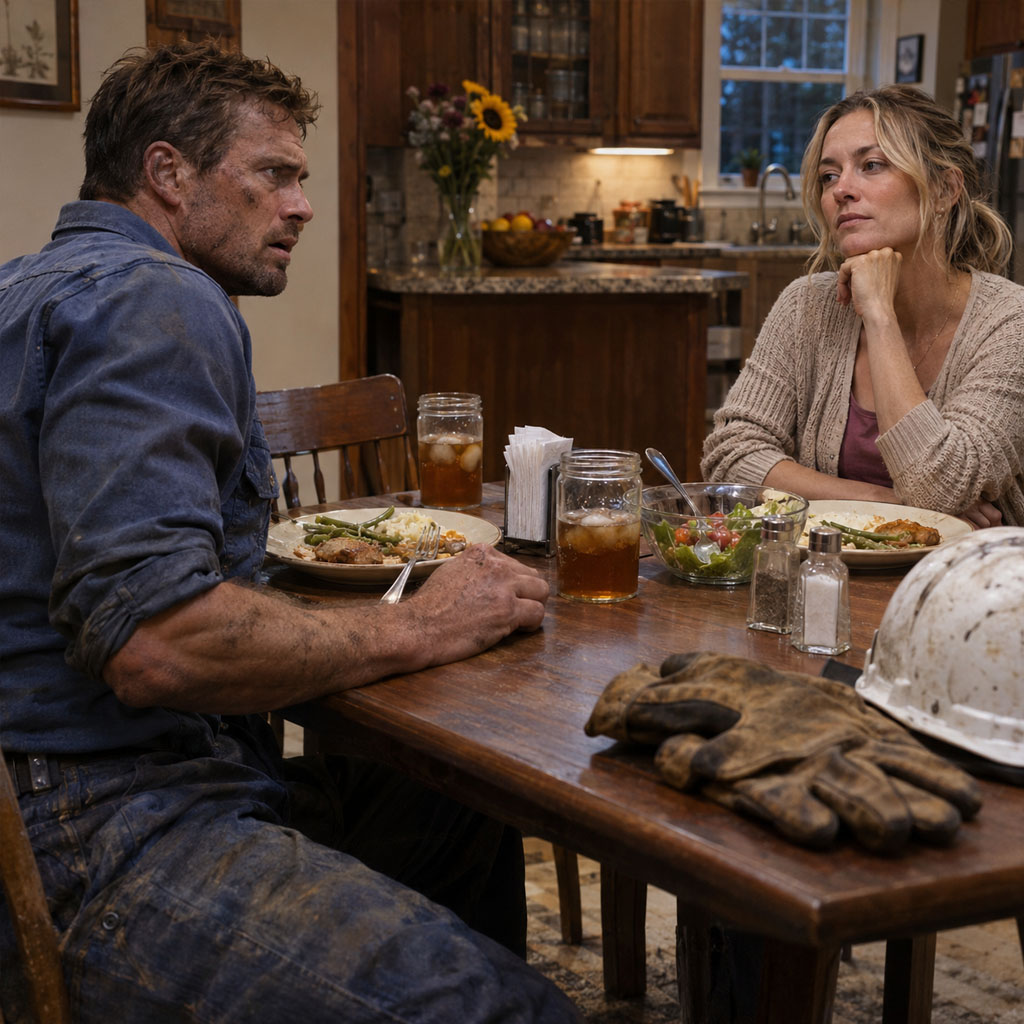
He looked terrible. He hadn’t shaved, and his flannel shirt was buttoned incorrectly.
Some foolish part of me wanted to reach out and fix it, the way I used to when I was a little girl.
“Coffee?” I asked.
“I’m not here for coffee.”
He didn’t sit.
“Josie has an interview with a detective on Monday.”
“I know.”
“You know? You sent them after your own sister!”
“She signed my name to a $68,000 loan.”
“She’s desperate, Wendy. The business failed. She’s scared.”
“She used my Social Security number, my tax documents, and my signature.”
He began pacing between the refrigerator and the table.
“Your mother hasn’t slept in a week. Josie is talking about leaving the state. You’ve got the whole family upside down.”
“Because I found out someone borrowed $68,000 using my identity.”
“Since when do we let money come between family?”
I looked at him.
“Since somebody decided my name was worth $68,000.”
He slammed his palm against the table.
My coffee jumped in its mug.
“Withdraw that report today, or you’re no daughter of mine!”
For a moment, I couldn’t breathe.
This was the man who had taught me to ride a bicycle. The man who had driven two hours through a snowstorm when my car broke down in college. The man who had called me Bird because I hummed while doing homework.
I let his words sit between us.
Then I opened the folder.
“Sit down, Dad.”
He stared at me.
“Page three.”
Chapter 3
My father hesitated before pulling out a chair.
I slid the first marked page toward him.
“Look at the signature.”
He picked it up.
“That’s your name.”
“Look at the W.”
He examined it more carefully.
“What’s wrong with it?”
“Mine has two sharp points. No loops. You know that because you used to tell me to stop making it fancy when I signed my report cards.”
He said nothing.
“That signature has loops. It’s Josie’s handwriting.”
Dad rubbed his eyes.
“She was desperate. She thought she’d pay everything back before you found out.”
“Now turn to page seven.”
He flipped through the documents.
Page four.
Page five.
Page six.
Then he reached the second yellow marker.
It was the notarization certificate.
Every personal guarantee at that bank required notarization. The certificate stated that the person signing the document had appeared before the notary in person and presented valid identification.
Below my forged signature was another signature.
Arlene M. Washington.
My mother’s name.
There was an embossed notary seal beside it.
Dad’s hand went flat against the paper.
For several seconds, he didn’t move.
My mother had worked at a title company for 22 years. She notarized legal documents almost every day.
She knew exactly what that certificate meant.
She had officially sworn that I had appeared before her, shown my identification, and signed the guarantee.
I had never been there.
My father slowly lifted his head.
His face had gone pale.
He didn’t say anything to me.
Instead, he stood, took his phone from his shirt pocket, and walked into the hallway.
My kitchen was small. The hallway was barely eight feet from the table.
There was nowhere to hide.
“Arlene,” he whispered. “Arlene, listen to me.”
I could hear my mother’s voice coming through the phone.
He swallowed.
“She has the application. She saw your stamp.”
Then he said something that made my stomach tighten.
“Same stamps on the other one. She found out about the other loan.”
I stared at him.
The other loan?
I had never heard of another loan.
Dad turned toward the kitchen.
He realized immediately what he’d said.
“What other loan?” I asked.
He lowered his phone.
“There’s no other loan.”
“I heard you.”
“I meant the first one. I got confused.”
“Then explain why you told Mom I found out about another one.”
He looked at the floor.
“Wendy, Bird, don’t.”
I raised one hand.
“Not right now. Sit down.”
And strangely enough, he did.
My father, who had just threatened to disown me, returned to the chair and lowered himself into it.
I folded my hands over the file.
“Here’s what’s going to happen. Detective Hunter already has these documents. Garrett has the same copies, and my attorney has them, too. The report isn’t mine to withdraw simply because you want me to.”
He looked at the page with my mother’s notary seal.
“The bank is going to request her notary journal. Every Ohio notary has to keep records of the documents they certify. Someone is going to examine those records.”
Dad stared at his hands.
“Whatever this other loan is, it’s coming out eventually. The only question is whether you tell me now or explain it to a detective later.”
He was quiet for so long that I began to wonder whether he’d speak at all.
Finally, he whispered, “January.”
“What happened in January?”
“After Christmas, the shop was losing money every month. Josie said she needed more working capital to get through winter.”
He rubbed his forehead.
“She found an online lender. Bright Path Capital. Forty thousand dollars.”
I felt my stomach drop.
“Whose name is on it?”
He looked at me.
“Yours.”
I stared at him.
“And yours?”
He nodded.
“I’m the second guarantor. I signed my own name.”
“Did Mom notarize my signature?”
He closed his eyes.
“Yes.”
I sat back.
Sixty-eight thousand dollars from the bank.
Forty thousand from Bright Path.
A total of $108,000 connected to my identity.
“I never agreed to either loan.”
“I know.”
“Then why did you sign yours?”
“Your mother said we could pay it back. The business was supposed to turn around.”
“And why did you let her notarize my name?”
He didn’t answer.
“How much have you paid on the second loan?”
“Nine hundred and ten dollars a month since June. Your mother and I have been making the payments.”
I stared at him.
“With what money? You’re retired.”
He looked away.
I suddenly understood the empty driveway at my parents’ house.
“The boat.”
He nodded.
“And some of the retirement savings.”
I put a hand over my mouth.
Twelve years of weekends on the lake. Fishing trips. Summer mornings when Dad would leave before sunrise and return with stories about the one that got away.
He had sold the boat to cover a loan he had signed alongside my forged name.
“Why didn’t you just pay the first loan, too?”
“We couldn’t afford both.”
“Then why did Mom tell me to pay $1,042 a month?”
He stared at the floor.
“Your mother thought if you paid the first one, the bank would stop calling. Nobody would pull the paperwork. Nobody would look at her notary stamp.”
I finally understood.
My mother hadn’t been trying to save Josie’s business.
She had been trying to protect herself.
She wanted me to spend $1,042 every month so nobody would discover what she’d done.
I heard the back door open.
Sam stood in the doorway leading to the backyard. He didn’t come inside. He simply looked at me, waiting.
I gave him a small nod.
He stayed where he was.
Twenty minutes later, my mother’s car pulled in behind Dad’s truck.
Josie was in the passenger seat.
Mom entered without knocking. She was wearing her work blazer, even though it was Saturday.
“Lloyd,” she said sharply. “Don’t say another word.”
I looked at her.
“He’s already said quite a few.”
She turned toward me.
“I don’t know what your father told you, but—”
“Forty thousand dollars. January. Bright Path Capital. You notarized my name twice.”
Her chin lifted.
“I did what I did for this family.”
“Did I appear in front of you?”
She didn’t answer.
“Did I show you my identification?”
“Josie needed one chance.”
“That’s not what I asked.”
My mother looked toward the window.
“You’ve had every chance in the world, Wendy. A college degree, a house, a man who adores you. Your sister has never caught a break.”
“I paid for my degree with loans I signed myself.”
Josie stepped forward.
“You have an 800 credit score. You have a house. You have Sam. You wouldn’t even have felt the payments.”
“I would have felt every dollar.”
Mom rolled her eyes.
“Oh, please. Is this still about that coffee can from when you were twelve?”
I stared at her.
“Three hundred dollars?”
“Whatever it was.”
“Three hundred and forty dollars,” I corrected. “Twenty-two years ago.”
My mother opened her mouth, then closed it.
I picked up my phone.
“There’s one more thing we need to do.”
Chapter 4
I found Garrett’s number and called him.
He answered after two rings.
“Wendy?”
“I’m sorry to bother you on a Saturday. I’ve just discovered another personal guarantee in my name. Forty thousand dollars from an online lender called Bright Path Capital. Same notary.”
My mother stepped toward the phone.
I moved it away from her.
“My father is here. He signed as the second guarantor, and I believe he’s willing to confirm the details.”
Garrett’s voice became more serious.
“Mr. Washington, are you available to speak?”
Dad looked at me.
I didn’t beg him. I didn’t threaten him.
I simply waited.
He leaned toward the phone.
“It’s Bright Path Capital. January ninth. Josie Washington’s business. I’m the second guarantor. My signature is real. My daughter’s isn’t.”
My mother’s face changed.
“Lloyd!”
He didn’t turn around.
“I’m 64 years old,” he continued. “An hour ago, I told my daughter she wasn’t mine anymore because of something you did. I’m not doing that again.”
There was a pause.
Then Garrett spoke.
“Thank you, Mr. Washington. That’s helpful. Mrs. Washington, if you’re there, I strongly advise you not to alter, misplace, or destroy your notary journal. That would create an entirely separate problem.”
My mother looked at the phone as though it had personally betrayed her.
I thanked Garrett and ended the call.
Then I stood.
“I’d like everyone to leave.”
Mom’s voice began shaking.
“If you do this, you’re going to lose your entire family.”
“You keep saying that as though it’s a threat. Dad already said it this morning. I’m still standing.”
Josie was the last person through the door.
She turned around on the front step.
“I’m your sister.”
I looked at her.
“Then you should have asked me.”
I closed the door.
Through the front window, I watched my father walk toward his truck alone. Mom and Josie got into the other car.
For almost a minute, nobody drove away.
Then Mom backed out.
Dad remained behind the steering wheel, his forehead nearly touching it.
Sam came up beside me and put his arm around my waist.
That was when I finally cried.
Not loudly. Not dramatically.
It was the kind of crying that starts quietly and doesn’t seem to stop.
“You did the right thing,” Sam whispered.
“I know.”
“Then why are you crying?”
I looked through the window at the empty driveway.
“Because they’re my family.”
The investigation took four months.
And none of what happened afterward was luck. Every consequence came from a decision someone had made long before I discovered the loans.
The following week, Garrett requested my mother’s notary journal through her employer.
Ohio notaries are required to record important details about the documents they certify, including the date, time, and identification presented by the signer.
My mother was meticulous about paperwork.
That was part of what made her job valuable.
Unfortunately for her, she’d recorded both of my supposed appearances.
April 11 of the previous year, at 2:15 p.m.
January 9 of this year, at 11:30 a.m.
Under identification presented, she’d written Ohio driver’s license on both entries.
There was just one problem.
I had never been in her office on either date.
I worked in hospital payroll. My employer maintained electronic badge records, and I kept detailed records of important meetings.
On April 11, at 2:15 p.m., I had been inside the hospital administration building attending a quarterly audit meeting.
Eleven other people were present. Three were outside auditors who had recorded the names of everyone in the room.
On January 9, at 11:30 a.m., I had been in that same building processing the first payroll of the new year.
The badge logs, meeting minutes, and computer timestamps all confirmed my location.
Kesha reviewed the records over my shoulder.
“Wendy, this is excellent evidence.”
I nodded.
For once, my habit of documenting everything had worked in my favor.
My mother’s employer was notified.
She had worked at that title company for 22 years. She knew every employee, had her favorite coffee mug, and had built a reputation as someone who could be trusted with important documents.
The company dismissed her after reviewing the investigation.
A coworker packed her desk and left her belongings at the front reception counter.
Her notary commission was revoked by the state.
In February, she pleaded guilty to two counts involving the false notarization of signatures. She received two years of probation and a fine, and she would never be allowed to hold a notary commission again.
Josie’s interview with Detective Hunter went about as expected.
She claimed I had given her permission to use my name.
When Hunter showed her the badge records, she changed her explanation.
Then she claimed Mom had told her everything was fine.
Hunter documented that, too.
Josie was charged with two felony counts of forgery and one count of identity fraud.
In March, she accepted a plea agreement. She received five years of probation, a felony record, and a restitution order covering the outstanding balances.
Kesha explained that debts arising from fraud were generally not erased simply by filing for bankruptcy.
“She can try,” Kesha said, “but she doesn’t get to pretend those obligations never happened.”
I didn’t celebrate.
I wasn’t happy that my sister had a criminal record. I wasn’t happy that my mother had lost a career she’d spent decades building.
But I also wasn’t willing to pretend that none of it had happened.
By November, the original bank released me from the personal guarantee.
In December, Bright Path issued its own release.
Both letters contained nearly identical legal language confirming that Wendy Washington bore no liability for the business obligations.
I read them at my kitchen table.
The same table where I’d discovered the documents.
This time, I didn’t end up sitting on the floor.
I placed both letters in a folder, closed it, and took a long breath.
I was free of the debt.
But my father wasn’t.
His signature on the Bright Path loan had been genuine. He had knowingly agreed to guarantee that $40,000.
And with my mother out of work and Josie making restitution payments on a call-center salary, the family’s finances began falling apart.
In January, my parents listed their house in Hilliard.
The house where I’d saved money in a coffee can.
The house where I’d done my homework while humming.
The house where my father had taught me how to change a tire in the driveway.
It sold in eleven days.
They moved into a two-bedroom apartment off Fishinger Road.
Josie moved in with them because nobody else was willing to co-sign a lease for her.
She took the second bedroom, which had a window overlooking the dumpsters.
I’d love to say I felt triumphant.
I didn’t.
One gray Sunday afternoon, I drove past the old house.
A young couple was carrying a crib through the front door. The fishing boat was long gone, and the marks where it had sat beneath the blue tarp had disappeared.
I sat at the stop sign for a moment.
Then I drove home.
Sam made grilled cheese sandwiches that evening.
We ate at the kitchen counter and talked about an upcoming school project.
For the first time in months, my family wasn’t the subject of every conversation.
And that was enough.
Chapter 5
My father came to see me on a Thursday evening in late March.
He didn’t knock.
He sat in his truck at the curb for nearly twenty minutes.
I watched him through the front window while Sam pretended not to notice that I was watching.
Eventually, I walked outside in my socks and tapped on the driver’s window.
He rolled it down.
He had lost weight. His flannel shirt was buttoned correctly, and his face looked older than it had the previous fall.
“I didn’t know if I was allowed to come to the door,” he said.
“You’re allowed to come to the door, Dad.”
We sat on the front steps.
Neither of us seemed to know how to begin.
The air smelled like rain and freshly cut grass from a neighbor’s first lawn mowing of the year.
He reached into his jacket and handed me an envelope.
It was thick and soft, as though it had been folded and unfolded many times.
Inside were $340 in cash.
Mostly twenties, with a few smaller bills.
There was also a note in his familiar blocky handwriting.
“I’m sorry it took me 22 years.”
I stared at the money.
The coffee can.
The Washington, D.C., trip.
The blue leotard covered in sequins.
I couldn’t speak.
Dad looked down at his hands.
“I’m not going to make excuses. I knew about January. I knew what your mother did. I signed my own name right next to it, and I told myself it was fine because we’d pay it off and you’d never know.”
He swallowed.
“I sold my boat to keep you from finding out instead of selling it to make things right.”
I looked at him.
“Why, Dad?”
He took a long breath.
“Because I was afraid of what would happen if everything came out. Your mother kept telling me Josie needed help. She said you could afford it. She said you were the strong one.”
He shook his head.
“And I believed her because believing her was easier than telling Josie no.”
I thought about all those years.
The dance competition.
The missed graduation.
The holidays when my military career had been treated like a personal insult.
“You told me I wasn’t your daughter,” I said quietly.
His eyes filled.
“I know.”
“You said it in my kitchen.”
“I know, Bird.”
He covered his face for a moment.
Then he lowered his hands.
“You were always the only one of us who tried to do things the right way. And I punished you for it because you were the one I thought could take it.”
I looked at the envelope again.
Three hundred and forty dollars.
It wasn’t enough to repair 22 years of disappointment.
But I understood what it meant.
He was finally acknowledging that the little girl who had saved that money deserved better.
“I accept your apology, Dad,” I said. “I mean that.”
He looked at me hopefully.
“But it’s going to take more than one envelope and one evening on these steps. I need to see things change over time.”
He nodded.
“That’s fair.”
We sat quietly for a while.
Then he mentioned my mother.
“Your mom still thinks you did this to her.”
I looked toward the street.
“Does she?”
“She says you destroyed the family over paperwork.”
I shook my head.
“She destroyed her own reputation when she signed a document saying I was standing in front of her when I wasn’t.”
He didn’t argue.
A month later, my mother sent me a four-page handwritten letter.
She explained that she’d only been trying to help her youngest daughter. She wrote about the sacrifices she’d made raising us, the stress of losing her job, and the humiliation of having her notary commission revoked.
She also said that someday, when I had children of my own, I’d understand why a mother sometimes had to make difficult decisions.
I read the first page.
Then I placed all four pages in the recycling bin.
I didn’t write back.
Josie and I haven’t spoken since the morning she stood on my front step and told me I was her sister.
I still think about her sometimes.
I remember the little girl who used to crawl into my bed during thunderstorms. I remember helping her with spelling tests and watching her dance at school recitals.
I also remember the woman who went through my filing cabinet, copied my financial information, and used my name to borrow money without asking.
Both people were real.
But I couldn’t keep pretending that loving the first meant accepting what the second had done.
Before Dad left that evening, he paused beside his truck.
“Am I still allowed to call you Bird?”
I considered the question.
“Not yet.”
He nodded.
“Ask me again sometime.”
He smiled a little, as though that answer was more than he’d expected.
After he drove away, I took the envelope inside and placed the $340 in a small wooden box.
I didn’t need the money.
I kept it because a twelve-year-old girl in a bedroom in Hilliard had waited a very long time for someone to make things right.
Chapter 6
Sam and I got married in May at the Franklin County Courthouse.
There was no elaborate ceremony, no expensive reception, and no long guest list.
Kesha stood beside us as our witness.
She also brought the old photograph of us in our freshman-year dorm towels, which she’d finally had framed.
The clerk laughed so hard at the picture that she had to pause before continuing the ceremony.
Afterward, the three of us went out for burgers and milkshakes.
Garrett and Detective Hunter both sent cards.
I still have them.
I sent my father one photograph from that day.
Just one.
Sam and I standing on the courthouse steps, smiling.
Dad wrote back four words.
You look so happy.
I read them twice.
Then I placed the photograph in a frame beside the picture of Caleb, the little boy whose accident had brought another family crisis into my life.
My father and I slowly began rebuilding our relationship. We didn’t talk every day, and I didn’t pretend that everything had returned to normal.
Sometimes he called to ask about work. Sometimes we discussed the weather or fishing.
Once, he asked whether I remembered the old boat.
I told him I did.
He apologized again.
I told him he didn’t need to repeat the words every time we spoke. What mattered was what he did next.
He seemed to understand.
My mother never changed her position.
She continued to believe that I had been too harsh and that Josie’s circumstances justified what happened.
I eventually stopped trying to convince her otherwise.
There is a difference between forgiveness and permission.
I could forgive someone for what they had done without giving them another opportunity to do it.
I could love my father without pretending his choices hadn’t hurt me.
I could miss my sister without reopening a door she had used to take something that wasn’t hers.
And I could finally stop being the dependable daughter who was expected to absorb every problem simply because she had the financial stability to survive it.
For most of my life, my family had treated me like collateral.
I was the daughter with the good credit, the steady job, the house, and the responsible fiancé. Whenever someone else needed a soft landing, my name was the first one they reached for.
At twelve, it was $340 for a dance costume.
At twenty-two, it was missed graduation celebrations and holidays.
At thirty-four, it was $108,000 in loans I never agreed to guarantee.
The amount changed.
The expectation never did.
But the day I refused to sign my mother’s withdrawal letter was the day something finally changed.
I stopped believing that keeping the peace was the same as keeping a family together.
Sometimes the person who refuses to carry everyone else’s burden is the only one willing to tell the truth.
And sometimes the most difficult part of loving your family is accepting that you cannot save them from the consequences of their own choices.
I still have that old coffee can.
It’s sitting on the top shelf of my closet, empty now, with a little dent near the bottom.
I kept it because it reminds me of a girl who worked hard, saved every dollar, and believed that promises meant something.
She deserved to go to Washington, D.C.
She deserved to have her graduation celebrated.
She deserved parents who didn’t make her feel guilty for being responsible.
And she deserved to have her name remain her own.
I couldn’t go back and give that girl everything she had missed.
But I could finally stop letting the people who disappointed her decide what happened next.
Sam and I are building a quiet life together. We pay our bills, make dinner, argue about which movie to watch, and occasionally visit my father.
My mother and sister remain distant.
Some relationships may never be repaired, and I’ve learned that accepting that truth doesn’t make me cruel.
It makes me honest.
I used to think family meant you never walked away, no matter what someone did.
Now I understand that love without boundaries can become a way of allowing people to hurt you repeatedly.
I don’t regret reporting the fraud.
I regret that it happened.
I regret that my mother chose to protect a false signature instead of her daughter. I regret that my father knew and stayed silent. I regret that Josie believed my life was something she could borrow against whenever hers became difficult.
But I don’t regret finally saying no.
Because my name belongs to me.
My money belongs to me.
And my love, however generously I give it, is not a debt anyone gets to collect.
THE END.\
⚠️ All characters and events are fictional. Do not imitate or apply them in real life. 😌😌😌