
Chapter 2
I had not spent those ten years standing still.
I graduated near the top of my class. My parents were not there when I crossed the stage. I accepted a clerkship under Judge Marcus Thorne, a brilliant, intimidating man who could dismantle a weak legal argument with one raised eyebrow.
He never asked too many questions about my family.
Once, close to midnight while we were finishing a complicated memorandum, he took off his glasses and said, “Anybody waiting for you at home?”
I almost told him everything.
Instead, I smiled and said, “No, sir. I’m fine.”
He studied me for a moment.
“All right.”
That was one of the things I respected about him. He knew the difference between a locked door and a door a person simply hadn’t noticed yet.
I became a prosecutor, then moved into complex financial crimes. I worked sixty-hour weeks and learned how greed hid behind respectable titles, clean offices, charitable boards, and carefully balanced spreadsheets.
For the first three years, I mailed birthday cards to my parents.
None were acknowledged.
Eventually, I stopped.
By my mid-thirties, I had built a reputation for being methodical, calm, and almost impossible to rattle. When a federal magistrate position opened, several senior attorneys encouraged me to apply. The vetting process was merciless.
During my final background interview, one investigator placed a folder in front of me.
“There’s an allegation from law school,” he said. “Academic dishonesty.”
The old lie had followed me after all.
I opened my briefcase and handed him the records I had carried from apartment to apartment for years: official transcript, registrar’s letter, disciplinary clearance.
He read everything.
Then he closed the folder.
“That settles it.”
That was all.
A stranger had given me more fairness in five minutes than my own family had given me in ten years.
When I was sworn in, the courtroom was filled with colleagues and mentors. Judge Thorne came with a cane he pretended he didn’t need. Evelyn Carter, the registrar who had once offered to call my parents herself, sat in the second row.
The seats where family normally gathered were empty.
I told myself I had made peace with that.
Then Maya’s case landed on my desk.
The investigation against her was painfully thorough. She had been finance director for the Oakridge Youth Alliance, a respected nonprofit running tutoring programs and meal assistance in low-income neighborhoods. According to investigators, she created a fake vendor and approved payments to it in small amounts over three years.
The account behind that vendor was hers.
The evidence included bank transfers, fabricated invoices, mailing records, computer logs, and a post-office box registered under a variation of her maiden name.
I read every page twice.
Not because I doubted the investigators.
Because some broken piece of me wanted the file to become someone else’s if I stared long enough.
At 8:50, I called Chief Judge David Carmichael.
“The defendant on my nine-fifteen docket is my sister.”
Silence.
“Your sister?”
“Estranged for ten years. I intend to recuse on the record as soon as the case is called.”
“You can transfer it now,” he said. “Quietly. No reason for anyone outside chambers to know.”
I understood what he was offering. It was legal, reasonable, and easier.
For several seconds, I wanted to accept.
Then I thought about my father refusing to see a transcript. My mother changing her email. Friends who had heard a rumor and never asked. A decade built on people choosing convenient silence.
“No,” I said. “I want the conflict stated openly. Clean record. No questions later.”
Carmichael exhaled.
“Harder way.”
“Yes.”
“Probably the right one.”
At 9:10, my clerk knocked.
“The gallery is full. A reporter is here.”
Of course he was.
I stood, straightened my robe, and walked toward the courtroom.
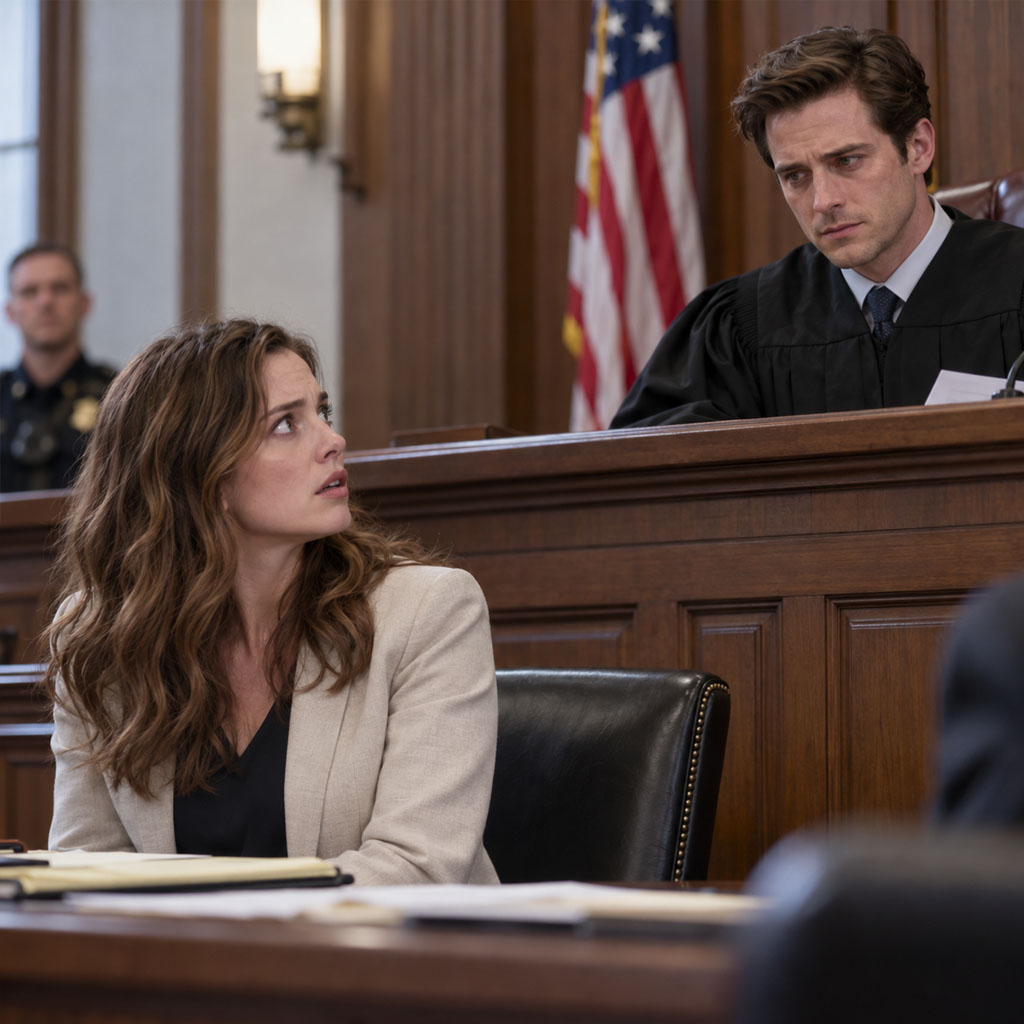
When the doors opened, attorneys rose and papers rustled. Near the aisle sat a young reporter with a notebook already open.
Then Maya entered beside her attorney.
She was polished and composed, wearing a charcoal blazer and the same expression she had worn since childhood whenever she wanted people to believe nothing could possibly be her fault.
Her lawyer looked down at his papers as he approached the defense table.
I recognized him.
Liam Croft.
We had attended law school together.
Ten years earlier, after hearing the rumor that I had cheated, Liam had quietly stopped inviting me to his study group. He had never asked whether the story was true.
Now he looked up.
His eyes met mine.
I watched recognition spread across his face.
Then Maya followed his stare.
Her composure disappeared.
She whispered my name.
And for the first time in my life, my sister looked at me as though the truth had finally entered the room before she could control it.
Chapter 3
The clerk called the case.
Maya stood beside Liam, her hands visibly trembling.
Mine were still.
I read the charges in the same measured tone I used every morning. I did not stare at her. I did not allow myself even the smallest satisfaction.
That mattered.
Revenge would have been easy to understand. Justice required more discipline.
Before a plea could be entered, I looked toward the court reporter.
“For the record, I am recusing myself from this matter effective immediately because I have a direct family relationship with the defendant.”
A murmur moved through the gallery.
Maya closed her eyes.
Liam lowered his head.
I continued.
“I have taken no substantive action on the merits of this case. The matter will be reassigned.”
Then I stood and left.
The entire encounter lasted only a few minutes.
Yet when the door closed behind me, my hands finally began to shake.
I went into chambers, sat down, and waited for the reaction to pass. Ten years earlier, the shaking had come after my father hung up on me. Now it came after I had done exactly what I wished my family had done all those years ago.
I had faced an uncomfortable truth and handled it openly.
Another judge took over. Maya was released on bond with travel restrictions while the case proceeded.
Two days later, a local newspaper published a short article about the charges. Near the end was one sentence explaining that the originally assigned magistrate judge had immediately recused himself because of a family relationship with the defendant.
That sentence reached Ohio.
Mom called me that evening.
Her number was still saved in my phone.
I stared at it until the third ring.
Then I answered.
“Julian?”
Her voice sounded smaller than I remembered. Older.
“Yes.”
There was a long pause.
“Is it true?”
I looked through my apartment window at the lights across the city.
“Which part?”
She started crying.
“Julian, please.”
“Which part, Mom? That I was never expelled? That I graduated? That I became a prosecutor? That I’m a judge? Or that Maya is charged with stealing hundreds of thousands of dollars?”
“I didn’t know.”
“You chose not to know.”
“We trusted her.”
“You refused to trust me.”
That stopped her.
For years, I had imagined this conversation. In some versions I shouted. In others she apologized immediately and I forgave her before the call ended.
Reality was quieter.
“We thought you were ashamed,” she whispered.
“I sent proof.”
“Maya said you would fabricate things.”
“Did you call the school?”
Silence.
“Did Dad?”
More silence.
“Did either of you ask one person whose job was to know the truth?”
“No.”
I closed my eyes.
There it was.
The answer I had already known for ten years.
“I went to Cousin Emily’s wedding,” I said.
Mom inhaled sharply.
“I saw you.”
“I know.”
“You looked away.”
She began crying harder.
“I was angry.”
“No. You had already decided I wasn’t your son anymore.”
“That isn’t true.”
“It was true enough for five years.”
She asked whether she and Dad could come see me.
I could hear desperation in her voice, but something inside me had changed. Once, I would have accepted anything—a phone call, a Christmas card, one sentence saying they missed me.
Now I understood that reconciliation and surrender were not the same thing.
“I’m not ready for that.”
“Julian—”
“I spent ten years learning how to live without you. You don’t get to undo that because the person you chose turned out to be capable of deceiving you too.”
I hung up gently.
Not triumphantly.
My mother’s pain did not heal mine.
But for once, I had not abandoned myself to make someone else comfortable.
Chapter 4
Dad called three days later.
He sounded exactly as I remembered him—controlled, practical, and deeply uncomfortable with emotion.
“Your mother told me you spoke.”
“We did.”
He cleared his throat.
“I suppose I owe you an apology.”
I waited.
“I should’ve checked.”
“Yes.”
“I was angry that you left.”
“I went to school.”
“You stopped coming home.”
“I was studying. Working. Trying to build a life.”
“I know that now.”
“No, Dad. You knew it then. You just preferred Maya’s explanation because it gave you somebody to blame.”
The line went silent.
For once, he did not argue.
He finally said, “I was wrong.”
Those three words should have meant everything.
They meant something.
Just not everything.
He asked about my work. He asked where I lived, whether I was healthy, whether I had anyone in my life. They were ordinary questions, but hearing them after a decade made them feel almost invasive.
Still, I answered some of them.
Not all.
Trust does not return because someone discovers they misplaced it.
A week later, Liam called chambers about an unrelated case. We handled the scheduling issue, and then he hesitated before hanging up.
“Julian?”
“Yes?”
“I owe you something too.”
“You don’t.”
“I think I do.”
He admitted he had believed the cheating story in law school because several people repeated it. He said he had been embarrassed since seeing me on the bench.
“I should’ve asked you,” he said.
“Yes.”
“I’m sorry.”
For the first time, I realized how many people had participated in my isolation without ever considering themselves cruel. They had simply taken the easier path.
Rumor required no courage.
Truth required a question.
Maya’s case continued without me. I did not request updates beyond what was public, and I never discussed it with the prosecutors involved.
Eventually, she accepted a plea agreement.
The evidence was overwhelming.
She admitted creating the false vendor and using nonprofit funds for personal expenses. Restitution was ordered, along with a prison sentence and years of supervised release.
I did not attend the hearing.
Mom did.
Dad did.
Afterward, Dad sent me a handwritten letter. He said sitting behind Maya in court had forced him to remember every time she had told them I was unstable, dishonest, bitter, jealous, or dangerous to the family.
He wrote that he could finally see how one lie had been used to support another.
At the end, he wrote:
We believed the child who stayed because we resented the child who left. That was our failure, not yours.
I read that line several times.
Then I placed the letter in a desk drawer.
I did not throw it away.
That surprised me.
Months passed before I agreed to see my parents.
We met halfway between Ohio and Massachusetts at a quiet restaurant near Albany. Mom looked smaller. Dad had gone almost completely gray.
For several seconds, none of us knew whether to hug.
We didn’t.
We sat down.
Mom apologized first.
Not the kind of apology that begins with if. Not the kind followed immediately by excuses.
She said she had failed me.
Dad said he had confused proximity with loyalty. Because Maya stayed close, he assumed she loved them more. Because I left, he interpreted independence as rejection.
“I punished you for becoming who you were supposed to become,” he said.
I looked at him across the table.
“That cost me ten years.”
“I know.”
“You don’t get those years back.”
“No.”
Neither did I.
That was the hardest truth in the room.
There would be no magical restoration. No photograph could replace my empty graduation seats. No holiday dinner could erase Thanksgiving alone at a diner counter. No apology could give back the night my mother saw me at a wedding and chose to look away.
But an apology could stop the wound from being denied.
Sometimes that is where healing begins.
Chapter 5
I never became close to Maya again.
Months after sentencing, she sent me a letter through our parents. I nearly returned it unopened, but eventually I read it.
She said the lie about law school began during a period when she felt invisible beside me. I had been the one relatives praised for grades and scholarships. She had stayed home, helping our parents, and convinced herself that I looked down on her.
So when someone asked how I was doing, she said I was struggling.
Then struggling became suspended.
Suspended became expelled.
When our parents believed her, she became frightened of admitting the truth.
That explanation might have moved me once.
Now I could see the missing piece.
She never stopped.
For ten years, she watched our parents mourn a living son. She watched them change phone numbers, block emails, and erase me from family events. Every day gave her another chance to tell the truth.
She chose herself every time.
I wrote back only once.
I told her I understood that insecurity could explain the beginning of a lie, but it could not excuse a decade of maintaining one. I told her I hoped she used her sentence and the years after it to become someone who no longer needed another person’s destruction to feel secure.
Then I wished her well.
That was enough.
My relationship with my parents returned slowly and imperfectly. We spoke by phone every few weeks. The first Christmas they visited me, Mom stood in my living room looking at framed certificates she had never seen before.
My law degree.
My bar admission.
A photograph from my swearing-in.
She touched the edge of the frame.
“I should’ve been there.”
“Yes,” I said.
She cried.
I did not tell her to stop.
Dad noticed an old photograph of Judge Thorne standing beside me at the ceremony.
“Who’s that?”
“Someone who showed up.”
Dad lowered his eyes.
For a moment I regretted saying it.
Then I realized regret was not necessary simply because the truth hurt.
He nodded.
“I’m glad somebody did.”
That Christmas was not warm in the effortless way holidays had been when I was a child. We were careful with one another. There were pauses. Awkward moments. Grief sat quietly at the table beside us.
But so did honesty.
And honesty, I had learned, was a better foundation than comfort.
Years earlier, I had believed vindication would feel like victory. I imagined the day everyone discovered Maya’s lie would restore something inside me.
It didn’t.
The truth did not return my twenties. It did not place my mother at graduation or my father beside me when I took the oath of office. It did not transform Maya into the sister I had once believed she was.
What it gave me was something quieter.
Freedom.
For ten years, other people’s belief had seemed like a verdict hanging over my life. Even when I succeeded, some part of me was still arguing my case before a family court that had already convicted me.
Then, one ordinary Tuesday morning, I understood I had been carrying the wrong burden.
My innocence had never depended on their willingness to recognize it.
Their refusal to look had been their failure.
Not mine.
I still keep Dad’s letter in my desk.
Sometimes, after a difficult day in court, I open the drawer and see the folded envelope. I rarely read it anymore. I don’t need to.
I remember the sentence.
We believed the child who stayed because we resented the child who left.
That mistake nearly destroyed a family.
But the truth eventually did what truth often does when someone finally gives it room.
It stood quietly.
It waited.
And when everyone else had finished talking, it was still there.
THE END.
⚠️ All characters and events are fictional. Do not imitate or apply them in real life. 😌😌😌


