
Chapter 2
“I’m in the hospital, Mom.”
I said it slowly, expecting the words to interrupt her lecture. Instead, my mother sighed as though I’d confirmed something terribly inconvenient.
“Well, Sloan said you’ve been behaving irrationally. Maybe getting some rest will help you think clearly.”
I looked toward the window, where Seattle’s pale morning light filtered through the blinds. Somewhere down the hall, a cart rattled past a nurses’ station. My mother hadn’t asked whether I was frightened, how I was feeling, or what the doctors had said.
She only wanted Sloan forgiven.
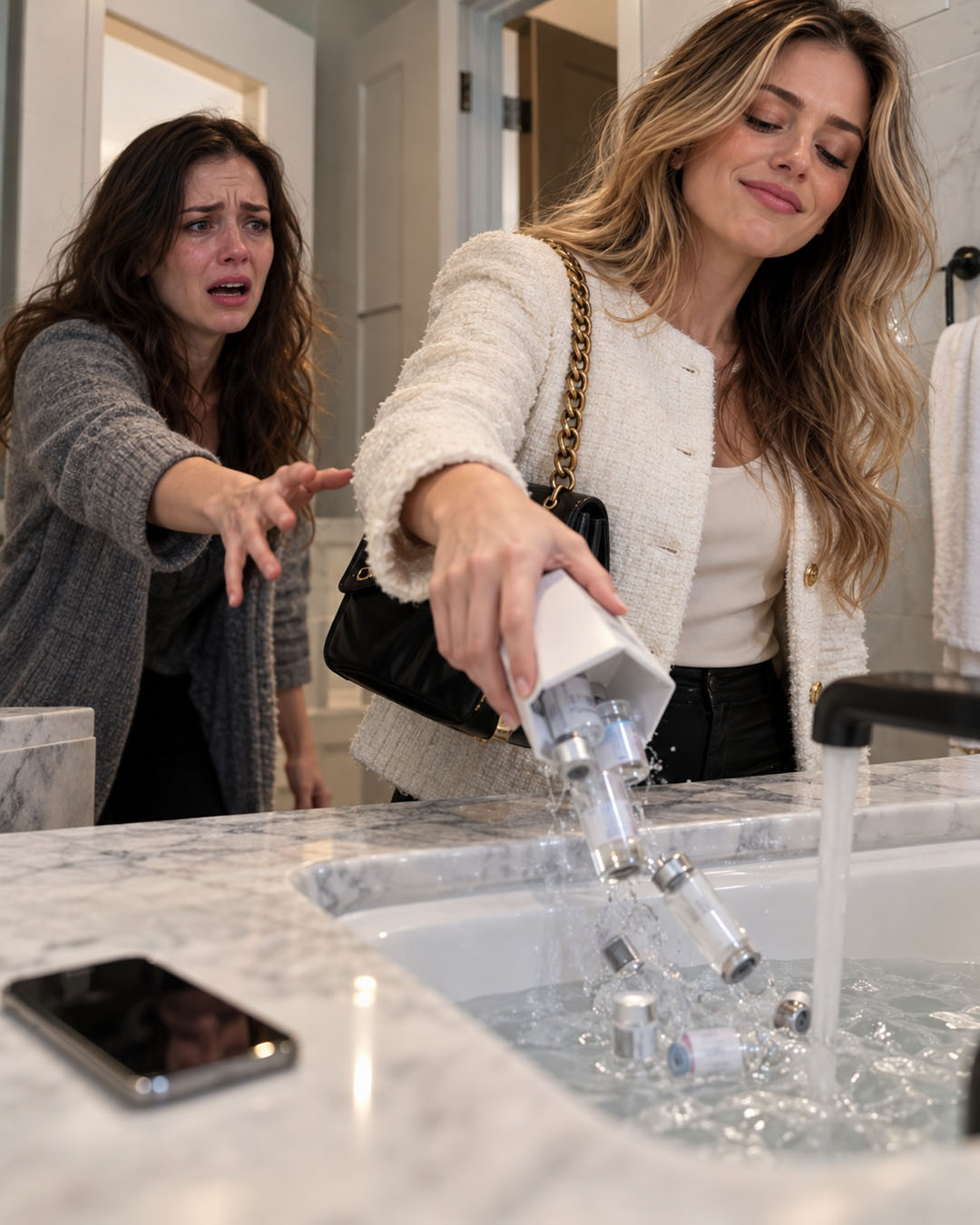
“Mom, Sloan destroyed twenty thousand dollars’ worth of medication that I need to stay healthy.”
“According to Sloan, you destroyed it yourself.”
“Why would I do that?”
“How am I supposed to know, Marin? You’ve been so emotional lately. Your sister was only trying to help.”
I closed my eyes. I’d spent decades waiting for my mother to recognize the difference between helping someone and hurting them. That morning, I finally understood how much of my life I’d wasted hoping.
“She wants an apology,” Mom continued. “And I think you owe her one. Family shouldn’t turn against family over misunderstandings.”
“This wasn’t a misunderstanding.”
“I’m not choosing sides.”
Those four words had followed me since childhood. Somehow, whenever Mom refused to choose sides, Sloan received everything she wanted, and I was expected to surrender.
“You’re right,” I said quietly. “There aren’t going to be any more sides to choose.”
I ended the call.
Three hours later, Vance entered my hospital room carrying an overnight bag and wearing the same wrinkled suit he’d traveled in. His face changed when he saw the IV in my arm.
He came to my bedside and held my hand.
“Tell me what the doctors said.”
I explained the emergency treatment, the difficulty obtaining replacement medication, and the possibility of additional hospital expenses. He listened without interrupting.
Then I told him what Mom had said.
Vance stared at me.
“She wants you to apologize?”
“Apparently I traumatized Sloan by getting upset about my medication.”
He shook his head slowly.
“Marin, this can’t continue.”
There was something different about hearing those words from him. Vance had always supported me, but he’d also respected my wish to maintain a relationship with my family. He’d watched me send money, cancel plans, and swallow insults because I believed being a good daughter meant keeping everyone happy.
Now he looked genuinely frightened by what that habit had cost me.
“I don’t want revenge,” I whispered.
“Neither do I,” he answered. “I want you safe. And I want her held responsible.”
After my doctors determined I was stable enough to go home, Vance drove me through the gray Seattle afternoon. When we parked in our driveway, I remembered the recording.
“There’s something I haven’t shown you.”
I took out my phone and pressed play.
Vance listened to every word.
He heard Sloan accusing me of pretending to be sick. He heard me explain that the medication was essential. He heard her dismiss my warnings and the sound of the toilet flushing.
When the recording ended, he remained still.
“She knew you needed it,” he said.
“I told her.”
“And she’s telling your mother that you did it yourself.”
I nodded.
Vance reached for my hand.
“Then we’re going to get professional help.”
That afternoon, he called Arthur Davis, an attorney he’d known since college. Arthur practiced civil litigation in Seattle and had handled difficult property and financial disputes for years.
He came to our house the following day.
I spread everything across the kitchen island: the specialty pharmacy invoice, the insurance approval, the hospital paperwork, my doctor’s notes, and photographs of the empty medication box.
Arthur examined the documents carefully.
“Twenty thousand dollars for the medication itself,” he said. “And you’re still waiting to learn what you’ll owe for emergency treatment?”
“Yes.”
He nodded, then asked about the recording.
I played it for him.
When it ended, he folded his hands.
“This is important, but we need to be careful. Washington has strict laws about recording private conversations. I need to review the circumstances before determining whether this recording can be used or shared.”
My heart sank.
“So she can simply lie her way out of it?”
“Not necessarily. Your medical records, pharmacy documentation, your account, and any statements Sloan makes are all relevant. We can pursue reimbursement, and we can report the destruction to law enforcement. But we’ll do it properly.”
He explained that intentional property destruction could have serious legal consequences, particularly when the value was substantial. Whether prosecutors brought charges, and what charges they selected, would depend on the evidence and applicable law.
He also explained that a civil claim could seek compensation for documented losses.
“What would you recommend?” Vance asked.
“I’d begin with a formal demand for reimbursement and preserve the evidence. Meanwhile, we’ll document every additional expense and contact the insurer about the replacement medication.”
I looked at the papers spread before me.
For years, my family had treated every problem as an emotional contest. Whoever cried the loudest won. Whoever objected became the troublemaker.
Now, for once, there were documents, facts, and people who didn’t care which daughter Mom preferred.
“Send the letter,” I said.
Arthur nodded.
“Seven days?”
“Seven days.”
The initial demand was for $20,400, covering the medication and the documented expenses we could establish at that point. Additional treatment costs would be addressed separately as the bills arrived.
That evening, my mother sent a long text message.
She was hosting a family reconciliation dinner on Saturday.
According to her message, Sloan had generously agreed to forgive me for my behavior. I was expected to attend, apologize, and stop making everyone uncomfortable.
The final sentence read: Family is everything.
I showed it to Vance.
“Don’t go,” he said immediately.
But something about the invitation bothered me. Mom was arranging the evening as though nothing had happened, as though a nice dinner could erase the fact that I’d spent the night in a hospital because Sloan wanted to teach me a lesson.
“I want to go,” I said.
“Marin, you’re still recovering.”
“I know. But I need to say what I should’ve said years ago.”
Vance studied my face.
“Then I’m going with you.”
Saturday arrived cold and damp.
Mom had prepared pot roast, mashed potatoes, and green beans, the same dinner she’d served for nearly every important family occasion since we were children. Her dining room smelled of rosemary and expensive candles.
Sloan was already seated when we arrived.
She wore a cream-colored silk blouse and the expression of someone granting an undeserved favor.
“Well,” she said, “look who finally decided to show up.”
Mom greeted Vance with a nervous smile before turning to me.
“Let’s get this unpleasantness behind us. Sloan has suffered enough.”
I sat across from my sister.
Vance took the chair beside me.
For several minutes, Mom talked about the weather and a neighbor’s new car. Then she set down her fork and folded her hands.
“Marin, I think we’re ready for your apology.”
Sloan leaned back.
“I’m willing to forgive you,” she said. “But you really scared me that night. You need to understand that.”
I reached into my purse and removed the envelope Arthur had prepared.
I slid it across the table.
Sloan smiled.
“What’s this? A written apology?”
“Open it.”
She tore the envelope and unfolded the papers.
Her smile disappeared.
Mom leaned forward.
“What is it?”
Sloan stared at the letter.
“You’re demanding twenty thousand four hundred dollars?”
“That’s the documented amount you’re responsible for so far.”
“This is insane!”
“Read the rest,” I said.
Sloan’s eyes moved down the page.
“You have a lawyer?”
“Yes.”
Mom snatched the document from her.
“Marin, how could you threaten your own sister with legal action?”
“Because she destroyed my medication.”
“That’s not what happened!” Sloan cried.
I looked directly at her.
“You told Mom I threw it away myself.”
“Because you did!”
I felt Vance shift beside me. Arthur had advised me not to make the recording public or distribute it without his review, and I had agreed. I didn’t need to play it to know what happened.
“Then you can give that account to the people reviewing the case,” I said. “I’m not arguing about it anymore.”
Sloan’s face hardened.
“You’d really destroy my reputation over some stupid medicine?”
“It wasn’t stupid medicine,” Vance answered. “It was her treatment. She was hospitalized because you destroyed it.”
Mom raised her voice.
“That’s enough! You’re both being ridiculous. Sloan made a mistake, and Marin is blowing everything out of proportion.”
I turned toward her.
“Mom, five days ago, I called you from a hospital bed. You never once asked whether I was going to be okay.”
The room became quiet.
She opened her mouth, then closed it.
“I didn’t know things were that serious,” she finally said.
“You didn’t ask.”
Sloan gave an impatient sigh.
“Oh, here we go again.”
I stood up.
“You have seven days to respond to Arthur’s letter. After that, we’ll proceed through the proper channels.”
Sloan’s expression changed.
“Marin, I don’t have that kind of money.”
“You should’ve considered that before destroying something you couldn’t replace.”
For the first time in my life, I left my mother’s dining room without waiting for permission.
Chapter 3
By Monday morning, half my extended family seemed to know about the demand letter.
Unfortunately, almost none of them knew what had actually happened.
Aunt Susan left a voicemail accusing me of being cruel. Uncle Richard sent a text declaring that respectable families didn’t involve lawyers in private disagreements. A cousin I hadn’t spoken to in eight years called to inform me that Sloan had always been sensitive and that I should make allowances.
Every message carried some version of the same instruction.
Forgive Sloan. Protect Mom. Pay the price yourself.
I sat at the kitchen table with a cup of tea and read them until something unexpected happened.
I stopped feeling guilty.
Instead of defending myself to everyone, I forwarded the relevant messages to Arthur for his records. Then I muted or blocked the relatives who refused to stop harassing me.
Vance watched from the doorway.
“How are you doing?”
“Tired,” I admitted. “But not confused anymore.”
That was the remarkable part.
For years, I’d mistaken family pressure for moral obligation. If enough relatives called me selfish, I assumed I must have done something wrong.
Now I could see that their anger wasn’t evidence of my guilt. It was evidence that I had stopped doing what they expected.
My recovery remained difficult. The emergency treatment had controlled my immediate symptoms, but fatigue followed me from room to room. Dr. Thorne and his staff spent hours arranging a medically appropriate replacement plan, while the pharmacy and insurer reviewed the unusual circumstances.
Each telephone call reminded me how easily Sloan had disrupted something that had taken months to establish.
On Thursday, Vance came into the living room carrying his tablet.
“You need to see this.”
Sloan had posted several photographs from a luxury spa resort in Whistler, British Columbia.
In one picture, she lounged beside a fireplace in a white robe. In another, she smiled over a glass of champagne against a backdrop of snow-covered mountains.
Her caption read: Healing from toxic people who try to steal your peace.
I stared at the photographs.
“She’s on vacation?”
“Looks that way.”
“She told me she didn’t have enough money to reimburse a dollar.”
Vance sat beside me.
“I saved the post. Arthur can decide whether it’s relevant to the civil case.”
I handed back the tablet.
Once, I might have called Sloan and demanded an explanation. I might have spent hours crying over the unfairness of it all.
Instead, I returned to my tea.
The next evening, our doorbell rang.
Mom stood on the porch holding her designer handbag against her chest. Her hair was carefully styled, but her face looked tired and drawn.
“Marin, please,” she said. “Can we talk?”
I remained in the doorway.
“What do you need?”
She glanced past me into the house.
“Can’t I come inside?”
“Not tonight.”
Her expression tightened, but she opened her handbag and removed a check.
“I’ve been trying to help Sloan. This is what I could put together.”
She held it toward me.
I looked down.
Two thousand dollars.
“Mom, the demand is for twenty thousand four hundred, and there are additional hospital expenses.”
“I know. But two thousand is a start. Surely you can accept this and make the rest go away.”
“Where’s Sloan?”
Mom hesitated.
“She’s been having a very difficult week.”
“At a resort in Canada?”
My mother’s face changed.
“She needed a break.”
I looked at the check again.
Sloan could afford champagne and spa treatments while my mother stood on my porch asking me to forgive the destruction of medication that kept me out of the hospital.
“Mom, I’m not accepting your money.”
“Please, Marin. If the police get involved, Sloan could be arrested. Think about what that would do to our family.”
I leaned against the doorframe.
“Did you think about what happened to me?”
“Of course I did.”
“What hospital was I in?”
She stared at me.
“What?”
“What hospital, Mom?”
“I don’t remember the name.”
“Do you know how many nights I stayed? What treatment they gave me? Whether I can get my medication replaced?”
Her eyes filled.
“Marin, don’t do this.”
“I’ve been waiting my whole life for you to care about me when it wasn’t convenient. I can’t keep doing that.”
She began to cry.
“I love both my girls.”
“Then you should want both of us to be responsible for our choices.”
I stepped back.
“If Sloan wants to resolve the financial claim, she can contact Arthur. And if you want a relationship with me someday, it has to begin with acknowledging what happened.”
Mom held the check a moment longer.
Then she lowered her hand.
“I don’t recognize you anymore,” she whispered.
For once, that didn’t hurt as much as I expected.
“I think I’m finally recognizing myself.”
I closed the door gently.
The deadline passed the following night.
No payment arrived.
Sloan didn’t contact Arthur, offer a repayment plan, or apologize. Instead, she posted another photograph showing a tray of pastries beside a mountain-view window.
The next morning, Vance drove me to the police station.
I wore a charcoal suit that had once been my favorite for important client presentations. My knees still hurt, and I carried a small bottle of water because fatigue had become an unpredictable companion.
Arthur had prepared a file containing the pharmacy documentation, medical records, photographs, messages, and a description of the recording. He had also reviewed the recording issue and explained its potential legal limitations.
We met Detective Daniel Harris in a small interview room.
He listened carefully while I explained what had happened.
When I finished, he asked several questions about my medication, the arguments with Sloan, and the precise sequence of events.
“Did she know these were prescribed medications?” he asked.
“Yes. I told her directly.”
“Did you ask her to stop?”
“Several times.”
He took notes.
Then he asked about the recording.
Arthur explained how it had been made and cautioned that its legal use required careful evaluation under Washington law. Detective Harris acknowledged the concern and said investigators would follow applicable procedures.
“We’ll gather the evidence independently,” he told me. “I can’t promise what charges, if any, the prosecutor will authorize. But this is certainly more serious than a disagreement between sisters.”
He requested the pharmacy records and asked permission to speak with Dr. Thorne.
I agreed.
Walking out of the station, I felt strangely lightheaded.
Vance took my arm.
“Are you okay?”
“I think so.”
“You did the right thing by telling the truth.”
I stopped near the parking lot.
“I used to think loyalty meant never telling anyone what happened behind closed doors.”
Vance waited.
“But maybe loyalty should mean protecting the people we love, not protecting the people who hurt them.”
He squeezed my hand.
“That sounds right to me.”
Three days later, Detective Harris called.
Investigators had obtained additional records and interviewed Sloan. Her initial statement was that I’d discarded my own medication and then blamed her.
But when detectives pressed her about details of the confrontation, she changed her account.
She eventually acknowledged that she’d tipped the medication into the toilet. She insisted she’d thought it was harmless and accused me of exaggerating the danger.
Then the detective asked whether I’d explained what the medication was.
According to the account later provided through the legal process, Sloan admitted that I’d told her it was expensive and medically necessary.
She said she hadn’t believed me.
That admission changed everything.
The prosecutor reviewed the case, including the documented value of the destroyed medication and the available evidence of intent. Sloan was subsequently charged in Washington state court with first-degree malicious mischief.
When Detective Harris informed me, I sat down at the kitchen table and cried.
Not because I was happy that my sister might face punishment.
I cried because someone had finally listened without first asking what would make Sloan comfortable.
Chapter 4
Sloan’s arraignment took place in a county courtroom several days later.
I sat beside Vance near the back. Mom was across the aisle, clutching a folded tissue, her shoulders trembling.
Sloan looked smaller than I remembered.
Gone were the dramatic entrances, the expensive perfume that filled every room, and the confident smile that used to silence every objection. She wore a plain jacket and kept looking toward her attorney.
When the judge addressed her, she answered so quietly I could barely hear.
It was an unsettling sight.
For thirty-seven years, Sloan had lived as though the rules applied differently to her. Now she was standing in a room where Mom couldn’t excuse her behavior and where shouting wouldn’t change the evidence.
The case took several weeks to move forward.
Arthur continued handling our civil claim while the prosecutor addressed the criminal matter. My medical expenses were carefully reviewed, and the specialty pharmacy supplied detailed records establishing the value of the destroyed treatment.
Dr. Thorne also documented the serious medical consequences of my interrupted care and the emergency measures required to stabilize me.
Through her attorney, Sloan eventually agreed to plead guilty as part of a negotiated resolution.
I wasn’t required to forgive her.
I wasn’t required to tell the court she had merely made a mistake.
And I wasn’t required to pretend the harm had disappeared because she was frightened of the consequences.
Before sentencing, I was given the opportunity to submit a victim impact statement.
I spent three evenings writing it.
The first draft was filled with anger. I described every birthday Sloan had spoiled, every dollar she’d borrowed, and every time Mom had made me feel invisible.
Then I read it again and realized something.
The court didn’t need thirty-four years of family history to understand what had happened.
It needed the truth about one evening and its consequences.
So I rewrote the statement.
I described being diagnosed with a disease that had threatened my future. I explained the relief of finding a treatment that worked and the painstaking effort required to obtain it.
I described standing in my bathroom, pleading with my sister not to destroy medication that my physicians considered essential.
And I described what happened afterward.
The hospital. The fear. The uncertainty of whether I could receive replacement treatment. The emotional devastation of knowing someone I’d loved since childhood had knowingly put my health at risk.
I ended with three sentences.
“I don’t want my sister to suffer because I’m angry. I want her to understand that my life matters, even when my needs inconvenience her. I am asking for accountability because no one should have to sacrifice their safety to preserve the appearance of a happy family.”
Vance read it and quietly handed the pages back.
“That’s exactly what needed to be said.”
At sentencing, the judge considered the guilty plea, the medical evidence, the financial losses, and Sloan’s circumstances.
The resolution included ninety days in county custody, followed by three years of probation. She was also ordered to pay $20,400 in restitution, with additional documented medical expenses addressed through the court-approved process and related civil arrangements.
Sloan began crying when the sentence was announced.
Mom covered her mouth.
I didn’t smile.
I watched my sister stand there, frightened and finally unable to hand her responsibilities to someone else. I thought about the girl who had once held my hand when we crossed the street, the teenager who’d taught me how to apply mascara, and the woman who’d destroyed my medication because she couldn’t stand being told no.
All those versions of Sloan belonged to the same person.
I could remember the good without excusing the terrible.
As we left the courtroom, Mom approached me.
“Marin,” she said softly.
I stopped.
She looked toward the doors where Sloan had disappeared with court personnel.
“She’s my daughter.”
“I know.”
“I couldn’t just abandon her.”
“I never asked you to.”
Mom began twisting her tissue.
“I thought if I could get everybody to calm down, we could make things normal again.”
“Normal wasn’t working, Mom.”
She looked at me then, really looked at me, and for an instant I saw something other than defensiveness.
“I was afraid of losing our family,” she whispered.
“You were so afraid of losing the family you wanted that you couldn’t see what was happening to the family you had.”
Tears filled her eyes.
“I’m sorry.”
I’d imagined hearing those words for years.
I thought they’d feel like a door opening or a great weight lifting from my shoulders. Instead, I felt sadness for everything that had been lost before she finally found them.
“Thank you for saying that,” I answered. “But I need time, and I need things to be different.”
She nodded.
I didn’t hug her.
I wasn’t ready.
And for the first time, I allowed myself to believe that not being ready was enough of a reason.
Six months later, Vance and I moved into a smaller modern house near a peaceful stretch of trees outside Seattle.
There were practical reasons for moving. We wanted fewer stairs, a quieter neighborhood, and a home that would be easier for me to manage during difficult periods.
But there was another reason.
I no longer wanted to live in a house where every sound near the front door made me wonder whether Sloan had come back.
The new house had tall windows overlooking a small garden. Vance planted hydrangeas along the fence, and I chose a wooden bench beneath a maple tree.
My medication was once again arriving on schedule. With Dr. Thorne’s help, the insurer and pharmacy had arranged replacement treatment, and my condition had returned to a more stable pattern.
I still had difficult days.
Some mornings, the stiffness in my hands reminded me that my illness hadn’t disappeared simply because the family crisis had ended. Sometimes I needed to rest halfway through an ordinary household task.
But I was learning not to apologize for needing rest.
Vance never made me feel that my illness was an inconvenience.
On particularly difficult mornings, he’d bring me coffee and sit beside me while the sun moved across the kitchen floor. Sometimes we’d talk about work, sometimes about the garden, and sometimes about absolutely nothing.
That quiet companionship became more precious to me than any dramatic declaration of love.
Sloan’s event-planning business eventually closed. She sold several valuable possessions to meet her financial obligations, and after serving her sentence, she began working a regular job while completing probation requirements.
I heard these things through Arthur and occasional updates from relatives who still spoke to us.
I didn’t celebrate her losses.
I simply stopped feeling responsible for rescuing her from them.
Mom spent a considerable amount of her savings on Sloan’s legal defense. Afterward, she had to reconsider her retirement plans and sell some of the expensive things she’d spent years collecting.
For a while, she continued sending messages asking when everything could go back to normal.
I didn’t respond to those.
Then, one afternoon, a different message arrived.
It was short.
“Marin, I finally understand that I kept asking you to forgive things I should have helped prevent. I don’t expect you to trust me right away. I just wanted you to know that I’m sorry, and I hope you’re feeling well.”
I read it twice.
Then I put the phone down.
A week later, I replied.
“Thank you, Mom. I’m doing better. I need more time, but I appreciate what you said.”
That was all.
There were no promises of holiday dinners, no immediate reunion, and no sudden erasing of the past.
Just a small, honest exchange between two people who might someday learn to speak differently.
One Sunday morning, I was sitting in the garden when Vance came outside carrying two mugs of coffee.
He handed me one and settled onto the bench.
“Thinking about anything in particular?” he asked.
I looked at the hydrangeas moving gently in the breeze.
“My sister, actually.”
He waited.
“I wonder if things would have been different if I’d stood up to her years ago.”
“Maybe,” he said. “But you can’t change those years.”
“I know.”
He reached for my hand.
“What matters is what you do with the years ahead.”
I smiled and leaned against his shoulder.
For most of my life, I’d imagined that being a good sister meant always forgiving, always giving, and always making room for someone else’s needs.
I had confused love with endless sacrifice.
But love shouldn’t require a person to ignore danger, surrender dignity, or pretend that cruelty doesn’t hurt.
And forgiveness, if it comes, doesn’t have to mean returning to the circumstances that caused the harm.
I looked across our little garden, where sunlight rested on the maple leaves and a pair of birds hopped through the grass.
There was no shouting.
No urgent phone call.
No demand that I explain myself or make someone else feel better.
Just the soft sound of the wind, my husband’s hand around mine, and an ordinary Sunday morning I had once feared I might never enjoy again.
My sister had flushed twenty thousand dollars’ worth of medication down a toilet because she believed my life revolved around getting attention.
She had walked away believing I would do what I’d always done: keep quiet, clean up the damage, and apologize for making her uncomfortable.
She was wrong.
The medication was eventually replaced, the financial losses were addressed, and my health slowly stabilized. The family I once knew would never be quite the same.
But I had finally learned that I didn’t have to destroy myself to hold it together.
And that was the beginning of a life I could truly call my own.
THE END. ⚠️ All characters and events are fictional. Do not imitate or apply them in real life. 😌😌😌


