
Chapter 2
That night, Sarah opened her laptop at our kitchen table and built a spreadsheet.
She was a CPA, so numbers were her native language. By midnight, she had calculated the likely monthly payment, estimated interest, closing costs, and what taking on new debt could do to our future plans.
“We’ve talked about kids,” she said quietly. “We’ve talked about moving someday if we need more room. We’ve talked about building a life where neither of us is terrified every time something breaks.”
“I know.”
“If you mortgage this house for Adam’s wedding, it won’t just cost fifty thousand dollars.”
I rubbed my eyes. “I know.”
“No, Michael. I don’t think you do.”
That hurt, mostly because she was right.
For years, my parents had trained me to measure goodness by sacrifice. If Adam needed money, I was fortunate because I had money to give. If Mom needed help, I was dependable. If Dad wanted something handled, I was responsible. Somehow, every compliment I received came with another obligation attached.
Sarah closed the laptop. “What happens when Adam wants a house?”
I said nothing.
“When he has a baby?”
Nothing.
“When your parents run short on retirement money because they spent fifteen thousand dollars on this wedding?”
I stared across the kitchen at the house I had fought so hard to own.
Sarah’s voice softened. “I love you. But I can’t build a future with someone whose family gets to spend our future before we do.”
That finally reached me.
The next morning, I called my parents.
I told them there would be no mortgage. I told them my two-thousand-dollar gift remained available. I told them Adam was an adult and financing a wedding he couldn’t afford would not help him become one.
Dad called me heartless.
Mom said she barely recognized the son she had raised.
Adam’s messages were worse.
He accused me of jealousy. He said I had always looked down on him. He told me that because I had “gotten lucky” with a good career and a house, I couldn’t understand what it felt like to struggle.
I almost replied.
Then I remembered eating instant noodles in a rented room at twenty-two because my student-loan payment had cleared the same week my transmission failed.
I put down my phone.
Five days later, Sarah asked whether I would go to Sunday dinner at my parents’ house.
“To make peace?” I asked.
“Something like that.”
I should have recognized the look in her eyes.
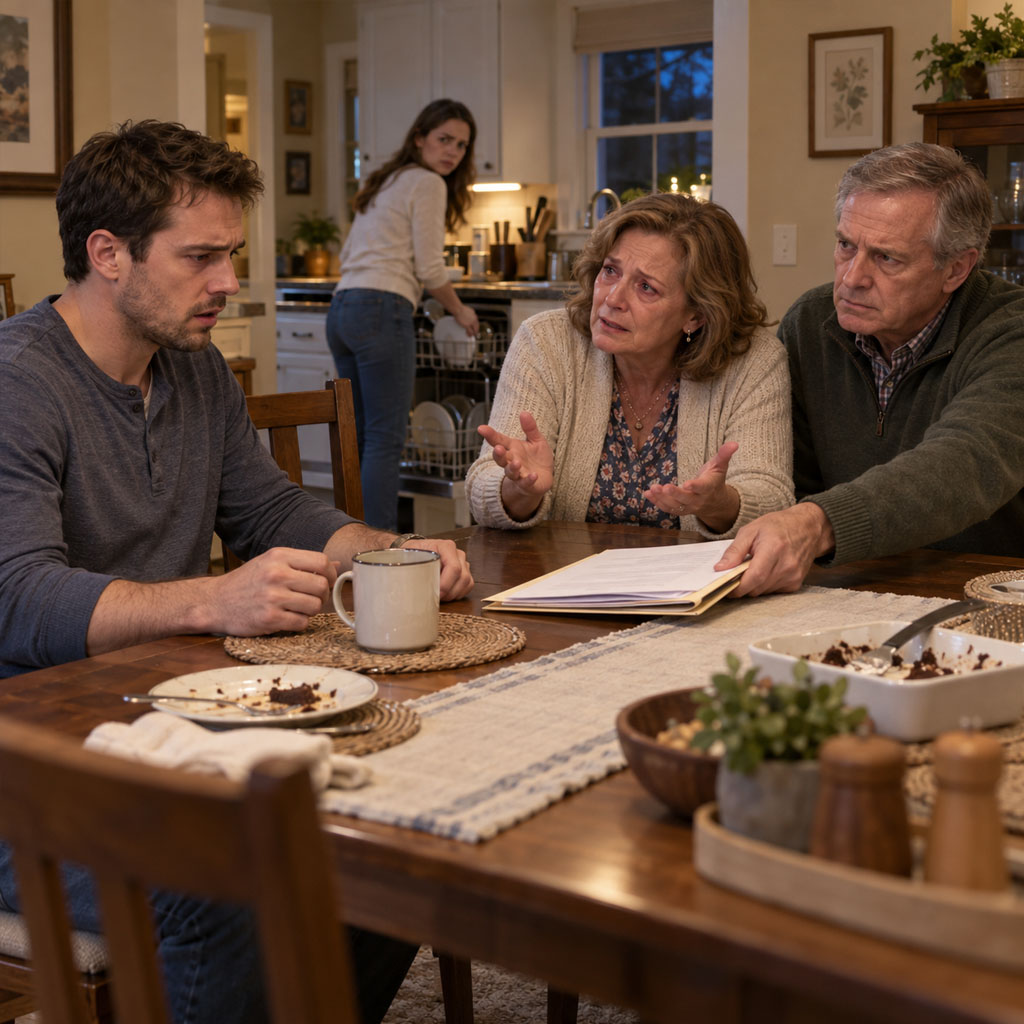
Adam and Nicole were already there when we arrived. Mom barely spoke to me. Dad made several comments about loyalty before we had finished the salad.
Halfway through dinner, Sarah set down her fork.
“Robert, Patricia, I need to say something.”
My stomach dropped.
Dad frowned. “I don’t think that’s necessary.”
“I do.”
Sarah folded her hands in front of her.
“For two years, I’ve watched Michael’s success get treated like a family resource. Every time he works hard and becomes more stable, somebody finds a new reason why he should give more away.”
Mom shook her head. “You don’t understand our family.”
“I understand enough.”
Sarah wasn’t shouting. That made every word land harder.
“Michael worked through college. He paid his own debt. He built his career and paid off his home. Adam was given help at every stage. Now Adam has chosen a wedding he can’t afford, and instead of telling him to change the wedding, you’re telling Michael to risk his house.”
Dad’s face darkened. “Watch your tone.”
“My tone isn’t the problem.”
Adam shoved back slightly from the table. “Why are you attacking me?”
Sarah turned to him.
“Because you’re almost thirty, and you were willing to let your brother borrow fifty thousand dollars against his home so you could throw a party.”
“It wasn’t my idea.”
“But you accepted it.”
Nicole looked down at her plate.
Sarah continued. “You have no stable career, no savings, and credit-card debt from an engagement ring. Yet somehow everyone here is discussing what Michael should sacrifice.”
“Enough,” Dad snapped.
“No,” Sarah said. “It has been enough for years.”
The room became completely still.
“Michael will not mortgage his house. And if you keep treating him like an ATM with feelings, eventually you’re going to lose him.”
Mom began to cry. “You’re turning our son against us.”
Sarah looked at her sadly.
“I didn’t teach Michael to fear disappointing you. You did.”
That sentence hit something inside me I hadn’t known was there.
Dad pointed toward the door. “You need to leave.”
Sarah stood.
I stood with her.
Outside, halfway to the car, my hands started shaking.
Sarah stopped beside the passenger door. “I’m sorry I blindsided you.”
I looked back at my parents’ house. Through the dining-room window, I could see Mom crying, Dad pacing, and Adam arguing with Nicole.
“I think you just blew up my family.”
Sarah’s eyes filled with tears.
“Maybe,” she whispered. “Or maybe I finally stopped helping them pretend it wasn’t already broken.”
Chapter 3
For two weeks, I didn’t speak to any of them.
Sarah helped me find a therapist who worked with adults raised in families where boundaries had never been respected. During our second session, she asked me a simple question.
“When did you learn that your value depended on being useful?”
I couldn’t answer.
That bothered me more than anything my father had said.
Then, unexpectedly, Nicole called Sarah.
They met for coffee. When Sarah came home, she looked stunned.
“Nicole never wanted the big wedding,” she told me. “Her family isn’t rich. They’re comfortable, but Adam assumed he had to impress them.”
Apparently, after Sarah’s speech, Nicole had given Adam a choice: build an adult life with her or keep waiting for other people to rescue him.
Three days later, Adam called me.
I almost let it go to voicemail.
“Mike,” he said when I answered, “can I talk without you hanging up?”
“That depends.”
He exhaled. “Fair.”
For the next twenty minutes, my brother did something I had almost never heard him do.
He took responsibility.
Nicole had made him list his income, debts, subscriptions, credit cards, and monthly expenses. For the first time, he understood that he wasn’t merely behind. He was living a life that depended on someone else absorbing the consequences.
“I kept thinking everybody had more money than I did,” he said. “I never stopped to ask why.”
I sat silently.
“Then I realized you didn’t have more because things were easier for you. You had more because you said no to things I kept saying yes to.”
His voice cracked.
“I was selfish, Mike. And I really did think you’d do it. That’s the worst part. I thought you’d risk your house because you’ve always fixed stuff.”
The apology didn’t erase anything.
But it mattered.
The seventy-five-thousand-dollar wedding disappeared.
Nicole’s parents offered their backyard. A family friend agreed to DJ. Flowers came from a local wholesaler, decorations were handmade, and the guest list shrank dramatically.
The new budget was ten thousand dollars.
Adam picked up extra shifts at the golf club and revived the graphic-design skills he had barely used since graduating. Nicole saved alongside him. Her parents gave them three thousand dollars as their wedding gift.
Nobody borrowed a cent.
My parents took longer.
Mom called after about a month.
“I thought helping Adam meant protecting him from struggle,” she said. “Maybe we protected him from learning instead.”
Dad’s version of an apology came later.
“I still think Sarah was out of line.”
I almost laughed.
“But,” he continued, “I suppose being out of line doesn’t automatically make a person wrong.”
For Dad, that was practically an emotional breakthrough.
A week before the wedding, Adam invited all of us to his apartment. He cooked spaghetti, burned the garlic bread, and seemed oddly proud of both.
After dinner, he raised his glass toward Sarah.
“You said something that made me furious,” he told her. “You said I was an adult who was content to let other people sacrifice for my comfort.”
Sarah looked uneasy. “I could have phrased that better.”
“No. If you’d phrased it better, I might not have heard it.”
Then Adam turned to me.
“I used to think you were the lucky one because you had your life together. But you weren’t lucky. You learned how to stand on your feet. I learned how to fall down and wait for someone to catch me.”
Mom covered her mouth.
Adam looked at our parents.
“You loved me. I know that. But every time you saved me, you made it easier for me not to change.”
Dad looked older than I remembered.
No one argued.
The wedding took place on a warm Saturday afternoon beneath strings of rented lights in Nicole’s parents’ backyard. Folding tables were covered with simple white cloths. Friends brought food. Someone’s aunt made the cake.
It was better than the expensive wedding ever could have been.
Adam looked proud because he had earned the day instead of purchasing an illusion.
During the reception, he stood to give a toast.
He thanked Nicole for refusing to marry the man he had been becoming. He thanked our parents for loving him enough to change with him.
Then he looked at Sarah.
“And I need to thank the woman who nearly got thrown out of my parents’ dining room.”
Everyone laughed, including Dad.
“She told me the truth when I had built my whole life around people making excuses for me.”
Then he looked at me.
“And my brother showed me what responsibility looks like, even when I was too immature to appreciate it.”
I turned away for a second because my eyes had filled.
Sarah squeezed my hand.
She was wearing an engagement ring.
Mine.
A month earlier, I had proposed in our backyard beside the maple tree we’d planted that spring.
I told her I wanted to marry the person who had protected our future when I was still afraid to protect it myself.
She cried, laughed, and said, “I’d marry you at the courthouse.”
We settled on something slightly fancier than that.
But nowhere near seventy-five thousand dollars.
Chapter 4
A month after Adam’s wedding, he invited us over again.
When Sarah and I arrived, my parents were already sitting in the living room.
Sarah glanced at me.
“Ambush?” she whispered.
“Probably.”
Adam heard us and laughed. “No ambush. I promise.”
After dinner, he brought an envelope to the table and slid it toward me.
Inside was a check for two thousand dollars.
My wedding gift to him.
“I can’t take this,” I said.
“Neither can I.”
“Adam.”
He shook his head. “You already gave me something more valuable.”
Then he placed another envelope in front of our parents.
Inside was a five-year payment plan.
Adam had tried to calculate all the money Mom and Dad had spent rescuing him over the years: credit-card payments, rent shortages, car repairs, old loans, and expenses he’d promised to repay but never had.
“I can’t undo all of it,” he said. “And I can’t pay all of it back. But I can stop taking.”
Dad opened his mouth.
Adam raised a hand.
“Please. Let me finish.”
He pulled up a banking app on his phone and showed them an account he had opened for their retirement.
Five hundred dollars a month.
Three deposits were already there.
Mom started crying.
“You don’t owe us this.”
“Maybe not legally,” Adam said. “But I owe myself the responsibility.”
Then he looked at me.
“You got less help, and somehow that forced you to become stronger. I got more help, and I used it as permission to stay weak. I don’t want that anymore.”
Nicole slipped her arm through his.
“I almost married a man who expected life to provide for him,” she said. “Now I’m married to a man who’s learning how to provide for himself.”
Dad stared at Sarah.
For a man who had spent most of his life treating emotion like a plumbing leak, he looked dangerously close to tears.
“You did something we should’ve done years ago,” he said.
Sarah blinked.
Dad cleared his throat. “You told both our sons the truth.”
Mom nodded.
“We thought Michael needed less because he was capable. And Adam needed more because he struggled. We never realized we were punishing one son for being responsible and preventing the other from learning how to be.”
I felt something inside me loosen.
Not disappear.
Healing wasn’t magic.
But it had started.
A few months later, Adam landed a full-time graphic-design position with benefits. He sent the offer letter to our new family group chat with a message that made me laugh.
Look, everybody. A job Mom and Dad didn’t apply for on my behalf.
Dad replied with a thumbs-up.
Mom sent eleven heart emojis.
Sarah wrote, About time.
Adam answered, And there she is.
By spring, Sarah and I were married.
Adam stood beside me as my best man.
Our wedding was small, warm, and entirely paid for before we arrived. There were no chandeliers, no ice sculptures, no champagne tower, and no debt waiting for us after the photographs.
During his toast, Adam raised a glass toward Sarah.
“To my sister,” he said, “who joined this family by telling all of us exactly what we didn’t want to hear.”
Even Dad laughed.
Chapter 5
One year after the dinner that nearly tore us apart, I stood in the backyard of the house my father once expected me to mortgage.
Sarah was watering two young maple trees we had planted after our wedding. Adam and Nicole were inside helping Mom prepare dessert while Dad argued with the television over a baseball game.
The house sounded different now.
Family dinners no longer carried invisible debts.
Dad had retired without draining his savings to rescue Adam again. Mom had returned to painting, something she had abandoned years earlier because she was always worrying about somebody else’s crisis.
Adam’s career was thriving. He and Nicole had saved for a modest home and bought one they could comfortably afford.
One afternoon, he told me, “It’s ridiculous how good it feels to buy something with money you actually have.”
“That concept is generally called adulthood.”
“Yeah, well. Nobody gave me the instruction manual.”
“You would’ve used it as a coaster.”
He laughed. “Also true.”
My relationship with our parents changed too.
For years, I had thought setting boundaries meant building walls. Therapy taught me something different. A boundary wasn’t a punishment. It was simply a line that showed where one person’s responsibility ended and another person’s began.
Mom no longer called when Adam needed money.
Dad no longer volunteered my time or resources before asking.
And I stopped automatically saying yes whenever saying no might disappoint someone.
On that anniversary evening, after dinner had been cleared away, Mom found Sarah near the back door.
I wasn’t supposed to hear their conversation.
“I need to thank you,” Mom said.
Sarah looked embarrassed. “You already have.”
“Not properly.”
Mom took her hands.
“I was angry because I thought you were taking Michael away from us. Now I understand you were trying to keep us from taking too much from him.”
Sarah’s eyes softened.
“We all love him.”
“Yes,” Mom said. “But you taught us that loving someone doesn’t give you ownership of what they’ve built.”
Mom hugged her.
Across the room, Dad and Adam were arguing about baseball statistics like nothing extraordinary had happened.
Maybe that was the extraordinary part.
We were finally ordinary.
Later, after everyone had gone home, Sarah and I sat beneath the maple trees. The night was quiet, and the windows of the house glowed behind us.
She took my hand.
Then she placed it against her stomach.
I looked at her.
We had found out four days earlier.
We hadn’t told anyone yet.
“You think we’re ready?” she asked.
I thought about my father asking me to put fifty thousand dollars against this house. I thought about how close I had come to mistaking surrender for loyalty.
I thought about Adam returning the wedding gift, my mother learning to let go, my father learning to apologize in his own stubborn language, and Sarah standing at a dining-room table while everyone glared at her because she loved me more than she feared their anger.
“Yeah,” I said. “I think we are.”
Our child would grow up knowing that helping family didn’t mean destroying yourself for them.
They would learn that generosity needed wisdom, that accountability could be an act of love, and that adults were responsible for the consequences of their own choices.
They would know that saying no didn’t mean you loved someone less.
Sometimes it meant you loved them enough not to help them remain helpless.
I looked at the home behind us.
For years, I had believed the greatest thing I protected that night was my house.
I was wrong.
The house had only been the visible part.
What I really protected was everything that could happen inside it: my marriage, my future children, my peace, and the possibility that my brother might someday learn to build a life of his own.
Refusing the mortgage hadn’t destroyed our family.
It had destroyed the arrangement that was slowly destroying us.
What grew in its place was harder to build and far more valuable: honesty without cruelty, generosity without obligation, love without manipulation, and a family where nobody had to become smaller so somebody else could avoid growing up.
Sarah rested her head on my shoulder.
Behind us stood the house I had refused to gamble away.
Ahead of us was a family I finally understood how to protect.
THE END.
⚠️ All characters and events are fictional. Do not imitate or apply them in real life. 😌😌😌


