
Part 2
Lena had entered the network two years earlier under the name Elena Maric, posing as the owner of a regional freight brokerage. Her target was Anton Kovac, a logistics broker whose real business was moving people. He could make a satellite engineer disappear into a trucking schedule, turn a cybersecurity specialist into an agricultural worker, and move technical talent across borders while governments argued over paperwork.
For fourteen months, Lena worked her way into his operational confidence. Three nights earlier, her control officer, Deputy Director Charles Weller, sent an emergency extraction order. The authentication was perfect, and the coordinates were known only inside Weller’s office.
“When I reached the site,” she told Mercer, “there were four men waiting.”
“Extraction team?”
“Kill team.”
She survived because she had privately mapped a drainage tunnel behind a collapsed wall. When the supposed rescue team closed in, she slipped through it and spent the next forty-eight hours alone.
“Weller listed me as nonrecoverable,” she said. “Once that designation hits the system, nobody searches. The file closes.”
“You’re sure it was him?”
“He was the only person who had the coordinates.”
Mercer looked toward the window. A compromised field officer was bad enough. A compromised director could redirect teams, bury reports, and make a murder look like procedure.
“Why would he protect Kovac?”
“That’s what I intend to prove tonight.”
The last convoy in Kovac’s pipeline would cross the valley after sundown. One man inside it, Dr. Samuel Orr, had secretly agreed to help Lena. Orr had worked at a research facility east of the valley and knew why the specialists were being collected.
“And Kovac?”
“He keeps handwritten records. Payments, warnings, favors, locations. He trusts paper more than computers.”
“You think Weller is in those records.”
“I know he is.”
By dawn, Brennan had come down from the loft and silently accepted Mercer’s explanation that their mission had changed to asset protection. Evan Cole reacted differently. At twenty-four, he was brilliant with signals equipment and still young enough to believe every question should be asked immediately.
“Who is she? How did she get in here? Are we still making the morning transmission?”
“No,” Mercer said. “Eat something.”
Cole stared at Lena, who stared back until he decided breakfast was the wiser priority.
Near two in the afternoon, Lena handed Mercer the binoculars. Eleven figures moved along the base of the southern ridge, spaced so naturally they looked like villagers returning from market. Mercer counted six armed escorts.
“That’s them,” Lena said.
“Kovac?”
“At the receiving point.”
From the far corner, Brennan spoke. “And you’re going there tonight.”
Lena turned.
“Your source is there. Kovac is there. You can’t get what you need from this window.” Brennan set down his rifle. “How many people?”
She hesitated. “Four.”
Mercer glanced at Brennan, then Cole. Neither objected.
“Then you have four.”
“You understand nobody ordered you to do this,” Lena said.
“I understand nobody trustworthy is available to order me not to.”
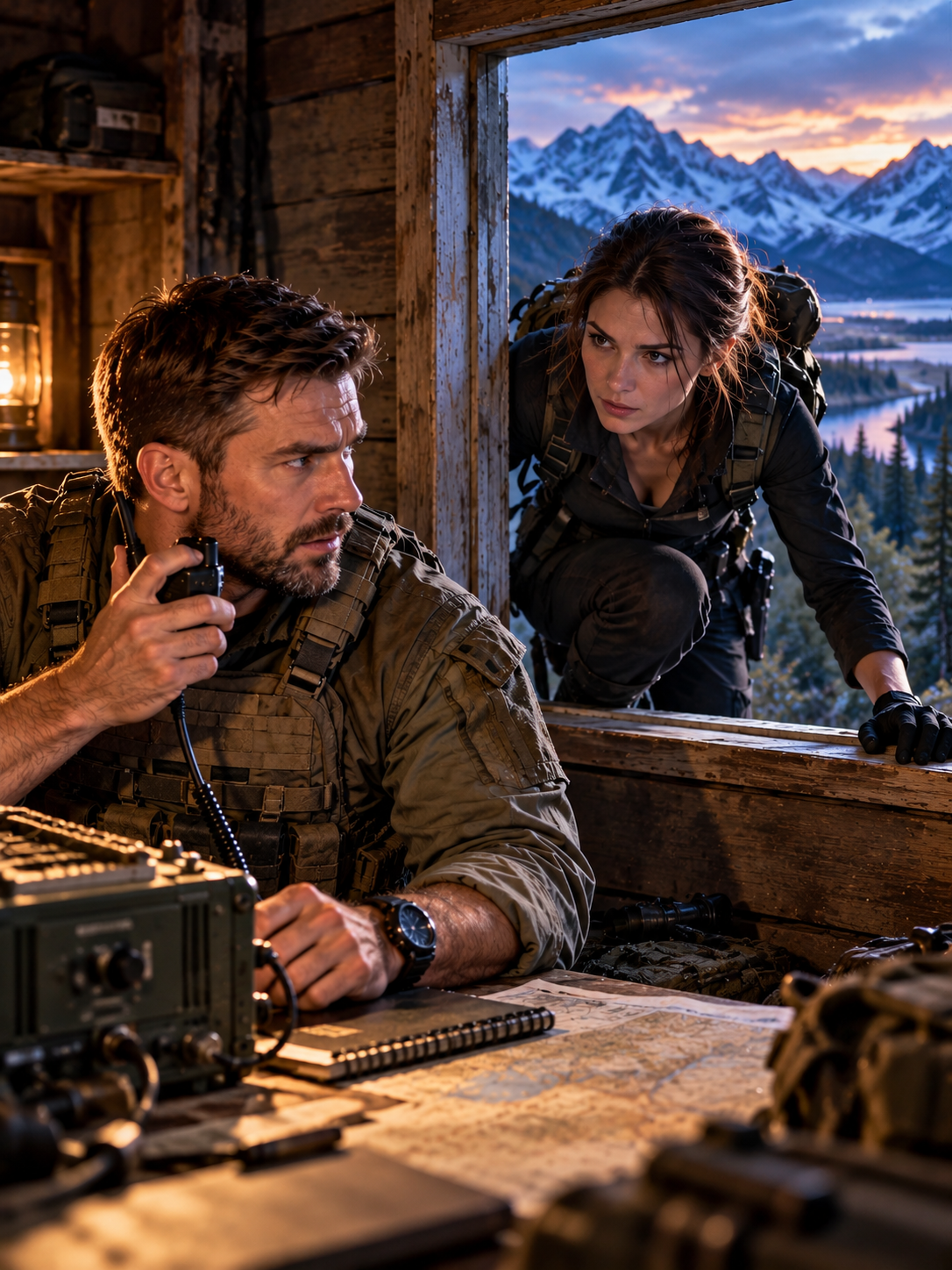
Just before eight, they left through the north window. Lena led them through dry creek beds and strips of broken rock to an abandoned farm complex tucked into a fold in the mountains. She placed Brennan and Cole on the outer approaches, Mercer beside the main entrance, and disappeared through a breach in the north wall.
For fourteen minutes, nothing happened.
Then Brennan whispered in Mercer’s earpiece, “Outer security moving south.”
A sharp crack sounded inside the building.
Not a gunshot. A radio being smashed against stone.
Four more minutes crawled by before Lena’s voice returned. “I have the records. I have Orr. Kovac is cooperating.”
Two minutes later, she emerged with a thin, middle-aged man beside her and a leather satchel under one arm. Mercer searched her face.
“Kovac?”
“Alive. Tied to a chair. He’ll have an unpleasant morning.”
They were nearly back to the farmhouse when Dr. Samuel Orr stumbled on the slope. Mercer caught his elbow.
“You have no idea what they’re building,” Orr whispered.
Mercer looked at Lena.
She said nothing.
That frightened him more than an answer would have.
Part 3
Inside the farmhouse, Orr drank half a canteen before he spoke. He gave his full name, his credentials, the laboratory where he had worked, and the date men connected to Kovac’s network forced him into the pipeline. His voice was careful, almost clinical, as if precision were the only thing keeping fear from taking over.
The specialists being moved east were building a distributed communications system capable of hijacking emergency networks, military relays, civilian infrastructure, and regional satellite links during a crisis. It could not control everything forever. It did not need to. A few hours of false evacuation orders, disabled hospitals, spoofed military traffic, and redirected aircraft could turn confusion into catastrophe.
Cole went pale. “And make every country believe someone else did it.”
Orr nodded. “That’s the point.”
Lena opened Kovac’s satchel. Inside were handwritten ledgers, loose sheets, coded initials, dates, payment routes, and meeting locations. She began cross-referencing them with the speed of someone who already knew what she hoped not to find.
After fifteen minutes, she stopped turning pages.
“All of it?” Mercer asked.
She nodded once. “Fourteen months of my reports.”
Brennan frowned. “Your reports?”
“Weller fed Kovac my operational updates. Every time I got close, Kovac moved. Every time I identified a courier, Weller warned him.”
Her hand settled on a page dated two days before the false extraction. Next to Lena’s cover initials were the location and time of the kill site. Beneath them, in Weller’s personal shorthand, were three words: Close file after collection.
For several seconds, Lena stared at the page.
“He used me,” she said. “For two years, every risk I took helped protect his arrangement. My operation was cover for his.”
Mercer crouched beside her. “You were good at your job. That’s why you found what he couldn’t allow you to find.”
Her eyes lifted to his.
“And that,” he said, “is why you’re alive.”
Brennan went to the window. “These records have to reach someone Weller can’t bury before he knows she survived.”
Mercer already knew how.
Three years earlier, in that classified briefing at Fort Belvoir, the instructor had taught one additional protocol after the black-operations signal. It was intended for a compromised chain of command. The channel bypassed theater headquarters and routed to independent oversight with access high enough that a director could not shut the door.
“I have a channel,” Mercer said.
Lena’s attention sharpened. “Have you ever used it?”
“No.”
“Do you know it from memory?”
“Yes.”
She looked at the ledgers, at Orr, then back at Mercer. “Use it.”
At 3:42, Mercer entered a sequence he had never written down. The authentication took nearly a minute. Static answered first, then an older man’s voice.
“Identify.”
Mercer gave his name, unit, location, and operational status. Then he spoke plainly.
“I have Captain Lena Voss, nonofficial cover officer, currently listed as nonrecoverable. She is alive. She possesses physical evidence of director-level compromise and a corroborating source tied to an unauthorized technical-transfer network.”
A pause followed.
“Authenticate Voss.”
Mercer handed her the radio.
Lena gave a string of numbers, words, and call signs Mercer had never heard. Her voice never shook. When she finished, the channel went silent for eleven seconds.
Then the voice returned.
“Captain Voss, status corrected. You are active.”
Cole bowed his head. Orr closed his eyes. Brennan straightened at the window.
Lena did not move.
For one unguarded instant, Mercer understood what those words meant. For forty-eight hours, the country she had served had accepted a lie that said she no longer existed. Now, in five administrative words, someone had given her name back.
She inhaled slowly. “Ready to transmit evidence.”
“Secure channel open,” the voice replied.
Part 4
Cole photographed every ledger page while Lena dictated sequence numbers. Orr recorded a statement identifying the facility, the personnel transferred through Kovac’s network, and the capabilities of the system under construction. Each file was acknowledged separately.
When the final image uploaded, the voice on the channel said, “Package received and duplicated to independent repositories. Captain Voss, your restoration is logged. Dr. Orr is under emergency protective authority. Extraction for all five of you at 0630. Coordinates follow.”
Mercer copied them.
Then came a brief pause.
“Master Sergeant Mercer.”
“Yes, sir?”
“Your decision to bypass your assigned reporting chain was justified by the evidence. Good judgment.”
The channel closed.
Nobody celebrated. Men like Weller did not vanish because of one radio call. There would be investigations, sworn testimony, lawyers, denials, and months of people deciding who had known what and when. But the evidence no longer belonged to one man’s chain of command.
Brennan began packing. Cole gave Orr a spare thermal layer and started talking about terrible military coffee, perhaps because ordinary conversation was the kindest thing he could offer. Mercer erased their communications logs and restored the farmhouse to the bare shell it had been before they arrived.
Lena remained beside the satchel.
Mercer joined her. “When you sent that signal, you knew someone on this team had the countercode.”
“I knew the kind of reconnaissance element assigned here.”
“That’s not the same thing.”
“No.”
“You read my file.”
She looked at him but did not deny it.
“You knew I’d had the briefing,” Mercer said.
“I knew you had access.”
“And you trusted me to use it.”
“I trusted you to recognize what it meant.”
He almost smiled. “You bet your life on a stranger.”
Lena shook her head. “I bet on training. I bet on evidence. And I bet that a man who had spent eleven days noticing this valley didn’t make sense would not stop asking questions when it mattered.”
Outside, dawn separated the eastern ridge from the sky. In less than ninety minutes, a helicopter would come through the northern pass and carry them toward the machinery of accountability.
At the extraction point, the aircraft arrived exactly at 6:30. Two security officers jumped out first, followed by a gray-haired woman in civilian clothes who walked directly to Lena.
“Captain Voss?”
Lena stopped. “Yes.”
The woman held out her hand. “Welcome back.”
That was all.
Lena took it, and for the first time since climbing through the farmhouse window, her expression broke. Just enough for Mercer to see tears gather before she blinked them away.
On the flight west, Orr slept strapped into a canvas seat. Cole watched the mountains fall behind them. Brennan sat with his eyes closed, though Mercer knew he was awake.
Lena held the satchel in her lap.
“You all right?” Mercer asked.
She looked toward the open side door, where morning light spilled over the ridges.
“No,” she said. “But I will be.”
Three weeks later, Mercer sat in a secure room outside Washington while investigators showed him a photograph of Charles Weller leaving a federal building between two officers. Several officials had been suspended, Kovac’s ledgers had opened investigations in four countries, and the transfer network had been shut down before the communications system became operational.
The investigator closed the folder. “There may never be a public account of what happened.”
Mercer looked at Weller’s photograph one more time. “I didn’t do it for a public account.”
Months passed before he heard from Lena again.
The message arrived through official channels, only four words long.
Still active. Still asking questions.
Mercer read it twice and smiled.
Years later, when young soldiers asked him about judgment, he never told them about the nameless valley or the woman who had been declared dead. He told them that training mattered, rules mattered, and chains of command mattered—but none of those things relieved a person of the duty to recognize the truth when it was standing directly in front of him.
And sometimes, he told them, the most important signal you will ever receive is not the one telling you what to do.
It is the one asking whether you still know who you are.
THE END.


