
### Part 2: Twenty Years Later, My Mother Entered the Wrong House
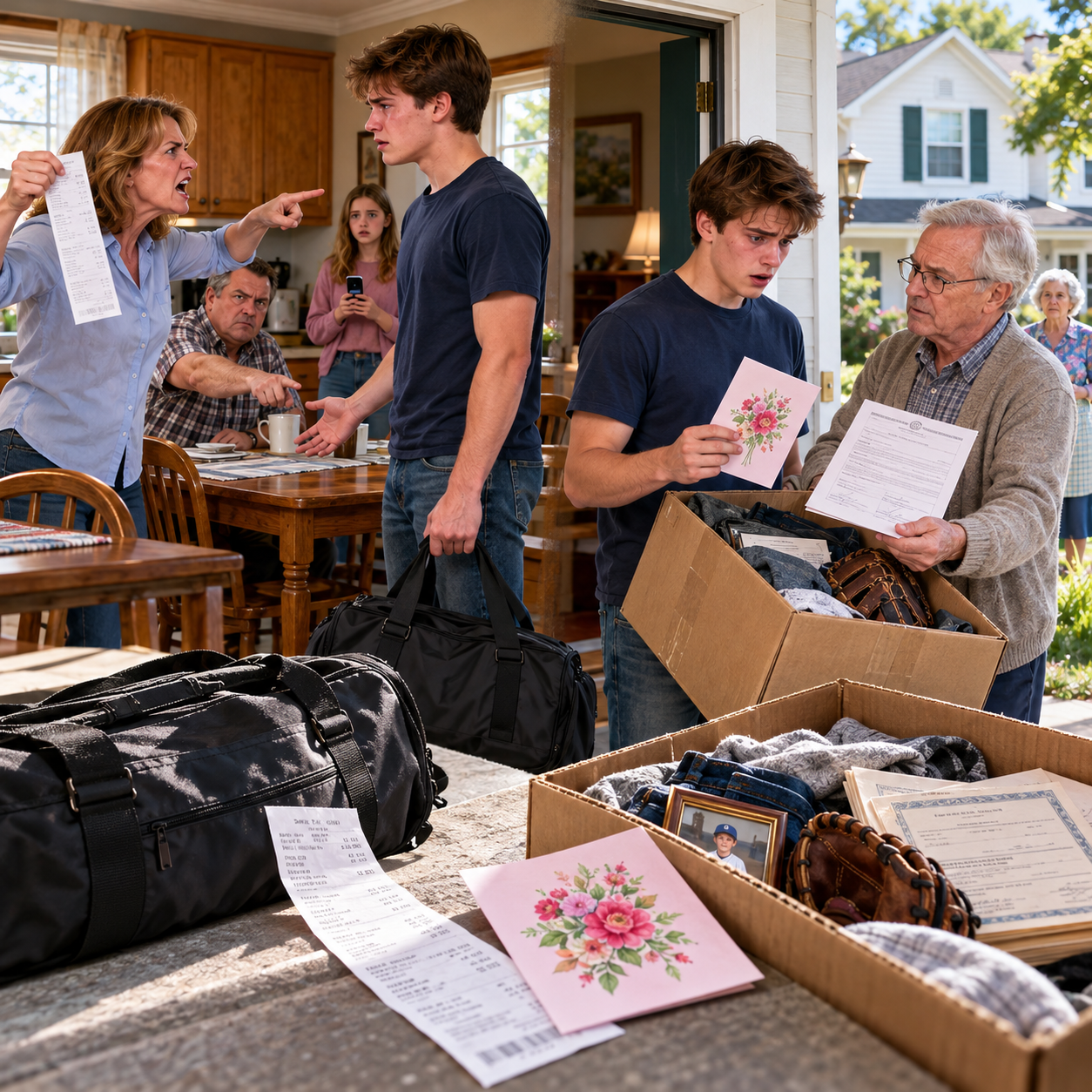
I carried the box back across the yard without crying. Thelma was reading the Sunday newspaper when I placed it on her kitchen table. She examined my mother’s handwriting, opened the lid, and carefully folded the baseball jersey lying on top.
“Keep it,” she said.
“Why would I want anything from them?”
“Because it’s your history, Aaron. You don’t have to like a thing to remember what it taught you.”
She helped me place the box in the hall closet behind Elroy’s railroad lantern. I never opened it again.
Three weeks later, I graduated from high school. Thelma stood in the bleachers cheering louder than the parents around her, while Homer took photographs so crooked that his thumb appeared in nearly every frame. My mother, father, and sister weren’t there.
That August, Thelma called an old friend of Elroy’s, a retired railroad carman named Red Linn. He came to dinner, studied me across two helpings of chicken and noodles, and asked whether I could work hard in miserable weather.
I told him I could.
By September, I was working in the Burlington rail yard. Years later, I became the first-shift car shop supervisor, responsible for nineteen men and equipment worth more than I ever imagined earning. I still came home smelling of grease, but I had steady work and something my childhood hadn’t provided: security.
When I turned twenty-two, Thelma announced that I needed my own apartment. She found me one two blocks away, then complained whenever I missed Sunday dinner.
In 2011, she practically ordered me to meet a second-grade teacher named Allison at a church fish fry. Allison had kind brown eyes and a laugh that made everyone turn around. We married two years later, with Thelma in the front row complaining that the wedding music was too loud.
Henry arrived in 2015, and Maggie three years later. Thelma spoiled them shamelessly, slipping butterscotch candies from her apron pockets and allowing them to ring Elroy’s bell at six. She’d never let me touch it when I was little.
“Different management,” she said when I protested.
I never heard from my parents. Occasionally I wondered about Miranda, but I assumed she’d believed whatever explanation they’d given her.
By her nineties, Thelma needed help organizing medication and getting around the house. I visited after work, fixed what needed fixing, and listened while she argued with Homer about Cubs baseball.
She died peacefully in March 2023, at ninety-eight.
Her will left me the little white house. Attached was one instruction: keep it, rent it affordably to somebody who needed a home, and never let a hungry person leave without food.
I spent two years repairing the roof, refinishing the kitchen floor, and painting the shutters. I kept her table and Elroy’s bell exactly where they belonged.
In July 2025, I finally advertised the house for $850 a month.
Four days later, while scraping our backyard grill, I answered an unfamiliar number.
“Hello,” a woman said. “I’m calling about the house on Maple Avenue. My husband and I grew up there. We want to come home.”
My hand froze around the grill brush.
“Saturday at ten,” I answered. “I’ll show you around.”
When Allison heard who had called, she stared at me.
“You’re really going to show your mother that house?”
“She asked to see it.”
“And she doesn’t know it’s yours?”
“No.”
On Saturday, July 12, I arrived early wearing jeans, work boots, glasses, and my railroad cap. Twenty years had added a beard and forty pounds. I wondered whether either parent would recognize me.
At ten, a silver Buick with Florida plates stopped outside.
Mom climbed out first, wearing sunglasses and expensive-looking sandals. Dad followed, grayer and heavier, moving stiffly.
“Colleen,” she said, extending her hand. “And this is Tom.”
I shook my mother’s hand for the first time in twenty years.
“Come inside.”
She admired the polished floors and sunlit kitchen, telling me about Florida hurricanes, insurance costs, and how much she’d missed this neighborhood. Dad kept staring at Thelma’s old table.
When we sat down to complete the rental application, I asked how many children they had.
“One daughter,” Mom answered. “Miranda. She’s a nurse in Arizona.”
“A nursing aide,” Dad corrected quietly.
I wrote one child.
“Grandchildren?” I asked.
“None.”
I thought of Henry and Maggie, playing baseball and riding bicycles across town.
Mom pointed toward the house next door. “We lived right there before Florida. And Thelma, who owned this place, was practically family. Such a wonderful woman.”
Dad lowered his eyes.
“She was close to your family?” I asked.
“Oh, very. Always feeding the neighborhood children. She adored us.”
I slowly capped my pen.
“Actually, Thelma left me this house.”
Mom’s face brightened. “Then you must understand how special it is!”
I rose, walked to the hall closet, and pulled Elroy’s lantern away from a shelf.
Behind it sat the cardboard box.
I carried it into the kitchen, placed it before my mother, and turned the handwritten word toward her.
She stopped talking.
I removed my glasses.
“Hello, Mom.”
### Part 3: My Mother’s Lies Collapsed When My Sister Learned the Date
For several seconds, nobody moved. A freight train rumbled through the distant rail yard, vibrating the kitchen window. Mom studied my face, then looked at Dad.
“I told you it was Aaron,” he murmured.
“You said he looked like your cousin Howie!”
Twenty years apart, and their first conversation about finding me was an argument over my resemblance to a distant relative.
I almost laughed.
Then Mom recovered, clasping her hands together as though she’d just received wonderful news.
“Aaron, sweetheart! This is unbelievable. Your own mother coming home to a house you own. Thelma must have arranged this somehow.”
“She died two years ago, Mom.”
“Of course, I know that. But surely you aren’t going to charge your parents rent.”
I sat down and reopened the application.
“Eight hundred fifty a month, first month’s rent, security deposit, and a credit check.”
Dad cleared his throat. “Our credit isn’t very good right now, son.”
It was the first time he’d called me son since I was eighteen.
Mom leaned forward. “We could pay three hundred. That’s all we can manage.”
The number struck me harder than her sudden smile.
“Three hundred,” I repeated.
“Family should help family.”
I touched the box lid. “The last time three hundred dollars mattered to you, you threw me out.”
“We raised you!”
“Thelma fed me while you were gone. She sat through my graduation. She introduced me to my wife. She held my children. If anyone earned the right to call this home, it was her.”
Mom’s jaw tightened.
“That woman turned you against us.”
“No. She gave me somewhere to go when you decided I wasn’t coming to Florida.”
Mom grabbed her purse. Dad looked toward the back door, where the brass bell still hung. For a moment, I thought he might apologize.
Instead, Mom called sharply for him to leave, and he obeyed.
I believed that was the end.
Two weeks later, one of my railroad mechanics approached me at the coffee machine. His wife had overheard a woman at Hy-Vee telling shoppers that her wealthy son had inherited a house but was forcing his elderly parents to live in a motel.
Soon the story reached the Main Street diner. According to Mom, Thelma had manipulated me as a boy, stolen my affection, and poisoned me against my family. In another version, I’d locked my parents out after inviting them inside.
Allison wanted me to defend myself.
“People are believing her, Aaron.”
“People who knew Thelma will know better.”
“Not everyone knew her.”
That bothered me more than I admitted. Even Rosalie, the cashier who remembered my Wednesday grocery trips, began treating me cautiously.
Then Homer telephoned. He’d heard Mom speaking at the diner and offered to explain what happened twenty years earlier.
He still had the signed purchase agreement in his desk drawer.
“Not yet,” I told him.
On August 20, an Arizona number appeared on my phone.
“Aaron? It’s Miranda.”
My sister’s voice sounded older, but I recognized it.
She skipped the greetings.
“Mom and Dad are living in a motel, and you have an empty house. I’ve been sending them money for a year. How can you be this cruel?”
I let her finish.
“Miranda, what did they tell you about why I stayed behind?”
“You refused to move. You said you’d rather live with that woman.”
I closed my eyes.
“Ask Dad when they sold our house.”
“What does that matter?”
“They signed the papers March fourth. I wasn’t thrown out until April tenth.”
Silence.
“That’s impossible.”
“Ask him. Ask who bought it.”
She disconnected.
Two hours later, she called again. This time, her voice trembled.
“Dad wouldn’t deny it. He just kept telling me to ask Mom.”
I rested my palm on Thelma’s kitchen table.
“Miranda, I came over on Mother’s Day with a card. They were already gone.”
She began crying.
“They told me you hated us. They said you refused to come, and you’d never speak to me again.”
“I thought you’d chosen them.”
“I was fourteen, Aaron.”
“I know.”
We talked for more than an hour. She told me about her divorce and her two children. I told her about Allison, Henry, and Maggie, then sent photographs. For the first time in twenty years, my sister knew her niece and nephew existed.
Before hanging up, she said she wouldn’t send our parents any more money.
“That’s your decision,” I told her.
“It is,” she said. “I just wish somebody had let me make my own decisions twenty years ago.”
Three weeks later, my mother returned to Thelma’s house. This time, the man sitting at the kitchen table had been waiting twenty years to tell her the truth.
### Part 4: An Old Purchase Agreement Exposed Everything My Parents Had Hidden
By September, I’d chosen a tenant.
Homer was eighty-two, and his knees had become so painful that his doctor advised him to avoid stairs. Thelma’s house was one story, close to his friends and the neighborhood he’d loved for decades.
I offered it to him for four hundred dollars a month.
He protested the price, saying it was far below what I could collect.
“Thelma wanted somebody who needed the place,” I replied. “Besides, you were honest with me when you could have stayed quiet.”
On September 6, Homer sat at the kitchen table signing his lease. Allison had sent over coffee cake. We were discussing garbage collection when the silver Buick pulled outside.
Mom marched through the screen door without knocking.
“You’re renting this house to the mailman?”
I stood. “Good morning, Mom.”
“A stranger gets a discount while your own parents live in a motel?”
Homer slowly removed his glasses.
“Hello, Colleen.”
She stared at him. Recognition spread across her face.
He reached into his shirt pocket and withdrew a folded document.
“Remember selling me your house?”
Mom stiffened.
Homer unfolded the paper and laid it beside her purse.
“Residential purchase agreement. March fourth, two thousand five. Your signature and Tom’s.”
Her eyes flicked across the page.
“That’s private business.”
“I bought the house,” Homer replied. “That makes it my business.”
He tapped the date with one finger.
“You sold your home in March. You turned Aaron out in April. Why?”
Mom opened her mouth, then closed it.
“We were going to tell him.”
“When?” I asked.
She looked toward the door.
Dad was standing on the porch beneath Elroy’s bell. He stepped inside, holding the frame for balance.
“Because Patty only had one spare room,” he said.
Mom swung toward him. “Tom, don’t.”
But he kept speaking.
“Your aunt Patty, in Florida. She said we could stay until we found work, but there was space for Miranda, not Aaron.”
I felt something cold settle behind my ribs.
Dad stared at the floor.
“We knew he could stay with Thelma. Colleen said it would be easier if he thought moving out was his decision.”
Mom’s face flushed.
“We did what we had to do.”
“No,” Dad said quietly. “We did what was easiest for us.”
Twenty years. All those birthdays, Christmases, and unanswered questions had been built around an arrangement made before I knew there was anything to arrange.
Mom looked at me with sudden anger.
“You always cared more about that woman.”
I glanced around the kitchen, at the worn table, the flour tin on the counter, and the sunlight falling across the place where Thelma used to sit.
“She was there, Mom.”
Nothing more needed saying.
Mom walked out. Dad followed after a long moment. Homer returned the purchase agreement to his pocket, picked up his pen, and asked which page he still needed to sign.
Within days, the truth traveled through Galesburg. Homer told his longtime coffee companions exactly when he’d purchased the house. People who had known Thelma began sharing their own memories.
At Hy-Vee, Rosalie left her register to apologize.
“I knew what that woman did for you,” she said, tears gathering behind her glasses. “I should’ve trusted what I knew.”
I hugged her.
My parents eventually found a small apartment near the interstate. Homer moved into Thelma’s place and sold his old house to Tori, a twenty-nine-year-old nurse raising her seven-year-old son, Grayson. She worked second shift at the hospital.
One Sunday in November, Dad came to Thelma’s porch alone. We were preparing dinner inside. He looked thinner, older, and uncomfortable standing where he’d once watched me cross the yard.
“I should’ve thanked her,” he said. “For feeding you. For everything. And I should’ve told you the truth about Florida. I knew what your mother was doing, and I let her.”
I watched him struggle to meet my eyes.
“Thank you for saying that.”
He glanced through the kitchen window. Henry was setting out silverware while Allison stirred chicken and noodles. Maggie stood beside the bell, waiting for six.
Dad looked at me, silently hoping I’d invite him inside.
I couldn’t.
“Take care of yourself, Dad.”
He nodded. “You too, son.”
Then he walked away.
I didn’t feel triumphant. I simply understood that accepting an apology didn’t require pretending the past had disappeared.
At Christmas, Miranda visited with her children. Our kids exchanged gifts, argued over board games, and stayed awake whispering long after bedtime. When she hugged me goodbye, she said, “I wish we’d had these years.”
“We have the ones ahead,” I told her.
The following spring, our family gathered for Sunday supper at Thelma’s, just as we’d done for years. Homer sat at Elroy’s old place, Allison carried steaming bowls to the table, and Maggie announced that she was officially responsible for the six-o’clock bell.
She rang it so loudly that Homer nearly dropped his fork.
Ten seconds later, somebody knocked.
I opened the back door.
Grayson stood there in a hooded sweatshirt, his hands buried in his pockets.
“Mr. Homer said if I hear the bell, it means supper.”
I looked toward Homer. He was suddenly fascinated by the ceiling.
“Where’s your mom, buddy?”
“Working until eleven.”
His mother had arranged for a neighbor to check on him that evening, but he’d heard our bell and wanted to see whether Homer’s invitation was real.
“Have you eaten?”
“A granola bar.”
I opened the door wider.
“Come wash your hands.”
At the table, Maggie gave him the biggest dinner roll. Allison served him chicken and noodles over mashed potatoes, and he studied his plate before taking a careful first bite.
When he finished, he asked whether he could have more.
“One condition,” I said. “Tell us something that happened at school today.”
He considered the question.
“Some kid got sick on the bus.”
Homer burst out laughing.
I stood there holding the serving spoon, hearing a seventy-year-old woman’s voice from a kitchen that had once saved my life.
“That counts,” I told him.
And I filled his plate again.
Grayson started coming to Sunday supper regularly. His mother joined us whenever her schedule allowed. Soon he and Henry were playing catch in the yard where I’d once dragged my belongings in a duffel bag.
One evening, Henry found the old cardboard box on the hall closet shelf.
“Dad, why do you keep this?”
I took it down and brushed the dust from the lid.
“Because somebody I loved told me it was worth keeping.”
He studied the word written across the top.
“Who’s Thelma?”
I looked into the kitchen, where Allison was laughing with Homer, Maggie was arguing over who got to ring the bell next Sunday, and Grayson was reaching for another roll.
I thought about an eighteen-year-old boy standing on a porch with a Mother’s Day card, believing he had lost everyone.
Then I remembered an old woman opening her door and making room at her table.
“She was the person who taught me what family means,” I told my son.
Henry touched the cardboard.
“Are you glad you kept it?”
I looked at my mother’s handwriting one final time.
She’d written Thelma’s name because she wanted to send my entire life across the yard.
What she never understood was that she’d sent me exactly where I belonged.
“Yes, Henry,” I said, returning the box to its shelf. “I’m very glad.”
A moment later, Maggie rang the bell.
And everyone came to the table.
THE END.
All characters and events in this story are fictional, created for storytelling and entertainment purposes. Thank you sincerely for reading. Your feedback and support are invaluable and motivate me to continue sharing more stories with you.


