
Chapter 2
The meeting was set for the following Thursday at Gerald’s downtown law office.
Rochelle called me twice beforehand.
The first time she wanted to know whether I had gathered the business valuation documents. The second time she reminded me, in a voice usually reserved for forgetful children, that estate transitions became “messier” when people resisted what was inevitable.
I said very little.
Grief had changed shape inside me. At first it had been a heavy thing lying across my chest. Now it had become something colder and steadier.
I returned to work every morning.
I walked the warehouse floor. I reviewed supplier contracts. I listened to employees complain about football, school taxes, transmission repairs, and the price of groceries. Ordinary life kept me upright.
At home, I slowly sorted Elaine’s clothes.
I could not touch her books.
She had been a school librarian for thirty-three years and believed books belonged in conversation with one another. History beside biography. Poetry near the window. Mysteries on the lower shelf because, she claimed, mysteries should make you bend down and work for them.
I still loved her.
That was the hardest truth.
A betrayal discovered after death does not politely erase all the tenderness that came before it. Elaine had held my hand through my father’s funeral. She had slept in a hospital chair when I needed emergency surgery. She had packed my lunch for decades even after I told her I could pack my own.
She had also lied to me.
Both things were true.
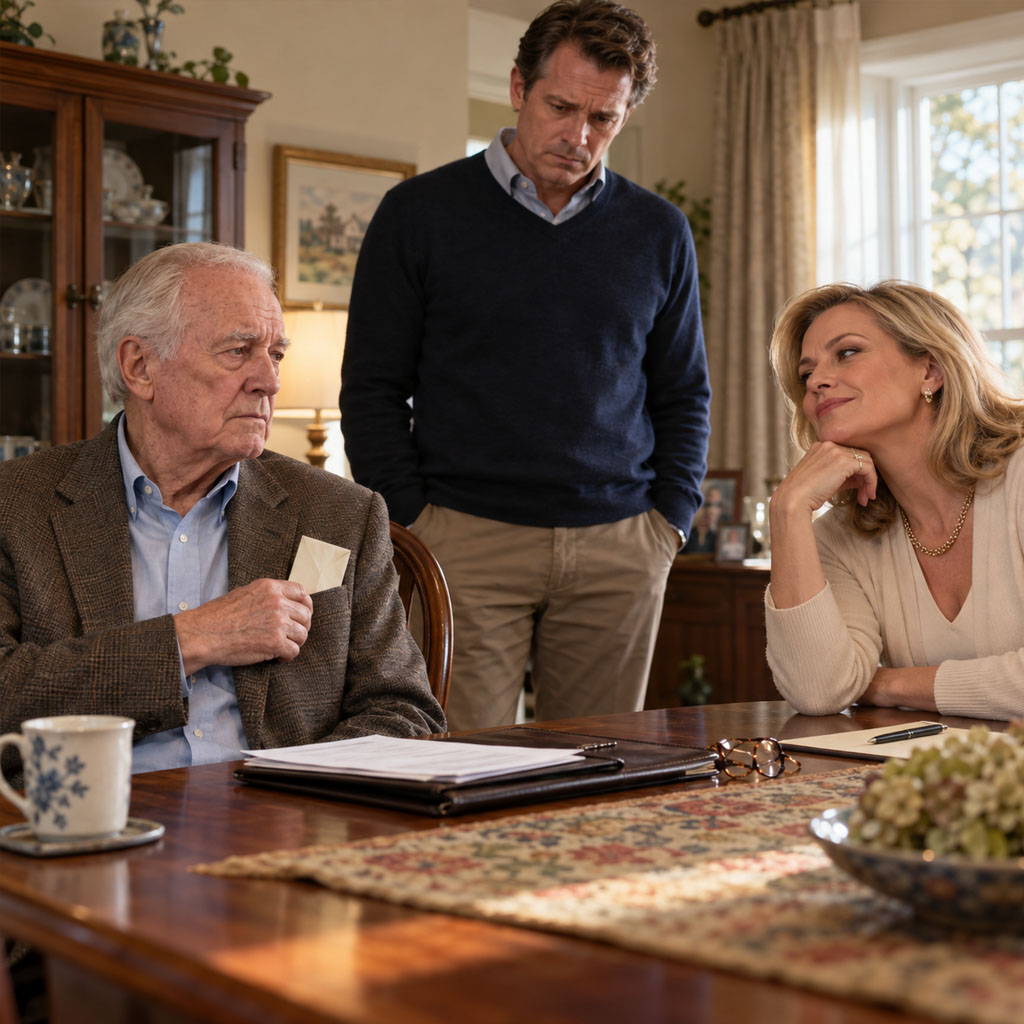
The morning of the estate meeting, I wore my gray sport coat. The laboratory report was sealed inside an envelope in the breast pocket.
Gerald was already in the conference room when I arrived. Floor-to-ceiling windows overlooked the Great Miami River.
“You ready?” he asked.
“No.”
He nodded. “Good answer.”
Rochelle arrived exactly on time carrying a bound presentation. A young corporate attorney followed her. Daniel came last.
Rochelle took the seat directly across from me.
Her eyes dropped briefly toward my hands, perhaps checking whether they trembled.
They didn’t.
“Frank,” she said pleasantly, “I’m glad we’re finally getting this resolved.”
Finally.
Elaine had been buried six weeks.
Rochelle opened her binder.
She had prepared twenty-two pages detailing a proposed transfer of my company to Daniel. The valuation was almost forty percent below what I knew the business to be worth. Under her proposal, I would surrender operational control within ninety days.
Then came the house.
She and Daniel would purchase it under what she described as favorable family terms.
“You’d have flexibility,” she said. “A condo, assisted living eventually, maybe somewhere warmer.”
“I’m sixty-seven.”
“I’m planning ahead.”
“So I’ve noticed.”
Daniel shifted in his chair.
Rochelle ignored him and continued. At the end she folded her hands and gave me the expression of someone who had just presented the only reasonable solution.
“This is what Elaine would have wanted.”
I stared at her.
For a moment I pictured Elaine beside the bird feeder on a winter morning, wearing her old red cardigan, scolding squirrels as though they understood property rights.
Then I looked at Gerald.
He opened his briefcase.
“There is an issue we must address before discussing any transfer,” he said.
Rochelle’s attorney straightened.
Gerald placed several documents on the table. “The Mercer family trust contains restrictions regarding the transfer of controlling company shares and certain protected property. Those provisions require verification of direct biological lineage where inheritance is claimed on that basis.”
Rochelle frowned.
“Daniel is Frank’s son.”
Gerald’s voice remained neutral. “That assumption was tested.”
Daniel slowly looked at me.
Rochelle laughed once.
It was a small, dismissive sound.
“You had paperwork prepared based on some technicality?”
Gerald slid the laboratory report across the table.
“No technicality.”
Rochelle read the first page.
Her smile disappeared.
Daniel leaned toward the report.
His lips parted.
Gerald continued quietly. “The certified result excludes Mr. Mercer as Daniel’s biological father.”
No one spoke.
Even Rochelle’s attorney stopped taking notes.
Daniel lifted his eyes to mine.
“Dad?”
That one word nearly broke everything I had carefully held together.
Because no laboratory could remove the voice of a five-year-old calling for me after a nightmare.
No test could erase thirty Christmas mornings.
No percentage could undo the time I taught him to change a tire in the rain.
I swallowed.
“I know.”
Rochelle pushed the paper away.
“This is ridiculous.”
“It’s certified,” Gerald said.
“She was his wife.”
“Yes.”
“Daniel is legally his son.”
“That is a separate matter from the specific transfer provisions being discussed.”
Rochelle turned toward me. Her cheeks had gone pale.
“You did this behind our backs.”
I met her gaze.
“You asked me for my company before my wife’s flowers had wilted.”
“That has nothing to do with this.”
“It has everything to do with why we’re sitting here.”
For once, Rochelle had no answer.
Daniel still had not moved.
He kept staring at the report.
And then he whispered the question I had dreaded since opening the cedar box.
“Who was he?”
Chapter 3
“Philip Stover,” I said.
Daniel repeated the name as if testing whether it belonged in his mouth.
I told him about the photograph. The letters. Denver in the early seventies. A geologist who worked oil fields in Colorado and apparently loved Elaine before I ever met her.
I did not read the letters aloud.
Whatever else Elaine had done, I would not turn her private words into entertainment for Rochelle or two attorneys.
Daniel leaned back.
“Did Mom know?”
“Yes.”
His expression tightened. “Obviously she knew.”
“I’m sorry.”
He looked at me then, and for the first time that afternoon the shock gave way to anger.
“Why are you apologizing?”
“I don’t know.”
“Did you know when I was a kid?”
“No.”
“Did you ever suspect?”
“Never.”
He nodded slowly, but the answer seemed to hurt more than suspicion would have.
Rochelle finally recovered enough to speak.
“So what happens now?”
There it was.
Not who was Philip.
Not Daniel, are you okay?
What happens to the money?
Gerald explained that the transfer proposal before us could not proceed under the trust provisions. My shares remained mine. The home remained mine. Other estate provisions would be handled separately, but no automatic succession gave Daniel control of Mercer Industrial.
Rochelle’s attorney leaned toward her and whispered something.
She barely listened.
“What about a settlement?”
Gerald’s eyes shifted to me.
“I am prepared to discuss reasonable provisions at a later date,” I said. “Today is over.”
Rochelle stared at me in disbelief. “We came here in good faith.”
“No, Rochelle. You came here with a discount valuation and plans for where I should live after you got my house.”
Her mouth tightened.
Daniel spoke without looking at her.
“Stop.”
She turned. “Daniel—”
“I said stop.”
It was the first time I had heard my son speak to his wife that way.
Rochelle stood.
Her attorney began gathering papers.
“We’ll contact Gerald,” she said.
I did not answer.
She walked toward the door, then stopped beside Daniel.
“Are you coming?”
He remained seated.
“No.”
She stared at him for several seconds.
Then she left.
Gerald quietly excused himself, closing the conference-room door behind him.
Daniel and I sat facing each other across the glass table.
For fifty-one years, I had believed I understood our relationship. Now we were two men being told that biology had revised the footnotes.
“Do you hate her?” he asked.
“Your mother?”
He nodded.
“No.”
He seemed surprised.
“I’m angry,” I said. “I feel foolish. Some days I feel like half my memories have been moved to different shelves without anyone telling me. But hate? No.”
“How can you not?”
“Because I loved her for thirty-nine years. You don’t switch that off because you found a box.”
Daniel looked toward the river.
“I’m not sure I want to know who he was.”
“You don’t have to decide today.”
“What if he’s alive?”
“I don’t know.”
“What if he has another family?”
“I don’t know.”
He laughed bitterly. “You really don’t have answers.”
“At my age, I’ve learned to be suspicious of people who always do.”
That earned the faintest smile.
Then he rubbed his forehead.
“Am I still your son?”
The question was so quiet I almost wished he had shouted it.
I stood and walked around the table.
Daniel looked up at me.
“You’re the boy I carried into the emergency room when you split your chin open on that bicycle. You’re the teenager I grounded for sneaking out. You’re the man who borrowed thirty thousand dollars from me and still owes twelve.”
He actually laughed.
I put my hand on his shoulder.
“A lab can tell me whose blood you carry. It cannot tell me who raised you.”
His eyes filled.
Neither of us mentioned it.
Then I added, “But being my son does not entitle you to my company.”
His expression changed.
“I know.”
“Do you?”
He nodded.
“I should have stopped Rochelle before this.”
“Yes.”
“I should’ve called more when Mom was sick.”
“Yes.”
“I let her speak for both of us.”
“Yes.”
He looked down.
I did not rescue him from the truth.
After a minute he said, “I’m sorry.”
That mattered more than I expected.
Chapter 4
For the next month, Rochelle did not contact me directly.
Her attorney sent two letters. Gerald answered both.
Daniel called once a week.
At first our conversations were awkward. We discussed neutral subjects: weather, the Bengals, a roof leak at one of his properties. Then one Sunday he asked if he could come over.
He arrived alone carrying a bag of birdseed.
I stepped aside.
He walked through the kitchen and out the back door without saying much. Together we filled Elaine’s feeder.
“She always bought the sunflower mix,” he said.
“You remember.”
“She used to complain the cardinals were picky.”
“She was right.”
We stood beneath the oak tree.
After a while Daniel said he had located Philip Stover through an old professional association.
My stomach tightened.
“Alive?”
“Yes. Eighty-two. Outside Fort Collins.”
“Did you call him?”
“No.”
“You going to?”
“I don’t know.”
That became a phrase we shared.
I don’t know.
There was dignity in it.
Daniel also told me he had moved into an apartment.
I looked at him.
“Temporary,” he said.
“Rochelle?”
“We’re taking some time.”
“I’m sorry.”
“I’m not sure I am.”
He kicked at a fallen acorn. “After the meeting, all she talked about was the trust. She kept asking what I could challenge.”
“And you?”
“I kept thinking about Mom.”
He looked toward the kitchen window.
“About you.”
Then he asked the question I knew was coming.
“What are you doing with the company?”
“Eventually?”
“Yes.”
“I’ve been thinking about an employee ownership plan.”
He blinked.
“For the workers?”
“They built it with me.”
“I thought you wanted it in the family.”
“I wanted it protected.”
Daniel absorbed that.
I expected disappointment.
Instead, he said, “That actually makes sense.”
A week later, he came to my office.
I walked him through the warehouse for the first time in years, not as an heir but as a visitor. He talked to supervisors, machinists, drivers. He watched people who had spent decades building value that families like ours too often treated as inheritance instead of labor.
At the loading dock, Daniel said, “I think I understand.”
“Understand what?”
“Why you were so angry.”
“I wasn’t angry because you wanted the company.”
“Yes, you were.”
I smiled. “All right. Partly.”
“You were angry because we acted like you were already gone.”
That stopped me.
He was right.
Elaine had barely left this world, and Rochelle had begun redistributing mine.
Two months after the meeting, I changed my estate plan.
I kept the house.
I kept control of the company.
I created a structure that would eventually transfer much of Mercer Industrial to the people who worked there, with safeguards against an outside buyer stripping it apart.
I also created a trust for Daniel.
Not because he shared my DNA.
Because he was my son.
The amount was substantial, but it came with no controlling interest in the business.
Gerald raised an eyebrow when I approved it.
“You’re comfortable?”
“No.”
He smiled slightly.
“That seems to be becoming your standard.”
“It’s an honest standard.”
I also removed the blood-lineage restriction from my revised estate documents.
That clause had served its purpose, but I did not want the next generation inheriting my shock as philosophy.
Blood could reveal truth.
It could not define love.
Chapter 5
The following spring, I finally opened the rest of Elaine’s letters.
For months I had avoided them because I believed every page would diminish her.
Some did.
Others complicated her.
Philip had begged her once to leave me. She refused. In another letter he said Daniel deserved stability and that he would honor her choice never to interfere.
There was no evidence they had continued a physical relationship after our marriage.
Their betrayal, if that word can contain so many years, existed mostly in the secret itself.
Elaine had entered our marriage carrying a truth she feared would destroy the life she wanted.
So she buried it.
Then she spent thirty-nine years beside me.
I could condemn the lie without pretending the marriage had been nothing but one.
That distinction gave me peace, though not forgiveness in the simple sense.
One Sunday in April, Daniel came over for dinner.
He brought a photograph.
An elderly man stood beside a wooden fence with mountains behind him.
“Philip?” I asked.
Daniel nodded.
“You contacted him.”
“Last month.”
I waited.
“He cried.”
That was all Daniel could say at first.
Later he told me Philip had never married. He had no other children. He had kept one photograph of Daniel as a baby, mailed secretly by Elaine more than fifty years ago.
“Are you going to meet him?”
“Next month.”
I looked at my son.
“You should.”
Daniel studied me carefully.
“You mean that?”
“Yes.”
He nodded.
Then he said, “You could come.”
I nearly answered too quickly.
“No.”
His face fell slightly.
“This belongs to you,” I said. “Not me.”
He understood.
We ate dinner at the kitchen table.
Afterward, Daniel washed dishes without being asked. Elaine would have considered that evidence of divine intervention.
Just before sunset, two cardinals landed on the feeder.
Daniel pointed.
“Mom’s birds.”
I looked at them.
“For years I thought one truth had to defeat another,” I said.
“What do you mean?”
“That if she lied to me, then maybe she hadn’t loved me. If you weren’t biologically mine, maybe raising you had somehow been based on a fraud.”
Daniel dried his hands.
“And now?”
“Now I think life is less tidy than that.”
The cardinals hopped along the perch.
“Your mother lied to me,” I said. “And she loved me. Philip is your biological father. And I’m your dad.”
Daniel stared through the window for a while.
Then he nodded.
“I can live with that.”
“So can I.”
He left around eight.
At the door, he hesitated.
“I should’ve stood up to Rochelle sooner.”
“Yes.”
“I keep waiting for you to tell me it’s okay.”
“It isn’t.”
He smiled sadly.
“Fair enough.”
“But you’re standing up now.”
He looked at me.
“That counts.”
After he drove away, I walked through the quiet house.
It no longer felt three sizes too large.
Elaine’s books were still on their shelves. Her red cardigan still hung behind the bedroom door because I had not yet decided what to do with it. Her handwriting remained on a grocery list stuck to the refrigerator.
Milk.
Coffee.
Birdseed.
I smiled at that.
The estate meeting had begun because Rochelle believed she knew what everything was worth.
The company.
The house.
My age.
Daniel’s place in the family.
She had reduced a lifetime to assets waiting for signatures.
But value is a strange thing.
A company is worth more than its sale price when sixty-two families depend on it.
A house is worth more than its appraisal when a marriage has lived inside its walls.
A son is worth more than a laboratory result when you have spent half a century loving him.
And a wife can leave behind both beautiful memories and an unforgivable secret without either one making the other disappear.
I stepped outside with a scoop of sunflower seed and filled the feeder.
A cardinal waited on a branch above me.
“You always spoiled them,” I told Elaine, though there was no one there to hear it.
The bird dropped down the moment I stepped away.
I stood on the porch for a while, watching.
For the first time since Elaine died, I did not feel as though I were standing at the ruins of my life.
I felt like a man looking at what remained.
Some pieces were cracked.
Some had never been what I thought they were.
But enough was still standing.
And what remained was mine to understand, mine to forgive or not forgive, and mine to protect from anyone who mistook patience for weakness.
Then I went inside, closed the door, and made dinner for one.
Not because I had been left with nothing.
Because after thirty-nine years of marriage, fifty-one years of fatherhood, and one terrible piece of paper, I finally understood that truth does not erase a life.
It simply asks you to see it whole.
THE END.
⚠️ All characters and events are fictional. Do not imitate or apply them in real life. 😌😌😌


