Chapter 2
I remembered that letter as soon as Brad began reading it. Prudence and I had been twenty-three, living in a tiny apartment above a laundromat, eating cheap takeout on the floor because we couldn’t afford a dining table. When we learned we were expecting our first child, she cried with happiness, then took my hand and placed it on her stomach.
“Hello, little person,” she had whispered.
I had written the letter that night, promising that I would never confuse a difficult life with a bad life. I hoped our home would always be loud, that there would be shoes by the door and crumbs on the floor, and that we would never forget how lucky we were to have people who needed us.
I hadn’t seen the letter in years. I had assumed it was lost somewhere among old photographs and boxes of things we no longer used.
Now it was being read at my brother’s wedding.
“What else is in there?” I asked.
Prudence was crying too hard to answer, so I listened as the guests discovered the rest of Caleb’s carefully packed box. There was a baby pacifier, a toy truck, a soccer schedule, grocery receipts, permission slips, and one of Finn’s old socks. Each item had a note explaining a memory that Prudence had once treasured.
The toy truck was from the day she had taught our first son to push it across the living room rug. The soccer schedule recalled the Saturdays she had promised to attend every game, even when she was exhausted from work. The grocery receipts reminded her of the summer she had picked up extra shifts so we could take the boys camping.
The sock came from a night when Finn was a baby and Prudence had changed him during a diaper disaster so funny that she laughed until she cried.
Caleb hadn’t sent those things to embarrass her. He had sent them because he wanted his mother to remember that the life she had called too difficult was also the life she had once loved.
Then Brad began reading the letter.
“If you’re reading this someday, I hope you’re older and more tired, and I hope you’re complaining about the very things you once prayed for. I hope our house is loud, and I hope there are shoes by the door and cereal on the floor, because that will mean we’ve been blessed with the kind of life we dreamed about.”
I closed my eyes.
There was a long silence on the other end of the call. Somewhere in the reception hall, a fork dropped, and the music stopped. I could imagine Prudence standing in her wedding dress, surrounded by people who had come to celebrate a fresh beginning, suddenly confronted by the family she had left behind.
“I don’t remember writing that,” she whispered.
“I do,” I said.
“I remember the apartment.”
“So do I.”
“I remember being happy.”
I looked through the kitchen window at the soccer ball lying near the fence and the garden we had planted together, now tangled with weeds. I remembered those early years, when money was tight but we laughed often, and when every new child seemed to bring another reason to keep going.
“You were happy,” I said. “But what happened after that is something you have to figure out for yourself.”
I ended the call gently. I wasn’t going to use the letter to shame her or demand that she return home. If she had forgotten the promises we made, no speech from me could make her remember them in the right way.
Caleb was already upstairs when I turned around. Finn poked his head out of the blanket fort and asked whether we were still having movie day.
“Of course we are, buddy.”
We made pancakes for lunch, watched an old adventure movie, and let the boys build the biggest blanket fort our living room could hold. It was not a perfect day, but it was ours.
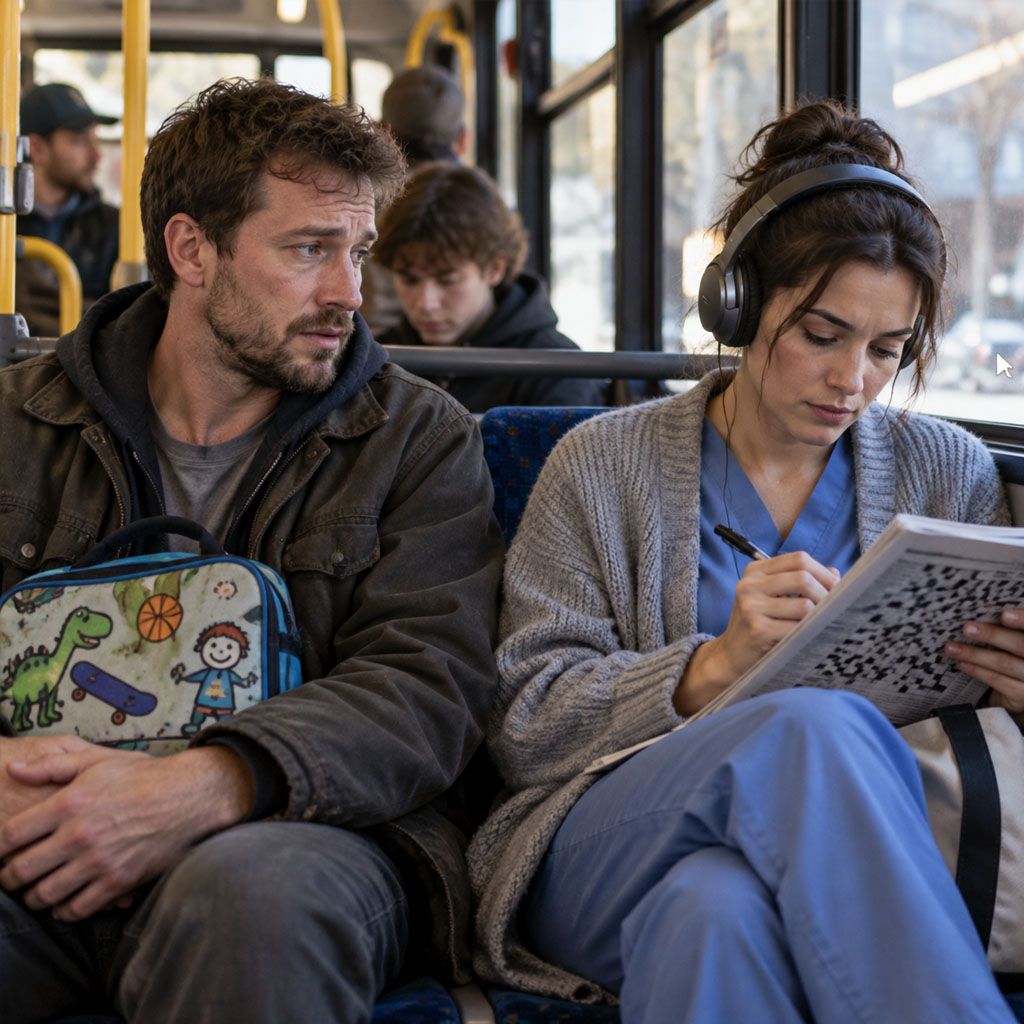
On Monday morning, I boarded the bus and found Vanessa waiting in her usual seat. She moved her tote bag onto her lap, and I sat down beside her. When I told her what Caleb had done, she listened with her crossword forgotten in her hands.
“Your son sounds like a good person,” she said.
“He is.”
“You know where he learned that?”
I looked away, suddenly unable to speak.
She didn’t push me for an answer. She simply turned back to her puzzle, giving me the room to feel whatever I needed to feel.
Two days later, Prudence emailed me. She didn’t ask me to forgive her or suggest that we should try our marriage again. Instead, she asked whether she could begin seeing the boys consistently, provided each child was comfortable with the arrangement.
I didn’t answer immediately. I sat down with the older boys first, explaining that they were allowed to miss their mother without pretending they weren’t hurt by what she had done. Caleb was reluctant, but Ethan admitted that he missed her, and Noah said he missed the mother who used to help him with his school projects.
The twins wanted to know whether she still made chocolate chip waffles. Owen asked if he could bring his favorite board game when he visited, and Finn wanted to know if Sugar could ride in the minivan.
Their answers reminded me that the boys didn’t need me to punish their mother on their behalf. They needed me to protect them while allowing them to decide what kind of relationship they wanted with her.
I wrote back and suggested Sundays from noon until six. If she promised to come, she needed to show up, and if she couldn’t make it, she needed to tell us in advance. The boys had enough uncertainty in their lives already, and they deserved reliability more than another apology.
Prudence agreed.
The first Sunday, she arrived eleven minutes early and waited on the porch wearing the gray sweater Caleb had given her for Christmas two years earlier. The boys came downstairs one by one, except Caleb, who stayed in his room, and she didn’t ask him to come out.
I respected that.
At five minutes to six, the minivan pulled back into the driveway, and the boys spilled out carrying bakery bags and talking over one another. They had visited the park, eaten lunch, and argued about the rules of a game that apparently none of them understood.
“Mom remembered the cinnamon twists!” Luke announced.
Finn handed me a cookie wrapped in a napkin and said it was mine. I looked at Prudence, who stood beside the van as though she wasn’t sure whether she belonged in our driveway anymore.
“Thank you,” I said.
She nodded and drove away.
The following Sunday, she came again. She forgot Noah’s band practice once, bought the wrong yogurt, and struggled to help Ethan with algebra because the school taught it differently from the way she remembered. But she kept showing up, and the boys slowly began to trust that she would be there when she said she would.
Meanwhile, Vanessa and I developed a routine of our own. She rode the bus after her overnight shifts, and I boarded at Maple Street on my way to the warehouse. I brought her a coffee from the gas station on the corner, and she handed me the crossword once she’d finished the clues she liked.
She knew every one of my boys by name. She remembered Caleb’s interest in engineering, Ethan’s soccer schedule, Noah’s trumpet practice, and Finn’s habit of carrying Sugar everywhere. I learned that Vanessa called her sister in Phoenix every Sunday and that she had been living alone for years after a relationship that had left her reluctant to trust anyone again.
I looked forward to those mornings more than I wanted to admit.
Then, one Monday, she wasn’t there.
The tote bag was missing, too, and another passenger occupied the seat beside the window. I stood for the entire ride, staring at a man eating a breakfast burrito as though he had personally ruined my week.
The next morning, Vanessa returned, and the bag moved as soon as I boarded.
“Where were you yesterday?” I asked.
“Double shift. I got off late.”
“Did you miss me?”
She looked at me over the top of her crossword. “No.”
I nodded solemnly. “Good. I was worried you’d say yes.”
She laughed so hard that the passenger in front of us turned around. Then she admitted that she had missed our conversations, although she refused to say it without making a joke about my terrible sports clues.
For the first time since Prudence left, I caught myself imagining a future that wasn’t built entirely around the past.
Then Brad called.
He apologized for the way he had spoken to me on the night I first confronted him. He said the box and the letter had forced him to think about what he had done, and that he had begun to understand how easily he had convinced himself that our situation was simple.
“You married my wife,” I said. “There wasn’t anything simple about that.”
“I know. I was selfish, and I didn’t want to think about what it meant. I’m sorry, Mark.”
I didn’t forgive him immediately, but I listened. He told me that Prudence had admitted something after the wedding, something that explained why she had walked away from our family so abruptly.
He said she had been ashamed of a financial mistake involving the boys’ college savings. She hadn’t told him the whole story, but she had confessed that she felt she had failed our children and didn’t know how to face them.
That night, I went into the garage and opened Prudence’s old desk, which I hadn’t touched since she left. Inside a folder of tax papers and appliance warranties, I found an envelope with my name on it.
Her unfinished letter began with a confession.
“Mark, if you’re reading this, I’ve finally found the courage to tell you why the boys’ college accounts are almost empty.”
I pulled out the bank statement tucked inside.
The balance was far lower than it should have been, and the withdrawals added up to $48,000.
At the bottom of the page was a name I never expected to see connected to our children’s money.
Hector, Prudence’s father.
Chapter 3
I sat on the garage floor with the bank statement in my hands, reading the numbers until they blurred. We had been building those college accounts since Caleb was born, adding money whenever we could and hoping each boy would have more opportunities than we had. I had trusted Prudence to manage the savings, and because we were raising seven children and working full-time, I hadn’t examined every statement as closely as I should have.
The letter explained that her father had been facing serious financial trouble. Hector had managed a hardware store for thirty years and later bought a minority share in a second location, but the business had struggled after a partner withdrew. He was at risk of losing his home, and Prudence had discovered the situation during a family gathering.
She had offered him the money without telling me.
According to the letter, she believed she could replace it before I noticed. She had asked Hector to keep the arrangement secret, and he had agreed out of embarrassment and gratitude. But the money had not been returned to the accounts, and Prudence had never found the courage to tell me what she had done.
The next morning, Vanessa took one look at my face and asked what was wrong. I showed her the statement, although I couldn’t explain why I trusted her with something so personal after knowing her for only a few months.
She studied the page carefully.
“That’s a lot of money,” she said. “Have you talked to Hector?”
“Not yet.”
“You’re going to. You’re just scared of what he’ll say.”
I stared at her. “How do you always know what I’m thinking?”
“Your face is very loud, Mark.”
I drove to Hector’s house that Saturday, borrowing a car from our neighbor because I didn’t want to take the bus across town with a folder full of financial records. Hector was seventy, retired, and a man I had always respected. He had taught Caleb how to use a drill and helped Finn build a birdhouse, and I had never doubted that he loved his grandchildren.
He was waiting with coffee when I arrived.
I placed the statement on his kitchen table. His expression changed almost imperceptibly, but I saw it.
“You know what this is?” I asked.
He removed his glasses and rubbed the bridge of his nose. “Where did you find it?”
“In Prudence’s desk. How much did she give you?”
He stared at the table for a long time before answering.
“Forty-eight thousand dollars.”
I asked him why he had accepted money that belonged to his grandchildren. He explained that he had been terrified of losing his home and ashamed to tell his family how badly the business had gone wrong. Prudence had offered to help, and he had convinced himself that he could repay her quickly.
“I didn’t know she took it from the boys’ accounts,” he said. “She told me it was an investment she could move around.”
“You didn’t ask where it came from?”
“I did. She said it was money she’d set aside herself.”
He looked up at me, his eyes full of regret. “I should have asked more questions.”
Hector explained that he had since sold his share of the business and repaid $36,000, sending the money to Prudence every month. He had assumed she would restore the college accounts, but apparently she had invested some of the repayments in rental properties through an acquaintance connected to Brad.
The investment had failed, costing her another substantial amount.
I thanked Hector for telling me the truth, though I made it clear that the money needed to go directly into the boys’ accounts from that point forward. He agreed without argument and promised to provide records of every repayment.
When I returned home, Prudence was waiting in the driveway after bringing the boys back from their Sunday visit. She saw the folder in my hand and lowered her eyes.
“You found it,” she said.
We sat on the front steps beneath the porch light, the same place where we had taken first-day-of-school photographs for eleven years. I told her I had spoken to Hector and knew about the money, the failed investment, and the repayments she had received.
She didn’t try to deny anything.
“I thought I could fix it before you found out,” she said. “When the investment failed, I didn’t know how to tell you. Every time I walked into the house, I saw seven futures I had damaged. Caleb’s plans for college, Ethan talking about engineering, Noah practicing his trumpet, and all I could think was that I’d stolen from them.”
“So you took yourself away, too.”
She flinched, but she didn’t argue.
“I told myself you’d all be better off without me.”
“That wasn’t your decision to make.”
“I know.”
She admitted that being with Brad had initially felt like an escape from the pressure she had placed on herself. He had no children, no complicated schedules, and no college accounts to worry about. She had mistaken the absence of responsibility for happiness, and she had convinced herself that leaving would somehow erase the shame she carried.
But the guilt had followed her.
“You were still their mother,” I told her. “And you were still responsible for the money.”
“I know,” she whispered.
I told her that she needed to restore the accounts, but I wasn’t going to accept another promise without a written plan. She agreed to work with a financial adviser, set up automatic transfers, and put every repayment in writing. Hector would pay directly into the accounts, and Prudence would redirect part of her own savings toward the balance.
The boys didn’t need to know every financial detail immediately, but they deserved honesty when the time came. I wasn’t going to let another family secret grow until it became too large to face.
That Monday morning, I told Vanessa everything. She pulled a small notebook from her enormous tote bag and began writing down the figures, helping me organize the repayment plan into something manageable.
“You’re doing fine,” she said when she finished. “Now stop making that face.”
I kept the page she gave me in my wallet.
That evening, I spoke with Caleb. I told him that his mother had made a serious mistake with money and had hidden it because she was ashamed, but that she was taking steps to repair the damage. I didn’t tell him the exact amount or make him responsible for solving a problem that belonged to the adults.
He listened quietly.
“Is that why she left?”
“Partly.”
He shook his head. “She could have just told us.”
“Yes,” I said. “She could have.”
After a moment, he asked, “Dad, who’s Vanessa?”
I nearly dropped my coffee.
“What?”
“Finn says you talk about a nurse on the bus. He says she likes Sugar.”
Apparently, I had told Finn that Vanessa considered his stuffed dinosaur a distinguished creature, and he had shared this information with every person in the household. My private morning routine had become a family investigation.
“She’s a friend from the bus,” I said.
Caleb narrowed his eyes. “You’re doing the face.”
I had no idea what face he meant, but I was beginning to suspect that everyone in my life knew more about my feelings than I did.
A week later, I came down with the flu and spent four days at home. Caleb managed the morning routine like a small military commander, getting his brothers fed and dressed while I lay on the couch wondering whether a person could actually die from congestion. I couldn’t contact Vanessa because I had never asked for her phone number, and the idea of asking had always felt like it might break the comfortable little arrangement we had.
On the fifth morning, I dragged myself onto the bus, pale and exhausted. Vanessa was sitting in her usual seat, and the moment I sat down, she placed the back of her hand against my forehead.
“You came back too early,” she said. “You should still be in bed.”
“How did you know I’d been sick?”
“Edwin told me your son mentioned it at the elementary school.”
Our bus driver, Edwin, apparently knew everybody’s business, too.
I looked at her tote bag. “Did you keep the seat for me?”
She turned toward the window. “I don’t know what you’re talking about.”
From the driver’s seat, Edwin called, “She kept it all four days, Mark. Made a man in a suit stand, too.”
Vanessa groaned, and I laughed. Before I reached my stop, I finally worked up the courage to ask for her number.
“No,” she said.
My heart sank.
Then she tore a corner from her crossword, wrote something on it, and handed it to me as I stood.
Under the phone number, she had written, “For emergencies, like the flu or a burrito in your seat.”
I stepped off the bus grinning like a fool.
I didn’t use the number for three days, until Finn’s beloved dinosaur lost a leg and the boy was inconsolable. I texted Vanessa that we had a medical emergency involving a stuffed triceratops with a suspected fracture.
She replied within minutes with instructions to use a small stick and tape, followed by the message, “Tell Sugar he’s very brave. Bill to follow.”
We repaired the dinosaur, Finn stopped crying, and the boys began referring to Vanessa as Sugar’s nurse.
After that, our messages became part of the evening routine. She sent photographs of her cat looking offended, and I sent pictures of the laundry pile that seemed to reproduce whenever I turned my back. Sometimes she told me about a difficult night at the hospital, and I sent her a picture of Finn asleep in the blanket fort with Sugar tucked under his arm.
We never rushed anything. We were both carrying enough history to understand that a good relationship needed room to grow.
Then, one Tuesday evening, Prudence arrived at my door holding a store-bought apple pie.
“I didn’t know what people bring when they want to talk to their ex-husband,” she said. “Flowers seemed like a bad idea because you’re allergic to half the things that grow outside.”
I almost laughed.
She sat at the kitchen table and told me she and Brad were separating. Their relationship had not survived the reality of the life Prudence thought she wanted. She had imagined quiet evenings, spontaneous dinners, and a simpler household, but instead she found herself missing the boys, their school schedules, and even the chaos she had once complained about.
“I thought the family was the problem,” she said. “I thought if I got away from the noise, I’d finally be happy. But the quiet wasn’t what I wanted, either.”
I listened without feeling the satisfaction I might once have expected. Her relationship with Brad had collapsed, but that didn’t undo the damage she had caused or automatically make our marriage worth rebuilding.
“None of this makes me happy, Prudence,” I told her. “But I hope you figure out what you actually want.”
She nodded, and for the first time in a long while, we spoke as two people who understood that the past could not simply be restored.
Chapter 4
A week after Prudence told me she and Brad were separating, Caleb came home carrying a large envelope from his high school. He had been nominated for a scholarship after a teacher submitted a project he had built for an engineering competition, a model bridge that had once collapsed across our kitchen table during dinner.
I hugged him before he could finish explaining the details.
“Dad, I know,” he said, tolerating the embrace for a few seconds before pulling away. “But the final round requires an essay.”
The prompt asked students to describe a family experience that had changed how they understood responsibility. Caleb took his papers to the kitchen table and worked late into the night, surrounded by notebooks and research materials.
I didn’t read his essay, because it was his story to tell. But as I walked past him one evening, I caught a glimpse of a line near the end.
“My mother taught me that people can fail you and still choose to get better. My father taught me something harder. You can love someone without pretending they never failed you.”
I stood in the hallway for a long time after that.
Prudence continued working on the college accounts. She sold her share of a family lake cabin she had loved for years, and the proceeds, combined with her savings and Hector’s repayments, eventually restored every dollar that had been missing. She brought the final bank statement to my house herself, placed it on the table, and waited while I checked the numbers.
“It’s all there,” she said. “Every dollar.”
Caleb had been listening from the staircase. He came into the room and looked at his mother.
“Mom, I’m not buying forgiveness.”
“I know,” she answered. “I made a mistake with the money, and then I made a bigger mistake because I was ashamed of the first one.”
He hesitated before asking the question he had apparently been carrying for months.
“Do you regret us?”
Prudence answered immediately.
“No. Never. I regret how I acted, and I regret the ways I hurt all of you. But I have never regretted being your mother.”
Caleb nodded. He didn’t hug her, and she didn’t ask him to. When she left, however, he walked her to the minivan and waited until she had started the engine before going back inside.
Sometimes progress looks like nothing more than a child deciding he is willing to walk someone to the door.
In March, the scholarship committee called. Caleb had won, and although it wasn’t a full scholarship, the award combined with the restored college fund made his dream of attending an engineering program three hours away financially possible.
The house erupted.
Ethan shouted loud enough for the neighbors to hear, Noah demanded to read the email himself, and the twins began chanting Caleb’s name for reasons that made sense only to them. Owen played a triumphant note on Noah’s trumpet, which sounded like a goose protesting a traffic ticket, while Finn ran around wearing one sock and holding Sugar over his head.
I stood in the middle of the kitchen, surrounded by noise, crumbs, shoes, and seven boys who trusted that they could celebrate their happiness without worrying about who might disapprove.
Prudence arrived with a cake that had Caleb’s name misspelled on the icing. Brad showed up later with another cake that had the spelling right, and for several seconds, the entire room went quiet as everyone looked between them.
Caleb groaned. “Can everybody stop buying cakes?”
Finn immediately asked whether that meant he could have both.
The tension broke, and the family began laughing. Brad looked at me and asked whether he should leave, and I considered the question before answering.
“Stay. But staying isn’t the same as pretending nothing happened.”
He nodded and stayed.
Later that evening, we washed dishes together while the boys played in the living room. Brad apologized again, this time without excuses, and I told him I wasn’t ready to forget what he had done. Still, he was my brother, and if we were ever going to rebuild that relationship, it would have to begin with honesty rather than another slogan about love.
The following morning, I boarded the bus and found Vanessa waiting in her usual seat. I handed her a coffee, and she gave me the crossword, as she had done hundreds of times before. When I told her about Caleb’s scholarship, she smiled and asked whether he had decided which engineering program he wanted to attend.
“You remember that?” I asked.
“Of course I remember. I’ve been hearing about that bridge for months.”
I laughed, then looked at her for a long moment. There was something about the ordinary warmth of that conversation that made me realize how much she had become part of my life, even though we had never formally defined what we were to each other.
My sons noticed, too. Caleb began asking when I was going to invite Vanessa over for dinner, and Ethan informed me that I was making what he called my “romantic face.” The twins started chanting that I should ask her out, while Finn announced that Sugar approved of the idea.
Even Prudence, during one of the boys’ Sunday visits, quietly told me I looked less tired than I had in months.
“Good,” she said. “You deserve to be happy, Mark.”
I thanked her, and for once, the conversation didn’t feel like a negotiation. She was learning to live with the consequences of her decisions, and I was learning that I could wish her well without wanting to return to the life we had shared.
One morning, I finally asked Vanessa if she would like to have breakfast with me on Saturday. I tried to sound casual, but my hands were sweating so badly that I nearly spilled the coffee I was holding.
She lowered her crossword and studied me for a moment.
“No,” she said.
My heart sank so quickly that I thought it might land somewhere near the bus driver’s feet.
Then she smiled.
“I’d like to have breakfast with you. Dinner is my lunch, and I work nights, remember? Saturday, eight o’clock. The diner on Fifth Street. Don’t be late.”
Edwin honked the horn twice, and a few passengers laughed. I stepped off the bus feeling as though I had just won something far more valuable than a scholarship or a promotion.
On Saturday, I arrived at the diner half an hour early. Vanessa came in wearing jeans and a green sweater, her dark hair loose around her shoulders. I had seen her in scrubs and under fluorescent bus lighting for nearly a year, and suddenly I understood why people wrote songs about the way someone could look in the morning.
We talked for three hours. She told me about growing up in Phoenix, studying nursing, and ending an engagement with a man who thought she cared too much about her work. I told her about my marriage, the boys, and the way I had spent so many years believing that being dependable meant never admitting I was hurt.
At some point, I asked the question that had been on my mind for months.
“Vanessa, why did you save that seat for me?”
She stirred her coffee and looked out the window.
“The first day you got on the bus, you were carrying that ridiculous lunch bag your son made. You looked exhausted, and you still had a lunch packed for your children. I thought you needed one thing to go right that day, so I moved my bag.”
“And the next day?”
“You looked like you needed it again.”
She smiled a little, then added, “After a while, I needed it, too. I looked forward to seeing you, even on the mornings when I’d barely slept. You made me laugh when I was tired, and you listened without making me explain everything. I guess I started saving that seat for myself as much as for you.”
I sat there, trying to understand how something so small had grown into something that mattered so much.
Two weeks later, Vanessa met the boys. She brought treats for her cat to show them, and Finn insisted on introducing her to Sugar, whose repaired leg was holding up beautifully. She examined the stuffed dinosaur with the seriousness of a doctor reviewing a chart and declared him fully recovered.
Finn looked at me as though I had introduced him to a wizard.
Caleb shook Vanessa’s hand and thanked her for keeping me company when things were difficult. She told him he didn’t need to thank her, but I saw the way she looked at him, and I knew she understood how much that small gesture meant.
Life continued. Prudence worked on rebuilding her relationships with the boys, Brad and I took cautious steps toward a more honest brotherhood, and Vanessa became a familiar presence at our Sunday dinners. She never tried to replace their mother, and she never asked me to forget what had happened. She simply kept showing up, which was the very thing she had taught me mattered most.
Then, almost a year after the day she first moved her tote bag, Edwin stopped me as I was leaving the bus.
“Mark, you know Vanessa doesn’t need this route, right?”
I frowned. “What do you mean?”
“She lives two blocks from the hospital. She gets on there, rides past her stop to the end of the line, and loops back. She’s been doing it for a year.”
I stood on the sidewalk, unable to speak.
The bus pulled away, and through the window I could see Vanessa sitting in the third row from the back, her tote bag resting on the empty seat beside her. She had spent an entire year riding a bus she didn’t need to ride, simply to share forty minutes of conversation and a cup of coffee with a tired father who had once thought his life was falling apart.
The next morning, I boarded the bus carrying a paper bag. Inside was a new crossword book, a good pen, and a small cardboard sign that Finn and I had made together. It read RESERVED, with a drawing of a triceratops underneath.
Vanessa looked at the sign, then at me, and her face turned bright red.
“Edwin told you,” she said.
“He did. Apparently, he’s been keeping a lot of secrets.”
She laughed, but her eyes were shining.
“Why didn’t you tell me?” I asked. “You didn’t need to ride this bus every day.”
She looked down at the sign. “Because if I told you, you might stop needing the seat. And then I’d just be a woman on a bus.”
I sat down beside her.
“You were never just a woman on a bus.”
She moved the tote bag to the floor, something she hadn’t done in a year, and leaned her head against my shoulder for the rest of the ride. I told her I was arranging to start a later shift at the warehouse, which meant I wouldn’t be able to take the 6:40 bus anymore.
Her expression fell, and for a moment I wondered whether I had ruined something beautiful by changing the routine.
Then I told her I had bought a used minivan and asked whether she’d let me pick her up after her shift. It had seven seats in the back, plenty of room for the boys, and a front passenger seat I intended to keep reserved for her.
She laughed so hard that Edwin glanced at us in the mirror.
“You’re doing the face,” she said.
“What face?”
“The face you’ve been making at me for a year.”
I didn’t know I had a face, but apparently everybody did.
The following August, we drove Caleb to college orientation. Prudence brought four of the boys in her minivan, while Vanessa and I took the others in mine. Brad and Hector met us on campus, turning what should have been a simple orientation trip into a family expedition involving sandwiches, Frisbees, and a lengthy argument over who had cheated at a game.
Caleb pretended to be embarrassed by all of us, though he was smiling when he thought nobody was looking. We sat beneath an oak tree, watching the boys run across the grass while Vanessa helped Finn open a juice box and Prudence listened to Ethan explain something about engineering.
I looked around at the people gathered beneath that tree and thought about the years we had spent believing that a family had to be perfect to be worth keeping.
Mine wasn’t perfect. We had made terrible decisions, hidden painful truths, and hurt one another in ways that could never be completely erased. But we were learning to tell the truth, to show up when we promised, and to stop treating love as something people had to earn through silence.
When we returned home that evening, the house was loud again. Someone was hungry, someone couldn’t find a backpack, and Noah was playing the trumpet when nobody had asked him to. Finn fell asleep holding Sugar, and Vanessa carried him upstairs without being asked.
When she came back down, she found me standing in the kitchen, watching the chaos with a smile.
“What?” she asked.
“Nothing,” I said. “I was just thinking that this used to feel like proof I was carrying too much.”
She took my hand.
“And now?”
“Now it feels like proof I’m still here.”
She squeezed my fingers and leaned against me.
“You were always still here,” she said. “That’s why I saved the seat.”
I don’t ride the 6:40 bus anymore, but every morning after Vanessa finishes her shift, I pick her up outside Mercy General. The passenger seat is always empty when I pull up, and Finn has taped a little cardboard sign to the headrest that reads RESERVED, complete with another drawing of Sugar the triceratops.
She kept a seat open for me every day for a year, even when she didn’t need the bus and nobody knew what she was doing. Now I keep a seat open for her, not because she needs rescuing, but because she has become part of the life I am grateful to come home to.
I once believed that the measure of a good life was how much responsibility a man could carry without asking for help. Vanessa taught me that sometimes the smallest kindness can remind a person that he doesn’t have to carry everything alone.
And the most beautiful part is that she never asked me to become someone else before she made room for me.
THE END.
⚠️ All characters and events are fictional. Do not imitate or apply them in real life. 😌😌😌