
Chapter 2
For several seconds, nobody moved. The woman pushing the stroller smiled at me, while all three toddlers began calling my name with the excitement of children who had been separated from their mother for far too long.
“Mommy! Mommy! Mommy!”
I stood so quickly that my chair scraped against the marble floor.
“There’s my crew!” I called, crossing the room.
Sophia reached for me first. I lifted her from the stroller, kissed her warm cheek, and felt her small arms wrap tightly around my neck.
Behind her, Lucas began protesting.
“My turn, Mama!”
Emma joined him.
“Mine too!”
I laughed, bending to kiss them both.
“You three act like I haven’t seen you since Christmas. I was gone for two hours.”
“Long time,” Lucas informed me solemnly.
The man behind the stroller smiled.
“He’s been telling me that since we left the house.”
He leaned down and kissed me.
Not on the cheek.
On the lips.
A familiar, affectionate kiss that belonged to two people who had shared ordinary mornings, sleepless nights, difficult decisions, and years of happiness.
“Sorry we’re a few minutes late, sweetheart,” he said. “Emergency surgery took longer than expected.”
“Everything okay?”
“The patient’s stable. Dr. Martinez took over recovery.”
He adjusted the two infants sleeping against his chest.
“These two are ready for their afternoon bottles.”
“Then we’d better get them fed.”
I turned toward the ballroom.
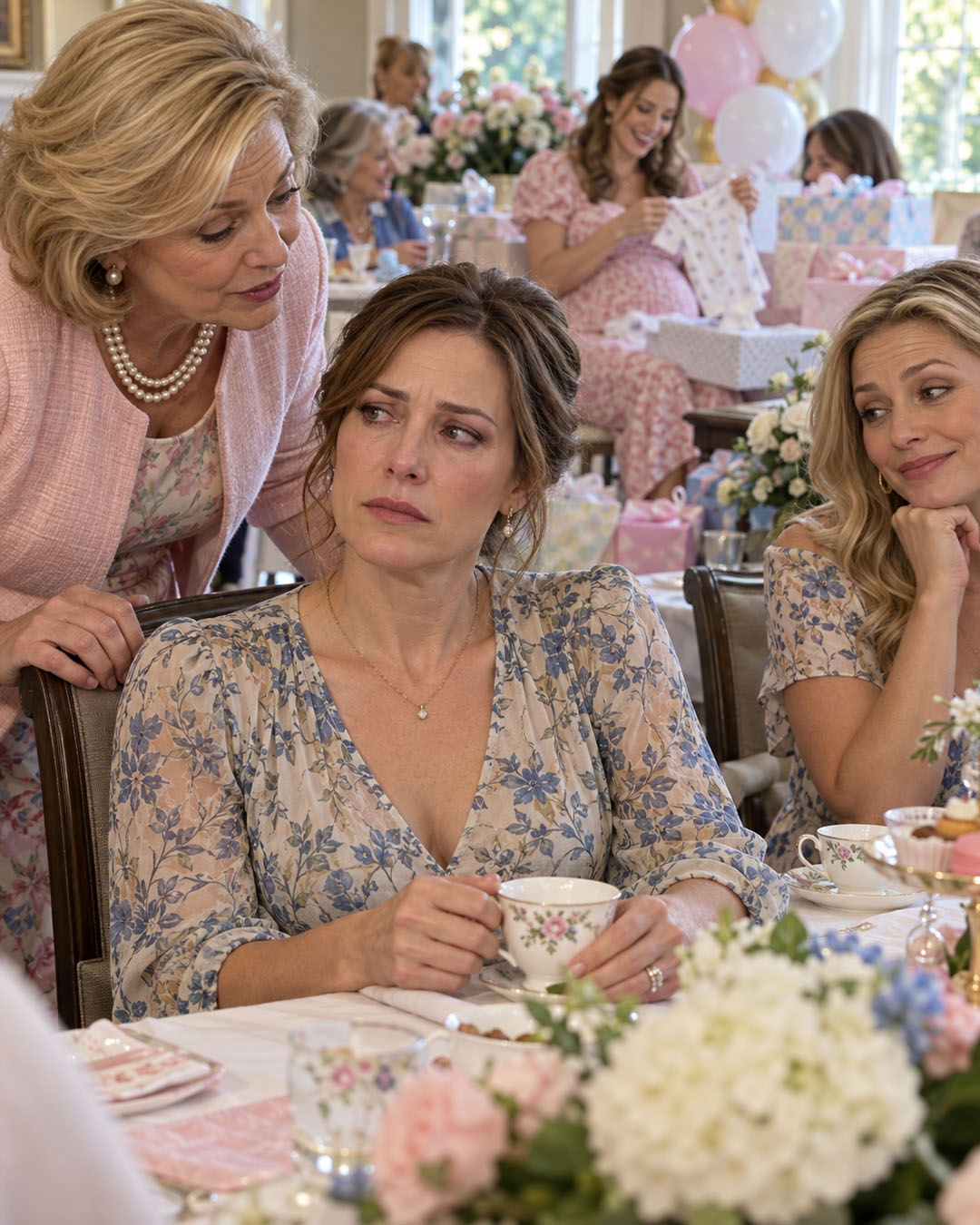
Thirty women were staring at us.
My mother stood motionless beside the dessert table, her mouth slightly open.
Natalie’s fingers gripped the edge of a chair.
Finally, Aunt Susan spoke.
“Catherine? Whose children are those?”
I smiled.
“Mine.”
A spoon struck the floor somewhere behind her.
Mom blinked repeatedly.
“Yours?”
“Yes, Mom.”
I touched Sophia’s curls.
“This is Sophia. That’s Lucas, and the little troublemaker trying to climb out of the stroller is Emma. They’re two years old.”
Emma waved cheerfully.
“Hi!”
I turned toward my husband.
“And these are James and Lily. They’re six months old.”
My mother staggered backward until she found a chair.
“Five?” she whispered.
“Five children,” I confirmed.
Aunt Margaret pressed her hand against her chest.
“But that’s impossible.”
“Apparently not.”
The man beside me extended his hand toward Susan.
“Alexander Cross. Catherine’s husband. It’s nice to finally meet you.”
Susan shook his hand mechanically.
“Her husband?”
“Yes, ma’am.”
Alexander slipped an arm around my waist.
“We’ve been married four years.”
Mom made a small sound.
“Four years?”
“That’s right,” I replied. “We had a quiet wedding on Martha’s Vineyard. A few close friends, some colleagues, and Alexander’s immediate family.”
Natalie stared from my face to Alexander’s.
“You’re married?”
“Very happily.”
“To a doctor?”
Alexander smiled politely.
“I’m a neurosurgeon at Massachusetts General Hospital.”
Emily looked at his scrubs.
“Wait. Are you Dr. Alexander Cross? The one who spoke at that medical conference last year?”
“That would be me.”
She stared at me.
“And you’re his wife?”
“Yes, Emily. That’s generally what being married means.”
Maria approached with the diaper bag.
“Mrs. Cross, I packed everything the children need. Their bottles, snacks, extra clothes, and the little stuffed rabbit Emma wouldn’t leave behind.”
“Thank you, Maria. You’re wonderful.”
Maria had been part of our household since the triplets were infants. She was dependable, patient, and capable of calming a roomful of restless children with a single gentle sentence.
I turned toward my relatives.
“Everyone, this is Maria. She helps us care for the children when Alexander and I are working.”
Maria smiled warmly.
“It’s very nice to meet you all.”
Mom stared at her.
“You have a nanny?”
“Yes.”
“And five children?”
“Still yes, Mom.”
She looked at Alexander again.
“And a husband?”
Alexander raised an eyebrow.
“I certainly hope so.”
A few nervous laughs rippled through the room.
But Mom wasn’t laughing.
She looked as though the world she’d understood for five years had vanished beneath her feet.
“The accident,” she whispered. “The doctors said you couldn’t have babies.”
I adjusted Sophia on my hip.
“No, Mom. They said I might have difficulty conceiving. Those were their words.”
“But you never corrected me.”
“I tried. Several times.”
“Then why didn’t you tell us everything?”
That question made me pause.
There were plenty of answers, but none of them would be comfortable.
“Because whenever I tried to talk about my life, you changed the subject to what you thought was wrong with it.”
Natalie slowly lowered herself into a chair.
“But five children, Catherine? How could you keep something like that from your own family?”
I looked at her carefully.
“That’s a fair question. And I owe you an explanation.”
Sophia rested her head against my shoulder.
“But before we talk about that, I want everyone to understand something.”
I turned toward Mom.
“You stood in front of thirty people and told them I was broken. You didn’t ask whether I was happy. You didn’t ask what my life looked like. You decided you knew.”
Mom’s eyes filled.
“Catherine, I was worried about you.”
“Worry doesn’t give you permission to humiliate me.”
The room went quiet again.
I kissed Sophia’s forehead.
“And whether I had five children, one child, or none at all, what you said would still have been cruel.”
For the first time that afternoon, my mother had nothing to say.
Chapter 3
Alexander settled into a chair and began preparing James’s bottle while Maria helped the triplets with their snacks. Watching my husband support our baby against his shoulder, I felt the familiar warmth that came from seeing how naturally he’d become a father.
He was brilliant in an operating room, but it was his patience at home that had made me fall in love with him.
“Can somebody explain how this happened?” Natalie asked.
I sat across from her.
“Which part?”
“All of it. The marriage. The babies. How you managed to build an entire family without any of us knowing.”
I took a slow breath.
“After the accident, my doctors recommended that I see a fertility specialist before trying to conceive. I followed their advice, and when Alexander and I decided we wanted children, we started treatment.”
Alexander looked up.
“We went through IVF. We were fortunate that it worked, although the result was a little more exciting than we’d anticipated.”
I smiled at the memory.
“We had two embryos transferred. One eventually split, and suddenly we were expecting three babies instead of two.”
“Triplets?” Emily whispered.
“Triplets.”
I glanced at Sophia, Lucas, and Emma.
“Lucas and Emma are identical twins. Sophia was our surprise third member of the team.”
Maria chuckled.
“Surprise is certainly one word for it.”
Alexander nodded.
“I nearly dropped my coffee during that ultrasound.”
Despite the tension, several guests laughed.
Natalie rested her hands over her belly.
“And the younger twins?”
“They surprised us too,” I said. “We conceived them without fertility treatment. My doctors monitored the pregnancy carefully, and thankfully, everything went well.”
Mom wiped her eyes.
“You carried five children after that accident?”
“Over two pregnancies, yes.”
She stared down at her hands.
“All those years, I thought your body had failed you.”
I looked at her.
“My body survived something terrible, Mom. It healed. That’s not failure.”
Her shoulders sagged.
I continued, “And if I hadn’t been able to carry children, that wouldn’t have made me a failure either.”
Aunt Susan nodded slowly.
“You’re absolutely right.”
I turned to Natalie.
“There’s something else you should understand. I didn’t hide my children because I was ashamed of them. I wanted a private life, and I didn’t trust our family to respect it.”
Natalie’s face tightened.
“That’s hard to hear.”
“It was hard to live.”
Alexander gently patted James’s back.
“When Catherine and I met, she told me she had a complicated relationship with her relatives. I didn’t understand how complicated until I heard some of the phone calls.”
Mom looked offended.
“What phone calls?”
“The ones where you asked why I was wasting my life on work,” I answered. “The ones where you compared me to Natalie. The ones where you suggested no decent man would want someone with my medical history.”
Mom opened her mouth, then closed it.
“I said that?”
“More than once.”
She lowered her eyes.
Natalie crossed her arms.
“Okay, but you could at least have told us you were successful.”
I studied my sister.
“Successful at what?”
“Your job.”
“What do you think I do?”
She frowned.
“Something involving medical equipment. Sales, right?”
Alexander looked at me.
I could see him trying not to smile.
“No, Natalie,” I said. “I design and manufacture medical devices. I founded the company nine years ago.”
Emily leaned forward.
“What’s it called?”
“CrossTech Medical.”
Natalie’s expression changed.
“Wait. CrossTech? The company that makes surgical equipment?”
“Yes.”
She grabbed her phone.
After a moment, her eyes widened.
“Catherine, this says your company had three hundred forty-seven million dollars in revenue last year.”
“That’s correct.”
Aunt Margaret gasped.
“You’re a millionaire?”
I hesitated.
“I’ve done well, Aunt Margaret. But the company’s revenue isn’t the same thing as personal income.”
Natalie kept scrolling.
“You’re the CEO.”
“Yes.”
“And you own most of it?”
“Seventy-three percent.”
She looked at me as though I’d become a stranger.
“But Mom said you had some little office job.”
“Mom never asked what I did.”
Mom suddenly looked up.
“That’s not true. We talk every Sunday.”
“We talk, but you don’t listen.”
“Catherine—”
“At Christmas, I told you we were opening a new manufacturing facility. You asked whether Natalie had picked out nursery furniture.”
Mom swallowed.
“I remember that.”
“Last spring, I told you I’d been invited to speak at a medical innovation conference. You asked if I’d considered freezing my eggs.”
Emily stared at the carpet.
I leaned back.
“Every conversation eventually became about what you believed I lacked. There wasn’t much room left for what I’d actually accomplished.”
Mom’s voice broke.
“I didn’t realize.”
“That’s what hurts.”
Alexander reached across the table and squeezed my hand.
“Catherine built that company before we met,” he said. “I watched her spend countless nights improving equipment that helps surgeons treat patients more safely. She employs hundreds of people, and she knows many of them by name.”
I felt my cheeks warm.
“Alex, you don’t have to give them my résumé.”
“I’m not giving them your résumé. I’m telling them what they should have known years ago.”
He smiled at me.
“You’re remarkable, sweetheart.”
For a moment, I remembered the evening we’d met.
It was a hospital fundraiser in Boston. I had been standing alone near a window, exhausted after a difficult week, when a handsome physician approached me and asked whether I thought the new surgical robotics market was overvalued.
Most men at those events asked what I did for fun.
Alexander had asked what I thought.
We argued good-naturedly for forty minutes, missed the keynote dessert, and ended up eating cheeseburgers at a diner after the fundraiser.
Six months later, he proposed.
He never asked me to become smaller to fit into his life. He simply made space beside him.
That was what love had felt like to me.
Not being completed by someone else.
Being accepted as I already was.
Across the table, Natalie stared at a photograph on her phone.
“Your wedding pictures are online.”
I nodded.
“Alexander’s social media is public. So is mine.”
She scrolled further.
“The triplets’ birthday party. Christmas photos. A vacation in Greece.”
“We had a wonderful time.”
“And here’s a picture of you pregnant with the twins.”
I smiled.
“That was taken on our anniversary.”
Natalie stared at the screen.
“Anyone could have seen these.”
“Yes.”
She looked wounded.
“Then you weren’t really hiding.”
“Not from the world,” I answered. “But I stopped volunteering personal news to people who used it to judge me.”
My mother pressed her fingers against her lips.
“I don’t even know where you live.”
“We have a townhouse in Beacon Hill.”
“Your old apartment?”
“I moved out of that apartment four years ago.”
“Where do you work?”
“At our headquarters outside Boston, although I work from home a couple of days each week.”
She whispered, “I know nothing about you.”
The words hung between us.
Then I answered softly.
“You know what you decided about me.”
Sophia climbed into my lap and touched my cheek.
“Mama sad?”
I brushed a curl away from her forehead.
“A little, sweetheart.”
She kissed my nose.
“Better?”
I smiled through the sudden ache in my throat.
“Much better.”
Sophia settled against me, satisfied that she’d fixed the problem.
And I wondered how a two-year-old could offer more uncomplicated kindness in one small gesture than I’d received from my mother all afternoon.
Chapter 4
The shower resumed awkwardly as Maria handed out crackers and fruit slices to the triplets. A few guests approached to admire the babies, but most remained in their seats, unsure whether they were witnessing a family reunion or the beginning of an argument.
Mom rose from her chair.
“Catherine, could we talk somewhere private?”
I looked at Alexander.
“I’ve got everyone,” he assured me. “Take your time.”
I followed Mom into a quiet hallway beside the ballroom.
For several moments, we stood facing each other beneath an antique brass chandelier. I could still hear the soft music and occasional laughter through the closed doors.
Mom twisted her tissue between her fingers.
“I don’t know where to begin.”
“An apology would be a reasonable place.”
She looked up sharply.
Then her expression crumpled.
“I’m sorry.”
I waited.
“I’m sorry for what I said today,” she continued. “And for the things I’ve said over the years. I truly believed you were suffering, Catherine. I thought you needed help.”
“Then why did you keep telling everyone?”
She looked confused.
“What?”
“If you thought I was suffering, why did you discuss my medical history at parties? Why did you make my supposed infertility part of every family gathering?”
Her lips trembled.
“I thought people should understand.”
“Understand what?”
“Why you were so distant. Why you worked so much. Why you never seemed interested in settling down.”
I shook my head.
“Mom, I was distant because I couldn’t talk to you without feeling judged. I worked because I loved my career. And I didn’t settle down until I met a man who treated me with respect.”
She leaned against the wall.
“I thought you were alone.”
“I know.”
“And all this time you had a husband and children.”
“Yes.”
Her tears began falling.
“I missed everything. Your wedding. Your pregnancies. The births of five grandchildren.”
I felt the familiar urge to comfort her.
For years, that had been my role. Natalie could complain, Mom could criticize, and I was expected to remain calm enough to make everyone feel better.
But something had changed.
“Mom, I understand that you’re hurt,” I said. “But you aren’t the only person who lost something.”
She looked at me.
“What did you lose?”
“I lost the feeling that I could trust my own mother with good news.”
She covered her mouth.
“I wanted to tell you about Alexander,” I continued. “I wanted to call when he proposed. I wanted you to see the sonogram of the triplets.”
“Then why didn’t you?”
“Because every time I imagined telling you, I heard what you would say.”
Mom shook her head.
“I would have been happy.”
“Maybe. But you also would have questioned my doctors, criticized my decisions, and compared everything to Natalie’s life. And I was scared that something precious would become another opportunity for you to tell me I wasn’t doing enough.”
She was silent for a long time.
Then she whispered, “I can see why you thought that.”
I nodded.
“I wasn’t right to let the distance grow this much. I should have been clearer about my boundaries instead of disappearing from so much of the family. I know that.”
Mom took a step toward me.
“Can you forgive me?”
I swallowed.
“I want to. But forgiveness isn’t the same as pretending nothing happened.”
“I understand.”
“Do you?”
She nodded slowly.
“I think I’m beginning to.”
I looked through the glass doors.
Inside, Alexander was laughing with Lucas, who was trying to balance a cracker on his father’s knee. Maria held Lily, while Emma showed Aunt Susan her stuffed rabbit.
Five beautiful children.
Five lives I had protected from the criticism I’d grown up hearing.
“Mom, I will never let my children feel the way you made me feel,” I said. “They will never be told they’re incomplete because they don’t meet somebody else’s expectations.”
She began crying again.
“I don’t want to hurt them.”
“Then respect their parents. Respect our choices. And don’t use love as an excuse to control us.”
Mom wiped her face.
“I can do that.”
“Good.”
Her voice dropped to almost a whisper.
“Would you let me meet them properly? Not as strangers at a party, but as their grandmother?”
I studied her expression.
There was no dramatic speech left, no prideful argument, no attempt to turn herself into the victim.
Only regret.
“I’ll give you a chance,” I said. “But we’re going to take things slowly.”
She nodded.
“Whatever you need.”
When we returned to the ballroom, Alexander was holding Lily against his shoulder.
Mom approached him cautiously.
“Could I hold her?”
He glanced at me.
I nodded.
Alexander carefully placed our daughter in her grandmother’s arms.
Mom stared down at Lily’s tiny face.
“She’s beautiful.”
“She has Catherine’s eyes,” Alexander said.
Mom smiled through her tears.
“She does.”
Lily blinked sleepily, stretched one little hand toward Mom’s necklace, and closed her fingers around it.
My mother’s expression softened in a way I hadn’t seen for years.
“Hello, sweetheart,” she whispered. “I’m your grandma.”
I watched without speaking.
No apology could give back the moments she’d missed. But perhaps the woman holding my daughter could learn to value the moments still ahead.
Across the room, Natalie sat alone beside a mountain of unopened gifts.
Her shower had become a gathering centered around my children, and suddenly I felt uncomfortable.
Whatever Natalie had said earlier, this was supposed to be her celebration.
I approached her.
“Nat, can we talk?”
She looked up.
“Sure.”
I sat beside her.
“I’m sorry the afternoon turned into this. I know you spent months planning your shower.”
She gave a tired laugh.
“Well, I’ll say one thing. Nobody’s going to forget it.”
I smiled faintly.
“That’s probably true.”
She studied me for a moment.
“Why today?”
“What do you mean?”
“Why bring the children today? You must have known what would happen.”
I hesitated.
That was the question I couldn’t answer with a clever remark.
“I knew Mom would probably make comments,” I admitted. “I asked Alexander to bring the children because I was tired of the assumptions. I wanted everyone to meet them.”
Natalie looked down.
“So you planned a surprise.”
“Yes.”
“At my baby shower.”
I let the words settle.
“You’re right. I could have chosen another day.”
She sighed.
“Mom was awful to you. I was awful too. But I wish we’d had this conversation somewhere else.”
“That’s fair.”
For a while, neither of us spoke.
Then Natalie whispered, “I don’t know why I kept making those comments about you.”
I turned toward her.
“I think you do.”
She stared at her belly.
“Because Mom always compared us. Growing up, you were the smart one, the ambitious one, the one who got scholarships and built a career. I felt like I could never compete.”
I hadn’t expected that.
“Nat…”
“Then I got married, and now I’m having a baby. Suddenly, Mom was treating me like I’d won some contest. And I liked it.”
Her eyes filled.
“I liked finally being the daughter who had something you didn’t.”
I reached for her hand.
“There was never supposed to be a contest.”
“I know that now.”
She looked toward Alexander, who was helping Lucas put on his little sneakers.
“And seeing you with your family makes me realize how much time we’ve wasted.”
I squeezed her hand.
“We can stop wasting it.”
She nodded slowly.
“I’m scared, Catherine.”
“About the baby?”
“About everything. Becoming a mother. Being good enough. Making mistakes. Mom keeps telling me having a baby will complete my life, but what if I’m still just me afterward?”
I recognized the fear in her voice.
“Then you’ll still be you,” I said. “And you’ll have a little girl who loves you.”
Natalie’s tears spilled over.
“You make it sound simple.”
“It’s not simple. Some days are exhausting. Some days I question every decision. Having five children doesn’t make me wiser than you, and it certainly doesn’t make me a better woman.”
She gave a watery smile.
“Five seems pretty impressive.”
“Five means we buy diapers in ridiculous quantities and someone always loses a shoe.”
She laughed.
I leaned closer.
“You don’t have to be perfect, Nat. You only have to keep learning and loving your daughter.”
Just then, Emma wandered over.
She stopped in front of Natalie and studied her round belly.
“Baby?”
Natalie smiled.
“That’s right. There’s a baby in there.”
Emma gently touched her stomach.
“Baby come play?”
“In a little while, sweetheart.”
Emma considered this.
“I share bunny.”
Natalie’s face softened.
“That’s very sweet of you.”
Emma handed her the stuffed rabbit she’d been carrying.
I watched my sister hug it against her belly.
And for the first time in years, there was no competition between us.
Only two sisters, a little girl, and a baby who hadn’t been born yet.
Chapter 5
We stayed long enough for Natalie to finish opening her gifts. This time, I sat beside her, admired the tiny dresses and blankets, and laughed when Aunt Susan presented a handmade sweater that looked large enough for a toddler.
The attention gradually returned to the expectant mother, exactly where it belonged.
Alexander helped clear wrapping paper while Maria gathered the children’s toys. My mother remained unusually quiet, occasionally looking toward the triplets with an expression that mixed wonder and regret.
When Natalie opened the final package, she held up a small silver picture frame.
“For my daughter’s first photograph,” she said.
I smiled.
“That’s beautiful.”
She looked at me.
“Maybe after she’s born, we could take a picture of all the cousins together.”
“I’d love that.”
Her face brightened.
“Really?”
“Of course.”
It was a small invitation, but something about it felt important.
For years, our conversations had revolved around comparison. Now she was asking us to share something.
As the guests began leaving, Mom approached me near the entrance.
“Catherine, Thanksgiving is coming up.”
“I know.”
“Would you consider bringing everyone to the house? Alexander, the children, all of you?”
I looked at her carefully.
Thanksgiving at Mom’s had never been particularly peaceful. There were always comments about careers, marriages, weight, appearances, and whichever child had disappointed her that year.
“Possibly,” I said.
She nodded.
“I understand if you’re not ready.”
I was surprised by her restraint.
“Mom, if we come, things have to be different.”
“They will be.”
“No criticism of our parenting. No comments about whether we should have more children. No comparing the kids to each other, or to Natalie’s daughter when she’s born.”
She listened without interrupting.
“And no discussing anyone’s private medical history with the rest of the family.”
Her eyes filled.
“I promise.”
I looked at her for a long moment.
“Then we’ll come for Thanksgiving.”
She pressed her hand against her heart.
“Thank you.”
“But if those boundaries aren’t respected, we’ll leave. I need you to understand that.”
“I do.”
She stepped forward.
“May I hug you?”
That question alone told me something had shifted.
For once, she wasn’t assuming she had the right to make decisions for me.
I opened my arms.
Her embrace was familiar, carrying memories of childhood birthday cakes, scraped knees, Christmas mornings, and all the years before we became two women who couldn’t understand each other.
“I’m sorry, Catherine,” she whispered. “I should have been proud of the woman you were, not disappointed by the woman I imagined you weren’t.”
My throat tightened.
“That’s all I ever wanted, Mom. To be seen.”
She held me a moment longer.
When we separated, Sophia came running toward us.
“Mama! Grandma!”
We both turned.
Mom knelt.
“Hello, Sophia.”
Sophia studied her face.
“You my grandma?”
Mom nodded, smiling through tears.
“Yes, sweetheart. I am.”
Sophia reached for her hand.
“Come see bunny.”
Mom looked at me for permission.
I nodded.
And the two of them walked toward the stroller together.
Watching them, I understood something that had taken me years to learn.
Boundaries didn’t have to be walls.
Sometimes they were doors that could open when people finally learned how to knock.
Outside the hotel, Alexander helped secure the triplets into their car seats. Maria checked the babies’ straps and made sure everyone had their favorite blanket or stuffed animal.
By the time we finished, Lucas was demanding a trip to the park, Emma was asking about cupcakes, and Sophia was insisting that her stuffed elephant needed a seat belt.
Alexander turned toward me with an amused smile.
“Quite an afternoon.”
“That’s one way to describe it.”
“Are you okay?”
I considered the question.
“Strangely, yes.”
He brushed a strand of hair away from my face.
“I’m proud of you.”
“For causing a scene at my sister’s baby shower?”
“For finally telling the truth. Even the parts that weren’t easy to say.”
I leaned against him.
“I probably should have done it years ago.”
“Maybe. But you did it today.”
He kissed my forehead.
“And we still have five children who need dinner.”
“Don’t remind me.”
He grinned.
“Welcome back to real life, Mrs. Cross.”
We climbed into the SUV and headed toward Beacon Hill.
Boston glowed beneath the late-afternoon sun. Brick townhouses lined the streets, autumn leaves gathered along the sidewalks, and the Charles River shimmered beyond the windows.
In the back, Lucas finally stopped asking about the park and fell asleep clutching his toy truck.
Emma followed a few minutes later.
Sophia murmured something about Grandma before closing her eyes.
James and Lily slept peacefully in their rear-facing seats.
I watched them in the rearview mirror.
There had been a time after my accident when I wasn’t certain what my future would look like. Recovery had been painful, and the uncertainty about having children was real. I remembered sitting alone in a hospital room, wondering whether I’d ever feel strong again.
But I also remembered the kindness of nurses, the patience of my doctors, and the determination that slowly carried me back into the world.
My life hadn’t become beautiful simply because I eventually had children.
It had become beautiful because I’d learned that a difficult chapter did not have to define the entire book.
My phone vibrated.
A message from Natalie appeared.
Thank you for coming today. I know things got complicated, but I’m glad I met your family. I’m sorry for how I’ve treated you. I really do want our kids to grow up together.
I read it twice.
Then I typed:
I’d like that too. And when your little girl arrives, I’m bringing dinner. You won’t have to cook a thing.
Three little heart emojis appeared on my screen.
A moment later, another message arrived.
This one was from Mom.
I’ve spent five years worrying about the wrong things. Today I realized I never asked whether you were happy. I hope you’ll let me learn who you really are. I love you.
I stared at the message.
Then I wrote:
I love you too, Mom. We can start with Thanksgiving.
I set the phone down.
Alexander glanced toward me.
“Good news?”
“I think so.”
He reached across the center console and took my hand.
“Tell me.”
I smiled.
“I think my family might finally be ready to know me.”
He squeezed my fingers.
“They’re going to like what they discover.”
I laughed softly.
“Let’s not get carried away.”
But as we turned onto our street, I felt lighter than I had in a very long time.
Thanksgiving arrived with cold winds, a gray Boston sky, and five children dressed in sweaters that matched for approximately ten minutes.
I had been nervous about going to Mom’s house. Alexander noticed me checking the clock repeatedly that morning and reminded me that we could leave whenever we needed to.
But when we arrived, something unexpected happened.
Mom opened the door, smiled at the children, and asked if she could take their coats.
She didn’t offer unsolicited advice. She didn’t question our schedule or comment on the children’s clothes.
Instead, she showed Sophia a basket of coloring books, asked Lucas about his favorite trucks, and listened patiently while Emma explained why her stuffed rabbit needed a chair at the dinner table.
Natalie and Brad arrived shortly afterward.
Natalie was nearing the end of her pregnancy, and when she sank onto the couch with a sigh, I brought her a glass of water.
“How are you feeling?”
“Like I’m carrying a bowling ball.”
I laughed.
“That sounds about right.”
She took my hand.
“I’m glad you came.”
“Me too.”
Dinner wasn’t perfect.
Lucas spilled cranberry sauce. Emma refused sweet potatoes. James needed a diaper change just as everyone sat down.
But Mom didn’t criticize.
She laughed, grabbed a towel, and helped clean the floor.
Later, while Alexander was reading a picture book to the triplets, Mom sat beside me.
“I’ve been thinking about something,” she said.
I waited.
“When your father was alive, he used to tell me you were going to do extraordinary things. I always thought he meant you’d become a famous doctor or marry someone important.”
I smiled faintly.
“Dad did like making predictions.”
“He did.”
Mom looked toward the children.
“But I think he meant you’d build a life that made you happy. Whatever that looked like.”
My eyes stung.
Dad had died years before the accident, and I missed him most during holidays.
“He would have loved these kids,” I whispered.
Mom nodded.
“He would have been impossible around them. They’d have gotten away with everything.”
We laughed together.
Then she took my hand.
“I’m proud of you, Catherine.”
It was a simple sentence.
She didn’t mention my company, my husband, our home, or the number of grandchildren I’d given her.
She was proud of me.
For the first time, I believed her.
Several weeks later, Natalie delivered a healthy baby girl named Grace.
When Alexander and I visited the hospital, Natalie placed her daughter in my arms. Grace was tiny and warm, with a delicate little face and one hand curled beneath her chin.
“Meet your Aunt Catherine,” Natalie whispered.
I looked down at my niece.
“Hello, sweetheart. We’ve all been waiting for you.”
Natalie smiled.
“You’re going to be a wonderful aunt.”
I glanced at my sister.
“And you’re going to be a wonderful mother.”
She reached for my hand.
“I hope so.”
“You already are.”
Standing there with Grace asleep against my chest, I realized how much had changed since that afternoon at the hotel.
My mother was learning that love required listening.
My sister was learning that motherhood wasn’t a competition.
And I was learning that protecting my peace didn’t mean I had to close my heart forever.
There would still be mistakes. There would be difficult conversations, boundaries to reinforce, and years of missed moments that could never be recovered.
But there would also be birthdays, Sunday dinners, cousins playing together, and holidays filled with laughter.
That was enough to begin again.
Five years earlier, my family had decided my story was over because one part of my life had become uncertain.
They had mistaken my privacy for loneliness, my independence for emptiness, and my silence for surrender.
But the truth was never that I needed five children, a successful company, or a loving husband to prove my worth.
I had always been worthy of respect.
Even in the hospital.
Even when I was frightened.
Even when my future was uncertain.
And even if my life had turned out entirely differently.
My children were blessings, not evidence that I had finally become whole.
I had been whole long before they arrived.
That was the lesson I hoped my mother would remember, the lesson I wanted Natalie to teach Grace, and the lesson I intended to pass on to every one of my children.
A woman is not broken because her life takes a different path.
Sometimes, the people who think they know her story have simply never bothered to turn the page.
And sometimes, when they finally do, they discover that the woman they pitied has been writing a beautiful life of her own all along.
THE END. ⚠️ All characters and events are fictional. Do not imitate or apply them in real life. 😌😌😌


