
Chapter 2
Connor and I grew up in a comfortable suburb outside Knoxville, Tennessee. Our father worked in commercial real estate, our mother was a dental hygienist, and we had a decent house with a trampoline in the backyard and a golden retriever named Biscuit. We were fraternal twins, different in appearance and temperament, but we shared a bedroom until we were twelve and spent countless afternoons arguing over video games and whose turn it was to walk the dog.
Connor was the outgoing one. He played varsity football, made homecoming court twice, and could walk into a room full of strangers and leave with half of them laughing. Teachers liked him, neighbors remembered him, and relatives seemed to know every detail of his life. My father loved football, and Connor gave him something familiar to celebrate.
I was quieter. I liked books, drawing furniture designs, and working with wood in the high school shop. I had friends and dated a girl during my junior year, but I never had Connor’s appetite for attention. I wasn’t unhappy with who I was. I simply assumed my parents would eventually learn to appreciate the things that made me different.
They never seemed to.
Dad filmed Connor’s football games religiously, even the scrimmages. When I won first place in a state woodworking competition at sixteen, he missed the awards ceremony because Connor had practice. Mom promised she’d come, too, but later explained that she hadn’t realized the event mattered so much to me.
At family gatherings, she’d introduce Connor with a list of his accomplishments, then turn toward me and say, “And this is Dustin, his twin brother.”
That was usually the end of the introduction.
When we graduated, Connor received a partial athletic scholarship to the University of Tennessee. My grandparents drove up from Georgia, Dad cried openly, and the family held a celebration that lasted the entire weekend. I was genuinely happy for my brother. He’d worked hard, and I didn’t begrudge him his success.
A few weeks later, I told my parents I’d been accepted into a competitive furniture-making and woodcraft program in Asheville, North Carolina. The program offered hands-on apprenticeships with working artisans, and I’d dreamed of attending for years.
Mom smiled politely. “That’s nice, honey. Do you think you’ll get a regular college degree, too?”
Dad asked how much it would cost, then changed the subject to Connor’s orientation.
I went to Asheville anyway.
After graduation, I began making custom tables, bookshelves, and bed frames for customers who appreciated the care I put into every piece. I started small, working out of a rented garage and taking commissions wherever I could find them. My parents occasionally asked whether I’d considered something more stable, but they never asked to see my work.
Connor graduated from college and landed a job in sports marketing. There was another family celebration. Then he proposed to his girlfriend, Paige, and my parents arranged an engagement dinner at a downtown restaurant.
I was building a business, learning to manage money, and trying to figure out what kind of future I wanted. Yet whenever I talked about my work, Dad’s attention drifted toward Connor’s latest plans. Mom had a remarkable talent for turning almost any conversation into a discussion about her favorite son’s life.
I didn’t recognize how deeply this affected me until I met Leah at a craft fair in Asheville. She admired a walnut bookshelf I’d made, asked thoughtful questions about the joinery, and bought a small side table for her apartment. We started talking, and within a few months, I knew I’d met someone who noticed details other people walked past.
After we’d been dating for about a year, she accompanied me to Thanksgiving in Knoxville. Throughout dinner, Dad asked Connor about his job, his weekend plans, and his opinions on professional football. When I mentioned a commission I’d just completed, he nodded distractedly and asked Connor whether his company was planning any major promotions.
On the drive home, Leah turned toward me.
“Dustin, does your family even know you exist?”
I laughed because the question was uncomfortable, but it stayed with me long after we’d returned to Asheville.
By the time Connor and I turned twenty-five, I’d built a modest but growing furniture business. Leah and I had been together for two years, and we’d rented a little house with an option to buy. We were happy, even if our happiness was quiet and our accomplishments rarely made it back to Knoxville.
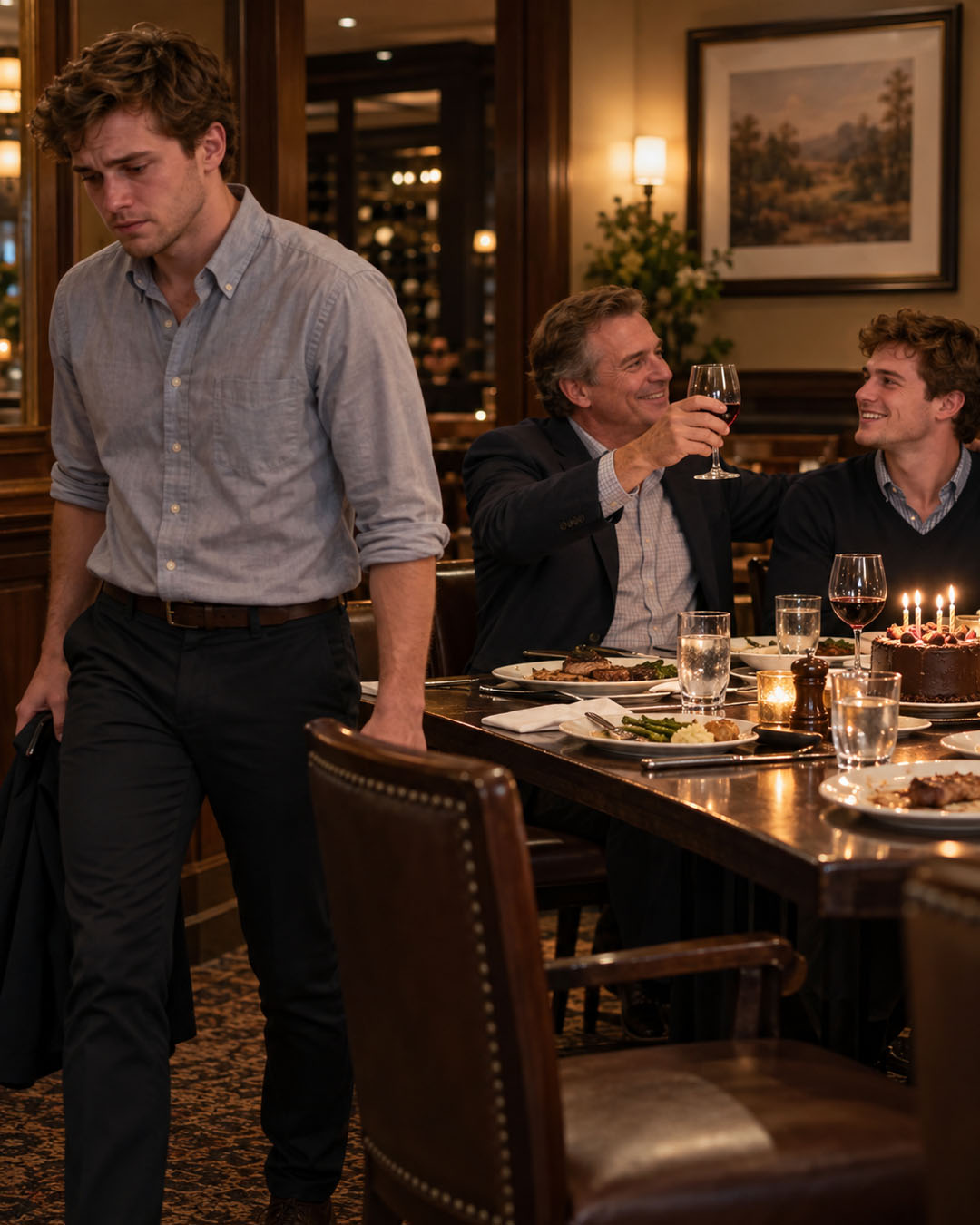
Our parents insisted on throwing us a joint birthday dinner. Twenty-five was a milestone, they said, and both their sons deserved to be celebrated. They booked a private room at a steakhouse, invited thirty relatives and friends, and ordered a cake bearing both our names.
Leah and I drove to Knoxville the night before. My parents’ guest room had been converted into what Mom called a memory room, a space filled with Connor’s trophies, jerseys, framed newspaper clippings, and even his old homecoming sash. There was barely room to set down a suitcase.
Leah noticed the display and squeezed my hand without saying anything.
The dinner itself began pleasantly enough. Connor arrived with Paige and spent the first half hour greeting guests. I hugged my mother, shook Dad’s hand, and caught up with my aunt and a couple of cousins. For a while, I convinced myself that perhaps this evening would be different.
Then Dad stood to give his toast.
He spoke about Connor’s birth, his first steps, his first words, and his first touchdown. He told a story about Connor standing up to a playground bully when he was seven, describing it as the moment he’d known his son would become someone special. He praised Connor’s athletic career, his personality, his new job, and the future he believed awaited him.
He even praised Paige, saying he was proud Connor had found such a wonderful woman.
People listened with shining eyes. Mom cried, Paige pressed a hand to her chest, and Connor looked down at his plate with the modest smile of someone accustomed to being admired.
I sat three chairs away, waiting for Dad to mention something about me.
He didn’t.
After nearly ten minutes, he paused, raised his glass, and delivered those seven words. Then he sat down, leaving me to wonder whether he had ever really wanted to know the son sitting beside his favorite child.
That night, Leah asked me a question I couldn’t answer.
“What if they never see you the way you deserve to be seen? What would you do then?”
For the first time, I considered that my life might not improve by trying harder to earn their attention. Maybe the problem wasn’t that I hadn’t accomplished enough. Maybe I’d spent too many years measuring my worth with a ruler my parents had never intended to use fairly.
In early March, I began seeing a therapist named Dr. Reeves. He was an older man with a calm voice and a way of listening that made me feel I could say anything without being judged. During our first session, I told him about the birthday dinner and the long history behind it.
He listened, then asked, “How long have you been performing okayness for other people?”
I laughed because the phrase was so accurate it almost hurt.
He helped me understand that I’d turned my parents’ neglect into a personal failing. I’d convinced myself that wanting recognition made me needy, that asking for attention made me weak, and that being the bigger person meant never admitting how much I’d been hurt.
“You can love people from a distance,” he told me. “You can wish them well without continually putting yourself in situations that leave you feeling worthless.”
I wrote that down and kept it in my wallet.
I stopped calling my parents first. I stopped arranging every family conversation and stopped feeling obligated to answer every text immediately. It wasn’t punishment. I still loved them, but I was learning that love didn’t require me to volunteer for disappointment.
And while I was doing that emotional work, something unexpected began happening in my business.
Chapter 3
Around the time of my birthday dinner, an interior designer named Claire contacted me after seeing my work in a local design magazine. She was working on a high-end residential project near Charlotte and wanted me to build a complete dining set: a hardwood table, eight chairs, and a matching buffet. The budget was eighteen thousand dollars, more than I’d ever been offered for a single commission.
I nearly turned it down. I’d spent so many years wondering whether my work was good enough that success sometimes felt like a mistake waiting to be exposed. Leah stood beside me while I drafted the acceptance email, reminding me that Claire had contacted me because she liked what I made.
For three months, I worked long days in my shop, selecting lumber, refining the designs, and making sure every joint was as strong as it was beautiful. When I delivered the finished pieces, Claire’s client became emotional. She told me it was the most beautiful furniture she’d ever owned.
Claire photographed the set and shared the images with her professional network. Within weeks, new inquiries began arriving. She referred me to three more designers, a boutique hotel commissioned furniture for twelve rooms, and a restaurant owner hired me to build a long live-edge bar top.
I brought in my former classmate Bryce to help with production, then hired a talented young craftswoman named Jade. By summer, I had incorporated the business as Dustin Cole Woodworks, rented a proper commercial workshop, and built a website with Leah’s help.
For the first time, I was making a living from something I’d created with my own hands. My work was no longer a hobby that required defending at family dinners. It was a business with employees, customers, deadlines, and a future.
Leah and I got engaged that July. I proposed on the porch of our rental house with a walnut ring box I’d made myself, inlaid with a tiny outline of the Blue Ridge Mountains beyond our yard. She said yes before I finished asking the question.
I didn’t call my parents immediately. In fact, it took two weeks for me to mention the engagement to Mom during a brief phone conversation. Her response was warm enough, but within seconds she was telling me Connor and Paige were thinking about having children.
I listened, said I was happy for them, and changed the subject.
That Thanksgiving, Leah and I stayed in Asheville and hosted dinner for friends. Bryce came, Jade brought her boyfriend, and Leah’s sister flew in from Portland. We cooked too much food, played board games, and laughed until our stomachs hurt.
It was the happiest Thanksgiving I could remember.
Mom sent several messages expressing disappointment that I hadn’t come home. She said Dad was upset and Connor had asked about me. I answered politely that we’d made other plans and hoped to visit around Christmas.
At Christmas, I agreed to come to Knoxville for the day but booked a hotel so Leah and I wouldn’t have to stay all weekend. Connor received another extravagant celebration, complete with gifts, stories, and lengthy discussions about his future. I sat beside Leah, no longer pretending the imbalance didn’t bother me, and left by two in the afternoon.
In the car, she looked at me and said, “You’re not the same person you were a year ago.”
She was right. I’d stopped begging for scraps of attention from people who rarely reached out unless they wanted something. I’d started building a life around the people who showed up, listened, and cared about what mattered to me.
Then, in April, Connor lost his job.
His sports marketing firm went through a round of layoffs, and he called me sounding confused and shaken. He’d always believed that working hard and doing everything expected of him would keep life moving in the right direction. Losing his job challenged that assumption.
I felt sorry for him. Whatever resentment I carried about our childhood, I didn’t want my brother to suffer. I listened, asked whether he and Paige were managing financially, and told him he could call if he needed to talk.
A couple of days later, Dad called me.
“Dustin,” he said, “your brother is having a rough time. I wondered if you might have some work for him while he figures out his next move.”
I sat at my desk, staring at the unfinished plans spread across it.
“Dad, what do you know about my business?”
There was a pause. “You build furniture, right? Tables and stuff?”
Tables and stuff.
By then, I’d been featured in a regional design publication, interviewed on a podcast about American craftspeople, and signed contracts with designers and hotels in several states. I had five employees and a growing waiting list. My work was supporting not only my future but the livelihoods of the people who depended on my shop.
Yet my father still thought I made tables and stuff.
I explained that the business required specialized woodworking experience and that Connor would probably be better off looking for another job in his field. Dad went quiet before saying, “I just thought family helps family.”
I nearly laughed at the irony. For years, I’d asked for nothing more than a little interest in my life, and now that I had built something valuable, I was suddenly expected to make it available whenever Connor needed help.
Still, I didn’t slam the door on them. I told Dad that if he and Mom wanted to visit Asheville, they were welcome to come for a Saturday. I’d show them our house and the workshop, and we could have dinner if everyone was comfortable.
Mom sounded relieved when I agreed.
They arrived in late May, almost a year after my birthday dinner. Connor and Paige came along, too, which I hadn’t expected but accepted without complaint. At our house, Mom complimented the furniture I’d made in the same detached tone she’d once used for my school projects, while Connor moved from room to room asking how I’d built everything.
“This is yours?” he asked, running his hand over the dining table. “You made all of this?”
“Yes,” I said. “Every piece.”
For once, my brother seemed genuinely impressed by something that had nothing to do with sports or status. He asked about the tools I used and how long the projects took, and I found myself enjoying the conversation rather than waiting for him to turn it back toward himself.
At the workshop, I introduced everyone to Bryce and Jade and showed them the lumber storage, the finishing room, the design wall, and the pieces currently in production. Framed photographs of completed projects hung beside magazine features and customer letters.
Dad walked slowly through the space, taking it all in. I saw him pause before a nearly finished dining table, tracing the edge with his eyes as if he were seeing my work for the first time.
“This is a real operation you’ve got here,” he said.
It wasn’t much of a compliment, but it was more acknowledgment than I’d received in twenty-five years.
That evening, Leah and I took everyone to our favorite restaurant in downtown Asheville. The conversation was pleasant until dessert, when Mom began discussing Connor’s job search.
“Dustin,” she said, “are you sure there isn’t something Connor could do at your little shop? Even part-time? It would mean so much to your father and me.”
I set down my fork.
There it was again. The assumption that my life’s work was small, that my success mattered less than Connor’s difficulties, and that my responsibility was to make things easier for the child they’d always favored.
“Mom,” I said, “before we talk about giving Connor a job, I’d like to ask you something.”
She looked up.
“Do you know what my company earned last year?”
Nobody answered.
I told them about the contracts, the employees, the hotel projects, and the business I’d spent years building. I explained that it wasn’t a little shop and that I was proud of what we’d accomplished.
Then I turned toward Dad.
“Do you remember my twenty-fifth birthday dinner?”
His expression changed. Mom stopped moving her fork, and Connor looked from me to our father.
“You stood up in front of thirty people and talked about Connor for ten minutes. You told everyone about his childhood, his football career, his job, and his future. Then you raised your glass and gave me seven words before sitting down.”
Dad lowered his eyes.
“Seven words,” I continued. “I counted them. And you know what hurt the most? It wasn’t that you praised Connor. He deserved to be celebrated. It was that you couldn’t find anything to say about me.”
Mom started to speak, but I raised my hand gently.
“I want to finish. Dad, you missed my woodworking showcase. You forgot my state competition because Connor had a scrimmage. You’ve never visited my workshop until today, and even when I tried to tell you about my business, you changed the subject. Mom, you’ve introduced me to your friends as Connor’s brother, as if I didn’t have an identity of my own.”
The table fell silent.
“Do you understand what that does to a person over twenty-five years? I kept telling myself I was mature enough not to care, but I did care. I wanted my parents to be proud of me. I wanted them to ask questions and remember what mattered to me. I wanted to feel like I belonged in my own family.”
My mother’s eyes filled with tears. Dad stared at the table, and for a moment, I thought he might retreat into silence as he always had.
Then Connor spoke.
“He’s right.”
Everyone turned toward him.
Chapter 4
Connor placed both hands on the table and took a slow breath. For once, he wasn’t smiling or trying to make the room comfortable. He looked directly at our parents and spoke with a seriousness I rarely heard from him.
“Mom, Dad, he’s right. I’ve seen this for years. Every dinner, every holiday, every conversation seems to end up being about me. I liked the attention, and I let it happen because it felt good. I should have said something a long time ago.”
Paige reached for his hand, and he squeezed hers without taking his eyes off our parents.
Mom began crying. She said she hadn’t realized how bad things had become, although I struggled to believe she’d never noticed the difference in how she treated us. There is a difference, I was learning, between not recognizing the harm you’ve caused and refusing to look closely enough to understand it.
Dad remained quiet for so long that I wondered whether he’d say anything at all.
Finally, he cleared his throat.
“I didn’t know how to be proud of something I didn’t understand.”
He looked up at me, his eyes tired.
“Connor did things I knew how to celebrate. Sports, competition, the things I grew up with. You worked with wood and made furniture, and I didn’t understand the artistry in it. I didn’t know what to say, so I said nothing. Somewhere along the way, not knowing how to talk about your work became not paying attention to you at all.”
He paused, swallowing hard.
“That doesn’t excuse it. You deserved a father who tried harder, and I didn’t try. I let you believe that what mattered to you wasn’t worth my time, and I’m sorry, son.”
I had imagined hearing those words for years. I’d imagined Dad visiting my shop, praising my work, and telling me he was proud of the person I’d become. Yet when he finally admitted what he’d done, I didn’t feel the instant relief I’d expected.
Twenty-five years of being overlooked couldn’t be repaired by one apology, no matter how sincere. But it mattered that he had acknowledged the truth without blaming me for being too sensitive or insisting that I’d misunderstood his intentions.
Mom apologized through tears, too. She admitted that she’d relied on me to be the easy child, the one who didn’t complain, because she assumed I didn’t need as much attention as Connor. She hadn’t understood that my silence wasn’t proof I was fine. It was what I’d learned to do when asking for more never seemed to change anything.
“I should have paid attention,” she said. “I’m sorry I didn’t.”
I nodded. “I appreciate you saying that. But I need you to understand that things can’t go back to the way they were. I can’t keep pretending it doesn’t hurt and then showing up as if nothing happened.”
Nobody argued.
The next morning, Connor joined me on our porch before our parents drove back to Knoxville. We sat with our coffee and watched the morning sun settle over the mountains. For the first time in years, there was no family gathering to organize and no audience waiting to hear about his achievements.
“I owe you more than an apology,” he said. “I owe you years of being a better brother.”
“I’m not asking you to pay me back,” I told him. “I’m asking you to change.”
He nodded slowly. “Then that’s what I’ll do.”
Over the next six months, things began to change, though not in a dramatic, overnight way. Dad started calling every couple of weeks. His calls were short at first, but he began asking what I was building and how the business was doing. One afternoon, he asked me to explain dovetail joints, and I spent twenty minutes describing the process while he listened and occasionally said, “Well, I’ll be.”
A few weeks later, he texted me a photograph of a finished table I’d posted online.
“That’s beautiful work, son.”
Four words, but they were the right four words.
Mom began making a more deliberate effort, too. She sent Leah a birthday card with a handwritten note thanking her for loving me the way I deserved to be loved. Leah cried when she read it, and I had to look away for a moment because I knew how much those words meant to both of us.
Connor found another job with a sports media company in Atlanta. He and Paige moved there, and he started calling me separately from family conversations. Sometimes we’d talk about business or the weather, and sometimes we’d talk about nothing important at all. The difference was that he asked questions and waited for my answers.
He visited my workshop on his own one afternoon and spent several hours watching Bryce and Jade work. Before he left, he stood beside the dining table I’d been finishing and said, “I’m proud of you, man. I should have told you that years ago.”
I believed he meant it.
Meanwhile, Dustin Cole Woodworks continued to grow. We signed a six-figure contract to furnish the lobby and restaurant of a resort in the Smoky Mountains, and I began planning how to expand the business without sacrificing the quality that had brought us this far. Bryce and Jade had become trusted leaders, and the younger apprentices were learning to take pride in work that would outlast them.
Leah and I bought our house in March. It was a three-bedroom Craftsman with a wraparound porch, a small yard, and a view of the Blue Ridge Mountains. It wasn’t extravagant, but every room held something we’d chosen together, and much of the furniture had passed through my own hands.
We planned to get married in October on that porch, surrounded by the people who had shown up for us. I didn’t need a grand celebration or a speech that lasted ten minutes. I wanted a day filled with people who knew us, loved us, and understood why the life we were building mattered.
I also continued seeing Dr. Reeves. He reminded me that healing wasn’t a straight line, and that an apology didn’t require me to erase the past or pretend I was no longer affected by it. Some days, a familiar comment or a family photograph brought back the old ache of being the overlooked twin.
When that happened, I tried to remember that the child who had waited for his father’s approval wasn’t foolish for wanting it. He had simply been a child who loved his parents and wanted to be loved in return.
I still love my family. I no longer measure that love by how much disappointment I can endure.
Dad’s birthday toast remains a painful memory, but it no longer defines the way I see myself. He gave Connor ten minutes of praise and gave me seven words, yet those seven words eventually forced me to confront a truth I’d spent years avoiding: I couldn’t make other people recognize my worth by working harder, achieving more, or asking more quietly.
I could only decide what I would do with the life I had.
On the day Leah and I married, Dad stood beside the porch with the other guests, looking at the furniture I’d built and the people who had gathered to celebrate us. Before the ceremony began, he approached me and adjusted the collar of my suit.
“You’ve built something good here,” he said. “I’m proud of you, Dustin. Not just the business. The man you’ve become.”
I looked at him for a long moment. Part of me wanted to return to that birthday dinner and give the younger version of myself those words before he had to wait twenty-five years to hear them. But I couldn’t change what had happened, and I didn’t need to pretend it hadn’t hurt.
“Thank you, Dad,” I said.
It wasn’t a declaration that everything was fixed. It was simply the beginning of a different conversation, one in which I could accept his effort without surrendering the boundaries I’d worked so hard to establish.
After the wedding, Leah and I stood on the porch as our guests gathered in the yard. The mountains stretched beyond the trees, and the warm evening light settled across the tables and chairs I’d made with my own hands. I watched our friends laughing together and realized that, for the first time, I wasn’t wondering whether I belonged in the room.
I already knew I did.
My father had given my twin brother ten minutes and given me seven words. For years, I’d believed those seven words told me how little I mattered. Now I understand they revealed how little my father had learned to see beyond his own expectations.
His failure to recognize my worth was never proof that I lacked it.
I had built a business, found a woman who loved me, bought a home, and created a life I was proud of. None of those things became meaningful because my father finally noticed them. They had been meaningful all along.
And if you’re the quiet child in your family, the sibling who gets overlooked, or the person who keeps showing up hoping this time someone will finally see you, I hope you’ll remember something I wish I’d understood sooner.
You don’t have to become louder, richer, more successful, or more impressive to deserve love. You don’t have to keep sitting at a table where your presence is treated as an afterthought, waiting for somebody else to decide you’re worth celebrating.
Sometimes the hardest thing you’ll ever do is stop asking for a place at that table and start building one of your own.
I spent twenty-five years trying to earn my father’s attention. It took one painful birthday dinner to teach me that I could stop waiting and begin living.
My name is Dustin Cole. I build furniture for a living, and I’m finally learning to build a life without measuring my worth by who notices me.
The best thing I’ve ever built isn’t a table, a business, or even a home.
It’s a life that belongs to me.
THE END. ⚠️ All characters and events are fictional. Do not imitate or apply them in real life. 😌😌😌


