
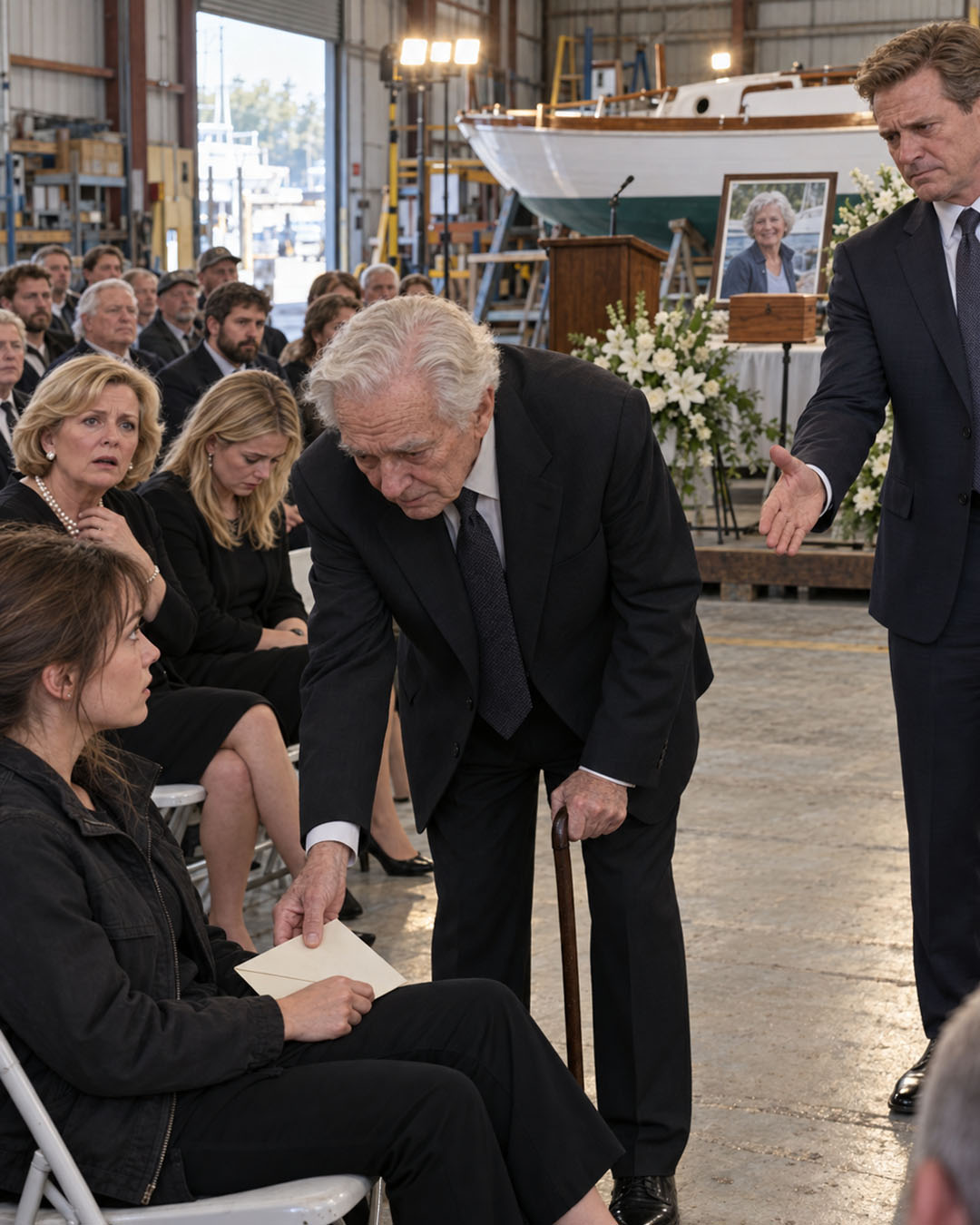
Chapter 2
That afternoon, I went back to Sykes Boat Works.
My badge still worked, and I intended to leave my department clean. Whatever my father thought of me, the next production manager wasn’t going to inherit missing safety files or unfinished inspections.
Saturdays were quiet. Half a crew was working overtime, music drifted from the gel-coat booth, and somebody’s dog was sleeping beneath the forklift chargers.
In my office, I opened the visitor log.
One entry caught my attention.
Three visitors had toured the yard a month earlier under the company name Coastal Risk Partners. They claimed they were conducting an insurance inspection, but they hadn’t inspected much.
They measured loading docks.
They asked how quickly our largest molds could be removed.
They asked which workers were most productive.
I had stapled their business cards to the log.
Because reading dense print takes me longer, I photographed the cards and used the text-to-speech app on my phone.
One email address ended with a different domain.
Harborline Marine Group.
I searched the name.
Harborline acquired family-owned boat manufacturers and consolidated production in Florida.
Consolidated.
That word sat like a stone in my stomach.
Below my office window, Otis Dupree, who had worked at Sykes for more than 30 years, walked between the molds carrying his coffee.
If Harborline bought us and moved production, hundreds of people like Otis would lose their jobs.
Then Juliet walked into my office carrying two coffees.
She handed me mine exactly the way I liked it.
“I wanted to see you without Dad.”
“Okay.”
She sat.
“It’s not personal, Gabby. Somebody has to handle the lenders and contracts now. The company’s bigger than Grandma ever imagined.”
“And I can’t?”
She hesitated.
“You know how much paperwork comes through the front office.”
I turned the visitor log toward her.
“Who’s Harborline?”
Juliet answered too quickly.
“A supplier.”
“A supplier of what?”
She stood.
“Don’t do this.”
“Do what?”
“Make Monday harder.”
“For who?”
She left without answering.
At 2:10, my badge stopped working.
Security escorted me upstairs to collect my jacket and phone charger.
Then Dad’s voice crackled over the supervisor radio.
“Lonnie, make sure she doesn’t take anything she can’t read.”
A small laugh followed.
Every supervisor on the production floor heard it.
Lonnie switched off the radio.
“Take whatever belongs to you,” he said quietly. “I didn’t see anything.”
Down on the floor, Otis was staring up at my office.
Nobody laughed.
That afternoon, I picked up my 8-year-old niece, Maddie.
We sat on the dock behind my apartment with a children’s mystery novel. Maddie had her own blue overlay cut from the same kind of plastic I used.
She read slowly.
Painfully slowly.
And courageously.
Halfway through a page, she stopped.
“Aunt Gabby?”
“What?”
“Mom says Grandpa can’t see my blue thing.”
I looked at her.
“Why?”
“She says he doesn’t like kids who read slow.”
Something cold passed through me.
That night, we had dinner at my parents’ house.
Dad had invited a board member named Boyd Lacader. Mom used Grandma’s china.
Before dinner ended, Dad asked Maddie to read a printed blessing.
The card used a looping decorative font.
Maddie struggled with the first line.
“Go ahead,” Dad urged.
She reached into her dress pocket and pulled out her blue overlay.
Dad froze.
“What’s that?”
“It helps.”
He took it from her.
Then he looked at Juliet.
“Tell me you didn’t make another one.”
Maddie ran outside.
I followed her.
Later, when I returned for her sweater, I saw Dad alone in the kitchen.
He was holding the blue plastic beneath the light.
His hand was trembling.
Then he dropped it into the trash.
I waited until he left and retrieved it.
When I returned to the porch, Maddie was curled on the swing.
“He took it.”
“I got it back.”
“I don’t want it anymore.”
“Why?”
Her voice was tiny.
“I don’t want to be another one.”
I put my arm around her.
That sentence stayed with me.
Before I left, Dad summoned me to his study.
Two documents waited on his desk.
The first said I was voluntarily resigning.
“If you sign,” he said, “you get $25,000 and a good reference.”
“I’m not resigning.”
“You were fired anyway.”
The second thing he wanted was Grandma’s old company key ring.
I handed it over.
A brass tag stamped WS1979 hung from it.
Dad closed his fingers around the keys and relaxed.
“One more thing,” I said. “Let me say goodbye to my crew Monday at shift change.”
He laughed.
“Five minutes. Parking lot.”
Then he looked directly at me.
“You think people aren’t laughing when you struggle with words? They are. They always will.”
I stared at him.
“The letters jump around on you,” he continued. “I know what that feels like.”
My breath caught.
I had never used those words with him.
Not once.
Before I could ask how he knew, his phone rang.
Mom was calling because the estate company had canceled Monday’s cleanout.
Cyrus, as trustee, had forbidden anyone from touching Grandma’s property.
Dad smiled after hanging up.
“Doesn’t matter. The old trust makes me successor. Monday, Cyrus hands me Mom’s shares.”
That night I returned to Grandma’s letter.
One sentence seemed to wait for me on the page.
He will believe the company is already his.
Chapter 3
Sunday morning, three longtime employees came to help pack my office.
They carried boxes in their church clothes.
Otis loaded my photographs.
Neva from canvas carried my boots.
Darnell from rigging carried a box of manuals.
Nobody mentioned Dad’s radio joke.
When we finished, Darnell said, “Six o’clock tomorrow.”
I hadn’t told him about my goodbye.
Apparently somebody had.
As they left, Dad arrived with a stranger wearing expensive loafers.
“Gabby,” Dad called cheerfully. “Meet Quentyn Roarke. Friend of the family.”
I recognized the name from Harborline.
Quentyn shook my hand.
“Oh,” he said. “You’re the daughter with the reading issue.”
Dad laughed.
I didn’t.
They walked toward our largest molds.
Dad pointed at the overhead hoists, then toward the south loading dock.
Otis watched them too.
At home, Juliet appeared an hour later.
She saw Maddie’s stained overlay on my kitchen counter.
“You took it out of the trash.”
“Somebody had to.”
She touched the edge.
“Maddie’s being tested. The school thinks she has dyslexia.”
“I figured.”
“I haven’t told Dad.”
“I know.”
Her voice cracked.
“You have no idea what it’s like being the one he’s proud of, Gabby.”
I waited.
“You can never stop performing. Not for a day.”
Then I asked, “The Harborline proposal. Did Dad read it himself?”
“Of course not. I read everything to him. His eyes are—”
She stopped.
The room changed.
“His eyes are what, Juliet?”
She left without answering.
That afternoon, I visited Ramon Castillo, our chief financial officer.
I showed him the visitor cards, Harborline’s domain, and photographs of Dad touring the yard with Quentyn.
“Has the board seen an offer from them?”
Ramon frowned.
“In March, Terrence said they made an informal inquiry and withdrew it.”
“That’s all?”
“That’s all.”
“If he were negotiating now?”
“I’m the CFO. I should know.”
He looked at my phone again.
“Go home, Gabby.”
That evening, I met Cyrus.
He had prepared a notice calling the board together Monday at 4:00, three hours before Dad’s meeting.
The meeting was being called by the trustee of Grandma’s trust.
At the direction of the trust’s beneficiary.
I signed beside Cyrus.
“Second question,” I said. “Can I call the board myself?”
His eyes softened.
“That,” he said, “is the question your grandmother hoped you’d ask.”
The notice went out at 6:00.
Fourteen minutes later, Dad texted me.
Cyrus finally came around. He’s handing over Mom’s shares Monday. Don’t bother coming. You’d need someone to read the minutes.
At 9:07, Ramon called.
“I found something.”
“What?”
“I can’t legally tell you. You aren’t an officer anymore.”
My heart sank.
“But I can give it to Kathleen Booker, the corporate secretary.”
He paused.
“Your grandmother would have called law enforcement already.”
Monday morning, I arrived outside the boatyard just before 6.
I no longer had a badge.
There were nearly 300 people waiting.
Night crew.
Day crew.
Canvas workers.
Welders.
Riggers.
Employees who weren’t even scheduled.
When I stepped through the side gate, somebody started clapping.
Then everybody did.
I had planned a speech.
I forgot every word.
“Thank you,” I managed. “And wear your respirators.”
People laughed.
Upstairs, Dad stood behind his office window watching.
At 8:30, Juliet climbed into my truck in a grocery-store parking lot.
She looked sick.
“The board agenda came out.”
I waited.
“Harborline’s letter of intent is on it.”
Then she unfolded a paper.
It was an integration plan.
Next to her name were the words Interim CEO — 6 months.
After that, a Harborline executive would take over.
“Dad told me five years,” Juliet whispered. “He said they wanted me to lead the company for five years.”
Dad’s initials appeared at the bottom.
“I read every document to him,” she said. “Every one.”
“Only the ones he gave you.”
She closed her eyes.
“I’m not going to stop you today.”
At 11, Mom came to my apartment.
“The bank called,” she said. “Your father’s loan on the mountain property is coming due. If this deal falls apart, we could lose everything.”
“Whose name is the lake house in?”
She blinked.
“Mine.”
I wrote down the name of an independent attorney.
“Call her before you sign anything Dad gives you.”
Mom stared at the paper.
“That’s all you’ll do?”
“That’s what I can do.”
She took it.
At noon, Dad called.
His voice was gentle again.
“Come back as a floor supervisor. Same salary. No executive paperwork.”
“What do you want?”
“The envelope Winona gave you.”
“No.”
The warmth vanished.
“If Cyrus tries anything this afternoon, I’ll tell this whole town you manipulated an old woman for money.”
“See you at 4, Dad.”
I hung up.
At 2:00, I drove to the old wooden shed where Grandma built her first boat.
I read the final page of her letter.
Don’t let them make you something because of me, Gabby. If they make you something, let it be because they saw what I saw.
You walk onto that floor and hear a bad hull before anyone else sees it. You know people’s names. You know who needs overtime and who needs to get home to a sick husband.
That was never the small thing.
That was always the whole thing.
When I lowered the page, Cyrus’s old Buick was parked behind my truck.
He handed me another sealed envelope.
This one said:
TERRY.
“For your father,” Cyrus said. “Only if he loses.”
“What’s inside?”
“I’ve never opened it.”
He drove away.
The board meeting was at 4.
Grandma’s 72 hours were almost gone.
Chapter 4
Dad sat at the head of Cyrus’s conference table when I entered.
My old key ring lay in front of Juliet.
The brass WS1979 tag faced upward.
Dad smiled.
“Well, look who came.”
I sat at the opposite end.
“All right,” he said. “I call this meeting—”
“You didn’t call it,” Kathleen Booker interrupted.
Cyrus opened his briefcase.
“The trustee called it at the direction of the beneficiary.”
Dad looked amused.
“Then let’s hear it.”
I stood.
“I call the meeting to order.”
The smile disappeared from his face.
Cyrus opened a thick document.
“This is the restated Winona Sykes Trust, signed May 2, 2024, after an independent cognitive evaluation found Mrs. Sykes fully competent.”
He turned a page.
“Article Four. Mrs. Sykes’s 51% controlling interest in Sykes Boat Works passes to Gabrielle Sykes on one condition.”
Nobody moved.
“Within 72 hours of the moment my office places the designated letter in her hands at my memorial, Gabrielle must personally call the board of directors to order and present this trust.”
Cyrus looked at the clock.
“The letter was delivered Friday evening. The condition has been satisfied.”
Mom whispered, “No.”
Dad stared down the table at me.
Then he said the same thing he had said in front of 350 mourners.
“She can’t even read it.”
I took my blue overlay from my pocket.
I laid it across the trust.
Then I read the first paragraph aloud.
Slowly.
I stumbled once.
Started the word again.
Nobody laughed.
When I finished, I sat down.
“Before anything else,” I said, “I have a question for the corporate secretary.”
I slid a photograph of my termination letter toward Kathleen.
“Did this board vote to fire me?”
She examined the signature.
“No. The board has not met since August.”
Otis leaned forward.
Dad tried to explain.
Then Neva held up the resolution Dad had emailed that morning asking the board to “ratify” all personnel decisions he had already made.
“You’re asking us to approve it afterward,” she said. “Because we never approved it before.”
Cyrus placed Grandma’s recorder on the table.
He played 40 seconds.
Mom’s voice: “It’s for your own good.”
Dad’s voice: “Eventually you’ll sign.”
Grandma’s voice, clear and sharp: “Dr. Fenwick has never examined me.”
Cyrus stopped the recording.
Then Ramon opened his folder.
Harborline had originally offered $96 million for Sykes Boat Works.
Dad told the board the offer had disappeared.
It had not.
He secretly signed a new letter of intent for $84 million.
Twelve million dollars less.
Attached was a private consulting agreement paying Dad $3 million over two years.
Three hundred thousand had already reached his personal account.
The employee retirement plan owned 23% of the company.
That lower sale price would have cost our workers nearly $2.8 million in value.
Then Ramon delivered the final blow.
“Harborline intends to move production to Florida next year.”
The room went silent.
Otis looked down at his hands.
Dad stood.
“This company was failing. Somebody had to make the hard decision.”
“No,” Ellis Hennessy said. “Somebody made a profitable decision. For himself.”
Juliet had gone white.
Every document she had read aloud to Dad had been curated.
Every promise about her becoming CEO had been temporary.
She had spent her life believing she was Dad’s chosen child.
She had been useful to him for the same reason I had been embarrassing.
I stood.
“When the transfer is complete, I control 51% of the company. I could replace this board tomorrow.”
Dad stared at me.
“I’m not going to.”
I looked at the directors Grandma had assembled over decades.
“She built this board so the people who work at Sykes would have a voice.”
Then I asked, “Does this board still have confidence in Terrence Sykes as chairman?”
Ellis made the motion.
Another director seconded.
Kathleen called the roll.
“No confidence.”
“No confidence.”
“No confidence.”
Seven votes against Dad.
Four for him.
Juliet voted with him.
I watched her do it.
So did she.
Under Grandma’s original bylaws, a chairman who lost the confidence of the board was required to resign.
Dad shot to his feet.
“I’m not resigning to a dyslexic and a dead woman’s tape recorder.”
Cyrus barely reacted.
“You’re free to challenge the bylaws.”
Kathleen printed a resignation letter.
Dad carried it into the lobby.
When I followed, he stood beside the window holding the page too close to his face.
Then too far away.
He tilted it.
Moved it beneath the light.
His reading glasses remained uselessly pushed onto his forehead.
I knew that posture.
I had lived inside it.
Maddie saw it too.
She walked toward him.
Then she reached up and placed her blue overlay across his resignation letter.
“Do the letters jump for you too, Grandpa?”
Dad froze.
“This helps,” she said. “You have to keep it still.”
Juliet appeared behind me.
“I’ve read for him for 21 years.”
Her voice cracked.
“Since I was 12.”
She looked at Dad.
“Your eyes weren’t tired.”
Mom stood behind Juliet with one hand against the wall.
Her face told me what I needed to know.
She had always known.
I took Grandma’s second envelope from my jacket.
“Grandma left this for you, Dad. Cyrus said you only get it if you lose.”
Dad accepted it.
Then he held it toward Juliet.
She shook her head.
“No.”
His hand stayed extended.
The same hand Cyrus had walked past at the memorial.
Finally, Dad turned toward me.
I opened the letter.
Placed my overlay across the page.
And read.
“Terry, when you were 10, your father burned your reading books and called you stupid in front of the men behind the fish house.”
Dad’s face changed.
“I said nothing because I was afraid of him. I have regretted that for nearly 50 years.”
Nobody moved.
“When Gabby came along and the letters moved for her the way they moved for you, you did to her exactly what your father did to you.”
Dad sat down.
“I promised myself I would not stand by twice.”
I swallowed.
“I am not leaving her the company because she is my favorite. I am leaving it to her because she is not ashamed of the thing you have spent your entire life hiding.”
Then the final sentence.
“You can stop hiding now, son. It is too late for me to be proud of what you did to the company. It is not too late for the rest.”
Below that, in Grandma’s handwriting, were three words I did not read aloud.
I love you.
I folded the letter.
Maddie pointed to the overlay on Dad’s knee.
“You can keep mine, Grandpa.”
Then she took my hand.
“I’ve got Aunt Gabby.”
Dad stared at the blue plastic.
Eventually, he laid it across the resignation letter.
He began reading aloud.
Slowly.
Painfully.
“I, Terrence Sykes… resign… as chairman…”
Nobody hurried him.
Nobody laughed.
When he finished, he signed his name.
Chapter 5
The board accepted Dad’s resignation.
Ramon became interim CEO.
Harborline’s deal was rejected.
Outside counsel was hired to recover the $300,000 already paid to Dad.
Then Otis moved to void my termination because the board had never authorized it.
The motion passed unanimously.
Juliet’s hand went up last.
Afterward, she asked the board to remove her name from consideration for CEO.
At 7:40 p.m., exactly 72 hours after Cyrus had placed Grandma’s envelope in my lap, I signed the stock transfer.
“One last question,” I told him.
“Your third.”
“Did Grandma know Dad would lose?”
Cyrus looked toward the dark window.
“She thought he might finally read something for himself.”
Outside, Main Street was lined with pickup trucks.
Workers stood beneath the streetlights.
Nobody had organized it.
Nobody needed to.
Otis climbed the steps and handed me Grandma’s key ring.
“She talked to me last year,” he said. “Told me when she was gone, you’d need somebody who saw you before they saw the paperwork.”
He closed my fingers around the brass tag.
“We saw you, Gabby.”
Juliet came outside holding Maddie’s hand.
“I’m sorry,” she said. “I should’ve stood up for you Saturday night.”
“Yes.”
She blinked.
“You should have.”
I wasn’t going to make forgiveness cheap just because we were sisters.
She nodded.
Five months passed.
The bank eventually took Dad’s company shares because he had pledged them against a private loan. Under Grandma’s bylaws, the employee stock plan had the right to buy those shares before any outsider could.
So the people Dad had nearly sold out—the welders, laminators, upholsterers, riggers, and mechanics—became owners of another large piece of Sykes Boat Works.
The outside attorneys recovered the $300,000.
Dad moved into a rented condo in Greenville.
Mom finally called the independent lawyer whose number I had given her. The lake house belonged to her, and she sold it before Dad’s debts could swallow it.
She works part-time now at a furniture store.
I’m told she’s good with customers.
Juliet went back into banking.
She calls me on Sundays.
Not every Sunday.
That’s all right.
Some bridges should be rebuilt carefully enough that you know which boards are holding your weight.
Maddie was formally diagnosed with dyslexia.
Twice a week, she sees a reading specialist.
Every Saturday, she comes to my place with a mystery book and a blue overlay.
She no longer hides it.
In February, the board voted to make me chief executive officer.
They asked me to leave the room while they voted.
Ten directors voted yes.
None voted no.
When Kathleen told me afterward, I laughed.
Grandma would have appreciated the procedure.
Then, on a cool Friday in March, we launched our first new boat under my leadership.
It was a 16-foot skiff modeled after Grandma’s original 1979 design.
Half the town came down to the river.
Maddie stood on the dock in a yellow raincoat with a christening card in both hands.
Three hundred people watched her.
She placed her blue overlay across the words.
And she read.
Slowly.
Nobody hurried her.
She reached the boat’s name.
“Winona.”
Applause rolled across the dock.
Maddie looked toward me.
“When I grow up, I’m going to build boats too.”
“You are?”
“And I’m going to read every name myself.”
Otis released the line.
The little skiff slid into the river and settled perfectly on the water.
I watched it float and thought about Dad standing in Cyrus’s lobby with a page he couldn’t read.
I thought about a frightened 10-year-old boy watching his own books burn behind a shed.
Understanding what happened to him does not excuse what he did to me.
It does not excuse humiliating his daughters, deceiving his board, risking hundreds of jobs, or using another child’s weakness to hide his own fear.
But I finally understood something Grandma had spent her life trying to teach me.
Pain can travel through a family for generations if nobody decides to put it down.
Dad inherited shame.
He turned it into cruelty.
Grandma inherited regret.
She turned it into protection.
And I inherited a company, yes.
But that wasn’t the inheritance that mattered most.
What she really left me was a different way to live.
To see the worker before the spreadsheet.
The child before the diagnosis.
The person before the label.
For most of my life, my father called Juliet the smart one and me the slow one.
Grandma never argued with him.
She simply sat beside me every Thursday, laid a piece of blue plastic across the page, and waited as long as it took.
Sometimes the person who changes your life isn’t the one who tells the world how talented you are.
Sometimes it’s the one who quietly pulls up a chair and says, “Take your time. I’m listening.”
THE END.
⚠️ All characters and events are fictional. Do not imitate or apply them in real life. 😌😌😌


