
Chapter 2
Mom looked around at my workbench, the clamps, the unfinished violins, the wall where restored instruments hung from their scrolls.
“It smells like a furniture store.”
“Hello, Mom.”
She put the cookie tin on the bench.
Then she placed the envelope neatly on top of it.
“Maple Grove updated their care plans. Since you’re backup contact, you need to sign.”
“I’ll read it.”
For half a second, something changed in her face.
Then she smiled.
“Don’t bother with all that fine print. Nobody reads those things.”
After she left, I waited until closing.
The first page carried Maple Grove’s logo.
The second described Grandma’s care needs.
The third had no logo at all.
QUITCLAIM DEED.
It transferred Grandma’s house to Gorman Home Buyers.
A yellow tab marked my signature line.
In my mother’s handwriting were four words and a tiny heart.
Sign here, honey.
I photographed every page and put everything back exactly as I had received it.
I didn’t call Mom.
I didn’t call Colton.
I sent the photographs to Joanne.
Her reply came ten minutes later.
Keep the originals exactly as they are.
On Sunday, I found Grandma packing her belongings into a pillowcase.
“They say I’m leaving on the fifteenth,” she said happily. “Are you taking me home?”
I sat beside her and removed her cardigan, hairbrush, socks, and my grandfather’s photograph from the pillowcase.
“Not today.”
She patted my knee.
“That’s all right. I’ll be ready.”
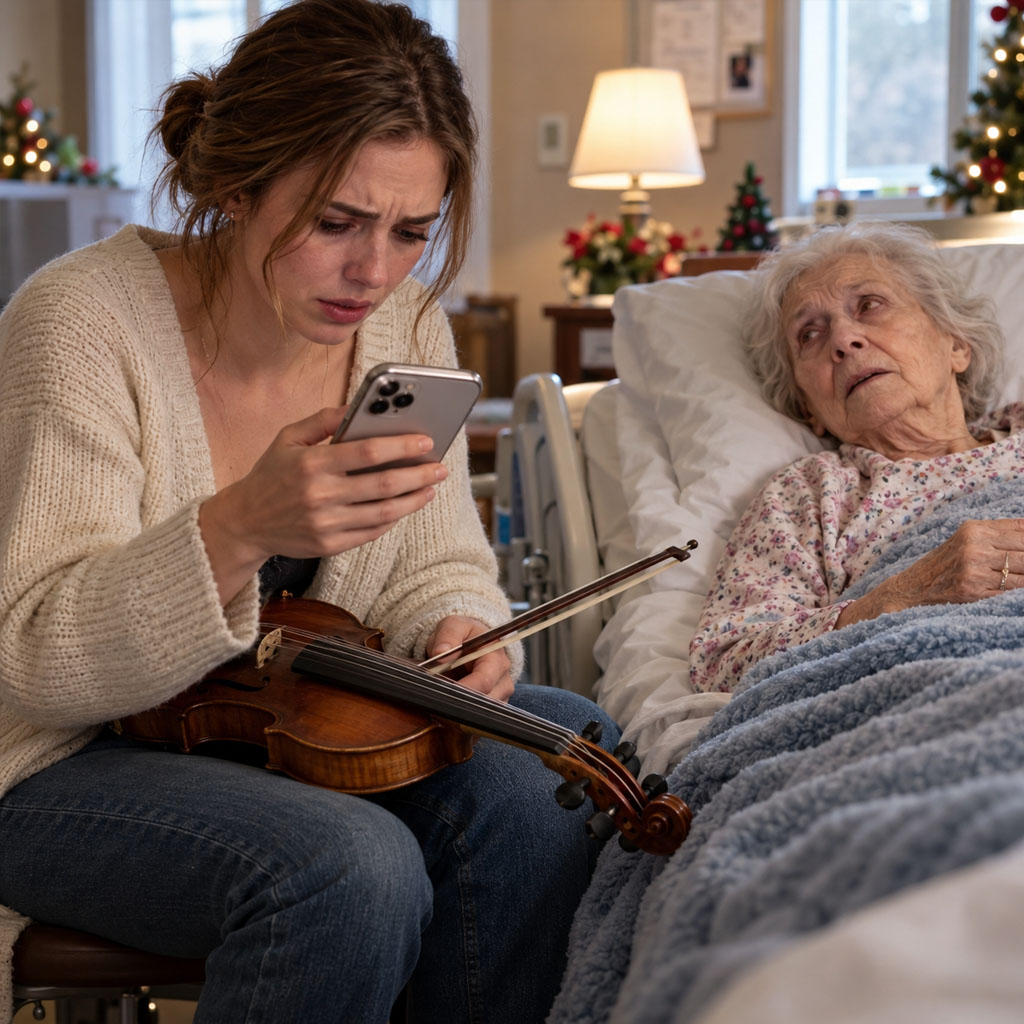
I played until she fell asleep.
Then I went to the parking lot and called Joanne.
“Make the call.”
“You’re certain?”
“Yes.”
“All right.”
Monday passed quietly.
Too quietly.
On Tuesday evening, the chat exploded.
Sharon had heard from the title company.
Because of an ownership issue, all required signers had to appear personally with photo identification. No mobile notary. Christmas Eve, ten in the morning.
The buyer would be there too.
Mom wrote:
How do we get Thea downtown?
Dad:
Tell her Maple Grove moved the signing.
Colton:
What happens when she sees the buyer?
Mom:
She’ll see a man in a suit. Once she’s sitting there with everyone watching, she’ll sign. Thea has never made a scene in her life.
I read that sentence five times.
She was right.
I never had.
The next day Mom called me.
“Small change of plans, honey. Maple Grove moved the care-plan signing downtown. Ten o’clock Christmas Eve.”
“Of course.”
Her relief was audible.
“And bring the envelope. Don’t sign ahead of time. They need to witness it.”
“I haven’t signed anything.”
“Good girl.”
That night Colton wrote in the group:
She’s so easy it’s almost sad.
Dad answered with a thumbs-up.
Ally’s typing dots appeared.
They stayed there almost a full minute.
Then vanished.
Nothing came.
A day later, Grandma’s fiddle disappeared.
An aide called me from Maple Grove.
“Your brother came by around lunch. He said the family wanted the violin appraised.”
I put down the cello top I had been holding.
“Is Grandma okay?”
“She’s upset. She keeps asking for Ed.”
I left work the moment the shop closed.
Grandma was sitting by her window wearing her winter coat indoors.
The buttons were wrong.
“A man took Ed’s fiddle,” she said as soon as she saw me. “I told him no.”
“I know.”
“Ed’s going to be angry.”
I corrected the buttons, then took the coat off and sat beside her.
“I’ll find it.”
Grandma squeezed my hand.
“You always find things.”
At 9:10 that night, Colton posted a marketplace link in the group.
Antique fiddle. Professionally restored. $350.
Four photographs.
The fiddle lay on Grandma’s old quilt.
My quilt.
My name was visible in blue thread.
Another photograph clearly showed the repair label I had glued inside the instrument years earlier.
Restored by T. Chambers.
He had photographed my name twice without seeing me once.
Mom replied to his listing.
Good. Every little bit helps.
I wanted to message the listing immediately.
I could have offered four hundred dollars.
I could have driven across town with cash.
But the moment my name appeared, Colton would know I was reading the chat.
Seven days remained.
I saved the listing.
Just before midnight, Ally texted privately.
Is Grandpa’s fiddle at your shop?
No.
Her typing bubbles appeared.
Disappeared.
Okay, she finally wrote.
The next morning came the message that changed everything.
Mom posted:
Mama’s CD matured today. Moved the $14,000 into Colton’s account. That gets Blue Stem through Christmas Eve. Don’t mention it to Maple Grove.
Grandma owed $20,700 for her own care.
Her last $14,000 had just gone to my brother’s restaurant.
I sent the screenshot to Joanne.
She replied:
Keep copies in two places.
By then I had more than sixty screenshots.
I still had not said one word.
That Sunday, Mom finally visited Grandma.
She had to. Maple Grove’s business office had been trying to reach her about the unpaid bill.
She entered Grandma’s room carrying a red poinsettia.
I was sitting beside the window with Grandma, playing cards.
“You don’t have to come every Sunday like some kind of martyr,” Mom said.
“It isn’t a contest.”
“Then why do you make it look like one?”
Grandma looked up.
For a moment, her attention sharpened.
“Reneie.”
Mom froze.
Nobody called her that anymore.
I had only seen the name once, written on the back of an old school photograph.
“Hi, Mama,” Mom whispered.
Grandma looked toward the empty closet shelf.
“Reneie, where’s Daddy’s fiddle?”
Mom’s hand disappeared into her coat pocket.
When it came out, she was gripping her keys.
The little brass wrench on her key chain pressed into her palm.
“I’m not burying another man in this family, Mama.”
Her voice cracked.
Then she turned toward the window.
I waited.
Some part of me still believed she might finally tell me what all of this meant.
Instead she turned back.
“Ten o’clock Thursday,” she said. “Don’t be late.”
“I won’t.”
Outside, I saw Dad sitting in his truck with the engine running.
He had driven her there but hadn’t come inside.
I knocked on his window.
He rolled it halfway down.
“You could have visited Grandma.”
“I’m no good in places like that.”
“She’d still like to see you.”
He stared at the building.
“Your mother handles these things.”
Then his eyes shifted toward me.
“Thursday. Ten o’clock. Don’t make this hard on her.”
He raised the window before I could answer.
On Wednesday night, Mom posted the Christmas Eve schedule in the family group.
10:00 title office. Thea thinks it’s Maple Grove.
12:00 lunch at Betty’s Smokehouse to celebrate.
4:00 cookies at our house.
6:00 candlelight service.
Colton replied:
Opening a tab for us. Drinks on Blue Stem. LOL.
Dad sent a thumbs-up.
At 9:10, Ally texted me privately.
Are you coming tomorrow?
Yes.
After a long pause, she wrote:
Wear the green sweater. Grandma likes it.
That night, I arranged everything on my kitchen table.
The certified deed.
The fake care-plan packet.
Sixty-one screenshots.
The marketplace photographs of Grandpa’s fiddle.
Joanne Keller’s business card.
Outside, light snow drifted past the windows.
At 8:51 the next morning, I opened the family chat.
For the first time in eighteen days, I typed.
Chapter 3
Go ahead. Just ask your buyer to read page three of the deed.
I pressed send.
Fourteen seconds later Mom replied.
Page three is handled, sweetheart.
Then the chat exploded.
Colton:
Wait. She’s in here?
Colton:
WHAT IS PAGE THREE?
Dad:
Maybe we should call Sharon first.
Mom:
She’s bluffing.
My phone began ringing.
Mom.
Colton.
Mom again.
I answered none of them.
At 9:12, a gray notice appeared.
Maren Chambers removed Thea Chambers from the group.
I finished my coffee.
Then I put the folders in my bag, buttoned my good black coat, and drove downtown.
Three Rivers Title occupied the fourth floor of an old brick building near the courthouse.
Joanne was waiting in the lobby.
She looked at my green sweater.
“Not the work apron.”
“Not today.”
Through the glass wall of Conference Room B, I could see my whole family before they saw me.
Mom wore her camel coat. Her keys rested on the table.
Dad stared at his hands.
Colton wore a Betty’s Smokehouse hoodie and bounced one knee.
Sharon sat in a red blazer, her phone face down in front of her.
At the far end was Hunter Gorman, the buyer.
Mom stood when I entered.
“There she is. Sit down, honey. Let’s get Grandma’s papers finished so everybody can enjoy Christmas.”
Then she saw Joanne.
Her smile faltered.
Joanne introduced herself.
“I represent Betty Huff.”
I didn’t sit beside Mom.
Instead, I walked to the far end of the table.
I placed the certified deed in front of Hunter Gorman and opened it.
“Mr. Gorman, my mother says page three has been handled. Would you read it?”
He studied me.
Then he put on reading glasses.
The room went silent.
He read slowly.
The deed, recorded August 14, 2018, transferred Grandma’s home to Betty Huff and Thea Chambers as joint tenants with rights of survivorship.
He stopped.
Looked at the page.
Then at me.
“Thea Chambers?”
“That’s me.”
Joanne spoke calmly.
“Betty and Thea jointly own the property. Betty could not sell the entire property without Thea’s signature. Betty arranged this while legally competent.”
Hunter looked at the title officer.
“This is the requirement?”
“Yes.”
“We were told the co-owner had agreed to sign today.”
“Who told you?”
The title officer looked toward Sharon.
Sharon looked toward Mom.
Nobody answered.
I slid Mom’s envelope across the table.
“This is what I was asked to sign. My mother brought it to my shop and told me it was a new care plan from Maple Grove.”
Hunter opened it.
The first page carried the memory-care logo.
The second listed Grandma’s needs.
Then came the quitclaim deed.
He found the yellow flag beside my signature line.
“Sign here, honey,” he read.
He leaned closer.
“There’s a heart.”
Sharon made a faint choking sound.
Mom clenched her keys.
“You don’t understand,” she said.
She wasn’t speaking to Hunter.
She was speaking to me.
“You don’t understand what it’s like to watch somebody lose everything.”
Then her face hardened.
“Sign it, Thea. Right now. Because if you don’t, Maple Grove puts your grandmother out January fifteenth. Is that what you want? You want that on your conscience?”
Every person at the table looked at me.
“No.”
Mom blinked.
“No?”
“Grandma is facing discharge because $1,180 a week went from her account to Blue Stem for almost a year. And because you moved her last $14,000 into Colton’s account six days ago.”
Silence.
Colton stared at me.
“You’ve been reading the chat.”
I said nothing.
His face changed.
“This whole time?”
Dad was staring at the fake care-plan packet.
At the yellow flag.
At Mom’s handwriting.
Hunter Gorman put the papers back in order.
Then he stood.
“Ma’am, I buy houses from the people who own them.”
He turned to the title officer.
“Cancel the closing. Return my funds.”
Mom sat down as if her knees had disappeared.
The sale was over.
By the time I reached my car, my phone had rung nineteen times.
It continued through the afternoon.
Mom.
Colton.
Mom again.
Dad once.
A number I didn’t know.
Later, Sharon’s managing broker left a voicemail asking to speak with me about documents one of her agents may have helped prepare.
I didn’t return anyone’s call that day.
At 9:47 Christmas Eve night, Colton left a message.
His voice sounded exhausted.
“Blue Stem says they’re filing Monday. They’re going to take the smoker. Maybe everything. Mom said I couldn’t be the guy who lost the restaurant. Why couldn’t you just sign the stupid paper?”
I deleted nothing.
Grandma’s cream-colored envelope from Joanne sat on my kitchen table.
For Thea. Open when you have to decide something about me.
I left it sealed.
Christmas morning, I went to Maple Grove at ten.
The hallways smelled like cinnamon and floor polish. Paper snowflakes turned slowly from strings in the ceiling vents.
Grandma sat beside her window in her blue cardigan.
I had brought her red slippers and peppermints.
I was kneeling to put the slippers on her feet when somebody stopped in the doorway.
Ally.
She wore pajama pants under her winter coat.
In her arms was Grandpa’s fiddle case.
Grandma saw it.
A small sound escaped her.
“Ed’s.”
I stood.
“Where did you get that?”
“Marketplace.”
Ally wouldn’t look at me.
“I had my friend Jenna message Colton so he wouldn’t know it was me. She bought it from him at a gas station.”
“You paid three hundred fifty dollars?”
She nodded.
“With what?”
“My textbook money.”
“Ally.”
“I’ll figure it out.”
She swallowed.
Then she looked at me.
“Thea, I didn’t add you to the family chat by mistake.”
The room seemed to become very still.
“What?”
“In November I heard Mom talking to someone from Maple Grove. She said, ‘The house will cover everything, and Thea never needs to know.’”
Ally’s eyes filled.
“I didn’t know what to do. You know what Mom’s like. I’ve never said no to her.”
“So you added me.”
“I knew she wouldn’t remove you herself because that would mean admitting something had gone wrong. I posted all those cookie pictures so the notification would scroll away.”
I remembered every set of typing dots.
“You were trying to tell me.”
“I typed messages over and over. Then deleted them.”
“Why?”
“I was scared.”
Her face crumpled.
“I’m sorry.”
I put my arms around her.
She was taller than me now, but for a moment she felt six years old again.
Grandma, meanwhile, was touching the fiddle’s scroll with two fingers.
“Play, honey.”
So I did.
I tuned it.
Tightened the bow.
Then played “Red River Valley.”
Near the end of the first verse, Grandma looked directly at me.
Her eyes became clear.
“That’s my Thea.”
Ally covered her mouth.
I kept playing.
When I opened my eyes after the second verse, someone else stood in the doorway.
Colton.
He said nothing.
He stayed through the third verse.
When I finished, Grandma clapped twice.
Softly.
Colton turned and walked away.
Chapter 4
Two days later, Dad came to my shop.
He had never visited before either.
He stood inside the doorway in his old mill jacket, holding a business envelope that had been opened and folded so many times it had gone soft.
“Can I sit down?”
I pulled out a stool.
He handed me the papers.
Blue Stem Funding.
Notice of default.
The amount owed by Betty’s Smokehouse was more than $100,000.
Three personal guarantors were listed.
Colton Chambers.
Maren Chambers.
Lawrence Chambers.
Dad tapped his own name.
“I never guaranteed that restaurant.”
Then he showed me another form.
A continuing guarantee.
His signature was at the bottom.
“She gave it to me at the kitchen table,” he said. “Said it was some kind of spousal acknowledgment because we were married.”
He looked at me.
“I signed where she pointed.”
His eyes reddened.
“I never read past the first page.”
Neither of us moved.
He remembered.
I could see it happen.
The same words he had typed about me.
She never reads past the first page.
Dad put his face in his hands.
“What do I do?”
I wrote down the name of an attorney Joanne had recommended.
I folded the paper and slipped it into the pocket of his work jacket.
“Call her today.”
He looked at the pocket.
“Thea, I—”
“It’s a phone number, Dad. Not a check.”
He nodded.
At the door, he stopped and looked back at the instruments hanging along the wall.
“Which one’s yours?”
“All of them.”
He stared.
Then he left.
Betty’s Smokehouse began collapsing before the year ended.
The restaurant account was frozen.
Payroll bounced.
Two employees stopped coming in.
Then the landlord taped a notice to the front door.
Four months of unpaid rent.
Lockout pending.
I drove past on New Year’s Eve.
The restaurant was dark.
The chalkboard still advertised Betty’s Burnt Ends.
Behind the building, Colton’s giant smoker sat beside the dumpster with a collection notice stuck to it.
My brother had wanted to sell Grandma’s house to keep her name over the restaurant door.
Now her name hung over a locked building.
At the same time, Joanne sent Mom a formal demand for an accounting of Grandma’s finances.
The records showed fifty-two payments of $1,180 to Blue Stem Funding.
Then the $14,000 transfer from Grandma’s certificate of deposit.
Total taken from Grandma’s money:
$75,360.
On January 2, Mom came to my shop.
No cookies.
No fake forms.
She held her purse against her body.
“Everything I did, I did for this family.”
I kept cleaning glue from a bridge.
“For Grandma?”
“For everybody.”
“Grandma was losing her home and her care.”
“Your brother was losing everything.”
“That doesn’t make Grandma’s money his.”
Mom’s jaw tightened.
“You have no idea what it’s like to watch a man lose himself.”
Her voice changed.
She reached into her pocket and touched the little brass wrench attached to her keys.
“My father lost the hardware store when I was young.”
I waited.
“After that, he wasn’t the same.”
She looked away.
“Colton is not going to end up like my father.”
There it was.
Not a defense.
But an explanation.
The closest thing to truth she had given me in years.
Then she straightened.
“Sharon knows another buyer. A family this time. You sign, we sell in February, and part of the money goes to Mama’s care.”
“Part?”
Mom’s face changed.
“Thea, stop making everything difficult.”
“Grandma’s care isn’t what you were selling the house for.”
She stared at me.
“You were always her favorite.”
“I wasn’t her favorite.”
“Yes, you were. Thea, Thea, Thea. Always Thea.”
“No, Mom.”
I set down the bridge.
“I was there.”
She opened her mouth.
Nothing came out.
Then she turned and left.
The next day, Maple Grove placed Grandma’s discharge on hold.
Joanne had provided the updated power of attorney and notified the facility that Mom’s authority was being challenged.
Grandma would not be leaving January 15.
For the first time in weeks, I could breathe without feeling something pressing against my ribs.
On January 4, all of us met in Joanne’s office.
Mom.
Dad.
Colton.
Ally.
Me.
Joanne placed two envelopes on the desk.
“The first contains your resignation as Betty’s agent,” she told Mom. “Thea becomes successor agent, as Betty arranged.”
She tapped the second set of papers.
“There is also a repayment agreement for $75,360, secured by a mortgage against your house.”
Mom’s mouth tightened.
Joanne touched the second envelope.
“In this one is a petition to the court requesting a full accounting under oath and your removal as agent.”
Silence.
“I can file it tomorrow.”
Mom looked at the first envelope.
Then she opened it.
She took out her reading glasses.
And she read.
Every page.
Every paragraph.
Front and back.
It took twenty-two minutes.
Nobody interrupted her.
When she finished, she signed.
Dad had to sign the mortgage too because the house belonged to both of them.
He read every page before touching his pen to paper.
He asked questions.
Three of them.
Then he signed.
Joanne handed me the document naming me Grandma’s financial agent.
I read it.
Then I signed.
Afterward, I wrote my own rules on a sheet of legal paper.
“Grandma’s care gets paid first every month. Before anything else.”
Nobody objected.
“Nobody is removed from her visitor list.”
Mom looked up.
“You’re keeping me on it?”
“She’s your mother.”
Mom lowered her eyes.
My third rule was simple.
“I will never sign anything for Colton’s business.”
Colton looked away.
At the door, he stopped.
“I’ll pay Grandma back.”
Joanne nodded.
“I’ll send you the account information.”
That Wednesday, I finally opened Grandma’s cream-colored envelope.
I was her financial agent now.
I had to make decisions about her care and her house.
Inside was one sheet of blue stationery dated August 14, 2018.
Thea,
If you are reading this, someone has tried to sell my house and I cannot stop them myself anymore.
Your mother asked me this summer to put the house in Colton’s name so he could borrow money against it for a restaurant.
I told her no.
Then Grandma explained something I had never known.
When Mom was thirteen, Grandpa Ed lost his hardware store.
He fell into a terrible despair.
One night, frightened by what he might do, thirteen-year-old Reneie hid his truck keys beneath her mattress.
Grandpa had another set.
Grandma wrote:
Your mother has spent her whole life trying to hide the keys from every man she loves.
She believes saving them means never letting them fail.
Then came the sentence that made me put the letter down.
I did not put you on the deed because I wanted you to have my house.
I put you there because someone in this family needed to ask you.
Nobody asks you, honey.
You just come.
I covered my mouth.
Grandma’s final instruction was simple.
When she could no longer make her own decisions, the house should be sold if necessary.
But the money was for her care.
Her comfort.
Her life.
Not Colton’s restaurant.
Not anyone else’s rescue.
Grandma had never been trying to give me a house.
She had been trying to give herself one person who could say no.
Chapter 5
That weekend, Ally and I went to Grandma’s house.
The piano was gone.
The sewing machine too.
But the quilts were still packed in black bags.
We saved every one.
In the kitchen, the old doorframe carried our childhood heights in pencil.
Colton at six, nine, twelve.
Me at five, eight, eleven.
Ally always slightly shorter than I had been at the same age and furious about it.
Near the top was another mark.
1983.
No name.
Later, inside a box of photographs, I found Mom’s eighth-grade school picture.
On the back, Grandma had written:
Reneie. Measured her on the doorframe the morning after the funeral. She wouldn’t let me write her name.
I understood then why Mom had held onto Grandpa’s little brass wrench all these years.
Understanding did not erase what she had done.
It did not return Grandma’s money.
It did not turn deception into love.
But it allowed me to see the frightened thirteen-year-old girl buried beneath the woman who had spent her life controlling everyone around her.
That Sunday, Mom visited Grandma.
I was already there.
When she entered the room, I moved aside.
Grandma studied her.
“Reneie.”
Mom sat down.
Grandma looked at the keys in her hand.
“You hid his keys.”
Mom froze.
“I tried.”
“You were thirteen.”
Tears filled Mom’s eyes.
“I should’ve—”
“No.”
Grandma reached across and touched her hand.
“That wasn’t yours to carry.”
Mom began crying.
Not neatly.
Not quietly.
She bent forward until her forehead nearly touched Grandma’s bed.
Grandma patted her hand.
Then her voice changed.
“But this is yours.”
Mom slowly raised her head.
Grandma released her.
“Go home now. I’m tired. Thea’s going to play.”
Mom looked at me.
I said nothing.
She stood.
At the doorway, she turned back once.
Then she left.
I lifted Grandpa’s fiddle.
When the song ended, Grandma looked at me.
“You’re the one who comes.”
I had to lower the instrument.
“I know.”
“I know you know,” she said. “I wanted somebody to say it.”
Grandma remained at Maple Grove on January 15.
Instead of packing a pillowcase, she ate meatloaf in the dining room and beat an aide at two games of cards.
The house eventually sold in April.
Not to an investor.
To a young couple with a toddler, a beagle, and a thirty-year mortgage.
They paid more than Hunter Gorman had offered.
At closing, I read every page.
So did they.
Every dollar from Grandma’s share went into her care account.
I placed my own share there too.
Before handing over the keys, Ally and I carefully removed the piece of kitchen doorframe trim carrying all the pencil marks.
It hangs behind my workbench now.
Inside a cabinet for the new owners, I left a short note.
Measure your child on the doorframe.
Write the name.
Let everyone know who was here.
Mom and Dad sold their own house months later to settle what they owed Grandma and handle the financial damage surrounding Colton’s restaurant.
Mom reads documents carefully now.
Even when people tell her they are routine.
She visits Grandma on Sunday afternoons.
I go Sunday mornings.
We are not close.
Maybe we never will be.
But neither of us pretends Christmas Eve didn’t happen.
Colton lost the restaurant.
He took a job working the line at someone else’s barbecue place.
On the first day of every month, one hundred dollars appears in Grandma’s account from him.
He has never missed a payment.
Dad works part-time at a hardware store.
He calls me most Sunday evenings.
Whenever someone gives him a contract, he reads it before signing.
Sometimes he reads it twice.
Ally moved into my apartment above the dry cleaner while finishing nursing school.
She also picked up weekend shifts at Maple Grove.
She says older people deserve someone who listens the first time.
In late April, the lilacs outside Grandma’s window began blooming.
She had been asking me the same thing for weeks.
“When the flowers come, play Ed’s song by the window so he can hear.”
Ally rolled her chair close to the open window.
Spring air entered the room, carrying the smell of lilacs and cut grass.
I lifted Grandpa’s fiddle.
Inside it remained my old repair label.
Restored by T. Chambers.
The crack in its top was still visible if you knew where to look.
That is the strange thing about repairing instruments.
You do not erase every wound.
Sometimes you strengthen it from the inside.
Then you let the music continue.
I played “Red River Valley.”
Grandma tapped one finger against the windowsill.
When the final note faded, she looked up.
“Thea.”
“Yes, Grandma.”
She smiled.
That night, Ally created a new family chat.
Three members.
Ally.
Me.
And a photograph of Grandma beside the lilacs because Ally insisted the photograph counted.
She named the group Huff Girls.
I read every message.
For years, I had confused being dependable with being invisible.
I believed that showing up without being asked meant I should never ask for anything in return.
Not gratitude.
Not respect.
Not even the truth.
My family believed the same thing.
They thought the quiet daughter would remain quiet.
They thought the woman who signed Grandma’s admission papers quickly would sign whatever appeared beneath a yellow flag.
They thought love meant saving one person from consequences, even if somebody else had to pay.
Grandma understood something before the rest of us did.
Sometimes love is not rescuing people from every failure.
Sometimes love is making sure the vulnerable person is cared for first.
Sometimes love is letting a grown man lose a restaurant rather than letting an old woman lose her home, her savings, and her security.
And sometimes the quietest person in the family is not weak.
She is simply listening.
I stayed silent in that family chat for eighteen days.
Not because I had nothing to say.
Because, for once, I wanted everyone else’s words to finish speaking for them.
THE END.
⚠️ All characters and events are fictional. Do not imitate or apply them in real life. 😌😌😌


